Patrick Kelly's Blog: PATRICK KELLY—AUTHOR BLOG, page 8
April 7, 2014
Demon of the Week 016
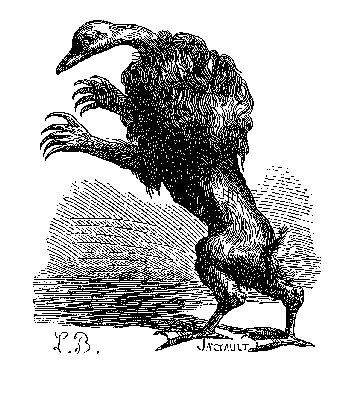
Ipos as depicted in Collin de Plancy's Dictionnaire Infernal.
Ipos is an Earl and powerful Prince of Hell who commands thirty-six legions of demons. He knows and can reveal all things, past, present and future.
He can make the most shy person confident, witty, and bold. His services are highly sought after, as he inspires an air of power, making boring people seem interesting and the average-minded seem like intellectuals.
Some who have summoned Ipos have stated that he is the same entity as the Egyptian god Anubis.


April 4, 2014
Image of the Week 015
Giovanni Michele Granieri's The Fortune Teller depicts a barker, who excites onlookers with conjuring tricks, and by his cunning use of mystical gestures. He holds a vial, which supposedly contains an elixir for long life, extracted from the philosopher's stone. All of the gullible spectators are ready to proclaim a miracle has occurred, enthralled as they are by his charlatan's theatrics.
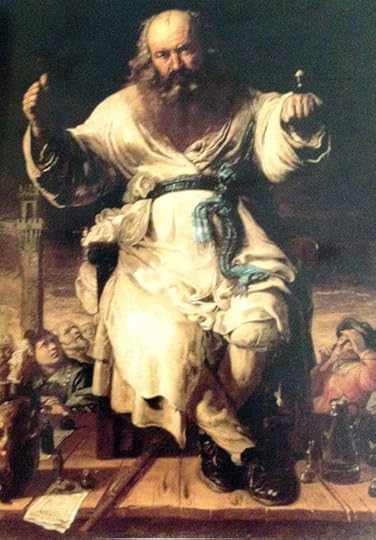
Giovanni Michele Granieri, The Fortune Teller, 1520.
April 3, 2014
Myth of the Week 015
The Alkonost is, according to Russian folklore, a creature with the body of a bird and the head of a beautiful woman. She sings beautifully, and those who hear her song abandon every mortal qualm or concern. The alkonost lives in the underworld with her counterpart, the sirin.
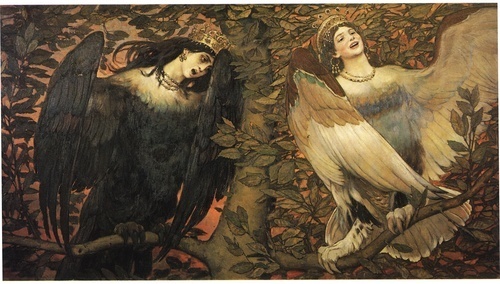
Viktor M. Vasnetsov, Sirin and Alkonost—Birds of Joy and Sorrow, 1896.
The alkonost lays her eggs on a beach and rolls them into the sea. When her eggs hatch, a vast and turbulent thunderstorm appears overhead. The name of the alkonost comes from a Greek demigoddess whose name was Alcyone. In Greek mythology, Alcyone was transformed by the gods into a kingfisher.
April 2, 2014
Note of the Week 015
That soundtrack...chilling.
Who's seen it? Thoughts?
April 1, 2014
Novel of the Week 015
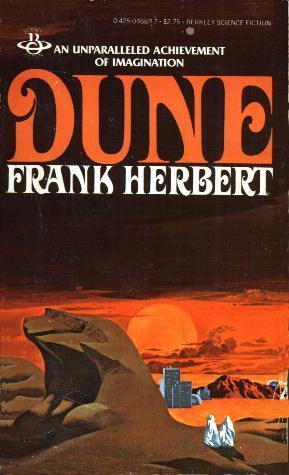
Frank Herbert's Dune is set in a bleak far-future, amidst a feudal interstellar society in which noble houses control individual planets. The sci-fi masterpiece tells the story of young Paul, whose noble family (Atreides) accepts the stewardship of a desert planet named Arrakis. Because Arrakis is the only source of the great "spice" melange—the most important and valuable substance in the universe—control of the planet is a dangerous undertaking. The novel explores the interactions of politics, religion, technology, and human emotion, as the forces of the empire confront one another in a struggle for the control of Arrakis and the spice.
Drawing inspiration from centuries of great thinkers, Herbert succeeded in creating a deeply philosophical and mystical journey: one that still impresses, almost 50 years later.
I must not fear. Fear is the mind-killer. Fear is the little-death that brings total obliteration. I will face my fear. I will permit it to pass over me and through me. And when it has gone past I will turn the inner eye to see its path. Where the fear has gone there will be nothing. Only I will remain.
— Bene Gesserit, Litany Against Fear
March 31, 2014
Demon of the Week 015
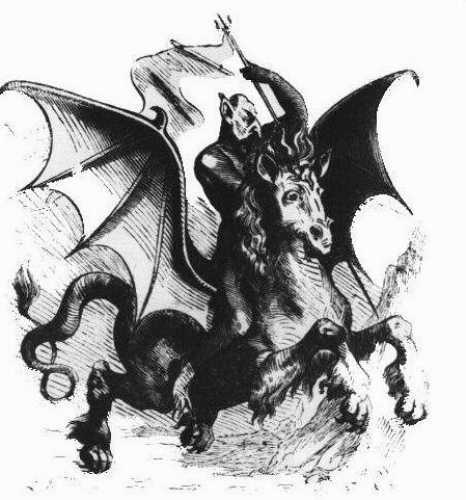
Eligos and his steed, as depicted by Jacques Collin de Plancy.
Eligos (also called Abigor or Eligor) is a Great Duke of Hell, ruling 60 legions of demons. He can predict the outcome of wars, and is depicted in the form of a goodly knight carrying a lance, an ensign and a sceptre.
Alternatively, he is depicted as a ghostly spectre riding a skeletal, winged horse, or the Steed of Abigor. His horse is a minion of Hell, too, and was a gift to Eligos from Beelzebub. It was created from the remains of one of the horses of The Garden of Eden.
March 28, 2014
Image of the Week 014
This week's image is Narcissus by Caravaggio.
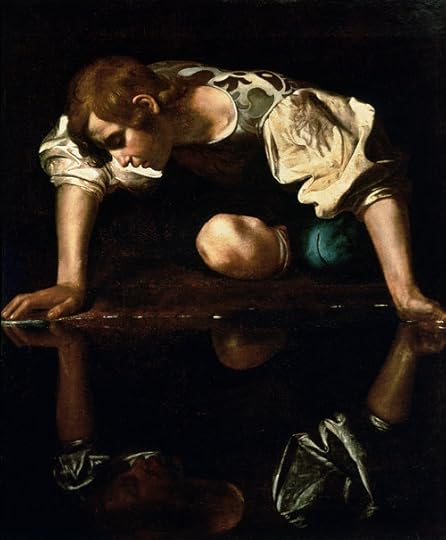
Caravaggio, Narcissus, 1599-1600.
Narcissus symbolizes the soul falling in love with perceptible beauty and neglecting to contemplate spiritual beauty. From an esoteric point of view, this myth is a variant of "love sickness"—the body is consumed by an erotic longing for its own likeness.
March 27, 2014
Myth of the Week 014
An illustration from a 15th-century German manuscript, depicting "Saint Brendan and the whale", an event described in the immram Voyage of Saint Brendan.
The Aspidochelone is a mythic sea creature, variously described as an enormous whale, gigantic sea turtle, and a sea monster with ridged, protruding spines along its back. Sailing passersby might mistake the creature for an island, as its back is rocky, interspersed with valleys and greenery. This early myth—and all its brethren, superior and subordinate alike, varying from Leviathan to Pristis to Jasconius—may have served as the inspiration behind everything from moralistic allegory (Physiologus) to 19th-century literature (Pinocchio and Baron Munchhausen).
March 26, 2014
Note of the Week 014
Here's another quick excerpt from Taking Jezebel.
A trail of burning rosemary hung upon the air, herbal and intoxicating. Something dragged him, an invisible tether coaxing him through the abandoned, shadowy halls of their cloisters. A coven’s muted whispers tapped against his ticklish ribs, their maniacal laughter subdued by the distance between them, but gradually swelling with each of his reflexive steps in their direction, toward an arched entryway, through the port cased in sumac (its leaves flourishing as he passed by underneath, spinning on their vines like bracted fingers, straining to scratch at his skin). The port opened outward, onto a quadrangle between the buildings that formed the ring-shaped compound. That sliver of open air, cast from the center of the structure, was used for their deepest, darkest, inmost conniving sorcery—dredging up their Takers, their demons, with age-old words of conjuring.
A platform was raised at the center of the grounds and hooded figures surrounded it, arms raised in supplication toward their leader, standing at his throne, at court before them. His robe was specially designed, with a separate golden hood—a detachable swatch of fabric that was tied around his neck and obscuring much of his face; only his sharp-pointed bird’s nose and harsh-cleft chin peeked out. Unlike his attendants, who all wore traditional burlap cowls with wide open sleeves, the Overseer’s arms were only covered up to the middle of his forearms. Veins curved and collided across his pasty skin. He was whispering something in Latin, which Orson couldn’t quite decipher. It rose in pitch.
March 25, 2014
Novel of the Week 014
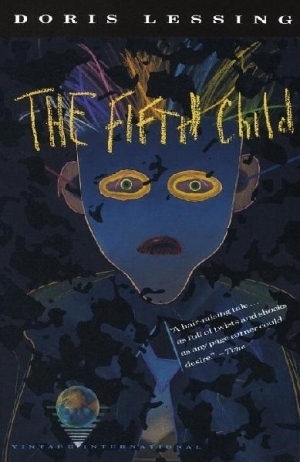
Doris Lessing's The Fifth Child is equal parts We Need to Talk About Kevin and Ursula K. Le Guin. If that doesn't have you convinced, here's a more thorough description:
Doris Lessing's contemporary gothic horror story—centered on the birth of a baby who seems less than human—probes society's unwillingness to recognize its own brutality. Harriet and David Lovatt, parents of four children, have created an idyll of domestic bliss in defiance of the social trends of late 1960s England. While around them crime and unrest surge, the Lovatts are certain that their old-fashioned contentment can protect them from the world outside—until the birth of their fifth baby. Gruesomely goblin-like in appearance, insatiably hungry, abnormally strong and violent, Ben has nothing innocent or infant-like about him. As he grows older and more terrifying, Harriet finds she cannot love him, David cannot bring himself to touch him, and their four older children are afraid of him. Understanding that he will never be accepted anywhere, Harriet and David are torn between their instincts as parents and their shocked reaction to this fierce and unlovable child whose existence shatters their belief in a benign world.