Patrick Kelly's Blog: PATRICK KELLY—AUTHOR BLOG, page 4
June 2, 2014
Demon of the Week 024
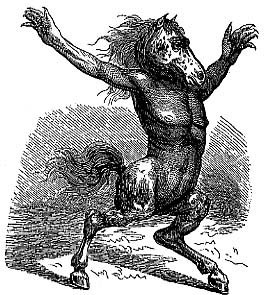
Orobas is a powerful Great Prince of Hell, with twenty legions of demons under his command. He can interpret past, present and future through divination, and possesses hidden knowledge about the creation of the world. Orobas is faithful to his conjurer, is not swayed by the temptations of spirits, and never deceives anyone who seeks his council. He is depicted as a horse that can change into a man at his summoner's request.


May 30, 2014
Image of the Week 023
In Philipp Otto Runge's The Small Morning, the dawn represents spiritual redemption and renewal. In the Hermetic tradition, it is a metaphor for Sophia, the cognitive principle that puts an end to the ignorance of the adept and achieves the purification of matter. The Black Sun at the bottom of the work alludes to the darkness of the soul and mind.
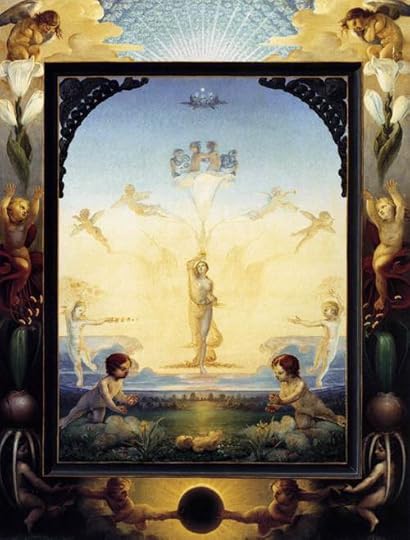
Philipp Otto Runge, The Small Morning, 1808.
May 29, 2014
Myth of the Week 023
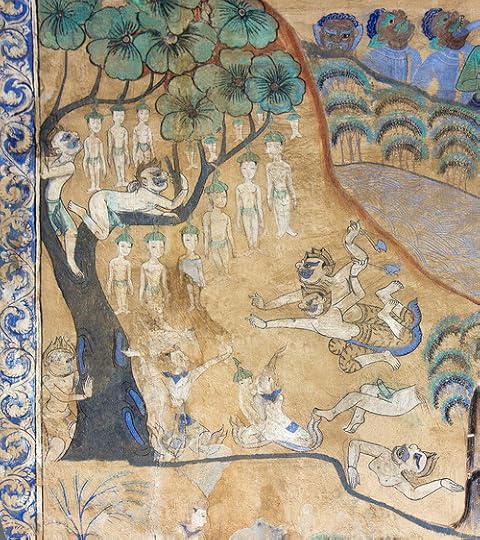
The Nariphon (นารีผล), also known as Makaliphon or Makaliporn, is a tree in Buddhist mythology which is said to bear fruit in the shape of young women. These maidens grow, attached by their heads, from all the tree's branches. The Nariphon itself is said to exist in the Himaphan, a mythical forest where the sprouting women are enjoyed by the Gandharvas, who cut them down and steal them away.
According to Buddhist mythology, the God Indra created a pavilion as an abode for Vessantara, his wife and two children. His wife went into the forest to collect fruit and was constantly threatened by Hermits or Yogis who lived there. So Indra, King of the Gods, created twelve of these special Nariphon trees, which would bear fruit whenever Vessantara's wife went out to collect food, so distracting her attackers.
Being all in the image of Indra's beautiful wife, like "sweet-smelling naked sixteen-year-old girls," the men who threatened Vessantara's wife took these female-fruits instead, bringing them back to their respective homes. After making love to the "women," the men would fall asleep for four months and lose all of their power.
Fun Facts:
[image error]
An example of a fake "Nariphon girls" photo
Representations of the Nariphon tree are very common in Thai comics.Amulets and charms in the form of Nariphon girls are sold throughout Thailand.Folk stories claim that the tree still grows somewhere in the Phetchabun Mountains, and doctored photos of the "Nariphon girls" are quite common.
May 28, 2014
Note of the Week 023
Check out the trailer for Ryan Gosling's directorial debut, Lost River.
Described as a "gritty urban fable" and "a Detroit Gothic," the film is so far garnering mixed-to-favorable reviews around the festival circuit. It recently screened at Cannes, where Gosling's work was described as "[wading] knee-deep in David Lynch territory." Others cite Gaspar Noé as inspiration. I can see a dash of Jodorowsky in there myself.
So, what do you think? Does Gosling's new, trippy vision entice you? Will you be rushing to your local indie theatre to see this one, or do you think the actor should move away from his new role as auteur?
May 27, 2014
Novel of the Week 023
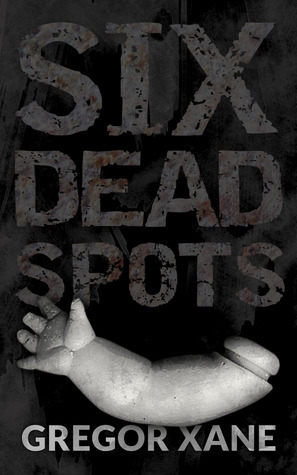
That damn baby arm again!
Six Dead Spots is a short novel that isn't short on shocks. As the story and its hero descend to ever-darker places with every flick of the page, you'll never be exactly sure whether protagonist Frank is awake or dreaming—an effect I'm sure Mr. Xane intended, and one that comes across with great effect.
Frank's story begins with the odd discovery of six dead spots on his body (three across his trunk, perfectly mirrored by an equally-spaced trio running down his back). When no one is equipped to explain the root of his malady, Frank begins his own investigation—one that includes adventures with sex spectres, porn stars, buckets of bodily fluids, prescription drugs, and lucid dreams.
Check this one out if you're looking for something as dark as it is comedic. It's well-written, even entrancing at times, and a great example of the good work that exists in the indie horror game.
Original review on Goodreads. Be sure to follow Mr. Xane (and me!) on the site so you can stay up to date on projects and reviews.
May 26, 2014
Demon of the Week 023
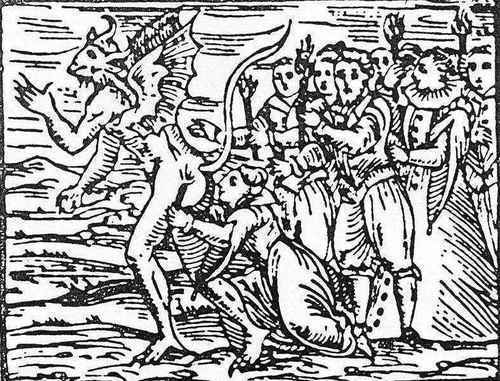
The Ördög ("Urdung" in Old Hungarian) is a shape-shifting, demonic creature from Hungarian mythology. The creature personifies all of the dark and evil aspects of the world. It is often said in Hungarian mythology that Isten (God, in Hungarian) had help from Ördög when he was creating the world.
The Ördög is often thought to look somewhat like a faun; usually black, with hooves, horns, a sharp and pointy tail. Sometimes he is described as carrying a pitchfork. He also had a sulfurous stench about him. He dwells in the underworld or hell ("Pokol" in Hungarian), constantly stirring a huge cauldron filled with all the souls he's collected. When he does come to earth, he takes the form of a fox, a dark flame, or the guise of a Hungarian shepherd with sparkling eyes. It is his habit to make bets with humans, to see if they will become corrupted.
Sound familiar? There appear to be many similarities between this Hungarian devil and the modern mythic conception of our Western devil, as has evolved through the ages.
Have something else to share about the Ördög? Feel free to post your thoughts in the comments section below.
May 23, 2014
Image of the Week 022
In Picasso's drop-curtain for the ballet Parade, the monkey at the top of the ladder is emblematic of the Hermetic Mercury. Associated with the devil and with God's monkey (simia Dei), it alludes to the paradox of the agreement of opposites.
The blue ball at the bottom left represents the cosmos.
Pegasus symbolizes the synthesis of heaven and earth.
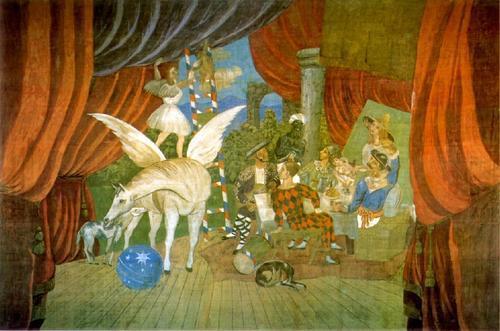
Pablo Picasso, Drop-curtain for the ballet Parade, 1917.
May 22, 2014
Myth of the Week 022
According to Australian-Aboriginal tribal legend, the Nargun is a fierce half-human, half-stone creature that lived in the Den of Nargun, a cave under a rock overhang behind a small waterfall in the Mitchell River National Park, Victoria, Australia. The Nargun is described as a beast that was mostly made of stone, except for its hands, arms, and breast. The fierce beast would drag unwary travelers into its den, and any weapon directed against it would be turned back against its owner.
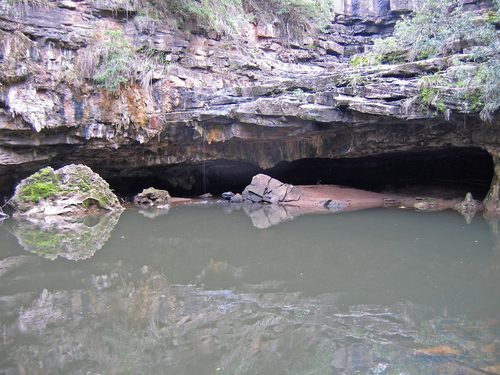
The infamous Den of Nargun on Woolshed Creek.
Know something else about this myth? Share what you've heard in the comments below.
May 21, 2014
Note of the Week 022
The following is an excerpt from Chapter VI of Taking Jezebel.
This wasn’t the boardwalk he’d imagined; it was no bustling carnival, nothing like what he’d seen in photos. It wasn’t flooded with the sound of laughter, nor the smell of hot dogs dripping at their stands. The delight of fluorescent bulbs flashing across marquees was absent. Instead, all of that was replaced by a mostly-vacant, half-abandoned, ramshackle swath of oddball storefronts, their windows backlit with neon, mounted with crumpled bills rolled up at their edges and browned with age:
WELCOME: OSCAR’S ODDITIES, OBSCURITIES, & ABERRATIONS;
THE MAJESTIC MARIAH SEES ALL;
DINAH’S ALL-YOU-CAN-EAT DONUTS: ONE FREE RIDE TICKET.
Peter walked past a bored teenager wearing a pinstripe uniform and white paper cap, playing with his cell phone behind the cover of a cotton candy stand. He passed a souvenir shop, closed, which advertised custom screen printing for tourists who didn’t exist. The example they provided read,
I SURVIVED
THE CIRCULAR SERPENT
AND ALL I GOT WAS
THIS LOUSY T-SHIRT.
The place reminded him of a film, Carnival of Souls, except that he wasn’t dead and he was also pretty sure the few people he saw weren’t spirits. Unless spirits carried cell phones. The sense of abandonment that film captured, of deterioration and malevolence, was definitely there, though. And it gave the hairs on Peter’s neck a micro-jolt of static so that they stood on end.
He made for the pier, which stuck out into the Pacific like the continent’s own corroded protuberance. It seemed to bob in place alongside the ferris wheel, which stood on stilts and swayed in pace with its ligneous neighbor the pier. Both seemed to hang by their last fragile threads, ready to collapse at any moment. Along the way he spotted two young women holding hands. One had a mohawk, dyed blue, and a piercing shaped like a bone struck horizontally—and stiffly—through her nostrils. The other was morbidly obese and wore too-tight clothing, her love handles rolling over the sides of her dirty black jeans. When Peter passed by them, they glowered at him. The fat one raised her plump hand to expose her middle finger, and she grimaced like a feral cat, her fulvous teeth bared. He hurried along.
As he made his way farther out along the wharf, he ran his hands across the rope suspended along its edge. He let its coarseness grate against his palms and stopped halfway out, plopping into a seated position with his legs dangling over the edge of the construction, suspended ten feet above the billowing ocean below. Bits of salt water picked up in the sea breeze and sprayed against his calves. He stared up at the big, lifeless ring of the so-called Circular Serpent above him. It floated in place, and its little cabs swayed indistinctly. What looked like a girl in one of the lower compartments peered down at him, met his gaze, and matched his insouciance. It was only a doll.
While he swung his sandaled feet above the eddies, a stranger passed along the pier behind him, quiet as a breath.
Peter rose to leave—to find a less macabre stretch of beach—and he saw the newcomer. The man waltzed unhurriedly toward the far end of the pier with his back turned to Peter. He was wearing unremarkable gray track pants, which floated around his slim form, and a black hoodie pulled up over his head. The man approached the very tip of the walkway and turned sideways, revealing his profile: a fat lip, bulged and purple. His nose dribbled gouts of green fluid. The one eye that was visible looked swollen shut, its shape bloated, tumescent with bruising.
May 20, 2014
Novel of the Week 022
Tigana is a good fantasy novel that's hindered by occasional POV fatigue—shifting erratically, even frantically at times.
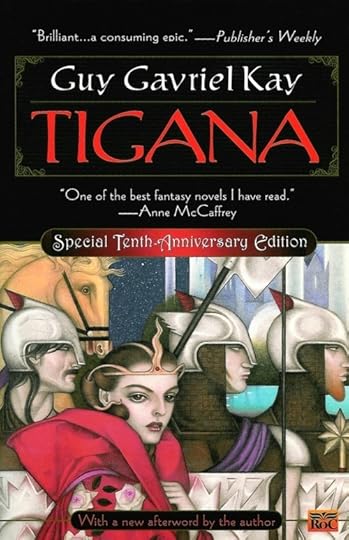
Much of Tigana is what I'd call worthwhile, and most of it is pretty enjoyable. I'd comfortably recommend this book to any fan of so-called "epic" fantasy, especially as it's its own complete entity (no ten-part series here, just a solitary work that's sprawling yet manageable). However, I did think that some sections of the story felt throw-away. For example, a lengthy chapter around the middle of the book sees one of our (many) primary characters, Baerd, entering a sort of dream world, inhabited by dark entities called Others. There, on the eve of the "Ember Days," he and a group of companions take up husks of corn as weapons and contend with these malevolent spirits. It's an interesting idea that ends up pointless to the bulk of the larger story arc.
Too, the romance scenes, which are sprinkled generously throughout, risk coming across as forced, rushed, or gratuitous. I appreciate that Kay's world is populated by a huge profile of characters who run the gamut of sexualities—and also enjoy that no one in his world seems bothered by the range of proclivities so openly on display here—but when the oftentimes stilted prose of the book's longer passages takes a sudden, hokey turn south (a "vixen" throwing her body at men like some gimcrack tool of war!), much if not all of its charm evaporates.
Pick this one up if you like your fantasy lengthy but light on the fantastical (no dragons, only one mythical creature, and barely a pinch of magic), particularly if you prefer a dash of romance in the mix.
Review originally posted on Goodreads, scored 3/5 stars or "Good".