Patrick Kelly's Blog: PATRICK KELLY—AUTHOR BLOG, page 6
May 5, 2014
Demon of the Week 020
The Batibat or Bangungot is a vengeful demon found in Filipino culture, specifically in Ilocano folklore. The demons are said to have caused the fatal nocturnal disease called bangungot, also known as "Sudden Adult Death Syndrome".
A batibat typically takes the form of a giant, fat, old woman who resides in a tree. They usually come into contact with humans when the tree that they reside in is felled and processed for the construction of a home. This causes the batibat to migrate into holes found in the building's support posts or foundation. The batibat forbids humans from sleeping near the processed wood it supposedly occupies. When someone does fall asleep near it, the batibat transforms into its true form and attacks the person. It sits on the chest of its victim until he or she suffocates to death.
To ward off the batibat, one should "bite one's thumb or wiggle one's toes." In this way, the person will awaken from whatever nightmare is being induced by the batibat, and the victim may thusly prevent his or her own death.


May 4, 2014
Image of the Week 019
Camping at Yosemite this weekend inspired some ideas for new work. Look out for the wild outdoors.

May 1, 2014
Myth of the Week 019

According to Japanese tradition, the bakeneko is a supernatural creature. Its name means "changed cat". It is often confused with the nekomata, another cat-like being. However, the common thread across the bakeneko mythos involves a distinguishing feature: cats that have been killed by humans in a brutal manner, or were somehow abused, are most likely to change. After death, the cat returns as a bakeneko to curse the human who caused them harm.
April 30, 2014
Note of the Week 019
Thanks to everyone who submitted reading suggestions last week. From the entries, I've added the following to the top of my reading list:
The Death Gate Cycle by Margaret Weiss and Traci HickmanSuggested by Thomas Burkett.This heptalogy of fantasy novels follows the conflict between two powerful races. From Burkett's suggestion: "A tale of greed, corruption, faith and redemption...there was no clear delineation of good and evil."Hell by Yasutaka TsutsuiSuggested by Lixian Ng.From the author who wrote the novel that inspired the famed anime classic Paprika. However, from Ng's description (not to mention the title of the work itself), Hell sounds like a much darker tale. "Hell is a very short and fast-paced novel. It's more of a paranormal-fantasy type of book...the characters end up in a [sort of] purgatory. It [gets] pretty violent and gross sometimes, but it's light [at others] and maybe even a bit touching..."Thanks again for all the suggestions. You can follow my complete reading list and reviews on Goodreads.
April 29, 2014
Novel of the Week 019

Jazzy, trippy, sexy, and surreal...
Boris Vian's L'Écume des Jours (translated as Foam of the Daze/Froth on the Daydream, or sometimes called Mood Indigo) is all these things and more. Recently adapted to film by French auteur Michel Gondry, now's the perfect time to read this classic of French literature—before the movie releases stateside this summer. From pianocktails to flowers in the lungs, Vian's tongue-in-cheek meditations on philosophy, love, and life are at once humorous and inspiring. A must-read.
Buy it in paperback here or, if you've already read the book, watch the trailer for the new film here.
April 28, 2014
Demon of the Week 019
After Satan, the demon Azazel enjoys the distinction of being one of the most mysterious extrahuman characters in sacred literature. Unlike other Hebrew proper names, the meaning of "Azazel" itself is rather obscure, and its meaning is often the subject of heated debate.
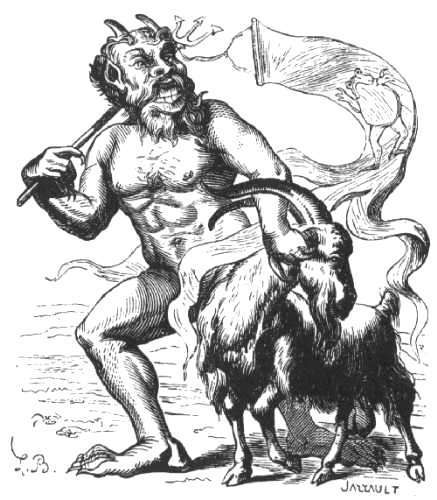
Azazel as depicted in Collin de Plancy's Dictionnaire Infernal, 1818.
In the Dead Sea Scrolls, Azazel is described as the leader of the fallen angels. He was said to be of the order of seraphim, the highest order of angels, before his fall. In Islamic demonology, Azazel is named as a Djinn who was captured by angels and grew up among them, eventually rising to lead alongside the highest of angels.
In some lore, Azazel is believed to be the first of the fallen angels. This may explain why, in the Koran, he is considered to be the "Prince of Darkness" himself. In African Islamic traditions, he is known as Zeraili, the angel of death. Some speculate that Azazel may have been an early Semitic goat god whose worship was later condemned.
April 25, 2014
Image of the Week 018
This work, by Russian Symbolist painter Mikhail Vrubel, depicts the diabolical Mephistopheles in red and Faust behind him. Mephistopheles represents the will to overcome the psychological, intellectual, and physical limitations that constrain all mortal creatures.
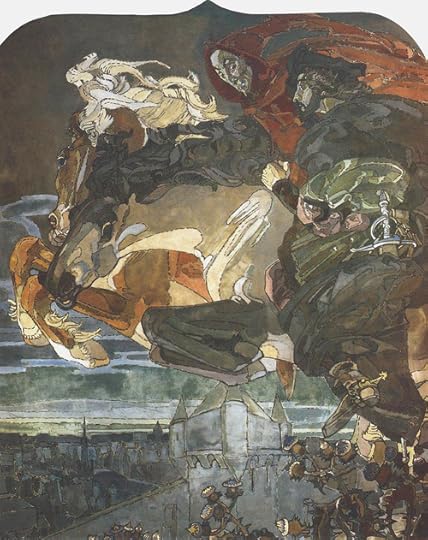
Mikhail Vrubel, The Flight of Faust and Mephistopheles, 1886-1896.
April 24, 2014
Myth of the Week 018
The Nyx (in German, Nix/Nixie; and in Norwegian, Nøkk or plural, Nøkken) are shapeshifting water spirits. They have appeared in the myths and legends of almost all Germanic peoples through Europe, although they are perhaps most popular in Norwegian and Scandinavian folklore. In recent times, the creatures have been commonly depicted as closely resembling humans.

Theodore Kittelsen, Nøkken, 1904.
Their sex, bynames, and various animal-like transformations vary according to geography. The German Nyx and his Scandinavian counterparts are male, whereas the German Nix or Nixie are usually depicted as female river mermaids.
April 23, 2014
Note of the Week 018
This week, I'm turning to you for reading recommendations.
Lately I've been craving a serious escape from the real world, so help me out by sharing your favorite FANTASY or SCI-FI novel/series.
Name
Name
First Name
Last Name
Book Title *
Book Author *
Message *
Tell me why you love it and why I should read it.
Thanks for your recommendation! Next week I'll reveal the top recommendations.
Thanks for your input. If we aren't already connected on Goodreads, be sure to add me here.
April 22, 2014
Novel of the Week 018
A divisive modern masterpiece that's as flabbergasting as it is fascinating. From the dust jacket:
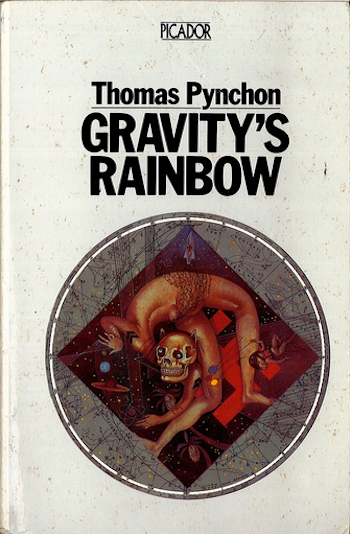
“A screaming comes across the sky...”
A few months after the Germans’ secret V-2 rocket bombs begin falling on London, British Intelligence discovers that a map of the city pinpointing the sexual conquests of one Lieutenant Tyrone Slothrop, U.S. Army, corresponds identically to a map showing the V-2 impact sites. The implications of this discovery will launch Slothrop on an amazing journey across war-torn Europe, fleeing an international cabal of military-industrial superpowers, in search of the mysterious Rocket 00000, through a wildly comic extravaganza that has been hailed in The New Republic as “the most profound and accomplished American novel since the end of World War II.”
Last year, for the novel's 40th anniversary, Flavorwire.com surveyed the wide range of art that has graced the front cover of the book since its initial publication. Check out the slideshow.