Patrick Kelly's Blog: PATRICK KELLY—AUTHOR BLOG, page 13
January 28, 2014
Novel of the Week 006
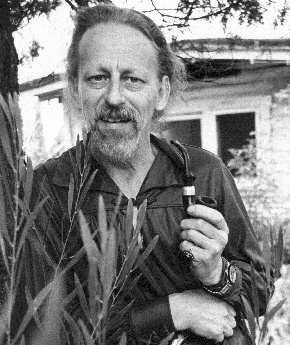
Theodore Sturgeon
More Than Human, by Theodore Sturgeon, is a 1953 sci-fi novel whose premise is as interesting as it is unusual. The novel concerns the meeting of six extraordinary people with strange powers who are able to "blesh" (a portmanteau of "blend" and "mesh") their abilities together. In this way, they can act as one organism. They progress toward a gestalt consciousness, called the homo gestalt, which Sturgeon suggests is the next step in human evolution.
Forming the gestalt are: Lone, dubbed the "Idiot," a 20-something homeless man with telepathic powers; Janie, a young girl with telekinesis; mute twins Beanie and Bonnie, who can teleport themselves; and the baby, who has an extraordinary mental capacity. Things seem to be going well for the troupe of freaks, until...
Enter Gerry, an abused, amnesiac sociopath who takes Lone's place as the group's leader (for reasons I won't divulge). What ensues under Gerry's care is a struggle that effectively questions humanity's progression toward domestic living—weighing this tendency against the unbridled, wild style of living the gestalt has grown used to.
In the concluding act of the novel, the reader meets a brilliant military engineer who threatens to unearth one of the gestalt's long-forgotten experiments. Things heat up, and the "evolution" of our species hangs in the balance. As the reader reaches the conclusion of this fantastical journey, he's left with a burning impression of Sturgeon's mastery of the genre, and is awed by the author's ability to inject universal questions of morality, individuality, and belonging into a work whose genre is oftentimes ridiculed for its technicalities and lack of emotional depth.
Sturgeon proves those generalizations wrong.
Inner space is so much more interesting, because outer space is so empty.
— Theodore Sturgeon
Have you read More Than Human or another of Sturgeon's works? What did you think? Add your thoughts in the Comments section below.


January 27, 2014
Demon of the Week 006
Ifrit is the name of a class of supernatural creatures from Arabic and Islamic folklore. They are considered a class of Jinn (or Djinn, or Genies) most recognized for their great strength and cunning. An ifrit is composed of fire, winged, and enormous. There are both male and female ifrits, and they always live underground—frequently in ruins or abandoned caves. They live in a tribal society, complete with kings and clans, and generally marry one another (though it's possible for them to marry humans, too).
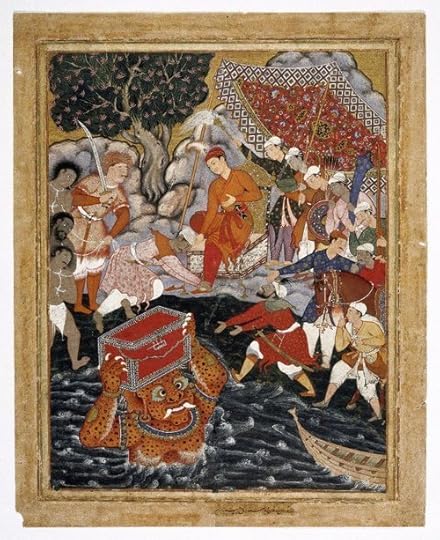
Arghan Div Brings the Chest of Armor to Hamza, unknown artist (1562-1577).
Mortal weapons and forces have no power to harm an ifrit, but they are susceptible to the influence of magic, which humans can utilize to injure and kill—or capture and enslave—them. Though it's tempting to place the ifrits in a category of "bad" or "evil"—and they are generally depicted as such; wicked and ruthless—there are those among them who are capable of good.
From True Blood to Final Fantasy, "Ifrit" makes many appearances throughout popular culture. This week we'll forgo the list, but feel free to share your thoughts and favorites below.
January 24, 2014
Image of the Week 005
Austin Osman Spare was a 20th century English artist and occultist who worked as a draughtsman and painter. Influenced by symbolism and the artistic decadence of art nouveau, his art was known for its clear use of line, and its depiction of monstrous and sexual imagery. In an occult capacity, he developed idiosyncratic magical techniques, including automatic drawing (developed by the surrealists as a means of tapping the subsconscious, it required entering a gnostic, almost fugue-like state of introspection) and sigilization (a technique that's been further popularized by chaos magicians, where the artist prepares and casts—or "charges"—sigils in unique ways, oftentimes for spells as well as the creation of thoughtforms).

Ascension of the ego from ecstasy to ecstasy, from Spare's The Book of Pleasure (1913).
For I am I: ergo, the truth of myself; my own sphinx, conflict, chaos, vortex—asymmetric to all rhythms, oblique to all paths. I am the prism between black and white: mine own unison in duality.
— Austin Osman Spare
January 23, 2014
Myth of the Week 005
The story of the Watchersor Grigori in Genesis 6:1-4 tells of heavenly beings who once descended to Earth, intermarried with humans, and produced thenephilim, who were born half-angel and half-man. Jewish tradition regards those heavenly beings as wicked angels,but the myth may be a fragment of pagan mythology about gods interbreeding with humans to produce heroes.

The Fall of the Rebel Angels, detail from the triptychThe world before the flood, by Hieronymus Bosch c. 1514.
When human bei...
January 22, 2014
Blurb of the Week 005
So, let's switch things up with this week's BOTW and get some classic film in on the action.
Jean Cocteau—filmmaker, poet, novelist, playwright. With Cocteau's first film, Le sang d'un poète(The Blood of a Poet), the artist explores "a kind of half-sleep through which I wandered as though in a labyrinth." It's appropriate he would say this, as he'd just kicked his opium habit. Cocteau vehemently rejected the film's association with the surrealist movement, and explained:
The Blood of a Poet...
January 21, 2014
Novel of the Week 005

Ah, The Wasp Factory. A novel that will always be near and dear to me. There's so much to be said about this near-perfect debut from the late Iain Banks, but saying too much would spoil the surprise. Without spilling all the beans, let's just say that the novel's protagonist—16-year-old Frank—isn't all he appears to be. He lives with his father outside a remote Scottish village, and spends his time building mildly sadistic traps for the wild animals roaming along the coast. Additionally, he...
January 20, 2014
Demon of the Week 005
Kumbhakarnais a Rakshasa—a humanoid being of unrighteous spirit—who appears in the Indian Ramayana epic. He is one of Ravana's six brothers.
Despite his monstrous size and great hunger, Kumbhakarna was described to be of mostly good character, though he killed and ate many Hindu monks, just to show his power.
When the time came for asking a boon (blessing) fromBrahma, Kumbhakarna's tongue was tied by the goddessSaraswati, so he accidentally asked for "Nidraasana" (bed for sleeping). It is also...
January 17, 2014
Image of the Week 004
Marcel Duchamp's last major work—Étant donnés(Given: 1. The Waterfall; 2. The Illuminating Gas), 1944-66—is a tableau, visible through two peep holes in a wooden door. It is rife with symbolism of the four elements: the spring refers to water, in which gestating life takes form and is nourished; the headless goddess is an allusion to Mother Earth; and the oil lamp alludes to alchemical fire, both life-giving and destructive.
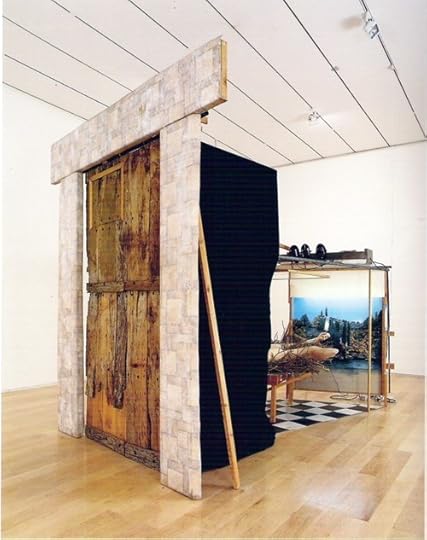
Side view of the tableau.

Looking through the peepholes.
January 16, 2014
Myth of the Week 004
Tuonela (also Tuoni, Manala, and Mana), in Finnish and Estonian mythology, is the realm of the dead, synonymous with the Greek Hades, or Hell.
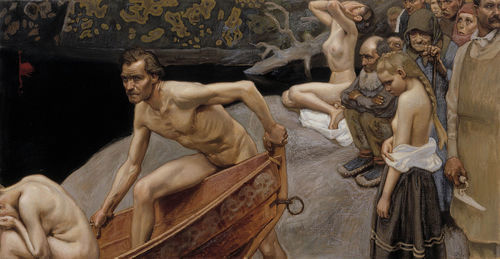
By the River of Tuonelaby Akseli Gallen-Kallela, 1903.
It's most recognizable for its appearance in the 19th-century Finnish national epic poemThe Kalevala. In the 16th song of the work, the protagonist and shamanistic heroVäinämöinentraveled to Tuonela seeking certain knowledge and magics which only the dead can impart. On the way, he met the ferryma...
January 15, 2014
Blurb of the Week 004
Why Horror?
In the literary world, horror, fantasy, and sci-fi sometimes gets a bad rap.Especiallyhorror. This is understandable, given the sheer bounty of meaningless, violent, and otherwise nonsensical writing that emerges from the genre every single year. But, is there a balance between literary and so-called "genre" writing, and how can it be achieved? Here are my thoughts.
For my debut novel, I chose to write in the categories of dark fantasy, horror, and dystopian (among others) for sever...