Patrick Kelly's Blog: PATRICK KELLY—AUTHOR BLOG, page 10
March 10, 2014
Demon of the Week 012
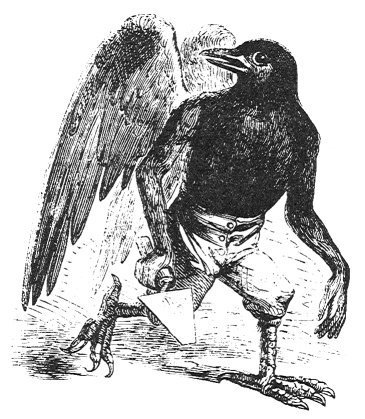
Malphas as depicted in Collin de Plancy's Dictionnaire Infernal, 1818.
Malphas is a mighty Great President or Prince of Hell. He builds houses, high towers and strongholds, throws down the buildings of his enemies, destroys their desires, and can quickly bring artificers together from all places of the world. Malphas willingly and kindly accepts any sacrifices offered to him, but will easily deceive the conjurer to do his biddings.
Malphas is depicted as a crow who can transform into a man, and he speaks with a hoarse voice. He also rises from the vanity of mankind, plaguing those he touches and rendering his conjurer mad with dementia, hallucinations, and mighty illusions. Malphas commands forty legions of demons.


March 7, 2014
Image of the Week 011
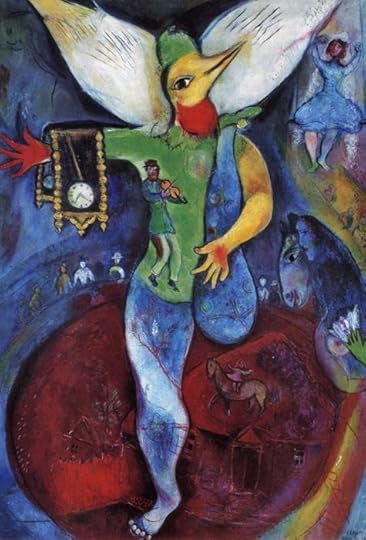
Marc Chagall, The Juggler, 1943.
Read about Marc Chagall here.
"The theme of Hermeticism was revived in the 20th century by Surrealism and metaphysics, and by artists like Chagall, Man Ray, and Picasso.
"Here, the image of the juggler embodies the concept of the Hermetic man, the magician-artist who works in a sacred region that may be compared to the upside-down world of carnivals and circuses. The perimeter of the circus ring alludes to the motif of the magic circle. The head of the juggler has been replaced by that of a cock, a magical animal of solar origin linked to the myth of Circe and to the Egyptian divinities Horus and Thoth."
— Matilde Battistini, Astrology, Magic, and Alchemy in Art
March 6, 2014
Myth of the Week 011
Read about the Basilisk here.
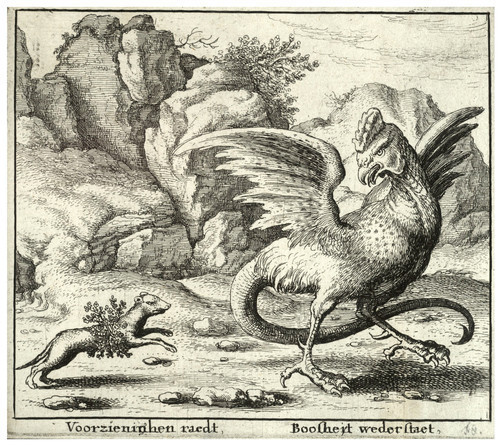
Wenceslaus Hollar (1607-1677), The basilisk and the weasel. Date unknown.
March 5, 2014
Note of the Week 011
Taking Jezebel Giveaway, Round 2.
On Goodreads and Twitter, I received lots of great feedback and excitement around the giveaway I hosted, so thanks for that...
Well, I'm feeling generous, so here's Round 2! Three copies up for grabs, and an entry deadline of midnight on 3/19.
It's still pending review by the GR team, but go ahead and bookmark the link for easy access. It should be approved sometime today.
Who knows, maybe a Twitter giveaway next?
Goodreads Book Giveaway
Taking Jezebel
by Patrick Kelly
Giveaway ends March 19, 2014.
See the giveaway details
at Goodreads.
Enter to win
Good luck, friends!
March 4, 2014
Novel of the Week 011
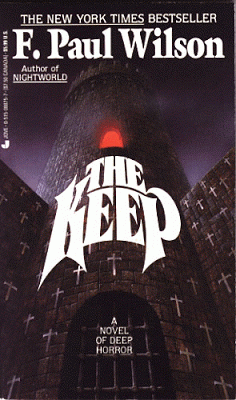
Inside a mysterious castle, an elite SS extermination squad finds something that's both powerful and terrifying. Invisible and silent, a hidden enemy selects one victim from their ranks per night, leaving behind a bloodless and mutilated corpse.
The entity responsible for the deaths calls itself Molasar. He is revealed to be an ancient sorcerer from the "First Age" of humans.
Enter Glaeken—an immortal man, and a champion of ancient Forces of Light. From across the world, he becomes aware of the entity's recent activity and travels to the keep. Long ago, Glaeken built the fortress as a prison for the entity, out of the reluctance to kill him outright. The two beings are mystically linked in a way that binds their destinies together. Thus rekindles their ultimate battle.
March 3, 2014
Demon of the Week 011
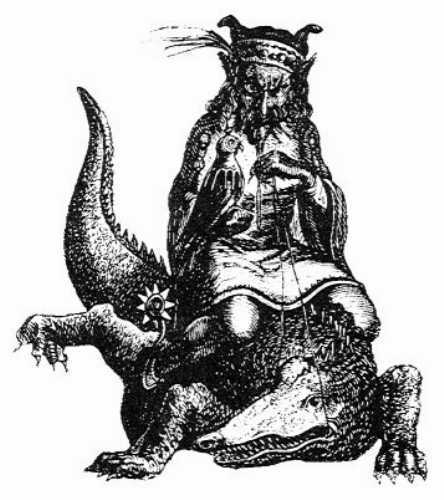
Agares as depicted in Collin de Plancy's Dictionnaire Infernal, 1863.
Agares (or Agreas) is a Grand Duke, ruling the eastern zone of Hell, and being served by 31 legions of demons.
Agares can make runaways come back, and those who stand still run. He can cause earthquakes and teaches languages, finding great pleasure in immoral expressions. Also, he has the power to destroy dignities, both temporal and supernatural.
He is depicted as a pale old man riding a crocodile and with a hawk on his fist.
February 28, 2014
Image of the Week 010
Read about hermetic philosopher and alchemist Heinrich Khunrath here.
[image error]Hans Vredeman de Vries (1527–1604) and shows Khunrath in his laboratory.
The musical instruments denote the philosopher's understanding of the universal harmony that unites different levels of reality.
The circle alludes to the mystical center of the cosmos, the spiritual omphalos, seat of illumination.
The tabernacle under which the adept is praying heightens the mystical and sapient value of alchemy, turned toward self-knowledge and integration of the many components of human nature.
February 27, 2014
Myth of the Week 010
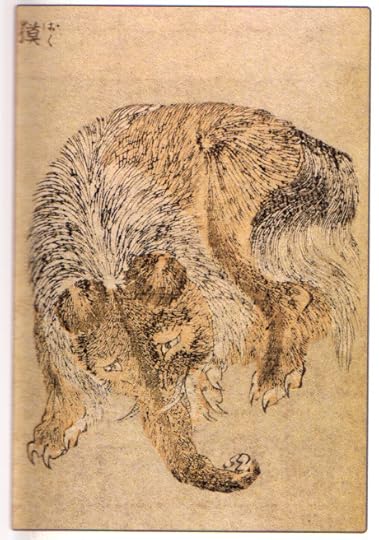
A baku as depicted by Japanese artist Katsushika Hokusai (1760-1849).
Baku are spirits who devour dreams and nightmares. They have a long history in Japanese folklore and art.
The Japanese term baku has two current meanings, referring both to the traditional dream-devouring creature and to the zoological tapir. In recent years, there have been changes in how the baku is popularly depicted.
The traditional Japanese nightmare-devouring baku actually originates from Chinese folklore, and was familiar in Japan as early as the Muromachi period (14th-15th century). An early 17th-century Japanese manuscript, the Sankai Ibutsu (山海異物), describes the baku as a shy, Chinese version of a chimera, with an elephant’s trunk, rhinoceros eyes, an oxtail, and tiger paws, all of which protected the creature against pestilence and evil.
Eating nightmares was not originally included among its list of abilities. However, in a 1791 Japanese wood-block illustration, a specifically dream-destroying baku was depicted with an elephant’s head, tusks, and trunk, with horns and tiger’s claws. The elephant’s head, trunk, and tusks are characteristic of baku portrayed in classical era Japanese wood-block prints and in shrine and temple carvings.
February 26, 2014
Note of the Week 010
Just a quick one today.
Only 1.5 days left to enter for a chance to win a signed print copy of Taking Jezebel. Winners will be announced on Saturday, February 29, 2014.
Goodreads Book Giveaway
Taking Jezebel
by Patrick Kelly
Giveaway ends February 28, 2014.
See the giveaway details
at Goodreads.
Enter to win
Good luck, friends!
February 25, 2014
Novel of the Week 010
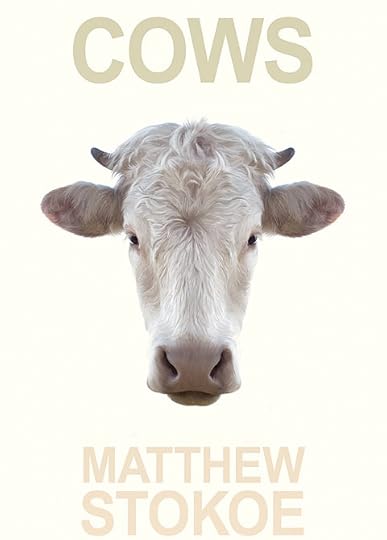
For me, Matthew Stokoe's Cows has always represented something special: it's one of the few novels that successfully grossed me out. Like, completely.
Now don't get me wrong, I've read plenty of novels that have induced a cringe or two, but this one takes the cake. Its lighthearted moments are too few to count (are there any?), and reading the book is akin to being strapped to a chair, forced to watch hours of torture porn... But, similar to Max Renn in Cronenberg's Videodrome, you just can't look away. There's something so fascinating about the gut feeling of animalic dread that the novel creates; with revulsion and compulsion in equal measures, you're dragged along—begrudgingly, even painfully—to see what happens next. From protagonist Steven's twisted "dinners" with his fat, sadistic mother (dubbed "the Hagbeast") to his slow progression from victim to empowered, violent beast, Stokoe does a brilliant job of tightening the reins on your sense of dread, all the way through to the novel's final page.
Check this one out, if you can stomach it.