Patrick Kelly's Blog: PATRICK KELLY—AUTHOR BLOG, page 12
February 10, 2014
Demon of the Week 008
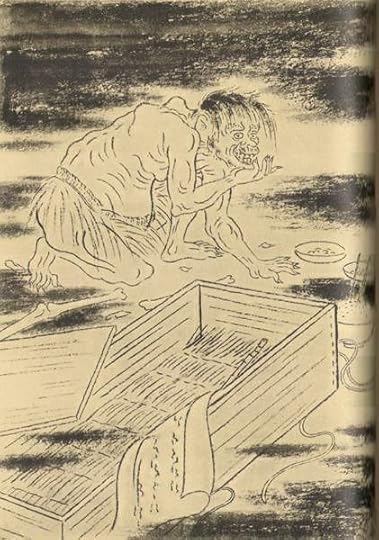
A jikininki finishes off his meal.
Jikininki (食人鬼, "human-eating ghosts"; pronounced shokujinki in modern Japanese) are the leftover spirits of greedy, selfish or impious individuals who are forever cursed to seek out and feed upon human corpses. They do this under cover of night, scavenging for bodies and stealing the offerings left out for the newly deceased. Sometimes the jikininki also loot the corpses they eat for valuables, which they may use to bribe local officials to leave them in peace.
For however evil their deeds may seem, Jikininki actually lament their condition and hate their repugnant cravings for dead human flesh. Often, jikininki are said to look like decomposing cadavers, perhaps with a few inhuman features such as sharp claws or glowing eyes. However, several stories describe their the ability to magically disguise themselves as normal human beings, and even to lead normal lives by day.
So keep an eye on your new neighbor, just to be certain they aren't lying in wait for the old woman in the top floor apartment to croak.


February 7, 2014
Image of the Week 007
February 6, 2014
Myth of the Week 007
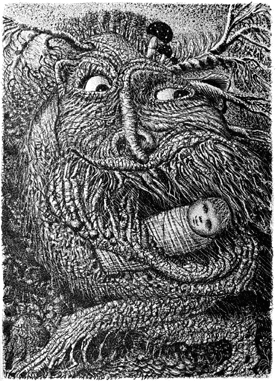
A leshy as depicted by Boris Zabirokhin
The Leshy or Lesovik is a spirit creature from Slavic mythology. He is said to protect the forest and all its animals. He's about the height of a tall man, but he can also morph to become as small as a blade of grass. Occasionally, he is depicted with a tail, hooves, and horns, but almost always is shown with pale skin and luminescent, gaping green eyes. Also, he has no shadow.
For company, the leshy keeps wolves and bears near at hand, and he carries a club to demonstrate his prowess and seat as master of wood. His blood is blue, tinting his cheeks, and he often wears a red scarf. As protector of the forest and all its occupants, the leshy tells his neighbors when to migrate and where.
When the need arises, leshies can transform into humans to disguise themselves, but his glowing eyes often betray his true nature (and he's said to put his shoes on backwards, which is another dead giveaway). Nevertheless, if a human manages to make a friend of a leshy, he or she can learn all of the creature's secrets, including his ancient magic. For this reason, farmers would often make pacts with leshy to protect their crops and livestock.
Leshies are terribly mischievous and have horrible cries. In order to lure a passerby back to his cave—where the leshy is free tickle the stranger to death—the creature can imitate the voices of those familiar to wanderers of the forest.
For however malicious their acts may seem, leshies aren't inherently evil—instead, we'll call them sportive. Although they enjoy misguiding humans and kidnapping young women, they're also said to keep grazing cattle from wandering, and their underlying motive is always to maintain and protect their home, the forest, and all the other creatures living therein.
February 5, 2014
Note of the Week 007
This week's Note of the Week is a quote from Henry Miller's Tropic of Cancer.
If there were a man who dared to say all that he thought of this world there would not be left him a square foot of ground to stand on[. . .] If now and then we encounter pages that explode, pages that wound and sear, that wring groans and tears and curses, know that they come from a man with his back up, a man whose only defenses left are his words and his words are always stronger than the lying, crushing weight of the world, stronger than all the racks and wheels which the cowardly invent to crush out the miracle of personality. If any man ever dared to translate all that is in his heart, to put down what is really his experience, what is truly his truth, I think then the world would go to smash, that it would be blown to smithereens and no god, no accident, no will could ever again assemble the pieces, the atoms the indestructible elements that have gone to make up the world.
— Henry Miller, Tropic of Cancer
February 4, 2014
Novel of the Week 007
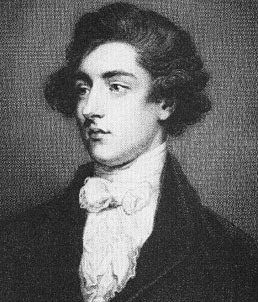
Perhaps due to its subject matter (mysticism, a subject that's always been of interest to me, especially as of late), I've chosen William Beckford's The Vision as the Novel of the Week. This slim novella, which you can read for free here, was published five years before the author's most famous work—Vathek, another treasure—and was composed at a very young age, supposedly only to impress Beckford's tutor.
The Elders of these happy Tribes separating from the Youth who lead an active Life in the Forests, ascend when Age has in a manner, consecrated them to us even to the verge of our glistening Caverns and there lifted above the Storms the Vapours and the concerns of Humanity enjoy all the sublimity of Meditation. In this Region they remain till Death delivers them to the Æther of Souls. With what delight we dwell upon the genuine Descendents of those Patriarchs who in former times were esteemed worthy of the interposition of the Creator of all things. These and these alone are conversant with the pure Spirits that move at this instant around us.
— William Beckford, The Vision
February 3, 2014
Demon of the Week 007
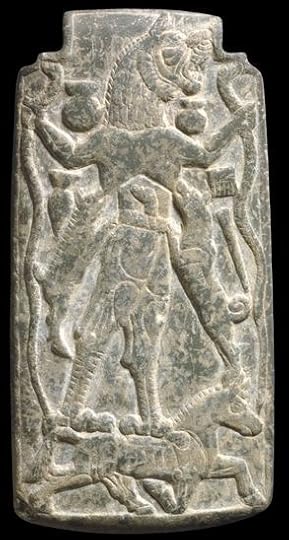
An amulet with a representation of Lamashtu standing on a donkey, suckling a jackal and a wild pig. Dated to 800-550 BCE.
In Mesopotamian mythology, Lamashtu—AKA Dimme—was a malevolent female demon who preyed on women during childbirth, aiming to kidnap babies while the mother was breastfeeding. Having succeeded, Lamashtu would gnaw on the child's bones and drink their blood.
She is often depicted with a hairy body, a lioness's head, donkey's teeth and ears, long fingers and nails, and the taloned feet of a bird. Typically, she is shown standing or kneeling on a donkey, nursing swine or canine, and/or holding serpents.
Her list of evil deeds included slaying children (unborn and neonatal), causing harm to mothers and expectant mothers, eating men and drinking their blood, disturbing or interrupting sleep with horrific nightmares, infesting waterways, and bringing disease, sickness, and death. Quite the résumé, Lamashtu.
What do you think about Lamashtu? Know something more? Add to the conversation in the Comments Section below.
January 31, 2014
Image of the Week 006
Warning: potentially NSFW.
This week, I wanted to feature "forgotten surrealist" Pierre Molinier's beautiful and startling photography, which prominently and proudly displays his tastes for fetishism and transvestitism in striking montages and self-portraits. It was too difficult to choose just one, so here are a couple I hope you can't take your eyes off of:
[image error]
"Étoile de six" ("Star of six"), a collage from Board 43 of the book Chaman et ses créatures ("The Shaman and his creatures"), ca. 1965-68.
[image error]
"Mandrake se régale" ("Mandrake is regal"), photomontage ca. 1968-70.
If you're interested, you can read more about Pierre Molinier here and here. Add your thoughts to the Comments section below.
January 30, 2014
Myth of the Week 006
This week, let's look at a rather unusual mythological creature (and one that's completely new to me): the Akaname.
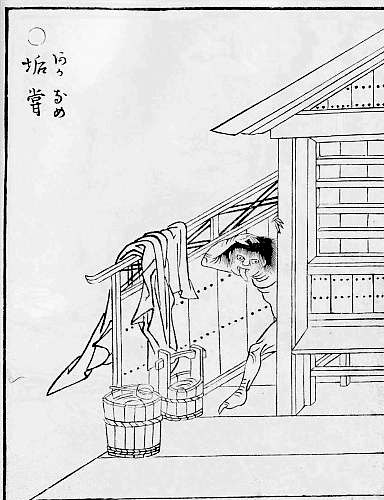
An akaname as depicted in the first volume of Toriyama Sekien's Gazu Hyakki Yakō (1776).
According to Japanese folklore, the akaname is a demon whose name (literally translated as "Filth Licker") says it all. The creature is said to sneak into dirty bathrooms to lick them clean.
The demon typically takes the form of a red, warty humanoid with frog-like features and an elongated tongue. Keep an eye out for this guy, as he's slippery and sneaky. If you happen to find all those hard-to-reach crevices around the bathtub are sparkling, yet you haven't lifted a finger or sponge in months, you'll know who the culprit was.
He's also described as the "personification of the fear of using a dark bathroom late at night." Furthermore, what a great little tale to share with your kids, to scare them into keeping the tile scrubbed and the toothbrush jar wiped down.
While some might find this myth creepy, I'd happily welcome an akaname if it meant not having to scrub the john.
January 29, 2014
Note of the Week 006
In general, starting can be a difficult endeavor—perhaps especially so when it comes to embarking on a new creative venture. While Taking Jezebel is still brewing in the huge vat of recently released fiction (and awaiting consensus), I've already begun plucking away at a second project: something wholly different, and inspired (in part) by my own experiences meandering through life, traveling across the country and world, questing for meaning.
Let's put the WHAT of the new novel aside for a moment and instead discuss the HOW of setting out on a writing project.
Here's an example of a quick idea-mapping exercise, wherein I asked myself the following question: "If my protagonist set out across the United States in search of a true mystic (perhaps the last), who would he meet?"
What freaks, phonies, and vagrants would he cross paths with on his journey for meaning? Where would he find the 'real deal,' or would he at all? Perhaps buried in the desert, alongside Askuwheteau and clan? Or maybe down a dark alleyway in his native New York, behind a curtain of strung magenta beads, in a room swirling with incense and brooding with ill-lit menace?
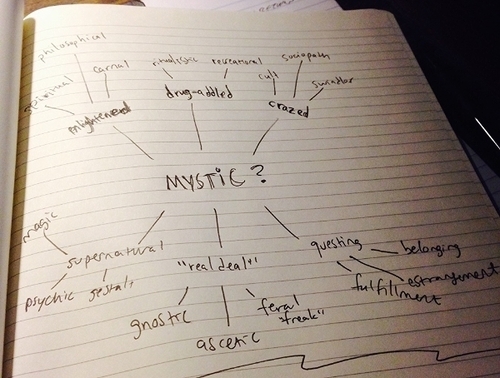
So, what works best for you when prewriting? How do you plan and outline? Share your thoughts in the Comments section below.
Blurb of the Week 006
In general, starting can be a difficult endeavor—perhaps especially so when it comes to embarking on a new creative venture. While Taking Jezebel is still brewing in the huge vat of recently released fiction (and awaiting consensus), I've already begun plucking away at a second project: something wholly different, and inspired (in part) by my own experiences meandering through life, traveling across the country and world, questing for meaning.
Let's put the WHAT of the new novel aside for a moment and instead discuss the HOW of setting out on a writing project.
Here's an example of a quick idea-mapping exercise, wherein I asked myself the following question: "If my protagonist set out across the United States in search of a true mystic (perhaps the last), who would he meet?"
What freaks, phonies, and vagrants would he cross paths with on his journey for meaning? Where would he find the 'real deal,' or would he at all? Perhaps buried in the desert, alongside Askuwheteau and clan? Or maybe down a dark alleyway in his native New York, behind a curtain of strung magenta beads, in a room swirling with incense and brooding with ill-lit menace?
So, what works best for you when prewriting? How do you plan and outline? Share your thoughts in the Comments section below.