Patrick Kelly's Blog: PATRICK KELLY—AUTHOR BLOG, page 3
June 16, 2014
Demon of the Week 026
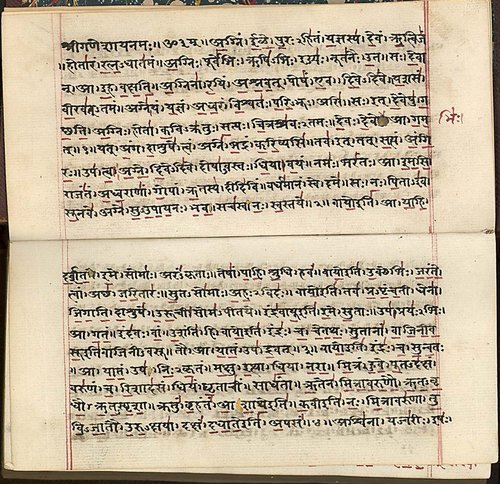
The Rigveda, a sacred Indo-Aryan collection of Vedic Sanskrit hymns that is still used in India.
The Panis are a class of demons in the Rigveda, their name meaning "bargainer" or "miser," especially someone who is cheap on the sacrificial oblations. The Panis appear in the Rigveda as watchers over stolen cows, are located behind the stream Rasā, and are sought out by Sarama, the so-called "bitch of the gods." The Panis boast to Sarama that they are well-armed and will not yield their cows without a battle, and that the cows are furthermore well hidden in a secluded rocky chamber.
The word pani is also applied in the Rigveda to human beings, even to respected members of a community, who are unwilling to share their wealth with others.


June 13, 2014
Image of the Week 025
The woman at the far left—Ariadne, daughter of King Minos of Crete—holds a ball of twine, embodying the female element of Theseus.
Theseus himself is portrayed as a 16th-century knight, toward the middle of the image.
The labyrinth is a symbol of the inner journey of the hero into his own unconscious.
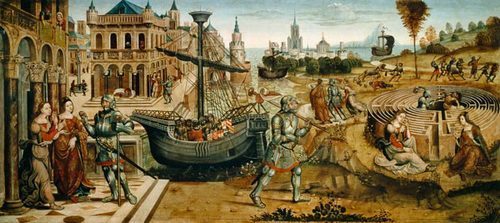
Master of the Campana Cassoni, Theseus and the Minotaur, 1510-20.
June 12, 2014
Myth of the Week 025
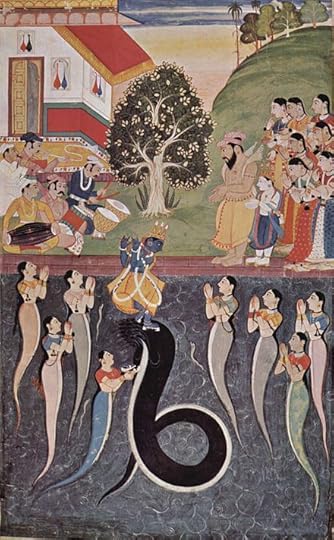
Nāga is the Sanskrit and Pāli word for a deity or class of entity or being who takes the form of an enormous snake—specifically the king cobra. The Nāga is found in Hinduism, Buddhism, and Jainism. A female Nāga is called a nāgīor nāgiṇī.
The creatures have variously been depicted as negative or evil, as persecutors of all other creatures, and as virulent, poisonous snakes of great prowess and strength. Their physical characteristics vary somewhat, ranging from mostly serpent-like to somewhat anthropomorphic. In Hinduism, however, the creatures are said to be snakes who may take human form at will. They are inquisitive and tend to be malevolent, but only when mistreated. They are associated with rivers, lakes, seas, and wells, and have come to be known as guardians of certain treasures.
In some parts of the world, the Nāga is altogether holy, objects or creatures of reverence—for example, in South India, where is it believed that they bring fertility and prosperity. In other parts of the world, they are believed to hold the key to immortality and youth. Extravagant rituals are conducted in their honor, and whole communities believe they are ethnically or ancestrally linked to the creatures.
Note of the Week 025
Only a couple weeks left to enter the Taking Jezebel giveaway.
I'm making it super easy for you to enter. You can utilize one of the entry methods listed last week OR you can simply fill out the form below to be included in the drawing at the end of the month. The FIVE (5) winners will receive the novel in their choice of ebook format.
Name *
Name
First Name
Last Name
Email Address *
Your information will not be shared.
Why should you win? *
Thank you!
Thanks for playing and good luck!
June 10, 2014
Novel of the Week 025

The Castle of Otranto is a 1764 novel by Horace Walpole, first published under a pseudonym. It is generally regarded as the first ever gothic novel, initiating a literary genre that would become extremely popular in the later 18th century and early 19th century.
The novel tells the story of Manfred, lord of the castle, and his family. Manfred's sickly son Conrad is set to be wed to princess Isabella, but Conrad is crushed to death by an enormous helmet before the ceremony ever begins. This inexplicable event links back to an ancient prophecy: "That the castle and lordship of Otranto should pass from the present family, whenever the real owner should be grown too large to inhabit it." Manfred, terrified that Conrad's death signals the beginning of the end for his family line, resolves to avert destruction by marrying Isabella himself while divorcing his current wife Hippolita. In the ensuing chaos, knights gallant and unexpected heirs abound.
Demon of the Week 025
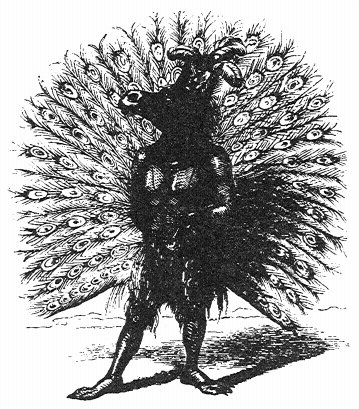
Adramelech, also called Adrammelech, Adramelek or Adar-malik, was a kind of sun god related to Moloch. He was first worshipped in a town called Sepharvaim. According to II Kings 17:31, the cult of Adramelech was brought by the Sepharvite colonists into Samaria: "the Sepharvites burnt their children in the fire to Adrammelech and Anammelech, the gods of Sepharvaim."
Baal Adramelch ("Baal" here means "Lord", not to be confused with the goetic Baal, who's been covered here before) is described as the son and murderer of Sennacherib, king of Assyria in II Kings 19:37 and Isaiah 37:38. The concept that children were sacrificed to Adramelech remains a subject of some dispute, mainly because of a lack of archaeological proof of the existence of the large bronze statues this practice typically required.
Like many pagan gods, Adramelech is considered a demon in Judeo-Christian traditions. So he appears in Milton's Paradise Lost, where he is described as a fallen angel, vanquished by Uriel and Raphael. According to Collin de Plancy's book on demonology, Adramelech became the President of the Senate of the demons. He is also the Chancellor of Hell and supervisor of Satan's vast wardrobe. He is usually depicted with a human torso and head, and the rest of the body of a mule (or sometimes as a peacock).
A poet's description of Adramelech can be found in Robert Silverberg's short story "Basileus". Adramelech is described as "The enemy of God, greater in ambition, guile and mischief than Satan. A fiend more curst—a deeper hypocrite."
Image of the Week 024
The Lady of Shalott depicts the eponymous Lady, who was forbidden to look directly at the real world. Instead, she was doomed to view the world through a mirror, and weave what she saw into tapestry. Her despair was heightened when she saw loving couples entwined in the far distance, and she spent her days and nights aching for a return to normality. One day the Lady saw Sir Lancelot passing on his way in the reflection of her mirror, and dared to look out at Camelot, bringing about a curse. She escaped by boat during an autumn storm, inscribing "The Lady of Shalott" on the prow. As she sailed toward Camelot and certain death, she sang a lament. Her frozen body was found shortly afterward by the knights and ladies of Camelot, one of whom is Lancelot, who prayed to God to have mercy on her soul. The tapestry she wove during her imprisonment was found draped over the side of the boat.
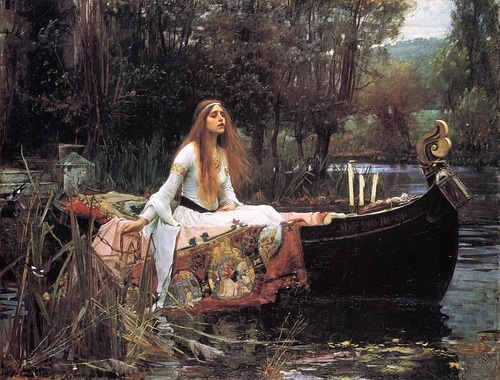
John William Waterhouse, The Lady of Shalott, 1888.
June 5, 2014
Myth of the Week 024
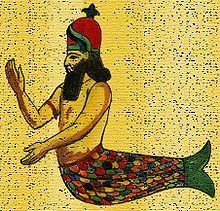
Dagon was originally an East Semitic Mesopotamian fertility god who later evolved into a major Northwest Semitic god, reportedly of grain (as a symbol of fertility) and of fish and/or fishing (as symbol of multiplying).
...Next came one
Who mourned in earnest, when the captive ark
Maimed his brute image, head and hands lopt off,
In his own temple, on the grunsel-edge,
Where he fell flat and shamed his worshippers:
Dagon his name, sea-monster, upward man
And downward fish; yet had his temple high
Reared in Azotus, dreaded through the coast
Of Palestine, in Gath and Ascalon,
And Accaron and Gaza’s frontier bounds.
— John Milton, Paradise Lost, Book 1
Horror fans will know the name Dagon well. There is a whole wiki page describing his appearances in popular culture. An appropriately campy horror film was produced in 2001, directed by Stuart Gordon of Re-Animator fame. It combined the traditional-mythic Dagon with H.P. Lovecraft's 1936 novella of the Cthulhu mythos, The Shadow over Innsmouth.
June 4, 2014
Note of the Week 024
June's GIVEAWAY opportunity is here! Enter to win a FREE e-copy* of Taking Jezebel.
Choose your entry method:
Tweet @patrickkauthor with the hashtag #TakingJezebel and a brief summary of why you should win.Repost on Tumblr with a brief summary of why you should win and your e-mail address.Reply on patrick-kelly.info with a brief summary of why you should win and your e-mail address.Reply on Goodreads with a brief summary of why you should win and your e-mail address.I will randomly select FIVE (5) winners at the end of the month. You may increase your chances of being randomly selected by entering via all four channels. Good luck and happy reading!
*No purchase necessary. Upon selection, winners will be offered their choice of one (1) .EPUB or one (1) .MOBI copy of the novel, Taking Jezebel by Patrick Kelly.
June 3, 2014
Novel of the Week 024

The City and the City is a departure of sorts for Miéville, in terms of the fantastical elements so typical of his work. That's not to say that the novel isn't intriguing in its own unique way; it is simple in concept, but riddled with the odd mythos of two (or is it three?) disparate yet wholly interconnected cities.
Told from the perspective of a sarcastic, seasoned member of an Extreme Crime Squad, the novel is fundamentally a police procedural, though peppered throughout with the esoteric trappings fans look for from the author.
I'd recommend picking this one up as a light induction to Miéville's work, or if you're interested in crime/noir thrillers with a less tropey angle than those genres usually see.
Original review published on Goodreads, with a "Good" rating of 3/5 stars.