Patrick Kelly's Blog: PATRICK KELLY—AUTHOR BLOG, page 5
May 19, 2014
Demon of the Week 022
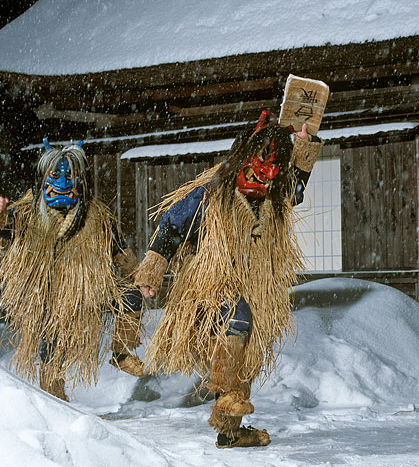
Men dressed as Namahage.
According to Japanese folklore, a Namahage (生剥) is a demonlike being, often portrayed by men wearing oversized ogre masks and straw capes, especially during the New Year's ritual of the Oga Peninsula in the Akita Prefecture of northern Honshū, Japan.
The frightfully dressed men are armed with deba knives (albeit wooden fakes, or sometimes made of papier-mâché) and tote teokes (手桶, roughly translated, a "hand pail" made of wood). They march in pairs or in threes, going from door to door, making the rounds of peoples' homes and admonishing children who may be guilty of laziness or other bad behavior.
An Akita legend has developed regarding the origins of this Namahage tradition: that Emperor Wu of Han (d. 87 BC) from China came to Japan bringing five demonic ogres to the Oga area. These beasts established quarters in the two local high peaks, Honzan (本山) and Shinzan (真山). These oni, as they are most commonly called in Japan, also stole crops and young women from Oga's villages.
In response, the citizens of Oga made a wager: if the demons could build a flight of stone steps—one thousand steps in all—from the villages to the five shrine halls in a single night (alternately, the legend says they were ordered to build the steps from the sea shore to the top of Mt. Shinzan), then the villagers would supply them with a young woman as offering, every year. But if they failed at their task, they would have to leave forever. Just as the ogres were about to complete their work, a villager mimicked the cry of a rooster, and the ogres departed, believing they had failed.


May 16, 2014
Image of the Week 021
Georges de La Tour's The Fortune-Teller depicts the act of palmistry, one of the most ancient magic arts. Each line of the hand corresponds to a segment of human life: family, love, death, success, social position, instinct, and intelligence. The "mounts" are studied in relation to the seven planets.
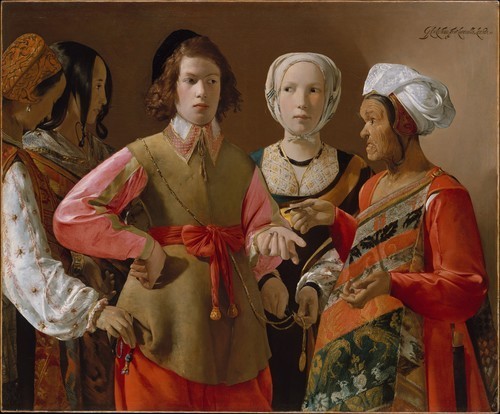
Georges de La Tour, The Fortune-Teller, ca. 1632-35.
There are some interesting details hidden in the piece. The young man's naiveté is made more apparent by the words "love" and "faith" inscribed on the chains he wears around his neck. Distracted by the chiromancer, he does not notice that his pocket is being picked.
May 15, 2014
Myth of the Week 021
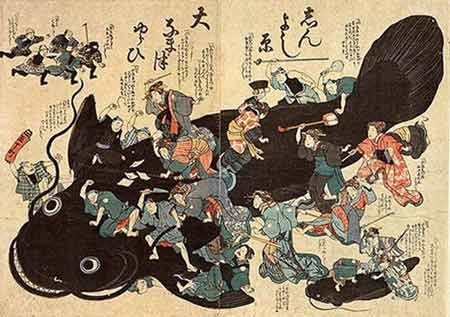
This Namazu represents the earthquake of Edo (modern Tokyo), which occurred in October of 1855.
In Japanese mythology, the Namazu (鯰) is a giant catfish said to cause certain earthquakes. He "lives in the mud under Japan," and is guarded by the god Kashima, who can restrain the Namazu with an enormous stone. But when Kashima lets his guard down, Namazu thrashes about, and has been credited for causing some of Japan's most violent earthquakes.
In the illustration at left, the creature is attacked by peasants and concubines. However, in the background, help for the gargantuan catfish approaches—craftsmen, who will take profit from the destruction and imminent re-construction of the city, in the wake of disaster. The earthquake of Edo, which killed thousands of inhabitants, coincided with the traditional “month without gods,” which is believed to be a period when all of the gods gather in a secret temple. Taking advantage of the absence of Kashima, the coward Namazu takes advantage of his freedom during this period, causing destruction and sorrow.
May 14, 2014
Note of the Week 021
Say hello to Warren, a new member of the Kelly family. He is approximately 1 year old, docile and sweet as can be.

Rescued from a shelter, this little buddy is a testament to the power of adopting at-risk and stray animals. There are so many loving companions out there waiting for a safe and comfy home; why look for pedigree and breed when there are sweethearts like this one hoping to be saved?
Do you have a pet? A touching rescue story? Share yours below!
May 13, 2014
Novel of the Week 021
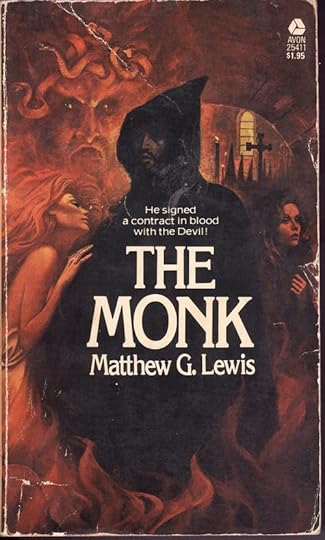
The Monk is a classic of Gothic literature, and perhaps my favorite so-called morality tale of the genre. Matthew Lewis wrote the entire, detailed, drippingly decadent novel in all of ten weeks—and before his 20th birthday.
When the work was first published in 1796, it was criticized for its "obscene" themes, though this didn't stop readers from scooping it up in droves. No doubt they were anxious to see if the work lived up to its devilish reputation.
The story concerns a Capuchin superior, Ambrosio, who succumbs first to the fleshly temptations offered by a young girl who has entered his monastery disguised as a boy. In time, Ambrosio continues his descent into depravity with increasingly grotesque acts of sorcery, murder, incest, and torture. Combining sensationalism with acute psychological insight, The Monk is a powerful exploration of how violent and erotic impulses can break through the barriers of social and moral restraint.
Open your eyes, Ambrosio, and be prudent. Hell is your lot; You are doomed to eternal perdition; Nought lies beyond your grave but a gulph of devouring flames.
— Matthew Gregory Lewis, The Monk
May 12, 2014
Demon of the Week 021
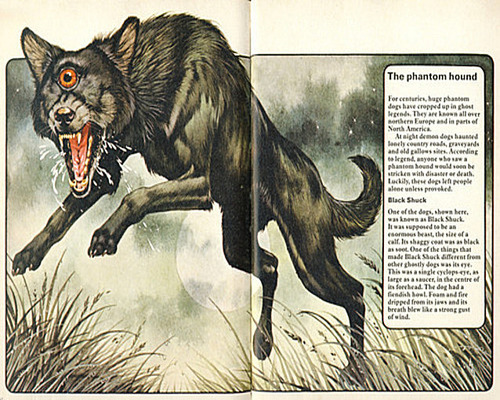
Black Shuck, Old Shuck, Old Shock or simply Shuck is the name given to a ghostly black dog that is said to roam the coastline and countryside of East Anglia. Accounts of the animal form part of the folklore of Norfolk, Suffolk, the Cambridgeshirefens and Essex.
The name Shuck may be derived from the Old English word scucca meaning "demon", or possibly from the local dialect word shucky meaning "shaggy" or "hairy".
Black Shuck is one of many ghostly or demonic black dogs that have been recorded across the British Isles. Sometimes recorded as an omen of death, sometimes a more companionable animal, it is classified as a cryptid—a creature or plant whose existence has been suggested but has not been discovered or documented by the scientific community—and there are varying accounts of the animal's supposed appearance. Writing in 1877, Walter Rye stated that Shuck was "the most curious of our local apparitions, as they are no doubt varieties of the same animal."
Its alleged appearance in 1577 at Bungay and Blythburgh is a particularly famous account of the beast, and images of black sinister dogs have since become part of the iconography of the area.
May 9, 2014
Image of the Week 020
In the 17th century, the astronomer was still comparable with the ancient figure of a divining astrologer. The celestial globe and astrolabe in the painting suggest Vermeer's interest in the scientific culture of his time.

Jan Vermeer, The Astronomer, 1668.
Myth of the Week 020
"Nikolaus and Krampus in Austria." Newspaper-illustration from 1896.
Krampus is a beast-like creature from the folklore of Alpine countries. He is thought to punish children during the Christmas season who have misbehaved, in contrast with Saint Nicholas, who rewards well-behaved ones with gifts. Krampus also captures particularly naughty children in his sack and carries them away to his lair.
Typically, Krampus is represented as a beast-like, demonic creature. Although his roots are in Germanic folklore, his influence has spread far beyond Germany's borders. Young men often dress up as Krampus in Austria, Romania, southern Bavaria, South Tyrol, northern Friuli, Czech Republic, Slovakia, Hungary, Slovenia and Croatia during the first week of December and roam the streets frightening children with rusty chains and bells. There are many other names for Krampus, as well as regional variations in his portrayal and celebration.
May 7, 2014
Note of the Week 020
What are you reading right now? What's your favorite novel of all time, and why?
Complete the survey below. Your comments may be posted next week.
Name *
Name
First Name
Last Name
What are you reading right now? *
Do you like it? Tell me why. *
Favorite Genres *
Classics
Comedy
Fantasy
Gothic
Historical Fiction
Horror
Literary
Mystery
Mythology
Poetry
Science Fiction
Short Story
Other
Other Genre
If you selected Other, please explain.
What is your favorite book of all time, and why? *
Thank you for completing this survey!
May 6, 2014
Novel of the Week 020

Naked Lunch by William S. Burroughs is one of those classic, divisive works that transcends genre, translating across generational gaps and changing world cultures. Originally published in 1959, Burroughs's short novel is one of loosely connected vignettes; they are chronologically disordered and hazy as a fever dream. From the US to Mexico and eventually Tangier, we follow our narrator—William Lee, a superhuman, drug-addled version of Burroughs, the junkie himself—into the Interzone, where time and space shift as readily as a breath.
David Cronenberg also released an adaptation of the novel in 1991—to cries of frustration, as the novel is rather difficult to translate to film. It initially received lukewarm-to-moderate reviews, but has since become something of a cult classic, garnering retrospective praise for its challenging, non-linear approach to storytelling and for its mind-bending, surreal moments.