Tim Prasil's Blog, page 21
January 12, 2022
My Newest TARDIS Page Is Bigger on the Fireside
In my efforts to make BromBonesBooks.com a useful and maybe even interesting place, I recently turned a page that had been called Descriptions and Depictions of Fireside Storytelling into the Fireside Storytelling Descriptions & Depictions TARDIS. In my universe, TARDIS is an acronym for Trusted Archival Research Documents in Sequence, and these timelines are designed for researchers seeking historical documents online. This makes five TARDIS pages here at BBB, each one waiting to spin you through time and space. Here are your destination choices:
The Cock Lane Ghost TARDIS
Crocker Land and Other Mapped Mirages of the Arctic TARDIS
Fireside Storytelling Descriptions & Depictions TARDIS
The Rise of the Term “Ghost Hunt” TARDIS
Telescopes versus the Moon People TARDIS

In addition, the pages charting fireside storytelling and the roots of the term “ghost hunt” have recently gotten bigger. A 1711 passage by Joseph Addison and some lines from a 1744 poem by Mark Arkenside went up on the former, and to the latter, I added an 1804 newspaper report and an 1825 anecdote about a Ramsgate ghost hunt gone sideways. If anyone thought that the custom of sharing ghost stories near Christmas began with Charles Dickens — or that the term “ghost hunt” emerged during the Victorian period or afterward — I hope these two pages will surprise and delight you as much as I was when I had to boot those misconceptions out of my head.
History is cool.
— Tim


December 29, 2021
The World Is Now Prepared for the Project, the Details of Which the World Had Not Been Prepared!
A few times, I blogged about my project — the details of which the world is not yet prepared! It was my goofy way of saying I wasn’t sure I could complete it. And I didn’t have a title for it.
But now I am sure and do have one. Certain Nocturnal Disturbances: Ghost Hunting Before the Victorians will be my first book-length history. It will include some cases that are probably at least a bit familiar to those who visit this site: the Drummer of Tedworth and the Cock Lane Ghost come immediately to mind. Hopefully, though, I’ll stir in fresh ideas and new details as I retell those tales, if only because I look at what they tell us about the long legacy of ghost hunting rather than of ghosts. Also, I bet I’ll introduce almost all my readers to some brand new old hauntings and the investigations of them.
Various projects have led me to explore this “deep history” of ghost hunting. They include the Ghost Hunter Hall of Fame, the Rise of the Term ‘Ghost Hunt’ TARDIS, and The Victorian Ghost Hunter’s Casebook. It’s been an interesting experience drawing from these to create a book that just might revise and expand current thinking about the topic. Certain Nocturnal Disturbances should be available around the middle of 2022, if not sooner.
More Tales (to Be) ToldI completed Season One of Tales Told When the Windows Rattle. Season Two probably won’t begin until next October, but there will be “extras” in the meantime. I’ve decided to call these Tales Told Whenever I Feel Like It, which gives you an idea of the scheduling.
 Please notice the cat on the far left.
The first selection will be Edgar Allan Poe’s “A Cask of Amontillado,” a personal favorite and one that — like many of Poe’s tales — lends itself to an audio presentation. When will it be available?
WHENEVER I FEEL LIKE IT!
Other Books and Best WishesOf course, there will be additional developments here at Brom Bones Books in the coming year. For instance, I’ll be polishing and reprinting a collection of occult detective fiction, one that I had edited for Coachwhip Books before BBB became a thing in 2017.
Look at that. I’m coming up on five years! I’ll have to think up some way to celebrate.
Until that happens, I wish you a peaceful and happy 2022. Stay strong, dream big, and appreciate the little things.
— Tim
December 22, 2021
Railroad Hauntings You Can Still Visit: The MK&T Freight Yards in St. Louis, Missouri
 “Seen by Six Different Persons”
Do people who walk St. Louis’s Riverfront Trail know that, once upon a time, the freight yards of the Kansas, Missouri, and Texas Railroad sat a bit north of the Cotton Belt Freight Depot? Do they know that, in early 1902, six train workers spotted a ghost in those yards, between Mullanphy and Mound Streets? The sightings made the front page of The St. Louis Republic.
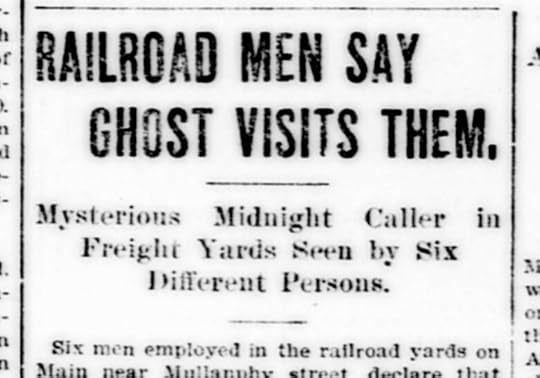
The article says that “near the hour of midnight a ghost flits about among the freight cars in the vicinity,” eluding those hoping to get a grasp on what it is. The apparently male figure darted around without making a sound, sometimes coming so close to the wheels of moving trains that one jittery worker asked to be reassigned to the day shift.
An explanation given for the ghost — if ghost it was — involves an engine having struck and killed a man near the Mound Street bridge. William Owens, a night yardmaster, and Matthew Cummings, a switchman, both claimed to have seen the specter near this bridge. The latter says that, when one gets close enough to the figure, “it assumes a phantomlike appearance as if it were only a mist or shadow.”
Updating the Phantom’s TerritoryThe article is pretty specific about where the ghost ran: “Main near Mullanphy” and on and beneath a bridge built at Mound Street. Attempting to match these 1902 sites to what’s there today, I started with an 1870 map. A lot can change in 32 years, but this was the best I could find. Mullanphy and Mound are both still there, but at some point, the stretch of Main Street between them was renamed Commercial, according to the Google map. (Meanwhile, not far away, 2nd Street was renamed 1st. Broadway retains its name along with some of the area’s other cross streets, such as Brooklyn, Florida, and O’Fallon.) In other words, assuming 1870’s Main and Mullanphy was the same spot in 1902, it’s now Commercial and Mullanphy.
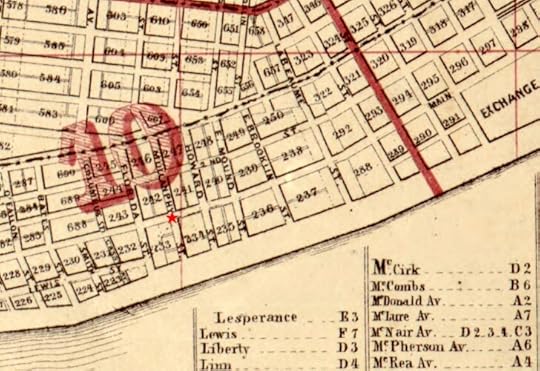 The 1870 map cropped to show where Main met Mullanphy. I put a red star at the spot.A Short Side Track
The article says: “The spot most frequented by the apparition is the site of the old Waddingham mansion. The old house was torn down in 1830 to make room for the M.K.&T. freight-house.” I had hoped this landmark would confirm the location, but I’m having difficulty learning much of anything about the Waddingham mansion. Somehow fittingly, it seems to have vanished without a trace! I did discover that a few , which is alleged to have a few ghosts of its own.
Returning to the freight yards, I mention above that the Riverfront Trail and Cotton Belt Freight Depot are close by. It’s a very industrial area, though, and maybe not the safest place to wander around at night. St. Louis offers ghost hunters several alternatives, including haunted theaters (aren’t all theaters haunted?) and spooky mansions. If you brave the freight yard, let us know what happened. If you visit one of those mansions, perhaps you could ask the guide about what became of the old Waddingham place. No matter what ghosts you hunt in St. Louis, I’d love to hear from you in the comments below.
— Tim
Discover more “Railroad Hauntings You Can Still Visit” at the page forAfter the End of the Line: Railroad Hauntings in Literature and Lore

December 19, 2021
A Tale Told When the Moon Is Full: Season One of Tales Told Is Now Complete!
Episode 10 of Tales Told When the Windows Rattle — the last for Season One — is now available. It has a different feel from the earlier ghost and otherwise creepy stories. But it’s not that different. Imagine a couple on their honeymoon. They’re traveling through rural Cornwall or Maine, and for one reason or another, they end up in a haunted house. That premise has a familiar ring, right?
Now, swap out Cornwall or Maine with the Moon, and you have George Griffith’s “A Visit to the Moon,” a story first published in 1900. There’s no haunted house exactly, but there are several ancient cities littered with skeletal remains. Don’t misunderstand me, though. The newlyweds learn that the Moon isn’t entirely a dead satellite. . . .
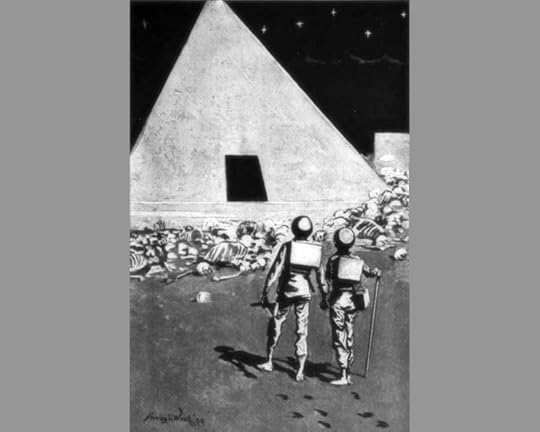 “This fringe was composed of millions of white-bleached bones and skulls.”
As an added treat, this episode makes its YouTube debut on the same day as the final full Moon of 2021. Unplanned, yes — but still quite nice.
I’m already thinking about what to read for Season Two. In the meantime, I’ll add a few Tales Told extras. What shall I call these? At this point, Tales Told When I Feel Like It is in the lead. Too snarky? Or is the snark funny? We’ll see.
Until then, you’re now in a good position to pick and choose which of the ten stories you want to listen to, helping revive the old custom of sharing scary stories ’round a cozy fire during snowy and/or rainy and/or windy weather. Do that at the Tales Told YouTube channel — or here at the Tales Told rec room. Merry holidays!
— Tim
December 15, 2021
Was the Term “Ghost Hunter” Around in the Late 1700s??? (Yep, I Think So.)
The more I look for uses of the term ghost hunter (or ghost hunters or ghost hunting or ghost hunt), the farther back in time I travel. At first, I thought it might’ve originated around the 1830s. That’s the decade that gave birth to Morris Brady, the title character of Michael Banim’s novel The Ghost-Hunter and His Family (1833), and Thomas Ingoldsby, the protagonist of Richard Harris Barham’s short story “The Spectre of Tappington” (1837), where he’s referred to as a “ghost-hunter” twice. These were both well-liked works, and they probably did a lot to popularize the term.
But then Michelle McKay smacked the back of my head (figuratively, mind you) by rediscovering Richard Sicklemore’s 1809 novel Osrick; or, Modern Horrors, which uses both ghost-hunting and ghost-hunter. And then I found the term being used in newspaper and magazine articles about the Hammersmith Ghost in 1804.
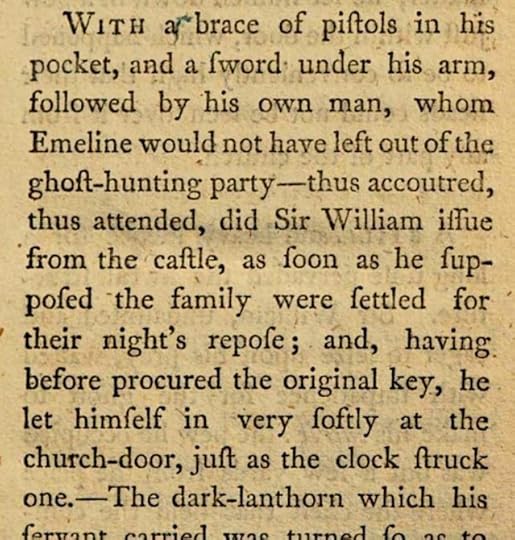
And then I came upon this in Elizabeth Gunning’s 1794 novel The Packet:
 From Elizabeth Gunning’s 1794 novel
The Packet
.
From Elizabeth Gunning’s 1794 novel
The Packet
.Yep, a character named Sir William Montreville sets out late at night, armed with piftols and fword — uhm, pistols and sword — for some ghost-hunting with his servant! Earlier, the character interviews those who claim to have witnessed a specter at the church. While remaining skeptical, he promises “he would himself go in search of this terrible ghost.” Upon arriving at the site said to be haunted, Sir William sits hidden in a pew, watching and waiting. Nocturnal surveillance — the hallmark of ghost hunters since Athenodorus! In other words, this use of ghost-hunting isn’t a way of saying a fool’s errand or some other figure of speech. Though intending to debunk the haunting, Sir William is acting as a ghost hunter in the way I suspect most people today apply that label.
I’ve also found several other uses of the term in the early 1800s, and not all in prose fiction. I put together another TARDIS (Trusted Archival Research Documents in Sequence) to chart and link what I’ve found. There’s some interesting and pretty charming stuff there. For instance, there’s D. Lawler’s 1808 The School for Daughters, a play whose title page explains that the show was:
PERFORMED BY THEPUPILS AT A LADIES’ BOARDING SCHOOL
NEAR LONDON.
There’s also the 1817 book about “preservation from the horrors of the grave by premature interment!” Author John Snart (a name Dickens might’ve loved) shares an anecdote about how he taught his kids to not fear ghosts. He had the children play at, yep, ghost-hunting, each one equipped with a bottle as if the spectral phenomena were butterflies. C’mon, that’s pretty adorable — and considerably cheaper than supplying the wee Snarts with spirit boxes!
Looking at what I’ve found — and imagining all the documents that have been lost or that still exist but have not been digitalized/put online — I’m left with a hunch that the term ghost hunt and its derivations were fairly well-known in the early 1800s in England and its linguistic colonies. I hope ghost hunters of the early 21st century find this to be kind of cool, a heritage to be proud of. I also hope you take a glance at The Rise of the Term “Ghost Hunt” TARDIS.
— Tim
December 12, 2021
Tales Told the 9th: Dead Men Tell No Tales — or Do They?
The penultimate episode of the first season of Tales Told When the Windows Rattle features an anonymous story called “Curious Mesmeric Experiences in California” (1860). As I mention after my reading, this story foreshadows Ambrose Bierce’s “An Occurrence at Owl Creek Bridge” (1890), especially in what it says about the conditions under which we might become acutely aware that time depends upon perception. “Time is relative,” says the narrator of the 1860 work. Apparently, Einstein wasn’t the first.
 This isn’t really a spoiler. Not really.
Be warned: this is a fairly “expository” story. It explores ideas and abstractions, leaning more on premise than plot or characterization. Who knows? Maybe hearing it is preferable to reading it. (And before anyone complains about my inconsistent, muddy English accent, remember this narrator has spent several years in the States! This might be a flimsy excuse — but it’s the best one I’ve got!)
“Curious Mesmeric Experiences in California” is now available at the Tales Told YouTube channel. I’m planning to post additional readings before Season Two starts, so please consider subscribing. You can also find the video version and a downloadable audio-only version here at the Tales Told page.
— Tim
December 8, 2021
Railroad Hauntings You Can Still Visit: A Railway Crossing in Carthage, New York
According to the March 27, 1915, issue of the Watertown Daily Times, the citizens of Carthage, New York, had been hearing horrible, seemingly disembodied cries at the spot where the New York Central tracks crossed John Street. A witness described the sound as “one of the most weird that can be imagined, at first, and then [it] ends with a shriek of ‘murder,’ that is both loud and piercing.”
The police were called. No explanation was found. It snowed, and the screams continued. No footprints were left behind.

The article also explains that this particular spot “is used the least of any of the other crossings in this village and there have been more people killed at it.” Well, maybe it was avoided because it was so dangerous. But that’s not all. Readers also learn that “a woman was murdered in the vicinity of this crossing, and some are of the belief that it is her ghost come back.” The same readers are then left with no solution to the mystery — just like the poor residents of John Street.
Mapping the CrossingTrying to locate this haunted site, I was lucky enough to find a map of Carthage printed in 1915, the same year the ghostly screams were reported. I cropped it to show that — in Section 6, colored brown — there are two spots, close together, where the NY Central tracks crossed John Street.
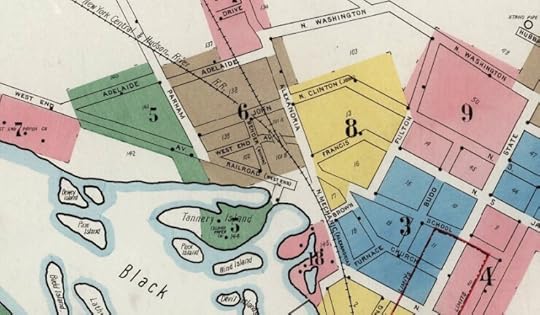
Things look somewhat different today, according to Google Maps. Apparently, a chunk of John Street was simply removed so that trains could have the full right of way. No crossing = no more fatalities? In the process, a curve was put in to meet the north-south street marked “Bender (Quinn)” on the 1915 map, and the top part of that street was renamed John. Also, there’s a leftover stub of John Street extending from North Clinton. Hopefully, these changes all make sense to the good people of Carthage.
Fortunately, for ghost hunters, the once-haunted area remains easy to find, since it sure looks like there are still tracks there. Just mosey along the John Street curve on the west side of the tracks, or set up shop at the dead end of that eastern stub of John Street. You might ask the neighbors if they’ve heard anything and maybe even present them with a copy of the 1915 article.
As always, be extremely careful when investigating haunted train tracks. As always, let us know if you visit this spot, regardless of whether you hear any spectral shrieks or not. I imagine the screaming ghost might be hoarse by now, but one never knows…
–Tim
Discover more “Railroad Hauntings You Can Still Visit” at the page forAfter the End of the Line: Railroad Hauntings in Literature and Lore
December 5, 2021
Tales Told 8: My, What Big Feet You Have!
This week’s episode of Tales Told When the Window Rattle features another Vera Van Slyke “ghostly” mystery. I put ghostly in quotations marks because, every now and again, Vera and Lida venture outside the traditionally ghostly realm. In this case, they join what we would now call a cryptozoologist on a hunt for what we would now call Bigfoot or Sasquatch. Back in 1908, the preferred term for the creature was something like “wild man in the woods.”
 This 1846 issue of
Scientific American
shows that the editor was not above making a zippy zinger!
This 1846 issue of
Scientific American
shows that the editor was not above making a zippy zinger!And as my favorite ghost-hunting duo learns, where there’s a wild man of the woods, there’s quite possibly a woman every bit as woodsy and wild!
The video version of my dramatic reading of “Monstrimony” is at the Tales Told YouTube channel. The video and audio-only versions are here at the Tales Told rec room.
— Tim
December 2, 2021
What’s the Plural of TARDIS?
TARDISes? TARDI? (No, it couldn’t possibly be “tardi” — it’s a time machine, after all.)
Anyway, I’ve often found myself traveling through time and space to create time lines/links to online historical documents. I recently decided to re-name them — uhm, to name each one a TARDIS: Trusted Archival Research Documents in Sequence.” For instance, my most recent one is really just a means for me to get a handle on London’s Cock Lane Ghost case of 1762. Two previous TAR — rats! For an earlier project, I created a TARDIS to chart the history of Crocker Land and other “mapped mirages” of the Arctic, meaning land that was reported but that turned out to not actually be there. For another earlier project, I look at how life on the Moon was imagined and debated until telescopes became strong enough to pretty much settle the issue.
A slightly enhanced 17th-century engraving depicting how Cyrano de Bergerac playfully imagined a craft used to get to the Moon.No doubt, I’ll be creating more — OUCH! No doubt, there will be another TARDIS or two in my future. Until then, feel free to be my companion as we visit Cock Lane, the Arctic, and the Moon.
— Tim Lord
P.S. It only now occurs to me that not everyone will get the joke here. Ah well…
November 28, 2021
This, Then, Is the Episode that Kicks Off the Tales Told Christmas Ghost Stories
It was Christmas Eve, and a small party of people were seated in the smoking room of Hensham House. Now Hensham House was built in the sixteenth century, and, like all properly constituted country houses, it owned a haunted room, in which Miss Van Renslaar desired to spend the night.
— Ivy Hooper’s “The Baron’s Room”
The narrative frame of Ivy Hooper’s “The Baron’s Room” (1896) is set at a Yuletide gathering. The revelers have settled themselves — presumably by a hearth — and, sure enough, the conversation turns to ghosts. The tale does not concern Van Renslaar’s experience in that haunted room, however, as the introductory passage quoted above might suggest. Instead, it concerns a chamber in France that has a strange, tragic history. The storyteller, we learn, had investigated that room one night. One windy and terrible night…
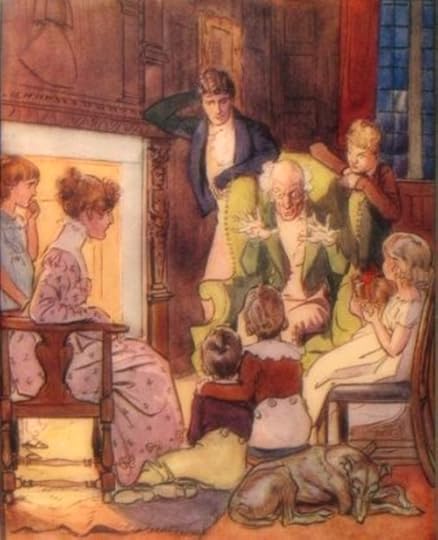 “Ghost Stories Round the Christmas Fire,” by H.M. Brock, The Christmas Tree, by Charles Dickens, (Hodder & Stoughton, c. 1911).
Of the ten works I chose to read for Season One of Tales Told When the Windows Rattle, Hooper’s is the only one specifically set at Christmastime. It works well, then, to shift things away from Halloween and towards the rekindling tradition of sharing fireside ghost stories at a winter gathering. Want to learn why this oral tradition waned in the early 1800s and shifted to literary depictions of it? I discuss that in my introduction to Echoing Ghost Stories: Literary Reflections of Oral Tradition.
In that introduction, I also discuss how some written-for-the-page Victorian ghost stories seem to act almost as scripts to be read aloud. “The Baron’s Room” is one of these — except for one quirky but quick interruption, which I’m pretty sure you’ll catch when you hear it. You can do so here at the Tales Told rec room, where you can also download the audio version for offline listening. If you’d prefer, the video-only version is up at the Tales Told YouTube channel, where I can still pull in more chairs for new subscribers.
Of course, if you’d rather wait till we’re closer to December 25th, I’ll perfectly understand.
— Tim