Tim Prasil's Blog, page 24
July 11, 2021
Railroad Hauntings You Can Still Visit: The Engine House in Old Saybrook, Connecticut
Let’s start in 1870. This is when whatever remained in the grave of Lady Alice Apsley Boteler Fenwick — best remembered as Lady Fenwick — was dug up to clear a path for the incoming railroad. Lady Fenwick had been one of the original English settlers in Connecticut’s coastal town, Saybrook — now Old Saybrook — and had died there in 1645. She had rested on Tomb Hill for 225 years. To be sure, her remains were moved to Cypress Cemetery nearby — but an article at that cemetery’s website points out that some unsettling mysteries arose in the process.
Indeed, not everyone was pleased with having Lady Fenwick’s quiet rest disturbed so that noisy trains could come and go. In 1905, historian George Sheldon referred to the reinterment as an invasion committed by “the heartless railroad.” Was the spirit of Lady Fenwick also displeased? After all, it seems she had a part or two missing by the time she was reburied!
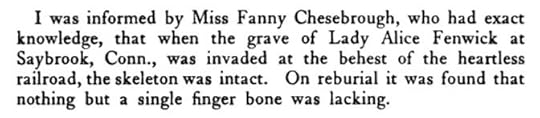 From George Sheldon’s introduction to History of Hadley, Including the Early History of Flatfield, South Hadley, Amherst and Granby, Massachusetts (H.R. Huntting, 1905) p. xxiii.
Well, jump about 30 years later. According to the January 23, 1900, issue of Washington D.C.’s The Evening Times, something strange had happened at the railroad company’s engine house in Old Saybrook, a building that stood “near the Hotel Fenwick.” More significantly, the spot where Lady Fenwick was originally buried is “where the engine house now stands.” The night watchman there, a man named Arthur Beebe, “was engaged polishing metalwork on the engines when the tongues in the bells on the half dozen locomotives began to strike, soon after midnight, gradually increasing in speed until they were all vibrating with the rapidity of electric gongs.” He then heard inexplicable footsteps that sounded like some kind of ghostly clog dance performed on the boiler jackets.
Meanwhile, at the train station up the track a bit, Charles Beecher was experiencing a different kind of weird phenomena. His reading was interrupted “when the big account books were suddenly lifted from the desk and slammed upon the floor.” Now, while earthquakes on the East Coast are rare, they’re not unprecedented. However, according to the Evening Times article, “The station agent stooped to pick up the books when they arose, apparently of their own volition, and deposited themselves upon the desk.” Rule out an earthquake.
Beecher attributed the strange night to Lady Fenwick, who — along with a few spirits in attendance — had a reputation for haunting Old Saybrook. The Topeka State Journal ran a slightly different article featuring the same two witnesses about the same spooky night, and there Beebe is quoted as saying, “They’re the same old ghosts that have always made this place their headquarters.” Apparently, if you work the night shift in Old Saybrook, you simply take ghosts in stride.
The short but intriguing article at the Cypress Cemetery website offers help in locating where once rose Tomb Hill (and, presumably, where once stood the engine house that supplanted it). They say the spot is “overlooking the Connecticut River close to what is now the parking lot for Saybrook Point’s Pashabeshauke Pavilion.” The pavilion was later, but I find it marked as the “Pavilion at Saybrook Point” on most maps. If you’ve visited this place or pay it a visit in the future, please leave a few comments about your experience below.
— Tim
Discover more “Railroad Hauntings You Can Still Visit” at the page forAfter the End of the Line: Railroad Hauntings in Literature and Lore!


June 27, 2021
Is It Too Early for Me to Tell You This?
Is it too early to announce that I’m planning to help resurrect the old-fashioned tradition of sharing chilling tales around a crackling fire? It’s often thought of as a Victorian Yuletide custom, but it can be traced back at least as far as Shakespeare and it was never confined to Christmas. Certainly, a perfect time to listen to a fireside ghost story is Halloween — or, really, any autumn or winter evening. Or any dark and stormy night.
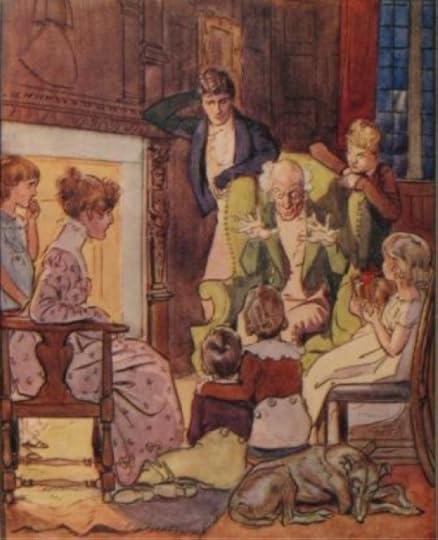
My plan is to launch a YouTube series featuring my own readings of unsettling stories taken from the volumes published here at Brom Bones Books. I’ll sprinkle in some sound effects, too. The project is titled Tales Told When the Windows Rattle, and — if you don’t have your own nasty weather and cozy fire — the video will gladly provide those for you. I’m treating it as a conventional TV series, ten episodes per season. In fact, I’m now halfway through producing Season One.
As I say, it might be too early to announce this, since the first episode won’t debut until October 17. Afterward, I’ll release a new story every Sunday, taking advantage of the Halloween spirit first and then the approach of winter. Once the Christmas season arrives, all ten episodes will be available, and folks can choose which tales they’d like to enjoy (or, hopefully, re-enjoy).
Early, yes, but I wanted to make it a blip on your radar.
— Tim
June 6, 2021
Fact-Checking Vera’s Reference to a Case of Canine-Related Murder
I haven’t mentioned it, but this case continually reminds me of one I read about last year. In California, a woman was taken to jail on suspicion of having murdered a neighboring rancher. The sheriff believed that she let loose her dogs — almost twenty of them, I recall — upon the victim. Of course, she claimed the rancher had attacked her and the devoted dogs came to her rescue.
Vera Van Slyke says this in The Hound of the Seven Mounds. She goes on to explain that the suspect’s story might have been convincing but for the coroner discovering a head wound on the deceased, one inflicted prior to the canine attack. The woman “loved those dogs more than anything, and she feared they would be exterminated as man-killers,” Vera continues. The sheriff assumed that threatening to do exactly that — to execute her beloved dogs — might prompt the suspect to crack and confess. Vera ends the anecdote with these words: “But his plan failed. She remained devoid of emotion.” The great ghost hunter mentions this case for two reasons: it bares similarities to the one she’s investigating, and it provides a chilling example of a woman being capable of much more than some men believe.
As often happens when I edit my great-grandaunt’s chronicles about her ghostly adventures with Vera, I wondered how historically true this reference is. I did some Internet digging. Well, I found that it is yet another instance of real history woven into my ancestor’s narrative. While not all of the pieces of this event fit nicely together, here’s what I found in the newspapers:
On August 8, 1922, the front page of the Santa Cruz Evening News carried this headline: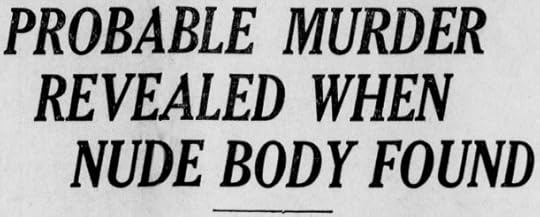
The body belonged to Anton Biese, a California rancher, and it is described as “torn from head to foot,” the result of a canine attack. But the mauling had occurred outside, and the body was found inside Biese’s house. This was explained by Louis Belardi, a neighbor who had reported finding the body. He said he and his wife had moved the body inside in an attempt to save Biese. But the Belardis owned eighteen or twenty dogs (the newspapers disagree on the exact number), and one of them was found to have blood on its fur. The Belardis were arrested as suspects.
The very next day, Mabel Belardi made a confession. She said that Biese had initiated the attack, and the pack retaliated. Meanwhile, the Red Bluff Daily News reported that Biese had previously made it known that he had been supplying the Belardis with food. His threat to stop doing so suggested his gruesome death might have resulted from the couple’s revenge. Indeed, evidence was then found suggesting that Biese had been struck first — the dog attack happening afterward (to disguise the wound?) — and a blood trail revealed the body had been dragged from the Belardi property to Biese’s house. One report even says that, after Coroner John T. Skelton found wounds much deeper than dog teeth would inflict, and the weapon used on Biese might have been something like a nail-studded club or a pitchfork.
On the 10th, the dogs were executed. I wasn’t able to find out what then happened to either of the Belardis, but Mabel became the focus of suspicion.
Now, so far, I’ve been looking at California newspapers. Vera, I knew, was in New York in 1922, so I checked to see if the news traveled that far east. Given the grisly and bizarre nature of the crime, it’s not surprising that I found two New York newspapers carrying the story. The first appeared in the August 11, 1922, issue of the New York Herald, and this seems to be where Vera got her information. Here are the last few paragraphs, the quotation on top coming from Mabel Belardi:
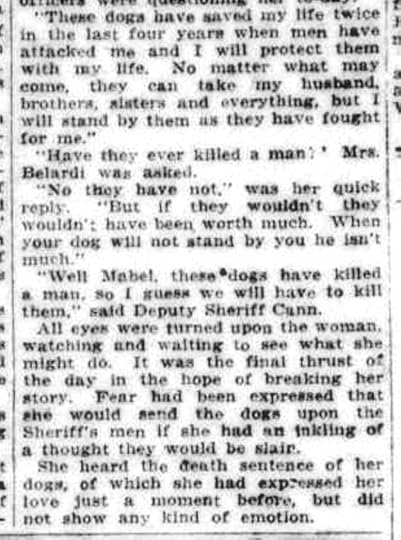
The second article I found in a New York paper wasn’t published until about a month-and-a-half after the story had broken. It appears in the September 28, 1922, issue of the Evening World, and it includes photos of Mabel Belardi with her dogs (along with the houses of Biece and the Belardis). Overall, it feels a bit dramatized, but it helps put some of the pieces together.
Probably the strangest thing about this second article, though, is it compares the mauling/murder in California to Arthur Conan Doyle’s famous Sherlock Holmes novel The Hound of the Baskervilles. As fate would have it, the author was lecturing on Spiritualism in Kansas City in May of 1923, right when Vera was not terribly far away in an area called the Seven Mounds, Oklahoma. The two even met on a train. It’s the kind of crazy coincidence that’s better suited to reality than fiction, and it leaves me wondering how much of my great-grandaunt’s chronicle is true. That’s something I often find myself wondering.
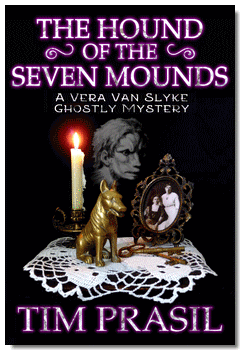
You can find out why Vera saw parallels between the Belardi case and sightings of a not-entirely-human creature shepherding a pack of fierce dogs across Oklahoman pasture lands in The Hound of the Seven Mounds: A Vera Van Slyke Ghostly Mystery.
— Tim
May 30, 2021
A Ghost Hunter’s Poem (Written During a Ghost Hunt)
I stumbled upon something rare and wonderful: a poem written during a 1785 ghost hunt! The allegedly haunted spot was a bed chamber in a house on Mecklenburgh Street, which I’m assuming was in Dublin, given that I learned about all of this from the March, 1785, issue of that city’s Hibernian Magazine. The lady of the house complained of a woman phantom — dressed in black robes, yet bathed in light — that opened the bed curtains and gestured for the living woman to follow. Apparently, the living woman declined. Instead, she asked relatives to share the room with her the following night, and sure enough, they heard groans and “uncommon noises.” The relatives quickly vamoosed, but the living woman spread the word.
Knowledge of the haunted chamber reached a man named Nolan, “so well known for his poetic and political abilities.” He accepted a challenge to spend an entire night alone there. The Hibernian reporter says:
[Nolan] was accordingly shut in, about nine o’clock on the night of the 22nd of March last, but for the sake of defense against any improper practices, he took with him a dog, and a case of loaded pistols, and was not released till six o’clock the next morning; when he was found by his companions, so long fast asleep, that he suffered his fire and candle to expire, without being replenished.
The article adds that the poetic politician had no encounters with a ghost, but he did hear a lot of noises. After threatening to shoot whoever — or whatever — came near him, things quieted down.
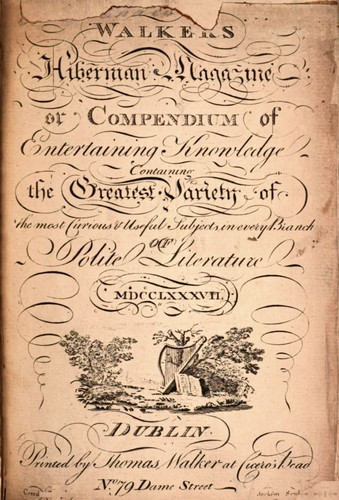
Now, once upon a time, the most valuable part of a ghost hunter’s arsenal was old-fashioned patience. Nolan had his pooch and pistols, which — along with a bottle of something or other — would become standard equipment by the Victorian period. However, to bide his time, he also brought pen and paper. We know this because the Hibernian article reprints the poem he wrote during his sleepy stakeout. I’ve transcribed the work and offer some interpretive comments below it. (NOTE: Attempting to reproduce the original’s line format on this blog page was driving me bonkers, so I centered all the lines.)
Stanzas, written in a Haunted Room
IF from cearments of the silent dead
Our long-departed friends cou’d rise anew,
Why feel a horror, or conceive a dread
To see again those friends which once we knew?
To gaze on Beauty’s melancholy shade?
Or hear the sorrow of the love-lorn maid?
Father of all! You gave not to our ken,
To view beyond the ashes of the grave;
‘Tis not the idle tales of busy men
That can the soul appall. The truly brave,
Seated on Reason’s adamantine throne,
Can place the soul, and fear no ills unknown.
O! if the flinty prison of the grave
Could loose its doors, and let the spirit flee,
Why not return the wise, the just, the brave,
And set, once more, the pride of ages free?
Why not restore a Socrates again?
Or give thee, Titus, as the first of men?
Dear friend of human kind! you cannot come
To mend the manners of a Vandal age;
Lost are the boast of Athens and of Rome,
Nor patriot chief remains, nor hoary sage;
Intomb’d in dark oblivion’s cave they lie,
Strangers to all the fame of round Eternity
In this lone room, where yet I patient wait
To try if injured beauty can appear;
O! cou’d a Burgh escape his prison-gate,
Or cou’d I think Latouche’s form was near,
Why fear to view the shades which long must be
Sacred to FREEDOM and to CHARITY.
A little onward in the path of life,
And all must stretch in death this mortal frame,
A few short struggles end the weary strife,
And blot the frail memorial of our name.
Torn from the promontory’s lofty brow,
In time, the rooted oak itself lies low.
Here’s my stanza-by-stanza interpretation: 1) If the dead returned to us, why be afraid? What if it stirred our appreciation or sympathy instead? 2) God doesn’t let us see what lies beyond, so rather than be scared by silly stories, let’s be cool with what we can’t know. 3) But what if the dead could return? What if really smart folks, like Socrates, or great leaders, like Titus, came back? 4) Nah, can’t happen. We’re stuck in an age that pales in comparison to Classical Greece and Rome. 5) More of the same: if the dead could return, wouldn’t it be great if Burgh or LaTouche could return? These appear to be historical figures — dead before 1785 or they’d make bad ghosts — related to freedom and charity. The first might be James Burgh (1714–1775), who argued for free speech and universal suffrage. The second is possibly Claude Guimond de La Touche (1723-1760), a French playwright-poet educated by Jesuits. Little help for the Americanist here? Added points if you can identify Nolan! 6) We all die. Let it be.
I used to tell my students that, when it comes to literature, the room for interpretation is bigger than a closet but smaller than a gymnasium. In other words, unless you think this poem is all about your Uncle Marty, it’s great if you see something more or different in it. Nolan’s message, I guess, is fairly conventional. At the same time, the work’s uniqueness and charm come mostly from the ghostly context in which it was written.
— Tim
May 23, 2021
New Inductees to the Ghost Hunter Hall of Fame: The Ghostly Guild (If That’s What You Want to Call it)
Not too long ago, I bought Peter Underwood’s tragically short book The Ghost Club: A History. (It’s about 50 pages long, twelve of them used for pictures of members.) This organization, which — despite being disbanded and revived a few times over its many decades — still exists, and I was particularly interested in learning about its very first “incarnation,” as Underwood calls it. Tragically, there’s little information about that first group, which was comprised of students attending the University of Cambridge around 1850.
I can’t complain too much. There’s very little historical data with which to tell the story. We have the text of the groups’ circular, created to gather information about ghostly encounters and the like. We have the text of a letter written by one of the members about its progress. Other than that, it’s mostly short recollections recorded in biographies of the group participants who went on to merit biographies. There’s a spattering of histories about the Cambridge project, too, but these are also short and sketchy. As I suggest, it’s hard to sculpt a statue with half a handful of clay.
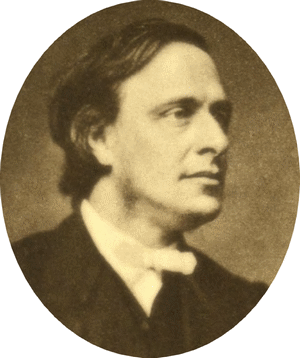 Edward White Benson (1829-1896) was both a member of the Ghostly Guild and, at a considerable time later, the Archbishop of Canterbury
And this is too bad because the students took a fresh, even revolutionary approach to ghosts. Instead of zeroing in on one specific case, their idea was to gather as many accounts about ghostly encounters as they could and draw conclusions from this diverse body of evidence. It’s a methodology the Society for Psychical Research would use about thirty years later.
For their unique efforts, I decided to 1) induct the group into the Ghost Hunter Hall of Fame and 2) put together a page that organizes what I’ve been able to eek out about it. The first thing that struck me was that the organization was known by several names: the Ghostly Guild, the Association for Spiritual Inquiry, the Ghost Society, and the Ghost Club. In addition, some of the members did okay for themselves afterward, including Edward White Benson, a bloke who became the Archbishop of Canterbury.
You can go directly to this page here, or if you’re new to the Ghost Hunter Hall of Fame, feel free to wander down its illustrious corridor here.
— Tim
May 16, 2021
The Hound of the Seven Mounds: A Vera Van Slyke Ghostly Mystery Is Available!
The third novel in the Vera Van Slyke Ghostly Mysteries series is now available! Meanwhile, the first two remain priced at a discount. Each novel stands on its own, but it wouldn’t hurt to read them in the order released: Help for the Haunted, Guilt Is a Ghost, and then The Hound of the Seven Mounds.
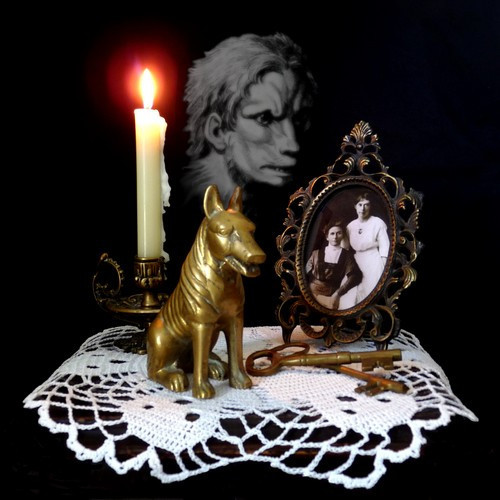 Should anyone ask, tell them that the weird head floating over the brass dog comes from a series of artistic imaginings of human-animal hybrids by Charles Le Brun (1619-1690)
This story is set in 1923, and the latest we’ve seen Vera in the previous books is 1909. She still struggles to remember names. Still likes lunch. Still likes beer (though Prohibition is in effect now). However, she’s gone through some changes, too. Some serious changes. She’s adjusted her priorities. For instance, she’s drifted away from ghost hunting a bit — and that might spell trouble for those counting on her to solve the mystery surrounding a supernatural creature that might not even be a ghost, anyway!
All I’ll say is that, as usual, Vera Van Slyke is valuable to have around when confronted with any kind of otherworldly entity, even one that’s shepherding a pack of very corporeal, fiercely hungry dogs.
To learn more about The Hound of the Seven Mounds: A Vera Van Slyke Ghostly Mystery, visit its page. If you’re already invested in the great ghost-hunter’s adventures, why not go straight to Amazon?
— Tim
May 9, 2021
“The Spectre of the Laird,” by Allen Upward: A Minor (and Somewhat Disappointing) Discovery
Fans of occult detective characters might recognize the distinctive name of Allen Upward. Along with a wide range of writing, in 1905, he penned five tales about haunted-house investigator Jack Hargreaves for Royal Magazine. See The Chronological Bibliography of Early Occult Detectives — Early 1900s for details and links.
This is why I recognized the name when I was searching for a different kind of haunting. Seeking material to include in After the End of the Line: Railroad Hauntings in Literature and Lore, I discovered a ghost story written by Upward. It’s titled “The Spectre of the Laird,” and I can’t find it published or republished elsewhere, so maybe it can be considered “lost.” Unfortunately, while there is a train trip briefly mentioned in it, it’s certainly not a story about a railroad haunting. I won’t be including it in that particular book (scheduled to be available this fall, if not earlier).
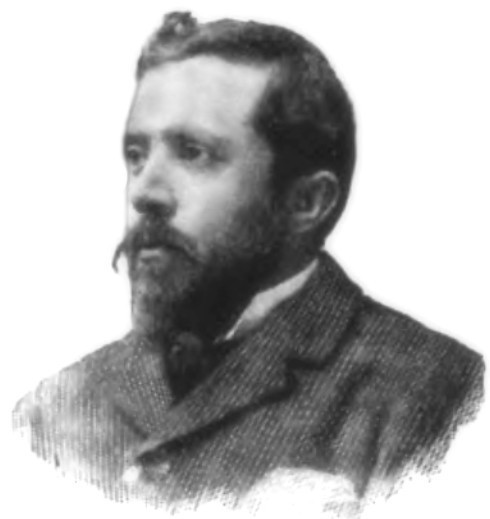 Allen Upward (1863-1926)
Instead, the adventure involves a student named Forbes, who’s a nerd about occult subjects, and a fellow student who comes to him for help regarding a possible family curse. Unfortunately, the case winds up being fairly routine, if not lackluster. Upward’s ending especially disappointed me, and I wonder if the author had to truncate things for publication. You see, Forbes fails to solve the case. As a result, it would be a stretch to call him an occult detective, despite his scholarly interests. On the other hand, the character exhibits a few signs of one day becoming an occult doctor, and that made things a bit more interesting. Well, more interesting for me, at least.
“The Spectre of the Laird” was published in two parts in the Evening Express, a newspaper based in Cardiff, Wales. There’s a good chance it was published in other British newspapers, too — that was a pretty common practice — but, luckily, the National Library of Wales offers it online for free to anyone. The first part was published on April 13, 1910, and the second part on the next day, April 14.
If you’re interested in Edwardian ghost stories or curious about the author, you might take a moment to read this tale by Upward. As I suggest, though, you might also keep your expectations of it downward.
— Tim
April 25, 2021
Cover Release for The Hound of the Seven Mounds: A Vera Van Slyke Ghostly Mystery
I’m pleased to unveil the cover of the next novel in the Vera Van Slyke Ghostly Mystery series: The Hound of the Seven Mounds.
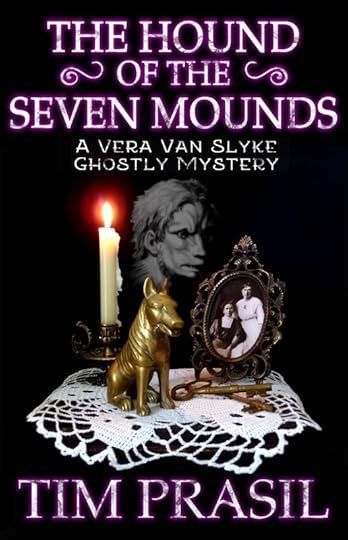
If that title brings to mind Arthur Conan Doyle’s The Hound of the Baskervilles (1901) — or Nathaniel Hawthorne’s The House of the Seven Gables (1851) — then everything is going according to plan. This supernatural mystery spins elements of both those novels, which share some key components. The earlier novels both involve a devious scheme to acquire family wealth. Both feature a portrait of a long-dead ancestor with a curious resemblance to a living descendant. Both spotlight a legend about a supernatural curse. And both include a psychologically afflicted brother. That said, Hawthorne’s and Conan Doyle’s novels are very different from one another, and I certainly worked to make mine as distinctive while playing with those same elements. Best of all, these novels all stand very much on their own — you certainly don’t need to be familiar with one to enjoy the other.
You can get a sense of The Hound of the Seven Mounds by visiting its page here. And if everything continues to go according to plan, this novel will be available in early summer. In the meantime, the two other volumes in the series, Help for the Haunted and Guilt Is a Ghost, are available at a reduced price.
— Tim
April 11, 2021
Railroad Hauntings You Can Still Visit: Sag Bridge in Illinois
This week, I completed a very solid first draft of After the End of the Line: Railroad Hauntings in Literature and Lore. Of course, I’ll make space if I stumble upon any more cool pieces about a railroad haunting, be they fiction or non-fiction. (Both are included in this anthology.) I still have at least a few months of work on this project.
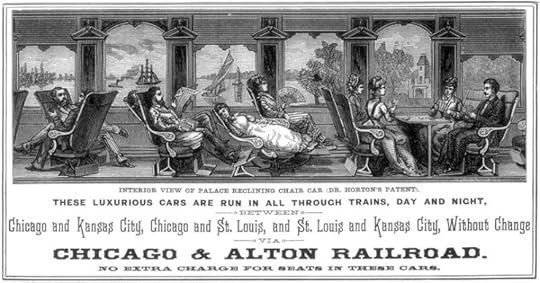
One of the non-fiction works I included collates various reports of ghosts following a terrible head-on collision between two trains near Sag Bridge, which once stood between Willow Springs and Lemont, Illinois. First, let’s look at the tragic accident. Not long after 10:00 on the night of August 16, 1873, a passenger train heading southwest from Chicago to St. Louis left the Willow Springs station. This station is on the outskirts of Chicago, and the train was about 10 or 15 minutes later than usual.
Meanwhile, roughly 10 miles down the line, at the Lemont station, the conductor of a freight train facing northeast made a deadly mistake. According to one railroad official, “The business of the conductor was to wait at Lemont for that passenger train, even if it were ten years, and the wheels rotted off.” But Edward Beane, the conductor of the freight train, disobeyed company rules by starting forward to Willow Springs, even though this stretch of the Chicago & Alton Railroad only had a single track. There’s a curve along the way, too, which explains why neither engineer saw the other train coming. According to the inquest, “The two trains collided near a curve just south of Sag Bridge, in the town of Lemont….” I haven’t found an exact count, but the mistake cost as many as twenty lives. Many more people were injured, many scalded by steam.
Now, the article that I reprint in After the End of the Line was originally published in an 1896 issue of The Conductor and the Brakeman, a magazine for railroad personnel. Over two decades had passed since the collision when this piece was published, and the author gets some minor facts wrong when recounting that tragedy. (I provide corrections in footnotes, since I have the advantage of digitalized newspapers.)
The writer’s main focus is, not that tragic event, but the supernatural ones that followed. These include the repaired engine’s cab lamps and headlight inexplicably shutting off each time it passed the spot of the disaster. And the variety of ghosts seen either hovering near Sag Bridge or riding on night trains passing by it. Probably the eeriest report comes from the brakeman who heard disembodied “chattering of teeth” and “outcries of someone as if in anguish.” He also claims to have seen “faces peering into the windows” of the caboose and something like “a boiling mass of burning sulfur” that sank into the ground — while laughing.
The Sag Bridge from the 1870s no longer exists. However, one website suggests a stalwart investigator could find where it had been by looking for “an isolated remnant of Old Archer Avenue leading to the south bank of its former site . . .”. And if the ghosts from the train disaster were ever real, they seem to have spread out or, perhaps, joined with others in the neighborhood. Pat Camalliere offers a very good overview of this haunted region of Chicagoland, mentioning Resurrection Mary, St. James at Sag Bridge, and Bachelors Grove Cemetery.
These days, the Metra commuter train from Willow Springs to Lemont runs along tracks that are at least close to those of the old Chicago & Alton Railroad. If you’ve ever traveled that route or plan to in the near future — especially after dark — please let me know if anything ghostly looked back at you through the window.
— Tim
April 4, 2021
Railroad Hauntings You Can Still Visit: Hempfield Tunnel in West Virginia
 I doubt I’m alone in thinking that haunted railway tunnels are — all by themselves — pretty creepy. Well, there’s one in West Virginia that was dug under a cemetery! This tunnel then became a place for, not just fatal accidents, but at least one grisly murder! Welcome to Wheeling’s Hempfield Tunnel . . .
Enter at your own risk.
I learned about this tunnel from a long article published in the Wheeling Daily Intelligencer back in 1869. It’s become a key source of information on the haunting, and I’ll reprint it in full in my upcoming anthology titled After the End of the Line: Railroad Hauntings in Literature and Lore. In a nutshell, a small group of tipsy men decided to brave the tunnel. There, they heard echoing “groans and supplications for mercy.” An apparition dropped from the ceiling with a message: “Let the dead rest!” The men ran and managed to get others to return with them to the haunted spot — and the same thing happened!
There’s more. The next day, another man heard about what had happened and then confessed to having had an experience of his own. Presumably more sober, he had been about to enter the tunnel when he too witnessed a specter. Each time, this ghost appeared with a bashed and bloody head. Given that this place was where a man named Joseph Eisele had killed Aloys Ulrich with a hatchet, it’s a fairly good guess that the ghost belongs to that victim. At least, that’s the assumption of the anonymous Intelligencer reporter, who ends by vouching for the credibility of all of the witnesses, but also invites readers to decide for themselves.
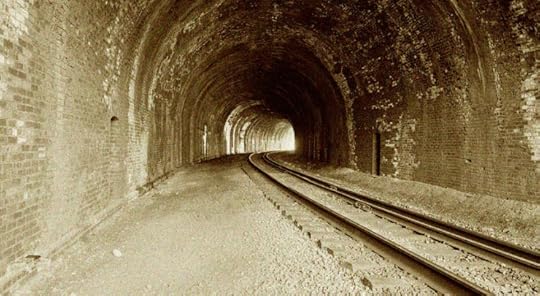 The Hempfiled Railroad Tunnel (before the tracks were removed and the graffiti was added)
I was pleased to find that this tunnel 1) still exists and 2) is easy to visit. In fact, it’s become part of the Wheeling Heritage Trail. Recent articles on websites confirm that, if you find yourself in Wheeling, it might be worth a stroll.
A good place to start is Cassie Bendel’s article “Myth or Legend? The Haunting of Tunnel Green Lives On.” It’s at a site called Weelunk. After quoting from that Intelligencer article, Bendel explains that she was unable to find anyone who has personally encountered anything paranormal in the tunnel. As a result, she walked it herself — with her four-year-old son. All I’ll say is: they made it through. Both ways.
On the Only in Your State website, Robin Jarvis provides some good history in an article titled “You Won’t Want to Explore West Virginia’s Most Haunted Tunnel Alone or at Night.” (Sadly, the rubric used to validate “most haunted” is not discussed.)
Both of these have nice pictures of the tunnel, but there are a few videos on YouTube made by folks who have walked through it. My favorite is this one:
I’ve been to Morgantown, West Virginia, but never to Wheeling. I’m tempted to plan a trip there. Until then, if you’ve been to this tunnel or happen to visit it before I do, please leave a comment below!
— Tim