Tim Prasil's Blog, page 23
October 4, 2021
Railroad Hauntings You Can Still Visit: The Curve Near Republic, Ohio
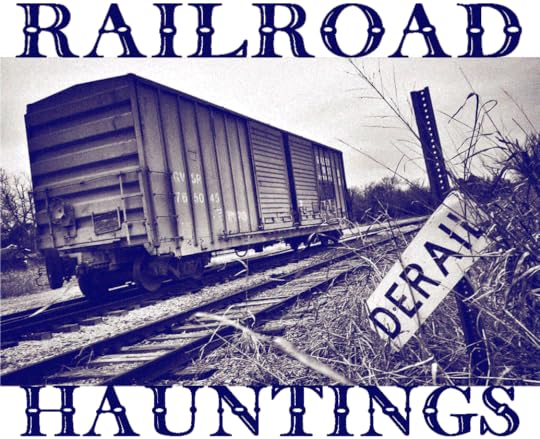
The train tracks curve from northwest to west — or east to southeast — as they brush by the tiny town of Republic, Ohio. You can see it on a map. It was along this curve that a crowded Baltimore and Ohio passenger train, running from New York to Chicago, collided with an eastbound freight train. The tragedy happened on January 4, 1887, several hours before sunrise on that very cold night. The passenger train was late and moving fast — the freight train had stalled. The collision was so great that the engine “telescoped” into the baggage car behind it while the other cars piled on top of one another and caught fire. About nineteen people died, either from the impact itself or from being trapped in the flames.
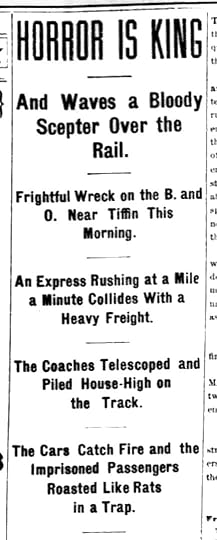 From the front page of the January 4, 1887, issue of Ohio’s Springfield Globe-Republic
Exactly what caused the wreck was uncertain, but the freight train’s crew was the target of blame. They should have been waiting on a siding for the passenger train to pass, and that’s exactly what the conductor, F. Fletcher, had intended to do. His mistake, though, was trying to wait at Republic rather than farther west. One report says that the bitter cold caused the steam train to stall on the curve, and by the time the conductor had gotten out to signal the passenger train, it was too late to do anything. Another report claims the freight engine wouldn’t have stalled at all if its engineer hadn’t been “hilariously intoxicated.”
A Ghostly SignalRegardless of why the freight train stalled, a couple of months later, Ohio newspapers reported on a signal light seen by the engineer running a train on the same route and schedule as the one that had wrecked. It was a red light, meaning danger. The engineer put on the brakes and came to a stop — at about the very stretch where the disaster had occurred — but the light was now gone. The fireman (who oversees the steam) had seen the light, too, and both workers agreed that it had been held by a woman in white. They got out and searched the tracks, but found no woman, no one wearing white — nothing at all to explain what they had seen. They even returned to the station in Republic, but the agent there said that no danger signal had been issued.
And this ghostly light was seen on two other occasions.
A “posse” of ghost hunters from Republic was organized, but I haven’t found anything regarding their findings. The only follow-up I’ve found comes from well over a century later: a phantom train is sometimes witnessed on those tracks. Here’s a personal account from a Republic visitor, and here’s a more general report.
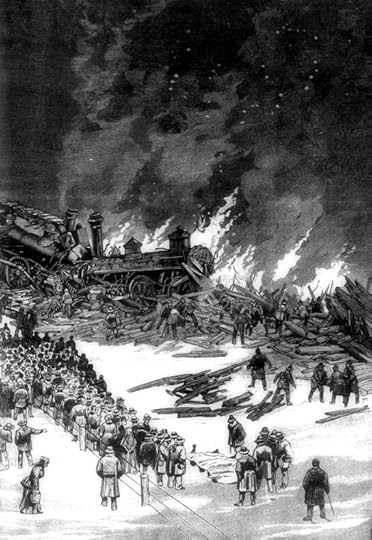 The train disaster depicted in the January 15, 1887, issue of Frank Leslie’s Illustration Newspaper
I found another story associated with the wreck that has nothing ghostly about it, but it’s still fairly unsettling. It appeared in the Springfield Daily Republic a bit more than a week after the disaster. Charles St. John was a travelling sales representative for the Ohio Valley Coffin Company. On the night of the train wreck, he was in “a small country town called Fort Washington, a short distance above Republic.” He had intended to catch that doomed train, but — since it was so cold — he told the clerk where he was lodging that he wouldn’t mind staying in a warm bed instead. And that’s what happened. The clerk never gave him a wake-up call, the train he would have boarded crashed, and St. John wound up assisting in the terrible rescue efforts. The report ends with this line: “Mr. St. John’s firm furnished the coffins in which the bodies were buried.”
I wonder if there’s an historical marker somewhere near the crash site. If so, that might be a good spot to start some ghost hunting. If you don’t see the woman in white carrying a red light, perhaps you’ll witness the phantom train. Who knows? Maybe you’ll be lucky enough to glimpse lucky Charles St. John still trying to make a living! Please let me know whatever you do or don’t see in the comments below. As always, when exploring train tracks, be very, very careful.
— Tim
Discover more “Railroad Hauntings You Can Still Visit” at the page forAfter the End of the Line: Railroad Hauntings in Literature and Lore


September 25, 2021
Take a Peek at the Tales Told when the windows rattle Rec Room
At great expense and effort, I built a rec room here at BromBonesBooks.com exclusively for my Tales Told when the windows rattle series. It’s a bit empty right now, but you’ll see the episode guide — with story summaries and post dates — along with the trailer for Season One.
TTwtwr is my contribution to reviving the centuries-old tradition of sharing chilling stories by a cozy fire during nasty weather. It features my readings of unnerving stories, each one selected from a volume published by Brom Bones Books. (Don’t worry — the sales pitch for the book doesn’t appear until the very end. It’s easily skipped.) If you are unable provide the cozy fire or the bad weather, the video will provide those for you. The series debuts on October 17 and runs for ten episodes. A new story will be posted each Sunday in the rec room and on YouTube.
I confess I don’t fully understand the benefits of subscribing to a YouTube channel, but if that appeals to you, my channel is located here. Of course, that will only give you the video version. In the rec room, you’ll have the video option, another for audio-only, and yet another to download the audio file (a good, ol’ .mp3) for offline listening.
Finally, I’ve been collecting interesting quotations and visual art pertaining to the old, old tradition of fireside storytelling, and you can meander through that gallery via the TTwtwr rec room, too. Look for the link to the Descriptions and Depictions of Fireside Storytelling page.
Remember: Tales Told when the windows rattle debuts on October 17!
— Tim
September 19, 2021
Railroad Hauntings You Can Still Visit: Port Kennedy Station, Pennsylvania
In southeastern Pennsylvania, just inside the eastern edge of the Valley Forge National Historical Park, there stands a small, quaint railroad station. Once upon a time, it served the village of Port Kennedy, but that’s been swallowed up by the Park and by a neighboring town with the interesting name of King of Prussia.
In early 1883, a ghost — or maybe two ghosts — taunted railroad workers on the tracks near this station. An article first published in the Philadelphia Record was reprinted on the front page of the March 7th issue of Pennsylvania’s Somerset Herald. It says that, on a snowy and stormy night, engineer David Lowe spotted something weird on the line near Royersford, roughly ten miles northwest of Port Kennedy. He claimed it wasn’t a ghost — he didn’t believe in ghosts, after all — but it involved a red light and a woman in white. The crew braked to a full stop to see if there had been an accident. However, “the figure, the light and all, disappeared” before they had even left the train.
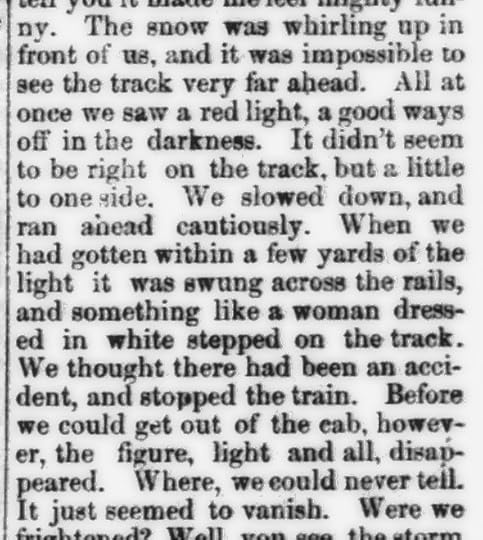
The article then shifts to what is apparently a different ghost. This manifested much closer to the Port Kennedy station, where it was seen by several trainmen and thought to be the spirit of a tramp killed on the tracks. Engineer Charles Welsh and brakeman George Nelson are named as witnesses, the latter having shot point-blank at the figure! The ghost just laughed, though, “and floated away on the wings of the howling wind.”
Another article, this one originating in the Philadelphia Times, was reprinted elsewhere, too. It also quotes Welsh and Nelson, and it drops an intriguing hint about that tramp. The Times reporter says,
Ten years ago, a vagrant was run over just near the spot which is now haunted, under circumstances which implied negligence on the part of the man in charge of the locomotive.
This tragedy sparked ghostly activity. There was then a lull, but paranormal phenomena resumed after some time. This second wave was when the two men quoted had their experiences with the tramp’s spirit — or whatever had arrived by then.
The Station Seems Easy to LocateThat second article puts the ghost sightings at “just below Port Kennedy Station,” and this building apparently still stands. These photos show that it’s now marked as the Valley Forge Park station. It might be an interesting trip, even for the casual ghost hunter. That historical area right there is probably worth visiting. And if you want to counterbalance the supernatural mystery with some natural wonder, there’s an Audubon Center with birding and hiking a bit to the north of Port Kennedy Station.
If you do investigate the station, please let me know what happened. As always, whether there’s a haunted history or not: be very careful when exploring railroad tracks!
— Tim
Discover more “Railroad Hauntings You Can Still Visit” at the page forAfter the End of the Line: Railroad Hauntings in Literature and Lore
September 12, 2021
ALL ABOARD! (It had to be said.) After the End of the Line Has Now Arrived at the Station!
Watch your step while boarding. Have your ticket ready. What else do conductors say? I can’t recall, but I can announce:
After the End of the Line:Railroad Hauntings in Literature and Lore
has arrived early!
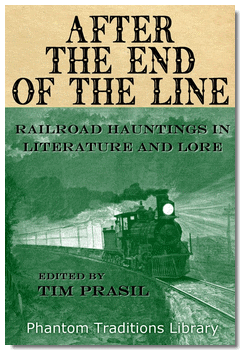
This anthology — mixing fiction, newspaper articles, memoir, narrative poetry, and more — is now available at Amazon.
There are selections written by authors you’re likely to recognize: Charles Dickens, Bret Harte, Amelia B. Edwards, and Algernon Blackwood. However, when searching for material, I came upon a number of long-buried gems. I especially like “At Ravenholme Junction” and “B 88,” both published anonymously.
“At Ravenholme Junction” (1876) was possibly inspired by Dickens’ classic ghost story “The Signal-Man” (1866), since both have a signal station as their main settings. Still, they’re very different tales, almost two sides of the same coin in that the first is about glimpses of future tragedies and the second involves a past tragedy witnessed in the present. Both works are in After the End of the Line.
Similarly, “B 88” (1871) might have been influenced by Edwards’ much more famous “The 4:15 Express” (1866). Again, both head in very unique directions, yet both follow the old, old outline of a ghost appearing to a fairly ordinary, seemingly random witness. That witness then becomes the ghost’s living proxy, nudged to reveal a terrible secret (as well as where the body can be found). These two stories are also in the anthology.

Besides putting such works of “forgotten” fiction alongside the well-remembered greats, what makes After the End of the Line distinctive is its inclusion of railroad hauntings found in other narrative forms: journalism, autobiography, and poetry. There’s even a creepy account of a spectral manifestation in the railway yards that I found in an 1897 compendium of allegedly true ghost stories.
Fans of this kind of ghost story might find After the End of the Line to be a worthy companion to two other anthologies that feature completely different short stories: The Platform Edge: Uncanny Tales of the Railways, edited by Mike Ashley, and Railroad Stories, edited by Trevor Denyer.
I hope you’ll take a moment to consider After the End of the Line: Railroad Hauntings in Literature and Lore. Find yourself a seat, and it will take you places. Dark places. Chilling and unsettling places. Train travel at its very finest!
— Tim
September 5, 2021
Railroad Hauntings You Can Still Visit: The Tracks Near West Trenton Station, New Jersey
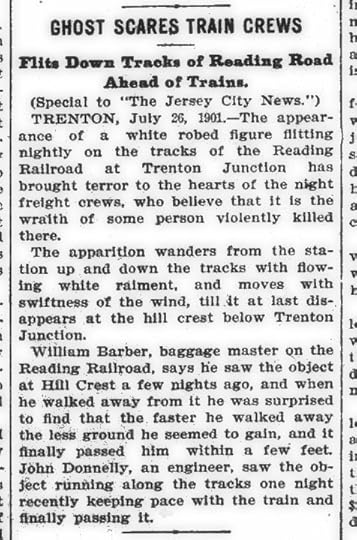
In 1901, railroad crewmen in Trenton, New Jersey, reported seeing a robed and swift-moving apparition at night. It moved along the tracks outside of what is now called West Trenton station, but at the turn of the century, it was known as Trenton Junction.
I haven’t found much on the reported haunting, only this front-page article in the July 26, 1901, issue of The Jersey City News:
That’s all I can share regarding the ghost. I found no follow-up articles. Not even reprints of this article in other papers.
But I do know that, in 1929-1930, a very nice depot was built at Trenton Junction. Here’s a photo of it from an issue of the Reading Railroad Magazine published about when work was completed:
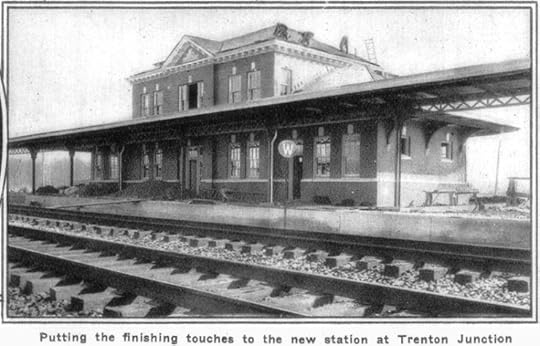
Online photos confirm that it still stands and is now called West Trenton station. Maybe ghost hunters can start here to determine if the robed figure continues to walk or to run along these tracks.
The scarcity of news coverage on Barber’s and Donnelley’s testimony might explain why this ghost seems to have, well, vanished. It is neither among the thirteen haunted spots in the Garden State discussed at NJ.com nor in the top ten offered at the NJ101.5 site. In fact, Trenton is quiet — much too quiet — in both lists.
Maybe that can change. If you explore this area in search of the ghost, do so safely. Train tracks, after all. However, please report your findings here in the comments, too.
— Tim
Discover more “Railroad Hauntings You Can Still Visit” at the page forAfter the End of the Line: Railroad Hauntings in Literature and Lore!
August 22, 2021
The Startling Dr. Veeder: A Tentative Solution to Last Week’s Mystery
Last week, I explored a 1904 report about human bones being uncovered at an upstate New York home. Not just any home, though. About half a century earlier, this home was where the Fox Sisters claimed they had made contact with the spirit of a murdered man, and that claim ignited an international burst of interest in Spiritualism. The 1904 bones at least hinted that a murder might have taken place long ago.
Ralph Shirley, the editor of a British magazine called The Occult Review, requested that Dr. Major Albert Veeder investigate the bones. Veeder, after all, lived in nearby Lyons, New York. Alas, the doctor’s findings suggested a hoax.
In that post, I touch on the mystery of how Shirley, an ocean away, knew about Veeder and knew that the doctor would be interested enough to consider the assignment. I can’t say as I’ve solved the puzzle, but it appears that Shirley had visited the U.S. He returned in 1907, though, which is pretty long after Veeder’s 1905 report on the bones. More importantly, I discovered that Veeder was interested in psychical subjects.
In fact, Dr. Veeder was interested in all kinds of things. He wrote a piece on thunderstorms, and he titled it: Thunderstorms. He also studied the aurora, a.k.a. the northern lights, along with how activity on the Sun affects Earth’s weather. But why did this guy who spent a lot of time peering upward agree to look into formerly buried bones? Well, I also found out Veeder kept an eye on fringe science, too.
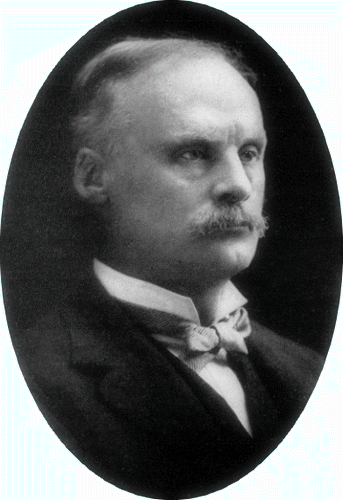 Major Albert Veeder (1848-1915)
In 1905, a letter to the editor of The New-York Tribune appeared, one written by Isaac Kaufman Funk. Some might recognize this name, since the same man was the first part of Funk & Wagnalls dictionary and encyclopedias. He had also authored a 1904 book called The Widow’s Mite and Other Psychic Phenomena, which reveals his support for Spiritualist mediums, spirit photography, and similar phenomena. Funk’s letter to the editor follows the same lines, and Veeder’s name is mentioned in connection to an experiment in long-distance telepathy:
By an arrangement with Dr. M. A. Veeder, of Lyons, N.Y., a medical scientist of wide repute, I in Brooklyn drew the figure of a fish and then pointed to the zenith. Sensitives whom Dr. Veeder had at his office told him at that moment that I drew a fish and pointed to the zenith. No one but myself, four hundred miles distant, could have known either fact by any scientifically recognized method of communication.
And the versatile Veeder also appears to have done some psychical researching of his own, including performing an experiment in, well, let’s call it “thought photography.” According to the front page of the February 1, 1906, issue of The New-York Tribune, the doctor had gathered some friends, visited the local photography studio, and attempted to mentally project an image onto an unexposed photographic plate!
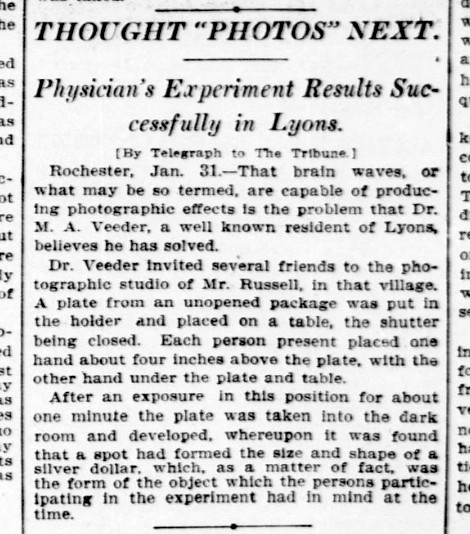
Keep in mind, the photo revealed a spot, not an image, that matched a silver dollar. I’m a bit sorry Veeder hadn’t chosen, say, something star-shaped. Or a scissors. A bottle, a banana, a bagel even. Another newspaper report says the object the group were focusing on was “a ball thrown down on the floor,” and this conflicting information was repeated in journals and books: The Annals of Psychical Science reported it was a silver dollar while, in Spiritism, Edward Barrett Warman says it was a ball of surgeon’s gauze.
My research led me to believe that Veeder had a more lasting impact on meteorology than on telepathy. I found no evidence of his ever conducting a ghost hunt, though, which I confess was my original hope. Still, he was an interesting man. If you’re ever at Vale Cemetery in Schenectady, why not pay your respects?
— Tim
August 15, 2021
What Dr. Veeder Said about Those Bones Under the Fox Sisters’ House
I made good progress this week on a project — THE DETAILS OF WHICH THE WORLD IS NOT YET PREPARED! Along the way, I was prompted to take a closer look at a report that human bones were unearthed at the crumbling home once belonging to the Fox Sisters in upstate New York. The bones were found in 1904, but back in 1848, the family had claimed to be in contact with the spirit of a murdered man. It was a big claim. Very big. It made headlines and sparked the international Spiritualism movement.
The 1848 BonesLet’s begin with the original claim. In a statement dated April 11, 1848, Margaret Fox — the mother of the soon to be famous Fox Sisters — explains how, after hearing curious knocking in their house, the daughters began to ask the “knocker” to respond to their prompts. It did! The spirit could hear them, but it could only telegraph replies by rapping. Nonetheless, the Foxes began to discover who was sharing their house:
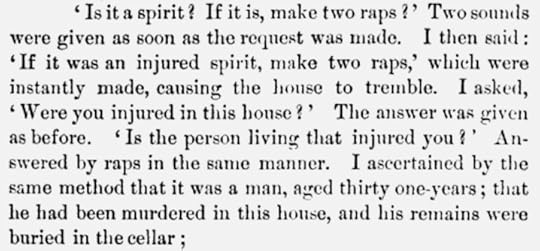 From Ann Leah Underhill’s The Missing Link in Modern Spiritualism (Thomas R. Knox, 1885) p. 7.
Subsequent interrogation, conducted with the help of neighbors, revealed the spirit “was murdered by having his throat cut with a butcher knife.” The mother says that digging in the cellar, presumably to find the bones, was attempted, but “they dug until they came to water, and then gave it up.” Ann Leah Underhill, the married name of the oldest Fox sister, then says the digging resumed during dry season. Eventually, the work party reached some charcoal and lime — then found “some hair of a reddish or sandy hue, and some teeth….” The next day, a number of “bones where found which doctors pronounced human bones…. One, I remember, was said to be from the ankle, two from the hands, and some from the skull, etc.” Please note that, in this account, at least parts of the skull (including those teeth) were found.
The 1904 BonesOver the decades, the story had changed, as stories do. By 1904, the murder victim was remembered as having been fully beheaded. Again, skeletal remains were reportedly unearthed in the house’s cellar and, in fact, the discovery included most of the “important bones of the body except the skull.”
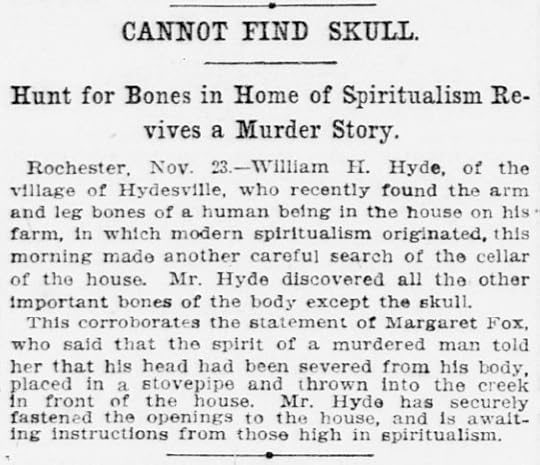 From the New York Tribune, Nov. 24, 1904, p. 10.
One curious thing about this is that it probably wasn’t considered very important news. I really had to struggle to find the handful of articles I did, checking the digital archives at both Chronicling America and the NYS Historic Newspapers. Even those few articles were placed well after the front page. One article published (on page 5) in the Monroe County Mail suggests folks were taking a “maybe so, maybe not” attitude in response to the news. It ends by saying:
The question as to whose spirit once rattled around in these bones will probably never be answered satisfactorily to all. The peddler may have been murdered and buried there as claimed, or the bones may have been disinterred from some cemetery and placed there for effect.
Moving from newspapers to magazines, I found a couple of articles about a follow-up investigation conducted by a physician named M.A. Veeder. He lived in the area of the Fox home, and Ralph Shirley, the editor of The Occult Review, asked the doctor to evaluate the bones. Accepting the assignment, Veeder concluded that, to borrow from the Monroe County Mail, the bones had been “placed there for effect.” And a shoddy job it was!
Veeder’s short report was published in The Occult Review:
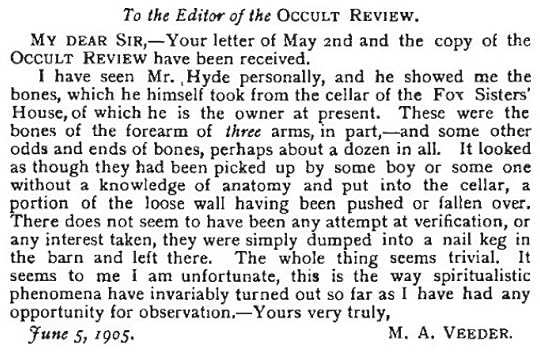 From The Occult Review 2.7 (July, 1905) p. 52.
One might wonder why having the advantage of three arms hadn’t helped defend against the murderer. Sorry. I do find it interesting, though, that Veeder describes himself as “unfortunate” for never finding anything to support “spiritualistic phenomena.” Unless he’s being gently snarky, it seems like he really did want to find such evidence, and perhaps his earlier efforts were how Shirley had become acquainted with the doctor in the first place.
The Controversy ContinuesOf course, not everyone would have subscribed to The Occult Review, which was a British publication. However, in 1909, Veeder’s findings were again mentioned in The Journal of American Society for Psychical Research with the added information that the doctor had since heard a confession from the prankster. Some defenders of Spiritualism had either missed or dismissed these two articles, continuing to suggest the bones confirmed the Fox Sisters’ 1848 claim. They did this by reprinting an article from the Boston Journal printed on November 23, 1904, when the news was still very fresh and unconfirmed. Franklin A. Thomas does it in Philosophy and Phenomena of Spiritualism (1922), and the same goes for Arthur Conan Doyle in Chapter 4 of The History of Spiritualism (1926).
Presumably, this has something to do with why some websites today treat the 1904 bones as validation of the Fox Sisters’ claim while others treat them as a hoax.
— Tim
August 8, 2021
A New Page (But Not a New Inductee) at the Ghost Hunter Hall of Fame
I finally got around to devoting a full page to Athenodorus, an ancient Roman ghost hunter who is the earliest (by far) inductee in the Ghost Hunters Hall of Fame. A quartet of inductees there are better thought of as ghost hunters of legend rather than of verifiable history: Athenodorus, Antoinette du Ligier de la Garde Deshoulières, John Rudall, and Richard Dodge. All four existed in reality, but the stories told of their ghostly pursuits are folklore, tales that are sometimes believed to be true but that blend fact and fiction. It’s a bit like George Washington and that unfortunate cherry tree. George was real, and in his younger years, he actually had been a boy. Cherry trees and hatchets are also real. The rest of the story? Well, let’s call it legend.
The great thing about Athenodorus’s adventure is how, on one level, it seems surprisingly “modern.” There’s a house haunted by a creepy ghost who rattles chains. The people living there flee. The house gets a bad reputation and can’t be sold or rented, even at a bargain. Athenodorus hears about this and performs some nocturnal surveillance. Boom! He solves the mystery of the house and ends the haunting. This is why I put his story into Ghostly Clients & Demonic Culprits: The Roots of Occult Detective Fiction.
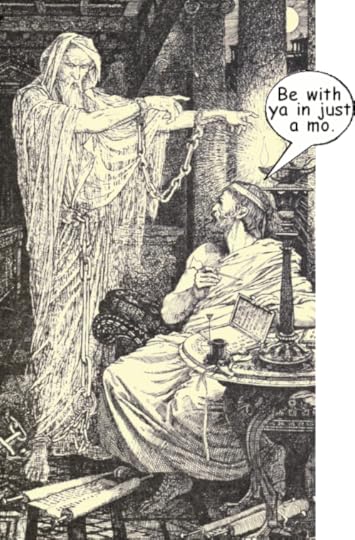 H.J. Ford’s illustration — somewhat embellished — for Mrs. [Leonora Blanche] Lang’s The Strange Story Book (1900).On another level, though, Athenodorus is unique in his approach to ghost hunting. He deliberately kept the ghost a low-priority on that night. Instead of checking for cold spots or bringing a trustworthy dog or checking to see if the candles would burn blue, he focused on his writing. In fact, when the foreboding specter trudged into the room, manacled and fettered, Athenodorus bid the spectral gent to stay put a moment. This rattled the ghost’s chain, so it rattled its chains louder. The ghost had waited long enough for someone who wouldn’t simply run away, someone like Athenodorus. This is why I titled the page “Athenodorus and the Ghost Who Waited.”
I hope you enjoy it.
— Tim
August 1, 2021
How D’ya Like Your Endnotes Cooked?
I’m working on a non-fiction book, the details of which THE WORLD IS NOT YET PREPARED! Fine — I’m not yet prepared to share those details. I am willing to divulge, though, that it’s a pretty research-intensive project, and I’ll be using endnotes (not footnotes) to document that research.
Looking at similar books, I see endnotes handled in three ways. Now, I’m a reader who likes to know where information is coming from, and the first method I’ll discuss makes discovering that fairly frustrating. Here, a writer gives no indication of an endnote in the main text, not even a raised (a.k.a. superscript) numeral. Instead, the reader flips to a section in the back of the book and looks for a page number with a one-, two-, or three-word link to the spot on that page. For example, on page 59 of the main text, one reads:
Poe wrote, “I have great faith in fools:–self-confidence my friends will call it.”
“Well,” I might say, “Poe is frequently misquoted, and he’s sure not famous for having written jokes in the style of stand-up comedy. Show me where he that got published!” I then look through that back section, hoping to find something like:
59 “I have great faith”: Southern Literary Messenger, 15.6 (June, 1849), p. 837.
Sometimes, the note even refers to the Bibliography, so finding the original source takes effort! But I suppose this is the least intrusive way to document one’s sources, allowing readers to get caught up in the main text without the “blips” caused by those raised numerals. Personally, I’m not at all annoyed by those numerals. In fact, they comfort me with an assurance that the writer/researcher has done some homework. “Hey, writer!” says I. “I don’t know you! I don’t trust you! Earn my trust! Over and over! Intrude a tiny bit!” Maybe that’s just me, though.
The next method involves the raised numerals, but also puts all the endnotes into one big section at the end — not the end of the chapter, mind you — but at the end of the book. This is the method I see used in most of my books, and I’m pretty okay with it. However, the numbering typically starts over with each chapter, and that makes things a touch more difficult. “Okay, you tell me that Poe once wrote a thing. I want to know where you got that. What chapter am I in? Okay, I find that chapter at the end. What was the endnote’s number again? Oh yeah. Okay. Yeah, there it is. The Southern Literary Messenger. Okay. I’m good.”
I wonder, though, if it doesn’t make sense to put endnotes with raised numerals after each chapter. Wouldn’t that make it easier still for a reader to check a source? This method is used in one or two of the books on my shelves, but I wonder if it’s rare because it’s become old-fashioned or even outdated. And, if so, have I become old-fashioned or even outdated, too?
Of course, having footnotes at the bottom of each page makes checking sources a real breeze, but then maybe the intrusiveness/distraction factor really is a concern. Footnotes, in my head, are great for clarifying what one is reading as one is reading it. Speaking of Poe, in “The Facts in M. Valdemar’s Case,” the narrator offhandedly compares Valdemar’s physicality to John Randolph. He doesn’t bother clarifying who John Randolph is or what he looked like because so many of his mid-19th-century readers knew that already. Very few readers in the 21st century do, however. That’s where I come in with some research. “Glance down at the footnote, dear reader, and learn that Randolph was a congressperson who was tall, especially in his legs. Sorry for the interruption, but you now better grasp how Poe is painting his title character. Back to the story.”
For documenting sources, though — for showing the writer is reliable and has done solid research — I don’t think one needs to be so “immediate.” One can shove that information at the end of the chapter . . . or the end of the book. But how far back should I shove it?
That’s a decision I’ll have to make before this book is complete. Any feedback to help me decide would be much appreciated. How do you like your endnotes?
— Tim
July 25, 2021
Read the Introductions to the Phantom Traditions Library Books. They’re Free (and Hopefully Make Me Look a Bit Smart)!
I put a fair amount of research into the introductions and footnotes found in each volume of the Phantom Traditions Library. Granted, I’m one of those curious types who gobble up learning about popular literature and the history surrounding it. And I like to share what I’ve discovered, too.
With this in mind, I made those introductions available in pdf format on the pages for the following books:
Entranced by Eyes of Evil: Tales of Mesmerism & Mystery
Echoing Ghost Stories: Literary Reflections of Oral Tradition
Ghostly Clients & Demonic Culprits: The Roots of Occult Detective Fiction
Imagining Life on the Moon During the Rise of the Telescope
Give me a few days, and I’ll do the same with my two non-fiction anthologies of historical ghostlore: Spectral Edition and The Victorian Ghost Hunter’s Casebook.
In other news, work on After the End of the Line: Railroad Hauntings in Literature and Lore is coming along nicely! This will be the fifth volume in the Phantom Traditions Library, and it should be available by early October. It’ll be perfect for setting a Halloween mood.
— Tim