Tim Prasil's Blog, page 2
September 3, 2025
Haunted Ancestral Homes 12: The Nun and the Lady of Watton; Or, The Two Spectres
This article comes from the April 12, 1892, issue of the Brechin Herald.


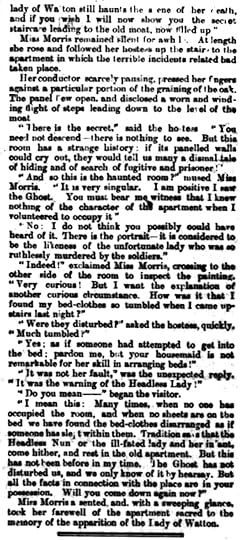
Watton Abbey (a.k.a. Watton Priory) still stands, but it is a private residence. Sites interested in the structure’s haunted history — such as Mysterious Britain & Ireland and Walking the Wolds— follow the Watton Abbey chapter in John Ingram’s The Haunted Homes and Family Traditions of Great Britain (1884). Ingram, in turn, gets his information from a newspaper series on Yorkshire lore.
13: The Mysteries of Hinton ManorIf you’re intrigued by Victorian ghostlore, consider purchasing The Victorian Ghost Hunter’s Casebook. It features fourteen firsthand chronicles of actual ghost hunts.Click on the cover to learn more.


August 27, 2025
Haunted Ancestral Homes 11: The Itchell Ghost
This article comes from the March 29, 1892, issue of the Brechin Herald. Note: Frith uses racially insensitive language and negative ethnic stereotyping while introducing his narrative.


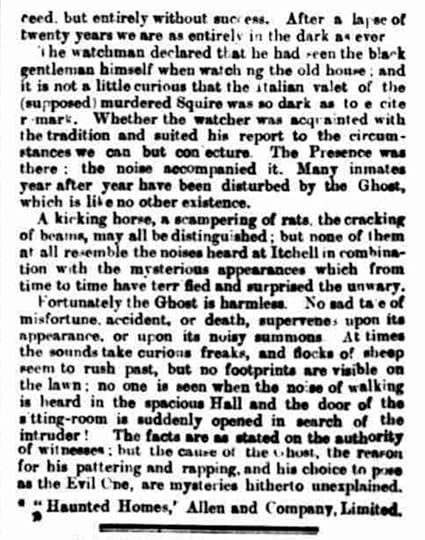
Frith refers to the “Ewshott House” chapter in John H. Ingram’s Haunted Houses and Family Traditions of Great Britain. Now known as Eshott Hall, the structure still stands and serves as a luxury hotel. Accommodations are available elsewhere on the grounds, too.
12: The Nun and the Lady of WattonIf you’re intrigued by Victorian ghostlore, consider purchasing The Victorian Ghost Hunter’s Casebook. It features fourteen firsthand chronicles of actual ghost hunts.Click on the cover to learn more.
August 21, 2025
Railroad Hauntings You Can Still Visit: A Spectral Figure in Kirkstall, West Yorkshire
This railroad haunting presents a couple of hurdles. First, the station platform from which the ghost was observed no longer exists: the Pennine Horizons Digital Archive reports that Kirkstall Station in West Yorkshire, England, “closed in 1965.” That online archive provides a nice photo of the place, though, and there’s another one here. Nonetheless, comparing this 1851 map to what we see today, we find that Kirkstall Station stood between the River Aire and what’s now called Wyther Lane, just below the B6157 bridge. The station might be gone, but we know where it was.
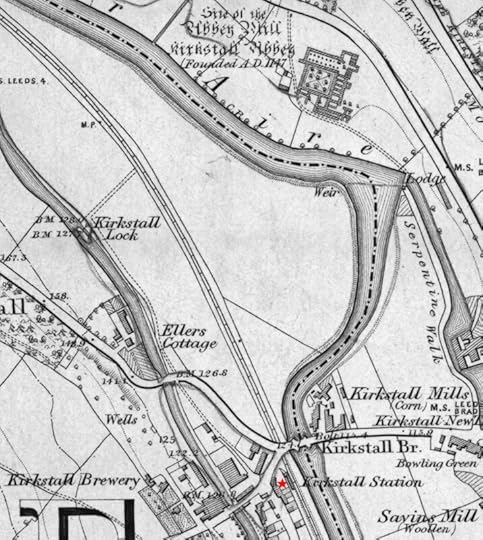 I added a red star to show Kirkstall Station on this detail from the lower right corner of the 1851 map. The Kirkstall Brewery buildings remain, but they now serve as housing. To the north are the ruins of Kirkstall Abbey, which has a few ghosts of its own.
The second hurdle is the haunting was quickly debunked. As I argue below, though, it might have been debunked far too quickly!
An Early ReportAs reported in the June 4, 1904, issue of The Stockton & Thornaby Herald,* a railway porter was on the station platform at midnight, when he spotted “a spectral figure clad, as it were, in a long grey sheet, down which streamed a long streak of red.” It was seen “gesticulating from the roof of one of wooden sheds which lie behind the station buildings.” When the porter tried to show the ghost to the signalman, neither one were able to see it. But then a passenger, a booking clerk, and that same porter observed it again in the same place some time later. Let’s keep this in mind: three witnesses and two separate appearances.
The article goes on to say that, after this double sighting,
strange lights were seen flickering around the station and the neighbourhood of the goods shed, and then the troubled spirit was again discovered haunting the purlieus of the goods shed. This time a party was formed, each member taking a different direction, and the chase once more began, but the search was fruitless.Let’s also keep in mind the strange lights, the third sighting, and the concerted yet unsuccessful effort to find a cause for it all. You see, a theory offered to explain the sighting — flimsy in and of itself — fails to account for these elements of the case.
A Flimsy DebunkingThe piece in The Herald ends with a short bit about how all three witnesses had been fooled. It says the alleged ghost was really “a mill girl, who, rising early, went out wrapped in a blanket, and mounted the shed in the goods yard in order to see the time by the station clock.” Well. Perhaps. Odd for 1904, when timepieces were fairly common, isn’t it? And why did the mill employee climb up on the shed repeatedly? And why was she “gesticulating”? Was she attacked by a swarm of moths?
In the days to follow, a somewhat more detailed version of this debunking appeared in newspapers, including the June 9, 1904, issue of The Ripon Observer:

But this all seems pretty thin unless that early article in the Herald completely misinformed readers about 1) the first two sightings being spaced some time apart, 2) the strange lights, 3) the third sighting a few nights later, and 4) the team of investigators failing to catch the mill employee, if indeed she had returned to the shed yet again.
It doesn’t add up. I’m usually pretty wary of these old railroad ghost reports. Here’s a case, though, that prompts me to squint and raise an eyebrow at the “prosaic ending” more than the initial report.
If Not the Station Grounds, Visit the Abbey!That said, I suspect I would exert minimal energy spook snooping at the grounds where the station and its shed once stood. It’s certainly worth a stop, but paranormal investigators might be far more eager to nose around the nearby ruins of Kirkstall Abbey.
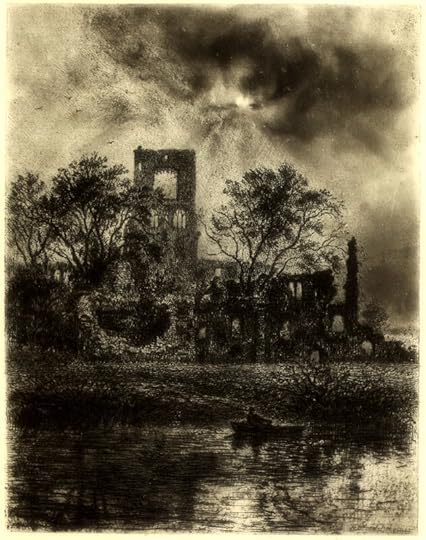 A wonderful sketch of the ruins of Kirkstall Abbey, from William Lefroy’s
The Ruined Abbeys of Yorkshire
(1883)
A wonderful sketch of the ruins of Kirkstall Abbey, from William Lefroy’s
The Ruined Abbeys of Yorkshire
(1883)After all, this location is well known for its ghosts. According to the Spooky Isles website, there’s a 12th-century monk said to linger and loiter among the ruins. There’s also a wife who turned her murdering husband over to law officials, and her feelings of betrayal were strong enough that she’s haunted and haunting still. I guess it’s not surprising that both the Herald and the Observer articles open by implying the ghost seen by the porter and others must have strolled down from the abbey, across the bridge, and to the railway station.
If you do happen to visit either of these places, please tell us about your experience in the comments below. Those tracks, by the way, are still active, so avoid them and take extreme caution in their vicinity.
*I link only free-to-see articles at the British Newspaper Archive, but sign-up/sign-in is required.
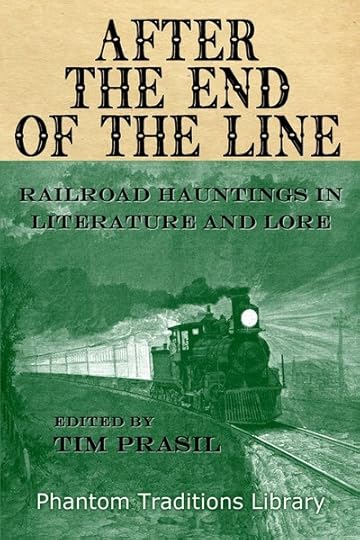
Discover more “Railroad Hauntings You Can Still Visit” at the page forAfter the End of the Line: Railroad Hauntings in Literature and Lore.
August 20, 2025
Haunted Ancestral Homes 10: The “Silky” Spectre of Denton House
This article comes from the March 22, 1892, issue of the Brechin Herald.

This paragraph is tough to read. It says: “Aye, Pride and Poverty, I said. It was bad enough when the rush was on the floor, the tapestry on the wall, the table groaning under venison and boar, and the home-brew and red wine in horn and goblet. ‘Twas not all hollowness then, though what seemed, was; the land was the laird’s. It’s all hollow yonder, all false, false, false. All white sepulchres, young lady. Whited sepulchres! I tell you, you tread on ashes. Beware! Trust not them — they are Dead Sea fruits, your merchant’s apeing aristocracy. Fair though it seems, it is but the result of disease, like the pearl in your hair yonder in the mirror — –“


Frith refers to the chapter on Denton Hall in John H. Ingram’s The Haunted Homes and Family Traditions of Great Britain: Second Series. The structure still stands, and accommodations are available at the Hall itself as well as elsewhere on the grounds.
11: The Itchell GhostIf you’re intrigued by Victorian ghostlore, consider purchasing The Victorian Ghost Hunter’s Casebook. It features fourteen firsthand chronicles of actual ghost hunts.Click on the cover to learn more.
August 13, 2025
Haunted Ancestral Homes 9: The “White Lady” of Ashley Hall
This article comes from the March 22, 1892, issue of the Brechin Herald.


Cheshire’s Ashley Hall still stands, but I haven’t found any evidence that it’s open to the public. I’d be happy to be corrected on this. Mysterious Britain & Ireland offers a nicely researched discussion of the haunting.
10: The “Silky” Spectre of Denton HouseIf you’re intrigued by Victorian ghostlore, consider purchasing The Victorian Ghost Hunter’s Casebook. It features fourteen firsthand chronicles of actual ghost hunts.Click on the cover to learn more.
August 6, 2025
Haunted Ancestral Homes 8: The Buried Treasure of Birchen Bower: Or, The Headless Seeker
This article comes from the March 15, 1892, issue of the Brechin Herald.


Unfortunately, Birchen Bower was demolished long ago. The Mysterious Britain & Ireland site, however, provides a useful map of where it once stood. The post also suggests the apparition lingered, having been witnessed on the factory grounds that replaced the house.
9: The “White Lady” of Ashley HallIf you’re intrigued by Victorian ghostlore, consider purchasing The Victorian Ghost Hunter’s Casebook. It features fourteen firsthand chronicles of actual ghost hunts.Click on the cover to learn more.
July 30, 2025
Haunted Ancestral Homes 7: The Grinning Skull of Burton Agnes
This article comes from the March 8, 1892, issue of the Brechin Herald.


Burton Agnes Hall still stands and is visitor friendly. They offer a Halloween event, and it looks like they’re not shy about discussing the ghost. In fact, they claim the skull remains somewhere within the dwelling’s walls. (I discuss another persnickety skull and the railroad haunting linked to it in this post.)
8: The Buried Treasure of Birchen BowerIf you’re intrigued by Victorian ghostlore, consider purchasing The Victorian Ghost Hunter’s Casebook. It features fourteen firsthand chronicles of actual ghost hunts.Click on the cover to learn more.
July 23, 2025
Haunted Ancestral Homes 6: The Spectre of Berry-Pomeroy Castle
This article comes from the March 1, 1892, issue of the Brechin Herald.


Berry Pomeroy Castle still stands and is very visitor-friendly. Emma Heard, who runs the Weird Wiltshire site, offers a wonderful post about the congregation of ghosts at Berry Pomeroy Castle with lots of intriguing pictures, some of them taken by ghost hunters.
7: The Grinning Skull of Burton AgnesIf you’re intrigued by Victorian ghostlore, consider purchasing The Victorian Ghost Hunter’s Casebook. It features fourteen firsthand chronicles of actual ghost hunts.Click on the cover to learn more.
July 16, 2025
Haunted Ancestral Homes 5: The Ghostly Visitation of Calverly Hall
This article comes from the February 23, 1892, issue of the Brechin Herald.


 6: The Spectre of Berry-Pomeroy Castle
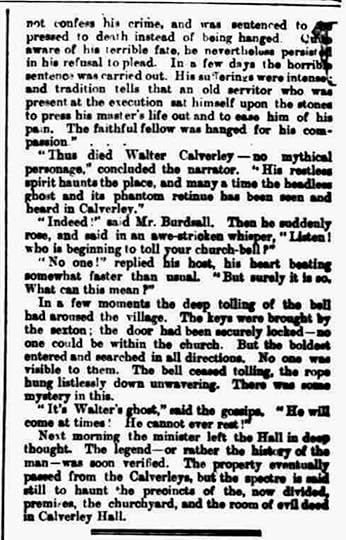
Calverley Hall still stands, though it’s now called Calverley Old Hall. There’s a nice history and YouTube tour provided here. And here is a cool post on St. Wilifrid’s Parish Church, the cemetery wherein Walter Calverey does not rest.
If you’re intrigued by Victorian ghostlore, consider purchasing The Victorian Ghost Hunter’s Casebook. It features fourteen firsthand chronicles of actual ghost hunts.Click on the cover to learn more.
July 14, 2025
Railroad Hauntings You Can Still Visit: A Headless Ghost in Burns, Tennessee
 The Bad News
An article titled “A Ghost by Daylight” was printed in the November 29, 1893, issue of Arkansas’ Pine Bluff Daily Graphic. I’ve found the piece published elsewhere, too, and there’s a transcription of it from a Tennessee paper here. It’s an intriguing report about a ghost — headless and seen in daylight! — manifesting on the Nashville, Chattanooga, and St. Louis line, a bit east of Burns, Tennessee. Unfortunately, there’s only one witness named. While that witness, Mr. Terrell, tells us that others confirmed what he had seen, we’re forced to trust him on that.
Furthermore, I haven’t been able to find much at all to explain why a headless ghost would manifest at that particular rural spot. Terrell ends his statement by offering three possibilities:
McNairy cut has been been haunted for years. It was here that, during the late war, the noted bushwhacker, [Alexander D.] McNairy, committed many bloody deeds. Two trains collided here and the engineer, named Johnson, was caught between the engines and his body scalded and cut from his lower limbs, and lifted from the roasting fire, only in time to see him die, by Dr. Anderson. It was here, also, that an unknown negro was murdered a short while ago.I’ve found information on McNairy’s sabotaging the railroad and killing at least one man — but nothing on his having beheaded anyone. I also haven’t located anything to confirm the engineer’s loss of lower limbs or an unknown man being murdered there.
The Good NewsThat said, Terrell’s report is tantalizing — if disturbing — in his description of the apparition:
A thrill of horror crept over me as I beheld it move aimless about — a man without a head. The bleeding neck appeared as if it had been severed with a sword, while the arteries and veins constantly blubbered and spurted bloodstained foam.Yeesch! I’ve read a lot of these newspaper ghost reports from the 1800s, but I can’t remember one being quite this grisly!
In addition, Terrell’s account is very specific on the location of his encounter: “a sag just beyond the noted McNairy cut, about a mile east of Burns Station….” (Though the map linked here says “McNair Cut,” this 1916 article suggests that “McNairy Cut” is more accurate or what the place had been called previously. It also suggests the “sag” has been filled and the tracks modified a bit.) TN-47 runs parallel to the tracks, and this might facilitate paranormal investigators wishing to safely explore the stretch of tracks alleged to have been haunted.
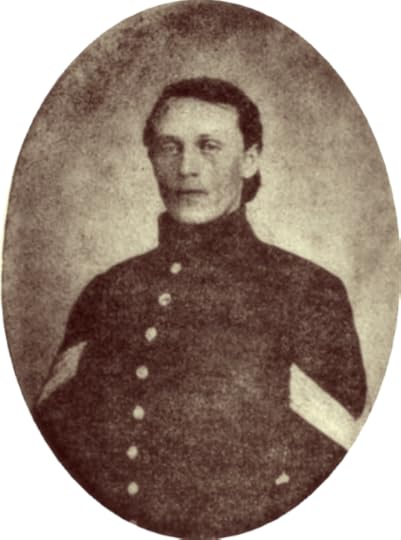 Captain Alexander Duval McNairy, from Bromfield Lewis Ridley’s
Battles and Sketches of the Army of Tennessee
(1906)Even Better News
Captain Alexander Duval McNairy, from Bromfield Lewis Ridley’s
Battles and Sketches of the Army of Tennessee
(1906)Even Better NewsThe tracks near McNairy’s Cut might be only one stop on a ghost hunting expedition to Burns. The place is something of a paranormal/cryptozoology hot spot! Just to the northeast is Montgomery Bell State Park, where some say a werewolf or two prowl. (Maybe at a later time, I’ll look into the circus-train accident from which the creatures are said to have escaped.) Travel further east along US-70, and listen for the White Bluffs Screamer. Is it a banshee? A exasperated Bigfoot? A fox during mating season? Well, it deserves a hearing.
If you’re looking for something less ghostly and more iron horsey, take TN-47 about five miles northwest from Burns to Dickson. There, you’ll find the Clement Railroad Hotel Museum along with its Train Room and Dickson Model Railroad Display. Before you head up there, however, take note that even the name of the town itself reflects a railroad heritage: Burns, Tennessee, was named for Michael Burns, President of the Nashville and Northwestern Railroad.
Whether you visit for the headless ghost, the escaped werewolves, the spooky screamer, or the railroad history, please let us know about your experiences in the comments below.
Discover more “Railroad Hauntings You Can Still Visit” at the page forAfter the End of the Line: Railroad Hauntings in Literature and Lore.