Janine Robinson's Blog, page 18
June 15, 2014
TMI in College Application Essays?

For more than five years now, I’ve encouraged students to write their college application essays using a narrative style. Sharing true-life stories to reveal your personality, character, interests, dreams and goals is the best way to tell about yourself in a personal essay.
Until recently, many “college experts” directed students to write more formal, academic essays. But now many also are championing slice-of-life essays—which is great!
Like many pendulum shifts, however, this one is now in danger of swinging too far and potentially knocking some of the more bold essay writers out of the running. How? Students share their gritty, real-life stories, but don’t know how to handle them, especially those that explore highly personal or emotionally charged terrain. The temptation is to go for the shock value to “grab the reader.” This can backfire, however, if the details come across as gimmicky or off-putting.
I was tipped off about this so-called “trend” by a recent editorial in The New York Times, which the writer called “Naked Confessions of the College-Bound: Oversharing in Admissions Essays.”
“…an impulse in many essay writers to tug readers into the most intimate corners of their lives and to use unfiltered frankness as a way to grab attention. In some of the essays that students begin to draft and some of the essays that they actually wind up submitting, there are accounts of eating disorders, sexual abuse, self-mutilation, domestic violence, alcoholism, drug addiction,” wrote editorial writer Frank Bruni.
This should not stop you from finding and telling your own stories in your college essays. I still think the larger risk is writing an essay that is predictable and dull. But in this ridiculously competitive atmosphere, you must remember that more of a good thing isn’t always the best. What I’m talking about is TMI–too much information. You don’t need to traumatize, appall or nauseate your reader to standout. A gentle twist or surprise (the unexpected works great!) is much more effective.

If you don’t have good radar on when you have “overshared,” it’s best to have someone else review your essay. Ask a reader directly: Is it too much? Where exactly do you think I crossed the line? Are there parts that turned you off?
Here’s my advice: When you are writing about a topic that is sensational, it’s best to understate (tone down/generalize) your descriptions. For example, if someone had their arm chopped off by a chain saw, you don’t need to describe all the gross details. Just say “their arm was chopped off.” We get it!
Keep in mind the point of your essay: To help colleges decide that they want you to attend their school. So if you come across as tasteless, awkward or insensitive–or unlikeable on any level–see if you can re-work your point to tone down the unsavory parts. Chances are, if it’s strong material, it will still pack a punch. The last thing you want to do is come across as some sort of freak. If you have faced weird, melodramatic or unbecoming issues, that’s fine, and feel free to write about them–just focus more on how you handled them and what you learned. Easy on the details.
I know this can be confusing. In general, I encourage students to share the parts of their lives that have been defining, and most of the times, those times have not been pretty (death, divorce, injury, etc…). The challenge is to learn how to share them so the reader can get clear sense of what you faced, but at the same time not be distracted or turned off by the sensational details.
My other advice when tackling tricky topics is to first go ahead and get out your stories, including all the details, gory and awkward and ugly, but then go back and tone it down. Only leave enough so the readers get a sense of what you are talking about, and quickly move onto the most important part: How those experience affected you, changed you and helped make you who you are today.
In the New York Times editorial piece, the writer quotes “prominent admissions counselors” who spend hours and days helping students find the perfect balance in their essays. (One counselor described in this article charged $14,000 for a 4-day essay writing camp. Per student! How did this editorial writer casually include that as though that was at all normal? $14,000??? That’s obscene!)
I know most students don’t have the luxury of professional guidance, and frankly, I don’t believe most need it to anything near that level. (This blog has plenty of free writing advice to help you craft a terrific essay!) Part of writing is learning to trust your own instincts, and also find others who you can use as a sounding board if you think you have gone too far: English teachers, high school counselors, parents, friends, etc. Of course, some might want to take all the good stuff out of your essay, so you have to watch for that as well.
Bottom line: If what you are describing is gross, crude or off-putting, that’s a red flag. A little goes a long way for the reader to “get it.” When in doubt, take it out.


June 10, 2014
Score Sample College Application Essays for CHEAP CHEAP!
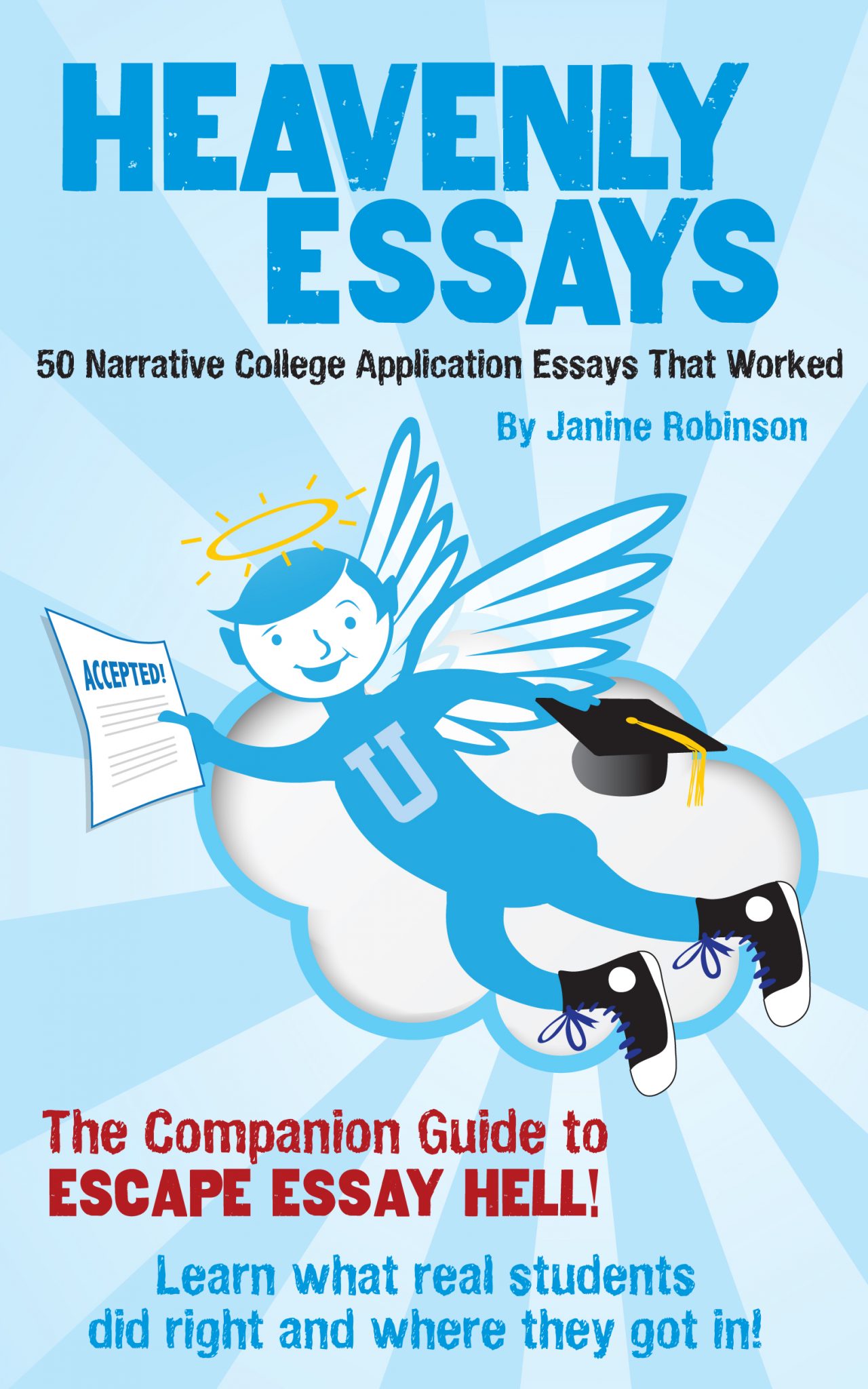
To help kick off the college admissions “Season,” I’m offering my new collection of inspiring college application essays–Heavenly Essays–for under a buck. Yup, you can download an ebook copy from this blog, and start reading right now, for just 99 cents.
Just enter the Discount Code: 99EssayCollection before you hit “Buy Now.” This is a limited time offer!
Now there’s no excuse not to check out examples of other students’ essays to help inspire you to get cranking on your own! I believe reading sample essays is one of the best ways to get ideas for your own topics. These essays are all examples of the narrative (storytelling) style, which I believe work the best for college app essays.
I’m also sharing one of the essays below, so you can get a sense of what they are like. Notice how simple and mundane Jack’s topic is, and see how he started with an anecdote to grab the reader. (Here’s another good one from Heavenly Essays, about tying knots, that I shared a couple weeks ago.)
Jack Wyett
Laguna Beach, CA
University of Southern California, Los Angeles, CA
Sisters
It was the middle of the day, and I was relaxing on the big couch in the family room, happily watching the last few minutes of a potential buzzer beater game. First, my oldest sister walked in, followed by the other two with their friends.
“Get out,” my youngest sister demanded, standing in front of the screen.
I knew right then that all the begging I could do wouldn’t get her to budge, or the entire group to leave me alone. But I always gave it a try.
“I’m not leaving,” I said, sinking deeper into the couch. After that, they launched into their threats and other attempts to push me out of their girl world.
Ever since I can remember, my three older sisters did whatever they could to make me get lost. When they were all crammed in the bathroom playing with make-up in front of the big mirror, they would slam the door in my face. Or when they had friends sleep over, they would banish me from their bedrooms. It wasn’t that I wanted to join them in their activities, but I was bored and lonely.
The only time they wanted me around was when they needed me to do their dirty work. Like when there was a spider to be caught, who did they call? Me. When there was trash to be picked up, who did they call? Me. When something went wrong, who did they blame? Me.
I was the runt of the family and the lowest rank in the hierarchy. My three sisters, now in their early 20s, were about 5 to 7 years older than me. And up until junior high, they all towered over me. They were never really mean, but loved to tease me constantly. To them, I was “the baby” or “little guy.”
But then things changed. By eighth grade, I started sprouting up, growing about a foot in just a couple years. Until 8th grade when all of a sudden everyone started looking at me differently. I had grown taller than everyone and now I was in control. I noticed that along with my new height, my maturity increased and the level of respect that I received from my sisters did as well. The teasing stopped. And we even started to have normal conversations about school and friends. Even my parents started treating me more like a young man than the baby of the family.
Even though I can’t say I enjoyed some of those moments, I can say on some level that I understood that treatment since I was just at the bottom of the pecking order. And I also don’t feel like I need to get back at them, even though I now have the clear advantage physically. If nothing else, I am more sensitive to people who are at a disadvantage in the world, whether it’s because of social status or other circumstances. I know what it’s like to be the underdog.
Even though my role in a family dominated by girls changed over the years, I was not completely off the hook. Having to complete the tasks that the younger brother would do never really ended. I still take out the trash, and stomp on spiders. But now when it comes to the last minutes of a Laker’s game, I’m not moving.
ANALYSIS : Boy did Jack have a hard time settling on a topic. I know Lynn Fair of Square One counseling spent time brainstorming, and they kept hitting walls. Both of us kept urging him to explore his family because he had the three older sisters. But he was pretty resistant at first.
But once he started describing out loud some of the details of his daily life as the youngest of a family of girls, I believe he began to hear his own story, and voice. This was a perfect topic for the fifth Common App prompt that asks to share a transition into the adult world.
He started with a simple recreation of a typical argument with his sisters. There’s nothing impressive or shocking with this topic or anecdote; just a vivid description of normal, bickering siblings: Something many of us can relate with easily. That’s what makes it work—the reader connects with the writer’s “problem.”
And I love his confessions: “I was at the bottom of the pecking order.” And, “I know what it’s like to be the underdog.” And his sense of humor: “I was the runt of the family.” By using self-deprecating descriptions of his childhood role, Jack can then show that he is now mature enough to look back and understand what was going on, accept it for what it was, and enjoy his new role without resentment. This reveals a mature, well-adjusted kid with a nice sense of humor. What else could you want?
If you want to learn how to write a narrative-style, college application essay like this, just keep reading through this blog (Help By Topic) and/or check out my snazzy guide, Escape Essay Hell.
June 9, 2014
Top 5 College App Essay Writing Fears Debunked

Over the years, I’ve heard almost every imaginable complaint and concern about writing college application essays. Like most common fears, they are almost all in your head.
That doesn’t mean they don’t feel real. But if you can realize that a lot of your success will depend on not psyching yourself out, and staying calm and focused, you can then get to work.
Find a great topic. Map out a writing plan. Pound out a rough draft. Before you know it, you will have a knock-out essay!
If it helps, here are the top five essay fears, phobias and concerns I’ve encountered in the seven years I’ve been working with students. And you know what, they were all proven wrong!

1. I will never think of anything interesting enough to write about that will make my essay stand out and help me get into my dream school.
Truth: You will think of something interesting to write about. But you need to spend some time brainstorming. I can’t tell you how many students have told me these exact words, and every one of them wrote great essays. I doubt you will be the first exception. Start brainstorming.
2. There’s nothing impressive about me. I’m just a basic kid who works hard in school and does the same type of activities as everyone else.
Truth: First, you are impressive just because you are a basic kid who works hard in school and participates in activities. Second, you don’t need to impress anyone with these essays. Third, the best essays don’t involve “impressive” topics at all. In fact, everyday topics often work the best. Learn about Mundane Topics.
[image error]
3. I’m no good at writing.
Truth: There are few students (and even not that many adults) who are good at writing. Writing is not a gift. It is a learned skill. And the reality is that most high school students have had little instruction in writing, especially the type of narrative (storytelling style) essays that work best for college admissions. So chances are you have as good a chance as almost all other students at writing a terrific essay. (Some of my students who didn’t do well in English and Language Arts classes ended up writing some of the best essays!)
4. I don’t know how to start.
Truth: Yes, you do know how to start. Let me help you. First, read some sample essays and see what other students have written about. This will give you an idea of possible topics, and how to write in a narrative style. There, you have officially started. (Note: my new ebook collection of real student college app essays, Heavenly Essays, is available for 99 cents for a limited time, if you want more examples of inspiring narrative essays. See right sidebar.)
5. I mean, I don’t know how to start the actual writing part of my essay.
Truth: That is one of the hardest parts–for ALMOST EVERYBODY on the planet who ever needs to write anything–but not impossible. Writing takes work, and it’s natural to avoid it as long as possible. This is where you break down the process into doable steps, and don’t focus on the entire undertaking. Just take them one at a time.
First you need to pick a great topic. I direct my students to find a defining quality and then look for real-life examples (anecdotes) that they can use to illustrate that quality. If this approach appeals to you, try my Jumpstart Guide to get started. Once you find a topic you are excited about, it won’t be that hard to pick a time to sit down and pound out a rough draft. Just give yourself a half hour to work on it at a time. A couple sessions and you will be on your way, and possibly done! That’s how you start!
And before you know it, you will be FINISHED with your college application essay!!
June 3, 2014
Aim High With Your College Application Essay!

Meet Jessica Peyton Roberts, who is a talented and enthusiastic private college admissions consultant from Tacoma, Washington. Roberts, of Aim High Writing College Consulting, recently wrote a comprehensive guide for students and parents called Navigating the College Application Process .
In her ebook, she has a chapter on writing the college application essay, and graciously allowed me to share part of her sage advice.
I talk a lot in this blog and my guide books about how to find and share your personal stories, usually in the form of an anecdote, to bring your narrative-style essays to life and reveal part of who you are. Although Roberts has her own unique approach to writing these essays, she shares my love of real-life stories to illustrate your personality and character. In this part of her book, Roberts, an alum of both Notre Dame and Harvard, revealed how she found and leveraged her own story.
Here’s an excerpt from the chapter titled “Writing the Competitive Application Essay”:
STEP 2: WHAT STORY DO YOU WANT TO USE TO ILLUSTRATE WHO YOU ARE?
Step 1 is about figuring out what you want to come out about you to the reader through your essay.
In my college essay, I wanted to show the admissions committee that I was prepared to succeed at their school because of my personal traits of resilience in the face of the unknown, adaptability to new situations, and comfort with diverse sets of people and environments.
Step 2 is picking the story or anecdote that illustrates the development of these personal traits, interests, and qualities over time.
I chose to discuss how my family moved several times prior to me applying for college, including to places out of the United States. I learned a little French while I was living in Canada, and a lot more Spanish when I did half of high school in Costa Rica. I also wove in my Native American heritage and standing as a member of the Cherokee nation.
This narrative about moving allowed me to talk about how I learned to be comfortable in new and sometimes difficult situations, picked up language skills along the way, and had a proven record of succeeding academically even while adapting to new learning environments.
Get it? Your story is really meant to be a prism through which the applications committee can view various aspects of your background and personality as preparing you to be a good fit at their school.
WANT TO READ MORE? You can order Navigating the College Application Process: A Complete Guide for Students and Parents on Robert’s Aim High Writing Web site.

“The single most important component of any application is the (college application) essay. Your ability to effectively communicate your qualifications, personality, and aspirations is what stands to set you apart from your competitors.” Jessica Peyton Roberts
May 27, 2014
English Teachers: Lesson Plan Ideas for the College Application Essay
[image error]
When my two kids were finishing their junior years of high school, they each received the assignment from their English teacher to write a college application essay. It sure sounded good—they could get a jump on these dreaded essays and receive professional direction on how to find great topics and write them in an engaging, memorable style.
It didn’t quite work out that way.
From what I could tell, this task of teaching how to write college admissions essays was dumped on these teachers, and they had to cram in a last-minute writing section at the very end of the year (and compete with the AP test crunch time, other end-of-year deadlines/pressures and spring fever.).
Also, as far as I could tell, no one really taught the teachers how to write college admissions essays and students had had very little practice writing in a narrative style.
I’m sure this assignment was better than nothing. And that there are English teachers out there who do know about writing, and provide great advice and direction for their students. But for those teachers who feel overwhelmed and under-prepared, I offer these ideas that could easily be incorporated into lesson plans or a unit on how to write a college application essay:

1. DAY ONE: Discuss what makes a great college application essay. The best way to help students understand what makes a great essay, and see for themselves how these essays use a different style of writing (narrative/slice-of-life), is to share some samples. Find some good ones, even a couple bad ones, and have the class read them together and talk about what they liked, and what they didn’t like. Students should be encouraged to trust what they find entertaining, moving and interesting, and try to copy the literary techniques other students used in their essays. Try to find sample essays that show the variety of topics that can work, especially those that are mundane (everyday).
2. DAY TWO: Help students brainstorm their own topic ideas. I have written a condensed, step-by-step guide on this process, but also have several posts on how students can find their defining qualities, and then search for their own real-life stories that illustrate a core quality. It would be very easy to convert the steps I take students through into your own instruction–just step them through this process in class. (I also have a short guide book, Escape Essay Hell, that maps these out in 10 steps.)
3. DAY THREE: After each student has collected a short list of defining qualities, have them brainstorm “times” they used or developed one of these qualities in real life. Tell them that they are looking for mini-stories, called “anecdotes,” that they can share in their essays. One huge key to a great anecdote is if it involves a problem (this is your chance to talk about the power of “conflict” in a story.) My Crash Course in How to Write an Anecdote.
Try to find examples of anecdotes, either in sample college admissions essays or at the start of magazines or feature stories in the newspaper. (All the sample essays in Heavenly Essays use anecdotes, and the last chapter of Escape Essay Hell showcases examples of anecdotes.) You could even assign students to find one on their own and bring it to class. My posts on anecdotes not only explain what they are, but have details on how to craft them. Teach this process to your students–and you will have given them one of the most powerful writing techniques around.
4. DAY FOUR: Have the students write up one of their real-life moments or incidents into an anecdote (require that it involves a “problem.”) Talk about how this anecdote shows the reader about their defining quality as opposed to just telling them about it. Discuss why this is so powerful to grab the reader at the start of the essay. After they write their anecdote, have them go back and try to condense it even further. This is part of the skill of writing these, and they do take practice. (Check out this short visual guide to crafting a story.)
5. DAY FIVE: Now that the students have described in a story-telling style something that happened to them, and it involved some type of problem, have them start to think about, and jot down notes in list form, these questions:
a. How did that problem make them feel?
b. How did they handle that problem? What steps they took. Where they drew inspiration to face it. (Have them be aware of how their core quality is involved in this process, or the role it plays. And write down their thoughts.)
c. What did they learn in the process of dealing with it? About themselves. About others. About the world in general.
d. Did this experience change them, or how they think about things/life, in any way? Tell them to get reflective and analytical at this point.
These notes will help them continue writing their essay, and use their anecdote to explore how they deal with life, which will reveal what kind of person they area, how they think, what they care about, etc.
6. DAY SIX: Help students map out a simple writing plan. Explain how narrative essays are written in a more casual style, and not the 5-paragraph format. Then have them start writing out a rough draft: Have them start with the anecdote to SHOW the problem and then background the incident (a couple paragraphs); and then go on to TELL about what it meant (explain, reflect, analyze, etc.–drawing off notes from Day Five) in a couple more paragraphs.
(Depending on how much time you have to spend on these essays, I have many posts on specific parts of the process–from finding topics to how to write the conclusion to adding titles. Just browse the Index on the right side of this blog to find them.)
Homework: Have the students complete their rough drafts at home. If they just stick to this order in general, they should end up with an interesting piece of writing that is compelling and reveals their core quality.
Now it’s up to you how you want to help them critique and revise their essays. These pieces may be highly personal for some students, but for others, they might benefit from some type of peer review, whether in pairs, small groups or with the entire class.
It’s always great to read these out loud, and have them listen and note the “golden lines,” or parts they like, and pay attention to times the essay gets dull (time to cut it!). Encourage the students to write as long as they want, but then have them cut their essay to a word count (650 words is limit for the Common App.) There’s no better self-editing exercise then shortening a writing piece.
I believe this assignment can be a wonderful writing assignment, and I bet the students will even enjoy it. It’s amazing how much we all like to think and write about ourselves! Teachers should take advantage of that. You will be amazed at some of the stories the students come up with, which will range from entertaining, moving, sad (even tragic) and funny. I wouldn’t discourage any topic, as long as the student makes sure to use the story to show something about herself or himself.
This is just one way to teach narrative writing, and how to write a college application essay. If you have other techniques or ideas, that’s great (and I would love to learn more about them!). But maybe this will give you a place to start.
May 26, 2014
A Sample College Application Essay from Heavenly Essays
I thought you might like to read one of the 50 sample college application essays featured in my new book, Heavenly Essays. This is the first one in the book. Like most of the essays in this collection, it was written by a former tutoring student of mine. I will share a few others in the next couple weeks.
Like I say in the book, I believe reading examples of essays written by other students is one of the best ways to learn how to write your own. Not only can these essays give you ideas for your own topics, but you can get a feel for the style that works best—narrative (storytelling) writing.
You also can get a sampling of my mini critiques after each student essay. My goal with each “analysis” was to help readers use these samples to recognize creative writing techniques that make narrative essays compelling and effective, and try them out in their own pieces.
Here is Brock’s essay:
Brock Csira
Laguna Beach, CA
University of California, Berkeley, CA
Hang Ups
Dangling about 30 feet above the ground, I looked down on the entire neighborhood park with its rolling hills, vibrant green grass, and multiple tall eucalyptus trees. Buckled tightly in my brand new Diamond Mountain climbing harness, I admired my handiwork.
My old blue-and-black braided climbing rope thrown over a branch held me aloft, while a slipknot I tied while hoisting myself up prevented my descent. After a few minutes, I decided to return to the ground, but realized my knot grew too tight for me to untie. I was stuck.
Ever since my dad taught me the Bowline in second grade, the intricacy of knots has fascinated me. I spent hours mastering the craft, reading every knot book and website I could get my hands on. All my knots usually came in handy. In 8th grade, I won a competition in the Boy Scouts with a square knot, beating the instructor who taught an alternative knot that took longer to tie. A couple years later, I rescued my brother’s pickup out of the mud with the unbreakable loop of the Bow Line during one of our off-road adventures. I even returned a stranded rock climber’s lifeline by tying a Sheep’s Bend between a small piece of paracord and his climbing rope.
Ironically, on the day I got stuck in the tree, I spent all morning trying to finally conquer the biggest and baddest knot of them all: the Monkey’s Fist. After at least 50 failed attempts at the step-by-step process, my trusty blue rope finally bore the complex, dense sphere of rope. With a heavy Monkey’s Fist on the end of my rope, I could throw an end over any branch.
After hoisting myself into the treetops that day I dangled for several hours due to that hastily tied Slip Knot. When my dad finally returned from work and saw me, he lugged over an extension ladder, and laughed as he untied me from the tangle he inspired years earlier.
When I reflected on this adventure, I realized another irony in the situation: It took a complex knot like the Monkey’s First to elevate me into the tree, but a simple Slip Knot stopped me from getting back down. Comparing these knots, I learned that the effort and persistence I invest in a challenge like tying a knot translates into a certain lasting power.
A Slip Knot is extremely easy to tie, but disappears with a quick pull on the rope. However, a Monkey’s Fist takes hours to learn and minutes to tie, but is impossible to untie. In so many other parts of my life I have experienced this similar relationship: that the more I try, the more useful and permanent the reward.
I expect that my knot-tying adventures, and the related lessons, even the most embarrassing ones, will help me through any future hang ups I encounter from here on out.
ANALYSIS : When Brock was brainstorming for topic ideas, he knew he had a strong interest in engineering. So we started by thinking of qualities, talents and interests he had that would make him an effective engineer.
One of the qualities was that he was a problem solver. And one of his hobbies was knot tying, which is a form of problem solving. Aha! The next step was to find an example of Brock applying his problem-solving skills in real life.
A great way to find compelling real-life, mini-stories—also called anecdotes—is to think of “a time” you faced a problem. Problems can come in many forms: challenges, obstacles, crises, phobias, idiosyncrasies, life changes, etc. When Brock mentioned the time he got stuck in a tree because of his knot-tying ability, we both knew instantly he had hit upon a hot topic.
When you read this essay, notice how naturally this self-deprecating anecdote and knot metaphor showcase Brock’s insightful thinking and engineering prowess—as well as his natural humility.
You don’t always need to title your essays, but when you land on a witty one like Brock’s “Hang Ups,” it only makes it that much better.
May 20, 2014
Why I Do This: The Essay Hell Manifesto
I thought it might be helpful to type up an explanation of why I write my blog, the source of my intentions, and what I think about the dreaded college application essay. You might find it boring, but I wanted to get it out and all in one place. It will be one of the tabs on my blog, under Manifesto. Here’s what I have so far:

The Essay Hell Manifesto
I believe college application essays can be fundamentally unfair. Most students have not been taught how to write personal statements, or other types of narrative-style essays. Some can afford outside help; most cannot.
At the same time, these essays have become one of the most important pieces of the college application process in deciding who gets into which schools, especially the most competitive ones.
When I started my Essay Hell blog in 2008, my goal was to share advice, tips and inspiration with students who didn’t have other writing support in an attempt to even the playing field. In the last year or so, I also wrote three guide books filled with the same type of information.
I believe writing is something that can be taught and learned. It mainly takes desire, determination and lots of practice–and sound guidance.
I know most students dread these essays. And I don’t blame them, especially given the pressure that is placed on the entire college admissions process. But I also believe that these essays are a terrific writing exercise, and can be used to hone excellent communication and personal expression skills.
They also are a national rite of passage for students finishing their high school years, and provide a unique opportunity for them to pause and reflect on themselves and who they have become–and where they want to go.
Why I Am Passionate About Narrative Writing
My background is journalism, and I wrote for top daily newspapers during the late ’80s and ‘early 90s, a time when there was a major shift in how news was presented. It was called The New Journalism. Starting in the ’70s, writers (such as Tom Wolfe, Truman Capote, Joan Didion, Hunter S. Thompson, Norman Mailer, etc.) had started reporting the news and current events using literary writing techniques. When they wrote about real-life incidents and told them as though they were fiction (like stories), readers loved them.
What good is important information if no one wants to read about it? Stories solved that problem. New Journalism newspaper reporters, magazine writers, personal essayists, biographers, narrative non-fiction authors, memoirists and other writers all employ narrative writing techniques, such as anecdotes (mini-real life stories about moments in time), dialogue, scene setting, different “voices” and characters, descriptive language, sensory details, etc., to engage, inform and educate their readers.
I realized that students writing their college application essays could do the same by using these creative writing techniques. It seemed obvious: When asked to write about themselves (personal statement prompts), students could share their real-life stories to reveal who they were, how they thought and learned, and what they cared about. Narrative writing worked perfectly–especially to engage bleary eyed college admissions folks.
After I started working with students on these essays, I was shocked to learn that many essay “experts”–from English teachers to college admissions counselors to “helpful” parents–had other ideas, and promoted essays that were formal, pedantic and meant to impress. And ever since, I’ve been on a crusade to spread the word that narrative style, “slice-of-life” essays work the best for personal statement essays.
I still believe college application essays are fundamentally unfair. But as long as students are required to write them, I believe they should use them as a chance to develop a powerful writing skill set–and learn to tell their stories. Oh yea, and land in their top-choice colleges!
Janine Robinson
May 14, 2014
Want Two of my Guide Books for Free?
I’m very excited to announce that my new collection of sample college application essays–Heavenly Essays–is now available in paperback on Amazon. You also can buy ebook copies there and on this site as well.
To celebrate–and help spread the word–I’m offering Heavenly Essays: 50 Narrative College Application Essays That Worked, along with my snappy essay writing guide, Escape Essay Hell, for free in exchange for a review.
Here’s the deal if you are interested:
Send me an email letting me know that you would like to review one of these two guides. I will send you the ebook for the one you want to review, and once you leave a review, I will send you a link to the other ebook guide. Simple Simon!
What does it mean to review a book? Basically, you read the ebook and then give it a review on its Amazon page. If you have an Amazon account, it’s really easy. I will send you the links to its Amazon page. Then, you just click the “Write a Customer Review” button, give it a star rating (1-5) and write a couple sentences about what you thought of the book.
You can even leave reviews with pen names (the option is in the upper righthand corner of the Customer Review page). Or you can use your existing Amazon name.
The more reviews, the better prominence the book will have on Amazon, especially when customers search for certain topics. The good news for you is that you will end up with two free copies of my ebook guides. And I like to think that they will help you immensely on writing standout college application essays.
Here’s what you need to send me:
1. Send email to essayhell@gmail.com.
2. Put “Free Guide Book” in the Subject line.
3. Let me know which book you want to review: either Heavenly Essays or Escape Essay Hell.
4. Include your name. (Let me know your pen name if you don’t plan to use your real name–so I can recognize your customer review.)
I will send you a link to the book you will review, and instructions on how to leave a review. Once I see you have left a customer review, I will send you the second book (whichever one you didn’t already receive).
I’m planning on running this offer through the end of this month, May, or the first 100 books–whichever comes first.
That’s it! Please feel free to let me know if you have any questions as well.
Thanks for your support! Of course, you are welcome to spring for a copy yourself any time!
I can’t wait to hear what you think!
May 5, 2014
College Application Essay Contest Winners!
At the end of last year, I announced an essay writing contest. My goal was to find some quality examples of narrative writing by real students that I could include in my just-published collection of 50 sample college application essays, called Heavenly Essays.
About a hundred or so students generously submitted their essays, and most were very well-conceived and engaging. It was extremely difficult for me to pick the winners.
What I looked for were students who revealed a part of themselves in their essay by using narrative writing techniques, such as anecdotes, dialogues, descriptive writing, sensory details, an authentic voice, etc.
I chose three winners. Each of their essays are included in Heavenly Essays, as well as seven other essays from students who participated in the contest. The other 40 essays were written by my former tutoring students.
First Place: Nathan Selinger, Skokie, Illinois. Attending Northwestern, Evanston, IL, this fall.
Second Place: Cassandra Pruitt, Syracuse, New York. Attending Williams College, Williamstown, MA, this fall.
Third Place: Francis Mejia, Domincan Republic. Attending Indiana University Bloomington, IN, this fall.
The following seven students’ essays also are included in my collection (includes their hometown and college they will be attending this fall):
Sarita Chu, Phillipines: Smith College, Northampton, MA
Eleasha Chew, Penang, Malaysia: Harvard University, Boston, MA
Andrew Yang, Eden Prairie, MN: University of Illinois, Champagne, IL
Annie Beier, Sandy Hook, CT: Brown University, Providence, RI
Hebani Duggal, Milford, CT: Cornell University, Ithaca, NY
Amelia Karlin, Barrington, RI: The University of Pennsylvania, PA
Martina Pansze, Durango, CO: Whitman College, Walla Walla, WA
Congratulations to all of you!! Here are the three winning essays:
The Kiss
By Nathan Selinger
“Um, now?” I asked the director, praying he was joking.
“Yes.” He wasn’t.
“Like, on her lips?”
“M-hm.”
By now, I have had many “transitions to adulthood.” My grandma lovingly shows her friends photos of me chanting Hebrew at my Bar Mitzvah. My closet is stuffed with the blue polos I wore to my first summer job. And I have finally mastered the art of looking cool while driving my little sister around in my mom’s red 2001 Dodge Caravan.
However, the community in which I feel I’ve gained true grown-up status is Thespian Troupe #113, the nationally recognized theatre group at my high school. Nearly twenty hours a week, eight shows a year, and countless late nights memorizing lines or analyzing scripts, my friends and I take pride in putting on professional-quality shows that push the boundaries of what high school theatre can be.
Whether I’ve been cowering from an onstage school shooting (with a frighteningly realistic gun), showering glitter onto a childhood beauty pageant, or twerking to an all-male a cappella version of “My Milkshake,” every show I’ve worked on has exposed me to new, fascinating challenges. If I had to choose one particular show that marked my theatre “transition to adulthood,” it would be when, my sophomore year, I unexpectedly landed a leading role in the fall play– and had to kiss a girl, onstage, for the very first time.
I stood in the rehearsal room, completely flummoxed. I looked at my scene partner, a good-looking junior named Lena who had played the exotic dancer in the previous year’s production of RENT. I took a deep breath, puckered up, closed my eyes, and gave her a hurried half-second mouth-touch. The room went quiet.
“We’ll work on it later,” said the director, clearly unimpressed. My face had turned redder than the small smudge of Lena’s lipstick that was now on my lower lip. I quickly turned the page in my script and nervously continued the scene.
Now, if this were an offbeat indie rom-com, the story would go a little like this: Using my awkward boyish charms, I (played by Michael Cera) seduce Lena (Zooey Deschanel) into overlooking my awful kissing and starting an adorably quirky romance with me. The truth, though, gets a little uglier.
As the rehearsals went by, the director’s notes went from polite (“Pretend you do this every day”) to painfully direct (“Stop looking like you’re molesting her!”). This kind of criticism was something completely new to me. My academic classes got tough at times, but there was always an emphasis on positive feedback and simply “doing your best.” In rehearsals, though, the final product was more important than the process. It didn’t matter that I was trying my best, since my best attempt at kissing still wasn’t good enough for a professional-level show.
My cast mates grew even more impatient. I could tell from their expressions after one particularly disastrous attempt that they were starting to smell my blood in the air. Actually, it was probably Lena’s blood in the air, since I had somehow cut her lip with my freshly tightened braces. Hopelessness was setting in. Could I ever get it right?
Finally, it was show time. We had only run the whole thing a handful of times before. Backstage, my knees trembled with anticipation. I can’t really remember what happened onstage –it’s a panicked blur in my head– but as we took our curtain call, the audience jumped to their feet with applause. We had done it.
I’ve made many more memories in the theatre department, but this one will always hold a special place in my heart as the time when I began my journey to becoming a theatre grown-up. I’ll always cherish the lessons my friends and teachers in theatre have taught me, starting with the universal truth that if at first you don’t succeed, just pucker up and try again.
The Gift
By Cassandra Pruitt
Christmas day at my grandparents’ country house, an elegant pink brick building, once a Quaker meetinghouse, nestled in pristine snowy fields. Inside, a fire blazes merrily in the hearth. Stockings droop, overflowing with chocolate, marzipan, truffles, and trinkets. The tree glimmers with ornaments.
Everything is candlelight, old wood and the smell of cloves. The elegant banisters and chandeliers are draped with yards of evergreen garlands. Christmas carols drift from an unseen stereo on the balcony. All around me is Limoge china, gleaming silver, beautiful antiques, blown-glass ornaments, and tarte tatin.
My eight-year-old self sits sprawled on the soft Oriental rug in my new Christmas pajamas, surrounded by relatives and mounds of expensive wrapping paper. Presents are given and received, all day. More and more, so many that they cannot be counted: first edition books, cashmere sweaters, collectible dolls, a tiny aquarium, soaps from France, toys from museums. Nothing is enough.
Perhaps, over the years, I’ve gilded this memory, lingered over the smell of warming Stollen. But I’ve never forgotten the feeling that for all its glossy perfection and elaborate preparation, this day is only an empty box wrapped in beautiful paper. Unspoken words pile in snowdrifts and resentments hang in the air with the scent of pine and nutmeg. What this charming vignette doesn’t show is the anxiety beneath the surface, the forbidden sadness, the demand that everything must appear absolutely perfect, no matter the cost.
My childhood was punctuated by these holidays of “wretched excess,” as my mother jokingly called them. But life with my mother and sister was fun and spontaneous. After school we explored the forests, gorges and waterfalls of Ithaca. We never had a television; every evening we read together, curled up on our tattered yellow love seat. We played board games and visited museums.
One winter we used no electricity after nightfall, relying on oil lamps and candles to illuminate our evening piano practice. We grew vegetables in our small backyard and painted birdhouses to hang among the flowers. We perused the OED for new words, then made up definitions for them (scopula: a female scallop).
At holidays, instead of shopping, we baked the dozen kinds of Christmas cookies collected in our much-annotated cookbook. We were never wealthy but we were comfortable and happy. I cherished my home life, and the Montessori school we struggled to afford. I had no idea how quickly I could lose these gifts I took for granted.
You know the people you see pushing shopping carts along the highway? That’s my family today. We’re the ones who have to put groceries back at the checkout because we don’t have enough money. This year I’m making do with the remnants of old notebooks because we can’t afford new school supplies. I come home to an empty house furnished only with air mattresses and stacks of books.
We have no kitchen; all our food is made with a toaster oven and plug-in kettle perched on a cardboard box. The windowpanes are cracked and I study by the light of a bare bulb. Seven months ago, our ancient car broke down for the last time. Since then, we’ve been walking or taking the public bus.
You must be wondering how this could have happened. When I was thirteen, my mother’s partner left without a backward glance, leaving behind his Steelers coffee mug and his business debts; the next year my loving grandfather died with an expired will; and my mother’s health problems worsened, leaving her chronically bedridden. In addition to drastic material loss, these momentous changes stripped away my sense of safety and continuity. Untethered from everything that had defined my life, I didn’t feel at home anywhere. I was living on a knife’s edge.
It took years, but when my life finally settled into a new shape, despite the countless losses, I had gained unimaginable resilience and perspective. Poverty entails a thousand petty humiliations, but it has also stripped away the nonessential, imparting clarity and uncovering deeper values. We chose to sell our antique silver in order to keep driving the long commute to school. We chose to sell clothes instead of books, our furniture, but not the piano. Looking around this room, everything I see is precious to me: my books, my flute, my running shoes, my schoolwork, my beloved dog, my mug of tea.
Equally valuable are my newly developed resourcefulness and perseverance, the new closeness with my little family and my evolving gratitude.
I see my past clearly for what it was– the rich opportunities, the glow of security, as well as the dependence on surface perfection. I also see the present, with its unexpected joys and its refrain of uncertainties. Each morning I wake up to unanswered questions, but I feel at home in myself and in my life.
*Please note: this essay was submitted for QuestBridge, an organization that helps match high-achieving, low-income students with top colleges, hence the 800-word count.
The Day I Bullied My Mother
By Francis Mejia
While lying on my bed watching T.V. one night, I thought I had a brilliant idea. I jumped up and walked into my mom’s room, where she was sitting on a couch. We could hear my little brother, Osvaldo, playing Playstation in his room down the hall.
“Mom, could you please order us a pizza?” I asked. I couldn’t remember the last time we had our favorite, pepperoni and double cheese.
“PIZZA!” my brother shouted from his room, and even left his game to wait for her answer.
My mother looked up at us hovering over her, and said in a soft voice: “Francis, you know I don’t have money to buy junk food.”
Slightly annoyed, I raised my voice and started to blame her for not having a job. For “sitting in her room doing nothing every day.” But after hearing all my accusations, my mother with a dismal look on her face started explaining how hard she was trying to get a job. But angry as a raging bull who saw red, I quickly walked away from her room, ignoring every single word that came out of her mouth.
My father left the house when I was a little kid, too young to understand, too young to miss. I was raised by my single mother for many years until she married again in 2003. But three years after her marriage my stepfather suddenly died from a brain attack. My mother was really hurt inside but her eagerness to work and never back down regardless of the situation was my reason to smile. However things changed when she broke her ankle and was forced to remain in bed for over a year. This injury caused her to lose her job.
Not having a job is no reason to make another person feel bad. In hindsight, it seems like I took all the frustration I had with my father because of his absence in my life and threw it all over my mother. I spent days angry at myself because I couldn’t understand how could I blame my mother for something so dense; for not having a job. But this problem was not just between my mother and me. What about my brother? What example am I giving to him? And the fact that my anger was triggered because of a pizza was even worst. I felt weak. I couldn’t even talk. Not a word.
Moments such as those made me the person I’m today. No, I’m not perfect, in fact I’m full of flaws, but the way I see and approach others has changed. Sometimes I used to go to places and rarely greeted people, maybe because I was a little shy. In contrast, now every time I see someone, from the supermarket cashier to the bus driver, I try to make some contact to make them feel more comfortable regardless of their social status or situation.
However my mother never let me down. It seemed like she didn’t care about all those words I threw at her. Because after that day she was still there. She was still there preparing me breakfast every morning. She was still there asking me how I felt every day after school. But at that moment I was too blind inside my head to realize what her actions really meant. She showed me how to forgive others and live on without hate.
I will be contacting the three winners so they can claim their prizes!
If you want to write a compelling, effective college application essay like these, start with my Jumpstart Guide. My other book, Escape Essay Hell, also teaches you how to write a narrative-style essay, and was used as a guide for many of the standout essays featured in my new collection.
April 27, 2014
College Application Essay Lessons from Modern Family

I was watching the most recent episode of Modern Family the other night, and thought it was funny and telling that Alex Dunphy, the token brainiac of the family, was obsessing about her college application essay. The family was on a vacation in Australia, and Alex kept annoying everyone by trying to find life lessons and metaphors from the trip to use in her essay.
First off, what does that tell you about how these essays are becoming more and more of a national obsession? (My last post was about David Letterman’s Top 10 Ways to Make Your College App Essay Stand Out.) To me, it says that these dreaded essays continue to rise above the other parts of the college admissions process in terms of what can either get you into a top college or keep you out.
If you are searching for the perfect essay topic, then you can learn something from Alex Dunphy: She was going about it the wrong way. Like many students, Alex thought she needed to go on an impressive trip to a faraway country in order to have an experience she could showcase in her essay. Wrong! Most essays written about vacations or even philanthropic mission trips usually do not result in effective college app essays. The problem is that they do not reveal much about the student. And they are dullsville to read.
By the end of the show, Alex is climbing to the top of the famous Sidney Harbour Bridge with her family—who have reunited after a lot of internal bickering—and discovering how the bridge is a metaphor for her family re-connecting. Her epiphany was meant to be funny for a reason. While metaphors can add another dimension or insights to an essay, they often can be cliche or simplistic, or just miss the mark of the larger point. In Alex’ case, writing an essay about her family’s trip to Australia, and how climbing a bridge together at the end symbolized the power of their closeness, could be really boring—and, well, dumb.
(If she’s not careful, I believe smartypants Alex could be the victim of The Top Student=Bad Essay Paradox, and hurt her chances to get into that Ivy she must be dreaming about.)
So how do you make sure your brainstorming efforts and ultimate topic choice are not the butt of a joke, too? Here are three tips to make sure you land on a topic that is original, interesting and reveals who you are:
ONE: Don’t write about vacations or mission trips. At least, don’t just relay what you did on them for your essay. If something specific happened while you were on a vacation or mission trip, and you can write about how it affected you, how you handled it, and what you learned from it, that could make a great topic.
TWO: You don’t need to obsess about your topic, like Alex. Instead, set aside about a half hour to brainstorming ideas. Sit at your desk and jot down your ideas. Don’t rule anything out. This Jumpstart Guide is a great place to start.
THREE: Go easy on larger-than-life metaphors. For example, resist writing an entire essay on how your life is like a sailboat, or how your brain is like a video game. It’s fine to use metaphors, similes or other comparisons to make a larger point; I would just avoid having a metaphor comprise your entire essay. Also, if you make a comparison, make sure it’s original. If you have heard or read it before, don’t use it. (There are other ways to give depth and meaning to your essay.)
We all relate to Alex’ stress when it comes to finding that perfect topic. And it’s fun to laugh at her efforts. You, too, will find a great topic as long as you spend more time brainstorming than obsessing. And never lose your sense of humor–especially with these college application essays.