Janine Robinson's Blog, page 16
November 18, 2014
Comic Relief for College App Essay Writing
This hilarious video is making the rounds on the Internet (my niece’s husband shared it with me on Facebook) just in time for many college application essay deadlines. It’s funny because the outrageous statements made by students are painfully true.
A couple of my favorite lines: “I’m trying to hide the fact that I’m a privileged white person.” and “If this wasn’t a college essay, it would be considered way over-sharing.”
Another favorite was: “I’m using words I literally just learned a minute ago on Thesaurus.com.”
I thought I would take this opportunity to offer my two cents on the value the thesaurus. It’s common for writing instructors to admonish students who use them.
I disagree. I believe it depends how they are used. In fact, I love the thesaurus and use it all the time.
I believe the main reason English teachers and other writing “experts” advise against using them at all is the temptation to try to find words that sound impressive. Especially for students who feel the need to try to find long, smart-sounding SAT-type words to beef up their college app essays. Plethora. Cacophony. Obsequious. These experts are totally right. Don’t do that! (If you wouldn’t use a word in your everyday speech, don’t force it into an essay.)
However, you often can use the thesaurus to help find the right or better word, or one that has more punch. I often look up verbs to try to find words that more accurately describe an action. Such as, instead of saying he “hit” the stranger, I could use “slugged” or “pummeled” or “smacked” or “swatted.” See how each of those has a slightly different connotation? You can then pick the one that is closest to what you want to say.
I also love to use the thesaurus when I’m writing about a specific topic and I want to find other ways to say the same thing. In that case, I will look up the word and collect a short list of synonyms that I can fall back on once I’ve used my main word too many times. (For example, if you are writing to Prompt 4 of the Common App, it doesn’t hurt to find other ways to say “perfectly content.” Hint: start by finding synonyms for the words “bliss” or “gratified.”)
I also like using a thesaurus in the brainstorming process of helping students identify their defining qualities for personal statement essays, and zero in on descriptors that are more specific to their personalities or character. The more specific your defining quality, the more focused your essay will be.
For example, instead of a defining quality of “determined,” you can sort through a whole long list of synonyms to see if there is one that is a more precise fit: single-minded, obsessive, resolute, purposeful, purposive, adamant, single-minded, unswerving, unwavering, undaunted, intent, insistent; steadfast, staunch, stalwart; persevering, persistent, indefatigable, tenacious; strong-minded, strong-willed, unshakable, steely, four-square, dedicated, committed; stubborn, dogged, obstinate, inflexible, intransigent, unyielding, immovable.
I’m not advising you look up words on the thesaurus as you write. In fact, I think it’s best to pound out your rough draft using the best words that come to mind as you type, and then use the thesaurus (if you want) when you go back and re-read and make changes to improve it (called self-editing, which is what real writing is all about.)
My point is that the thesaurus is just another writing tool. It’s not a good thing or a bad thing. It’s value is how you use it. Sparingly and wisely works best.


November 11, 2014
UC College Application Essay Instant Boot Camp
If you are working on your two college application essays for the University of California freshman application, I’ve put together a short list of my most helpful posts.

Prompt 1: Describe the world you come from — for example, your family, community or school — and tell us how your world has shaped your dreams and aspirations.
How to Describe the World You Come From
Sample College App Essay for UC Prompt 1
Brainstorm the World You Come From
A Peek into the Many World You Come From
How to SHOW the World You Come From
What World Do You Come From? (Tumbler)

Prompt 2: “Tell us about a personal quality, talent, accomplishment, contribution or experience that is important to you. What about this quality or accomplishment makes you proud and how does it relate to the person you are?”
Personal quality, talent, accomplishment, …
The Personal Statement (video from UCLA admissions)
Jumpstart Guide for Writing Personal Statement Essay

Here are some other helpful posts I think will help you brainstorm topic ideas and learn how to write strong essays for these prompts:
Crash Course in How to Write an Anecdote
There’s lots more where those came from on this blog! Check the indexed listing of posts on the right sidebar. Keep reading and learning! GOOD LUCK!!
UC College Application Essay Boot Camp
If you are working on your two college application essays for the University of California freshman application, I’ve put together a short list of my most helpful posts.
Prompt 1: Describe the world you come from — for example, your family, community or school — and tell us how your world has shaped your dreams and aspirations.
How to Describe the World You Come From
Sample College App Essay for UC Prompt 1
Brainstorm the World You Come From
A Peek into the Many World You Come From
How to SHOW the World You Come From
What World Do You Come From? (Tumbler)
Prompt 2: “Tell us about a personal quality, talent, accomplishment, contribution or experience that is important to you. What about this quality or accomplishment makes you proud and how does it relate to the person you are?”
Personal quality, talent, accomplishment, …
The Personal Statement (video from UCLA admissions)
Jumpstart Guide for Writing Personal Statement Essay
Here are some other helpful posts I think will help you brainstorm topic ideas and learn how to write strong essays for these prompts:
Crash Course in How to Write an Anecdote
There’s lots more where those came from on this blog! Check the indexed listing of posts on the right sidebar. Keep reading and learning! GOOD LUCK!!
November 10, 2014
Get My Popular Writing Guide for Free!


Download “Escape Essay Hell” Free on Sunday, November 16!
This is the final countdown for college deadlines for most major colleges and universities. If you are already done and have turned in your applications, congratulations and please pat yourself on the back. For those of you still struggling to write your college application essays, good news for you, too! I’m offering my popular writing ebook guide Escape Essay Hell!: A Step-by-Step Guide to Writing Narrative College Application Essays for free on one day through Amazon.
Mark your calendars: Sunday, November 16.
From midnight November 15 through midnight November 16, you should be able to go to Amazon.com and order the Kindle ebook version for FREE! (If you are in a different time zone from me in California, you might have to adjust your order time a few hours.)
It’s a quick read and I believe it can help you find a great topic for a personal statement essay (for The Common App, the UCs and other prompts for major universities and schools) and help you quickly learn to write it in an engaging and memorable narrative (storytelling) style.
If you find it helpful, please consider writing a short rating/review on its Amazon page. I will be eternally grateful!!
TO ORDER ESCAPE ESSAY HELL FOR FREE
ON NOVEMBER 16,
CLICK THE BOOK IMAGE BELOW!
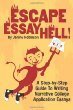
If you don’t own a Kindle, you can still read my ebook. But you will just need to download the Kindle app to your computer, Ipad, cell phone, etc. to read it on those devices. If you have an Amazon account, you can even read the Kindle books you have downloaded online through your browser (see link below to set yourself up for the Kindle Cloud Reader.)
November 8, 2014
Think Your Topic is Too Broad? It Probably Is…

How to Focus Your
College Application Essay!
I love all the comments students make about my posts. The most common ones ask about topics for the Common App or other core college application essays, including the University of California prompts. Students want to know what I think of their topic ideas.
I noticed the main problem with many of their ideas is that their topics are way to broad. WAY TOO BROAD! I think many ask my opinion because they suspect their topics are too general, but they don’t know how to focus them. And they are absolutely correct to worry about this. Essays about general topics are almost always dull and ineffective. (What good is an essay if no one wants to read it?)
I have written a lot about how to find topics that are not broad, and instead are engaging, meaningful and memorable. My best advice for students who worry that their topic is too broad would be to keep reading my blog posts! They all carry the same message—find a topic that is specific, zero in on real-life moments (anecdotes), brainstorm topics that are mundane (everyday) as opposed to impressive, pick one quality or characteristic to write about (as opposed to trying to cram in all the great things about yourself.) These are all ways to focus—or narrow down—your topics.

I know it’s challenging to be specific. You might feel as though you are limiting yourself, or forced to pick one thing when there are so many to talk about. But you must be decisive and choose! Even if there are many options and you have tons of great ideas, make yourself pick one. And go with that. Trust yourself!
If you still don’t quite get the concept of “focusing” your topic, here are some examples. These are some of the broad topics that students have asked me about in the comments sections, wondering if they would make a strong essay. I will follow their general topic with some possible ways to focus it down to something more specific and concrete. (HINT: As you narrow down your topic, try to steer toward the options that are more unusual or unique):
Travel (“I like to travel with my family a lot”): One country: one city: one experience: one moment (something that happened there). EXAMPLE: The time you spent 7 hours in an airport by yourself in Burma and hung out with a monk.

Music (“I want to write about my musical world for UC Prompt 1″): One instrument: one performance: one song: one experience: one moment (something that happened). EXAMPLE: The time you had to fill in at the last minute for the flute player even though you play French horn.

Literature (“I love to read all the time”): One writer: one book: one character: one quote he/she said(something that happened that connects you with that character). EXAMPLE: How you were shocked when you read Catcher in the Rye and realized you were the exact female version of Holden Caufield.
Swimming (“Swimming is my life”): One meet: one race: one experience (something that happened). EXAMPLE: The time you kept swimming an extra lap even after the race was over, and didn’t realize you had lost.

Cooking (“I love to cook with my grandmother from the Ukraine”): One meal: one dish: one ingredient: one experience (something that happened.) EXAMPLE: The time your Babushka grandma taught you to cook Borscht (beet dish) and you almost cut off your finger.

After any of these “something that happened” moments, there’s a strong chance that it made an impression on you, that you had to deal with it and that in the process you learned something. Include all this in your essay! See, you will still have plenty to write about even if you pick a specific topic!
A great place to learn how students narrowed their topics is to read their comments (and my responses) at the end of posts here on my blog, especially those that are about picking topics.
It’s better to pick something specific that you aren’t sure will make a great essay than to write about a topic that is too general. Believe it or not, focused essays have more depth and meaning. So just pick something SPECIFIC and start writing!
October 25, 2014
Essay Hell’s Top 10 Tips

Photo by Janine Robinson
Feeling a Bit Underwater
About Your College Application Essay?
It’s that time of year. Most “early decision” deadlines are counting down by the day, and other major deadlines aren’t far behind. Stay calm. Read my blog. Target your essay writing needs by using the Index listing of post topics on the right sidebar.
My last post was about an article that a USA Today reporter wrote sharing my advice on these essays, as well as tips from other college experts. When we first spoke, the reporter asked me to put together a list of my best tips. In her article, she wove in some of the tips I sent her, but I thought students might find the entire list I sent her even more helpful. So here it is:
Essay Hell’s Top 10 Tips
For Writing Standout
College Application Essays
1. Don’t try to impress. Instead, look for topics that are “mundane,” or everyday. (Scooping ice cream; singing karaoke; riding public busses; having big feet, etc.) It’s counter-intuitive, but those lead to the most memorable essays.
2. Forget the 5-paragraph essay. These are not the formal, pedantic essays from English class. Narrative style, personal essays are written in a more casual, familiar style and voice. Write more like you talk.
3. Trust your stories. Look back for real-life moments or experiences you can share to illustrate something about yourself, such as a core quality, talent, value or skill. Share these “anecdotes,” using creative writing techniques such as concrete details, scene-setting and dialogue, to engage the reader at the start.
4. Focus the point you are making about yourself in your essay. Pick one aspect of yourself to explore instead of trying to jam in all the great things you have done with your life. General essays are almost always dull.
5. Show your grit. This means your “raw determination” to face and deal with problems you have encountered. If you share a problem—you are set to also talk about how you handled it and what your learned. (Problem=challenge, obstacle, change, mistake, failure, phobia, crisis, etc.).
6. Include something “that happened.” If you only tell and explain about yourself, it can get boring to read. Dull essays land in bottom of the pile. Start with a little action. Problems work best.
7. Open up to connect with your reader. If you share your feelings, and even your failures and shortcomings, it makes your essay (and you) more accessible. You want to be “likable.”
8. Take a risk. Try to find a topic that shows something about you that the college would not learn in any other parts of your application. Tell them something that might surprise them; something unexpected. Don’t be afraid to be different. Colleges love that.
9. Read sample essays. You can find inspiration for your own topics when you read what others students have written about, and also learn how to write in a narrative style. Find them online and in essay collections in books. My collection of essays written by former students, “Heavenly Essays,” features excellent narrative essays.
10. Be careful of overdone or loaded topics—such as sports injuries, mission trips, pets, death, illness, divorce, etc. You can write a great essay about almost any topic. It’s all about what you have to say that’s specific and original. If you faced a life crisis, and it rocked your world, you almost can’t help write about it. If you choose a sensational or overdone topic, make sure to keep the focus on you and something specific within that topic.
October 24, 2014
Essay Hell Tips Shared in USA Today Article!

Photo via USA Today and iStock
My Essay Advice in USA Today Article!
A young reporter from USA Today interviewed me the other day to collect some of my tips on writing college application essays. She included advice from other top college experts as well. If you’ve read my blog, you’ve probably heard most of it before, but thought you might find the article helpful anyway:
9 essay writing tips to ‘wow’ college admissions officers
By: Paige Carlotti
October 23, 2014
You’ve taken the tests, requested the recommendations, completed the common app, and now it’s finally time to refocus on what you’ve been putting off: the essay.
While most students spend days, sometimes weeks, perfecting their personal statements, admissions officers only spend about three to five minutes actually reading them, according to Jim Rawlins, director of admissions at the University of Oregon.
High school seniors are faced with the challenge of summarizing the last 17 years into 600 words, all while showcasing their “unique” personality against thousands of other candidates.
“It’s hard to find a balance between sounding professional and smart without using all of those long words,” says Lily Klass, a senior at Milford High School in Milford, Mass. “I’m having trouble reflect myself without sounding arrogant or rude or anything like that.”
The following tips will help applicants make the leap from ‘average’ to ‘accepted’:
1. Open with an anecdote.
Since the admissions officers only spend a brief amount of time reviewing stories, it’s pivotal that you engage them from the very beginning.
“Instead of trying to come up with gimmicky, catchy first lines, start by sharing a moment,” says Janine Robinson, writing coach and founder of Essay Hell. “These mini stories naturally grab the reader … it’s the best way to really involve them in the story.”
Let the moment you choose be revealing of your personality and character. Describe how it shaped who you are today and who you will be tomorrow.
2. Put yourself in the school’s position.
At the end of the day, colleges want to accept someone who is going to graduate, be successful in the world and have the university associated with that success. In your essay, it is vital that you present yourself as someone who loves to learn, can think critically and has a passion for things—anything.
“Colleges always say to show your intellectual vitality and curiosity,” Robinson says. “They want kids who are going to hit the ground running—zoom to class and straight out into the world. They want them hungry and self-aware.
RELATED: Goucher College aims to level playing field with video application option
3. Stop trying so hard.
“One of the biggest mistakes students make is trying too hard to impress,” Robinson says. “Trust that it is those every day, specific subjects that are much more interesting to read about.”
Colleges are tired of reading about that time you had a come-from-behind- win in the state championship game or the time you built houses in Ecuador, according to Robinson. Get creative!
Furthermore, you’re writing doesn’t have to sound like Shakespeare. “These essays should read like smart, interesting 17-year-olds wrote them,” says Lacy Crawford, former independent college application counselor and author of Early Decision. “A sense of perspective and self-awareness is what’s interesting.
4. Ditch the thesaurus. Swap sophistication for self-awareness
There is a designated portion of the application section designated to show off your repertoire of words. Leave it there.
On the personal essay, write how you would speak. Using “SAT words” in your personal statement sounds unnatural and distances the reader from you.
“I think most students are torn between a pathway dividing a diary entry and a press release. It’s supposed to be marketing document of the self,” Crawford says.
RELATED: 3 tips for getting your college application materials in on time
5. Write about what matters to you, not what matters to them
Crawford recommends students begin by answering the question, “if you had 10 minutes to talk to them in person, what would you say?” The admissions teams are looking for authenticity and quality of thinking.
“Theoretically, I think anything could be ‘the perfect topic, as long as you demonstrate how well you think, your logic and ability to hold readers’ attention,” Crawford says.
6. Read the success stories.
“The best advice is to read essays that have worked,” Robinson says. “You’ll be surprised to see that they’re not winning Pulitzers; they are pieces of someone. You want your story to be the one she doesn’t put down.”
Once you find a topic you like, sit down and write for an hour or so. It shouldn’t take longer than that. When you write from your heart, words should come easily.
Rawlins recommends showing the essay to a family member or friend and ask if it sounds like the student. “Take a few days and come back to it. But only do that once,” Rawlins says. “Reading it over and over again will only drive you nuts.”
7. Don’t pretend to be someone you’re not.
While colleges tend to nod to disadvantaged students, roughing up your background won’t help your cause.
“It’s less about the topic and more about how you frame it and what you have to say about it, Robinson says. “The better essay is has the most interesting thing to say, regardless of a topic that involves a crisis or the mundane.”
The essays serve as a glimpse into how your mind works, how you view the world and provides perspective. If you have never had some earth shattering experience that rocked your world, don’t pretend you did. Your insights will be forced and disingenuous.
RELATED: Who reads your college applications anyway?
8. Follow the instructions.
While the directions on the applications may sound generic, and even repetitive after applying to a variety of schools, Rawlins points out that every rhyme has a reason.
“They have to know that college put a lot of thought into the instructions we give them—so please follow them!” he says. “We’ve given a lot of thought to the words we use. We want what we ask for.”
9. Use this space to tell them what your application can’t.
Most colleges don’t have the time or bandwidth to research each individual applicant. They only know what you put in front of them. “If they don’t tell us something, we can’t connect the dots,” Rawlins says. “We’re just another person reading their material.”
Like Crawford, he recommends students imagining they are sitting next to him in his office and responding to the question, “What else do I need to know?” And their essays should reflect how they would respond.
At the end of the day, however, Rawlins wants students to know that the personal essay is just another piece of the larger puzzle. “They prescribe way too much importance to the essay,” Rawlins says. “It makes a massive difference—good or bad—to very few out there, so keep it in context.”
Paige Carlotti is a senior at Syracuse University.
October 20, 2014
Great Student; Not a Great Essay
I’ve been meaning to write about the hubbub around the high school student who got accepted into all eight Ivy League schools last April. It was an amazing and well-deserved accomplishment for Kwasi Enin, a 17-year-old from Long Island, New York.
Because of his feat, many college experts have held up his college application essay as one of the main reasons he was accepted. And it has been publicized now as an example of a great essay.
I do not agree with this at all. I thought his essay was mediocre at best. (Read Kwasi’s essay and see for yourself.)
I believe Kwasi’s acceptances had more to do with his perfect GPA, 2,250 SAT scores, the 11 AP classes he took, his impressive musical and other talents. And it’s also true that his essay certainly did not keep him out of any of these schools (since he got in!), and might have helped him get in.
But I think it’s wrong to assume that this essay had a big part in his acceptance. It’s just not that good. At least in my opinion. It reminded me of the type of writing many adults and English teachers believe would make a good essay.
My main concern is that students will look to this essay as an example of a great essay, and try to emulate it.
Again, I’m not out to dis Kwasi or in any way imply that he is undeserving of his acceptances into these stellar schools. Who wouldn’t want this amazing guy?
But I’m all about writing standout college application essays, and trying to make sure that they help students get into their choice schools. I believe students should try to write essays that are engaging to read—especially from the start—and that carry their unique voice and reveal something that sets them apart from their peers. (This is especially true for students trying for their “reach” schools.)
I will spare you a blow-by-blow analysis of Kwasi’s essay. It certainly wasn’t terrible, and overall was earnest and heartfelt, and had some nice lines.

However, I think his topic was way too broad—”love of music”—and Kwasi tried to cover too much ground about himself, everything from his love of music in all things, how it linked to his leadership skills and even his career goal in medicine. I believe it could have had more impact and been more engaging to read if he had focused his topic. Instead of writing about all things music, he could have picked one specific part of his love of music and expanded upon that.
The worst thing about this essay, to me, was that it was on the dull side. It made all sort of general points that I didn’t find that interesting. He did bolster some of his points with specific examples, and that helped. But overall, it was written with a lot of passive voice and broad, flowery statements.
While I think it’s important to express what you think, feel and believe in these essays, I also think they need a sharp focus and lots of examples to back up general points. Otherwise, they end up on the bland side.
With Kwasi, I would have wanted to get a sense of his personality through the essay, and to hear his authentic voice. There was nothing in this essay that made him stand out from other zillion students who love music, at least in my mind.
Enough picking on Kwasi. Again, a huge congratulations to him and his future at Yale this fall! But if you are working on your essay, I wouldn’t use this one for inspiration or as a guide on writing your own. Be bold. Pick topics that haven’t been written about a lot. Focus them to make a specific point about yourself.
You may not be as brilliant as Kwasi, but I think you have a good chance of writing a better college application essay!
Read some Sample Essays I believe are better.
Kwasi Enin, a 17-year-old Long Island high schooler, wowed admissions officers as he wrote how his love of music sparked his “intellectual curiosity,” according to a copy of the paper viewed by The Post.
“I directly developed my capacity to think creatively around problems due to the infinite possibilities in music,” wrote Enin, who has played viola for nine years.
Enin also explained how his music has helped him play a role in his community and learn leadership values.
He made sure to note that his education has just begun.
“Although I hope that my future career is in medicine, I love that I still have much to learn about and from the world of music.”
September 9, 2014
Sample College App Essays for “Describe the World You Come From”

Looking for your World to answer the University of California Prompt 1?
A high school English teacher contacted me this week asking if I had any sample essays for the University of California college application Prompt 1.
She was using my guides and Essay Hell blog posts to help teach her students how to write their college application essays. (Those are some lucky students!)
The teacher said she had my collection of 50 narrative essays, Heavenly Essays, but that I had not included what prompts they addressed.
She was right. I only introduced the sample essays as examples of personal statements. (It would have been too confusing to explain how each essay was used for different colleges and prompts in the book.) Most were used for The Common App prompts, but many were also written for the UCs, including Prompt 1. I told her many students end up re-tooling their Common App essay for one of the UC essays.
I told her how the idea of describing a world should be viewed figuratively….I like to think that a student should be able to say after writing this essay to the reader: “Welcome to my world!” In that, they have written a piece that reveals what their life is like, or at least one important piece of it, and helped the reader walk in their shoes.
It also helps to read these posts that talk about how to think about the Describe the World You From prompt first, and then check out sample essays.
To help the enterprising English teacher, I went through all 50 essays and found the ones that either were used for the UC Prompt 1, or easily could have been used for that one, since they wrote about a world. I sent her the page numbers, (some listed here) in case you have Heavenly Essays. They include students writing about everything from the world of:
living with divorced parents (30)
two lesbian moms (59)
three older sisters (33)
discrimination based upon race (45)
an extreme religion (84)
being a big guy in a small person’s world (21)
ice skating (92)
activism (98)
excessive reading (114)
theater (129)
child of two shrinks (144)
ice cream making (140)
yoga (105)
everyone shorter than you (111)
on and on…Wow, quite a World we live in!
If you don’t have Heavenly Essays, I’m sharing three sample essays from that collection here that I believe will give you an idea of how you can write about your world. No one knows exactly how far you can push this idea of a world, but I believe it’s hard to go too far out there. If you think you are pushing it, maybe find a way to somewhere work in the actual word “world” somewhere–no more than once!–just so they know your intentions.

1. (The World of living with mostly short people…)
Duncan Lynd
Laguna Beach, CA
California State University, Long Beach, CA
A Small World
While grabbing lunch between games at a water polo tournament, I noticed one of my new teammates rarely looked me in the eye. Instead of taking the empty seat next to me, he opted to sit across the table. Even when I tried to start a conversation with him, he only looked down, and mumbled, “Oh, hey,” and walked away.
This type of cold-shoulder treatment wasn’t new to me. I’m a big guy. In bare feet, I’m about 6 feet 7 inches tall, and I’m pushing 300 pounds. Yes, it can be a pain. I bump my head going through doorways, I don’t fit in most mid-size cars, and I can barely squeeze into most classroom desks. But I understand that the world is made for average-sized people, and I like to think I’m above average. One thing, however, is hard for me to take: People who don’t know me assume I’m mean.
Like my frosty water polo teammate. I understand why he was intimidated by me, especially since he was one of the smaller players. I would have felt the same way. When I meet people for the first time, I often draw conclusions or make assumptions. Almost all my life, I’ve had to deal with the expectations and judgments people make about me just because I’m often the largest kid in the room. Ever since I was a kid there has been pressure for me to perform athletically because of my size and strength.
When I went to grocery store, random people consistently asked me if I played football. When I told them, “No,” the men always lectured me not only about why I should play football, but what I should be doing with my life, with my body, and with my potential. I normally just nodded and smiled, but it bothered me that they thought they knew what was best for me.
Not only did I never play football, but I defied many of the assumptions people made about me. How many people my size love nothing more than mixing up a chocolate batter, and decorating a three-layer cake? Beside my passion for baking, I also love working with little kids. For the last two summers, I volunteered at a camp where I taught kids how to surf. My nickname was Teddy Bear. And if I wanted to make my friends fall on the ground laughing, I reminded them of my dream to learn to play the violin.
In general, I ignore what people say to me or think about me when it comes to my size. Instead of reacting, I usually just give them a smile. On many levels, there are advantages to towering over most of the world. I always get the front seat since I don’t fit in the back. No one even dares call “shotgun.” I usually have the best seat in the house, whether it’s a rock concert or a ball game, no matter where I sit. And if people are getting rowdy and making my friends uncomfortable, all I need to do is step in the middle and simply ask, “What’s going on?” and they disperse.
Even the people who are intimidated at first by me eventually come around once they get to know me. Like the water polo player at the restaurant. Within about two weeks, we finally had a conversation and ended up finding we had a lot in common. In fact, he ended up as my best friend. For me, it is a small world after all, but I wouldn’t have it any other way.
ANALYSIS : How can you not like this guy after reading his essay? When I met with Duncan, it was obvious that his impressive stature could make a nifty essay topic. On some level, it had to define him. But we didn’t want it to be predictable or cliché.
Many students have traits or idiosyncrasies that feel unique to them, but the truth is many other students share them, such as being a big guy, being super tall, having too many freckles, being clumsy, afraid of heights, etc. They can all make terrific topics, but you have to work a little harder to give them a twist or something unexpected.
After talking about his height and girth a bit, it came out that not only did he bump his head a lot, but that people made assumptions about him based on his difference. Bingo! That other kids thought he was mean just because he was big was a different twist on the idea of being large.
By sharing how this bothered him, Duncan revealed himself as a sensitive, empathetic and insightful guy. That is all great stuff! You don’t only want to share your stories, but also how they make your feel, what you think and learn from them. Then you will have a knock-out essay.

2. (The World of life living between divorced parents…)
Gabrielle Mark Bachoua
San Diego, CA
University of California, Davis, CA
Leaping Dancer
As my mom backs out of our driveway, I glance at the back seats to make sure my basketball gear is there, along with my schoolbooks, phone charger, and beat-up copy of Catch-22. We slowly wind through my neighborhood and over about a half dozen speed bumps, then pull onto the highway heading south with the other Sunday traffic.
I sit back and watch the familiar landmarks—the large Denny’s sign with the missing “N,” the short stretch of undeveloped land, the Shell billboard that meant we were almost there—flash past my window.
I’ve made this 20-mile trip between my parents’ homes for the last decade, four times a week, ever since they divorced when I was seven. I must have taken it more than a thousand times. Sometimes I dreaded getting into that car, and resented my parents for putting my older sister and I through the circular logic that moving us back and forth will make our lives normal because we see each parent often, but moving back and forth isn’t normal, unless they make it normal, which isn’t normal. Now I know it makes sense because normal isn’t ideal, normal is the unexpected and the crazy and the unforgiving.
I now realize that those rides are the consistency amidst the madness. Looking out the window and down to the lane reflectors I think… about how on Friday’s basketball game my jump shot was off because I was floating to the left, about how I’m excited to see my dog and cat, about how upset I am because of Yossarian’s predicament, about how I’ll miss my dad, about how veterinary medicine is fascinating, about how I needed to study for my chemistry test, about how I will work harder to get into my dream school, and about how I’m glad that I get to take a nice nap before I go to mom’s.
I even remember the first time years ago when I noticed the smudge on the rear driver’s side window, which was shaped into a leaping dancer—a dancer in white. I would watch her move through the trees in El Cajon Valley, bob my head up and down to help her jump over hillside terraces of Spring Valley, and keep her from crashing into the Westfield mall sign two miles from my mom’s home.
It was those hours I spent thinking silently to myself when I learned more about who I am, where I envision myself going, and what my role is in this world. Sitting in the front seat, I’d take a moment to look back to see that same dancer in white, however faceless, nameless, and abstract, gave me a sense of comfort. That even though I wasn’t really ‘home’, I still was, because home isn’t simply where you rest your head, but also where you have the security to dream inside of it.
ANALYSIS : Once again, an essay like this proves that you can pick almost anything to write about as long as you give it a focus. In this case, Gabrielle picked a simple stretch of roadway between her parent’s homes. She described the weekly routine and drive with vivid, descriptive details, so you felt as though you were in the car staring out the same window.
But she used the trip as a metaphor for a meaningful time in her life, when she had lots of downtime to reflect on her life, her feelings and dreams. Even though it shares the pain of her parent’s divorce in an understated way, that’s always in the background—and we can tell it has shaped her.
If she never had the time to daydream and reflect on her day, who knows how she would have been different somehow, or those emotions would have played out somewhere else.
Nothing really happens in this essay, but it still manages to have momentum and hold our interest. I love how she personifies a little smudge on the window into a dancer, another metaphor for her own journey.
In the end, Gabrielle explored the idea of home, and defined it more as a journey than a destination—whether riding in a car for a commute between houses or a lifelong adventure.
I believe Gabrielle didn’t set out to write a “deep” essay filled with metaphors and heavy insights, but by describing a simple routine and then reflecting upon what it meant to her, she revealed herself as an observant, reflective and wise young woman.

3. (When a World literally falls out from under you…)
Luc Stevens
Laguna Beach, CA
University of Oregon, Eugene, OR
Skating Through Hard Times
I was in fifth grade eating breakfast with my family when the floor of my home gave way under our feet. We barely escaped from the house before it buckled into two pieces, and ran to safety before the entire hillside gave way. Our home was destroyed, and we narrowly escaped with our lives.
Six years ago, my family was caught in this terrifying landslide when my home and a dozen others slid down the side of a canyon in Laguna Beach. Within less than 10 minutes, my life literally fell out from under me. For the next five years, my family moved over a dozen times, often living out of boxes with friends and relatives. Besides my clothes and basic necessities, the only thing I hauled from house to house was my collection of skateboards.
Six months after the landslide, the city of Laguna Beach relocated us to a recycled trailer on a parking lot at the end of town so my parents could save money to rebuild our home. I see it now as an extremely generous gesture but at the time it was difficult. Living in this dilapidated, thin-walled trailer was definitely not the life I had envisioned. My backyard was an enormous parking lot.
As a lifelong skateboarder, however, that flat expanse of asphalt helped me get through the hardest years of my life. You see, I’m a skater from a hillside neighborhood and had never experienced such space and opportunity. I took advantage of the situation and made this neglected, dirty parking lot into a skateboarding oasis with ramps and rails that my friends donated.
We would all gather together after school as a release from the pressures of life for a while, practicing trick after trick, working to fine-tune each maneuver. Contests were created, videos shot, and movies made.
For the first time in my life, I had a flat area where my friends and I could hang out. Even though we didn’t talk much about the landslide, these friendships were both a distraction and softened the unpleasant living situation.
Also, balancing sports and loads of homework, I turned to what I thought of as my new backyard skate park at night to escape from reality each day. The sense of riding back and forth on a cold night helped me relax and persevere through my studies and life in general.
Numerous years passed in that cramped rickety, old trailer and life wore on dealing with everything from highway noise reverberating right outside our door to the constant rodent problem. When my family’s new, hillside home finally came to completion at Christmas last year, I was more than ready to move.
The only thing I would miss from my five-year ordeal was my beloved “skate park.” After moving into our permanent home, the crazy life I endured since fifth grade was now over and even though I could not bring the skate ramps themselves, I was able to bring plenty of memories.
One of the most important lessons I learned through all this is that I have the ability to find positive opportunities even in the grimmest circumstances. If I could find friendship, support and fun in a parking lot, I know I can find the upside to almost any situation.
ANALYSIS : Luc almost had no choice but to write about how he and his family lost their home in a landslide when he was young. It was such a defining experience—not just the terrifying event, but the long, slow process of “going home.”
I like how Luc recounted briefly the actual slide, and how he didn’t over dramatize or dwell on that. Instead, he picked right up on how he turned a bad situation into something positive. Like any good personal essay, this one has a clear universal truth: How every cloud has a silver lining (if you find it.)
Because Luc’s description of his experience showed us how bad things were and then the steps he took to improve them, he never had to spend a lot of time explaining what he learned. He only needed a couple sentences at the very end to share his lessons.
A lot of students who grow up in Southern California want to write about their passions for sports, such as surfing and skate boarding. I usually steer them away from these topics, since they aren’t very interesting to read. Luc’s essay is a huge exception!
* * * * * * *
Did you notice the titles? You can also learn how to title your own college application essay.
You also might find Essay Hell’s Pinterest Board on How to Find The World You Come From helpful.
If you are an English teacher interested in using my advice, ideas and tips from my books and/or this blog, I wrote a post on Lesson Plan Ideas for The College Application Essay to try to help you. Let me know if you have any questions or comments!
September 8, 2014
5 Reasons College App Essays Don’t Suck

If you are struggling with your college application essay right about now, you might be cursing the entire process. And I don’t blame you. You are supposed to think up some fascinating topic that will grab the attention of those bored-to-tears admissions officers and help your application stand out among the thousands of other students vying for the same spot at your dream college.
All the experts tell you “Just be yourself!” or “Tell a story.” While they are right, it’s totally normal that you don’t have much confidence in how to do that in 650 words or less. Most high school students have not been taught how to write a narrative (story-telling style) personal essay. And to write good ones takes a lot of practice.
But don’t be discouraged. I would suggest you keep browsing this blog and reading posts about how to find topics, how to address certain prompts, how to write anecdotes, and within a short amount of time I believe you will have a strong idea of not only what you need to write, but how to execute it. If not, keep reading!

In the meantime, I’ve cooked up a list of reasons why it’s worth putting your time and energy into these essays now:
1. You can learn invaluable writing techniques that you can use in college and beyond in the workplace. If you learn how to put a real-life story into your own words and tell it in a narrative style, you can power all types of writing. These are called anecdotes, and they are terrific ways to engage your reader. You can use them in everything from writing editorial pieces for magazines and blogs to marketing tools, such as advertorials, cover letters and press releases.
2. You have a chance to pause in your busy life and ponder who you are, how you are unique and and why it’s important. To write a powerful personal statement, you need to take a hard look at yourself, and explore what has shaped you so far and where you want to go next. This exercise can not only help you write a compelling essay, but also make you more mindful of your individuality and open the possibilities of your future!
3. This is your chance to use your personality and character to convince schools that you would be a great addition to their student body. No one really knows how much influence these essays have in helping students get admitted. But if you are a student applying to a super competitive college or university (and that seems to be most of them these days!), you have to think that these could often be a deciding factor if everyone has the same uber grades, test scores, extra-curriculars, etc. Same goes with students who have less than flawless grades, scores, etc., who need that extra edge to push past the competition. Be likable!

4. A great essay could earn you some money. Many of the smaller liberal arts colleges use these essays to determine who they want to accept and who they want enough to help afford their school. Think about it: If a college admissions officer reads an essay and she or he determines that you would be an ideal fit for their school, for whatever reason, they are likely to find ways to get you there, including offering scholarship money.
5. Chances are you will be writing other application essays in your future. Sorry for the bad news, but it’s likely you will need to write other application essays if you apply for things like transferring schools, scholarships (fellowships, internships, etc.) and advanced degrees (MBA, law school, med school, etc.) down the road. The time you invest now to learn how to craft these essays will help you later on. Keep these writing techniques–especially the Show AND Tell approach and anecdotes–in your tool kit to give you an edge in the future!
Even though these essays are a royal drag, they are worth your time and effort. So get cracking!