Janine Robinson's Blog, page 19
April 27, 2014
College App Essay Lessons from Modern Family

I was watching the most recent episode of Modern Family the other night, and thought it was funny and telling that Alex Dunphy, the token brainiac of the family, was obsessing about her college application essay. The family was on a vacation in Australia, and Alex kept annoying everyone by trying to find life lessons and metaphors from the trip to use in her essay.
First off, what does that tell you about how these essays are becoming more and more of a national obsession? (My last post was about David Letterman’s Top 10 Ways to Make Your College App Essay Stand Out.) To me, it says that these dreaded essays continue to rise above the other parts of the college admissions process in terms of what can either get you into a top college or keep you out.
If you are searching for the perfect essay topic, then you can learn something from Alex Dunphy: She was going about it the wrong way. Like many students, Alex thought she needed to go on an impressive trip to a faraway country in order to have an experience she could showcase in her essay. Wrong! Most essays written about vacations or even philanthropic mission trips usually do not result in effective college app essays. The problem is that they do not reveal much about the student. And they are dullsville to read.
By the end of the show, Alex is climbing to the top of the famous Sidney Harbour Bridge with her family—who have reunited after a lot of internal bickering—and discovering how the bridge is a metaphor for her family re-connecting. Her epiphany was meant to be funny for a reason. While metaphors can add another dimension or insights to an essay, they often can be cliche or simplistic, or just miss the mark of the larger point. In Alex’ case, writing an essay about her family’s trip to Australia, and how climbing a bridge together at the end symbolized the power of their closeness, could be really boring—and, well, dumb.
(If she’s not careful, I believe smartypants Alex could be the victim of The Top Student=Bad Essay Paradox, and hurt her chances to get into that Ivy she must be dreaming about.)
So how do you make sure your brainstorming efforts and ultimate topic choice are not the butt of a joke, too? Here are three tips to make sure you land on a topic that is original, interesting and reveals who you are:
ONE: Don’t write about vacations or mission trips. At least, don’t just relay what you did on them for your essay. If something specific happened while you were on a vacation or mission trip, and you can write about how it affected you, how you handled it, and what you learned from it, that could make a great topic.
TWO: You don’t need to obsess about your topic, like Alex. Instead, set aside about a half hour to brainstorming ideas. Sit at your desk and jot down your ideas. Don’t rule anything out. This Jumpstart Guide is a great place to start.
THREE: Go easy on larger-than-life metaphors. For example, resist writing an entire essay on how your life is like a sailboat, or how your brain is like a video game. It’s fine to use metaphors, similes or other comparisons to make a larger point; I would just avoid having a metaphor comprise your entire essay. Also, if you make a comparison, make sure it’s original. If you have heard or read it before, don’t use it. (There are other ways to give depth and meaning to your essay.)
We all relate to Alex’ stress when it comes to finding that perfect topic. And it’s fun to laugh at her efforts. You, too, will find a great topic as long as you spend more time brainstorming than obsessing. And never lose your sense of humor.


April 24, 2014
Letterman’s Top 10 Ways To Make Your College Application Essay Stand Out—and Mine

If you are a Letterman fan, you know that I am supposed to list these college application essay tips backwards, and end with No. 1. But I prefer chronological order. You can watch the YouTube video, where he has the young man, Kwasi Enin, who was accepted to all eight Ivies this year, count them down on his show. Some media have tried to pin Kwasi’s success on his essay—but that is pure conjecture (Kwasi is amazing on many levels). Anyway, if you are college bound, you might get a kick out of watching the whole thing.
If you are shy on time, I wrote out Letterman’s list here. And then I wrote my own list below. His may be funny; but mine works!
David Letterman’s Top 10 Ways to Make Your College Application Essay Stand Out
1. In the part where it says, “Office Use Only,” write: “Accept.”
2. Personally give to dean at home in the middle of the night.
3. If you’ve been to space, mention that you’ve been to space.

4. Instead of ink, use delicious butterscotch.
5. Include a moist toilette.
6. Lots of glitter
7. Mention your love of sleeping in bunk beds.
8. Include very well-lit photo of your brain.
[image error]
9. Every fifth word: Heretofore
10. Address the envelope to “The very handsome dean of admission.”
Okay, pretty funny. Now here’s my list. And in case you can’t tell, mine are serious.
Essay Hell’s Top 10 Ways to Make Your College App Essay Stand Out
1. Start with an anecdote. (Grabs the readers every time; isn’t gimmicky; shows the reader instead of tells them; something happens)
2. Include a title–but only if it’s a good one. Otherwise, leave it out.
4. Write like you talk (stick with a more casual style of writing and your natural voice will shine through.)
5. Include descriptive, colorful and specific details. Name the dog!
6. Take a risk.
7. No Tuxedo Talk! Don’t use words like heretofore, nevertheless, furthermore, thereby, etc. If you wouldn’t use a word when you talk, don’t use it in your essay. Big turn off.
8. Open up about yourself. Honesty is a great way to engage a reader. So is humility. Don’t be afraid to share your flaws.
9. Be idealistic. Especially at the end of the essay, when you share what you care about, believe in and have learned. Hope and dreams are contagious.
20. If you’ve been to space, mention you’ve been to space. Haha. See, I haven’t totally lost my sense of humor. Actually, it’s a good point. If you have something unique and amazing to write about in your essay, go for it. But most students haven’t been to space or had off-the-chart, incredible experiences. In that case, just stick to sharing a mundane (everyday) experience that challenged you on some level, and wow the reader with how you handled it. Chances are your college application essay will be way more compelling than the space story. Well, maybe.
Letterman’s Top 10 Ways To Make Your College App Essay Stand Out—and Mine
If you are a Letterman fan, you know that I am supposed to list these tips backwards, and end with No. 1. But I prefer chronological order. You can watch the YouTube video, where he has the young man, Kwasi Enin, who was accepted to all eight Ivies this year, count them down on his show. Some media have tried to pin Kwasi’s success on his essay–but that is pure conjecture (Kwasi is amazing on many levels). Anyway, if you are college bound, you might get a kick out of watching the whole thing.
If you are shy on time, I wrote out Letterman’s list here. And then I wrote my own list below. His may be funny; but mine works!
David Letterman’s Top 10 Ways to Make Your College Application Essay Stand Out
1. In the part where it says, “Office Use Only,” write: “Accept.”
2. Personally give to dean at home in the middle of the night.
3. If you’ve been to space, mention that you’ve been to space.
4. Instead of ink, use delicious butterscotch.
5. Include a moist toilette.
6. Lots of glitter
7. Mention your love of sleeping in bunk beds.
8. Include very well-lit photo of your brain.
[image error]
9. Every fifth word: Heretofore
10. Address the envelope to “The very handsome dean of admission.”
Okay, pretty funny. Now here’s my list. And in case you can’t tell, mine are serious.
Essay Hell’s Top 10 Ways to Make Your College App Essay Stand Out
1. Start with an anecdote. (Grabs the readers every time; isn’t gimmicky; shows the reader instead of tells them; something happens)
2. Include a title–but only if it’s a good one. Otherwise, leave it out.
4. Write like you talk (stick with a more casual style of writing and your natural voice will shine through.)
5. Include descriptive, colorful and specific details. Name the dog!
6. Take a risk.
7. No Tuxedo Talk! Don’t use words like heretofore, nevertheless, furthermore, thereby, etc. If you wouldn’t use a word when you talk, don’t use it in your essay. Big turn off.
8. Open up about yourself. Honesty is a great way to engage a reader. So is humility. Don’t be afraid to share your flaws.
9. Be idealistic. Especially at the end of the essay, when you share what you care about, believe in and have learned. Hope and dreams are contagious.
20. If you’ve been to space, mention you’ve been to space. Haha. See, I haven’t totally lost my sense of humor. Actually, it’s a good point. If you have something unique and amazing to write about in your essay, go for it. But most students haven’t been to space or had off-the-chart, incredible experiences. In that case, just stick to sharing a mundane (everyday) experience that challenged you on some level, and wow the reader with how you handled it. Chances are your essay will be way more compelling than the space story. Well, maybe.
Lettermans’ Top 10 Ways To Make Your College App Essay Stand Out–and Mine
If you are a Letterman fan, you know that I am supposed to list these tips backwards, and end with No. 1. But I prefer chronological order. You can watch the YouTube video, where he has the young man, Kwasi Enin, who was accepted to all eight Ivies this year, count them down on his show. Some media have tried to pin Kwasi’s success on his essay–but that is pure conjecture (Kwasi is amazing on many levels). Anyway, if you are college bound, you might get a kick out of watching the whole thing.
If you are shy on time, I wrote out Letterman’s list here. And then I wrote my own list below. His may be funny; but mine works!
David Letterman’s Top 10 Ways to Make Your College Application Essay Stand Out
1. In the part where it says, “Office Use Only,” write: “Accept.”
2. Personally give to dean at home in the middle of the night.
3. If you’ve been to space, mention that you’ve been to space.
4. Instead of ink, use delicious butterscotch.
5. Include a moist toilette.
6. Lots of glitter
7. Mention your love of sleeping in bunk beds.
8. Include very well-lit photo of your brain.
[image error]
9. Every fifth word: Heretofore
10. Address the envelope to “The very handsome dean of admission.”
Okay, pretty funny. Now here’s my list. And in case you can’t tell, mine are serious.
Essay Hell’s Top 10 Ways to Make Your College App Essay Stand Out
1. Start with an anecdote. (Grabs the readers every time; isn’t gimmicky; shows the reader instead of tells them; something happens)
2. Include a title–but only if it’s a good one. Otherwise, leave it out.
4. Write like you talk (stick with a more casual style of writing and your natural voice will shine through.)
5. Include descriptive, colorful and specific details. Name the dog!
6. Take a risk.
7. No Tuxedo Talk! Don’t use words like heretofore, nevertheless, furthermore, thereby, etc. If you wouldn’t use a word when you talk, don’t use it in your essay. Big turn off.
8. Open up about yourself. Honesty is a great way to engage a reader. So is humility. Don’t be afraid to share your flaws.
9. Be idealistic. Especially at the end of the essay, when you share what you care about, believe in and have learned. Hope and dreams are contagious.
20. If you’ve been to space, mention you’ve been to space. Haha. See, I haven’t totally lost my sense of humor. Actually, it’s a good point. If you have something unique and amazing to write about in your essay, go for it. But most students haven’t been to space or had off-the-chart, incredible experiences. In that case, just stick to sharing a mundane (everyday) experience that challenged you on some level, and wow the reader with how you handled it. Chances are your essay will be way more compelling than the space story. Well, maybe.
April 18, 2014
More College Application Essay Tips from “Concise Advice” Author Robert Cronk
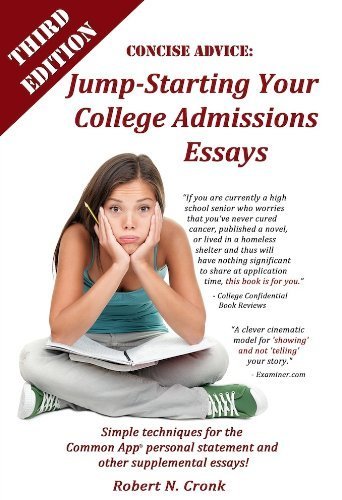
In my previous post, I featured a question and answer session with author Robert Cronk, who wrote a popular writing guide on how to write narrative-style college application essays. I found Concise Advise, which directs students on how to use movie-script writing techniques to bring their essays to life, a helpful resource.
I invited him to share more of his advice and tips here on Essay Hell, and this is the second part. (Here’s Part One in case you missed it.):
Me: What do you think is the most important part of a college app essay?
Bob: To me, it’s the element of character development, or transition, or transformation, or realization of something, even in small ways. The best essays start with a moment that led to that development and ends with a better, stronger, wiser person.
Me: Do you have any pet peeves?
Bob: Too many to name, but here are a few, summarized so I don’t start ranting about them. (1) Author Alan Gelb has a rule that says, essentially, “Never use your essay to brag, complain, or explain.” Good advice that covers a lot of sins and I hope is self-explanatory. (2) Avoid TMI. Not every little detail is important to the story. Use only the elements that advance the story. Keep it focused. I also recommend avoiding any topic of past drug or alcohol use, criminal activity, or mental issues one may have had. Never forget the goal is to have the school want you there. (3) Throw away your thesaurus! The essay has to be kept in your voice. If you read your essay out loud, does it sound like you talking? If not, change it.
Me: Do you have some favorite essays or topics you have read over the years?
Bob: I’ve already talked about my favorite essay ever, and that was a super-mudane topic. But in general, my answer on having a favorite topic is NO. The important thing is having a topic that is unique, powerful, and memorable to the writer, not necessarily to the reader.
Me: Do you think parents, friends, teachers, etc., can be helpful to students?
Bob: There are those “counselors” like you and I who can give some advice on getting started and how to proceed, but the essay has to come from the writer. Here’s the dangerous slope: It’s all well and good to get advice on word usage and grammar, but once you start hearing comments like, “You need to put yourself in a better light,” or “It’s too informal; you need to make it more intellectual,” or any of a hundred other suggestions, you’ll be in danger of losing your voice in the essay. Parents, especially, think that the essay is a place to toot your horn, but that is so wrong. So thank everyone for their comments on grammar, word usage, or sometimes structure, and listen carefully for ways to make it more focused, but make sure to keep the essay yours.
Me: Do you miss the old topic option to write about anything you wanted, called Topic of Choice? Among the five Common App prompts, do you have ones you like better than others?
Bob: Believe it or not, my best advice is to not even peek at the prompts before you write a personal essay. WTH, you say? I firmly believe that if you write according to the advice you and I are giving, it will totally fit one or more of the five prompts. And for more specific prompts, like an individual school might have on a supplemental app, a general essay can be easily adapted to lots of prompts. Just because the prompt changes, it doesn’t change what makes a good essay. I also think that the old “Topic of Your Choice” is still there on the new Common App. It’s disguised as follows: “Some students have a background or story that is so central to their identity that they believe their application would be incomplete without it. If this sounds like you, then please share your story.” This is just a wordier way of saying “Topic of Your Choice.” And also why I guarantee that any personal statement you write will fit at least one prompt Writing the essay without peeking at the prompts first leads to much less stress.
Me: Do you advise students to title their essays? (Here’s my take on Should You Title Your College App Essay?)
Bob: Funny you should ask, because for the actual student-written essays I use in my book, I’ve titled them, but they never did have titles before I published them. I don’t think titles add that much, but it just might intrigue the reader. I titled one student essay “Carless Hair?” and another “My Illicit Affair with the United States.” It might be a good way to engage the reader before they even start the essay, but in probably 95 percent of the essays I’ve read, having a title wouldn’t really add much.
Me: Any last brainstorming tips?
Bob: Write your essay(s) in the summer before your senior year. Write several. If you know how to start and how to structure the thing, it makes the process a lot easier. You don’t know how many people are like, “Help, this has to be submitted before midnight tonight. Please review!” I have no pity (Well, some, but not enough to respond to an email like that). Get your essays done in advance, put them aside, and take the rest of the application season in stride. Students, you probably won’t do that, but at least get started during that summer.
Thank you Robert for sharing your sage advice on how to write college application essays! (If you want to read Part One.)
More Essay Tips from “Concise Advice” Author Robert Cronk
In my previous post, I featured a question and answer session with author Robert Cronk, who wrote a popular writing guide on how to write narrative-style college application essays. I found Concise Advise, which directs students on how to use movie-script writing techniques to bring their essays to life, a helpful resource.
I invited him to share more of his advice and tips here on Essay Hell, and this is the second part. (Here’s Part One in case you missed it.):
Me: What do you think is the most important part of a college app essay?
Bob: To me, it’s the element of character development, or transition, or transformation, or realization of something, even in small ways. The best essays start with a moment that led to that development and ends with a better, stronger, wiser person.
Me: Do you have any pet peeves?
Bob: Too many to name, but here are a few, summarized so I don’t start ranting about them. (1) Author Alan Gelb has a rule that says, essentially, “Never use your essay to brag, complain, or explain.” Good advice that covers a lot of sins and I hope is self-explanatory. (2) Avoid TMI. Not every little detail is important to the story. Use only the elements that advance the story. Keep it focused. I also recommend avoiding any topic of past drug or alcohol use, criminal activity, or mental issues one may have had. Never forget the goal is to have the school want you there. (3) Throw away your thesaurus! The essay has to be kept in your voice. If you read your essay out loud, does it sound like you talking? If not, change it.
Me: Do you have some favorite essays or topics you have read over the years?
Bob: I’ve already talked about my favorite essay ever, and that was a super-mudane topic. But in general, my answer on having a favorite topic is NO. The important thing is having a topic that is unique, powerful, and memorable to the writer, not necessarily to the reader.
Me: Do you think parents, friends, teachers, etc., can be helpful to students?
Bob: There are those “counselors” like you and I who can give some advice on getting started and how to proceed, but the essay has to come from the writer. Here’s the dangerous slope: It’s all well and good to get advice on word usage and grammar, but once you start hearing comments like, “You need to put yourself in a better light,” or “It’s too informal; you need to make it more intellectual,” or any of a hundred other suggestions, you’ll be in danger of losing your voice in the essay. Parents, especially, think that the essay is a place to toot your horn, but that is so wrong. So thank everyone for their comments on grammar, word usage, or sometimes structure, and listen carefully for ways to make it more focused, but make sure to keep the essay yours.
Me: Do you miss the old topic option to write about anything you wanted, called Topic of Choice? Among the five Common App prompts, do you have ones you like better than others?
Bob: Believe it or not, my best advice is to not even peek at the prompts before you write a personal essay. WTH, you say? I firmly believe that if you write according to the advice you and I are giving, it will totally fit one or more of the five prompts. And for more specific prompts, like an individual school might have on a supplemental app, a general essay can be easily adapted to lots of prompts. Just because the prompt changes, it doesn’t change what makes a good essay. I also think that the old “Topic of Your Choice” is still there on the new Common App. It’s disguised as follows: “Some students have a background or story that is so central to their identity that they believe their application would be incomplete without it. If this sounds like you, then please share your story.” This is just a wordier way of saying “Topic of Your Choice.” And also why I guarantee that any personal statement you write will fit at least one prompt Writing the essay without peeking at the prompts first leads to much less stress.
Me: Do you advise students to title their essays? (Here’s my take on Should You Title Your College App Essay?)
Bob: Funny you should ask, because for the actual student-written essays I use in my book, I’ve titled them, but they never did have titles before I published them. I don’t think titles add that much, but it just might intrigue the reader. I titled one student essay “Carless Hair?” and another “My Illicit Affair with the United States.” It might be a good way to engage the reader before they even start the essay, but in probably 95 percent of the essays I’ve read, having a title wouldn’t really add much.
Me: Any last brainstorming tips?
Bob: Write your essay(s) in the summer before your senior year. Write several. If you know how to start and how to structure the thing, it makes the process a lot easier. You don’t know how many people are like, “Help, this has to be submitted before midnight tonight. Please review!” I have no pity (Well, some, but not enough to respond to an email like that). Get your essays done in advance, put them aside, and take the rest of the application season in stride. Students, you probably won’t do that, but at least get started during that summer.
Thank you Robert! (If you want to read Part One.)
April 17, 2014
Think Movies! Another Great Way to Write Your College Application Essay
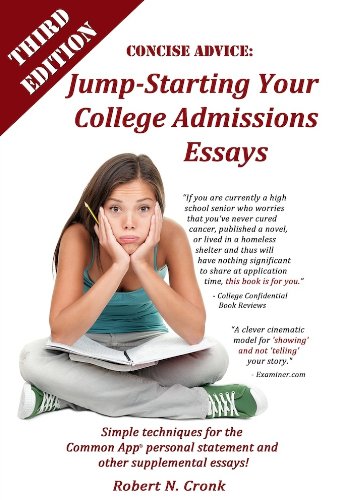
I’m always on the lookout for great writing guides—especially books on how to write narrative, slice-of-life essays (like mine). Only recently did I discover this book, Concise Advice, by Robert N. Cronk. What I loved was that his approach was different than mine, but arrived at the same goal—a compelling college application essay that reveals the writer’s unique personality, character, passions, talents, goals, etc.
This is what I wrote about our two different approaches in a review for Amazon on the latest (third) edition of his book:
I was surprised at how similar this book was to mine, although it offered a different approach–and our goals were very similar. My guide steps students through the process of finding their defining qualities, and then looking for slice-of-life “moments” or “incidents” that illustrate that quality in a compelling way. I encourage them to look for “times” when they encountered some type of “problem,” and use that to show how they handled it and what they learned. The result are highly readable “narrative” essays that do a beautiful job of revealing what makes a student tick.
Cronk’s approach has students use a movie script writing model, but it actually walks them through the same creative process. He encourages them to start with a “cold open,” where you begin with an exciting “moment” in a real-life story to grab the reader, and then go from there. He also encourages the reader to find some type of “conflict” that she or he can relate to show how they grew and changed.
See how similar they are? I actually love that there are different ways to find and tell our stories in these essays.
Anyway, I asked Robert if he would let me interview him for my blog so he could share some more tips and ideas with students. (I’m going to run our little question and answer in two parts.) Here is part one:
Me: So, Bob, the first thing I wanted to ask is how important you think the application essay is.
Bob: It depends on the school, but for selective universities, I think it’s more important than ever before. With the advent of the Common Application and the use of the Internet for college research and rankings, schools are getting record numbers of applications. And because students self-select for the most elite schools, the colleges are inundated with so many applications that all portray great students.
Everyone has great grades, wonderful EC’s, great recommendations, and so on. I participated once in the selection process for one department of a top school and I thought you could throw the apps into the air and grab randomly as they fell and still get a great set of students. So the essay is a chance for the school to start to really distinguish one student from another.
Me: What are your most helpful tips for writing these essays?
Bob: Writing an essay is unbelievably stressful for students. You stare at the prompts, you wonder how the school wants the prompts answered, and how to best put yourself in a good light. No wonder students get brain-freeze when they think about the writing process. And getting started is the hardest part of all. I think you and I agree that once an essay is started, the rest of the job is a little easier. So my top three tips (which will probably sound familiar to your readers) are: (1) Get started with an anecdote as you call it, or a “cold-open” as I call it; (2) Make your essay the telling of a story; and (3) Make the college want you.
Me: Can you sum up your approach that you share in your book?
Bob: You’ve always heard the phrase to “show” and not “tell” your story in an essay. But what is the most effective story-telling medium that shows the story and makes you fall in love with the main character? A movie, of course. So I teach the reader the basic “recipe” for movie scripts and how to adapt that to essays. My book gives specific ways to get started and to write in a focused way. For example, once the initial paragraph is written, I think the next step is to write the ending! This gives you a starting point and an ending point and helps keep the middle focused and the word count under control, essentially showing the transition from start to finish.
Me: Does your approach help students’ essays stand out from the crowd? If so, how?
Bob: We’ve all read essays where we’re bored by the end of the third paragraph, if not earlier. I’ve tried to create an approach that does two things I think are of utmost importance: First, write a story that keeps the reader’s interest, and second, leave the reader with a positive impression about the writer, one that makes a college say, “We want this person at our school.”
Me: What do you say to students who don’t think they have anything “special” or “unique” to write about?
Bob: For an essay to be memorable and powerful, the topic needs to be memorable and powerful to the writer. For something in your life to be memorable, it must be significant to you, special to you, unique to you. The topic for your essay has to found in your own memory. If that memory changed you, made you stronger, wiser, opened your eyes to something bigger than you, tested you, or impacted who you were, that is “significant,” and a good topic choice.
My favorite essay of all time – by far – was from a student who met a great guy, and talked about their first few hours together. It was not only brilliantly written, but it showed a subtle change in her realizing that she was not alone in feeling somewhat isolated from her “conformist” friends. That essay is included in the third edition of my book. I am totally convinced that it led to her Ivy acceptances and a full-ride, non-needs-based scholarship to a prestigious California university.
Thanks, Robert! Stay tuned for Part Two, and more advice on how to write stand-out college application essays!
Think Movies! Another Great Way to Write Your College App Essay
I’m always on the lookout for great writing guides–especially essay writing–and for ones that also teach how to write them in a narrative style, or how to craft a “slice-of-life” essay. Only recently did I discover this book, Concise Advice, by Robert N. Cronk. What I loved was that his approach was different than mine, but arrived at the same goal–a compelling narrative essay that reveals the writer’s unique personality, character, passions, talents, goals, etc.
This is what I wrote about our two different approaches in a review for Amazon on the latest (third) edition of his book:
I was surprised at how similar this book was to mine, although it offered a different approach–and our goals were very similar. My guide steps students through the process of finding their defining qualities, and then looking for slice-of-life “moments” or “incidents” that illustrate that quality in a compelling way. I encourage them to look for “times” when they encountered some type of “problem,” and use that to show how they handled it and what they learned. The result are highly readable “narrative” essays that do a beautiful job of revealing what makes a student tick.
Cronk’s approach has students use a movie script writing model, but it actually walks them through the same creative process. He encourages them to start with a “cold open,” where you begin with an exciting “moment” in a real-life story to grab the reader, and then go from there. He also encourages the reader to find some type of “conflict” that she or he can relate to show how they grew and changed.
See how similar they are? I actually love that there are different ways to find and tell our stories in these essays.
Anyway, I asked Robert if he would let me interview him for my blog so he could share some more tips and ideas with students. (I’m going to run our little question and answer in two parts.) Here is part one:
Me: So, Bob, the first thing I wanted to ask is how important you think the application essay is.
Bob: It depends on the school, but for selective universities, I think it’s more important than ever before. With the advent of the Common Application and the use of the internet for college research and rankings, schools are getting record numbers of applications. And because students self-select for the most elite schools, the colleges are inundated with so many applications that all portray great students.
Everyone has great grades, wonderful EC’s, great recommendations, and so on. I participated once in the selection process for one department of a top school and I thought you could throw the apps into the air and grab randomly as they fell and still get a great set of students. So the essay is a chance for the school to start to really distinguish one student from another.
Me: What are your most helpful tips for writing these essays?
Bob: Writing an essay is unbelievably stressful for students. You stare at the prompts, you wonder how the school wants the prompts answered, and how to best put yourself in a good light. No wonder students get brain-freeze when they think about the writing process. And getting started is the hardest part of all. I think you and I agree that once an essay is started, the rest of the job is a little easier. So my my top three tips (which will probably sound familiar to your readers) are: (1) Get started with an anecdote as you call it, or a cold-open as I call it; (2) Make your essay the telling of a story; and (3) Make the college want you.
Me: Can you sum up your approach that you share in your book?
Bob: You’ve always heard the phrase to “show” and not “tell” your story in an essay. But what is the most effective story-telling medium that shows the story and makes you fall in love with the main character? A movie, of course. So I teach the reader the basic “recipe” for movie scripts and how to adapt that to essays. The book gives specific ways to get started and to write in a focused way. For example, once the initial paragraph is written, I think the next step is to write the ending! This gives you a starting point and an ending point and helps keep the middle focused and the word count under control, essentially showing the transition from start to finish.
Me: Does your approach help students’ essays stand out from the crowd? If so, how?
Bob: We’ve all read essays where we’re bored by the end of the third paragraph, if not earlier. I’ve tried to create an approach that does two things I think are of utmost importance: First, write a story that keeps the reader’s interest, and second, leave the reader with a positive impression about the writer, one that makes a college say, “We want this person at our school.”
Me: What do you say to students who don’t think they have anything “special” or “unique” to write about?
Bob: For an essay to be memorable and powerful, the topic needs to be memorable and powerful to the writer. For something in your life to be memorable, it must be significant to you, special to you, unique to you. The topic for your essay has to found in your own memory. If that memory changed you, made you stronger, wiser, opened your eyes to something bigger than you, tested you, or impacted who you were, that is “significant,” and a good topic choice.
My favorite essay of all time – by far – was from a student who met a great guy, and talked about their first few hours together. It was not only brilliantly written, but it showed a subtle change in her realizing that she was not alone in feeling somewhat isolated from her “conformist” friends. That essay is included in the third edition of my book. I am totally convinced that it led to her Ivy acceptances and a full-ride, non-needs-based scholarship to a prestigious California university.
Stay tuned for Part Two!
April 16, 2014
What Makes a College Application Essay “Great”?

Are you starting to think about writing your college application essay? If so, you need to know what makes a great essay to know how to start brainstorming and writing your own. You can often recognize a “great one” when you read or hear it—but it’s more difficult to explain what exactly made it that way.
Here’s my attempt to list the features that comprise a great college application essay. Unlike other essays, these have a very specific goal that you must always factor in when you write a great one: To help your college application land in the “Yes!” pile. Many of the elements of an effective college admissions essay further that goal.

A GRRRREATTT college application essay:
1. “Grabs” the readers at the start. I believe one of the best ways to do this is to start with an anecdote (real-life incident). Something happens.
2. Usually is written in a narrative (story-telling/memoir-like/slice-of-life) style drawing off real-life experiences.
3. Reveals a specific core or “defining” quality (creative, resourceful, fierce, resilient, driven, etc.) about the writer, rather than trying to describe many qualities. This is how to focus the essay.
4. Showcases what the writer cares about and values; shows character. (Again, it shouldn’t try to cover everything the writer values, but focuses on a main point or two.)
5. Takes a risk. This means the writer tries to find a topic that is unique (includes The Unexpected or A Twist) and relates the story in a creative way. Narrative-style writing is creative.
6. Shows grit. If a writer shares “a time” she or he faced some type of problem (challenge, obstacle, change, mistake, etc.), the essay naturally will highlight the writers raw determination (eg grit). This is a highly prized quality by most colleges.
7. Reflects the writer’s individual voice or personality. The trick is to write these essays in a more casual style. Write close to how you talk.
8. Includes a “memorable” topic. Mundane (or everyday) topics usually work best for this, rather than topics that try to impress the reader.
9. Illustrates the writer’s ability (and passion) to think, reason, analyze, question and learn independently. This is what college is all about!
10. Connects with the reader. Sharing stories is the best way to relate with the reader, since they will want to know what happened, how you felt (the good and bad), what you did about it and how it changed you. Chances are, the readers has experienced something similar and will “get” you.
11. Makes you come across as likable. This doesn’t mean you have to only show your best side in the essay. Actually, writers who open themselves up in their essay, share their fears and flaws, end up the most appealing. Who likes someone who’s perfect?
12. Shows your command of the English language. Of course, make sure your essay is as free of errors as possible. Write “shitty” first drafts, but then go back and clean them up. Proofread like mad.
There are most likely dozens more of these elements that make good essays great. If you want to get a sense of what makes a great essay, read some samples. If one pops off the page and you really like it, take a minute to think about why it appealed to you. Use those same features in your essay!
Knowing what makes a great essay should help you write your own. Ready to start? Try this Jumpstart Guide.
April 1, 2014
Did You Write a Great Essay? Why Not Win Some $$$!

If you have already written your college application essays, and either know where you are headed this fall or are still waiting, why not enter them into some contests? Why the heck not? Some offer some decent cashola prizes.
Here’s the best one I found that looks like it’s worth the time it takes to send them in!
Extra Credit: Scholarships for Exceptional Student Writing. This contest will awards $5,000 to the three top winners! You can use essays you already submitted to colleges. The judge panel is amazing, including famous writers, such as Jeff Kinney (wrote Diary of a Wimpy Kid!), Wally Lamb (She’s Come Undone), Kelly Corrigan, Mary Roach (Stiff, about cadavers) and Anna Quindlen (famous New York Times columnist). It would be an honor just to have these brilliant writers read your work!
Good luck!