Janine Robinson's Blog, page 22
October 17, 2013
Pulling Your Hair Out Over The Common App? Here’s Some Relief

Students trying to submit their college applications–including their essays–to The Common Application are finding all sorts of glitches and problems this fall. Apparently, it’s a new system and some students have spent literally hours trying to make it work–and often without any luck. Some colleges have had to extend their deadlines.
The good news is that my friend, Lynn O’Shaughnessy, a renowned college expert from San Diego, has written a list of tips you can follow to try to avoid the nightmare–or at least find ways to deal with it. I love Lynn because she’s also a professional journalist who knows how to get the best inside scoop and communicate it well. (If you are trying to figure out how you are going to pay for your education, you should check out her web site, blog, books, workshops, and everything she offers that you can get your hands on!)
Lynn did a terrific job explaining the entire CommonApp debacle in this recent article. She graciously let me share her tips for students below:
What You Should Do
1. Check to see which schools use the Common App. This might not even be an issue for your child.
2. If your child will be applying regular decision to Common Application schools, I’d sit tight for now. With deadlines typically in January or later, let’s hope that the Common App folks right this ship before then.
3. Students who plan to apply Early Decision or Early Action to schools should consider searching for alternative ways to apply. Nonexclusive Common App schools still allow students to apply to their institutions.
4. See if any schools on your child’s list use the Universal College Application.
5. Follow the Common App’s public announcements through its Facebook page.
6. Work on the Common Application during non-peak times. The worse periods are after school and Sunday afternoon.
7. Consider using Chrome or Firefox browsers when working on the Common App.
8. Check out some additional Common App tips from Nancy Griesemer.
Lynn mentioned one additional tip: If you are experiencing problems, try contacting the Common App help desk. Here is the link: https://appsupport.commonapp.org/ics/support/default.asp?deptID=33013.
Try not to let any glitches drive you too crazy. It’s just not worth the energy. Take steps to deal with it the best you can–and realize you are not alone. With some luck, things should smooth out soon.


October 15, 2013
What’s Happening with Your Essay?

With all those early decision-type deadlines closing in at the end of this month–and regular college application deadlines not far behind–I can feel the energy out there. Students are writing essays like mad, but many are still wondering if theirs are any good.
Here’s one way to check if your college admissions essay it will engage your reader: See if something happened. If not, good chance it’s a snoozer.
I’ve written a lot about how you can bring an essay to life if you relay a story. And to find a good story, you usually need to find a problem to share. If you shared a problem, you most likely relayed something that happened. That is all good stuff!
Think about the last time you asked someone “What happened?” It probably meant that you wanted to know something from the past, usually the not-so-distant past. The story. The details. The scoop.
If your essay starts by relating something that happened, the reader is going to dive right into it and not stop until they are satisfied–until they know what happened.
What is an example of something that happened? Here are a few essay topics from my former students (See if you can find the “problem,” or what went wrong.):
A girl wrestled a store mannequin into skinny jeans while changing the window display and the arms fell off.
A boy hoisted himself up in a tree, but tied the knot wrong and got stuck.
A boy pronounced words in his native German accent and got laughed at by classmates who thought he was dumb.
A girl got separated from her parents while visiting Rome.
A girl made her bed every night before climbing in for the night.
A boy dragged home a discarded trampoline by the side of the road.
A boy sang a rock song while lying injured on a gurney in the ER.
A boy waiting tables mixed up an order and ended up picking up the entire bill for the family.
A girl who always got the lead role in school plays learned she didn’t make the staring role.
A boy loves nothing more than sitting with his mom and sister and watching soap operas together.
A girl forgot to water her mom’s prized geraniums while away on vacation.
Yes, these are just examples, and I know it might be hard to imagine where they took these little “problems” to write great narrative essays. But I’ve read them all, and they are all terrific. They started with something that happened, and then shared how it made them feel, how they handled it and what they learned. Simple Simon!
***
On some level, it doesn’t even matter what story you tell. It’s all about what you have to say about it–again, how you thought about, what you did about it and what you learned. The thoughts, insights, explanations and commentary are what reveal your values, passions, fears, goals and dreams in your essay. That’s exactly what you want.
***
One last tip: Another way to check your essay to see if anything happened is to make sure you used a large handful of strong action verbs. Duh, right? But it’s amazing how easy it is to write 650 words and not use a single one. (I’m guilty myself a lot of time!). Example of action verbs: Gargled, slipped, thought, trembled, sat, picked, ate, snored, shattered, braced, dreamed, watched, heard, bolted, cleaned, gripped, draped, panted, broke, fixed, plopped, etc.
Verbs in the passive tense (Passive: “There was trash on the ground” versus Active: “Trash covered the ground.”) or linking verbs (“to be”) don’t count.
***
So quit fretting over what you are going to write about. Find something that “happened” to you or in your life, share it with the reader and take it from there. If you want more help, you can either scroll through other posts on this blog (which will give you further guidance) or you can buy my book (Escape Essay Hell!), which will step you through the process.
***
Okay, for you parents out there. Do you remember that amazing Jesus Christ Superstar Rock Opera turned movie from the ’70s?? This post reminded me of a song with these lyrics: “What’s the buzz? Tell me what’s a-happening. What’s the buzz…” I know. I’m kind of going a little batty in Essay Hell right now. Bet you are, too. But I loved that song! (Found a YouTube video for you version of that song for you nostalgic types out there like me.)
***
So kids–Tell us what’s a-happening!!
October 4, 2013
SHOW the World You Come From or are Perfectly Content

How to Describe a Place
in a College App Essay
If you are applying to the University of California, you need to write two college application essays. I wrote about how to Describe the World You Come From three years ago, explaining how to think about the first prompt and brainstorm ideas for your essay. It would help you to read that advice first, then come back.
This time, I want to give you some ideas on how to SHOW the world you decide to write about when describing the setting of your world. These also can help you with The Common App prompt #4, which asks you to describe a place where you are perfectly content.
Since in the UC essay your world will be some type of community, I believe you might need to describe where you experienced it. (In The Common App Prompt #4, it would be the “place or environment.”) In writing, that’s called the setting. If you want a powerful essay, you will use descriptive language, sensory details and specific examples to help us see your world.
You can either explain your world, or show it to us. If you show it to us–help us see and experience it along with you–we will find it much more interesting! And chances are, if we find your world interesting, we (colleges!) also will find you interesting.
I recently discovered a wonderful short writing guide by James Thayer, who does one of the best jobs of teaching how to “show” in writing. He has one section just about how to show The Setting. (You can download Show or Tell? A Powerful Lesson on a Crucial Writing Skill on Amazon for less than a buck. If you want the golden key to great writing–including your college admissions essays–take ten minutes and read this gem!).
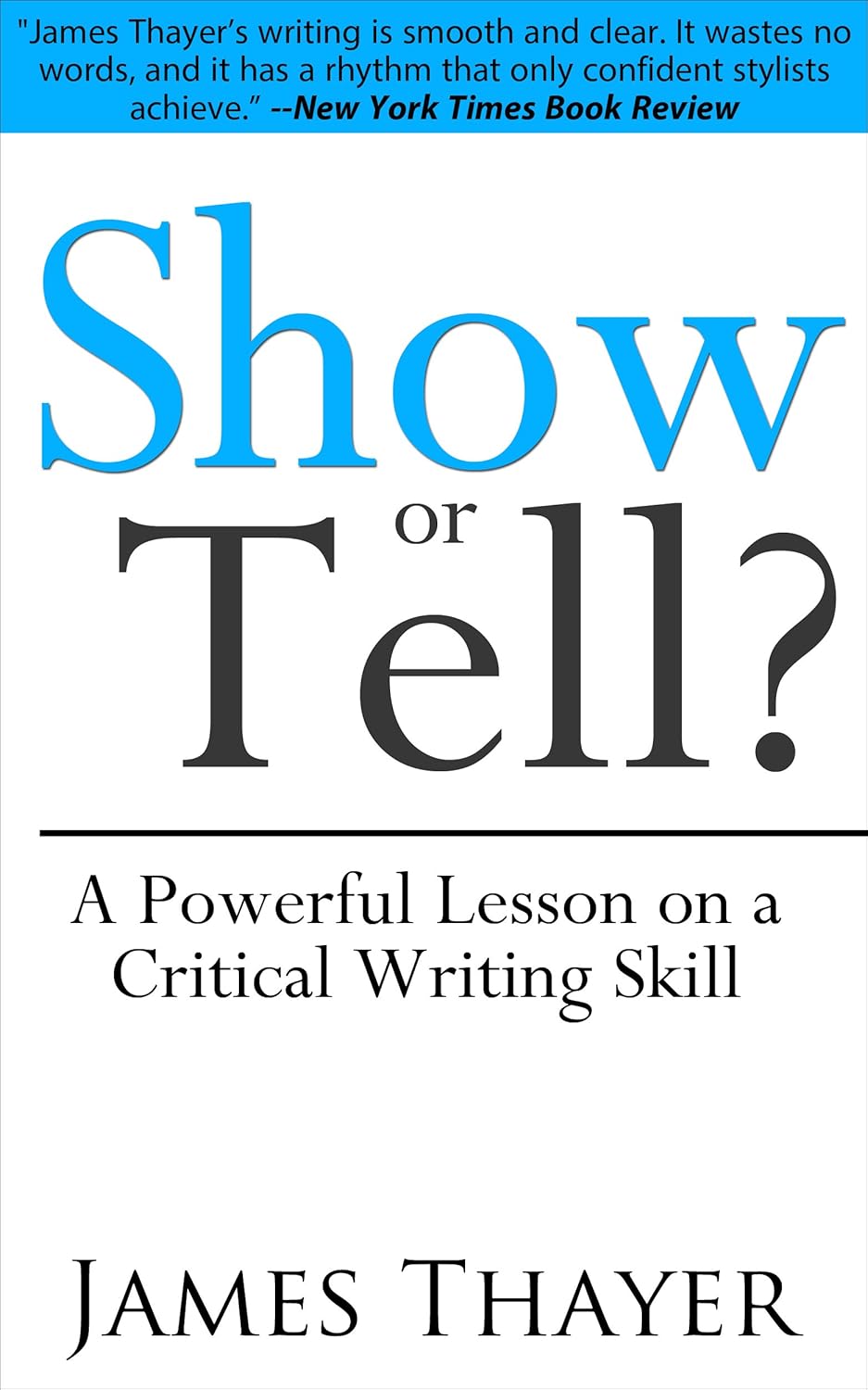
Here are some of his examples of how to Show your setting/world/place instead of simply explaining it (Tell). I’m going to bold the sensory details that help you see, hear, smell and feel the settings. Also, notice how Thayer also includes some action (things happen) to describe these places, using strong verbs.:
Tell: Rob’s bedroom was a mess.
Show: Rob kicked aside two empty Coke bottles, and swatted an empty pizza box off on his bed. He pushed aside a pile of shirts, then sat down.
* * *
Tell: The forest was gorgeous in the autumn.
Show: Aspen leaves had fallen, covering the forest floor in gold.
* * *
Tell: Janet had a colorful room.
Show: Streamers hung from the chandeliers, and helium balloons rose from every corner. A red and yellow banner read, Happy Birthday.
* * *
Tell: The house was stark and uninviting.
Show: The house was made of unpainted concrete blocks, and the windows didn’t have shutters or shades.
* * *
Tell: The lawn was dead.
Show: The grass rose as high as his knees, and dandelions grew between the paving stones.
In his book, Thayer has examples of how to SHOW other parts of writing, which could help you bump up your narrative essay–ranging from showing weather, aches and pains, how people look, reactions, personality and emotions. Did I mention it’s only 99 cents?
Here’s Thayer’s brilliant way to tell the difference between showing and telling:
“What’s the difference between these two sentences?
His arm itches.
He scratched his arm.
The difference is profound, and knowing it will instantly make someone a better writer.”
(In case you are still confused, “His arm itches” is telling and “He scratched his arm” is showing.)
Side Note: If you are applying for the University of California, keep in mind that your essay about Describe the World You Come From could be recycled for The Common App prompt on describing a place your are perfectly content. They might not be talking about exactly the same thing, but if they are close enough, why write an extra essay if you don’t have to?
Both of the prompts–the UC Prompt 1 and Where Are You Perfectly Content–that ask you about places, however, have potential pitfalls, and I have included warnings and ideas on how to avoid them in the posts I wrote about them. I strongly urge you to read them. Especially if you end up using the same one for both applications–they need to be good! (Hint: both are highly improved if you include something that happened in your world or special place.)
September 28, 2013
You Are Not Alone

Started 9-28-2013: Click the Map for Details
I gave away 100 copies of my ebook guide last week. (If you missed the giveaway, I’m planning on doing another in mid October.) Even though I’ve always had visitors from all over the world, I was overwhelmed by the enthusiastic students from so many countries. And they all shared one thing in common–they wanted out of Essay Hell!
I haven’t crunched the numbers, but I would guess only about 30 percent were from the United States. Some were from large public schools in New York, California, Virginia, Ohia, Utah, Connecticut, Wisconsin, etc. Others were from parochial schools and specialty (charter, magnet, Montessori, all girls, etc.) schools. Two were home schooled.
I was so impressed by the variety of countries. My favorite part was hearing all their unusual, distinguished names and home countries. Here’s just a sampling:
Bernice from Ghana.
Aawaz from Nepal.
Innocent from Kenya.
Ahn from Vietnam.
Peiching from Malaysia.
Azmayeen from Bangladesh.
Melissa from Dubai.
Yin from Singapore.
Jayani from India.
Guzman from Uruguay
Jezz from Taiwan
Aradhana from Thailand
And that’s just a sampling. Based on their names, I’m guessing quite a few students from U.S. schools have rich ethnic backgrounds and possibly parents who were recent immigrants–Nimalen from Alabama, Ha from Pennsylvania, Preethiya from New York and Anjali from California.
I know all these students are going to do well in their college search and lives. How? First, they were scrappy enough to find this web site. That alone showed me that they were serious about their applications and understood the importance of these essays. They were already devoting time searching the web for help. And most of them had already read many of the posts (a time suck in itself), and then they sent me emails to win the free book. This shows the all-important quality called grit!
Not to mention that every one of them expressed a lot of gratitude for the help and book. How can you not love these kids?
In honor of all the students all over the world who are struggling to write these college application essays–especially those who are doing it pretty much on their own–I’ve added a visitors counter on my home page. From this point on, it will show the flag of each visitor’s country.
So no matter where you are–in a small village in India, or a high-rise apartment in Tokyo or a beach town in California–and are feeling like you will never find that great topic for your essay, and you have nothing to write about, and that you are sunk, at least you are not alone! Almost everyone shares your despair at some point. But, if you just take a deep breath and know you do have great stories to tell, and keep reading advice and tips on how to find them and then write a narrative essay, you will surprise yourself–and write a great little college admissions essay!
Before you know it, you will join all the other happy college students in the world and forget all about this hard blip of essay hell in your life. So get back to work! If you can just get started writing, you will be done in no time.
Try this Jumpstart Guide to get started. Good luck!
September 26, 2013
Should You Humblebrag in Your Essay?

A smart dad sent me an email recently asking how college-bound students could work in related achievements and accomplishments into their personal, narrative-style essay, without sounding like they were blowing their own horn. It’s definitely a fine line. Students write these first-person essays as part of the application process to convince colleges to admit them. How can they not strut their best stuff?
The whole challenge reminded me of humblebragging. If you live on a different planet (or don’t use social media) and haven’t heard of this word for phony humility, it’s basically the fine art of boasting about yourself and making it sound like an accident. The trick is to cloak your bragging with other comments, which make it seem as though the impressive part just kind of slipped out. The more subtle, the better. Did I mention how much my hand hurts from signing copies of my new book?
Even though I promote a more soft sell in these essays, I believe students can still use them as an opportunity to share details about their impressive activities, interests and accomplishments. It’s all how you present them.

When casting around for a topic for a personal narrative (core essay), I usually start by identifying a student’s core or defining qualities. After we land on a good one, we root around for interesting stories, moments, experiences or incidents that the writer can use as a real-life example of that quality to start the essay (called an anecdote.) The whole idea is that the writer shares examples of that core quality in action, instead of simply explaining how they are that way and making a case for why it’s so impressive.
This is hard to explain. Hmmm. See if you can tell the difference between these two approaches by a student writing about a core quality. Let’s say he was a “resilient” (bounce back after defeat) guy.
A. I’ve always been a resilient person. I pride myself in my ability to pull myself back up even after I fail. I have a positive attitude and always try to set new goals, and not let minor setbacks get in my way. Even when I failed my driver’s license test five times, I went back with a new determination to pass it. I always succeed when I decide not to let anything stop me.
B. It was my sixth attempt to pass my driver’s license test. The first time I made two left turns without using my blinker. The second time I ran over a traffic cone and didn’t even notice. During my latest attempt, I accidentally punched the gas instead of the brake, and I just sat there and cried. But weeks later, I was back, hands on the wheel at 10 and 2. Not even the pounding rain was going to stop me.

So that’s the difference between A. talking about what you did in order to impress the reader and B. sharing examples of what you did. If this writer was writing a personal essay that showcased his resilience, and started with this anecdote of “the time” he took his driver’s license test under duress, he most likely will have opportunities later in the essay to weave in other examples of his ability to recover from setbacks. This is how you can work in related accomplishments in your essay without sounding like you’re bragging.
* * *
Later in the essay, this writer might share some other areas in his life or in his recent past where he got knocked down–in his social life, academic life, sports or other activities–but recovered because of his resiliency. He is not sharing these accomplishments, achievement or activities just because they are impressive, but because he just happened to be doing them when he got knocked down–and recovered. See the difference?
In your essay, simply relate what you did, and why–not that you were the one who did something impressive. If what you did and why were impressive, so be it! Or if what you were doing when you faced a setback and were then resilient just happened to be impressive (you were working on your hand-built battery for your AP Chemistry lab or you were sewing quilts to give away to children in the local hospital), so be it! These examples do have a hint of humblebragging to them, but you can’t help it if you are involved in impressive activities, right?
Just don’t force in activities or accomplishments that you think are impressive just to, well, impress readers. They will see through that in a heartbeat. The examples you share need to support the larger point you are making about yourself in the essay. If you stick to that, you most likely won’t cross the line into showing off. (Also, definitely don’t waste precious words trying to work in an activity or accomplishment in your essay if the college will learn about it somewhere else in your application.)

In your essay, let the impressive activities fall into the background, or serve as a backdrop. They do this naturally if you stick to what you were doing (the specifics), why you were doing it, what you thought about at the time, and what you learned in the process.
Another example: If you are writing about “the time” a tree that crashed on the roof of the church you were helping build in Malaysia, focus on what you did to keep others safe, or how you figured out how to get it off the roof–and just let the impressive fact that you were in Malaysia helping build a church fall in the background. Truly impressive facts pop off the page all by themselves. You want to show that you were too busy demonstrating your core quality (problem solver? resourceful? leadership?) to worry about how you came across. If it happens to be impressive, so be it!
A lot of my students have no idea that they are sounding boastful until we read their essay out loud together, and I flag parts that cross the line. Just ask whoever you have read your essay to look for parts where you might sound like you are bragging or come across as unlikeable. Insist that they be honest with you! Often, you just need to tone it down.
I would love to help you more, but I have to catch up on my accounting records for my booming book sales to keep up with the demand! Sometimes it’s really hard and overwhelming when so many people are knocking down my door for my help and advice 24/7. ; )
Haha!
September 23, 2013
Insider Essay Advice from Tufts

When people visit my Essay Hell web site, I can see where they come from on my Google analytics page. (I know, kind of creepy, but that’s just how it works now.) I noticed a recent spike of visitors from a blog written by an English teacher in Southern California.
Turns out, this teachers uses my blog to help teach her unit on writing college application essays. I’m so honored and would love to thank her publicly, but I’m not sure she would appreciate that I’ve been reading her class blog, which is intended for her students. This teacher assigned her seniors to read at least two posts and share what they learned from them on her blog. Great idea!
This was like a dream come true for me: A group of smart, motivated students who have no choice but to read my helpful advice and tips and be forced to say something nice about them. As you can imagine, I read every word they wrote, and swooned and laughed, and even shed a tear here and there. It made me feel so great–even though they had no choice but to write all those kind words!
(My favorite comment was the student who asked why the devil on my blog wears Converse sneakers. I have no idea. I guess he’s supposed to be a hip devil. Another student was annoyed by my shameless plugging of my book. Did I mention you can buy it for $9.98? Haha. And about half the students thought I was a man. Do I really sound like a guy?)
From their comments, however, I could tell that these students were going to turn out some amazing essays. They totally got most of my best advice, everything from picking mundane topics to using anecdotes to showing their grit. And unlike a lot of English teachers, their teacher clearly understands what makes up a compelling, narrative essay. They don’t know how lucky they are!

Tufts University
This teacher is so smart that I borrowed a fantastic video she shares with her students to help them get an idea of what admissions officers are looking for in these essays. The video with admissions officers from Tufts University is so worth the five minutes it takes to watch. If you don’t want to watch it, I’ve summarized some of their best advice:
First lesson: These admissions officers are young! I’m almost 53, and I keep thinking admissions officers are around my age (still young, right?). Wrong!! They are really young, having graduated in the 2000s instead of the 1980s. Even with the big age gap, however, I believe what they want isn’t that different from what their older peers would want:
In the video, they were asked: What are you looking for?
One said, “To unpack the story inside.” Another said, “To admit the kid.”
When asked what they wanted to know, they said:
“I want to know who you are. Not what you are doing, but the why and how of who you are. I can see clearly what you are doing (in rest of college app)…just I can’t jump in your mind…I want to feel like I just stepped out of your life.”

Another guy said, “Is this the kind of kid who gets really excited about ideas?” In the essay, he said he wanted the student to “be able to take a stand and express something.”
When it came to word counts, one admissions officer said she doesn’t pay a lot of attention to them, and never counts the words, but advised students stick with the limits.
Do they check students’ Facebook pages? They all laughed and said no way.
Final advice? One said, …”to be empowered to think of the things I was doing were cool.”
If I were you, I would just watch the video. It will give you a feel for who’s at the other end of this application process, and I think it will make you feel better in general. These are real people, not that much older than you, who want you to succeed and figure out if their school is where you would be the best fit.
Even after watching a video like this, however, I know some students will still come away confused. Yes, they understand now what admissions officers want–to know the real you–but how exactly do you write an essay that shows them this? Well, you have some more reading to do–this entire blog is packed with advice on how to do that. Start with my Jumpstart Guide, and go from there. And of course, you can always buy my book! ; )
Here’s the link to the video from Tufts University: http://www.youtube.com/watch?v=hxBo99fwBFE
September 18, 2013
Book Giveaway for Escape Essay Hell! Guide

I’m Giving Away 100 Copies of My Popular Writing Guide!
10 a Day for 10 Days
Almost every day, I have students tell me they cannot afford to buy my ebook guide on writing college applications essays–Escape Essay Hell!--so I decided to give some away for free. I want as many students as possible to find help writing these dreaded essays, and I understand that ten bucks can be a lot for some people. That’s the main reason I started my blog!
So, starting tomorrow (Thursday, September 19, 2013), I am going to give away 10 copies a day to the first students who send me an email request–and I will send 10 copies a day for a total of 10 days. That means I will be giving away 100 copies total.
So if you are interested, send me an email at this address: EssayHell@Gmail.com. In the email you must give me your name, the name of your high school or college, and that you would like a free copy. That’s it!
I will send you a copy of my ebook that you can download and read. I am going to go on a first-come, first-serve basis. I will let you know once I have reached 100 winners–so you won’t waste your time.
Good luck!
Janine Robinson
September 17, 2013
Work First, Surf Second: A Lesson in Mundane Topics

A student who I will call Ryan arrived for his tutoring session yesterday, and showed me what he had written for his English class. His essay started with how he worked with Habit for Humanity and a trip he took to work with Native Americans. Oh no. Not the old mission trip essay. Way too overdone. Usually dull as dirt. So I suggested we start fresh.
Example of One of My Tutoring Sessions
I asked Ryan to jot down some of his defining qualities. He wrote down conscientious, reliable, consistent and relaxed. I noticed that several of his qualities overlapped, so I asked him about his sense of responsibility–fishing for his interesting stories, moments or small experiences that could “show” how or why he is responsible in his essay.
“Was there a time in recent years when you were not responsible, and it maybe even got you in trouble?” I asked Ryan, trolling for “a time” we could use as an anecdote (mini-story) to start his essay.
He thought about it, and quicker than I expected, he said, “Well, when I forgot to water my dad’s plants.”
Bingo! Shazam! Yippee! I’ve been doing this long enough that I can usually spot a great topic when I hear just an inkling of one. (I’m confident you can tune your own ears to great topic material. Just pay attention to what catches your interest. Hint: problems, or when things go wrong.)
[image error]
Like a lot of moments like this, Ryan’s story only got better as we dug for details. His father had gone on vacation, and assigned Ryan certain responsibilities while he was away. Ryan was supposed to care for his dad’s tropical fish, maintain the hot tub chemicals and above all, water his beloved plants.
To help the reader get why it was such a huge ordeal, Ryan had to help us understand how much his dad cared about those plants. Again, we dug for details.
Turns out, his dad is a passionate gardener, and grows all types of rare tropical plants in his yard. He gave Ryan explicit instructions on how to water and even feed his prized plumeria trees, as well as tend other plants.
Then the big question for Ryan. What happened? How did you forget?
“Well, there was a really big swell that week…” he said. “I surfed every day, all day, came home and slept, for the entire week. I spaced the plants.”

You almost have to live in a beach town with a surf culture to understand what this means. Surfers can only surf if there are waves, which isn’t always. So when the wave patterns (swell) are huge, as in “Surf’s up, Dude,” even the most responsible people ditch their jobs (or school or college application essays…), grab their boards and hit the water.
I thought to myself, “Great, that’s the last thing we want to show colleges–that Ryan is one of those ‘flaky’ surfer guys.” But I knew this was a terrific, mundane topic, and true to Ryan. (I’ve written a lot about how mundane, ordinary, everyday topics–such as dead plants–make better topics than those that sound impressive.)
Not to mention, can’t you just wait to hear about his dad’s reaction? Yes, it was bad. The dad wasn’t the type to rage and yell, but instead delivered seething lectures in a calm voice that made Ryan want to crawl into a hole. But do you see how sharing a problem (which happens to line up perfectly with Common App Prompt #2?) makes us instantly relate with Ryan and want to read more? This empathetic connection is exactly what you want with your essay.
Now Ryan is perfectly set up to go onto to share how he reacted to this problem, and what he learned from it. The fallout couldn’t have been more perfect (at least for Ryan’s essay). Ryan said that his entire life his dad had emphasized being responsible the most. Ryan said he always told him, “Work first, surf second.” Can you see the larger life lesson here, which Ryan learned the hard way? It’s really a case of learning priorities and the old universal truth of putting “First Things First.”
Ryan even said that his dad, a successful entrepreneur, had two brothers and that both uncles were surfers and both now worked for his dad–something that made more sense to Ryan after this incident. Apparently, those guys still put surfing first. Ryan said he now works hard to put first things first, including chores and homework. He even earned back his dad’s trust, and was put in charge of plant watering again just last month, and everything survived this time. (This last fact was a perfect way to wrap us his essay–coming full circle with his topic.)

When Ryan reflects in his essay on this mistake, and what he learned from it, he will include all these great details, observations and insights. I think one of the most powerful features of this essay is how we can all relate to what happened to Ryan, and that gives his essay a huge appeal. It’s all about connecting with the reader.
I wanted to share this process with you since this is how I work with students to discover engaging topics, and help them learn to present them in a narrative style essay. I have a mini-version in my Jumpstart Guide post, and I take students step-by-step through this process in my ebook guide, Escape Essay Hell! (available here on my Web site or at Amazon.)
This is not the only way to write a great personal essay, but maybe it can help you get started!
September 15, 2013
Jumping to Conclusions: How to End Your Essay

How to Conclude Your College Admissions Essays
Here’s an excerpt from my ebook guide on how to write a college application essay using a narrative, storytelling style. I pulled this from my chapter on writing conclusions. Some students find ending their essays a snap, others get a bit lost at the end and get off track.
(These tips will make the most sense if you followed my loose formula for writing a personal essay, where you start with an anecdote to show your reader what you are talking about, and then go on to explain its significance in the rest of the essay. You can get a sense of this formula by reading my Jumpstart Guide post. If you want a step-by-step guide to this process, buy my instant ebook Escape Essay Hell! for about ten dollars either here or over at Amazon.)
THE FOLLOWING IS EXCERPTED FROM CHAPTER NINE OF ESCAPE ESSAY HELL!:
Like all conclusions, you are basically wrapping up your story, summing up your main point(s) and ending on a broad, upbeat note. You can mix it up however you want, but here are some surefire ways to making it a memorable wrap:
Bring Your Essay Full Circle
Find a way to link back to that original anecdote you started with (in this example, the writer wrote about how his short stature didn’t keep him from pursuing the high jump.). Bring the reader up to date to the present. For instance, with the high jumper, here’s how he could let us know where he is with that sport now: “I’m not sure if I will continue high jumping in college, and it’s not a sport you can pick up and play anywhere. So there’s a chance I may never catapult myself over a pole again in the near future. But I will never forget that moment of exhilaration as I cleared that bar during our big meet. Everyone raced up and gave me high fives and big hugs. What I will always remember is that feeling of rising above all the opinions of other people who thought I was just another short guy. …”
Re-state your main point in a fresh way, and touch on your core quality and what you learned if possible: “At this point, I almost believe that if I’m determined enough, I just might grow another inch or two.” (Humor never hurts in these essays; it often shows you don’t take yourself too seriously.)
End by touching on how you intend to use the life lesson from your essay in your future plans, to meet goals or dreams: “If nothing else, I’m eager to find out exactly how high I can go with my dream of finding a career in the world of chemistry or engineering.
HOT TIP: It’s always a good idea to try to end with a little “kicker” sentence—if it works and doesn’t sound too corny. Don’t be afraid to be idealistic and declare your dreams or goals. Or you can try a play on words. If you aren’t sure your “kicker” works or not, have a friend or parent give you some feedback. “One thing for sure, I know I won’t come up short.” Hmmm. Does that work or is it too corny?
September 6, 2013
Some Supps Are Just Asking for BS

Many of the students I work with have finished their core essays for their college applications, and are now asking for help on the supplements. For most, writing their personal statement-type essays wasn’t that bad, searching for their stories and unique topics to tell and share. But these supps are not nearly as fun. In fact, for most of the supplements I have seen so far, it’s a major drag.
So I ask: What’s the point? These supplements that want students to tell why they are the perfect fit for their school, or what they are going to give back to a university, or why they have selected a certain college. Most of my students tell me, “I have no idea what to write.” And why should they? Answering these questions is almost always an exercise in making up a bunch of stuff.
This is why I was so heartened to read this article yesterday about one fine liberal arts school, Kenyon College, that decided to drop its supps. Here’s a snippet from the article:
Previously, (Kenyon) Admissions posed three supplemental questions for applicants to answer. One of them was Kenyon-specific and asked what students thought made them a good match for the College.
“That was such a vanity question, you know. Tell us about ourselves,” said Dean of Admissions and Financial Aid Jennifer Delahunty said. “They had to go do some false research and then they had to sort of spit back to us what we put on our website, which we saw a lot of,” she added.
Way to tell it like it is, Jennifer! I know I am on the fringe of this whole admissions industry, but I would just suggest that schools that want to keep these supps at least ask questions that students can answer in a true and meaningful way.
When coming up with supp questions, shouldn’t colleges think about what kids are like in their mid teens? What they know. What they genuinely care about? The kids I work with are highly idealistic, and just beginning to get a sense of their own potential and of the world in general.
Schools that spend some time and come up with original, creative, provocative and age-appropriate questions must get such interesting responses. In my opinion, they could all ask that brilliant prompt that Stanford asks: Write a note to your future roommate…
I believe asking students questions that they do not have answers for just increases the stress of this entire process–and for no good reason. Do we really want to teach our kids that if they want something they must say whatever it takes, even when they have nothing to say. No! In the end, we all suffer.