Janine Robinson's Blog, page 17
August 26, 2014
The Prospect Cooks Up Delicious Essay Recipes!

If you’ve been looking for help with your college application essay, I assume you have discovered the mountains of information (some helpful; a lot no so much) out there on the Web. One of my favorite resources for students is The Prospect, which is an organization centered on college admissions and high school/college life.
The main reason I love The Prospect so much is that it is all about helping students survive high school and get into the college of their dreams–but it’s also run by students like you! Their talented staff offered to share some of their best essay-writing tips here on Essay Hell. I think you will find their foodie-approach fun, inspiring and useful!

College Essays: As Told Through Cooking!
(From the Staff at The Prospect)
For those of us who are beginning senior year, the college application essay is one of the biggest components to be considered in these upcoming months. The choices are wide-open: start right away or wait until it’s too late and you have to write it? Write a truthful story about who you really are or cook together a delicious pot of lies?
Luckily, The Prospect is here to help! The college admissions essay can be tackled with the help of just three tasty core ideas:
FIND the recipe
ADD your own spice
TASTE test it, then try again!
(It’s just as easy as cooking!)
Finding the recipe is the first step, and really goes into organization and planning. Here’s some tips and advice from The Prospect’s own graduating seniors and college students:

“Know your deadlines, keep reminders, apply about a week early – I applied to around 20 universities, so I depended on my counselor to keep a track of all the dates. Big mistake. I got to know of the U of Florida deadlines literally the day before it, and since it was my first application, I was at my wit’s end about the transcripts and what to write what. And this was a school that was in my top 3!” –Niharika
“Give yourself a lot of time to write your essays… Starting right now, keep a Word document or a notebook of random sentences and ideas you think of. This will help you when you write your essays later, because you never know when inspiration will strike. After you’ve written a draft of an essay, leave it for a few days and then read it out loud to yourself. This will help you figure out which parts of your essay need the most revision.” –Heather
“Start drafting essays early! I literally did not start writing my essays for schools using the common app until mid December. My first draft was so incredibly formal that it made me want to puke. After I wrote my first draft, I sent it to 3 people and asked them to basically shred it to pieces. I basically came up with 10 drafts in 7 days but I took about a 5 day break so my mind could be fresh when I did my final draft. If I were to compare my final with my first, the changes are so so so dramatic and different. Honestly starting out early (it doesn’t have to be summer early but start in October or so) makes all the difference.” –Ameera
The next step is to add yourself– pour in some sugar, sprinkle some spice, do whatever you need to do to showcase your personal pizzazz. Try out these tips to make it work:
“Don’t be afraid to write on a cliche topic. Note: I say don’t be afraid, not don’t let it your first and only topic of choice. It’s not about what the story is but rather how you tell your story. I tried so hard to steer away from any topic that made me seem like a pity party (religion, race, etc) but no matter what, I would always go back to writing about my hijab. For me, wearing the hijab plays such a huge role in my life that I didn’t want a college to base who I am simply on my statistic and grades–I wanted to prove that my hijab is me and I am more than a number. Though I did discuss my hijab, I injected my personality EVERYWHERE and made the essay mine.” –Ameera
“Try to sound natural and conversational. Don’t be pretentious, and don’t use big words for the sake of using big words. If you do use a big word, make sure you’re using it correctly. The words “plethora,” “myriad,” “arcane,” “cacophony,” and “ironic” are overused (in my opinion, based on essays I’ve read) and often seem out of place, so think carefully before you use one of them. In general, avoid overusing adjectives.” –Heather
“My college essay writing advice is simple: be yourself, be honest, and let your personality shine through. For the college I will be attending this fall, one of the essays asked what made you choose the major you had put on the application. While it could have been easy to give some complete BS, inspirational answer, I outright told them that the TV show The West Wing made me want to go into Political Communications. It may be a rather silly reason, but it was the truth.” –Annie

So you’ve finished, it’s all done, you’re never looking at that sorry essay ever again… And then comes in step 3: taste test it, then try again and again until the seasoning and the presentation is as perfect as possible. You really only have this one opportunity to showcase YOU– make it good! Try it again with these three tips:
“Don’t be afraid to start all over again. The essay that ultimately became my CA/QB essay was my third attempt. Before I had written it I had written two completely different essays, neither of which really worked. I feel like people are so afraid to completely trash an essay and they shouldn’t be. Often it takes a couple tries to find your voice and you shouldn’t be afraid to start over because your next essay might be a thousand times better.” –Samantha
“Always get people to read your essay and drafts. You don’t have to ask EVERYONE EVERYWHERE you go. In fact you don’t need 15 drafts to make an essay perfect. Just understand that if someone is criticizing your essay, you better be able to defend what you’ve written or else you really do need to change it. This goes for grammar, spelling, and topic of the essay.“ –Ameera
“When I wrote my college essays, I really didn’t spend enough time thinking about what I wanted to say and how I wanted to say it. I made my college essays too narrow instead of expanding on a bigger idea. For example, I wrote about being “shy” and how I learned to raise my voice, but I didn’t really include examples of how I had raised my voice. Instead, I just included what I learned but not what I learned it from and how I truly applied it; it’s important to incorporate not just what you learned, but also how it changed you and inspired you and motivated you. I had planned on doing this, but the word limit stopped me. If I would’ve started thinking about my essays sooner, I would’ve been able to include what I wanted to include despite the word limit. I rewrote my essays several times, but I could’ve written them more. Sometimes figuring out how to explain who you are takes lots of time, and that’s okay. But you have to allot yourself that time or you’ll end up with a halfhearted essay despite your intentions.” –Paige
The results are in: Work work work on your college admissions essay! It could make the difference between being accepted to your dream school and being rejected from it. If you don’t think you have a good topic, try doing something new this summer to make one! Plan your own expedition, volunteer at a cool charity, do something awesome. Best case scenario, you’ll find the perfect topic for the perfect essay. Worst case scenario? You’ll have great stories to tell come school time. If you wrote it once and you already think it’s perfect, try sending it to your English teacher and see what you can change.
The time has come, seniors. Head to the college admissions kitchen and get cookin’ on your delectable college application essay!


August 21, 2014
How to Write the UC Transfer Essay: Why This Major?
[image error]
Why You Chose Your Major: A Love Story
If you want to transfer into any of the University of California schools (UCLA, Berkeley, UCI, UC Davis, UC Santa Cruz, etc.), you need to write two college application essays. One is the same prompt that all students are required to write—which basically asks for a personal statement style essay. It’s known as Prompt 2, and I wrote “Personal Quality, Talent, Achievement…” as a guide on how to write this essay in a narrative style.
Now I want to offer some ideas on how to answer the second prompt required for transfer students:
Transfer Student Prompt 1: What is your intended major? Discuss how your interest in the subject developed and describe any experience you have had in the field — such as volunteer work, internships and employment, participation in student organizations and activities — and what you have gained from your involvement.
Like all prompts, the first step is to break it down and understand what it’s asking, so you answer it. (Use this as a checklist after you have written it.) This has four main parts:
1. What you will major in at the U.C.
2. How and why you got interested in that field or subject.
3. Examples from your past that involved that field, and contributed to your growing interest or knowledge in it.
4. What you have learned up to this point about this field or subject, and any ways it has affected you (your goals, what you value, etc.)
In general, I believe this essay will be shorter than the other (personal statement.) You have 1,000 words total for these two essays. It’s up to you, but I would shoot for roughly 600-700 for the personal statement, and 300-400 for this one about your intended field of study.
Think about this essay as a type of love story: You will recount the story of how you first met or the initial attractions, and/or what sealed the deal between you (share some of the highlights of your developing relationship with examples), and why you are convinced you will stay together.
To grab your reader at the start, my best advice would be to start your essay with your most interesting example of either:
1. What first sparked your interest in this field or subject (A specific moment, experience or “time”).
2. An experience you had related to this field or subject where you learned something about yourself, others or the world that helped confirm or develop your interest in it. (Places to look: volunteer work, internships and employment, participation in student organizations and activities…)
3. If you don’t have any remarkable direct experiences with this field or subject, find a core or defining quality that you have that has directed you toward it. Of course, try to include examples of real-life experiences where you developed this related core quality to illustrate your growing interest in this field or study. For example, if you want to study art. Maybe you don’t have a long list of specific art study programs yet, but you have had other experiences where you developed the arty qualities of being creative and expressive.
This is how you do not want to start your essay:
“My intended field of study at The University of California, Davis, is engineering. Over the years, I have developed a strong interest in this field and have participated in a variety of programs that have fueled my passion for engineering. Last summer, I worked at a company as an intern and learned many important skills related to computers and technology…”
Okay, this is an exaggeration, but you get the picture. Instead, pick one of those real-life experiences that either sparked your interest or helped you develop it, and start with that. This will engage the reader at the start, and also set you up to then explain the impact this experience had on you–what you learned about your field, how it challenged your thinking somehow, how you recognized that you were good at it (core qualities lined up nicely), how it made you feel about it in different ways, and that you enjoyed it.
Craft that moment into an anecdote, which is a way to relate a real-life moment using literary writing techniques. Anecdotes allow you to SHOW the reader your point as opposed to simply TELLING them about it. Put them in your shoes. Show yourself doing something related to your field or subject. Read these other previous posts to learn how to write an anecdote.
If you had an engineering-related internship or summer job, try to find a specific moment to share from that experience that illuminates your interest in this field. Start by sharing that moment, and how you felt about it, what you realized or learned, and go from there. Then you can work in other related experiences.

Basically, you are telling the story of how you fell in love with that field: How you first met, the moment you realized this was “the one,” other dating highlights, and how you have been changed and improved by this relationship, and your intentions for the future (Do we hear wedding bells? haha)
Sorry if that was an over-the-top metaphor, but maybe this will help you think about the order of your essay. Also, it is important to answer the fourth point about “what you have gained from your involvement” with this field. This is how I would wrap up the essay, and talk about how this field or subject matches who you are, what you care about, your passions, goals and dreams.
August 19, 2014
How to Turn a Real-Life Moment into an Anecdote

I confess: I love anecdotes. These are basically when a writer shares a mini-story about a real-life moment or experience. Usually, they are plucked out of the past, and presented without much introduction. Their power is that they draw you into a story, or college application essay, by starting with a punch of drama. Anecdotes make awesome introductions.
The key is to get as close to the action as possible. I’ve written tips and advice on how to write anecdotes, but thought I would try to model an example. They seem so simple when you read them, but they are harder than you might think to craft. The trick is to practice, and study how other anecdotes are put together. The most common place to find them is at the start of longer newspaper pieces or magazine stories, or of course, personal (narrative) essays.
I advise students to search their past for “times” or incidents or experiences that happened to them, which they can use to start their essays to illuminate something (quality, characteristic, talent, etc…) about themselves. I thought about my defining qualities way back in high school, and one was that I wanted to be adventuresome.
So here is a “time” when I was trying to be adventuresome. Like all good stories (including mini-stories like anecdotes), the best ones involve some type of problem. My problem in this case was that we were about to get in trouble.

Here’s what happened if I just tell it to you straight, as in describe it to you. Then you can compare how I re-wrote it in a more story-telling or fiction-like style to craft it into an anecdote. I’m hoping this will help you learn to convert your real-life moments or experiences into anecdotes:
I had just spent the summer after graduating high school waiting tables at a lodge in a National Park in Wyoming, and decided to hitchhike home with a friend to St. Louis, Missouri. (This was in the late 70s, when people still hitchhiked–although it was pretty stupid even then. So I do not advise this mode of travel.) Anyway, a guy who gave us a ride in Montana (we were up in Glacier Park) told us a hot tip: We should hop a freight train east. It would be a lot easier and more direct, he said.
At the time, all I thought about was how cool that sounded—and totally ignored how dangerous it could be. He told us to meet a friend of his who tended a corner bar in a tiny town, called Havre, and that guy would help us figure out the trains. The bartender told us to go to the train yard early in the morning (like 4 a.m.) and pick one of the longer trains heading east, and to get in a car closer to the engine (less bumpy.) So we did, and it was totally scary in the pitch dark around all these parked giant trains, and eventually climbed into an open freight car and tried to hide in the corner (There was no “hopping” involved.). At one point, a train worker found us, but for some reason didn’t kick us out. We road that train all the way to Fargo, South Dakota.

Ok, now I will extract an anecdote out of that “time,” and try to start as close to the “drama” or highlight of the action or tension or conflict or problem as possible. (This “moment” is from the sentence in bold above.) This is one way to write it:
Crouched in the far corner of the darkened freight car with my friend, I buried my head in my knees and waited. It had been almost an hour and the train had yet to budge. Then I heard the footsteps, which sounded like boots on gravel, that grew louder and louder. They stopped abruptly, apparently right outside the open door. I squeezed my eyes shut, but still could tell when something, a flashlight or lantern, was illuminating our car. I held my breath. To my relief, the footsteps started again.
“Evening folks,” said a deep, soft voice, before the footsteps faded into the distance.
(Back Story) That terrifying night last summer, when I hopped my first freight train on my way home after a summer waiting tables in the Rocky Mountains, was one of the most frightening times of my life, but at the same time, part of an adventure that taught me how much I was willing to risk for a free ride….We had started out hitching hiking, but then…
If you are trying to put together an anecdote about one of your experiences or a meaningful moment from your past, start by writing it out straight like I did, just recounting what happened. Then you can extract the details that you need to tell it like a story. Identify the moment closest to the action or excitement. Find the best details that describe the setting. Where were you when it happened? Who were you with? What happened? What did you hear, smell, touch, etc… How did you feel? Include a piece of dialogue–from someone else or even quote your own thoughts–to give it that narrative feeling.
One tip is to make sure to put yourself right in the middle of the action. Notice how I started by describing myself “Crouched in a the far corner…” Begin by saying where you were, or what you were doing, then go from there. This is often a great way to get started. You want the anecdote to be from your point of view, right at the center of the action.
At first, your anecdote might run long. If so, just go back and trim out anything that you don’t need, but leave the details to help it make sense. You will flush out the “back story” or larger context later in the piece.
Like I said, these take practice. But they are very powerful writing techniques. There’s no better way to put the reader in your shoes, and feel your pain, or thoughts or emotions. It’s the perfect way to help them care about you and what you have to say right off the bat. And this is what you want with your college application essay!
August 14, 2014
2 Sample Outlines for “Why You?” Supplements

Oops. Not again! We are talking about supplements for college application essays. Not vitamin supplements. Geez!
Even though supplemental essays usually are short—usually a paragraph or two—many students are stumped on how to structure them. Or on just how to start or end them.
In general, since they are so short, you don’t have to get fancy. Jump right into your points or answers. Be direct, but include details and specific examples.
Here are a couple ideas to help you get going. These are for the most common supp: “Why you at our college?” or “What will you contribute to our college?” or “Why do you want to go to our college?” My last post, 10 Tips to Power Your Supplemental Essays, can help you find great information to include in these short essays.
Here are two very simple outlines that might help you structure your “Why You?” Essay
A. Hit Your Best Point First
First paragraph: Start with your best or favorite point you want to make about what excites/intrigues/attracts you to this school, and briefly explain why. Often, this point is an example of a larger feature you like about the school. (Example: On school tour, you learned all students are thrown in a fountain on their birthday, and how you think traditions like that show a tight-knit, supportive college atmosphere, which you like.) You can spend a couple sentences describing this point, including specific details or emotion to give it color and interest. If you want, you could end this paragraph with some type of broader statement about how what you value (give specifics) lines up with what they value. (If you know what you want to study, it’s probably best to feature its academic appeal first, or emphasize that.)
Second paragraph: Now flush out your other points. Try to provide 3-5 other examples of how your college goals lines up with what they offer, and how you know that, and why it’s important. Draw from several areas in these examples: academic (this is most likely the most important); social; lifestyle; location; philosophical; extracurricular activities, unique opportunities, etc. If you make a point, back it up with a specific detail or example.
Unlike a typical longer essay, there’s no need to summarize or wrap up your supplement with a “conclusion,” unless it comes naturally. Better to use your space to give specific examples and make points supporting your main ideas.
B. Start With What First Attracted You to the School
First paragraph: Start by stating what was the main thing that first attracted you to this school. (Even if it’s relatively lightweight, you can expand into more meaty reasons next.) For example, one student wrote about how he always wanted to paint his face with this college’s colors and cheer on their football team. Or you could start with your first impression while on a school tour, or with what a friend of a friend told you about her or his experience. These are just ideas on how to get started. At the end of this paragraph, you can make a more general statement about the overall main reason you want to go there–and mostly likely this will be about your field of interest (top engineering program; study abroad emphasized; key location for future goals, etc.)
Second paragraph: This is where you can give more details on other top reasons you connect with that school. (Something first attracted you, but as you researched you learned about more and more features that you liked…) You can flush out the idea of how what they offer supports your academic goals–give specifics, such as individual classes, internship opportunities, special facilities, top professors, type of peers, supportive values, etc. But you can also mention other parts of the school that attract you and support your education goals–socially, lifestyle, philosophical values, hobbies, location, etc. (I don’t believe you need to have an actual “conclusion” with these supps where you formally summarize your points, unless it works out that way. Best to use the space to make solid points.)
You also might find my other post, Why College X?, helpful on answering this common supplement prompt.
August 13, 2014
What’s Sup? 10 Hot Tips to Power Your Supplements

Oops. Wrong SUP. We are talking college application essay supplements here. Haha.
I just gave a workshop on how to write college supplement essays to a group of college-bound students yesterday, and wanted to share some of the advice and tips on how to make them stand out. We talked mainly about the most common supplement prompt you will find this year: Why you at our college?
On applications, this prompt is stated in a variety of ways, from asking you to tell them why you are a fit, or what you will bring or contribute to their school, or just why you want to go there.
This prompt, though tiresome, is worth spending time on, especially for your top pick schools.
Of course, it will be different for each school, but chances are you can re-use many of your ideas. I wrote one post, How to Answer the Most Common Supplement Question: Why College X?, on how to match your goals with what the schools have to offer. In general, you need to identify how you connect with that school on a variety of fronts. Look for how what you want in your field lines up with what they have to offer. Take notes.

Photo via University of Aberdeen, Scotland (New library)
Here are some other tips:
1. Do your research. Scour the school’s Web site. Look for what they value in their messaging (key words: innovation; entrepreneurial; leadership, sustainability, etc.) and see if you can include experiences from you own background or interests that support these. I love college counselor Ethan Sawyer’s awesome list of resources, How to Write a “Why Us” Essay,” to research your target schools for these supps.
2. Dig for Ways to Make it Personal. (This is my favorite tip.) The best way to brighten a generic answer is to find personal connections. Mention something you saw while on a college tour–such as how a professor interacted with students or a specific moment with a student that impressed you (you could even gather details if you watch the online campus tour.). Mention how you had heard something about a college from a friend or family member who went there (a specific detail that you liked), and why you care about that, too. Or maybe someone you highly respect went there and that peaked your interest. You could even quote a college rep.
3. Get creative in your research. Go beyond the school’s Web site to learn what they are all about on many levels. Ask friends or family who go or went there for details. Follow the school’s Facebook, Twitter and other social media forums for insider info. Read forums on popular student sites, such as College Prowler and College Confidential–but also take what you read with a grain of salt. When your school holds their college fairs, show up and collect information on your target college by asking specific questions to the college reps. You can even call the admissions folks at your target colleges and ask questions. That’s their job!3. Collect information on what they value on many levels: academically, socially, environmentally, philosophically, lifestyle, etc. Are you a vegan and cafeteria food options matter a lot to you? Do you want a college that isn’t big on the Greek scene? Do you want a school with a rah-rah football team? Is an organic garden a must? Or a fencing club? Think hard about what you really care about, and feature that in your answer.
4. Look for specific examples and details of how what you want out of your college experience lines up with what they have to offer: internships, study abroad programs, exciting courses, stellar professors in your field of interest, unique learning opportunities, social activities, interesting locations, new facilities (Colleges will usually boast about these on their Web sites: libraries, media centers, training facilities, etc.).
5. If you mention something that intrigues you, make sure you know what you are talking about. If you say you live in the suburbs and want a big city experience, make sure your college actually is in a big city (eg. Columbia is not in downtown NY; and NYU is in Greenich Village and LMU is not in downtown Los Angeles.) It all goes back to doing your homework, which, with the Internet is EASY! If you mention the school mascot or colors, get them right!
6. Read samples. They might be harder to find, but search Google for “sample supplemental essay” for your target school. It doesn’t hurt to see what other student shave written. I know you are smart enough to not copy what they say, but get ideas for your own answers.
7. Know why you want to go there. Yes, this seems obvious. But my guess is that many students will have certain colleges on their list of target schools, but actually don’t know that much about them, other than their general reputation. This is your chance to do a little research, and learn more about what they have to offer. At the same time, you will have more to say if they require this “Why you?” supp.
8. Start with your best point. These supp essays are usually quite short–between 100 and 300 words. This usually amounts to a couple paragraphs. Although it’s not enough room to include anecdotes (mini, real-life stories), you can still “grab” the reader by starting with your most interesting point or idea. And these usually involve details or specific examples, which are natural “hooks.”
Spend a couple sentences on that one point–including more details. For example, if your main point is a specific program they offer, or that you fell in love with the friendly vibe on campus during a tour, or you have dreamed about using your 5 years of high school Spanish in a study abroad to Argentina (which they offer), talk about that first. Then (in your second paragraph) you can include other important points, maybe three to five, and speak about them in more general terms. The idea is that you use the color and description of that first juicy point to engage the reader. If you think college admissions officers get bored reading hundreds of Common App essays, just imagine reading these supplements!

9. Triple check your essays before sending them out: The last thing you want is for a supplement to hurt your chances. If you are re-using this prompt for multiple schools, make sure to proof each answer to make sure you don’t accidentally tell one school why you love another. Believe me, it’s happened before!
10. Stay tuned to this last tip. I’m going to write my next post on how to structure these supplement essays…
What’s Sup? Hot Tips to Power Your Supplements
Oops. Wrong SUP. We are talking college application essay supplements here. Haha.
I just gave a workshop on how to write college supplement essays to a group of college-bound students yesterday, and wanted to share some of the advice and tips on how to make them stand out. We talked mainly about the most common supplement prompt you will find this year: Why you at our college?
On applications, this prompt is stated in a variety of ways, from asking you to tell them why you are a fit, or what you will bring or contribute to their school, or just why you want to go there.
This prompt, though tiresome, is worth spending time on, especially for your top pick schools.
Of course, it will be different for each school, but chances are you can re-use many of your ideas. I wrote one post, How to Answer the Most Common Supplement Question: Why College X?, on how to match your goals with what the schools have to offer. In general, you need to identify how you connect with that school on a variety of fronts. Look for how what you want in your field lines up with what they have to offer. Take notes.
Photo via University of Aberdeen, Scotland (New library)
Here are some other tips:
1. Do your research. Scour the school’s Web site. Look for what they value in their messaging (key words: innovation; entrepreneurial; leadership, sustainability, etc.) and see if you can include experiences from you own background or interests that support these. I love college counselor Ethan Sawyer’s awesome list of resources, How to Write a “Why Us” Essay,” to research your target schools for these supps.
2. Get creative in your research. Go beyond the school’s Web site to learn what they are all about on many levels. Ask friends or family who go or went there for details. Follow the school’s Facebook, Twitter and other social media forums for insider info. Read forums on popular student sites, such as College Prowler and College Confidential–but also take what you read with a grain of salt. When your school holds their college fairs, show up and collect information on your target collects by asking specific questions to the college reps. You can even call the admissions folks at your target colleges and ask questions. That’s their job!
3. Dig for Ways to Make it Personal. (This is my favorite tip.) The best way to brighten a generic answer is to find personal connections. Mention something you saw while on a college tour–such as how a professor interacted with students or a specific moment with a student that impressed you (you could even gather details if you watch the online campus tour.). Mention how you had heard something about a college (something specific, such as their experience in a academic program or extracurricular activity) from a friend or family member who went there, and why you care about that, too. Or maybe someone you highly respect went there and that peaked your interest. You could even quote a college rep.
3. Collect information on what they value on many levels: academically, socially, environmentally, philosophically, lifestyle, etc. Are you a vegan and cafeteria food options matter a lot to you? Do you want a college that isn’t big on the Greek scene? Do you want a school with a rah-rah football team? Is an organic garden a must? Or a fencing club? Think hard about what you really care about, and feature that in your answer.
4. Look for specific examples and details of how what you want out of your college experience lines up with what they have to offer: internships, study abroad programs, exciting courses, stellar professors in your field of interest, unique learning opportunities, social activities, interesting locations, new facilities (Colleges will usually boast about these on their Web sites: libraries, media centers, training facilities, etc.).
5. If you mention something that intrigues you, make sure you know what you are talking about. If you say you live in the suburbs and want a big city experience, make sure your college actually is in a big city (eg. Columbia is not in downtown NY; and NYU is in Greenich Village and LMU is not in downtown Los Angeles.) It all goes back to doing your homework, which, with the Internet is EASY! If you mention the school mascot or colors, get them right!
6. Read samples. They might be harder to find, but search Google for “sample supplemental essay” for your target school. It doesn’t hurt to see what other student shave written. I know you are smart enough to not copy what they say, but get ideas for your own answers.
7. Start with your best point. These supp essays are usually quite short–between 100 and 300 words. This usually amounts to a couple paragraphs. Although it’s not enough room to include anecdotes (mini, real-life stories), you can still “grab” the reader by starting with your most interesting point or idea. And these usually involve details or specific examples, which are natural “hooks.”
Spend a couple sentences on that one point–including more details. For example, if your main point is a specific program they offer, or that you fell in love with the friendly vibe on campus during a tour, or you have dreamed about using your 5 years of high school Spanish in a study abroad to Argentina (which they offer), talk about that first. Then (in your second paragraph) you can include other important points, maybe three to five, and speak about them in more general terms. The idea is that you use the color and description of that first juicy point to engage the reader. If you think college admissions officers get bored reading hundreds of Common App essays, just imagine reading these supplements!
6. Triple check your essays before sending them out: The last thing you want is for a supplement to hurt your chances. If you are re-using this prompt for multiple schools, make sure to proof each answer to make sure you don’t accidentally tell one school why you love another. Believe me, it’s happened before!
August 11, 2014
No Excuses Book Offer!

The middle of August is when I first notice a dramatic spike in visitors to Essay Hell. A few students get that early start on their college application essays at the beginning of summer, but the majority seem to wait until now through fall.
I thought I would try to offer some encouragement to any student just diving into the process by extending a hot deal on my guide books. I’m offering all three of my ebook guides for $9.99. Usually they would cost more than double that. (Sorry, this deal doesn’t apply to paperback copies, which only are available on Amazon.)
So if you are ready to hunker down and start, this might be your big chance. I would suggest that you first skim through some of the sample essays in my collection of student-written personal statements from Heavenly Essays. This will give you an idea of what a narrative essay is all about, and also spark ideas for your own topics.
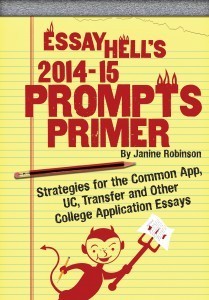
Then I would go through my 2014-15 Prompts Primer to get an understanding of your essay prompts, and strategies on how to find your own topics. Finally, I would read Escape Essay Hell, and systematically go through each step. It’s a short book, and before you know it you will be ready to crank out your own drafts, edit them and BE DONE WITH THIS!! And quite likely on your way to getting into some awesome schools. (For those of you who still need extra help, I also offer private tutoring in person or via Skype.)
Besides reading my guide books and posts on this blog, I also would suggest scrolling through the comments and answers from students under the posts about specific college application essay prompts, especially those on The Common App and University of California prompts. (Find them in the Topic Index on the right sidebar.)
Good luck! No more excuses! Just start!
July 6, 2014
Marriage of Hell and Heaven in College Application Essays

Parke Muth, a veteran college admissions counselor and writer from Virginia, interviewed me recently about my opinions and advice regarding college application essays. I thought I would share the interview, which he featured on his own highly informative blog.
It’s long, but I think it’s packed with a lot of great advice–if I don’t say so myself. Muth, who is a former Associate Dean of Admissions for the University of Virginia, knows the in and outs of the admissions game, and as a creative writing expert also understands more about college app essays than almost anyone else in the industry. In other words, he tossed me great questions, and even lobbed a few provocative ones!
Here’s his interview taken directly from his blog:
JULY 3, 2014
How to write Essays: The Marriage of Heaven and Hell: Janine Robinson Interview
I am lucky. Maybe it’s because I am old, but in any case, I have been given the opportunity to interview some of the finest students, scholars and educators around the world and post their words here. Today you are lucky too. Janine Robinson is not just an expert in her field; she’s also one of the best resources for I know for students applying to colleges and universities. The author of three books, Janine’s words here will convince you that her approach and her knowledge could make what might be a stressed filled process turn into a journey of self-discovery that will lead, not through any magic, but with a set of useful steps, to a voice that tells a story clearly and well.
****************************************************************************************************************************************
Questions
Can you give us little background on how you are where you are now? By this I mean you are now the author of three wonderful books on admission essays, you work with exceptionally talented students, and you are looked at as one of the experts in the field. How did you get to this point?
It started when I helped my own daughter (now 22) with her essay. I realized why this assignment was so stressful: No one taught her how to write a personal essay. (Not to mention the enormous pressure of the entire college admission industry.)
I also recognized that students could use the narrative writing skills I learned as a professional journalist, reporter and editor to power their essays. So I set out to find ways to teach them how to tell their real-life stories using literary, story-telling writing techniques.
I started with my Essay Hell blog, then wrote my guide books based on my experience working with hundreds of students.
Can you tell us a little bit about the genesis of your first book Escape Essay Hell? You give a ten-step approach that I think will help any student approach the process of writing an admission. How did you come up with the 10 steps?
The “ten steps” are really just a way to assure students that these essays are doable if you take them one step at a time. The Essay Hell “formula” I walk students through is the exact process I use when I work one-on-one with students. I knew I could only work privately with so many students, and I wanted to offer this approach to as many students as wanted my help.
Do you find that some of the steps are more challenging for students than others? Are there any which might be deemed more important than others?
I believe the most important “step” is to figure out what it is you want to reveal or say about yourself in the essay. In my book, I have students start by zeroing in on a defining or “core” quality. Then they can go forward and look for real-life examples they can share that illustrate their point.
This approach helps them get started, which often is the hardest part. After that, I find the biggest challenge is to take their rough draft to the next level. It’s very difficult to know what to leave in, what to take out and what to change on your own work (That’s why we have editors!) Self-editing is a skill that can be learned but takes a lot of practice.
This is why I wish high schools would include more personal and creative writing in their Language Arts classes. Then students wouldn’t be so flummoxed (and stressed out) by these all-important essays—and they could hone their writing prowess at the same time.
One of the things I particularly like is your emphasis on both showing and telling in an essay. Philip Lopate, who I look to as one of the great contemporary essayists, titles one of his book To Show and To Tell. Why do you think so many essay experts say show don’t tell? What are they missing?
Both “Show, Don’t Tell” and “Show and Tell” are powerful writing techniques. But it’s important to know the difference. In all good writing you need both Showing and Telling. They are the two ways we communicate—by giving examples (Showing) and by explaining what they mean (Telling.) Too much of either and the writing deflates.
(Both Lopate’s book and Writing Tools by Roy Peter Clark teach how to leverage these potent techniques in writing.)
When English Teachers talk about “Show, Don’t Tell,” they are usually just trying to explain the power of the “showing” part of writing, and distinguish it from the “telling” side. Most young writers feel more comfortable “telling” in their writing, and need to learn why it’s important to bolster your points and explanation with examples (details, specifics, etc.)
The confusion is mainly rhetorical at this point. If possible, I think writing teachers need to drop the “Show, Don’t Tell” maxim—and pound the “Show and Tell” concept. It’s the most powerful writing tool I have ever learned.
The other reason “Show and Tell” is so crucial for these college app essays is that students need to engage their reader, but also reveal the quality of their analytical/introspective/reflecting thinking. “Showing” with personal stories and concretedetails/examples is ideal for “grabbing” readers and getting them to care about what you have to say.
“Telling” what they mean by exploring more abstract concepts displays clear thinking, intellectual curiosity and the ability to express meaning. Just like “Show and Tell,” you need both in effective writing: concrete and abstract. They are really the same thing. And shifting back and forth between the two give a natural spine or structure to an essay.
You mention that all too often students try to impress admission officers with big topics rather than focusing on the mundane. I agree that for many students this advice is great. Could you talk a little about what you mean here?
Trying to impress admissions officers usually backfires because you come across as full of yourself and reading about your personal “wins” usually is boring. Do you think they will want you at their school if they think you are not likable? They will see all your accomplishments and accolades in other parts of your application anyway.
It’s counter intuitive, but choosing topics that are everyday work much better at showcasing who you are than writing about your life highlights (winning the big game, climbing a mountain, etc.) Better to pick a mundane topic (riding the public bus, singing karaoke, your missing front tooth, making kombucha, etc.) and say something impressive about your experience with it.
The mundane is concrete, specific and interesting; impressive typically is grandiose, broad and intangible. As a reader, I know I relate better to topics that are humble, authentic and gritty. Even if what you did was truly impressive, I don’t want to read about how fast you ran to win the track meet, that you worked with orphans in China or that you designed a computer that won the science contest.
It’s much more interesting to focus on something specific and everyday that happened during these impressive—or unimpressive—moments. And “happened” usually means something went sideways, or you encountered some type of problem along the way. Let the impressive context (the big game, the mission trip, the science fair, etc.) fall into the background of a specific moment, and go from there.
While I have just said I agree with you about what you say about the effort to impress often falling flat, I do think that some of the topics on Common Ap and U Cal for example ask students to write about overcoming significant challenges. In my experience the challenges that colleges often are hoping to hear about have more to do with overcoming certain kinds of things like growing up in a low income home or having to overcome racism or homophobia. Schools want a diverse student body and there has been a lot of presses lately about how many selective schools do not have many students from low income or under-represented groups. Would you advise student in these categories to write an essay on these big topics?
You, Parke, introduced me to the work of Angela Lee Duckworth, and her conviction that grit can be a more accurate predictor of success than IQs, test scores and family wealth. I believe essays that show a student’s grit can be the most effective, whether they are from a low-income or privileged background.
(It’s most likely more important to convey grit, however, if you are from a disadvantaged background, since this can help convince admissions counselors they you have what it takes to not only get into college, but also stick it out.)
The key to showing grit in an essay is to find a compelling personal challenge (problem) that you faced, and share how you handled it. That’s a winning formula for almost any effective college app essay, in my opinion. It’s also what makes a good story—a character dealing with conflict. And the reason narrative-style essays are the way to go.
Also, you can tackle the large issues—racism, homophobia, poverty, etc.—in an essay by focusing on a specific, personal experience, incident or moment that relates to those topics. Usually the real-life story has a mundane nature, but the underlying lessons expose or reflect on the larger societal or philosophical issue.
In my essay collection Heavenly Essays, one student started her essay by describing the time a woman mistook her for the wait staff at a Mexican restaurant, assumedly because the student was Hispanic. The student then went on to share how that made her feel (pissed off!), how she thought about prejudice and the unfairness of racial disparities and what she did to address them.
On the other hand, topics like divorce and death and depression don’t seem to get the same reaction from admission readers. Would you agree with this?
I guess it’s what qualities the admissions officers are looking for in their students. Although those can be loaded topics and challenging to write about, I believe students should write about issues that have defined them. Again, the trick is to drill down to some specific moment or lesson within the larger issue to give the essay focus and impact.
A student wrote about her parent’s divorce in one of the pieces in Heavenly Essays, but she started by describing and focusing on the weekly drive between their homes, and what she learned during those trips. Even though those commutes were about as mundane as you can get, she had a lot of insightful things to say about them.
Goldilocks question: Do you think colleges and universities use admission essays too much, too little or just about right in their evaluations?
Apparently, admissions officers often use these essays as the deciding factor when making final selections among the equally shiny pool of applicants. From what I understand, it’s a laborious process of elimination that often comes down to 650 words.
Only schools know what they are looking for, and can evaluate if essays are helping them hit their target students. My guess is that they end up with the student body diversity or standards they seek and use these essays to reach it, but that makeup may have little to do with what they thought the students were like based on their essays.
Do you think that students should be permitted to embed photos or video or music as a part of the essay? (Common Ap has suggested they might permit this in the future.)
I love this idea. I think it’s absolutely crazy that students who write better (for whatever reason) have a stronger chance of getting into a school than someone who has other strengths, such as music, technology, science or art.
It all depends on what colleges want to know about their potential students. If they want to know how they think, what they value and their passions (and get a sense of their personality and character), writing is a great forum to demonstrate those qualities, but not the only one. It would be up to the college to define and clearly explain what they want to learn about students, and then give them options on ways to demonstrate it.
If you had to estimate how much time a student takes from step 1 through step 10 in your essay strategy what would your estimate be?
It all depends on how quickly the student can brainstorm a strong topic, formulate a rough writing plan and pound out a rough draft. As we all know, there are infinite places and ways to get stumped, slow down or quit for a bit.
Assuming a student is motivated, she or he should be able to pound out a strong essay (including several rounds of self-editing) anywhere from two to six hours. I find most students do best to spread out the work among a couple days, but set deadlines. It does not have to take days and weeks. It just depends on how they work, their self-discipline and outside support. The biggest obstacle is usually yourself: feeling overwhelmed, procrastinating and doubting you have something interesting to write about.
Taking it step by step is a great way to work through those typical mental writing roadblocks.
Do you ever have parents say that the topic their child has picked or the approach is not right? If so what do you do?
Sure. I see part of my role as helping parents as well as students understand what makes a great essay. Showing them sample essays that “worked” often helps them get it quickly.
A lot of parents still believe essays must be impressive and sound like academic papers they wrote in college. They don’t trust that a simple story about parking cars for a summer or smiling too much can get their kids into Harvard or Stanford. But they are wrong.
I understand the concern of parents who feel so much anxiety about these essays and fear they won’t guide their students correctly, and hurt their hard-earned opportunity to attend a great college. I was there myself with my two kids.
But if you have doubts, do your own research. Read up on college essays on the Internet; hire a top-notch college counselor if you can’t figure it out. In the end, you should trust your kid and your own instincts.
The beauty is their student will land where they belong. I’m a big believer in finding the right fit and trusting that each student has her or his own path. College is like marriage—it’s not an end in itself, but just the start of the fun! ; )
How do you respond to people who say that experts like you provide unfair assistance to these students who have the economic means to afford help?
I’m a guilty liberal so of course I wrestle with that question. What I do does perpetuate an already unfair educational system—those with means have access to the best of almost everything. They can go to private schools, afford tutors, and network among their equally privileged friends, family and colleagues, hire private college counselors, on and on.
I try to justify my role with what I call my Robin Hood approach. I fill my blog with all my best writing advice and tips, which anyone with Internet access can use; I wrote three affordable guidebooks that include the exact information I use with my private clients, and I offer them for free to anyone who works with disadvantaged students. At the same time, I charge a lot ($200 an hour!) for my private tutoring.
To answer your question: Yes, I provide unfair assistance to rich kids. But I also try to help those who aren’t rich.
In your newly released book, Heavenly Essays you provide readers with 50 examples of students who know how to tell a compelling story. Could you talk about what you hope this book will accomplish for readers?
I believe this book will help students (and parents) understand that type of topics that can make great essays (most have “mundane” topics), and also see how narrative style essay work.
I wrote a brief analysis after each essay to try to show readers what specific narrative and literary writing techniques and devices were used, and why they worked—including anecdotes, dialogue, voice, sensory details, etc.
It was my attempt to Show students (and parents) what works instead of just Telling them.
How did you go about picking the essays?
I basically asked former students if I could include their essays in my collection. Of course, I tried to pick the ones I liked the best, and provide a mix of topics, styles and backgrounds.
In an attempt to get a broader variety of topics (most of my students are from privileged backgrounds), I also held an essay contest on my blog to collect essays, and 10 of these are featured in the book.
Do you think that over the last several years that the topics students choose for essays have shifted much?
I only work with students on their essays, and have done this since 2008. So I am no expert on what college admissions officers have been seeing or how much that has changed. I know it’s easier now than when I started to convince students, parents and college admissions counselors to go with personal topics. I don’t know how else they wrote “personal essays” in the past.
I only know that since I got involved with these essays my main mantra has been to ditch the formal academic, “try to impress” essays for narrative style, “slice-of-life” essays. And that seems to be growing more and more popular among other essay “experts.” Which is great!
A recent piece in the NY Times warns student that over sharing will result in a bad outcomes fro students. You advise students to stay away from certain topics. What is your view on the over sharing phenomenon?
If you really want to know my opinion, I wrote a post, “TMI In College App Essays?” Yes, I think a few students might need help knowing how far to go when sharing their personal issues, but in general I think it’s better to encourage them to get out all the nitty-gritty details, and then cut out anything off-putting.
I have to say almost anything must be better than a boring essay. When telling a real-life story that may have graphic, unpleasant details, it’s best to stick with the truth but try to tone down the melodramatic parts. When in doubt, ask for someone else’s opinion.
Frankly, I don’t think over-sharing is one of the most worrisome issues surrounding college admissions or these essays.
You advise student to avoid topics like trips to exotic places and things that seem to demonstrate a certain amount of privilege. Do you think there is at least among a certain percentage of admission essay readers a slight bias against students who come from the high end of the economic spectrum? (I do believe this as I have seen it in action.)
Yes, I advice my students to watch out for exposing their privilege. No one wants to read about your ski trips, riding lessons or trips to Fiji to surf. If nothing else, it exposes that they are oblivious to their life advantages. Often, it’s not their fault (not to point fingers but, ahem, parents?) so I just gently try to help elevate their self-awareness and flag off-putting topics.
You do not talk that much about audience in your books. Do you think there is a fairly accurate way of defining who the audience is in terms of what kinds of prose they value most?
I don’t try too hard to get into the heads of college admissions officers. My understanding is that they are on the younger side of me (20s-40s? on average), and are well-educated, well-meaning humans.
With all my writing, I use myself as my best gauge of what’s good or bad. If I find something interesting or readable, I assume others will, too. It’s part of learning to be your own editor, and trust your ear and sensibility.
That’s why I believe narrative (story-telling) essays are so powerful. They find connections on the most universal human level. And you want to read them. What’s the point of sharing information, no matter how profound, if no one can get past the first paragraph? (Especially when your audience has to read hundreds of these at a time!)
Do you ever find that some of the essays your students have written get raves from some and thumb down from others? (I see this with some of the essays I post.)
I have seen how some of your readers love essays you share and others dislike the same ones. My opinion is that there are readers out there who think they are supposed to like certain types of essays, and I think it’s wise to accept that some of the college admissions officers still are that way. (They come from the same ilk as those who still believe academic essays that use words like “Nevertheless” and “Furthermore” and toss in SAT vocabulary words at every turn are somehow “smarter” and better written.) I’m hoping they are more and more in the minority. I ignore them.
Your writing style both shows and tells. You have clear diction, don’t try to impress us with big words or theoretical terms, but give us a lot to think about and do. How would you describe your style?
That’s so nice of you to say. Actually, I wish I “showed” more with my writing. The truth is you have to go the extra step to show in writing, to dig out examples of your points. Often with my blog posts I’m in a rush to just convey the information, and move on.
So I stick to plain language and try to write more like a talk. Writing the blog has helped me find my own narrative “voice.” I highly encourage blogging for students who want to develop their own.
Anything else you want to add?
After all that, nothing left to say. But seriously, thanks for giving me a platform to talk (endlessly) about something I care deeply about: helping others realize that they can learn to write!
****************************************************************************************************************************************
We are our stories. This may seem like an exaggeration, but al least for those applying to selective colleges and universities it is accurate. Numbers are important of course. Without a strong set of tough courses and high grades and SATS that predict success in a competitive environment, an essay rarely will change a decision.
But given the spike in applications in the last decade from around the world, numbers are not enough. Admission readers look for a voice that will add to the incoming class. They are certainly not looking for a voice that is standardized in approach or topic. Instead, they look for a story, a narrative that encapsulates a student’s experience or view of the world in a way that compels a positive response.
Jeanine not only knows this, she both shows and tells students how to create a personal statement that will permit a reader to enter a world they have not visited before. These worlds need not be exotic in any way; instead, they could focus on parking cars or getting stuck in a tree. It sometimes surprises people to know that an essay about being stuck in a tree could be looked at more favorably than an essay about climbing Everest, but it’s true.
The tighter the focus, the more detail can show us the world and still leave room to tell us the importance of this slice of life. And the more a voice and the story behind and in front of it create an accurate portrait of a senior in high school, the more the essay has accomplished its goal. Jeanine’s books give students real essays to use to inspire them to find the beauty (and sometimes the dark side) in the life lived. She eschews big words and Pomo jargon and theories. She approaches her work and students with passion and clarity, which is just what students should do too.
I agree with Janine that schools don’t to enough to prepare students for writing a personal essay. And I also agree that students who have the means to find a great coach, editor or consultant are at an advantage. ( I have addressed this issue of editors and ethics and help here.) At the same time, I think many schools try in many ways to reward those students who come from low income background and under-represented groups. The do worry that the people who are already stretched thin in terms of income and paying for the full cost of a college are the ones who will not have the level of sophistication and approach as some who have added help. Janine’s books, blog and efforts can help them. I applaud her efforts to help those who cannot afford hourly fees and individual feedback. Her work should be hared in schools and by colleges and universities on their websites too.
Despite what some in education think, some of those doing the most to help students in significant ways are in the private sector rather than directly involved in education. I know many in addition to Janine who are committed to helping as many as they can at little or not cost. It’s about time more educators and administrators admit that people like Janine work in the trenches with students and work for many hours and that their insights and information can be useful to everyone applying to colleges. I think the inclusion of IECA in the Common Ap feedback groups demonstrates that at long last the people like her have wisdom that few others have. I do hope that CA will think seriously about including options for students to submit more than just words with their applications. It is starting to happen with college graduates and it is the world we now live in.
She and I have explored Angela Lee Duckworth’s research on grit. At this point last year she was the rage among admission offices and counselors. In my interactions with Angela I think she was worried that her research was being used for things it was not designed to do. Now that she has a MacArthur Genius Grant I hope her work will explore the issue of grit in ways that will help educators, students and admission offices choose students. I will have more to say about her work and a few others who also extoll grit in an upcoming post.
I would like to thank Janine for her willingness to share her insights here. I have learned a great deal from her books and this interview. Just this past weekend, I was a guest lecturer on essay writing at a highly selective university, and I mentioned Janine’s approach as a great way to actually enjoy the process of writing an essay. I have to say that in my work with students, either teaching or in some other way, most students, when given the chance to explore their stories find that it isn’t as hard as they thought and it does lead to an interest in writing that may not have been there before. I am virtually certain that this has been true of many of Janine’s students. I hope it is true for some of you who have just been inspired by her words here.
June 30, 2014
College App Grabber Trick: Show First!

When you write a college application essay, you want to “grab” the attention of your reader from the start. My favorite writing technique to hook readers is to engage them with an anecdote, which is a real-life moment or incident.
You might have already written your essay, and not noticed that you have one of these magical anecdotes down low. Chances are you started your essay telling about yourself in your essay, and missed the opportunity to reach out and grab your reader with a real-life anecdote that illustrates your point.
When the most interesting or engaging piece of a news or feature article is down low in the piece, we journalists used to call that “burying the lead.” And a good editor would spot this and encourage the writer to shift it to the top of the story. The idea was that you use the most interesting part to draw in the reader, otherwise, what was the point of sharing all the other information if you lose their attention and they stop reading? Same goes with these essays.
Most of the essays in my new collection of sample college application essays, Heavenly Essays, start with anecdotes. They are my favorite literary writing device when it comes to personal essays. They Show instead of Tell. Showing takes advantage of those concrete details that we can’t resist: the specifics of something that happened. Ooohhhh, who can resist the juicy stuff? Then the writer can “Tell” or explain, analyze, reflect, etc., on what happened later in the essay.
One student, however, started her essay by telling about herself, and didn’t share a real-life example of her point until fifth paragraph. The essay was still strong and interesting (she was accepted to Middlebury College, a top liberal arts school in Vermont!). But I want you to see if you think it would have had a more compelling introduction if she started with her anecdote (and showed her point).
The idea is that you scour your own writing for the juicy parts, the anecdotes, the interesting moments or real-life examples, and see if you can move them up to the top and start by showing instead of telling. Then go on to provide some background or context, and explain what they mean (telling).
See what you think. Here’s what she went with, which is in Heavenly Essays:
Anonymous
Seattle, WA
Middlebury College, VT
Fearless
Where I come from being religious is unusual; Washington is considered the least religious state in the nation. Very few of my classmates go to church. The few who do probably would find my belief system rigorous and almost radical. Christian Science is most known for the practice of spiritual healing and for me, it is a way of life. It does not only come out in times of need, but is a part of my everyday existence and rids fear from each activity.
Being a religious teenager in a highly secular place can be difficult. Sometimes I have to admit I dread the cliché questions of friends: What do you do when you get sick? Why don’t you go to the doctor? I can’t believe you have never taken any medicine! But I patiently answer these questions and embrace this challenge because spiritual living is crucial to who I am.
For me, being religious doesn’t just mean going to church every Sunday; it is a daily practice and supports a fearless approach to life. Although I may stand out in a crowd, and many of my peers don’t understand my commitment to my religion, I don’t compromise my faith. I have overcome countless scenarios with the help of prayer, including the biking accident I experienced while training for a 350-mile bike ride from New York City to Washington, DC.
(ANECDOTE) Biking along Lake Washington, the trees flew past me and the wind whistled in my ears. The dry smell of summer filled the air, and my legs churned up and down. The wind was at my back, and I felt like I was flying. Seconds later, however, I veered out of control. My bike and I hit the pavement and skidded across the road.
After bandaging the scrapes and resting in bed, I actively prayed to be healed. Supported by my mom and a Christian Science Practitioner, my thought was transformed from fear of the accident to reassurance that I would be okay. My body certainly needed time to mend, but being freed from fear was the central benefit of this healing. I wasn’t afraid to get back on my bike, and I trusted that my cross-country season and school attendance wouldn’t be compromised by my accident.
Although my classmates and peers seemed surprised to see me active again, I knew that my quick recovery was because of my prayer. I rely on my relationship with God everyday, and not just to recover from accidents. For example, when presenting scientific research to an audience of Bahamian government officials last spring, I was fearful of stumbling through my speech. Turning to God, however, I found confidence and assurance that I could deliver my proposal with poise. …
Here is the same essay when you move the anecdote to the beginning (I shifted three paragraphs to the top):
Anonymous
Seattle, WA
Middlebury College, VT
Fearless
(Anecdote: Showing) Biking along Lake Washington, the trees flew past me and the wind whistled in my ears. The dry smell of summer filled the air, and my legs churned up and down. The wind was at my back, and I felt like I was flying. Seconds later, however, I veered out of control. My bike and I hit the pavement and skidded across the road.
(Background: Telling) After bandaging the scrapes and resting in bed, I actively prayed to be healed. Supported by my mom and a Christian Science Practitioner, my thought was transformed from fear of the accident to reassurance that I would be okay. My body certainly needed time to mend, but being freed from fear was the central benefit of this healing. I wasn’t afraid to get back on my bike, and I trusted that my cross-country season and school attendance wouldn’t be compromised by my accident.
(More background: Telling) Although my classmates and peers seemed surprised to see me active again, I knew that my quick recovery was because of my prayer. I rely on my relationship with God everyday, and not just to recover from accidents. For example, when presenting scientific research to an audience of Bahamian government officials last spring, I was fearful of stumbling through my speech. Turning to God, however, I found confidence and assurance that I could deliver my proposal with poise.
Where I come from being religious is unusual; Washington is considered the least religious state in the nation. Very few of my classmates go to church. The few who do probably would find my belief system rigorous and almost radical. Christian Science is most known for the practice of spiritual healing and for me, it is a way of life. It does not only come out in times of need, but is a part of my everyday existence and rids fear from each activity.
Being a religious teenager in a highly secular place can be difficult. Sometimes I have to admit I dread the cliché questions of friends: What do you do when you get sick? Why don’t you go to the doctor? I can’t believe you have never taken any medicine! But I patiently answer these questions and embrace this challenge because spiritual living is crucial to who I am.
For me, being religious doesn’t just mean going to church every Sunday; it is a daily practice and supports a fearless approach to life. Although I may stand out in a crowd, and many of my peers don’t understand my commitment to my religion, I don’t compromise my faith. I have overcome countless scenarios with the help of prayer, including the biking accident I experienced while training for a 350-mile bike ride from New York City to Washington, DC. …
* * * * *
So, what do you think? Did you like one version over the other? My advice is once you have pounded out a rough draft of your college application essay, read through it and if one part is really catchy and interesting, see if you can pop it at the top, and go from there. I think you might be surprised how much better it will be!
June 19, 2014
Free College Application Essay Writing Guide Offer!
I watched this inspiring trailer video today about students from Stockton, California, who are learning to tell their stories using both poetry and investigative journalism (digging up facts.)
Since the economic downfall starting in 2008, their city turned into a virtual ghost town, leaving most teens with few resources and little hope. But with the help of some poets and investigative journalists, they found a lot to say and we all need to hear it.
I wish all students had talented teachers to help them learn to express themselves through writing. College application essays are just one format (the personal essay) where students can share their experiences, thoughts, values and dreams. And it’s unfair that only a small percentage have access to professional help and resources.
If it helps, I’m offering my three essay writing guides for free to teachers or college counselors who work with underprivileged students. I believe my guides can help students learn powerful writing techniques that help them mine their lives for meaningful stories and learn to express them in ways that will make others want to read them.
If you would like any or all of my guides, send me an email to EssayHell@Gmail.com. Please include your name, role, school or organization, and which book(s) you would like. It might take me a few days to get them to you, but I will send ebook versions that you can download. (You can help spread the word about this offer by sharing this post via Social Media!)
Here are my books:
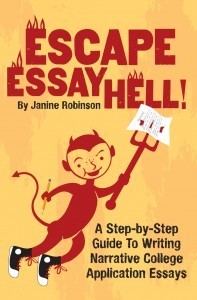
Escape Essay Hell: This is my short guide that spells out ten steps to write a college application essay.
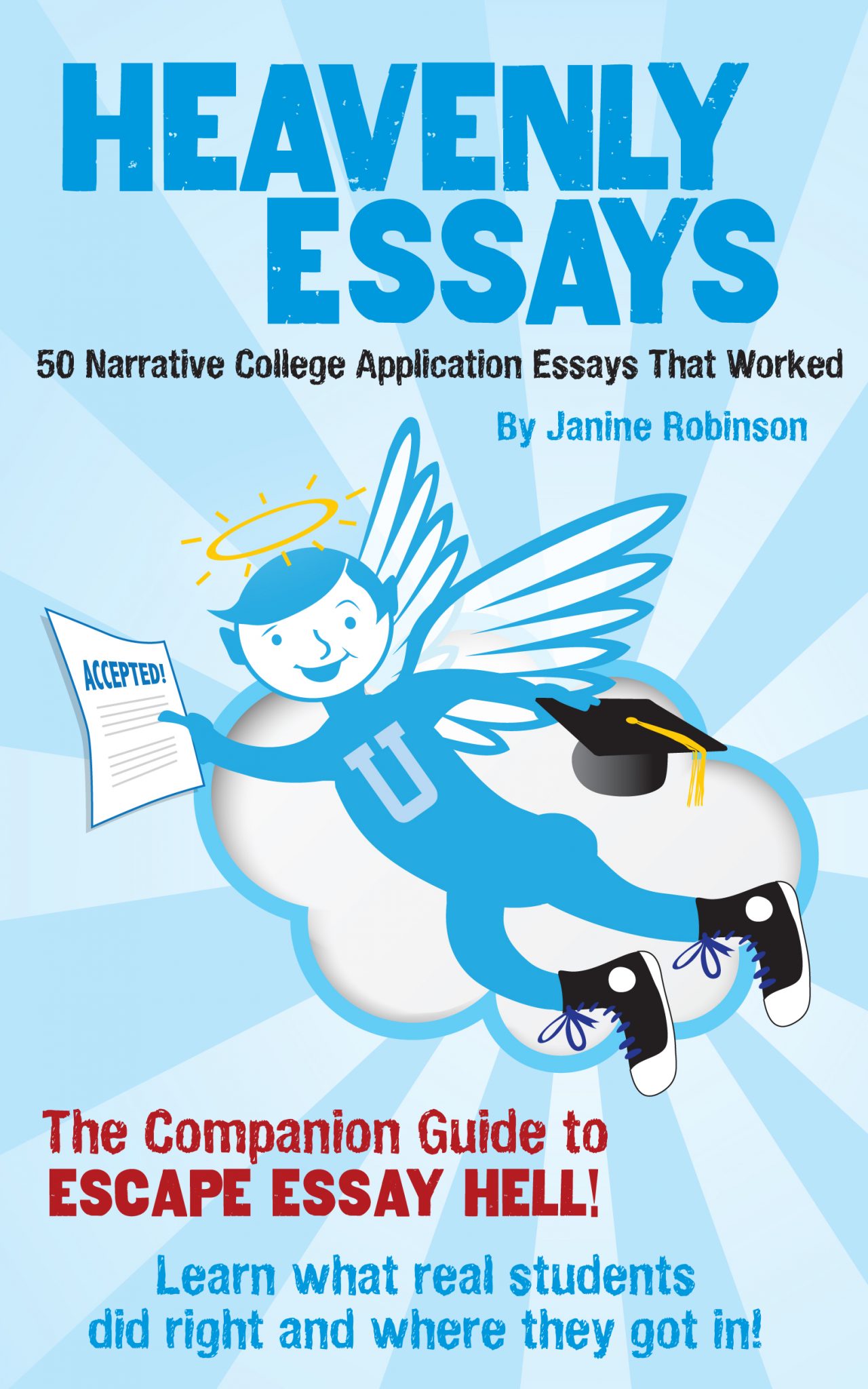
Heavenly Essays is my collection of 50 sample college app essays written by real students.
Essay Hell’s 2014-15 Prompts Primer is my collection of strategies on how to answer the most common college app essay prompts.