
Quinn Reid's Blog, page 19
January 10, 2012
Online Science Fiction and Fantasy Writing Courses with Cat Rambo

Writer Cat Rambo has recently been offering online classes and workshops that have proved fairly popular. Cat is a highly accomplished writer of fantasy and science fiction. Her work has appeared in top pro venues like Asimov's Science Fiction, Clarkesworld, Weird Tales, and Strange Horizons, and from there a number have made their way into year's best anthologies. My experience is that she's personable and insightful. If you write or are interested in writing science fiction or fantasy and want to improve your skills, the classes below might be just what the doctor ordered. They run from one to six sessions, are priced in the $100-$250 range, and are described in detail with schedule and price list at http://www.kittywumpus.net/blog/2012/01/04/online-classes-and-workshops-for-2012/ .
(Note: I don't get a cut of any of this; I'm just mentioning it because I think Cat is an unusually good source of writing knowledge.)
About the class format, Cat says "I do them on Google Hangouts, which means that people can participate via video (or if they are shy, by audio only). The format allows for a class that is conducted both during the class time and also outside of it via discussions on Google+. I've been very happy with this – I feel as though the combo of in and out of class exchanges has let me connect with students in a deeper way than in a once a week face to face class, weirdly enough."
Here are the current offerings:
Writing Fantasy and Science Fiction Stories: A six week workshop focusing on the basics of writing speculative fiction short stories, including plotting, creating believable and engaging characters, world-building, what to do with a story once it's finished, dealing with editors and markets, and other necessities. Students will have the opportunity to workshop two stories over the course of the class.
Editing Basics: This three week workshop targets editing both other people's works as well as your own. Topics include how to edit at both the sentence and story/book level, working well with writers, theory of ToCs, electronic publishing, copyright, and making a living as an editor. Each session is two hours and includes in-class editing exercises, with week one focusing on developmental editing, week two on copyediting and fact checking, and week three on publishing.
Bring On The Flash: A three-hour session focusing on writing flash fiction and consisting of a mixture of lecture, in-class writing exercises, discussion of how to turn fragments into flash, and an overview of flash fiction markets.
Your First Page: Co-taught with Louise Marley. Louise and I have done this workshop several times with great success – we thought we'd try an online version. You give us the first page of your novel and we'll critique and discuss it in a way that will be helpful with the overall work as well as talking about agents, and editors and how important the first page is when engaging them. More than one students had told me this was the single most useful workshop they'd ever had.


January 4, 2012
Amber Sistla's Writer Wednesday Interview with Luc Reid
Amber Sistla is running a series of well-designed interviews with neopro writers on her Web site every Wednesday, and her latest interview is with me. She asks me about some favorites, which is the kind of question I'm notoriously bad at answering, and throws me some other questions that led me to answers I didn't expect myself. (For example, my favorite comfort food, which isn't actually a food.)
You can read the whole interview here.
Some things have changed since Amber did the interview with me last month: for the moment, Futurismic is going semi-dormant, so I contributed my last scheduled "Brain Hacks for Writers Column" for now a couple of weeks ago ("Better Writing Through Writing About Writing") and will be watching for Futurismic to rise again when publisher Paul Raven is free to return to it. My collection Bam! 172 Hellaciously Quick Stories is not available on Smashwords any more at the moment, and my birthday has already passed (it was pretty great, thanks).
December 28, 2011
Annie Bellet on More Productivity Through Scheduled Breaks
Writer Annie Bellet, a fellow Codexian, recently offered a useful approach to improving productivity by planning breaks beforehand in her post "The Quest for Productivity." By planning out work time in alternation with breaks, she finds she's able to put off distractions and focus on the work at hand long enough to really get something done.
She also mentions writing in groups, a useful approach when it's practical to increasing a lot of kinds of productivity. Some variations: members of a household scheduling a time to all do cleaning together (we used to do this in a cooperative community I lived in years ago; we called it "chore party"); folding laundry with others; scheduled office organization days for multiple workers to do together; timed write-ins; study groups.
December 26, 2011
Digital Book World's ePublishing Predictions for 2012
The Digital Book World site recently posted "Ten Bold Predictions for Book Publishing in 2012," and while I certainly can't speak with authority on all of the subjects they address, none of their predictions struck me as unlikely.
Significantly, all of their predictions had to do with electronic publishing, except that some of what they said about the publishing industry as a whole would apply to paper books as well as eBooks. They don't seem to have take a shot at many numbers, although they did predict a new, larger Kindle tablet and name both the size and the price they expected.
I'd be interested to see predictions of impacts on libraries and bookstores and market share predictions for eBooks and for independent authors. Since it's the season for predictions, though, I probably just have to keep my eyes open and those predictions will appear.
What do you expect to see happening in publishing in 2012? Will things get crazier or settle down a bit?
December 24, 2011
Free until 12/26: Family Skulls – Curse-fighting in rural Vermont
My young adult novel Family Skulls, about a 16-year-old trying to break a generations-long curse on his rural Vermont family, will be free on Amazon for Kindle at http://www.amazon.com/Family-Skulls-ebook/dp/B00573Y36W until Monday 12/26.
One of the things I enjoyed most about writing this book was conjuring up elements of my Vermont childhood on the page. The story's hero, 16-year-old Seth Quitman, is much more self-possessed and practical than I was as a teen, but the dirt and gravel roads he bikes down, the house he lives in, and much else are very familiar to me.
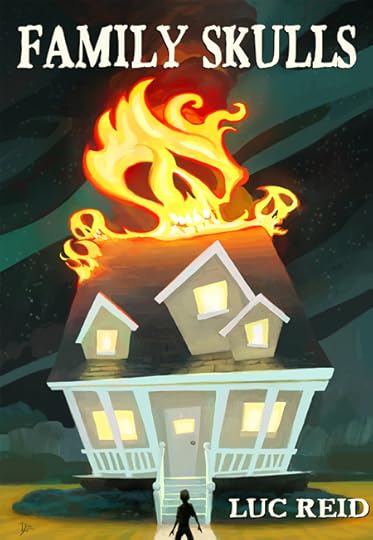
I also was very fortunate to get the chance for a cover by artist Dixon Leavitt, who managed to bring all of the key elements of the story (like the warmth and occasional claustrophobia of a close-knit family, menace, mystery, and the vastness and brilliance of a starry sky on a dark night) into his piece. I'll be posting about the development of that cover in the near future.
December 23, 2011
Willpower Through the Holidays: Some Helpful Articles

The holiday season, at least here in the U.S., is a troubling time for habits. Diets get blown, budgets get overspent, time with family can make for difficult emotional situations, and good habits get disrupted by travel and celebrations. For all the cheer and New Year's Resolutions, the Thanksgiving to New Year's period is a dangerous one. With that in mind, here are some articles from the site that may help with some of the tricky parts.
If you've been working on building a new, good habit (or on shedding an old, bad habit), you may be interested in reading (or re-reading) "How Long Does It Take to Form a Habit?" The key thing to take away from that article is not the time period, which depends on a lot of things anyway, but how habits are successfully formed: with consistency. If you are wondering whether giving yourself a break from your great new eating plan over the holidays or smoking a couple of cigarettes with your cousins is really such a big deal, the answer seems to be that it's not the end of the world, but it's going to be very disruptive and set you back a ways. Exceptions seriously weaken new habit formation.
That's not to say there's never a reason to ease up over the holidays, just that if we're considering it, we should probably try to be extra sure we like the bargain we're getting. If not, there are options, even if they involve annoying family members and breaking traditions. After all, stodgy family members and unhealthy traditions are not on your side if you're trying to do something new.
On that topic, if eating is a concern, you may be interested in "How Not to Blow a Diet Over the Holidays" and (if things don't go well, or if you're reading this too late to prevent some missteps) "Recovering After a Failure of Willpower."
If you expect there may be some family friction over the holidays, while those kinds of patterns can be hard to break, there's some usable advice in the article "How Not to Get Into an Argument."
Considering a New Year's Resolution, or a list of them? They're not always a good idea, and when they are, there are more and less successful ways to go about them: see "Should You Make a New Year's Resolution?" and "Why New Year's Is Such a Good Time to Make a Resolution."
Regardless, here's hoping you have a great time winding up the old year and that you start the new one with strong relationships, deeper self-understanding, and joy.
Photo by R. Motti
December 22, 2011
How Can Libraries Survive the Rise of eBooks?
In a previous post ("Are Libraries Doomed?"), I talked about the forces that I believe are likely to bring libraries as we currently know them to an end. In this post, I'll talk about the one approach I know of that I hope might save some libraries.
It's all about the community
One facet of libraries is unlikely to ever become entirely obsolete, and that's being a center for community activities. Many libraries already offer events like readings, talks, meetings, and play space for children, and this function could be expanded to turn the library into a key event venue, a meeting space, a hangout, and a focal point of local culture. While electronic communication continues to cannibalize face-to-face interaction, some face-to-face interaction is essential to us as human beings, and we've lost many places we used to have for doing that. If libraries can expand on their existing roles to become a major force locally as teen center, community center, senior center, performance space, meeting space, event space, workout space, dance space, and more, they could come to mean even more to their local communities than they do today.
Swans becoming monkeys
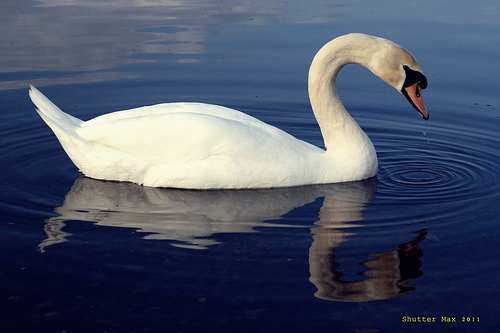
Unfortunately, there are at least a couple of problems with this approach. The first is that social activity is not what people who run libraries have devoted their lives to. It's easy to imagine a library as a cultural center, sure, with some social events–but the great strength of libraries and librarians has always been providing materials and resources to the community, not organizing Swing Dance Saturdays or boffer battles or remaking a room into an inviting teen center. Fortunately, a number of librarians have a lot of these skills–and yet sometimes the change in job would be like a swan becoming a monkey. The stereotype is that librarians are obsessed with quiet. Can the average librarian depart so far from that stereotype to embrace pretty much its exact opposite?
The other problem that comes to mind immediately for me is that as wonderful as such a center might be, we–at least we here in America–aren't generally used to having a community center where we want to go regularly. We would have to be convinced and retrained to stop by just to see who's around, to check the event schedule regularly, to think of new things to do there, and to go to the library instead of a coffee shop or bar–and instead of just going home to watch TV. Can we make that change?
My prediction: a few libraries will succeed at this brilliantly. Many will try and fail. Many more won't try and will just fade away. And a few–a very few–will continue to be supported as a sort of quaint curiosity doing what they have always done: making physical media available to people in person.
Photo by peaceman494
December 21, 2011
On Futurismic: Better Writing Through Writing About Writing
I'm wrapping up my series "Brain Hacks for Writers" at Futurismic (at least for now) with "Better Writing Through Writing About Writing," an article on some techniques I've learned and tested for getting past motivational problems with writing, getting better focus, making writing-related decisions, and so on. I present five written tools writers can use to improve things and some ideas on how best to use them.
December 20, 2011
Are Libraries Doomed?
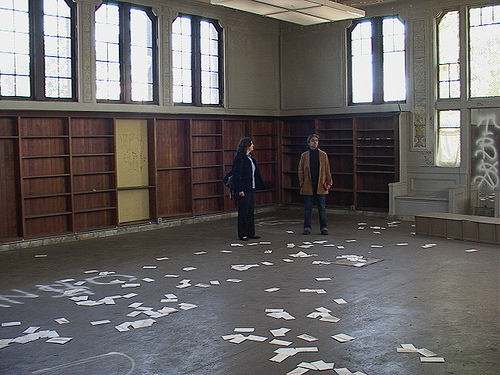
Before I start here, I want to make one thing clear: I love libraries. They have been a haven and a treasure trove to me since I was young. Whatever I may say in this post about the future of libraries, please know that it's not because I want anything bad to happen to them.
Primarily I love libraries because they're places we've created as communities to share the written word. Few things in life, it seems to me, are cooperative, highly useful, and (in a limited sense) free.
If libraries were to end, I also would hate to think of communities losing that anchor of identity, of the waste of beautiful buildings, of paper volumes being shredded or dumped or moldering away, and of librarians (who in my experience are disproportionately great people) cast off into unemployment.
Yet my honest sense is that libraries, by and large, are doomed.
What changed?
Maybe "what's changed?" is the wrong question: after all, we all know what changed–or to be more accurate, is in the process of changing right now. It's eBooks. Since before the Sumerians started making marks in clay 5,000 years ago, the written word has been intimately bound with physical objects. As personal computers and later other devices started to become more common, certainly a lot of electronic words sprang into being, but most of us don't want to use a computer to read: it's just not physically comfortable, and sometimes it's not practical. So while magazines and newspapers have been feeling the dark tendrils of obsolescence grope at them for a decade or more, until recently bookstores and libraries were largely unaffected.
In fact libraries expanded to embrace the availability of electronic media, adapting to offer computer terminals, free wi-fi, and online resources.
Now, though, eReaders have begun taking hold. This mundane-looking type of device with its limited features and lack of any sense of glitz has been quietly stealing away reader after reader from physical books (and some other printed media). I was stolen away about a year ago, when a friend bought me a Kindle. I thought I would really miss physical books. I was pretty much wrong.
I know there's debate over whether eBooks can replace physical books. People make good points like the physical experience of reading a book or the ability to hand a physical copy of a book to a friend. It's certainly true that there are some nice things about physical books. Not the trees mowed down to produce them or the excruciating returns procedures the publishing industry is locked into or the storage space requirements, but certainly the satisfaction of having a physical object that represents a wonderful experience, the ability to leave books lying around for children to stumble upon, the ability to pass along stories ideas by handing something to someone.
Yet having looked at the issue in great detail, I have to conclude that eBooks are going to almost completely replace physical books within the decade. You may disagree with me, but if you care about libraries, you may want to pretend for the moment that you grant the point and explore with me what this might mean, since if I'm right, libraries may have to change now if they are going to have any chance of surviving.
As with physical books, so with libraries
Although libraries were created to store and share physical books, they've adapted beautifully to new media. First reel-to-reel audio and films, then cassette tapes and video tapes, then CDs and DVDs became staple items at libraries. Libraries often provide free access to the Web and have a library Web site where you can look up books. The old card catalogs have turned into searchable databases. Microfilm and microfiche have yielded to digital storage.
Yet libraries are still tied to a physical experience in a specific place. The entire reason municipal libraries are funded in the first place is to benefit local citizens. While it's true that you can get digital media from libraries–as with some eBook borrowing programs–you can also get digital media from a lot of other sources, and you don't have to go to the physical library to get these in most cases anyway. Vermont librarian Kata Welch recently commented, " If people want e-books, libraries will find a way to supply them and meet their patrons' needs." I think she's right that libraries are more than able to accomplish this–but I don't think libraries can survive this way.
After all, what's the use of a physical building when you're sharing materials that can be easily shared with someone at any other location? And what's the use of a small local library online if there are thousands of other small local libraries online? If libraries take this approach of still being a source for sharing written and other media, but in electronic rather than physical form, then first they'll be forced out of buildings and onto the Web, then they'll inevitably join forces with other libraries because the economies of scale are so significant, and eventually the services will be so widespread that any sense of locality will be utterly lost–if the approach even survives at all. Given all the free material (books, stories, blogs, and so on) that's available for eReaders and how easy and sometimes inexpensive it is to buy eBooks, I'm not convinced that many people will continue to rely on borrowing books at all, regardless of form.
But libraries are more than books!
It's true, libraries are more than books. The problem is that sharing media–books, films, audio recordings, magazines, etc.–is the essential, core service that libraries provide. If libraries are no longer mainly about providing that service, can municipalities continue to justify paying as much as they do for them? How many people would use them? Enough to justify the space and expense?
I think there's one way many libraries might be able to survive, but it would take a lot of effort and change and still wouldn't succeed everywhere. I'll talk about that in my follow-up post in the next day or two.
Photo by aaron.michels
December 14, 2011
Announcement List for Luc's Writing

In case you're interested in hearing when I have a new book, story, or published article out (or for freebies and that kind of thing), I'm starting a low-traffic mailing list for those kinds of occasional announcements. If you're interested, send me a note by whatever means works (e.g., the contact link on my Web site). I'll be putting an unsubscribe page up that you can use to discretely remove yourself if you'd ever like to.
Photo by Munzerr
Quinn Reid's Blog

- Quinn Reid's profile
- 6 followers

