
Quinn Reid's Blog, page 17
March 20, 2012
How to Make Small Talk
Small talk has never been one of my great skills. I love to talk to groups, and I enjoy a lively one-on-one conversation, but for years I've been one of those people who at social events would kind of sigh and do my best to get through the thing without too many awkward moments. Starting and stopping short conversations on light subjects didn't seem to be something I did well.
I realized recently that this was something I'd like to change, and it occurred to me that small talk, like most skills, was very likely something I could improve with some study and practice (see "Do you have enough talent to become great at it?"). So I went out and did some studying, and this past weekend I had several opportunities to practice, including an event in another state where I knew almost no one.
The result? I'm still not a master of small talk, but the improvement was dramatic, and I expect things to keep getting better as I get more experience. Here are some of the tips I learned that helped me. In a follow-up post, I'll include links to articles I read on the subject, which can offer further information and ideas. I also hope to have a chance to write up pointers on how to remember names.
1. Small talk is important
Many of us don't take small talk very seriously, but the essence of small talk is making connections with other people. As human beings, connections with other people are about the most helpful and rewarding thing we can have in our lives. Even if you're just being practical, it helps to have a lot of friends and friendly acquaintances.
2. No one is forcing us
Even if someone manhandles me into the back of a van and throws me into a party without my permission, I don't have to talk to anybody. Whenever we have conversations, we're choosing to have those conversations. Why not do it well?
3. Collect things to talk about
Good conversation involves both talking and listening. In order to have something to contribute, it helps to actively look around for interesting topics that might be of interest to almost anybody: news, entertainment, strange local happenings, unusual things that have happened to us, etc. Then when a silence in the conversation opens up, we already have something to fill it in with that could start a good new conversation. This seemed obvious to me after I started to do it, but the idea of keeping a few things to talk about the next time I was in a social situation had never really crossed my mind.
4. Listen
Lecturing or going into too much detail about something that isn't fascinating to the listener is bad conversation. Leaving openings for the other person to respond and then paying close attention to what they say makes things flow easily. It's especially helpful to ask further questions when someone answers a question. Example:
YOU: Where are you from, originally?
THE OTHER PERSON: Kansas.
YOU: (Instead of just saying "Oh.") So how did you come to live around here?
Watching body language is also helpful. We can keep an eye out for signs we're boring the other person, for increased interest, for discomfort, etc.
5. Pick specific, friendly subjects of broad interest
Conversations can fall flat when we choose topics that are too general ("Sure has been sunny lately!"), too specific ("I'm trying to figure out how much arch support I need."), or too controversial for the person you're talking to (some people like to talk sex, religion, and politics and are bored with milder subjects; others are the opposite).
If you know the person you're talking to, personal topics ("How's the baby?" or "Did you ever get that car you were interested in?") can be especially good.
6. It's not an interview
For years, my habit in conversations has been to ask questions–lots and lots of questions. Sometimes this works wonderfully, and it's great for me as a writer. At other times, the person doesn't feel comfortable being the subject of intense questioning. Light conversation goes more easily when it's not just a question-and-answer session.
7. Don't pretend to know things you don't
Under most circumstances, stopping the conversation to say you don't know about something someone mentioned is actually a good thing: other people get to share topics they're knowledgeable about, you get to learn, and nobody has to pretend to know what's going on when they're really lost. My experience is that people generally respect an intelligent question, even about something they think of as basic.
8. Wrap it up and move on
At most events, it works better to have several shorter conversations than one long conversation. This depends on the circumstances, of course, but it often works well to find a graceful exit to each conversation before it grows to monopolize the whole time available. This is probably my weakest skill, though. In most cases, all I come up with is polite versions of "Well, I ought to talk to other people now." Any comments or suggestions on this particular point would be welcome, and I'll update this item down the road when I have more information.
9. Enjoy people
If I don't feel like spending time with other people, I'm not likely to make good conversation. It's important to come into a social situation with a willingness to enjoy the other people there–even (maybe especially) if they're not the kinds of people we usually spend time with.
10. Open with a general comment plus a specific question
One conversation opener that seems to work well is making a general comment about the situation and following it up with a specific question, for instance "I had no idea there were going to be so many people here. Are these always this popular?" or "I read that the band that's playing later is great. Have you heard them before?"
Of course, there are other good ways to start a conversation; this is just one good approach.
11. Ask questions about things you observe
Depending on who you are and who you're talking to, different kinds of questions about the other person can be another easy conversation opener, for example "That's a great hat! Where did you get it?" or "Is that one of the new iPhones?" or (after reading name tag that includes a company name) "Oh, you're from Gunderson & Gunderson? My uncle used to work there."
12. Don't force it
At least a couple of the sources I read strongly urged seeing movies, watching TV, keeping up on top radio hits, following the news, and otherwise building up your store of general knowledge of current events and pop culture. On this point, I'm going to have to break with the suggestions I've heard. If you're interested in current events or pop culture and want to use them as a way to make more conversation, great. Also, if your day-to-day life involves a very limited range of topics (for instance, your thesis, your cat, and that's it), then it can really help to expose yourself to books, movies, news, local happenings, or other topics you can use to connect with the people around you. However, most of us are exposed to enough current events and pop culture that seeking out more just to aid conversation strikes me as a bad idea.
First and foremost, I think it's important to be ourselves, by which I mean not to pretend interest in anything that doesn't genuinely interest us. If someone's talking to me alone about a subject that really doesn't interest me, the ideal is for me to either find a way to get interested or to offer a change of topic. This is especially true if I end up talking with someone who's very self-occupied and not picking up on my body language or signals.
If it's not possible to change the subject, it might be a good time to excuse myself to get a drink, find someone I meant to catch up with, or head home for the night.
Yet I don't often run into people who aren't interesting to talk to once I get started. Here's hoping that with some of this information, you won't either.


March 15, 2012
5 Keys to a Blissful Work Life

Two and a half years ago I posted the article "6 Ways to Be Happy at a Job You Don't Like." Today it belatedly occurred to me that it could be helpful to talk about what makes a job truly fulfilling–that is, instead of talking about making a better situation out of a job that doesn't feel like a good fit, addressing how a job can provide the greatest amount of satisfaction and enjoyment. I know of five things that can make key differences here.
Competence
This may be self-evident, but given that self-reliance and contributing positively to a group are basic to self-confidence and happiness, competence in a job seems to be a near-essential part of the job being satisfying. Fortunately skill and mastery can usually be developed through deliberate practice, so that almost any jobs we're enthusiastic about can in time become jobs we're great at. The exceptions are jobs that require some kind of innate attribute, like tallness or very good hearing.
Meaning
Meaning contributes to happiness and fulfillment by creating a feeling of being involved in something positive and larger than the individual. If I could do the exact same kind of work in two jobs, but in one I would be part of an organization that didn't do anything I cared about and in the other was helping make the world a better place (by my definition), I'm very likely to be happier with the second job. Unfortunately, it's hard to see how some jobs contribute to the world, especially when the worker is a functionary in a much larger system designed only to yield profit. This doesn't necessarily mean that it's time to quit your corporate job and go live on peanuts working for your favorite non-profit. On the other hand, if you're profoundly dissatisfied with your job, that might be exactly what it means.
Engagement
I've talked in a number of posts about psychologist Mihaly Csikszentmihalyi's concept of flow, a state in which a person is both highly productive and absolutely attentive to the work at hand. This kind of engagement–or even its milder relations–can make a profound difference in job satisfaction, because engaging in challenging work and doing well at it yields pleasure and satisfaction. Thus one way to enjoy work more is to find a way to minimize or cluster distractions and interruptions in order to be able to work with exceptional focus and involvement.
People
It's possible for us to enjoy jobs almost regardless of other considerations if we really like our coworkers. Of course, the reverse is also true: a coworker who inspires hate or fear can single-handedly wreck any enjoyment we may get from a job. Fortunately, finding meaningful and engaging work often lands us with like-minded people who will appreciate our priorities, opinions, and personalities.
Surroundings
Surroundings can drag a job down or boost it high up. A workplace that feels peaceful, attractive, comfortable, and encouraging creates reasons to want to show up every morning, while a depressing, unpleasant, cramped, uncomfortable, or distasteful workplace creates reasons to call in sick.
It's difficult–sometimes impossible–to find or create a job that hits the mark on all five of these points, but many jobs can be improved in at least one respect, and taking stock of all five may, I hope, provide some insights on how well your job–present or potential–measures up.
Photo by mangostani
March 14, 2012
Links, People! We Need Links!
I know I'm asking for it by posting here, but I just weeded my blogroll of blogs that are no longer providing regular posts of interest to readers here, and the remainder is woeful and sparse. What blogs do you know out there that consistently provide useful, reliable information on habits, goals, motivation, and willpower? Feel free to recommend your own blog, but only if you post regularly on that topic and are providing informational rather than mainly personal or reflective posts.
I may have to throw a few other blogs of great interest in there, too. As a matter of fact, I think I will. If you haven't been to Mayaland or XKCD, I really should recommend them to you. If you're in the target audience for either one, you'll thank me.
March 13, 2012
Talking Writing Motivation with the New Hampshire RWA
This past weekend I had a chance to do a talk at a meeting of the New Hampshire chapter of the Romance Writers of America on writing motivation, driving 150 miles each way to do it. It was more than worth the drive.
The process of giving voice to issues that I'm this passionate about and finding a structure to communicate the essentials of what I've learned within a single hour was engaging and fun for me, especially given that I was able to talk about these things with this group of committed writers. This event reminded me how rewarding speaking is and what great advantages there can be to communicating face to face rather than by the written word only. Clearly I'm going to need to do a lot more of this kind of thing.
After the presentation, in the question and answer period, one writer posed a question that will need research and thought to answer fully. I had been emphasizing the close relationship between motivation and happiness, and the question that was put to me was what happiness actually was, in the way that I meant it. My answer touched on some of the key issues, but wasn't concise enough or useful enough to please me, so I'll be revisiting the question and reforging the answer for a future post.
While my video equipment was not fully up to the task, I was able to get some footage of the talk and hope to be able to post pieces of it over the next couple of weeks.
Susan Ann Wall, author of two romances and a member of the RWA's New Hampshire chapter, blogged about the meeting, offering a good summary of some of my key points and expanding on them with telling details from her own experience. You can read her account at http://susanannwall.wordpress.com/2012/03/10/motivation-and-writing/.
After the meeting, I had a chance to catch up with fellow writers and Codex members Elaine Isaak and John Murphy. Codex members are scattered all over the world, with few close to my relatively remote location in western Vermont, so this was a rare pleasure.

March 9, 2012
Audio Fiction: Hunting for Ernest Hemingway in Kudu Heaven
From February 24th through March 9th, I'll be posting a free audio flash fiction story each Friday from my collection Bam! 172 Hellaciously Quick Stories. The stories are read by my father, voice, film, and stage actor J. Louis Reid.
Today's offering is "Hunting for Ernest Hemingway in Kudu Heaven."
Hunting for Ernest Hemingway in Kudu Heaven

Photo by Werner Vermaak
March 6, 2012
In the April Writer Magazine: "Instant Writing Motivation"
[image error]The Writer magazine gave me my first exposure to professional writing skills and expectations years and years ago. Now, the latest issue (April 2012) includes my article "Instant Writing Motivation," my first contribution to the magazine.
My friend Alethea Kontis, author of the novel Enchanted (coming out in May), recently got an enthusiastic review from Tamora Pierce, a writer whose work she's loved since childhood. In a quieter way, my having something meaningful to contribute to the pages of The Writer means the same kind of thing to me that Ms. Pierce's compliments mean to Alethea. In both cases, we'd love to be able to tell our younger selves about what we've accomplished so far.
In any case, I commend The Writer to you, not only for this one article, but for a wide variety of useful material on fiction and non-fiction writing, the writing life, business matters, and more. If you're already a subscriber, I hope you enjoy the article and am very much interested in your thoughts on it.
March 5, 2012
Finding Your Place in Tradpub versus Selfpub
Writing for publication has always been tricky–not to mention challenging, exhausting, unpredictable, and demoralizing. Still, for many years at least the path was clear:
You write a book.
You submit the book to publishers and/or agents.
Agents and/or publishers either do or (much more often) do not express interest.
If there's interest and you're lucky, you cut a nice deal with someone.
Your book gets released, and it sells badly, decently, well, or ridiculously well.
Depending on your sales, you're then either able to sell additional books more easily or else you have to go back to the drawing board, possibly with a pseudonym so that bookstores won't be prejudiced against stocking your titles given your underwhelming performance under your own name.
It was never half as thrilling as the daydreams we have of writing a bestseller that the critics praise to the skies (though even that can backfire: see my comments on Harper Lee in "The Courage to Suck" ).
You could say that none of the above has changed–after all, there are still agents and publishers, and the steps are still about the same with them as they have been for a number of decades. At the same time, there's this new thing, the eBook self-publishing approach.
Self-publishing used to be easy for me to understand: I'd decided it was mainly for people who couldn't make it in traditional publishing or didn't want to put up with rejection after rejection, who wanted the quick and easy path to becoming "a published author" even if it meant shelling out cash instead of getting paid for writing and not having a real readership. It was also for the niche writer who had an audience too small to interest big publishing houses but whose topic and readers were clearly-defined enough that the book could be sold directly.
For someone who has always aspired to writing for large audiences, to me the upshot was that [self-publishing==failure]. It was utterly to be avoided.
The game changes
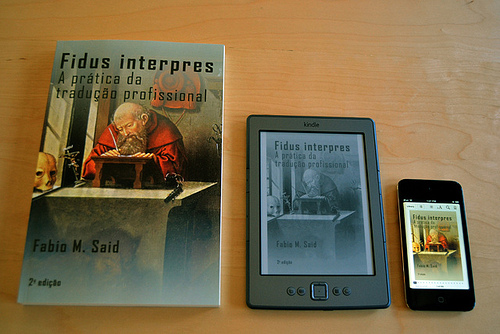
But then came Print On Demand and Lulu and CreateSpace, and after that came the Kindle. Suddenly the possibility opened up that writers could publish their work to a potentially wide audience with very little trouble or cost. For instance, let's say I had a modestly successful novel that went out of print a few years ago but that still had loyal fans. If the rights had reverted to me, either through a request to the publisher or though an automatic operation based on how my contract was set up, there was no real barrier to republishing it for the Kindle, and some people out there–an increasing number of whom would have Kindles–might be looking for it and end up buying it. One of my friends has done just this, parlaying a series whose traditional publisher had utterly failed to market properly into ongoing Kindle and POD sales that are providing him a full-time income. The books are making a good deal more selfpubbed than they ever did on bookstore shelves.
Or you might be one of those authors with an established following who decides to publish directly for readers who already know your work, like J.A. Konrath; or even an unpublished writer whose Kindle books catch on with readers to become Kindle bestsellers, like Amanda Hocking.
(Of course there are other places–BN.com, Google Books, Smashwords, and so one–where you can publish your eBook, and you can publish through Print on Demand technology in addition to or instead of eBooks, but Kindle sales are driving this revolution, so I'm focusing on those.)
Two roads diverged in the Interwebs
The point is, there's now an almost completely new, second career path option available to writers. What are we supposed to make of this? J.A. Konrath and Amanda Hocking are making boatloads of money on their eBooks, but the vast majority of people who have self-published eBooks are selling very few or no copies*. Most of the time, ePublishing your book gets it to about as many people as would read it if it were only available in the form of photocopied manuscripts hidden under an old rug in your basement.
This makes self-ePublishing–I'll call this "selfpubbing" for short, even though selfpubbing can include Print on Demand books too–both an incredible source of motivation and an incredible source of disappointment. You can selfpub your just-finished or multiply-rejected novel, novella, novelette, short story, collection, or poetry book for free in just a few hours, if you can put together a cover and follow the formatting requirements. Within a day or so, searching for your name on Amazon will bring up an actual (e)book that people can actually buy! Books that have merit but are difficult to categorize, books that were too long or too short or too much like a book that just came out or not enough like a book that just came out can be published and have their chance to find a readership.
Of course, if you just publish the eBook and wait for the cash to pour in with no promotion, as I suspect most selfpubbers do (and I'm not counting repeated pleas on Facebook and Twitter for friends to buy the thing as promotion), you're likely to be disappointed. If, however, you get reviews and get people to blog about your book, give interviews, find newsworthy angles and pitch them to news outlets, get mentions from people much more famous than yourself, and so on, then at least your book has a chance of reaching someone, and ideally it will reach a lot of someones, and those someones will love it and refer it to a lot of other someones. Unless you're famous through some other means, you can't launch a book to success all by yourself, but you can if more famous people or more far-reaching media take up your cause, or if you get readers excited and they start spreading the word.
Wait–why am I still in Kansas?
It's always possible, of course, that you'll exhaust yourself in promotional efforts and get nowhere–a few people will buy your book, hardly anyone will review it, and the moment you start to rest all interest and sales will vanish. Does this mean that you're an awful writer? Or that you're not cut out for selfpubbing and should stick to the tradpub approach? Or that you just need more promotion? Or different promotion? Or that you should be writing different books? How do you know when to put time into writing and when to put time into social media or contacting bloggers or buying Google AdWords?
There's no way to tell for certain. If your books don't sell, your writing may indeed be nowhere near good enough (yet) for people to want to read it. Or it could be spectacular, but you may be no good at promotion. Or maybe the writing and the promotion are great, but your book isn't packaged properly: the title and/or cover and/or price and/or supporting information are wrong.
A selfpub experiment
Let me give you an example: about six months before this writing, I selfpubbed a collection of 172 flash fiction pieces called Bam! 172 Hellaciously Quick Stories , which like most collections, sold very lightly. A few months later I got around to putting out a 99 cent sampler that included stories from Bam! plus one new story as a bonus: this I called 17 Stories About the End of the World. A while back, as an experiment, I dropped the price of Bam! to 99 cents, so that the sampler and the full book cost the same despite one having ten times as much content as the other.
The result was downright weird: the sampler has been outselling the full collection by a margin of five to one. At the same price. Through the same venues. That's the shorter book selling better, now.
To me, this is a clear demonstration of the importance packaging and presentation: clearly people are much more interested in "here are some stories about the world ending! (by some guy you've probably never heard of)" than they are in "here are some stories that are awfully short (by some guy you've probably never heard of)". Or they might prefer the sampler's cover (which I started but which was greatly improved by my friend Elise Catherine Tobler).
So what am I doing? A new experiment: I've broken out the book into nine separate samplers like My Friend in Hell and Other Very Short Stories and 19 Very Short Stories of Talking Animals with Serious Issues, which I've just released as of this writing. I've upped the price of the collection to $2.99, in part to help people who buy the samplers feel like they're not overpaying by comparison. At the very least, this should tell me whether my End of the World book is a fluke or not, and provide me with some fascinating (to me, anyway) sales information. What kinds of stories will turn out to interest readers the most? [Later update: none of the other samplers did nearly as well as the End of the World one, and I eventually removed them. I suspect the continued relative success of 17 Stories About the End of the World is due partly to the topic and partly to the cover. I've tried to coax Amazon to make the sampler free, but they are not biting so far.]
Selfpub isn't working! What now?
But enough of my example. If you've tried selfpub and you've tried self-promotion and you haven't made significant sales, you have three choices.
Choice number one is to relax and keep doing what you're doing. Statistically, it's likely that things will stay the same as they are and you'll never see significant sales, although things could begin to pick up over time, especially if you're doing some kind of promotion. If you're writing for the love of writing alone and don't much care about income or audience, this approach may be for you.
Choice number two is to become a combination economic researcher and marketing maven. Try different covers. Try different pricing, different promotional methods–even different kinds of books.
Choice number three is to say "screw this" and go back to tradpub, which may not welcome you back with open arms, but which probably wasn't throwing itself at you before, so you probably haven't lost any ground.
They're all legitimate choices. My suggestion in choosing among them is finding the method that gets you fired up. If you thrill to an "almost, but not quite" rejection letter (they're a lot better than a form rejection!) or start feeling queasy when you think of having to dive into Twitter every morning, maybe your path is to be published traditionally. That's also probably the way to go if you're not sure of the quality of your own work. It's all too easy to selfpub something just because it's finished without really knowing whether it's any good or not (see "Your Opinion and Twenty-Five Cents: Judging Your Own Writing").
If on the other hand, you want to embrace social media but can do so without frittering away all of your writing time on Facebook, and if you've gotten enough clear feedback from people who aren't your mother to know that your writing works for people sometimes, then maybe selfpub is worth a whirl.
Or you could go both ways
Or you may be like me, pushing projects on both tracks at the same time while simultaneously sending out short stories for good measure. I don't especially recommend this approach because it dilutes my efforts, slowing me down in every direction because I'm constantly exerting effort on several things at once. But then, this approach excites me, and I have a hell of a lot of energy. Ultimately I'm probably slowing down my overall progress, but at least I'm having fun doing it, and I'm moving forward.
I'd suggest that it's much less a business decision than a decision of the heart. We're lucky enough, at this point in history, to have at least two viable ways to make a living writing narrative fiction. Choosing the one that makes you excited to write will not only get you writing more, but will get you working more toward finding your audience–and I've yet to find a writer who complains about being too industrious at either.
If you're interested in seeing what I have on offer for the Kindle, here are the titles I currently have available:
17 Stories About the End of the World (a sampler of very short apocalyptic stories)
Bam! 172 Hellaciously Quick Stories
Family Skulls, a novel about a cursed family in modern Vermont
The Writing Engine: A Practical Guide to Writing Motivation
[ *My estimates of typical Kindle sales are based on comparing Amazon sales rankings for the total range of Kindle offerings to the rankings of eBooks for which I know specific sales figures through discussions with the authors and experience regarding my own books. ]
This article is reposted from my Futurismic column "Brain Hacks for Writers."
Photo by Fabio Said
March 2, 2012
Audio Fiction: The War With the Clowns
From February 24th through March 9th, I'll be posting a free audio flash fiction story each Friday from my collection Bam! 172 Hellaciously Quick Stories. The stories are read by my father, voice, film, and stage actor J. Louis Reid.
Today's offering is "The War With the Clowns."

photo by Talbot Troy, http://elhuecobolivia.blogspot.com
March 1, 2012
Cartoonist Raises $1.25 Million–How? By Offering Stories People Love
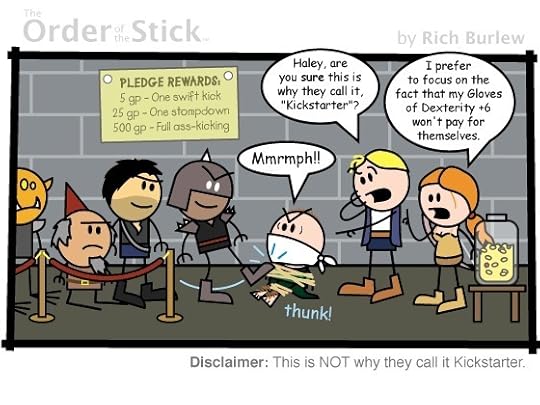
One of my favorite Web comics (and I only follow a few) recently ran a Kickstarter project hoping to raise $57,750 to reprint some collections of the comic. The Order of the Stick author/artist/genius Rich Burlew did a little better than that: the final total was $1.25 million dollars, the third biggest Kickstarter ever. You can read about it here on Publishers Weekly, among other places. Note that the majority of the money will probably go to getting the premiums printed and shipped.
I'm sure this will energize a lot of people to try Kickstarter for their own project, but I doubt any of them will have the huge and motivated fan base Burlew has. His series, which is about a set of Dungeons and Dragons characters on a quest to save the universe from an evil undead wizard, has adventure, surprises, good characterization, and a ton of humor. I don't know if it would be of any interest to a person who's never played D&D, as I did when I was young. You can read the series here: http://www.giantitp.com/comics/oots0001.html .
I think the lesson to take away here is not so much that it's time to rush to Kickstarter, or that successful Kickstarter projects have to be managed as masterfully as Burlew managed his (the charts showing progress each day were OOTS comics, for instance, and he kept adding new premiums every time a new goal was hit), but that the key to success as a creator of stories is to find a sweet spot where your storytelling turns a lot of people on (in the non-kinky way) (unless you write erotica, in which case knock yourself out) (not literally) (except who am I to tell you what to write in your erotica)?
Burlew champions the approach of building an audience through offering free material: "if you give it away first, people will form their opinion of you and your work before you ask them for money. And readers are a lot more likely to spend money on things they know they like than things they hope they will like. People want to own what they love, so rather than selling access to the content, sell the permanent incarnation of it – be that a book or an ebook or a DVD or whatever. The best thing about giving away your content first is that when it comes time to sell the final product, you're going to have almost 100% customer satisfaction. No one is going to complain that they didn't like the story they bought, because every one of your customers knew they liked it before paying."
There's a list of media mentions of Burlew's feat on his site. It was covered by Publisher's Weekly, Forbes, The Guardian, etc.
February 28, 2012
The Courage to Suck
 It seems that the best thing that ever happened to Harper Lee as a writer was also the worst thing that ever happened to Harper Lee as a writer.
In 1956, Lee received a gift of a year's wages from friends who told her to "write whatever you please." Let's take a moment now for intense jealousy. All done? OK, let's see what happened next.
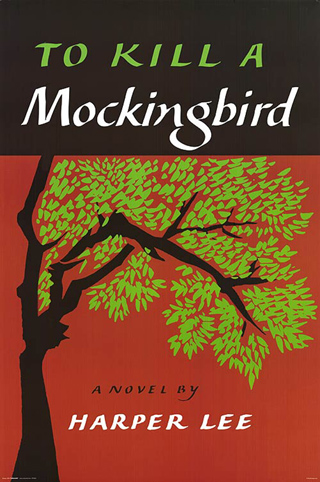
"Whatever Harper Lee pleased" turned out to be her first novel, To Kill a Mockingbird, which was published in 1960. It was a bestseller right out of the gate. Critics loved it. Readers loved it. It won a freaking Pulitzer Prize. To say that the book did well would be an ugly and thoughtless understatement.
Writers who would like to take the moral "Write whatever you please" from this story are welcome to take their things and go now. We'll wait while you get up. However, you may wish to consider the many, many people who write whatever they please and fail to become bestselling Pulitzer Prize winners. I'm just sayin'.
Hoping for a quick and merciful death
On to the actual point of today's column: Harper Lee's greatest triumph seems to have absolutely crushed her spirit. Here's what she said about the experience:
"I never expected any sort of success with Mockingbird. I was hoping for a quick and merciful death at the hands of the reviewers but, at the same time, I sort of hoped someone would like it enough to give me encouragement. Public encouragement. I hoped for a little, as I said, but I got rather a whole lot, and in some ways this was just about as frightening as the quick, merciful death I expected."
Impostor syndrome
My guess is that it was more frightening. I've talked on this site about Impostor Syndrome, which is the experience of feeling as though you are getting rewards or recognition you don't deserve, through some kind of fluke or fakery. One of the people I coach, for instance, is about to start her first year at Harvard after a fairly terrific high school academic career. Her grades were no accident, yet it's hard for her to believe that people aren't overestimating her. So it is, I suspect, with Harper Lee.
Because Harper Lee hasn't offered any fiction for publication since To Kill a Mockingbird was published. She worked on a second novel, but wasn't satisfied with what she was coming up with and, tragically and tellingly, burned it. While I don't know Ms. Lee and could potentially be making unwarranted inferences, it appears that she suffers from a crippling fear of sucking.
Risking disgrace
After all, how would it feel if you wrote a novel that was praised to the South Pole and back, then wrote a second novel that was universally recognized as unreadable hackwork? In reality, I suspect a bad second novel would be quickly forgotten after the initial disappointment. It would have to be far, far worse than the usual offering to lastingly tarnish her reputation. And yet the fear of sucking seems to have deprived us of any and all other Harper Lee novels that might ever have been.
And unfortunately, fear of sucking is not restricted to Pulitzer Prize winners. Whether we have great successes in our past or no track record at all, it's all too easy to look at something we're writing and let the fear that it isn't good enough crush us. We might stop writing, or fail to send it out, or fail to send it out a second time, or fail to send it out a fifteenth time. (Harry Potter and the Philosopher's Stone, by the way, took 13 tries. Rowling then went on to write six more books in the series, several of which are arguably better than that first, wildly successful volume, making J.K. Rowling in a way the anti-Harper Lee–as long as she doesn't consider the whole Harry Potter series her To Kill a Mockingbird.)
Sucking happens
I should be clear here: courage or no courage, our writing may at any given time suck. As good as practice can make us over time, there is never any absolute guarantee that our latest piece is any good, and there's virtually no way any one person can judge the true value of a piece of writing, especially not the writer.
Yet there's also good reason to believe that the latest thing you've been working on may well be the best thing you've ever written. Or if it isn't, that finishing it and sending it out may grant you a precious insight that will take you to a whole new level of writing awesomeness. Courage can't prevent us from sucking, but fear of sucking can prevent us from ever realizing our dreams.
A note: The discussion of Harper Lee in this piece is an extension of the big old section on overcoming writer's block in my free eBook The Writing Engine: A Practical Guide to Writing Motivation.
This piece is reprinted from my column at Futurismic.
Quinn Reid's Blog

- Quinn Reid's profile
- 6 followers

