
Quinn Reid's Blog, page 2
October 5, 2015
Things You Will Probably Not Say on Your Deathbed
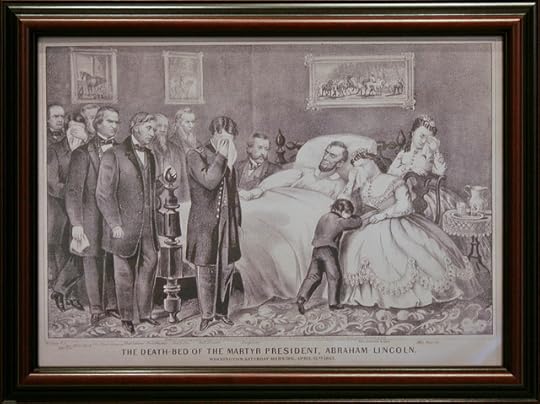
Man, I wish I’d spent more time watching TV
I now regret not eating more of those doughnuts people kept bringing in at work
All that time I wasted with my family and friends! Why didn’t I work constantly and become wealthy but unable to enjoy any of my income?
Those solar panels were pointless. Now that I really think about it, I don’t care whether climate change disasters would have been a lot worse over the last few decades if people like me hadn’t done something about it.
Good thing I took all those Facebook quizzes!
At least I got to argue with everyone who ever annoyed me.


Things You Will Probably Not Say on Your Deathbed
[image error]
Man, I wish I’d spent more time watching TV
I now regret not eating more of those doughnuts people kept bringing in at work
All that time I wasted with my family and friends! Why didn’t I work constantly and become wealthy but unable to enjoy any of my income?
Those solar panels were pointless. Now that I really think about it, I don’t care whether climate change disasters would have been a lot worse over the last few decades if people like me hadn’t done something about it.
Good thing I took all those Facebook quizzes!
At least I got to argue with everyone who ever annoyed me.
August 14, 2015
Top 12 Reasons Bernie Sanders Can’t Possibly Be Elected President or Even Win the Democratic Primary Because for the Love of Pete, Didn’t We Already Agree It Was Going to Be Hillary?
I hope folks will forgive me for making a post related to the presidential race. I’m not usually inclined to post about political matters, but lately I’ve been agog at how desperate the press seems to be to try to prove that Bernie Sanders can’t possibly win anything. I don’t say Bernie will win the presidential election, or even the primary, but for some reason he’s not yet being treated as a credible candidate, and that’s ridiculous. And speaking of ridiculous: here are the top 12 reasons he can’t possibly be elected.

Voters don’t think enough other voters will vote for him, so he won’t win, even if voters prefer him. That makes sense, right?
He’s just a left-wing Donald Trump (you know, because he speaks his mind and has messy hair), and Donald Trump isn’t going to win. Ergo, Bernie won’t win either, QED.
Bernie doesn’t have much Latino support, and with only 15 months left before the election, there’s no time for that to change.
Hillary already has the nomination locked in by winning over all the big corporate and private contributors–you know, the people whom Bernie is specifically trying to get out of government. All Bernie has is hundreds of thousands of average Americans. Since when do they count?
He’s not going to appeal to black Americans, because black Americans would never vote for the only candidate who even has a racial justice platform. So he marched for civil rights with Martin Luther King, so what? Everybody’s done that!
The press all says Hillary is going to win, and they’re the ones who matter. The only people Bernie has behind him are voters, and everyone knows they don’t make a difference in presidential races.
Everybody seems to like and respect him, even people who disagree with him. What kind of reputation is that for a president?
Sure he gets massive turnout at his events, but that doesn’t mean people are actually going to vote for him! I mean, come on: apples and oranges.
The idea of putting a heavier financial burden on people who can actually afford it to help out people who can’t make ends meet is repugnant, mean-spirited, and un-American.
Who said it was OK for him to run, did you think about that? Nobody, that’s who.
He’s too radical to appeal to a broad constituency. All the progressive Democrats who like him are too radical, too. Also the centrist Democrats. And I guess the independents. And the … Republicans …
He’s too honest: people don’t trust that in a politician.
Top 12 Reasons Bernie Sanders Can’t Possibly Be Elected President or Even Win the Democratic Primary Because for the Love of Pete, Didn’t We Already Agree It Was Going to Be Hillary?
I hope folks will forgive me for making a post related to the presidential race. I’m not usually inclined to post about political matters, but lately I’ve been agog at how desperate the press seems to be to try to prove that Bernie Sanders can’t possibly win anything. I don’t say Bernie will win the presidential election, or even the primary, but for some reason he’s not yet being treated as a credible candidate, and that’s ridiculous. And speaking of ridiculous: here are the top 12 reasons he can’t possibly be elected.
[image error]
Voters don’t think enough other voters will vote for him, so he won’t win, even if voters prefer him. That makes sense, right?
He’s just a left-wing Donald Trump (you know, because he speaks his mind and has messy hair), and Donald Trump isn’t going to win. Ergo, Bernie won’t win either, QED.
Bernie doesn’t have much Latino support, and with only 15 months left before the election, there’s no time for that to change.
Hillary already has the nomination locked in by winning over all the big corporate and private contributors–you know, the people whom Bernie is specifically trying to get out of government. All Bernie has is hundreds of thousands of average Americans. Since when do they count?
He’s not going to appeal to black Americans, because black Americans would never vote for the only candidate who even has a racial justice platform. So he marched for civil rights with Martin Luther King, so what? Everybody’s done that!
The press all says Hillary is going to win, and they’re the ones who matter. The only people Bernie has behind him are voters, and everyone knows they don’t make a difference in presidential races.
Everybody seems to like and respect him, even people who disagree with him. What kind of reputation is that for a president?
Sure he gets massive turnout at his events, but that doesn’t mean people are actually going to vote for him! I mean, come on: apples and oranges.
The idea of putting a heavier financial burden on people who can actually afford it to help out people who can’t make ends meet is repugnant, mean-spirited, and un-American.
Who said it was OK for him to run, did you think about that? Nobody, that’s who.
He’s too radical to appeal to a broad constituency. All the progressive Democrats who like him are too radical, too. Also the centrist Democrats. And I guess the independents. And the … Republicans …
He’s too honest: people don’t trust that in a politician.
July 1, 2015
Fiction Critique Hand Signals
For live critiquing:
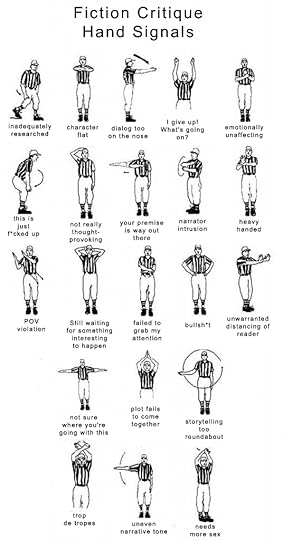
credits
Images: don’t know; didn’t ask
Nonsensical captions: me
Fiction Critique Hand Signals
For live critiquing:
[image error]
credits
Images: don’t know; didn’t ask
Nonsensical captions: me
February 16, 2015
New story free on Daily Science Fiction: When a Bunch of People, Including Raymond, Got Superpowers
My very short story about choosing superpowers wisely, When a Bunch of People, Including Raymond, Got Superpowers, is up today at Daily Science Fiction. Comments there or here are always welcome.
January 16, 2015
A Unexpectedly Brilliant Tool for Organization
In previous posts, I’ve recommended the online task manager Todoist for Getting Things Done-style organization. All the key features are available for free (though I subscribe to get the advanced features, paying $29/year). In March 2013, they introduced a tool called “karma,” a sort of ongoing game or rating based on how well you do at tracking and completing tasks. At the time, I must have thought it sounded to hokey or decided that the idea of having a productivity “score” was lame, because I didn’t start using it until five or six months ago. Since then, I’ve been a little amazed that it actually seems to work: I’m more productive, more focused, and more diligent specifically because of Todoist karma.
How can what basically amounts to a simple counting game help get more work done? By setting reachable goals and inspiring involvement. (For a more thorough consideration of the connection between games and motivation, read A Surprising Source of Insight into Self-Motivation: Video Games.)
Let’s look at how that works. Here’s a screen shot of my karma as of today (click to zoom):
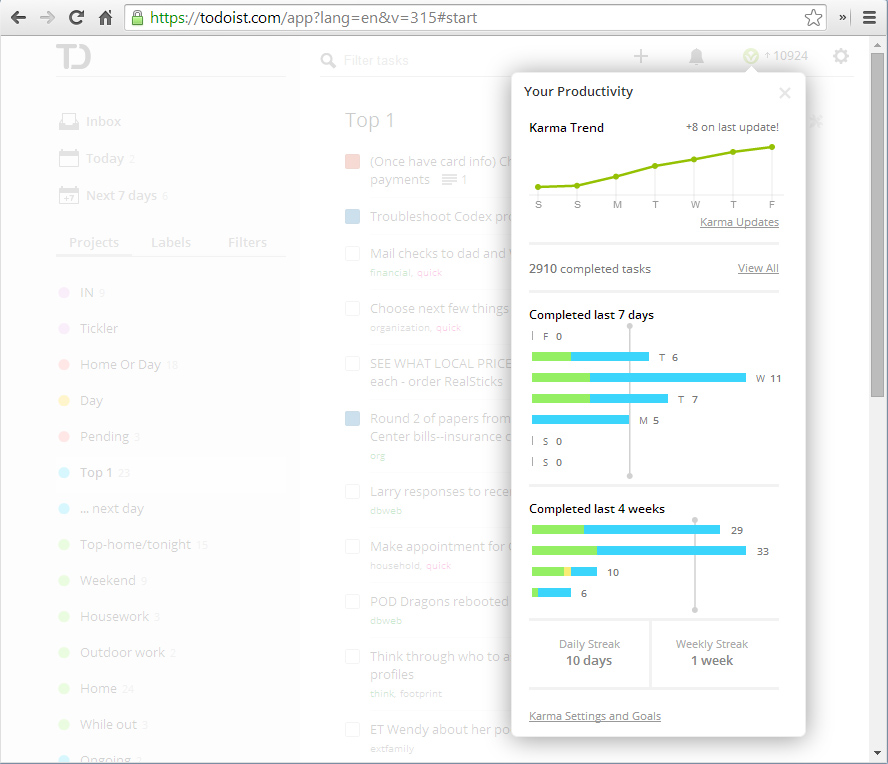
See the gray vertical lines, one for the last 7 days and one for the last 4 weeks? Those are my targets. I’m trying to complete at least that many tasks to keep on track, which is to say at least 5 per weekday and at least 25 per week. These are the default settings, which are actually great for me, but you can change them to whatever you want.
If I keep to these targets, my karma keeps going up, and my daily and weekly streaks (shown at the bottom) accumulate. (For more on motivation and winning streaks, see “Harnessing a Winning Streak.”)
As you can see from my streaks, I wasn’t able to keep on top of tasks in the same way as usual over the holidays, so I missed my targets several times up through the New Year, resetting the impressive streaks I had built up before Thanksgiving. Karma does have an important “vacation” feature (you just tell it that you’re on vacation, and it won’t expect you to get much done until you turn vacation back off). It also doesn’t expect you to get anything done on weekends (though you can change it so that you’re “on duty” any days of the week you like).
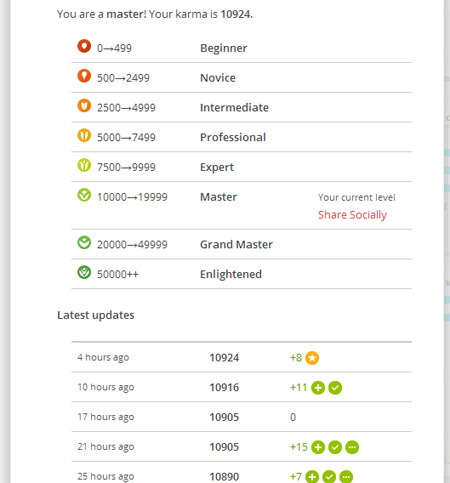
The rewards to attending to karma are minimal: your graph keeps going up, you build up your streaks, your score improves, and every once in a long while you “level up” to a new karma category. This may not sound like much inducement to get things done, but if you think about it, it’s very similar to a video game, and video games are notoriously addictive: you have a score, levels, goals, specific challenges … it’s not easy, but it’s not impossible … in a word, you’re engaged.
Another thing I like about karma that initially seemed like a drawback is that it mainly just tracks the number of tasks you get done rather than trying to deal with priority or importance or size. This makes it simple to use–pretty much automatic, in fact–but it also rewards breaking big goals down into small tasks, which is an excellent motivational and organizational technique. If you enter “redo flooring in dining room” in as a task, it’s a good bet you’ll never get it done. On the other hand, if you start with tasks like “Find out what kind of wood flooring options are out there” and “Measure dining room and write down dimensions,” then you’ve got a great basis for accomplishing something.
The way karma helps me the most is in setting a number of things to get done. My task list is probably thousands of items long, set up in many different categories with different priorities. To be productive, I have to get at least a few of those things done each day. Often what happens is that I’ll get to evening and have completed, say, three tasks (this is outside of my work task list, which I maintain separately). Being conscious of my Todoist karma, I’m aware that I can do two more to maintain my streaks and increase my score, or give up for the day, lose points and get my streaks reset. It’s nearly always possible to get two small tasks done, however, and so I generally do them, and this keeps my attention on what I have to do and also encourages me to do just a bit more each day. That’s exactly the level of quiet, private encouragement I need.
In short, if you’re in need of an elegant, easy-to-use, effective, and free task management system, you’ll have a hard time doing better than Todoist–and if you use Todoist, you should consider using the karma feature to engage more enthusiastically with all the tasks in your life.
November 14, 2014
Does Chocolate Really Contain Caffeine, or Are People Just Confusing It with Theobromine?

There’s an assertion circulating on the Web that caffeine content in chocolate is an urban legend based on misunderstanding of a related compound, theobromine. From what information I’ve been able to turn up, it appears this assertion is false: that is, the urban legend is that chocolate doesn’t contain caffeine.
The first significant information I found on this is on the Hershey Company’s site, which has a page entitled “Caffeine and Theobromine“. On this page they discuss the two separately and state that “For example, a 1.55 ounce (43g) HERSHEY’S milk chocolate bar contains about 9 mg of caffeine.” They later say “a 1.55 ounce (43g) HERSHEY’S milk chocolate bar contains about 64mg of theobromine.” It does not seem possible that they could be confusing the two in this situation.
This next page also gives specific numbers for both caffeine and theobromine content of chocolate, though I don’t know how reliable the source is: http://www.food-info.net/uk/qa/qa-fp47.htm
Getting into slightly more authoritative stuff, here’s a Russian article through Medline called “Biologically active substances in grated cocoa and cocoa butter” that discusses both caffeine and theobromine content in chocolate, separately: http://www.ncbi.nlm.nih.gov/pubmed?Db=pubmed&Cmd=ShowDetailView&TermToSearch=17674523&ordinalpos=2&itool=EntrezSystem2.PEntrez.Pubmed.Pubmed_ResultsPanel.Pubmed_RVDocSum .
Here’s another article, this one from The Journal of Chromatographic Science, also speaks of both caffeine and theobromine content in chocolate: http://www.ncbi.nlm.nih.gov/pubmed?Db=pubmed&Cmd=ShowDetailView&TermToSearch=17555636&ordinalpos=3&itool=EntrezSystem2.PEntrez.Pubmed.Pubmed_ResultsPanel.Pubmed_RVDocSum
Why does all this matter? Depending on who you are, it may not. After all, chocolate doesn’t contain a lot of caffeine. That Hershey’s bar mentioned above only has about 1/10 the amount of caffeine found in a cup of coffee, though dark chocolate has more. However, if you’re like me and have bad physiological reactions to caffeine (itching, headaches, etc.) under some circumstances, it’s pretty important to understand that chocolate–all chocolate–is going to have that effect.
On a related note, please remember too that decaffeinated coffee and tea aren’t devoid of caffeine, either–they both just have a lot less than their caffeinated counterparts.
All of the above is just based on online research, of course: I’m not a nutritionist, researcher, or medical professional.
Image courtesy of Pixabay
October 16, 2014
10 Ways to Increase Happiness: The CliffsNotes Version

There’s an excellent (if overenthusiastically titled) article on Inc.com called “10 Surprisingly Counterintuitive Ways to Be Incredibly Happy.” It lists 10 research-based insights into cultivating long-term happiness.
Here’s a summary of the approaches they recommend, which can also serve as a refresher to re-read once or twice over the next couple of days to a week after you read the original article (assuming you decide to read the original article), if you’d like a way to help ensure the ideas to stick.
Allow feelings of happiness and disappointment to mix
Keep happy friends close (or move near happy friends, or find happy friends nearby)
Learn something new, even if it’s stressful
Consider counseling, which the article describes as producing as much happiness as 32 times the money it costs
Don’t be overeager to seize happiness
Say “no” to almost everything and use “don’t” to stop yourself from unwanted behaviors*
Be comfortable and realistic in recognizing your strengths and weaknesses
Plan for the worst, both to create peace in the moment from knowing you’ve taken dangers into account and to be able to handle trouble more easily and effectively
Give up things you love for short periods in order to appreciate and enjoy them more
Picture realistic accomplishments instead of fantasizing**
*Item #6 strikes me as two separate points: the first is about not overcommitting yourself, which is huge and one of my own personal biggest stumbling blocks; the second is about how to talk to yourself about not doing something, e.g., not saying “I should work out” or “I have to work out” or “I can’t miss my workout,” but rather “I don’t miss workouts.”
**Item #10, for my money, was the least clearly presented, although in general I think the article is great. On this one, the key thing seems to be not giving up on visualizing wonderful things happening, but rather visualizing specific things it’s in your power to accomplish in the way that they might actually happen. For instance, fantasizing about becoming a basketball star may tend to sap your energy and undermine your success; picturing yourself making multiple baskets at an upcoming game and then practicing hard to make that more likely may well do the opposite.
Photo by Shindz
Quinn Reid's Blog

- Quinn Reid's profile
- 6 followers

