
Quinn Reid's Blog, page 4
September 9, 2013
Using Gold Coins in Writing
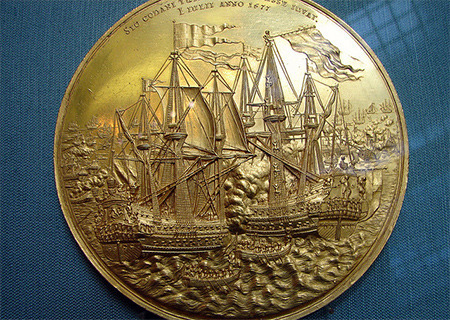
I’m nearly through reading Roy Peter Clark’s book Writing Tools, which is proving tremendously useful in upping my writing game right now, and which may possibly be the best book on writing I’ve ever read in terms of both insights and practical application. The book is written to apply equally to most kinds of writing: fiction, journalism, memoir, blogging, etc.
One of the 50 writing tools Clark describes is entitled “Place gold coins along the path.” I realized on reading the section that this was something I greatly valued in writing and that I instinctively enjoy doing in my own, but I had never thought consciously of it as a technique. Having it laid out in this clear way makes it easier to understand where and how I should use it, for instance where I might want to stop and create a rewarding moment in a particular part of a story.
A gold coin is anything delightful to the reader. It can be a powerful line or quote, a delightfully witty exchange, an unexpected insight, a thrilling plot turn, a gorgeously-sketched setting, a moment of utter hilarity, or anything else that provides unexpected value or enjoyment. Whenever you’re reading and you get to a part that makes you say “Oh hell yeah,” that’s a gold coin.
Gold coins are a treat to the reader, a reward for reading that helps create trust, enjoyment, and commitment to the book or story. Clark recommends finding ways to include them regularly as the writing progresses, like gold coins dropped here and there along a forest path. He also points out that a reader who encounters a few of them early in a piece will begin to expect them to appear regularly–which is to say, to have confidence that the piece will be worth reading through to the end.
This helps me understand why I so often disagree with the advice “Murder your darlings.” When it applies to self-pleasing material that doesn’t do anything for the reader, darlingcide is great advice. When we’re talking about some little gem of a moment in the story that may not necessarily serve any standard purpose, such as building character, plot, or theme, it could be a doomed darling, or it could be a gold coin. If it’s not going to actively detract from the story and is something the reader might really enjoy, my thinking is that makes it a gold coin. Of course, the ideal is to offer gold coins that reward the reader and advance the piece.
Photo by Tjflex2


August 14, 2013
Valley Players Present the 2013 Ten Fest of 10-Minute Plays
Thursday evening, Valley Players in Waitsfield, Vermont presents the 6th annual Ten Fest, a festival of 10-minute plays by Vermont authors. Included is my play “Willing,” in which an author struggles with her characters in an increasingly difficult attempt to maintain a plot.
I had the great pleasure of seeing another of my plays produced 2 years ago at the 4th annual Ten Fest, that being my caveperson micro-epic “The Discovery of Fire (and Other Bad Ideas).” The cast gave a rollicking performance, set off by costumes that are especially amazing when you take into account the fact that they were for such a short play. Maybe I have a picture here somewhere … oh, better yet, here’s a video:
Here’s a full list of the plays that will be presented:
“Helicopter Parents for Hire” by Stefan G. Lanfer
“Snowed In” by Em Frappier
“My Tea with Cocoa” by Jack Ruston
“Long Trips” by Richard Klovdahl
“Silver Lining” by Roger Strauss
“Ommm, Sweet Ommm” by John Kern
“Homeland Security” by Mimi D’Aponte
“Beach Combing” by Lauren Kelley
“Willing” by Luc Reid
“Lights Off” by Lynn Chlumecky
The cast includes Susan Bauchner, Ed Biello, David Ehrlich, Carl Emmons, Emily Flinn, Donna Imbeninato, Ron Kampner, Emma Kessler, Andra Krushenick Kisler, Cher Laston, Joe Laston, Sara Lee, Sara McDougal, Amanda Menard, Cynthia Seckler, Lisa Spencer. Quite a number of these artists, I’m pleased to say, appear in the video above.
The shows’ directors are Jeanne Beckwith, Henry Erickson, Cher Laston, Sara McDougal, and Dvora Zipkin. Crew includes other participants already named and Charles Coburn.
Tickets are $10 general admission, $8 for seniors and students. For reservations, call 802-583-1674. Full information on the performances is available, here, on Valley Players’ Web site. Hope to see you there!
July 29, 2013
A Simple Mnemonic for Being on Time

Lateness isn’t an enormously complicated problem, but a lot of us have trouble with it, whether from time to time or on a daily basis. A few years back, I posted How Not to Be Late: The 8 Principles of Being on Time, which has become one of the most popular articles on this site. That post covers the most practical information I can offer about lateness. For most of us, I believe those 8 ideas cover everything we have to do to conquer it.
Yet ideas are one thing, and putting them into practice is another. It takes time, effort, and attention to remember and use new behaviors, while for many of us, all three are in short supply. With that in mind, I put together a mnemonic that covers the four steps we can take to master lateness. I still strongly recommend reading How Not to Be Late, which covers both actions and attitude, but from there we just need a single word. That word is EAST, as in where the sun comes up in the morning (a time of day when lateness is especially common, which I mention in hopes of making the word itself a little easier to remember). Here’s what it stands for:
Early planning
Advance preparation
Set aside time
Tackle priorities first
Here’s a bit of explanation for each step:
Early planning: One of the mistakes many of us make is not thinking about being on time until the clock is already ticking. For instance, if I have an hour’s worth of things I really need to do before I leave, and I start 45 minutes before go-time, I’ve made myself late long before I walk out the door. Early planning means being aware of the event, knowing everything I’ll need to do to prepare, and having a good idea of how long getting ready will take.
Advance preparation: We identify the list of things we’ll need to do in the “early planning” step. Advance preparation can cross things off that list long before there’s any danger of lateness. Some examples of things that can be done in advance are gathering information, packing, preparing food, finding items that need to be brought along, planning routes, figuring out travel time, looking up telephone numbers, and picking out clothes.
Set aside time: This item isn’t needed for any task for which we can walk out the door (or pick up the phone) at a moment’s notice, but if we need to get cleaned up or dressed, get information, gather items, take care of things around the house or office, eat, or complete any other tasks before being free to head to the thing we want to be on time for, it’s necessary to set aside enough time to get those tasks done. It’s crucial to identify the true total amount of time that will be needed and to avoid cutting time we’ll need or being overly optimistic. Failing to handle this step well probably causes most incidents of lateness.
Tackle priorities first: When getting ready, starting with the most important tasks can let us be punctual even if something goes wrong or if preparation takes longer than expected. For example, if leaving to catch a train, it makes sense to ensure the ticket is at hand before, say, having a leisurely breakfast. The lower-priority items at the end of the process can often be sped up or skipped, but if we leave the most important tasks for last, that option disappears.
Putting EAST into practice
Using EAST will take a little effort up front: it requires fully understanding each of the points and memorizing the four terms. It won’t help me much to remember “EAST” if I forget what “S” means, for instance.
I’d recommend bookmarking this article, printing it out and putting it up somewhere you can easily refer to it, or to saving it to a smartphone or other device you’ll have on hand when you need it until you have the terms down and you’ve used them a number of times.
As always, please share this article on Facebook, Twitter, or other networks if you find it useful.
Photo by David Ashford
July 19, 2013
Analyzing the Living Tar out of Novel Beginnings

I’ve been researching and outlining my current novel for quite a while, but it was only this past week when I sat down to write the beginning of the book. Before doing that, I decided to try something intended to wake me up to what makes a good novel opening: I read through the beginnings of eight of the best novels I could think of–or more specifically, eight of the novels I was originally most engrossed by and continue to be most impressed by.
I didn’t worry about choosing my “eight favorites of all time,” and I strongly favored mainstream (that is, not romance, SF, Fantasy, mystery thriller, etc.) and adult over speculative and/or young adult (YA) because the novel I’m writing is a mainstream, adult novel. Otherwise I would have included The Lord of the Rings, The Golden Compass, The Amulet of Samarkand, The Hunger Games, Harry Potter and the Sorcerer’s Stone, etc.
By the way, except for Life of Pi (which I can’t recommend because I haven’t read it all the way through), I highly recommend any and all of these novels. To whatever extent your reading preferences are close to mine, I think you’ll love them.
My goal was to look for any specific tactics I would want to use in the opening of my own novel. I believe that beginnings are crucial, even more crucial than endings, because they signal what kind of book it will be and because readers often judge whether or not to read on from the first few pages or chapters. A bad ending may make the reader throw the book across the room, but a bad beginning will prevent the book from entering the room in the first place.
Of course, you can go back and redo your beginning any number of times, but as long as it’s not going to bog you down, why not start with your best effort? With that said, if you think it is likely to bog you down, this approach is probably no good for you. Some of us need more drive while others of us need more thought. I’m in the second camp.
The books I chose may or may not have been ideal for my purposes, since these books tend toward the “literary,” whatever that means when we’re talking about novel that were also commercially successful, and I’m trying to write a novel that offers a huge amount of real-life information in the form of an engrossing story, which is a bit of a different intention.
The results of my casual review were eye-opening for me. Here are the lessons I drew from the process, which may or may not be useful in your writing. I believe they apply in some measure not only to novels, but also to short fiction.
I do seem to love me some first person POV, which is too bad, considering the book I’m working on, after sober reflection, should be in third person. It surprised me, though, that most of the books I chose as favorites were written in first person.
All of the books gave a lot of information early on, but they varied enormously in what kind of information they gave and how pertinent it was to the story. Niffeneger gives a clear and understandable picture of a confusing and unusual condition (involuntary time travel) that is at the center of her story, for instance, whereas Martel drops a few vague hints of what his story is about and then starts spouting facts about tree sloths.
All of these books implied or stated that something significant and terrible was going to happen but (possibly with the exception of Niffeneger’s book) didn’t go into the details of what that thing was for at least a little while. This ranged from the subtle (beginning the chapter by quoting a poem dealing with blood and destruction) to the extremely blunt (“I was fourteen when I was murdered on December 6, 1973.”).
All used sharp and unusual metaphors and/or similes
I hadn’t previously imagined this would be a key point, but all made highly opinionated observations and philosophical statements. Of course, this may be partly a product of the predominance of first person stories, but even so, I was struck by how outspoken the narration was.
Most seemed to labor energetically early on (though not necessarily immediately) to explain anything that might be confusing or unusual about the story, but to do so in a way that seemed like a natural part of a story rather than stop-and-lecture. For example, Niffeneger demonstrates the time travel situation, Adams reveals that we’ll be reading a story about talking rabbits, and Stockett clearly depicts the structure of relationships in a household where a white woman hires a black woman to take care of her child.
Something bad is happening or has already happened to the main character pretty much right away; we have a reason to sympathize and take that character’s side. This is different than the “significant and terrible” thing. It’s the difference between Harry being locked in a cupboard under the stairs (which wins our sympathy) and having to face Voldemort (which is the key conflict of the book).
The first person narratives very often felt like being taken wholly into the person’s confidence right away: Holden Caulfield and Aibileen and Delores and all the rest feel like they’re telling all of their secret thoughts to the reader, implying a relationship of utter trust and confidence.
All bring up large and meaningful issues right from the start
Some of the books started with observations, reflection, and summary rather than diving right into a scene
Here are the raw notes I jotted down about each book as I went, in case you’re interested in the details I noticed.
Barbara Kingsolver, The Poisonwood Bible
· Immediately gives you reasons to both sympathize and be suspicious of the main characters
· Very “literary” in style, and first person, neither of which is well-suited to what I’m trying to do in my own book
· Surprising and gripping imagery
· Situation first, then explanation (not the other way around)
· Strong use of metaphor and vibrant description
· Brings up large issues (Africa, race, entitlement, guilt, privilege) in the first few pages
· Makes ethical/philosophical statements (“Most people have no earthly notion of the price of a snow-white conscience”) and controversial ones
· Strongly foreshadows
· Starts with reflection on everything (philosophy, metaphor, meaning, foreshadowing) and only then gets to the story of things
Audrey Niffeneger, The Time Traveler’s Wife
· Starts with personal reflection and immediate reference to danger and difficulty
· Ideas, philosophy, and generalization at beginning, not an immediate scene
· Startling premise given out in an incomplete way very soon
· Metaphor, simile
· First person again (still not applicable to what I’m doing, though)
· Second character introduced after only a few paragraphs, with vivid images of how time travel feels and specific examples that are half-summarized, half in-scene
· establish relationship immediately, in a meaningful way
· still a lot of reflection and summary in Henry’s part
· Beginning has an especially high proportion of effective poetics, sort of a demonstration of skill. Later in the book the descriptions and comparisons are still vivid, still lots of simile and metaphor, but the rest of the language is more transparent.
· The same is true in The Poisonwood Bible: later the story is still carried by metaphor and simile, but the intent is more narrative and less poetic and philosophical
J.D. Salinger, The Catcher in the Rye
· Starts with character, giving us an immediate and clear idea of who this guy is and how he sees the world. We also get a lot of detail about his life–where he goes to school, what he values, what his parents are like from his point of view (in general terms), his brother, etc. Long first paragraph that kind of runs on. Voice dominates.
· Then fragments of scenes, mostly told in summary, that continue to illuminate what his life is like.
· First person again, of course. That just kills me, all that first person.
· There’s a palpable warmth and feeling of trust: you immediately start feeling like a confidant, that Holden might not be very reliable to most people, but for some reason he’s chosen you as someone with whom he’s going to be absolutely, 100% candid. The same thing at the very beginning of The Poisonwood Bible.
Richard Adams, Watership Down
· Title of the first part is “The Journey,” which foreshadows, and then there’s a quote from a Greek play about death and the stench of blood, so before you read even a word of the actual story, some tension has been created.
· Starts with a traditional kind of “lay of the land” description, with specific plant names and object names, the layout of things, and so on. It paints a pretty fair picture and only gradually focuses our attention on the rabbits. Once it does that, it starts by showing them as we would see them, then implies some personality, then begins to refer to rabbit culture in a way that technically could maybe still be considered realistic if it were based on zoology rather than sociology, and then finally crosses the line into explicit talking rabbit territory.
· He gives a character sketch of each rabbit in kind of a static way, but the tension he has built up for us tides us over durng this uneventful (though pertinent) material.
· Story picks up with a scene fairly soon, with several more reminders of something dire to come (probably more necessary because the scene is only rabbits out nibbling, though there is conflict early on with the pushy Owsla members). There is even foreshadowing in the footnotes.
· He establishes the “rules” of his world very early on and imparts a surprising amount of rabbit cultural information quickly. The omniscient voice helps with this, as do the footnotes. The style is traditional or even antiquated by modern American standards, but not far out of expectations and very suitable for the book’s original time and place.
Yann Martel, Life of Pi
Disclaimer: I haven’t read this entire book: I picked it based on reputation and the movie.
· Begins with broad statements that suggest great troubles but say nothing about them, and instead focus on the narrator’s academic studies. Quickly focuses on sloths, with interesting comments
Some broad and philosophical statements that suggest a wide scope of meaning for the story
· Goes on for quite a while about the habits of sloths, then meanders onto religion and science in an apparently undirected way–still not revealing why there would be any great woe in store
· Gets even more poetic and philosophical as it proceeds
· Descriptions are vivid, surprising, and opinionated, and imply larger parts of the story that are not stated outright, e.g. “… but I love Canada. It is a great country much too cold for good sense, inhabited by commpassionate, intelligent people with bad hairdos.”
Continues with hints and hints … who is Richard Parker? Why were you in a hospital in Mexico? What brought you to Canada? What story did the other patients in the hospital come over to hear from you? etc.
Chapter 2 is a single paragraph, an outward character sketch of the narrator.
· Chapter 3 launches into the narrator’s personal history. Clearly we will have to wait a long time before finding out about Richard Parker and what the story was that the patients came to hear.
Wally Lamb, She’s Come Undone
· Starts with a memory full of personal details and clearly marked as having unreliable parts. Fills in family details, personality, and how she was raised and treated. One scene, then another. First person again.
· By the end of the second scene, a broad reference to something very bad coming. Earlier on, hints that signing on with Mrs. Masicotte was a bad decision that will cost the family. Lots of period detail.
Kathryn Stockett, The Help
· Rotating first person POV again. Yikes, all this 1P!
· Establishes voice and role immediately, and the delivery clarifies that racial issues will be central fromm the first paragraph without anything about that being explicit.
· By the second paragraph, a situation and a scene are forming, with the white lady employer unable and possibly unwilling to take care of her child
· Narrator immediately focuses on the child’s needs, even though a screaming child is hard to care about, and earns our trust and admiration–and then she is very quickly effective in her role and we come to attribute competence and intelligence to her as well
· Metaphor, simile, and voice. “Her legs is so spindly, she look like she done growed em last week.”
· Some daring statements that begin sketching out the big issues the story will tackle. “I reckon that’s the risk you run, letting somebody else raise you chilluns.”
· Then begins filling in a little of her personal tragedy (her dead son), laying out the details of his death with all the clarity and candor of everything else she’s said.
· We feel here too that we are getting the full, frank story in a way that none of the other characters in the book will get it.
Alice Sebold, The Lovely Bones
· A one-paragraph preamble that’s both sweet and ominous. We don’t know it, but it foreshadows the whole situation of the book.
· Once again first person and voice and the extreme frankness.
· She dispassionately describes her murder in the second sentence.
· A few paragraphs later, makes the first reference to “my heaven”
· Spends some time sketching out a character who will have zero role in the novel but does have emotional impact.
· Occasional sharp and well-observed metaphors and similes
· Very soon launches into the scene in which she is killed. Wastes no time.
· However, interrupts it with personal reflections and thoughts about her family–as is appropos, considering it’s a book about Susie’s relationship with her family.
· Still in the interruption of that murder scene, a fragment of a scene in heaven, observing a scene on earth in which the murderer talks to Susie’s mother.
· Family observations and fragments of scenes in Susie’s heaven continue to be interspersed with the murder scene, as well as reflections on what she did and should have done.
Photo by Let Ideas Compete
July 3, 2013
You Change Your Brain; It Changes Back
Some readers may already know that I’m a big fan of Cognitive Behavioral Therapy (CBT), a branch of psychology that deals with changing our emotions, choices, and experiences by changing our thoughts. There are two things I like especially about CBT. First, we can get a lot out of it on our own, without professional intervention (although good cognitive therapists can be worth their weight in iPhones), for instance through learning idea repair. Second, it really makes a difference. CBT has been known to work better than drugs for depression, for example, and works just as well for many other kinds of issues, big and small.
These two advantages are probably why researchers at the University of Chicago launched a study to see if teaching some basic CBT techniques to teens at high risk for committing violent crimes would make a difference in their lives (“Preventing Youth Violence and Dropout: A Randomized Field Experiment,” by Sara Heller, Harold A. Pollack, Roseanna Ander, Jens Ludwig, May 2013).
Did it work? Well, it was hugely successful … and then it was pretty much completely unsuccessful.
By “hugely successful,” I mean that in the first year of the program, incidence of violent crime was reduced by nearly half (44%) among teens who had taken the program–yet as NPR reporter Shankar Vedantam points out (“Therapy Helps Troubled Teens Rethink Crime“), the effects faded to nearly nothing within a year after the program ended. In other words, CBT techniques made a huge difference while they were in use, but the teens in the study seem to have forgotten or rejected the techniques after they had been away from them for a while.
Unfortunately, this pattern is all too familiar to anyone trying to change habits: we have a behavior we want to change, we fumble around until we find an approach that works, we make a big change, we eventually become very confident and stop working at it so hard, and then often–not always, certainly, but often–we lose all the ground we gained. It certainly has happened to me. Unfortunately, while we can reprogram our brains, overwriting years and years of habit usually requires years and years of new behavior.
But all of this is good news. Why? Because it suggests one obvious, easy explanation for why we fail so often at habit change. It’s not the only reason we fail–habit change is hard–but it’s probably a key one, and it’s that once we see ourselves acting in a new way, it’s easy for us to think that we’ve changed for good and don’t need to do all the hard work any more to keep the change going. Apparently, we do need the hard work. I’m sure that sounds depressing, but think back to a time when you’ve made a positive change in your life, when things were going well. What sticks with you? I can’t speak for your experience, but for me, thinking back on those times, what sticks with me is not that it was a slog, but the happiness at what I was achieving and pride that I was achieving it. Hard work isn’t really so hard when we’re seeing real results, and while we can’t count on great results all the time, any approach that works in our lives is worth sticking with long after it seems to have had its effect. It’s the difference between tasting success and locking it in.
For the teens in the study, tasting success has already made a big difference in their lives. Quite a number of them have avoided imprisonment, injury, and even death just from that one small study. Even if the effects are temporary, the study is worth far more than it cost–but the techniques they’re learning, like the techniques we can learn in our own lives, will mean the most if they and we find ways to stick with them for life.
Photo by JonoTakesPhotos
June 7, 2013
On Alex Shvartsman’s Blog, a Guest Post About Fiction With a Message
Fellow Codexian and editor of the Unidentified Funny Objects anthologies Alex Shvartsman recently invited me to write a guest post for his blog at http://alexshvartsman.com/ . We talked about possible topics and came up with this question: what are the dangers and unusual opportunities of writing a novel that tries to convey non-fiction information as well? The resulting post was Really? A Novel With a Message?.
June 6, 2013
The Town at World’s End: A Novel to Fight Climate Change
I hope my longtime readers will excuse all the chirping crickets lately on my usually very busy blog; I’ve been throwing all of my time and efforts into a project to tackle climate change problems, a novel called The Town at World’s End that incorporates wide and deep research into actual climate change solutions. I just launched the Kickstarter for it a couple of days ago. Check it out, and please share it if it means anything to you!
May 8, 2013
When Should a Writer Consider Kickstarter?
A disclaimer: I haven’t run a Kickstarter campaign to date. Everything I’m saying here is based on my experience with other publishing approaches and on a lot of investigation over the past few weeks into other people’s Kickstarter successes, failures, and takeaways.
What Is This Kickstarter of Which You Speak?
In case you’re not familiar with it, Kickstarter is Web site where a person can propose a project and try to get funding from customers, readers, and supporters to make that project happen. In the publishing category, the project could be a book, a magazine, an e-mail serial, etc., although here we’ll be mainly talking about books.
For instance, Mary might propose a novel called The Adventures of the Incredible Mary Sue and set a funding goal of $8,000. She would write up a description of her project, ideally make a little video explaining what it is and why she needs money to complete it, and describe a series of rewards people can get for pledging different amounts of money–for instance, a handwritten thank you from Mary on a postcard of the book’s cover, a copy of the eBook (when it’s complete), a paperback, a limited edition hardcover, or an in-person reading from Mary herself, depending on whether you’re pledging $1, $5, $10, $25, $100, or some other amount.
If your backers pledge enough money for you to make your goal, the money is released to you and you get to work. Of course you’re on the hook for delivering all of those rewards you promised as soon as your book is done (or sooner, for things like postcards).
If the full goal amount isn’t pledged, then nobody pays anything and we all go home. Because of this model, backers can pledge knowing that they’ll only have to shell out if a bunch of other people are joining them to make the project viable. Nobody has to go out on a limb–except for the project’s creator, insofar as it takes a lot of work to launch and run a Kickstarter campaign.
Some Projects Can’t Be Kickstarted
There are some limitations: Kickstarter only accepts creative projects from US and UK creators that fit into its categories, offer specific real or virtual rewards in exchange for pledges, and have a clear-cut goal to achieve. They don’t accommodate charity projects, projects from creators in other countries, projects that offer rewards made by other people, or start-ups that aren’t shooting to achieve a specific, time-bound goal. There are other services that work with these kinds of projects, though, chief among them Indiegogo (which also offers options for getting pledge money even if the goal isn’t reached), but Kickstarter is much bigger than the others and in theory has many more potential backers available to creators.
Successful Book Kickstarters
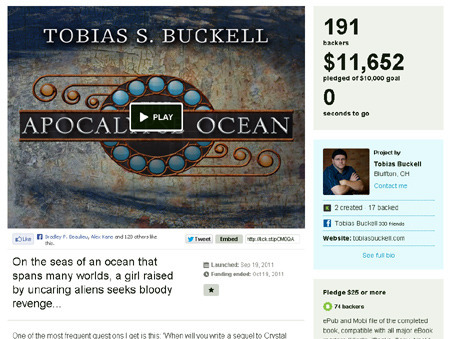
A number of writers have successfully launched books with Kickstarter projects: art books, children’s books, novels, memoirs, non-fiction books, and more. For example, the fourth book in Tobias Buckell’s Xenowealth series, The Apocalypse Ocean, was funded at $11,652 (comfortably over its $10,000 goal) in late 2011. Buckell also successfully funded a collection of his short fiction, receiving $3,290 on his modest $1,000 goal.
A much splashier example is Ryan North’s grown-up Choose Your Own Adventure-style book, To Be Or Not to Be: That Is the Adventure, which was funded at $580,905, almost 30 times the $20,000 goal he set. It was a clever idea with a very well-executed Kickstarter pitch page, but I’ll bet even North was surprised at the level of support he received.
Keep in mind that about 9% of the money that comes in for a successful Kickstarter campaign goes to Amazon (which handles the payments) and to Kickstarter itself. Depending on the project, much of the rest of the money goes to fulfilling rewards, and it’s easy to overrun on costs for those if you’re not careful. When calculating a goal, it’s necessary to figure in these amounts of money that you don’t get to keep in addition to the money that amounts to your advance on the project.
One of the appealing things about launching a book through Kickstarter is that the Kickstarter money is just the advance: typically, you can then selfpub the book and make whatever money you would usually make from sales, with the extra publicity boost of a Kickstarter to help you along (though some of your potential readers may already have gotten the book through Kickstarter, which could theoretically dent those sales). You could even conceivably get picked up by a traditional publisher at that point–although that’s definitely not the way to bet.
… and Many, Many Failed Book Kickstarters
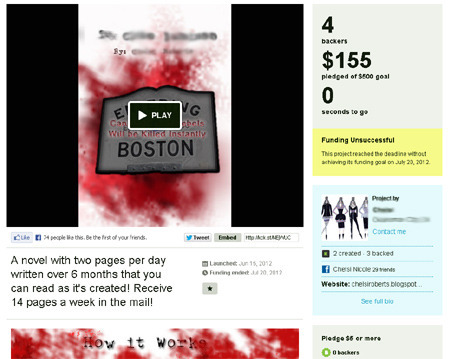
All that might sound exciting, and it is. Here’s a brand new publishing model to stand alongside selfpub and tradpub: crowdpub. At the same time, most Kickstarter projects (55.1%) fail, and the odds are worse for publishing projects than for the average: a whopping 68.6% of Kickstarter publishing pitches fail, according to Kickstarter (as of 5/8/13).
Let’s Play 20 Questions
So how do you know if Kickstarter is for you? Following are some specific questions you can ask yourself.
None of these points are meant to be absolutes, by the way. For instance, while most successful Kickstarter creators seem to have a big social media presence, not all do. Still, I’m hoping that if you’re considering crowdfunding your next project, the following lists will give you a clear idea of whether you should or not. You might even want to print these out and check off or highlight the ones that apply to you.
Things that argue for a Kickstarter campaign
You have a big social media presence
You already have a lot of readers who are hungry for your next book
You believe passionately in your project
You can’t move forward unless you have some guaranteed funding, or you don’t want to put time into a project that doesn’t have a proven readership
You crave the extra publicity boost a Kickstarter campaign can offer
The more money you have, the more you can do with this particular project (cover art, additional materials, behind the scenes materials, etc.)
You like to connect with readers personally and individually
You care a lot about the project, but need to see if readers do, too
You can estimate costs with some degree of accuracy
You’re good at pitching a project without resorting to begging
You have mad video and/or publicity skills (not strictly necessary, but helpful. Many successful Kickstarter creators have mentioned, though, that it’s much more important to be passionate and sincere about a great idea than to have a polished video.)
You’re happy writing to a schedule
Your book is based on a unique, punchy, grabby idea
You can show off work you’ve done before or work that has already gone into this project
Things that argue against a Kickstarter campaign
You already have a viable way to get published and paid through a traditional publisher or through selfpub
You don’t like using social media
You don’t like promotion
You don’t have an hour or more (ideally much more) per day to put into your Kickstarter campaign, which could run from 1-60 days–typically 30 days or so. This kind of time commitment isn’t strictly required, but a great many successful Kickstarter creators have said it was essential to their campaigns.
You don’t have the means or the skills to put together an effective video pitch. Keep in mind that showing text or a series of stills to music does not in this instance constitute an “effective video pitch.”
Your idea is not worked out in detail and ready to pitch
You don’t want to spend a bunch of time sending out rewards
You aren’t comfortable with the stress of watching and waiting for your campaign to succeed or fail
You aren’t a very public person
You don’t feel you can make a sincere and personal pitch
You plan to write the book no matter what and don’t need to get paid
You’re worried about people stealing your idea
You haven’t supported other crowdfunded projects yourself
You want to get a traditional publisher
You want or expect Kickstarter to be the sole means of promoting your book
You are picturing your Kickstarter campaign being a “build it and they will come” kind of affair
You don’t want to be involved with book design or publishing
The value of your work has more to do with the quality of the writing than with a grabby idea
Your idea comes across sounding similar to things you or others have done before, even if it will actually be different.
You can’t prove beforehand that you’re the best person to write this book.
April 29, 2013
Randall Munroe Tells You Whether or Not It’s Worth the Time
It’s no secret that I think Randall Munroe often presents things through his XKCD comic that are not only well worth knowing, but that pertain specifically to living a better life. His most recent (as of this writing) is an especially practical example.
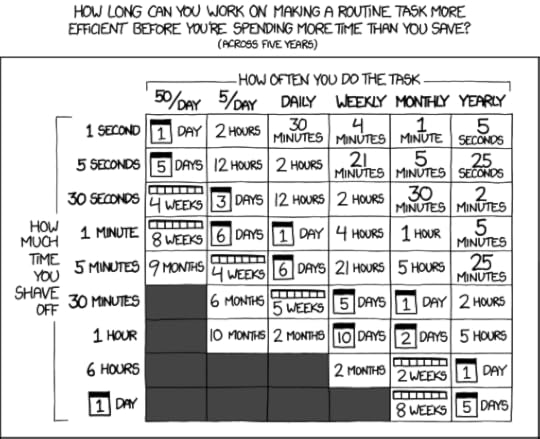
Is it worth the time?
A couple of useful things we can do with this chart:
Consider areas in our lives where it might be worth some time thinking about improvements.
Consider things we’re doing to make life more efficient that might not be worth the trouble.
April 23, 2013
Luc to Be Interviewed on Vermont Public Radio Today
 This is nothing to do with writing or habits, but at about 12:45 Eastern today, I’ll be on VPR’s Vermont Edition talking to host Jane Lindholm about the new CSA Matchmaker on our Web site, which helps Champlain Valley residents find the perfect CSA. In case you’re not familiar with the term, a CSA (“Community Supported Agriculture”) is an arrangement with a farmer to pre-pay for a season’s worth of food, often picked up weekly. The CSA member gets a good deal on great local food, and the farmer gets financial stability and regular customers. If you know anyone in the area who might benefit from joining a CSA, please send them over to the site. We’re coming up on 1,000 visits so far based on word of mouth, an article in the Free Press, and other exposure, so I think it’s working.
Anyway, I’ll be talking a little bit about the CSA Matchmaker and Localsourcers. In future we plan to expand the CSA Matchmaker to many other areas, and on May 1st we’ll be launching the Localsourcers Online Forum, a community for anyone anywhere interested in sharing information and connecting about local resources, local food, sustainability, and resilience. Come join Localsourcers (free) if you’re interested in taking part.
Quinn Reid's Blog

- Quinn Reid's profile
- 6 followers

