
When Should a Writer Consider Kickstarter?
A disclaimer: I haven’t run a Kickstarter campaign to date. Everything I’m saying here is based on my experience with other publishing approaches and on a lot of investigation over the past few weeks into other people’s Kickstarter successes, failures, and takeaways.
What Is This Kickstarter of Which You Speak?
In case you’re not familiar with it, Kickstarter is Web site where a person can propose a project and try to get funding from customers, readers, and supporters to make that project happen. In the publishing category, the project could be a book, a magazine, an e-mail serial, etc., although here we’ll be mainly talking about books.
For instance, Mary might propose a novel called The Adventures of the Incredible Mary Sue and set a funding goal of $8,000. She would write up a description of her project, ideally make a little video explaining what it is and why she needs money to complete it, and describe a series of rewards people can get for pledging different amounts of money–for instance, a handwritten thank you from Mary on a postcard of the book’s cover, a copy of the eBook (when it’s complete), a paperback, a limited edition hardcover, or an in-person reading from Mary herself, depending on whether you’re pledging $1, $5, $10, $25, $100, or some other amount.
If your backers pledge enough money for you to make your goal, the money is released to you and you get to work. Of course you’re on the hook for delivering all of those rewards you promised as soon as your book is done (or sooner, for things like postcards).
If the full goal amount isn’t pledged, then nobody pays anything and we all go home. Because of this model, backers can pledge knowing that they’ll only have to shell out if a bunch of other people are joining them to make the project viable. Nobody has to go out on a limb–except for the project’s creator, insofar as it takes a lot of work to launch and run a Kickstarter campaign.
Some Projects Can’t Be Kickstarted
There are some limitations: Kickstarter only accepts creative projects from US and UK creators that fit into its categories, offer specific real or virtual rewards in exchange for pledges, and have a clear-cut goal to achieve. They don’t accommodate charity projects, projects from creators in other countries, projects that offer rewards made by other people, or start-ups that aren’t shooting to achieve a specific, time-bound goal. There are other services that work with these kinds of projects, though, chief among them Indiegogo (which also offers options for getting pledge money even if the goal isn’t reached), but Kickstarter is much bigger than the others and in theory has many more potential backers available to creators.
Successful Book Kickstarters
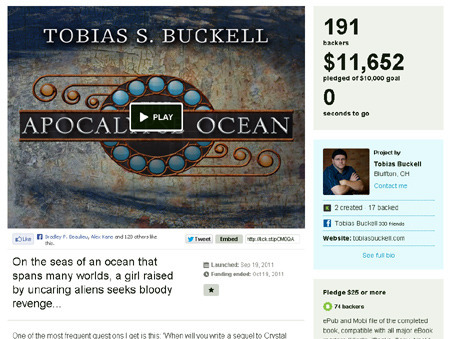
A number of writers have successfully launched books with Kickstarter projects: art books, children’s books, novels, memoirs, non-fiction books, and more. For example, the fourth book in Tobias Buckell’s Xenowealth series, The Apocalypse Ocean, was funded at $11,652 (comfortably over its $10,000 goal) in late 2011. Buckell also successfully funded a collection of his short fiction, receiving $3,290 on his modest $1,000 goal.
A much splashier example is Ryan North’s grown-up Choose Your Own Adventure-style book, To Be Or Not to Be: That Is the Adventure, which was funded at $580,905, almost 30 times the $20,000 goal he set. It was a clever idea with a very well-executed Kickstarter pitch page, but I’ll bet even North was surprised at the level of support he received.
Keep in mind that about 9% of the money that comes in for a successful Kickstarter campaign goes to Amazon (which handles the payments) and to Kickstarter itself. Depending on the project, much of the rest of the money goes to fulfilling rewards, and it’s easy to overrun on costs for those if you’re not careful. When calculating a goal, it’s necessary to figure in these amounts of money that you don’t get to keep in addition to the money that amounts to your advance on the project.
One of the appealing things about launching a book through Kickstarter is that the Kickstarter money is just the advance: typically, you can then selfpub the book and make whatever money you would usually make from sales, with the extra publicity boost of a Kickstarter to help you along (though some of your potential readers may already have gotten the book through Kickstarter, which could theoretically dent those sales). You could even conceivably get picked up by a traditional publisher at that point–although that’s definitely not the way to bet.
… and Many, Many Failed Book Kickstarters
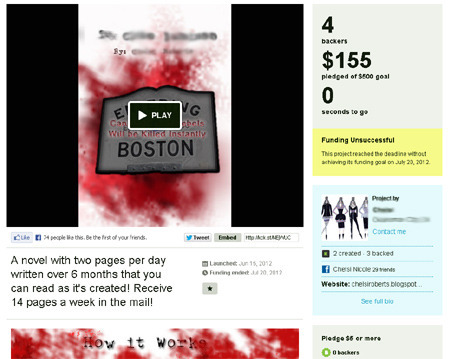
All that might sound exciting, and it is. Here’s a brand new publishing model to stand alongside selfpub and tradpub: crowdpub. At the same time, most Kickstarter projects (55.1%) fail, and the odds are worse for publishing projects than for the average: a whopping 68.6% of Kickstarter publishing pitches fail, according to Kickstarter (as of 5/8/13).
Let’s Play 20 Questions
So how do you know if Kickstarter is for you? Following are some specific questions you can ask yourself.
None of these points are meant to be absolutes, by the way. For instance, while most successful Kickstarter creators seem to have a big social media presence, not all do. Still, I’m hoping that if you’re considering crowdfunding your next project, the following lists will give you a clear idea of whether you should or not. You might even want to print these out and check off or highlight the ones that apply to you.
Things that argue for a Kickstarter campaign
You have a big social media presence
You already have a lot of readers who are hungry for your next book
You believe passionately in your project
You can’t move forward unless you have some guaranteed funding, or you don’t want to put time into a project that doesn’t have a proven readership
You crave the extra publicity boost a Kickstarter campaign can offer
The more money you have, the more you can do with this particular project (cover art, additional materials, behind the scenes materials, etc.)
You like to connect with readers personally and individually
You care a lot about the project, but need to see if readers do, too
You can estimate costs with some degree of accuracy
You’re good at pitching a project without resorting to begging
You have mad video and/or publicity skills (not strictly necessary, but helpful. Many successful Kickstarter creators have mentioned, though, that it’s much more important to be passionate and sincere about a great idea than to have a polished video.)
You’re happy writing to a schedule
Your book is based on a unique, punchy, grabby idea
You can show off work you’ve done before or work that has already gone into this project
Things that argue against a Kickstarter campaign
You already have a viable way to get published and paid through a traditional publisher or through selfpub
You don’t like using social media
You don’t like promotion
You don’t have an hour or more (ideally much more) per day to put into your Kickstarter campaign, which could run from 1-60 days–typically 30 days or so. This kind of time commitment isn’t strictly required, but a great many successful Kickstarter creators have said it was essential to their campaigns.
You don’t have the means or the skills to put together an effective video pitch. Keep in mind that showing text or a series of stills to music does not in this instance constitute an “effective video pitch.”
Your idea is not worked out in detail and ready to pitch
You don’t want to spend a bunch of time sending out rewards
You aren’t comfortable with the stress of watching and waiting for your campaign to succeed or fail
You aren’t a very public person
You don’t feel you can make a sincere and personal pitch
You plan to write the book no matter what and don’t need to get paid
You’re worried about people stealing your idea
You haven’t supported other crowdfunded projects yourself
You want to get a traditional publisher
You want or expect Kickstarter to be the sole means of promoting your book
You are picturing your Kickstarter campaign being a “build it and they will come” kind of affair
You don’t want to be involved with book design or publishing
The value of your work has more to do with the quality of the writing than with a grabby idea
Your idea comes across sounding similar to things you or others have done before, even if it will actually be different.
You can’t prove beforehand that you’re the best person to write this book.


Quinn Reid's Blog

- Quinn Reid's profile
- 6 followers

