
Quinn Reid's Blog, page 6
February 4, 2013
Aikido Interviews, #3: Like Learning How to Play Music
This post is the third in a series begun back in October interviewing 3rd degree black belt Aikido practitioner Dwight Sora of Chicago Aikido club. While I’m interested in martial arts for their own sake, Aikido strikes me as having some unusual philosophical lessons about acceptance, change, and growth.
Previous posts in this series are Aikido Interviews, #1: Trying to Discover Truths and Aikido Interviews, #2: “Lift Your Head and Say ‘Isn’t Today a Great Day?’”
The discussion in this post follows up on an idea Dwight brought up in the previous interview of becoming calm and not focusing on an attacker or problem.
Luc: If we’re engaging with an opponent (and I really mean this both in the literal and figurative senses), but we’re not letting the opponent take our focus, how do we strike a balance between being aware on the one hand and not getting sucked in on the other?
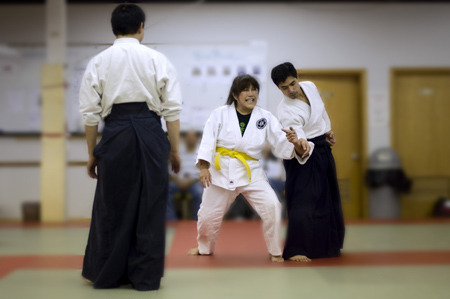
Dwight: First off, this is a question for which I still do not have a definitive answer. While prepping for my three degree black belt test recently, I was acutely aware that during Aikido randori (which takes the form of defending against multiple attackers) the very act of extending one’s attention to more than one attacker felt simply exhausting. Even though the situation was extremely safe and very controlled (for form’s sake, attackers during Aikido randori should be taking smooth ukemi or “receiving the technique,” not allowing the situation to turn into a knock-down dragged-out fight), I could feel my heart start to race, my fight-or-flight mechanism kicking into gear, etc. In particular, there were moments where I was aware that my back was turned to an oncoming attacker as a result of throwing aside another, and though this moment was brief, I could feel a spike in my stress level.
On one level, I do think it’s simply a matter of constant practice. You need to simply drill all those techniques into your muscle memory so that you can “think” with your entire body and respond to situations accordingly without wondering where your hand or foot is going. I really feel like learning martial arts is a lot like learning how to play music, especially improvisational forms like jazz. Drills and exercises are like practicing your scales, forms are like studying the work of other musicians so you understand what works and what doesn’t, and techniques are like chord progressions or melody lines that you can adopt, modify or riff.
In that sense, I believe the majority of those of us studying martial arts are more like musical students than actual musicians. We’ve practiced our scales a lot, have memorized a lot of pieces of music and have mastered a handful of melodies and chords; but only a handful of us really know how to make music. (To add, I think there’s absolutely nothing wrong with that, as long as you realize whether you’re a real fighter or not.)
Another way of looking at this question is to steal an idea from another teacher. I was once told to think of martial arts as not an external series of techniques by man, but a refinement of our basic animal instincts. Think of the way a common squirrel responds to its surroundings and possible
threats. It’s not thinking the way a person does, but it’s paying total attention to everything – sights, sounds, smells, movement. Its thoughts (whatever they are) are in total alignment with every fiber of its being, and if it needs to high tail it out of there, it seems almost instantaneous.
The idea is that maybe the study of martial arts allows us as human beings to get back to that sort of state, a kind of pure intuition. That, combined with the techniques we study, gives us a refined series of physical responses, a stronger “vocabulary” if you will, than simply running away (like the squirrel).
I don’t think this state of mind is particular to martial arts. I’m pretty sure when pro athletes talk about being “in the zone” or race car drivers feel like they’re watching their own actions in slow motion it’s the same thing. [A note from Luc: There's some good research to back this up. Interested readers may want to read “Flow: What It Feels Like to Be Perfectly Motivated” and “Some Steps for Getting into a State of Flow“] I work as a stage actor, so I’m constantly hoping to reach that sublime moment where I can connect with the audience and really bring a character to life, while still taking care of those pesky technical details (hitting my marks, remembering my lines and cues, etc.).
For my own training lately, I’m working on “forgetting” my body. Basically, I’m trying to allow myself to trust that I actually do know all this stuff I’ve been studying over the years and to remove any self-conscious movement.
That even goes to trying not to think about getting into a proper starting stance and putting my hands in the right place, and see if it happens automatically. It’s a little strange trying to “turn off” parts of my brain, and very disconcerting (especially when you end up responding late) but it seems to be the only way I’ve been able to free myself of the crutch of thinking of technique all the time and see if I can have natural responses to a situation.
Image courtesy of Dwight Sora


January 30, 2013
Aikido Interviews, #2: “Lift Your Head and Say ‘Isn’t Today a Great Day?’”
This post is the second in a series begun back in October interviewing 3rd degree black belt Aikido practitioner Dwight Sora of Chicago Aikido club. While I’m interested in martial arts for their own sake, Aikido strikes me as having some unusual philosophical lessons about acceptance, change, and growth.
The first post in this series was Aikido Interviews, #1: Trying to Discover Truths. New posts will go up on the next three Mondays, February 4, 11, and 18.
 Luc: What’s the relationship between engaging with the world and engaging with an attacker? What approach or approaches does Aikido indicate for a practitioner who is being attacked?
Dwight: This may seem overly simplistic and reductive, but it really does seem to boil down to staying calm. And furthermore, that really seems to be what all martial arts ultimately strive to achieve.
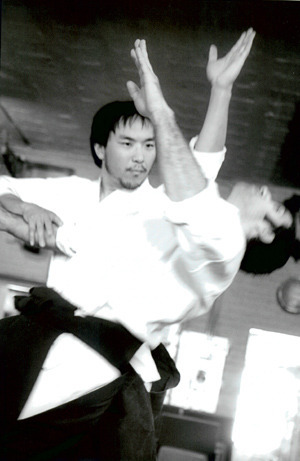
Naturally, Aikido, with its strong philosophical component, places a lot of emphasis on keeping the body relaxed and centered and keeping your mind focused. However, I have met senior Judo instructors who emphasized the exact same points. Also, years ago I attended a series of Aikido camps in the Colorado Rockies where the guest instructor was Kenji Ushiro, a traditional Okinawan Karate instructor. It seemed odd to have a Karate instructor at an Aikido camp, until I saw what he was teaching. His technique was amazingly soft, and he never broke posture (or a sweat) and moved with total control. (Clip below.)
[Note from Luc: I don't know if the following will be as fascinating to you as it was to me, but I do recommend checking out this short video Dwight sent.]
In terms of attitude, Aikido teaches one to respond to attackers non-aggressively. Now, that doesn’t mean passively, as some might assume from my earlier statement. The response is still dynamic, but you try to avoid ideas like “I’m going teach this guy a lesson” or “I’m going to put this person down.” And by keeping a cool head, you keep an open mind, and hopefully are able to see more possibilities (and of course, strategic openings) in a situation.
In terms of technicalities, the idea is that your body will also respond faster and stronger if your muscles are relaxed and not tense. And this does make a lot of sense even in street terms (I believe). I was once told that statistically speaking, a large number of the women who study martial arts will pick a striking art over anything involving grappling or throwing (So, Karate or kickboxing instead of Judo, Aikido or Jujitsu). The answer is understandable – A lot of women don’t like the idea of being in a room having to grab and possibly roll around the floor with men. However, I’ve also heard that if the intent of their study is self-defense against a mugger or rapist, there’s a hole in their decision-making. Most attackers on the street don’t want to fight you; they just want to subdue you or get the jump on you (often from behind) and grab on. The advantage of studying a grappling art is that you become desensitized to the fear that is induced during the act of being grabbed or choked, and learn how to keep your muscles relaxed (and flexible) while in such a situation to allow an effective response.
My senior teacher is always telling me to avoid being aggressive. He’ll even raise his head and say, “Don’t think about the other guy, lift your head and say ‘ Isn’t today a great day’.”
Image courtesy of Dwight Sora
January 28, 2013
Fight Climate Change With a Grocery Basket
I’ve launched a new community-based nonprofit called Localsource, with a Web site to help people connect around getting food and other necessities locally, and a local chapter called Champlain Valley Localsource that will hold its first meeting in Burlington, Vermont on February 6th.

People who join Localsource will have tools and information to get products they need in a way that is far safer for the climate and good for building community and the local economy.
Here’s our initial press release:
FOR IMMEDIATE RELEASE
New Local Foods Group to Hold Inaugural Meeting at Burlington City Hall
Burlington, Vermont – Champlain Valley Localsource, a new community nonprofit that champions use of local foods and resources, will hold its inaugural meeting on Wednesday, February 6, from 6:00-8:00 PM at Burlington City Hall Contois Auditorium. The Champlain Valley group is the first local chapter of the group, which is online at www.localsource.me.
“When our family started changing over to local foods, I was amazed that Burlington, one of the most local foods-friendly places in the country, didn’t have a group where people could share ideas and information,” says organizer Luc Reid. “Localsource is meant to fill that gap for Burlington and the rest of the Champlain Valley.”
A former group called Burlington Area Localvores previously held localvore challenges and promoted local foods, but disbanded several years ago.
Vermont ranked first among the fifty states in the 2012 Locavore Index, a comparison of state population to number of farmers’ markets and community-supported agriculture organizations sponsored by The Strolling of the Heifers and based primarily on USDA and U.S. Census data.
In addition to food-coops, farmers’ markets, community supported agriculture operations, farms, and food producers, the Champlain Valley is home to dozens of organizations that promote local foods, such as the Vermont Fresh Network, the Burlington Food Council, Addison County Relocalization Network (ACORN) and groups at Champlain College and UVM. New organizations are springing up to serve immigrant populations in the Champlain Valley and all of Vermont, such as New Foods for New Americans, which helps transplanted African farmers grow food in Vermont, and the Goat Collaborative, which this year will begin raising local goats as a source of meat for area residents to replace the frozen goats from Australia that have supplied that need so far. Localsource is unique among these organizations in that its primary mission is bringing together individuals and families to help each other transition to more local sources of food and other necessities.
The February 6 Localsource meeting will begin with a social half-hour, for which musicians are invited to bring instruments, followed by presentations, problem-solving, and discussion. It is free and open to the public. More information is available at www.localsource.me or by e-mailing luc @ localsource . me.
January 22, 2013
Just Released: The Expanded, Illustrated 2nd Edition of Talk the Talk: The Slang of 67 American Subcultures
About two and a half years ago, when I set about putting together a Kindle edition of my 2006 book Talk the Talk: The Slang of 65 American Subcultures, I thought I was looking at a couple of week’s work in whatever time I could spare. It turns out that updating my term database with the original edition improvements, adding three new subcultures, putting in multiple photographs for every subculture, editing, adding some terms that didn’t fit in the first edition, and otherwise preparing this new edition have taken … well, two and a half years. Yet I think it was worth it! Check it out here.
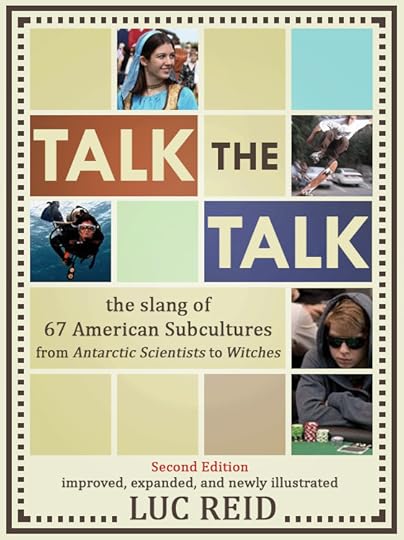
I was very pleased to find that no significant corrections were required from the original edition. Despite my careful research, I had half expected the day after the original book’s release to be deluged with telephone calls by irate members of the subcultures I’ve documented correcting my facts–but there weren’t any, then or since.
My favorite credibility moment came when a blog post upbraided me for using the term “shank” to refer to a cell-made prison weapon instead of what the post’s author (who like me, has not served time) put forth as the proper term, “shiv.” I didn’t have to defend my research, though: an actual former inmate commented on the post instead, saying that “shiv” was a popular media term, but the word that was really used “inside” was “shank.”
Regardless, whether you check the book out to browse the new photographs of all the unexplored corners of American culture, to test your knowledge of carnival slang (the public radio show Wait Wait, Don’t Tell Me used the original edition to do this to guest Julia Sweeney back in 2006), to come up to speed on Renaissance Faire or snowboarding slang, or to just enjoy the range of words model rocketry enthusiasts use when they talk about things blowing up, there’s likely to be something of interest to practically any culture afficianado in what BoingBoing! called “the kind of quirky thing that is endlessly fascinating and full of odd insights into worlds you never suspected existed.”
If you’re interested in a review copy, whether for publication or simply for your blog, Amazon, or Goodreads, etc., please use the contact form here on my Web page.
The print edition should be released next month.
(By the way, astute readers may have noticed that I mention adding three subcultures, but the number listed on the cover only increased from 65 to 67. That’s because hip-hop slang, which to my way of thinking is much too widely used to be considered subculture speak, was removed from the new volume. Instead, I made it available for free on Talk the Talk‘s Web site at www.subculturetalk.com.)
January 21, 2013
Have Trouble Getting to Sleep at Night?

I’ve been corresponding with Denise, a reader of this site, and she recently wrote to say
I realized last week that I can no longer go to sleep with the tv or a movie going on all night, but I do need something distracting to help me get to sleep. So I decided to try to have music play quietly and put it on a timer. It works. I have been falling asleep easily and am not semi-aware of it all night as I was with the tv. The strange thing is that it’s been a week, it’s clearly in place and it’s a done deal. So why was that so easy? You know what they say in texts; “lol” and that’s exactly what I am doing. Ridiculous.
Background music or sound really is a very handy approach, especially if you’re easily distracted at night or have trouble falling asleep due to background noise. My entire family uses CDs of ocean sounds at night to help us fall asleep. For myself, I won’t try music because I’d be afraid of it getting burned into my brain; I have that problem regularly. Heck, I saw Les Miserables three weeks ago and still have some of the songs running through my head against my will sometimes. Fortunately I have some good techniques for getting rid of them, but those techniques only work in the moment, alas.
But back to the sleeping thing: if you have trouble getting to sleep, give that a whirl. You could even try simplynoise.com, a handy white noise site, on an iPod or smartphone.
For more tips on sleeping better, check out “18 Ways to Get a Good Night’s Sleep.”
Image by striatic
January 11, 2013
Inclusivity and Exclusivity in Fiction: Pamela Rentz on People Running Off to Have a Vision Quest
This is the ninth interview and the eleventh post in my series on inclusivity and exclusivity in fiction. You can find a full list of other posts so far at the end of this piece.
In today’s interview we talk with author Pamela Rentz, a member of the Karuk Tribe.
 LUC: As both a member of a California tribe and a SF writer who writes Indian characters, what needs do you see in SF–or in literature in general–for growth or change? What’s broken right now in regard to Indian characters in fiction?
PAM: When Indian characters show up in stories, too often it’s to act out a narrowly defined role that’s about being Indian. They have to have names with hawk or eagle or bear in them. Some sort of personal spiritual quest is involved. In spec fiction they have to be shapeshifters. To be fair, I remember reading a great story, I think in F&SF, that featured a terrific Indian character and I’ve just spent about fifteen minutes trying to track down the author and title with no luck. But I still see a lot of the magical indigenous person, the spiritual wise one, the romanticized historical Indian. Or, who would have predicted this would develop in my lifetime: the casino Indian. Even in journalism I see the same tired narrative: a non-Indian person has managed to secure the trust of a group of Indians and via this special access is able to share his non-Indian perspective of what “real” Indians are like. The resulting story generally shows terrible poverty and/or something spiritual and exotic.
Where are the Indian detectives and librarians and space mission leaders and zombie hunters?
I’ve been asking myself what needs to happen to bring out more variety and depth to Indian characters and I’ve love to see more Indian writers telling their stories. I’m not suggesting that non-Indians can’t write Indian characters and especially the speculative fiction community tends to be better informed and more likely to do their homework. But, unless you’ve spent some time around Indian people it’s going to be difficult to capture the depth of characterization and unique Indian perspective I feel is missing.
I’m definitely seeing more Indian kids in social media and showing off great talent merging the traditional with the contemporary in fashion, music and art. I’m not aware of much fiction but I’m hoping it’s happening out there somewhere.
LUC: Why do you think that so many writers fall into the trap of Indians as keepers of some kind of secret knowledge or experience that reflects “real” Indians when, ironically, by doing that they’re ignoring the experiences of real real Indians?
PAM: That’s a terrific question. I wonder that myself.
I think part of it is that, not just writers, but most people don’t spend a lot of time with Indian people. I’m trying to figure out the best way to clarify this. Indian identity can be a touchy subject and I’m not trying to pick any fights here. What I’m talking about is spending time with Indians in connection with their Indian communities. Its one thing to have a friend or colleague who’s Indian and another thing to spend time in Indian Country.
Indian communities tend to be isolated and often not especially welcoming to outsiders. It’s tough to get an idea of the culture without seeing the tribal connections. I don’t feel like I really got it until I began working in Indian Country and seeing people from different tribes interacting and similarities in behavior. Things that I saw in my family but never connected to a bigger picture. As a writer, how can you give the Indian an authentic role without observing it yourself?
But then, why not see Indians like everyone else? There are Indian lawyers and school teachers and insurance adjusters. I don’t watch Law & Order but I understand that when Adam Beach (Saulteaux First Nations) was brought on the show his character was a detective who happened to be Indian not they needed an Indian character so they hired him. I saw Wes Studi (Cherokee) in a role once that wasn’t specifically Indian. In movies it seems like Indians show up because they need an Indian, but rarely because the appropriate actor happened to be an Indian. Of course, if you have a character and you cast them as Indian for no reason other than to be diverse, I guess that fails, too.
I think writers fall into traps with Indians for the same reason we often fall into traps when we’re inventing any kind of character. It’s an easy shortcut. The stereotype is universally understood. Why go through the trouble of inventing an Indian character if she’s just going to be turned into a zombie or be the guy on the space ship who says, “Yes, Captain”? You have a noble hero or a badass elder, why not have them save the day with some mystical Indian knowledge?
Every once in awhile I’ll see a description or discussion of something that is “typical Native American.” For example, Native American religion or Native American food. That’s like referring to European religion or European food. It might have value as a general shorthand, but really it’s meaningless. There are over 500 tribes and Alaska Native villages recognized by the US government. There are even more entities that don’t have federal recognition. They’re all unique and most of them don’t conform to stereotype.
LUC: I hope you’ll excuse me for referring to the vampire elephant in the room, but what’s your reaction to the Quileutes in the Twilight books and movies? I can’t help but notice they check off the “shapeshifter” point handily.
PAM: Well, I didn’t hate all of it.
What I liked is that the story had a small Pacific Northwest Tribe that is relatively unknown. It seems like Indians in stories are almost always from the same Tribes, usually Plains.
And in this story, Indians are introduced as regular people who are friends of Bella’s father. At least initially, their purpose isn’t to be Indian.
I also really liked that the tribal members were connected to their lands – the pact was made to protect the Indian lands.
I can’t remember every detail of the story but to the best of my recollection there was no stereotypical corny spiritual aspect such as a medicine man waving his eagle feathers around or people running off to have a vision quest.
On the other hand, Indians as shapeshifters cancels most of that out. It’s awful to see a Tribe’s origin story appropriated and rendered completely silly and then go on to make piles of money for all kinds of non-Native people. There was even Twilight inspired merchandise with “Quileute” designs.
I wonder if Stephenie Meyer had had any notion of how huge and far-reaching those books would end up, would she have done it differently? No way to know. Generally, I don’t think the dominant culture sees it that way. Urban Outfitters needed to be told that the Navajo Nation wasn’t honored to have their hipster panties named after the Tribe.
I’m not as outraged about Twilight as I might have been. The whole story is pretty dopey and doesn’t pretend to be anything other than entertainment. At least the Indians got to be on the winning side.
 Pamela Rentz is an member of the Karuk Tribe of California and works as a paralegal specializing in Indian Affairs. She is a graduate of Clarion West 2008 and has been published in Asimov’s, Innsmouth Free Press and Yellow Medicine Review. She’s published a collection of short stories called Red Tape Stories from Indian Country available for Kindle and other eReader devices at Smashwords. She can be found online at: www.pamrentz.com.
7/27/12 – interview with Leah Bobet
7/29/12 - Where Are the Female Villains?
8/3/12 – interview with Vylar Kaftan
8/9/12 - Concerns and Obstacles (multiple mini-interviews)
8/10/12 – James Beamon on Elf-Bashing
8/17/12 – Steve Bein on Alterity
8/24/12 – Anaea Lay on “An Element of Excitement”
9/21/12 - Leah Bobet on Literature as a Conversation
11/2/12 - Aliette de Bodard on Crossing Over
11/9/12 - Anatoly Belilovsky on Atrocities and Menschkeit
January 7, 2013
New Submitomancy Site Will Manage Market, Response, and Submissions Data

Writer Sylvia Spruck Wrigley, whom I’ve been fortunate to know for several years through the writing group Codex, has fired up an ambitious project to create a site offering a variety of important writing and publishing information, filling in the gap that’s left by Duotrope becoming an expensive, paid service and adding on a number of coveted writerly items. If you’re interested in checking the project out, hop over to Indiegogo and see where it stands: http://www.indiegogo.com/submitomancy .
December 31, 2012
Is Your New Year’s Resolution Doomed by Uncertainty?
 A resolution, whether it’s made at the New Year or any other time, is a fragile thing. It can get swamped by other priorities, be badly chosen and never bloom, die stunted from being planted with too many other resolutions, wither from inattention, or fail to thrive in any number of other ways. But even if we’ve chosen our goals wisely and pursue them relentlessly, there’s one necessity that can make or break us: certainty about exactly what we’re doing.
I’m running into this problem at the moment with eating habits. I’m training for a half marathon in the Spring, my first, and at the same time I want to eat lower on the food chain so as to fight climate change. I also want to manage my cholesterol better, since I have a genetic predisposition to cholesterol problems, but there are at least two major schools of thought on how to do that, and they’re completely opposed to each other. So do I want to eat better in the New Year? Absolutely: that’s a very important priority for me. Do I know exactly how I want to eat better? Well, uh …
It probably seems obvious that I need to understand exactly how I want to be eating before I can follow through, but the truth is that the traditional way of setting goals or resolutions skips this essential step entirely: we resolve to lose weight or to be more organized, to have more time with family or to increase our productivity–but the truth is, none of these are really resolutions or goals. They’re wishes, aspirations, the ways we’d like to see things turn out. They’re important to think about, of course, but in order to be successful we have to know what exactly we plan to do. Track calories every day for six months at MyFitnessPal.com and go to the gym at least three times a week come Hell or high water? Plan a family activity every weekend? Spend ten minutes every workday morning to organize tasks? Those are goals. Those are resolutions.
I’ll point a couple of things out about those examples: first, each one of them is quantifiable. You don’t have to guess whether or not you’re on track with goals like those. Second, they’re focused on what we do, not on what we want to have happen. We can largely control what we do; what happens then is a lot less under our direction.
If you’re working on a resolution for the coming year, good luck! You can find more articles on the subject at http://www.lucreid.com/?tag=new-years-resolutions.
Photo by norsez
December 28, 2012
Four Days Left to Win a Kindle Fire HD
If you haven’t yet entered the Kindle Books on Fire giveaway at www.kindlebooksonfire.com, you can get in just under the wire for a chance to win a Kindle Fire HD loaded with books. To enter, go to the contest Web page, choose the three books from the listing there that most appeal to you, then post the titles of your choices using Facebook, Twitter, our contest Web page, or all three. We’ll choose the winners on New Year’s Day. Full details are on the Kindle Books on Fire Web page, but the short version is that it’s easy to enter and free.
Our first prize winner will be chosen in a random drawing from all qualified entries and will receive a new Kindle Fire HD and all thirteen of the science fiction, fantasy, and historical fiction books from the contest page. Ten second prize winners will each receive the three eBooks they chose from the contest list when they entered.
December 21, 2012
In Which Elizabeth Shack Continues Her Quest for a Simple Way to Track Habits
Here’s a handy guest post from fellow writing and fellow Codexian Elizabeth Shack, originally published here. If you’re interested in the topic, you might also like my posts ”Harnessing a Winning Streak” and “How Long Does It Take to Form a Habit?“
The apps here are all iPhone ones. If anyone has suggestions for Android, PC, Mac, or Web-based solutions, please holler them out (via comments)!
About a year ago, I was looking for a habit-tracking app and never found a really good one. I wanted to make a list of 2-3 things I want to do every day, and check them off, without cluttering up my to do list or my calendar. For example: writing new words.
Maybe I was using the wrong keywords, or maybe tons of app developers secretly read my blog, because now there seem to be a lot of good apps. I’ve been playing with three of them.
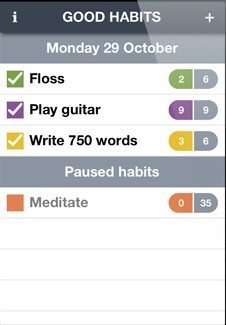 Good Habits (free) – This is the simplest and cleanest. It displays how many days in a row you’ve done each thing, and your maximum days in a row. Clicking on the name of a habit opens the calendar, where you can edit past days and see a monthly view of which days you did that habit. You can also set reminders.
That’s it. It’s almost exactly what I want, though it’d be nice to include things I only want to do once a week.
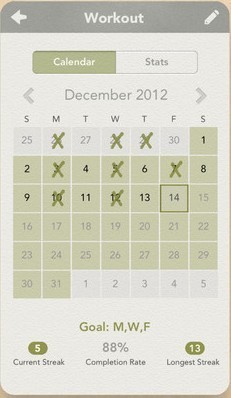 Habit List ($1.99) – Not quite as pretty, but still nicely designed. It lets you set whether you want to do something every day, or on specific days of the week, or at a certain interval, or a certain number of days a week. That has the side effect of making me want to add more things to it, and it’s also a little confusing–my list for today includes everything that I’ve set to do only once or three times a week, so I see it on my list even if I don’t plan to do it today. (Setting something for a specific day like Friday makes it not show up unless it’s Friday, though.)
If you really need more specific habit scheduling than daily, this is a great app.
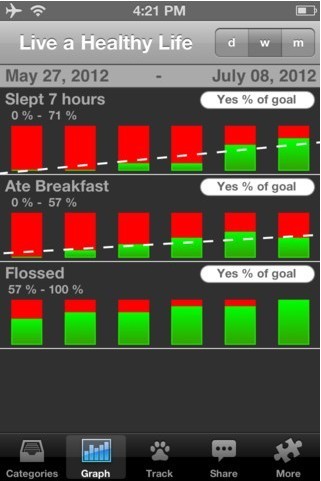 Habits Pro ($2.99) – This adds more features and is the only app I’ve tried that has an export option. In addition to a daily checklist or monthly calendar view, it shows graphs by day, week, and month. You can also change the item type–instead of a simple yes/no checklist, you can have a counter (how many times you did something), a timer (how long), or a note (where you can enter details about whatever, like what book you read instead of just checking off that you read something).
It’s a little clunky to use and not nearly as pretty as either of the other two apps, but definitely more flexible in what you can track.
So after this research, what am I going to use? Well, I printed out some calendars that I can tape in my journal, where I can see the whole year on one page. If I want to stick with something electronic (and I haven’t quite decided), probably Habit List until Good Habits adds flexible scheduling.
Elizabeth grew up near Johnson Space Center and earned two physics degrees, so of course she writes more fantasy than science fiction. She now lives in central Illinois, where she performs cooking experiments, brings up the rear in 5k races, and does excessive amounts of yard work.
Quinn Reid's Blog

- Quinn Reid's profile
- 6 followers

