
Quinn Reid's Blog, page 7
December 19, 2012
Climate Change Posts: Eating Oil, Carbon Pie Chart, and Hope
Elsewhere on the Internet, I’ve been slowly learning something about climate change and working on ways to make a positive impact on that catastrophic, immediate problem. My blog at FaceClimateChange.com is about finding inspiration and motivation to make a positive impact on a daunting and horrific problem. Here are some recent posts for anyone who can spend a few minutes taking a closer look at what’s going wrong and what we can do about it.
We’re Eating Oil–Literally
Videos: A Massive Iceberg Breakup and One Day on Earth
Where the Carbon Comes From: Getting a Clue
Climate Change: Hope Is Vital–and Dangerous
What I’m Going to Have to Do to Face Climate Change: First Steps
I’ve also started a Twitter list of useful sources of climate change news and information at https://twitter.com/lucreid/lucreid-climate-change .


December 10, 2012
New Year’s Resolutions for Change from the Inside Out
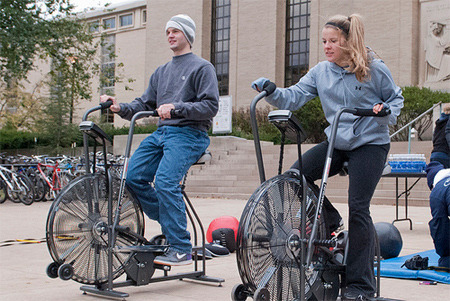
Jason Shen has an interesting blog I discovered only very recently. Entitled “The Art of A**-Kicking,” Shen’s blog focuses on “starting things, conquering fear and kicking a** in work and life.” In late 2010, Shen posted an article on New Year’s Resolutions that I highly recommend: “How to Set Great New Year’s Resolutions (Backed by Scientific Research!)”
I’ve written about New Year’s Resolutions before (for instance, see “Should You Make a New Year’s Resolution?“, “Why New Year’s Is Such a Good Time to Make a Resolution“ and “Taking Stock for a New Year’s Resolution“), and you’ll find a lot of common ground between my posts and Shen’s. What struck me most about Shen’s article, though, is his emphasis on making resolutions about the way you feel. This fits with much of what I know about how people successfully change their behavior, and it struck me as an unusually useful way to come up with a resolution.
Most resolutions seem to be about achieving some external result: losing weight, quitting smoking … that kind of thing. The examples Shen gives, on the other hand, are about changing how we feel about some significant part of our lives. They raise the question “What can I do to feel happier?” or “What would make my lifestyle feel more healthy?” By focusing on how the resolution makes us feel, we get two special advantages: first, we’re focusing on the process instead of the outcome, which tends to be a more motivating approach for a variety of reasons. Second, we’re making a special point of ensuring that the actions we’re taking make us feel the way we want to feel, and that good feeling motivates us to keep pushing ahead.
Examples of result goals and feeling goals
An example: let’s say my resolution is to lose weight; it’s 3 weeks in; and I’ve lost 1.5 pounds after upping my exercise and eating a little better. That’s not bad, but it’s not very inspiring: it doesn’t really feel like I’m succeeding, just maybe sort of a little on the road to succeeding. I’m putting all my enthusiasm into the idea that some time in the future, I will have achieved something big. In the mean time, which could be a very long time, I don’t have much good news to announce.
If instead, though, my resolution is to feel more fit, then every time I complete an exercise session or choose the better food option, I’ve succeeded. It’s not a big success, but successes don’t have to be big to feel good, and anything that makes us feel good is much more motivating than something that makes us feel like a disappointment, or at best a potential someday-success.
Not affirming affirmations
As much as I like Shen’s post, I had some comments to add for my readers here on a couple of thing he mentions. One is his recommendation of affirmations, which from what I’ve seen of the research are often counter-productive. One problem is that they risk creating broken ideas, and even though an affirmation may create an upbeat falsehood (“I look great and am easy to get along with!”) it’s still a falsehood and has all of the drawbacks a falsehood usually has when we treat it in our own minds as truth.
What’s a “goal,” exactly?
I also find Shen’s distinction between “goals” and “resolutions” potentially confusing, depending on how you think about the words. He defines goals as “external targets that rely substantially on things outside of your immediate control” and talks about “resolutions” as being largely within your control. For what he calls “goals” I tend to use words like “aspirations,” and what he calls “resolutions” I and many other people interested in motivation often refer to as “goals,” for instance in the posts “One Good Way to Judge Goals: S.M.A.R.T.” and “What Kinds of Goals Really Work?” With that said, a lot of people use the word “goals” to mean exactly what he describes, too, and I think the way he talks about using the words makes plenty of sense; it’s different from how the word is used in here and some other places.
Both of us, however, are trying to point out an important distinction that the English-speaking world doesn’t usually make, that of whether we’re talking about something that we can affect ourselves (like finishing a project) instead of something that to a large extent is outside of our control (like getting a promotion).
One thing at a time
Finally, Shen recommends keeping your goals to no more than 2 or 3 at a time. I haven’t yet come across research to shed more light on the question, but my experience and my inference from some of the literature is that adding only one new goal at a time is generally the way to go. Once you’re well on your way with that one, adding another works much more comfortably. The danger of adding too many at once is that of not having enough attention to spare to focus regularly on any of the goals, so they all fail.
The exception to this would be very simple goals, like drinking more water or making the bed in the morning. It appears that we can tackle several small changes more or less at the same time and still see success.
Photo by pennstatelive
December 4, 2012
We’re Giving Away a New Kindle Fire HD and 13 Engrossing eBooks
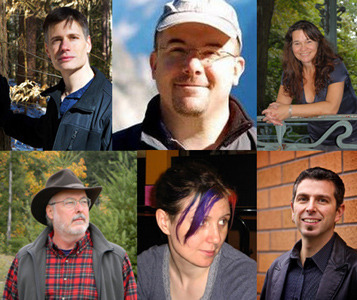
I joined up with five other authors (Judson Roberts, Ruth Nestvold, Del Law, William Hertling, and Annie Bellet) to start a contest that runs all this month. First prize is a brand spankin’ new Kindle Fire HD with 13 eBook novels and collections of science fiction, fantasy, and historical fiction. There are also 10 second prizes of three eBooks from your choice of those 13.
You can enter the contest up to once each (so a total maximum of three entries) through Twitter, Facebook, and on our contest Web page by simply listing the three books that most interest you from the list. You can enter and get all the details here.

Contest books include my own Bam! 172 Hellaciously Quick Stories and my novel of Vermont backwoods magic, Family Skulls. Some of the other books are William Hertling’s two futuristic AI novels, Judson Roberts’ deeply researched and action-drive Viking trilogy, Del Law’s unique and engaging fantasy novel of humans and non-humans in overlapping worlds, Annie Bellet’s novel of crime in fantasy city called Pyrrh, and Ruth Nestvold’s Arthurian Romance-Adventure novels.

Winners will be announced on New Year’s Day, 2013. Enjoy, and good luck!
November 26, 2012
11 Essential Things to Know If You Want to Write Fiction for a Living
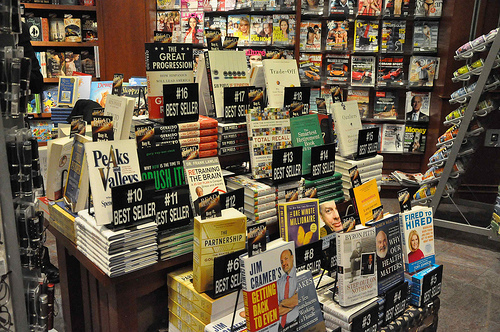
My 16-year-old son Ethan recently wrote his first short story intended for publication and my niece, a high school senior, is visiting colleges like Middlebury, Williams, Wesleyan, and Bennington looking for a school that can help her develop a career as a writer. Just in case I wasn’t already thinking enough about the topic, I also recently received this question through my Web site:
Could you offer some advice for my 17-year-old daughter? She is about to apply to a Canadian College for English, and she aspires to become a novelist. Her strengths are writing, philosophy, drawing, photography. She wants to be her own boss, and not necessarily take courses that most people do if they want to become a writer–any advice?
In terms of my qualifications for answering this question, I should make sure you know I don’t make a full-time living at writing. At the same time I’ve won a major national writing award, sold a book and multiple short stories, gathered a large daily readership for my Web site, and appeared in magazines that are circulated around the world. What may be even more useful in answering this question is that I run an online writer’s group, Codex, and have had the opportunity to talk to literally hundreds of skillful writers, from people still trying to make their first pro sale to ones who make a comfortable living from their fiction, about their approach to building a writing career and their experiences trying to do that.
Based on that, here are the 11 most important things I can tell an aspiring fiction writer.
Making a living writing fiction is a long shot, like making a living acting or painting. If you try to do it, try because you love writing and will write no matter what. If you don’t love it, spare yourself the heartache and aim for a field that can actually pay the rent. This article from a few years back explains some of the sad realities of trying to make a living in writing.
As the article I just mentioned suggests, you don’t have to go to college to become a good writer, but for some people–especially people who haven’t had a college education in another field–it can be an important step. With that said, facing actual troubles in the real world and learning something from the process is usually the strongest basis for writing that connects with readers.
Write only what fascinates you and draws your passionate interest. Don’t waste effort trying to write something solely because it seems more marketable, more respectable, more lucrative, more popular, or more seemly. Writing what you love will help inspire you, make it easier to push forward through difficulties, and will shine through in both your work and your promotion.
You can make a living at novels, feature-length screenplays, and other long-form work, but consider writing many short works first to hone your craft, to boost your spirits with sales, and to gain some credentials.
Never get angry at feedback or critique. Try to learn from it, and use it if it strikes a chord with you, but make a practice of understanding that your work is not the same as your identity and that nothing you can write will suit everyone. Also, learn to distinguish between “I don’t like it now but I would if you brought out this thing that’s consistent with your vision” and “I don’t like because I’m not the right audience for your work.”
Becoming a better writer stems from practice and feedback. Write a lot and get people to read your work by joining critique groups, submitting to publications, blogging fiction, or any other means that gets you information back about how people experienced your work. A useful article on this topic: “Critique, Mentors, Practice, and a Million Words of Garbage.”
Read a lot of books about writing, but watch out for advice that you have to do things a certain way. Many very successful writers seem to believe that their way of writing, editing, planning, outlining, or of structuring a career is the only one that works, and this is rarely true. They say this because it’s the only way they’ve experienced. Talking to or reading about more writers will clarify that there is not just one way to succeed.
The publishing world is in the midst of a huge upheaval, and the way to build a writing career has changed even in the last few years, closing some doors and opening others. Self-publishing and eBooks are now an essential part of the process, whereas they used to not matter. Pay attention to the changes in publishing, but don’t let them throw you. People will always be willing to pay for good stories, so there will always be writing careers of some kind, but don’t get too attached to your career unfolding–or continuing–in any particular way.
The most important basis for a writing career is strong, professional, affecting, engaging writing. If you always strive to make your writing better, you will be investing in your career. However …
Regardless of how good your writing is, you will almost certainly have to market it to someone, whether that’s an agent, an editor, a producer, the readers themselves, or some combination. Learn how to present yourself and your work professionally, how to summarize your writing projects effectively, and how to connect with new people who might just love your books.
Guard your integrity: it’s extremely valuable and very difficult to regain if lost. Misusing online review venues, misrepresenting your publishing history, or mistreat your colleagues, for instance, will all ultimately cost you more than you get from them.
Photo by Christopher S. Penn
November 21, 2012
My new blog site: Face Climate Change
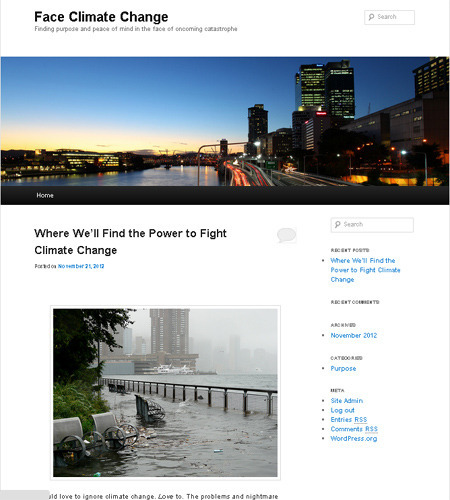
I’ve made it a practice in recent times to try to avoid taking on new projects. This is difficult for me, because I love coming up with new approaches to doing things, trying new strategies, and creating things, but at the same time it’s essential, because starting too many things means making it difficult to finish any of them.
Every once in a while, though, something comes along that is too important to ignore, and I need to step up and invest some real effort. Today that thing is climate change: it’s happening much more quickly than most of us imagined, and the results are more immediately devastating. For example, Vermont came very close to being hit by two tropical storms just a little more than a year apart. Vermont. This is a state where there are, generally speaking, no hurricanes, volcanoes, mudslides, earthquakes, tornadoes, tropical storms, or Lyme Disease–except that now we seem to be getting everything on that list except for volcanoes and full-blown hurricanes (though I don’t blame the occasional small earthquake on climate change, just so you know).
Looking at the problem, I see one particular way in addition to changing my own habits and environmental impact in which I might be able to be of some real help, and that’s in teaching principals that can help spread personal responsibility and courage and habit change skills, applied specifically to climate change. That’s what the new site is all about. I hope that if you have any interest in the topic at all, you’ll visit the site, comment, suggest resources, ask questions, or help move things forward in any way you’re willing.
My first post went up this morning: Where We’ll Find the Power to Fight Climate Change.
November 20, 2012
How Do You Forgive People Who Won’t Admit They’ve Done Anything Wrong?
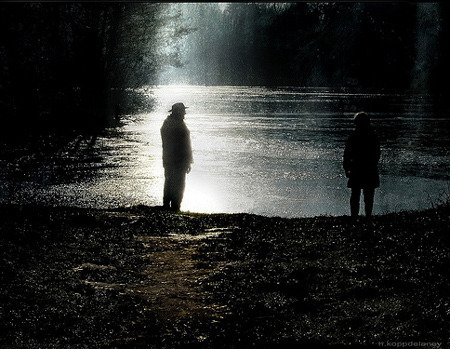
In recent posts like “3 Keys to Living Effectively: Attention, Calmness, and Understanding” and “You, Me, and the Dalai Lama” I’ve talked about some of the things I’ve been learning and contemplating from listening to recorded talks by the 14th Dalai Lama after having the good fortune to see him speak in person last month. At the end of his talks, he generally takes questions, and one of the questions that seems to come up pretty frequently is how to forgive someone who won’t admit they’ve done wrong.
When relationships in our life are disrupted or hurt through some past or present trouble, it can be a constant drain. In some cases the problem can be solved–or at least mostly solved–by cutting ties: friends who mistreat or lie to us, for instance, are sometimes not friends worth having, at least not if we’re trying to lift ourselves up by keeping company with people we admire.
In many cases, though, cutting ties is either not an option or too drastic an option, for instance when immediate family members do something (or a lot of things) that we find harmful. Even when it’s possible to stop communicating with a family member, the problem can still fester, and of course cutting off a family member creates its own problems.
So another avenue is to have a heart-to-heart discussion with the person who has done the harmful thing to try to understand and forgive. Of course this approach is a big improvement on simply cutting ties, and it’s likely to bring more peace. But what if the other person doesn’t want to be forgiven? What if the other person doesn’t even agree that there was any wrongdoing? For that matter, what if the person keeps doing the harmful thing?
A situation like this begins to make it clear what real compassion and forgiveness are. For us to feel compassion or forgiveness toward another person, that person doesn’t have to act according to our preferences or beliefs, because there is a difference between the person and the action. We can and should condemn actions that we think are harmful or unjust, but even while doing that we can accept and feel compassion toward that person. We can even feel compassion toward people we oppose.
I admit, this isn’t an easy thing to do, but at least the steps are clear. All we have to do is say “I condemn what you’ve done, but I support you“–and mean it.
There’s another piece of this, an important one: forgiveness and peace of mind are matters that happen within ourselves, not outside us. If we want peace of mind, we have to take complete responsibility for it ourselves. If we let even a small part of our peace of mind depend on what other people do, then we open ourselves to being disturbed and angered and made unable to act and think as we wish based on things other people do, things outside of our control.
In the same way that we can release anger that might come up from, say, getting cut off in traffic by reminding ourselves “I can’t make other people drive the way I want them to,” letting go of any feeling of possession about other people’s wrongdoings is necessary to feel peace of mind in troubled relationships and to offer compassion and support even to people whose actions we condemn.
Photo by h.koppdelaney
November 14, 2012
Watch online: The Discovery of Fire (and Other Bad Ideas)

In August 2011, my short play “The Discovery of Fire (and Other Bad Ideas)” was performed for the first time in Waitsfield, Vermont’s Valley Players theater as part of the 4th Annual Vermont Playwrights’ Circle TenFest of short plays. After a bit of a delay, it’s now available to watch on YouTube.
In “The Discovery of Fire,” a tribe of cavepeople try to come to grips with a freakish new phenomenon discovered by their tribesmate, Bluk.
November 12, 2012
Sleeping Less Leads to Eating More
Science Daily reported recently that a new study by researchers from St. Luke’s-Roosevelt Hospital in New York City and Columbia University seems to have found a link between how well we sleep and how badly we eat. In the study, people who were didn’t get enough sleep tended to feel hungry more often, eat more, and gain more weight. While this doesn’t mean we can somehow “sleep away the pounds,” it does suggest that sleeping well makes it noticeably easier to eat well–and we already know that eating well, in turn, helps us sleep better.
In other words, paying special attention to getting enough sleep, which for most of us means making a decision to go to sleep earlier at night, can help us eat better and feel more healthy, which in turn can help us sleep even better: a snowball effect, though I can’t tell you whether the effect would be small or large.
You can read the Science Daily article here, or click on the following link to see the abstract for “Alterations in sleep architecture in response to experimental sleep curtailment are associated with signs of positive energy balance” from the American Physiological Society.
November 9, 2012
Inclusivity and Exclusivity in Fiction: Anatoly Belilovsky on Atrocities and Menschkeit
This is the eighth interview and the tenth post in my series on inclusivity and exclusivity in fiction. You can find a full list of other posts so far in the series at the end of this piece.
In today’s post, I talk with Russian-American writer and physician Anatoly Belilovsky.
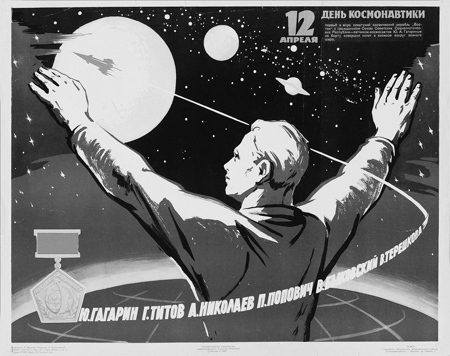
LUC: Your background and origins are very different from most English-speaking writers and readers. How does that affect how you read and write fiction?
ANATOLY: That used to be an easy question, until I found at least three other Anglophone writers with backgrounds somewhat similar to mine, whose writing and criticism of science fiction and fantasy (and much of everything else) is either different from mine, to varying degrees, or, in one case (and, no, I won’t drop names here) diametrically opposite. So, in a broad sense, I am not sure how my origins feed into my weltanschauung. I think the best I can do is tell my story and let readers make their own conclusions.
I grew up in a culture whose dominant language has no words for privacy and appointment, with an entire set rules of etiquette for behaving while on a queue, with another set of traditions for communal apartments with shared kitchens and bathrooms; a society in which, for most of its history, its own government, while pretending to look out for the good of the common people, committed unparalleled atrocities against them.
It was also a culture that took art and literature seriously – as serious tools for social engineering. “Inclusion” and “marginalization” had very different meanings there and then: “Inclusion” meant membership in Writer’s Union, which opened doors to publication, and “marginalization” meant being relegated to Samizdat (“Self-publishing,” a tricky proposition in a country in which typewriters were registered with samples of output to permit matching pages to their sources) or Tamizdat (“There-publishing,” by Russian emigre markets – the route that led to highly embarrassing Nobel Prizes in literature for Joseph Brodsky and Boris Pasternak, for works never published in their native country.) The Writer’s Union also took seriously the question of publishing underrepresented populations: having praises of Worker’s Paradise sung by a variety of voices in a variety of languages was a major priority. This led to a highly amusing episode: two banned writers encountered an unknown aspiring poet who was bilingual in Russian and another, obscure, language. Forming a mini-conspiracy, the trio wrote ideologically impeccable poetry that brought in money and prizes by the bucketful, and continued to circulate what they wanted in Samizdat.
Outside of the never-never land of inter-ethnic harmony in Social Realist literature, things weren’t all that rosy:
http://en.wikipedia.org/wiki/Deportation_of_Koreans_in_the_Soviet_Union
http://en.wikipedia.org/wiki/Volga_Germans
http://en.wikipedia.org/wiki/Deportation_of_the_Crimean_Tatars
http://en.wikipedia.org/wiki/Night_of_the_Murdered_Poets

To make a long story short, coming to America was a culture shock of which I’ll talk in another installment. Suffice it to say that, right from the start, much of what would be considered a dark dystopia by a Western reader, felt like a lighthearted satire of the real world (A Clockwork Orange, 1984.)
As for “literary” fiction, I never could bring myself to care for most of its characters and conflicts. Catcher in the Rye is emblematic of that: I’m afraid I never could see Holden Caulfield as anything other than a spoiled brat in search of excuses for his upper-class ennui.
LUC: What kinds of issues about inclusivity or disregard do you see in other people’s fiction that the authors themselves often miss?
ANATOLY:
I have a black, a woman, two Jews and a cripple. And we have talent.
–James Watt
If you prick us, do we not bleed?
If you tickle us, do we not laugh? If you poison us,
do we not die? And if you wrong us, shall we not revenge?
If we are like you in the rest, we will resemble you in that.
–William Shakespeare
Pound pastrami, can kraut, six bagels—bring home for Emma.
–Walter Miller Jr
I chose these quotes to illustrate a few points.
The second is to illustrate what inclusivity is, all too often, exclusively defined as: writing about characters whose “differentness,” and society’s callousness in dealing with that “differentness,” is the sole, or the major, driving force behind the plot and the character’s actions. That’s a perfectly valid way of looking at inclusivity, but it really isn’t mine. I look for common ground, for the universal experience.The first one is to illustrate what inclusivity isn’t. Hogwarts inclusion of the Patel twins and Cho Chang cannot be called inclusive: the twins’ roles rise barely above those of furniture, and Cho gets to break under pressure and then feel terrible about it. If plot is a river, Cho gets swept away by the current while the twins get to sit on the banks and stare at the water. Whatever roles were given to individuals who shared the panel with Mr Watt, they were clearly not the ones who rowed that boat.
Which brings me to the third quote. It bears repeating:
Pound pastrami, can kraut, six bagels—bring home for Emma.
Miller is writing about a Jew – never mind what happened to that Jew later, he’s certainly a Jew writing these words – who is thinking what anyone would be thinking, with apocalypse looming beyond the horizon: he is thinking of his family.. And instead of drawing a huge red arrow that says, “LOOK AT ME – A JEWISH MENSCH WHO LOVES HIS FAMILY!” he is keeping that feeling in the subconscious, the tip of the iceberg of genuine powerful love showing up as a note to self to bring home some food. Leibowitz’s Yiddishkheit quite literally shows up in the grammatic construction (of is superfluous in languages that have a genitive case) and in the food choices, the limbs and outward flourishes, while his universal, transcendent Menschkheit (which I choose to translate as “humanity,” not “masculinity”) is responsible for the caring that drove it.
Now I get to talk about my kind of inclusivity.
Ken Liu’s Nebula and Hugo-winning Paper Menagerie [note from Luc: between when we conducted this interview and now, the story also won the World Fantasy Award] is about a kid who’s ashamed of how uncool his mother is. OK, the kid is half-Chinese and his mother barely speaks English, and the descriptions are good enough that you find yourself totally immersed in the story, you can see the scenes and the characters as vividly as if they were on film, and yet it brought up memories of my late, decidedly non-Asian mother, and the catharsis of the story’s protagonist triggered one of my own. I had a conversation with Ken about that story at Readercon, and I think it surprised him, at least a little, how broad an appeal this story had.

On the same Hugo ballot was Mike Resnick’s Homecoming. It’s a universal “fathers and sons” story, relevant to anyone, and here is the funny part: I first heard it as a podcast, narrated by an African-American voice talent. I could see the characters of this story as well, in my mind’s eye, and the father came across as a very definitely African-American elderly man. Didn’t change the universality of the story, only grounded it in a very specific mental image. And I really don’t know if I would have had the same image if I had read the story in print, first.
On the subject of “exclusion,” I have a bone to pick.
There seems to be an approved list of oppressions and atrocities as subjects for fiction. The deportations by the Soviet government of a number of ethnic groups dwarf in size, in casualties, and in sheer nastiness, the Japanese internment of WWII. Seen any Anglophone stories set in the Holodomor? Me neither. No one seems to be protesting the exclusion of such oppressed minorities as Koryo-saram, Volga Germans, Crimean Tatars, Russian kulaks, Don cossacks, geneticists, students of Esperanto and abstract painters, all dealt with rather harshly back in the old country.
Amusing anecdote: I have my mother’s old 1950′s Soviet psychiatry textbook, somewhere. On page 100 there is a pearl the equal of which I have never seen – here in my translation:
Homosexuality is not necessarily a form of psychopathology. In reactionary societies where payment of bride price is customary, it may be the only possibility available to men of the poorer classes who cannot afford to marry.
I always wondered how drunk the editors had to be to come up with that.
I get the sense of Western civilization being singled out for criticism in both Western and non-Western literature, and I see this being accepted as the right and proper course, and I am not willing to leave this assumption unexamined in a comparative analysis. Suffice it to say that back in the old country at least, being “disregarded” was, for an individual or a minority population, the best of all possible states, and any kind of attention would have been immeasurably worse.
LUC: Now you’re bringing up a point that I don’t think I’ve really heard discussed before: prejudice and persecution of other cultures by other cultures. For instance, I suspect the reason we hear so little of Soviet oppression of the Koryo-saram (ethnic Koreans in the Soviet Union) in English-language literature is that English-speakers often have little familiarity with either Russians (and other Soviet cultures) or Koreans, to say nothing of Korean-Russians. It seems to be much simpler and more obvious for people who are trying to fight bigotry to focus on the bigotry of the people they know, yet the death by deportation and neglect of 40,000 Koryo-saram–not to mention some of the other atrocities you mention–dwarfs much of what happens in our own culture. What’s the case for learning about and writing fiction about persecution in other cultures?
ANATOLY:
It seems to be much simpler and more obvious for people who are trying to fight bigotry to focus on the bigotry of the people they know
There was an old Russian joke: a Russian and an American soldier are facing each other across Checkpoint Charlie. The American says, “It’s really better in the West. I can stand here all day yelling, “Down with Reagan!” and no one will bother me.” The Russian says, “So what? I can stand here and shout “Down with Reagan!” all day, too, and they might even give me a medal!”
I think the problem is better stated as, It seems more rewarding to focus on bigotry that affects them and the people they know. Which is a perfectly valid approach; my own activism, such as it is, is aimed at thwarting social – psychohistorical, if you will – forces that have a chance of leading us down the same terrible path as the one that had led to the 70-year Soviet nightmare, and to the crushing bigotry to which the resulting society subjected myself and my own family. And the first and most insidious of those forces is the demonization of success.
Before I get lumped in with Ayn Rand, I find demonization of lack of success equally repugnant. In fact, the only things worth demonizing are hypocrisy, in advocating changes sure to produce results opposite to those promised, and stupidity, in believing such promises.
What’s the case for learning about and writing fiction about persecution in other cultures?
Well, what’s the case against learning and writing about persecution in other cultures? Is it that it has no relevance to our world? Is it something that can’t happen here?
Or is it that, by pursuing one of these lines of thought, we…
…ritrovai per una selva oscura, che la diritta via era smarrita?
[find ourselves lost in a strange and darkened forest, where the direct path is lost -- Dante's Inferno]
as we realize that, in limiting ourselves to axes of oppression that intersect upon the standard model of privilege, we have been writing exclusively about spherical cows.
Let’s start with Internationale, which I remember by heart (in Russian, of course) having had to sing it countless times:
Весь мир насилья мы разрушим
До основанья, а затем
Мы наш, мы новый мир построим, —
Кто был ничем, тот станет всем.
We will destroy this world of violence
Down to the foundations, and then
We will build our new world.
He who was nothing will become everything!
Koryo-saram, Volga Germans, and others were not oppressed because they were poor, powerless minorities. They were oppressed because they were perceived to have power and privilege (in the form of land, a sufficiency of food, and a few non-spherical cows,) for not succumbing along with everyone else to revolutionary mismanagement. They were oppressed in order to make them into poor, powerless minorities that the Soviet state could then manipulate at will.
And to those who don’t think this has any relevance to the world we live in, I say: “Blessed are they who share the Universe with spherical cows.”
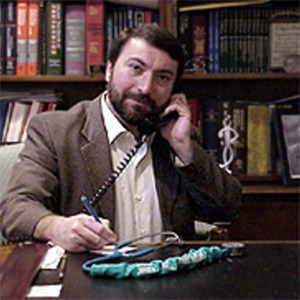 Anatoly Belilovsky came to the US from the USSR in 1976, learned English from watching Star Trek reruns, worked his way through Princeton as a teaching assistant in Russian, and ended up a pediatrician in an area of New York where English is the 4th most commonly spoken language. It is perhaps unwise to expect from him anything resembling conventional fiction. His fiction appears in Nature, Ideomancer, Andromeda Spaceways Inflight Magazine the Immersion Book of Steampunk, and elsewhere. He can be found online at http://apogrypha.blogspot.com/.
7/27 – interview with Leah Bobet
7/29 - Where Are the Female Villains?
8/3 – interview with Vylar Kaftan
8/9 - Concerns and Obstacles (multiple mini-interviews)
8/10 – James Beamon on Elf-Bashing
8/17 – Steve Bein on Alterity
8/24 – Anaea Lay on “An Element of Excitement”
9/21 – Leah Bobet on Literature as a Conversation
11/2 – Inclusivity and Exclusivity in Fiction: Aliette de Bodard on Crossing Over
November 7, 2012
Free Historical Fantasy Novelette Wed-Thu: The Violin-Maker’s Wife
 Some time back, my friend Maya Lassiter and I participated in a Codex collaborative story contest and created a historical fantasy story about deadly lights plaguing a small family in post-Civil War Missouri. Even after the story won the contest, we revised and rewrote and rewrote and revised, finally settling on a version that satisfied us both.
Today and tomorrow (Wednesday through Thursday, November 7th and 8th), our e-novelette “The Violin Maker’s Wife” will be available free on Amazon.com: click here to get it.
If you do get and read the story, we’d be very interested in hearing what you think! Comment here or post a review on Amazon.
Quinn Reid's Blog

- Quinn Reid's profile
- 6 followers

