
Quinn Reid's Blog, page 15
May 7, 2012
A Cure for Task List Avoidance
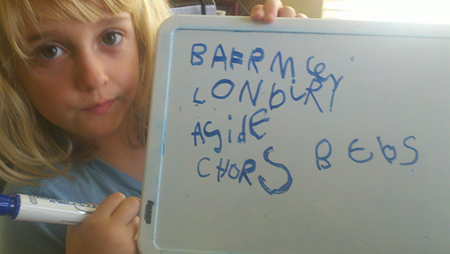
Our culture has a love-hate relationship with task lists. Many of us make them, use them for a while, then eventually start avoiding them, trying not to think about how out of date they’re getting and what there might be on them that we really ought to be doing.
Or we try to do without task lists, using sticky notes and flagged e-mails and calendar reminders and stacks of papers that need something done with them and all kinds of other systems, only to find that there are still a lot of tasks we need to keep in our head, which keep spurring anxiety because when we don’t have time to do them right away, we worry we’ll forget about them completely: parking tickets, birthdays, that leak in the basement, finding out what that weird charge on the phone bill was, getting cholesterol checked …
Some background: all about task lists
I won’t go into a complete discussion of why I think the solution to this is a single, well-organized task list with categories, because I’ve already talked about a lot of basic task list issues in other posts, and I don’t want to waste your time with repetitions. If you haven’t read them yet, though, here are some articles from the wayback machine:
Why Task Lists Fail
4 Ways to Make Sure You Get a Task Done
The Eight Things You Can Do With a Piece of Paper
Getting Rid of the Little, Distracting Tasks
My Top 1 Task
Weed Out Task Lists With the 2-Minute Rule
Don’t Use Your Inbox as a To Do List
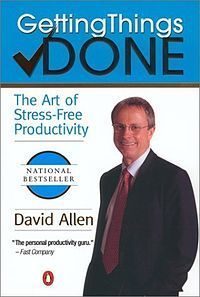
Useful Book: Getting Things Done
How I’m Keeping My E-mail Inbox Empty
When things start to slide
But even if you’ve followed my recommendations in these articles, do you ever find that your task management begins to slide–that you start falling back on notes or keeping things in your inbox, or you spawn new areas of your task list into which you throw tasks blindly, or you just try to keep everything in your head? Every once in a while this happens to me, so if it doesn’t sound familiar, my hat’s off to you. If it does sound familiar, though, then I may be able to offer an easy way out. All it takes is a little focus and time; it’s very low-stress.
The key is that a complete task management system relies on a certain amount of faith: you have to have faith that you’re actually going to get to at least some of the most important tasks on your list. If you lose confidence, if you start thinking you’re going to miss something on the list, then you may stop putting your more important items on the list, reasoning that it’s better to be a little flexible about what goes on the list than to risk not getting things done. As soon as you do that, you have a reason to avoid your list, because some of your most pressing tasks aren’t even on it, and this snowballs.
Or it can happen the other way around: you feel a little rushed and jot a few tasks on sticky notes or try to just keep them in memory, and then you realize that your list is no longer reliable and you lose confidence in it.
Fixing task list confidence
What’s the fix? Go back to basics, put your faith in your list, get everything on it, and pay attention to your list regularly. The steps are pretty easy:
Whenever you think of something you need to do (or would like to do) that isn’t on the list, put on the list right away. If you can’t always do that, then you need a different system: it doesn’t help to have a task list that you can’t add to in real time.
Keep a very small number of do-these-soonest items set apart. You can do this by assigning priorities, establishing a “very short-term tasks” category, tagging these top items, or any other means that works for you, but you need to be able to identify your top four to eight tasks. Any more than that and you’ll have a hard time doing the next step.
Put the task you want to get done first at the top of the list. Ideally, put the task in order from want-to-get-done-first on down, though it’s really that top task that’s essential.
As you get tasks done, bring more tasks into the “very short-term tasks” set and keep putting the next task you want to get done first at the top of the list.
Don’t put important tasks anywhere else: just on your list. Between adding tasks, looking tasks up, and crossing tasks off, you’ll be forced to
Visit your task list regularly, so that it never starts getting out of date.
Finally, do maintenance on your task list, re-prioritizing and recategorizing as necessary, checking in on your pending items, deleting items that it turns out you don’t have to or want to do after all. This should be don’t-think-about-it work, which you do separately from actually getting your tasks done (except that if you have some very quick tasks, it’s often more efficient to do them then and there, if you have any time at all, than to keep shuffling them around–even if they’re not very high priority). This seventh step is optional: if you maintain a good “very short-term tasks” group and keep choosing one of those tasks to go to the top, the rest of your task list can be a mess–but it being in good order makes keeping the “very short-term tasks” group up to date much easier.
Worried it won’t get done? Overwhelmed by the list?
This solution solves two distinct problems: anxiety about not getting tasks done and being overwhelmed by everything on your list.
The anxiety is alleviated by identifying that top task. If it really is the thing you should be doing first, then you don’t have to worry that you’re neglecting something more important. By contrast, if you didn’t have a top task, then you might be tempted to pick off the most inviting or easy-looking tasks, or to avoid your task list altogether because of not wanting to face the worry.
The feeling of being overwhelmed is taken away when you just ask yourself simple questions like “Does this belong in my list of very short-term tasks?” and “Which of this handful of tasks should I do first?” Just like going through e-mail or papers, going through a task list can be especially stressful if you look at it as a whole, because no one can do a whole bunch of things at once (see “How to Multitask, and When Not To“). By simply going through your items in the order you find them, you can make individual decisions that are easier and more pleasant than trying to grapple with a stack of decisions could ever be.
Photo by heymrlady


May 3, 2012
Live at Daily Science Fiction: “You Can’t Come Here Any More”
Daily Science Fiction is a free e-mail and Web magazine that offers a new science fiction or fantasy story every weekday. Today’s new story on the Web (which went out to e-mail subscribers last week) is my 110-word story “You Can’t Come Here Any More”: you can read it here. Reader Dennis G Williams called this kind of story “snap fiction” on Daily Science Fiction’s Facebook page.
May 2, 2012
Writing a Novel in One Week
How fast can you write well? Don’t mistake slowness for quality: what speedy writing lacks in deliberation, under the right circumstances and with enough writing practice behind it, it can more than make up for in involvement, awareness, and momentum.
 James Maxey, author of numerous successful short stories and of the Dragon Age trilogy of novels, has been used to a goal of 10,000 words written per week. This is pretty ambitious by almost anyone’s standards, and he doesn’t always hit the mark. Recently, though, he found he suddenly and unexpectedly had a full week without obligations, and he asked himself if for that time he might be capable of writing 10,000 words a day. Working like that for a week, he reasoned, it should be possible to write an entire novel.
Maxey planned a roughly 60,000-word sequel to his superhero novel Nobody Gets the Girl (Phobos Books, 2003; available in paperback and for Kindle), wrote an outline based on ideas he’d been having for years, and psyched himself up. At about 4:00 am on August 8th, he started writing. Stopping for little more than food and sleep, he pushed hard and completed the book in a 58,829-word first draft on August 14th at about quarter to three in the afternoon, with more than 13 hours to spare. His novel, appropriately enough, is called Burn Baby Burn.
And not only did he complete and survive the project, but he also kindly agreed to let me interview him about it a few days later.
Let me jump in with an obvious question: what in the world made you think you could write a novel in a week?
I knew that crime and adventure novelists from the pulp era often cranked out multiple short novels per month. Michael Moorcock claims to have written some of his Elric novels in a week, and I’d heard that Jim Thompson wrote The Grifters in a weekend (though I tried to Google that factoid this morning and couldn’t find it, so I may have been working under a false premise!).
Like most writers, I have a day job. I’ve pretty much been continuously employed since I left college. The vast majority of my writing takes place in stolen moments. When I’m in the zone, I can produce roughly 1000 words in an hour. But, it’s so hard to get in the zone. After I get home from work, I’m too burned out to sit down and write immediately. After I start feeling like myself again and get to work in an evening, right about the time I’m feeling warmed up, it’s bed-time, since I have to get up at 5:30 in the morning to punch the clock again.
And I’ve always wondered: What if I was punching the clock to write? Could I put my butt in a chair and leave it there for eight hours a day? Every now in then on a day off, I managed to do this. My record for a single day was 13,000 words. But, it’s rare I have a day off when I have a free eight hours. On weekends, I like to go biking and canoeing with my fiancée. My vacations are normally spent with family at the beach. I don’t want to be a recluse and cut myself off from all human contact. So, most weeks, I only get about 10 hours of writing time.
Then, in a surprising plot twist, my employer announced they were shutting down my workplace for a week to rewire the building for new equipment. I had only a month’s notice. Suddenly, I found myself with a week of time where I’d be home all day while my fiancée and all my friends would be at work. I had no plans to travel, no obligations at all. After fantasizing for the last twenty years about how much writing I could do if I wasn’t employed, it was suddenly time to discover if I had what it takes to write a book in one week, or if I’d been kidding myself all along.
I know this is already a long answer, but there are two more elements that play into this: 1. I discovered this year that I had a severe thyroid deficiency. One way I discovered this was that the records I keep of how many words I produce a week showed a declining trend. I’ve now been taking medication for several months to compensate, and just in the last few months have felt my brain wind back up to full speed. I wrote the bulk of my last novel, Hush, when my thyroid deficiency was at its worst, I felt like I’d been running a marathon wearing lead boots. Now, the boots were off, and I felt faster than ever. 2. The novel I had in mind was a novel I’d wanted to write for years, but hadn’t because I didn’t think I could sell it. But, the publishing world has been upended by e-books, and now I can write whatever I want to write secure in the knowledge that I can bring it to readers via Kindle and Nook. Knowing that what I’m writing is definitely going to see print (or pixels, at least) is a tremendous motivator.
What obstacle threatened to hold you back the most, and how did you get past it?
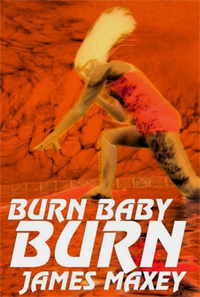 I would say that my biggest obstacle was that I can type a heck of a lot faster than I can imagine story details. So, after a big rush of words on the first day, each subsequent day got a little tougher as my imagination buffer kept running dry. By Wednesday, I really wondered if I should pull the plug on the project. I wrote a very clunky chapter that was also pretty short, but which still took hours to produce. I worried I’d reached a point of diminishing returns, and continuing might actually ruin the book if I kept cranking out bad chapters.
Fortunately, I was posting chapters to my blog at dragonprophet.blogspot.com as I wrote them. I’d announced I was going to finish a novel in a week there, and on Facebook, and on Codex. Failing to keep posting chapters would have been a pretty public failure. So, mostly to avoid embarrassment, I kept writing on Thursday morning. And, yay! I liked the chapter I wrote. I didn’t spend as much time at the keyboard Thursday – Sunday as I did Monday – Wednesday, when I was pretty much glued to the computer. I would walk away and think about what happened next, then what happened next, and not come back until I had three events to flesh out. Three events didn’t require a huge effort to think up, and proved sufficient to let me keep typing without feeling like my brain was running dry.
I do think that, if I hadn’t been so public with my goal, the temptation to quit after I’d gotten 30k words written for the week would have been difficult to overcome. I’d never written that much in a week before. It would have been very easy to call it a win and finish the rest of the book before the end of the month at my old 10k words a week pace.
How do you feel the book came out compared to books you’ve written at a more usual speed?
The plot was definitely more stream-lined. It’s still a fully developed main plot, but it only has two or three sub-plots. Through the book, there are only three point-of-view characters. Sunday and Pit’s POVs drive the main story, while the superhero known as Ap has a few POV chapters where the primary subplot is developed.
In comparison, my Bitterwood novels all have at least a dozen point of view characters, and more interweaving subplots than I can count.
But, I wasn’t aiming for epic fantasy. I was shooting for a page-turning pulp adventure featuring atomic supermen and space aliens drifting along dark desert highways. This is the sort of novel I used to devour on a single summer afternoon when I was a teenager. On the other hand, this novel isn’t mental junk food filled with empty calories. I think I manage to get to moments in the book that will prove thought provoking, and other moments that will provide genuine emotional catharsis. It’s a book I’m proud of, and can’t wait to get into the hands of readers.
You can also read James Maxey’s post “Five tricks for writing a novel in a week” here. The full text of the first draft of Burn Baby Burn is available permanently for free on Maxey’s Web site, though Maxey says “it may be a bit of a slog to read since I didn’t bother fixing the formatting for the web,” while you can get the finished and polished book for Kindle here. The result was entertaining and fairly engrossing, I thought. You can read my review on the book’s Amazon page.
By the way, James has a habit of coming up with pithy things to say about writing. You can see some of his writing quotes here.
This piece is adapted from my Futurismic column “Brain Hacks for Writers”
May 1, 2012
The Dalai Lama to Speak in Middlebury, Vermont in October
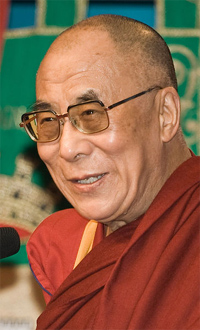 The 14th Dalai Lama, Tenzin Gyatso, will speak at Middlebury College on October 12th and 13th. The event on the 12th is for Middlebury students and staff only, while tickets for the event on the 13th will be available to the public in late September. You can find more information at http://www.middlebury.edu/studentlife/services/chaplain/hhdl .
Photo by Luca Galuzzi – www.galuzzi.it
April 30, 2012
The Top 5 Body Language Mistakes in Photos
Photos are a funny thing: they can often communicate things about us that are hard to convey in words, but many of us, when we’re being photographed, stop acting like ourselves: we try to force smiles, feel uncomfortable in front of the camera, or pose in a position we’d never take in real life.
I’m no expert on how to get the perfect author photo, but I do now how to avoid some major mistakes because of my interest in and study of body language and facial expressions. As I mentioned in a recent post about Michael Port’s Book Yourself Solid, photos on business books are often the worst offenders, but I see many of these problems in author and promotional photos of all kinds. Here are some things to avoid.
A fake smile. A true smile can really light up a photograph, but considering we’re relating with cameras and photographers and not with friends or family when we get our picture taken, they can be hard to come by. People often can identify fake smiles without even trying, making the subject of the photo look sad and desperate. Even if you know what the difference between a real smile and a fake smile is, it’s next to impossible to smile convincingly without having something to smile about. Consider going without a smile, having the photographer tell you dumb jokes, or talking about something you’re passionate about–although this last strategy can result in a lot of photos of you with your mouth open. If that happens, take time to stop and enjoy your subject without talking every few sentences to create actual smiling opportunities.
Crossed arms. Honestly, a lot of businesspeople seem to think crossed arms indicate power and confidence. What they usually indicate instead is anxiety. We tend to cross our arms over our chest or stomach as a protective measure, an instinctive attempt to keep our vital organs from being damaged. Even touching our hands together, or holding something that connects our hands, is just a diluted version of crossed arms. Real confidence is often transmitted by having hands at our sides or behind our backs.
 Hands in pockets. I think this is usually meant to suggest “Hey, I’m laid back and relaxed,” but in body language terms it often means “Please go away: I don’t want to talk to you.” This is not an ideal message for your photo. Interestingly, having hands in your pockets with thumbs sticking out, while still not especially inviting and open, tends to convey confidence, so if you absolutely have to hide your fingers, at least show your thumbs.
Crossed ankles. This seems to be another favorite “relaxed” pose, but in body language it commonly translates as “I’m holding something back” or “I have something to hide.” I can’t blame people for wanting to cross their arms over their chests or wanting to cross their ankles when in front of the camera, because lenses really can make us feel vulnerable unless we’re very used to being photographed or can consciously befriend the camera. Still, uncross those ankles! In addition to looking less sketchy, this helps us actually feel more open, because our body language doesn’t just transmit our emotions, it also helps shape them (see “Using Body Language to Change Our Moods“).
Touching the face. I think the intention is to imply “thoughtful,” but when we touch our faces in real life, it often more specifically signals doubt, or at least deliberation. For instance, you may be touching your face as you read this if you’re still trying to decide what to do with what I’m saying. If the chin is resting on the hand, the message can be boredom. In author photos, there’s a tendency for face touching to appear to be self-doubt, which again is probably not what you want to advertise.
 While there are other mistakes we can make, these five are the big ones, and avoiding them helps convey a sense of openness and reliability. Actually, though, the best way to use these pointers might not be to try to avoid the five mistakes, but to use them as a red flag and realize when we’re not comfortable in front of the camera. The most effective photos won’t be ones where we’ve just managed to avoid body language errors, but ones where we’re actually feeling open, energetic, and engaged. With that said, the worst promotional and author photos, at least in terms of the poses the subjects take, will be the ones where these errors slip by and go unnoticed–so at the least, let me implore you not to fall for any of them.
In case you’re interested in learning more, much of the material for this post comes from things I learned from Barbara and Allen Pease’s exceptional resource The Definitive Book of Body Language.
April 26, 2012
Smashwords Releases Revealing Analysis of eBook Pricing and Selling
Smashwords founder Mark Coker just released a presentation and related free eBook revealing the results of analyzing sales of more than 50,000 books over several years. Admittedly, what applies to Smashwords might not apply to Amazon, but based on what I’ve seen here and on the data I’ve seen from various writers (successful and not) who have been experimenting with Amazon eBook sales, this analysis does seem to reveal some basic truths about pricing, selling, and positioning eBooks.

Among the thought-provoking findings: the sweet spot for eBook pricing, as many of us suspected, is in the $2.00-$5.99 range. Books priced in the $1.00 to $1.99 range not only earn less money–they also often sell fewer copies!
It was also eye-opening to see what Coker did not find, including consistent patterns of eBook sales growth individually or in aggregate. Basically, past sales don’t predict very well what any particular title is going to be doing in future.
Coker emphasizes that books don’t sell well unless they’re great books, and that writing a great book is the hard part. With that said, selling a selfpubbed ebook is also no walk in the park, and Coker’s information helps selfpub authors to see the way a little more clearly.
April 25, 2012
Book Yourself Solid: A Book on How Integrity and Passion Make for Successful Marketing
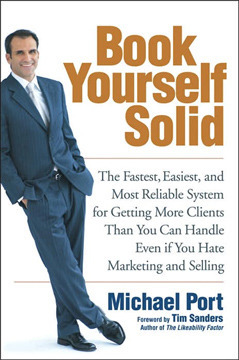 Michael Port’s bestselling marketing book for service professionals, Book Yourself Solid, doesn’t really break new ground, but it’s a profoundly useful book if you are a service professional trying to get more business and are willing and able to love what you do. The most powerful thing about the book is that it asks extremely productive, basic questions that we often don’t consider when trying to market ourselves, questions that put a high value on integrity and connection not just for their own sake, but as basic forces to find and book new clients. I learned a lot from Port.
With that said, there are also some serious problems with Book Yourself Solid. The most obvious is that it’s relentlessly self-promoting. Port uses “Book Yourself Solid” as a brand identity that he then plasters over page after page, referring to Book Yourself Solid Certified Professionals and the Book Yourself Solid Writing Strategy and whatnot. He even refers to fairly common marketing strategies with the BYS brand. Honestly, I don’t know if this is a shortcoming of Port’s marketing understanding or if I’m just outside his target market. Actually, he speaks repeatedly and meaningfully about the importance of knowing who is and is not a good client for you, emphasizing that every service professional has personal strengths and a personal style that will be great for some clients and not a good fit for others, but for himself, he seems to throw the net very wide. He doesn’t filter his readers: he tries to convince them they’re his kind of people. Actually, maybe that does filter his readers, because perhaps the people who believe in the hard sell and money for its own sake quickly get tired of his assumptions and give up on the book.
Regardless, although I was willing to sample Port’s e-mail newsletter and so on, I quickly unsubscribed once I realized how energetically he was spamming himself, and I expect to stay away from most of his other materials, too. In my particular case, he has managed to sell one book and get me to advocate for it, but he’s probably ruined his chances of selling me anything else. Not that he needs my money!
As for me, I’m entirely behind the idea that our work should be driven by our passions and by wanting to bring some meaningful value to those we serve. I just have trouble being bombarded over and over with blatant marketing messages. I was going to say I “can’t stand” that bombardment, but the fact of the matter is that I can and did stand it in order to get all of the good information out of that book.
And there is a lot of good information, especially the broad strokes and deep questions. Port offers a way to rethink a business from the ground up that takes the stress, distastefulness, and self-centeredness out of self-promotion while bringing in new clients. In some of the details, the book isn’t as strong, though here too there’s a lot of good material. I was impressed, for example, at how on the mark the social media section was, considering how changeable that world is.
The writing section, on the other hand, has some bad gaps and even some misinformation. For instance, there’s no mention of the fact that electronic querying for magazines is very common now; the SASE method is still described, and while that still applies for some markets, it seems a bit out of date.
Considering how strongly I would recommend this book to any service professional who wants to build up business through integrity and offering great value, I seem to have a lot of complaints about it, but let me mention one more: Port’s special article of faith. He states repeatedly that he believes that if you feel called to offer your services to the world, then there are people out there who need them. I have to say that I think this is dangerous bunk. Why dangerous? Because it suggests that you need to just do what you want to do, and the market for it will magically appear. I feel strongly that creating useful and valuable things in the world is accomplished by starting with the need itself, not with what you want to supply.
Fiction writing is a great example: for instance, just because I write and love a story doesn’t mean that there’s anyone else out there who wants or needs to read that story. Just because I love to write a particular kind of fiction doesn’t mean that there’s a market for that kind of fiction. Port seems to be promising unlimited success for everyone regardless of what they want to do, and some people who dive in regardless of whether there’s anyone who needs them will be sadly disappointed, because people don’t spend their money on just anything.
If you want to follow your passion without regard to what other people are wanting and needing, that’s fine–just don’t expect anyone to pay you for it.
With that said, I don’t think Port’s creed ruins the book, because it seems to me very close to the truth, which I’d say goes something like “Work hard at what you love and pay attention to what others need, and sooner or later you’re likely to find a place where the two meet.”
Overall, Port’s book was tremendously useful to me, even when it was being mildly annoying. If you’re working on building a business, I hope you’ll give it a shot, spend some real time thinking about the questions he raises, and see if it doesn’t help take you to the next level.
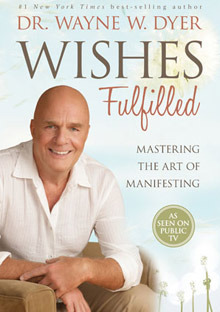
A side note: A lot of photos of business gurus are laughable in terms of body language, and this book cover is no exception. Michael, get your hands out of your pockets and uncross your ankles! If you don’t know why I’d say that, check out this book.
April 24, 2012
Audio Fiction at Toasted Cake: Tales of the Exiled Letters
 This week Toasted Cake, Tina Connolly’s weekly audio fiction broadcast, features two short stories of mine, “A is for Authority” and “B is for Bureauracy.” This is a series that I’d like to see through to completion some day (just 24 to go!), but frankly the stories are a little exhausting to write, so it may take a while. If you listen, you’ll see why.
I’ve been more energetic about sending out my fiction in recent months, and as a result I’ve been selling more stories, including one upcoming one to Nature, certainly the most widely-read and prestigious magazine I could land in this side of the New Yorker.
I’ve also done a long-overdue update of my bibliography here on the site, so that a nearly-complete list of my published short fiction is now available. Some of the stories are available free to read on the Internet; see the page for links.
Note: It’s only just at this moment that I realize why the initials of Tina’s site are T.C. Alas, I am not always quick on the uptake with these clever subtleties!
April 23, 2012
What’s the Essential Job of Parenting?
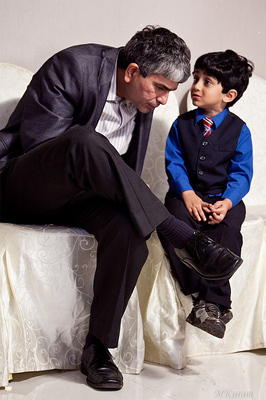 Recently Janine and I attended a series of six weekly classes (with substantial homework assignments) taught by parenting advisor Vicki Hoefle. Our children are wonderful, but we were running into problems like computer overuse with our teenager and getting our two grade school children out the door on time. Before we knew anything about Vicki’s work, I would have expected some helpful tips, useful insights, and gentle tweaks to our parenting. What I wouldn’t have expected was to hear–and quickly come to believe–that I’d been basically doing it wrong … and that I was not alone.
Wait, but I’m a good parent!
It’s very difficult for me, and I think for a lot of parents I know, to consider the possibility that we could be screwing up on a basic level. Sure, no parent is perfect. Ideas like “Ah, I should have been more involved here” or “In future, I’d better limit that” are perfectly comfortable for me. What’s not comfortable is to have to grapple with the idea that although I view parenting as one of the most important things I could do with my life, and although I’ve put great thought and effort into being a good parent, I was misunderstanding something as basic as what my job as a parent was.
This isn’t to say I haven’t been a good parent. I love my kids, and I make sure they know it. I go out of my way to spend time with them, to support them, and to listen to them. I help make sure they have good food, a stable home, fun, safety, and good schools. I try to guide and advise them to help them become better and more capable people. Isn’t that enough?
In a way, sure: my kids are great. At the same time, it’s not exactly on the mark: there’s an important understanding I (and virtually every other parent I know) had missed. That understanding is about who should be in charge. It’s not the parents: it’s the kids.
Parenting isn’t about telling our kids what to do
What’s the essential job of parenting? If you had asked a few months ago, I would have said something like “To love, support, teach, protect, and provide for our kids.” I also would have thought it was a pretty great answer. So where does it fall short?
To answer that question, I have to think about the thing that Vicki pointed out to us at the very first class: when they’re 18 or thereabouts, in most cases, our kids will be going out on their own. As of that moment, we will no longer be able to do things for them, teach them much of anything, or protect them from the world. By the time our kids leave home, they will need to know how to do everything we currently do for them and everything we expect them to do for themselves, as well as a bunch of things that we adults already do for ourselves and they will have never had to do before.
They have 18 years to learn everything. Go.
The list of things to know includes how to do laundry, how to cook, how to choose healthy foods, how to eat at regular times, how to get enough sleep, how to get up on time, how to be reliable, how to solve problems without anyone else’s help, how to act in a crisis, how to spend money, how not to spend too much money, how to earn money, how to save money, how to make and keep friends, how to resolve arguments and disputes, how to drive, how to navigate, how to keep a home clean even if you’re very busy, how to limit games and television so that they don’t get in the way of things like school and work, how to tell whether or not other people are trustworthy, how to deal with unexpected setbacks … and on and on and on. The complete list is probably too long to even fully imagine.
As competent adults, we know how to do a huge number of things, a lot of which we never even let our children try, sometimes because we don’t think they can do it and sometimes because it’s our job to do. (Do you let your children pay the gas bill without oversight? Hire their own lawyers? Take themselves to the hospital? I don’t either, although there are ways for them to learn how to do all these things without having to be abandoned by us.) As a result, young adults out on their own often make huge blunders with money, love, cleanliness, health, school, work, friendships, and in other areas. Sometimes they find their way through and eventually get good at these things. Other times they find an unhealthy status quo, like staying away from other people because they’re too nervous about negotiating relationships, or bossing everyone around, or bingeing on doughnuts every Friday night, or avoiding getting a serious illness or injury checked out because they don’t know how they’ll pay the medical bill, or ruining their chances at a great job and getting stuck with a lousy one.
Some of basic principles I took away from Vicki’s classes were these: let children do everything they’re capable of; let them find their own way; and help them learn how to do the things they can’t yet do.
Not all there is to it
There’s much more to what I’ve recently learned about parenting, especially in terms of what problems with kids’ behavior are really about and how to respond in a way that addresses the real issue instead of just trying to fix the situation. I’ve had to let go of a lot of my previous assumptions about parenting, though the principles of love, involvement, and support have only been strengthened by this process. If I tried to explain everything our family has gone through in the past six weeks, you might not even believe me. I will say, though, that our family is much, much happier and more functional than I could have imagined we’d be. We still have a lot of work to do, but we’re making steady progress.
How can I say this in strong enough terms?
I’ll try to express this as effectively as I can: I don’t think I know a single family with children at home that does not need what Vicki is teaching. Not a single one. I know some outstanding parents, and I suspect those outstanding parents would get at least as much–if not more–out of learning from Vicki as the average person.
When I say “need what Vicki is teaching,” too, I mean that any time, effort, and expense put into this education will pay off many times what was invested.
Just so you know, I have no affiliation with Vicki’s operation and don’t get anything for talking her up. The reason I’m so enthusiastic about promoting her work is that I think it is desperately needed.
Vicki has begun speaking more widely just recently, as her youngest child (of five) has just left the nest. This is good news for people who, unlike Janine and me, do not live in Vermont and would not previously have had direct access to her. Even more usefully, she has a book, Duct Tape Parenting, coming out in August. (She already has a for-Kindle-only book out called Real Parents, Real Progress, but it’s more of an extended preview of what she’s offering than a real resource in itself. Actually, it’s perfect if you wonder if there might be something to what I’m saying but don’t really believe me that it can make an enormous difference in your life yet. Invest the five dollars in the book and see whether you agree it’s worth pursuing.)
I’d suggest that if you can think of anything important that you’d like to improve in your relationship with your children, whether it’s a problem kind of behavior or anything else, that it would be well worth your time to look into Vicki’s site or her books. I’m sure there are other people in the world who have as deep and useful an understanding of parenting as Vicki, but I’ve never run across any of them, and they’re not the parenting experts I’ve heard of before. Prove me wrong if you can that Vicki’s take on parenting is something we desperately need.
Photo by Bindaas Madhavi
April 17, 2012
Should You Exercise When You’re Sick?
Recently my son came down with a bad head cold, and I soon caught it from him. Some combination of echinacea, zinc, extra sleep, and luck probably saved me from a week-long ordeal, because I woke up less than 24 hours after symptoms started feeling well.
The illnesses, though, started some discussions in our household about activity when you’re sick. My assumption about illness was that once you start getting sick, you should rest intensively until you’re better, but it turns out that the experts don’t necessarily agree. A Rodale News article on the subject quotes researcher David C. Nieman saying that people who exercise more get and stay less sick, which may be no surprise, but in the same article Nieman points to research he has done that seems to suggest that moderate exercise when we’re mildly sick (like with a head cold) can cut the length of the illness by half.
Nieman and article author Emily Main are quick to point out that exercising with a chest cold or severe illness is a recipe for trouble, and give pretty specific guidelines on when to exercise during an illness and when not to; read the full article for details.
Quinn Reid's Blog

- Quinn Reid's profile
- 6 followers

