
Quinn Reid's Blog, page 20
December 12, 2011
Bam! 172 Hellaciously Quick Stories free on Amazon until 12/15
My flash fiction collection, Bam! 172 Hellaciously Quick Stories, is part of an Amazon Kindle promotion and is free just until December 15th: here's the link.
"It's not easy to inject an entire world into one scene, but Reid does that time and time again. The characters, whether they live in one sentence or 20, are real people."
– David Kopaska-Merkel in his review of Bam! on Dreams & Nightmares
"172 fantasy and science fiction, flash stories … each of them short enough to read in a few minutes, each of them rich, well crafted, meaningful."
– Deborah Walker in her review of Bam! on Skull Salad Reviews
"thanks to this author's unfettered imagination, quirky sense of humor, and great touch with twist endings, these short stories provide entertaining and often intriguing micro reading experiences. Highly recommended!"
"Bam! is like a magic pocket that is way bigger on the inside than it is on the outside. You reach in and never know what you're going to pull out."
"These stories were funny, memorable, meaningful. Dark chocolate, flashes."
"Some absolute gems hide in here, such as the ingenious and infinitely anthologize-able 'The Last Log Entries at the Philadelphia Office of the Centers for Happiness Control.'"
–Amazon.com reviews
"Reid's smart humor and eye for irony are sure to attract plenty of readers, and keep them perusing the collection at their leisure. The wit he employs in the stories is perfect for setting up the most poignant of stories … because just as you begin to anticipate more humor, the weight of what is being said sort of sneaks up on you. It makes for a great read."
– Shelly Bryant, reviewing Bam! at SlothJockey.com


December 9, 2011
So This Sucks. What's That Shiny Thing? On Schema Avoidance

I'm big on using writing as a tool for mindfulness and self-understanding: I do a lot of sitting down to write out what my thoughts and experiences have been on certain problem topics (whatever I'm working on in my life at that point in time) and using tools I've acquired, like idea repair and identifying mental schemas to figure out what's going right, what's going wrong, and what I can do to improve things. Yesterday, in the middle of this process, I suddenly became distracted.
And now for something completely different …
I was writing about a situation that had been frustrating me and had gotten to the point of saying "OK, I don't know what's going on there, but it sure is frustrating." Sometimes I stop at that point if I don't have any further insights. In this case, I hadn't really thought the thing through very well, so I didn't know whether or not I had further insights. Before I could figure that out, I found myself thinking about some entertaining distractions on the Internet, a new little project I could start, and wanting to check my e-mail. Since I was fortunately already trying to pay attention to my thoughts, I pulled myself up short. What was going on with me? I was doing meaningful self-examination, and then suddenly I want to go see what's on YouTube? Was I trying to distract myself from something?
Having that thought, I was immediately inclined to drop the subject. It was as though I had walked up to a door and found a sign on it saying "Go away! We don't want any!" Since this was happening (metaphorically) in my own brain, that seemed like a red flag to me–and also, I just like being contrary. So I opened the door and looked around. When I did, I came face to face with the overcommitment problem I'd been mulling over recently and one of the hidden ways it has been affecting me.
Schema avoidance
So what had happened was that the thinking I was doing led me to make a connection between some of my behaviors and overcommitment, but as soon as I got close to that connection, I automatically started distracting myself. There's a name for this phenomenon. In schema therapy, it's a "schema coping style" called "schema avoidance."
Avoidance takes any number of forms: it can be television, surfing the Web, extreme sports, reading, going out with friends, eating, drug abuse, drinking, or anything else that can keep a person's attention well enough to block some other thought or feeling. It can even be something constructive, like doing the dishes or working out.
Unfortunately, coping styles (like avoidance) don't tell us much about what the underlying problem is. The fact that I was avoiding something only told me that there was something wrong, not what kind of thing it was.
It's worth thinking how much this has to do with procrastination. In our culture, we tend to think of work as being something we would naturally want to avoid, but there's nothing inherently painful about work, and often other problems–like fear of failure, perfectionism, or negativity–cause us to want to distract ourselves from working.
Opening the door marked "do not enter"
So learning about ourselves when we notice we're being avoidant means facing the avoidance and consciously choosing to stay on task, to keep thinking or talking or feeling or investigating whatever it was that set us off. If I go to open my mail and suddenly have the idea that it would be fun to go out ice skating or that it's time to watch a new DVD, then there's a good chance that there's something about the mail that triggers one of my mental schemas. If at that point I want to grow as a person and get past my current life obstacles, then the thing for me to do is to go to the mail, open it, and be observant of and gentle with myself as I face whatever it is I don't want to face.
Being observant is necessary if I'm going to understand myself better in order to change things. Being gentle is necessary because we've developed these schemas and coping styles for a reason: somewhere earlier in life, something along these lines was painful enough to force a schema to develop around it. If we want to unravel mental schemas that keep us from living a good life, we need to care for whatever part of us the schema is there to protect.
Got courage?
I understand this talk of being gentle with ourselves may be offputting to some readers, so I'd like to characterize it in another way: facing those things that disturb us even though doing so makes us uncomfortable and vulnerable requires focus, self-knowledge, and above all, courage. So if the thought of facing everything that makes you feel uncomfortable or bad in the world gives you a sudden urge to see what's on TV, I don't blame you–but I also wish you good luck pushing the avoidance aside and courageously moving forward.
Photo by rishibando
December 7, 2011
Codex Writers' Group Invites Indie Authors to Join
Codex Writers' Group is an online, independent group of about 200 active members that offers a lively forum, contests, writing news, writing discussions, in-person meet-ups, critiques, promotional opportunities, and other advantages. It's a friendly, vibrant, and supportive community whose members all qualify through writing accomplishments. The focus is on science fiction and fantasy prose, but there are some facilities for screenwriters, non-fiction writers, poets, and other writers.

I'm a little worried I'll come off sounding like a braggart, but since these are achievements of my friends and not of my own, I hope you won't mind me talking about some of Codexians' successes. A large proportion of Codex members have gotten literary representation, sold books to major publishers, sold stories to major magazines, sold movie options, won contests, or won major awards since joining. One has co-authored a NY Times best-selling book. Members' work appears in the great majority of major English language fantasy and science fiction magazines and in many other venues. In 2010, 15% of all Nebula nominations went to Codexians (I haven't tallied 2011 yet). Codexians have won the Writers of the Future contest, the Phobos contest (R.I.P.), the Hugo, the Nebula, the Campbell, and many other awards. Membership is free and open to all writers who meet one of the qualifications, provided they're willing to abide by the group agreements on privacy, consideration, etc.
The original means of qualifying were making at least one pro fiction sale or attending a major, by-audition-only writing workshop with industry pros (e.g., Clarion, Odyssey, Literary Boot Camp, etc.). In September we added the option of qualifying by getting representation with certain literary agencies.
As the publishing times are changing, we've just added a new means of qualifying to join Codex: sales of self-published fiction. Anyone who has sold at least 1,000 copies of self-published stories or novels and who has received at least $5,000 in income from these sales (note that this is income to the author, not gross sales) is now invited to join Codex. Discussions of indie publishing, eBook creation, cover design, and self-promotion have been very active on the forum lately, and more grist for the self-publishing discussion mill is always welcome.
If you're interested in the group, please visit www.codexwriters.com .
December 6, 2011
Overcommitted: Not Enough Time
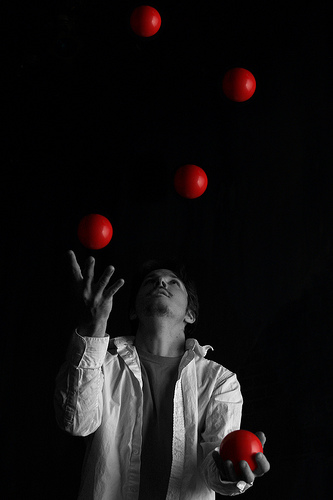 I do a lot of research reading and a lot of writing about motivation. The problem is the same whether we're talking about not having enough time to write, not having enough time to exercise, or any other shortage of time: in a word, it's overcommitment.
One of my character flaws
The reason I'm writing about this today is that overcommitment is a perennial problem for me. There's a lot of stuff I'm excited about, and I can't walk three feet without running into another cool opportunity of some kind. I realize that there should be a non-fiction book about a particular topic, or get a story idea, or come up with an idea for a Web site to help do something that's hard to do, or think about how I can help a cause that matters to me or improve our house or organize better.
Most of the time, thankfully, I ignore these impulses. I've probably thrown away a number of ideas that would have changed my life if I pursued them, but I've also thrown away a lot of just-OK or actually-pretty-awful ideas, and I've pursued some ideas that have changed my life (like starting intensive reading research about self-motivation or applying to study at Orson Scott Card's Literary Boot Camp back in 2001). The root of the thing is that there will never be enough time to do all the cool things that could be done in the world. In a way, this justifies the fact that we're all individuals. True, it means we sometimes feel alone and tend to repeat each other's mistakes over and over, but on the bright side, by each pursuing our separate passions we can collectively do most of the cool things there are to do. If I can't do all the cool things myself, it's reassuring to me that someone can.
Just trying to do better doesn't cut it
In a sense, it occurs to me, overcommitment is a bit like being over-motivated. Unfortunately, the results aren't all good. Whenever I take on more than I really have time to do, I'm really giving up some of the things I think I'm taking on, because in the end not all of it will get done.
One thing I can do to deal with overcommitment is to become more efficient: to organize my time, focus my efforts, and learn good habits for getting things done, but this doesn't do anything to address the underlying problem, because when I have more usable time at my disposal, I tend to take on more things to do. Even doing the things I've already got on my list tends to lead to me finding new things to do. For instance, I might work on getting the word out about my latest book and in the course of doing that find several new places on the Web where I could get involved and learn something or connect with new people. It's true that I'm on my guard about that, but I don't seem to have pared things down to anywhere near a fully manageable level yet. I get a lot done, but I also leave things undone.
Prioritization helps–somewhat
One partly successful way to approach this–and this is an approach I've been using a bit–is to get really good at prioritizing. If you prioritize well, then even though you don't get everything done, at least you get the most important things done, which is great.
Unfortunately, if I take this approach I'll still have put some effort and attention into the lower-priority things that I never got to, so it's still wasteful. Also, I won't be able to say for certain what I will and won't get done. It's not very satisfying to have someone say "Can you do this?" and for me to respond "I don't know: let's see whether I get to it or not." I can address that in part by bumping anything I've promised anyone to the top, but that means sometimes doing things that aren't as important just because I talked to someone about them. That's not the worst fate in the world, but it's hardly ideal.
Letting go
So really the solution to overcommitment is figuring out what to let go of and consciously letting go of it–keeping the workload down to a manageable level. This has a lot of benefits: you know what you will and won't be able to do; you can make promises and keep them; you have a lot fewer things to worry about; and you concentrate your efforts on things you're actually going to finish.
Sadly, this is much easier said than done. Even putting things in priority order is hard, because priorities change over time. Putting things in priority order and then hacking off the bottom of the list seems too painful and destructive to be borne–and yet it also seems like the required behavior. So I'd love to hear your thoughts: how would you change an overcommitted life so that you'd be doing less?
Photo by timailius
December 1, 2011
Counterfictionals: The Witch of the West
Apropos of nothing, here's a cartoon …

November 30, 2011
Writing Motivation for Academics
I recently wrote an article on motivation for academic writing, an especially tough area, and it now appears on the academic writing site PhD2Published: "The Will to Write: Getting Past the 6 Most Common Obstacles." The site posts daily articles to encourage and support the process of writing dissertations, papers, theses, monographs, etc.
November 29, 2011
Deferring and Sharing: The Well-Being of Others and Our Future Selves

You don't have to delay gratification or help other people to be human. Not delaying gratification can lead to a lot of suffering, and not helping others can lead to loneliness and insecurity, but they're not strictly necessary.
To some extent, though, the better we are at delaying gratification and helping others out, the more we start experiencing benefits out of the blue. Being a dependable and altruistic member of a community creates a network of people who are willing to do things for us, look out for our interests, lend us assistance when we most need it, and support us when we're recovering from a loss or setback. Handling our own desires intelligently has a similar effect: we continue to reap benefits from things we've done in the past.
Yet both helping others and delaying gratification pose a problem: we have to give things up now with a chance that we won't be paid back. For instance, if I have a box of fudge and I hold off on eating some or all of it, I have to give up the experience of eating the fudge right now and run the risk of someone else eating the fudge, of losing it, of it going bad, etc. The surest way to get all of the "benefit" from eating the fudge is to consume all of it, right away.
The problem with that approach is that taking everything you can get the moment you have it often leads to a cornucopia of troubles. In the case of the fudge, eating a lot of it at once can make a person sick, contribute to unwanted weight gain, create an unpleasant sugar rush and crash, and cause the person to look like a pig to onlookers. To eat all of the fudge, I don't have to give anything up, but in the end I bring on suffering and fail to experience the same kind of satisfaction I'd get from managing the fudge over time.
In a similar way, if I have a pound of fudge and some people I could share it with, the surest way to get all of the "benefit" of the pleasure of eating the fudge is to eat it myself, whether I do that now or later. Yet sharing the fudge with others makes others more likely to share with me, and over time is likely to yield a variety of benefits that a pound of fudge alone could not confer—especially if I don't want to eat a whole pound of fudge.
Evolving as individuals, becoming more enlightened and compassionate, and learning how to handle ourselves better therefore means a lot of saying "I'm going to give up on this pleasure I could get right at the moment" and "I'm going to give up on this surer thing for this more uncertain thing." It's counterintuitive, and to a large extent we're not built for it, and yet our lives become much happier the more we learn to defer and share. We can't experience the pleasure our future selves will experience when we set things by for them now, or directly experience the pleasure others feel when we do things on their behalf. Fortunately, we can experience the immediate goodwill we call forth when we do things for other people and the satisfaction we get from making good choices. While these things don't give us the immediate animal response we'd get from eating a pound of fudge, they also tend to make us feel healthier, happier, and in better harmony with our lives and environments–rather than making us sick.
If you're interested in this topic, you may enjoy reading my article "The Difference Between Pleasure and Happiness."
Photo by Xiangdian
November 23, 2011
Thanksgiving Fiction: On Reincarnation in Turkeys
In celebration of Thanksgiving, here's a short story in honor of the brave and often delicious turkey, originally published at The Daily Cabal. If this whets your appetite, there are 172 more very short stories of mine in the collection Bam! 172 Hellaciously Quick Stories.
 "OK, I respect that," I said to the other turkey, "but if we're going to have a conversation, I need to give you some kind of name. Why don't I call you Lashonda?"
"Gobble," said Lashonda.
A chubby guy in rubber gloves and a rubber apron snatched me up by the feet and hung me upside down.
"Hi!" I said in Turkey, but of course he didn't understand.
A second later he hung Lashonda up next to me, and we swung gently from side to side as the track we were hanging from carried us into the gloom.
"This feels strangely peaceful," I said. "Who would've imagined? Hanging upside down … it's so relaxing. It's a little like grooming. I had an incarnation as a spider monkey once, and we were always grooming each other. Most relaxing thing in the world."
Up ahead, there was a burst of gobbling that was abruptly cut short. The machine we were swinging from made a gentle creak-creak sound.
"Gobble gobble," said Lashonda.
"You know, it's funny you should mention that," I said. "That's what I've been wondering about: why a turkey in the first place? I mean, we're raised butt-to-wattle in a pen, fed terrible food, and eventually carted off to be slaughtered. What's the point in that kind of existence? I'm worried that if I don't learn anything from this life, I'll just have to do it all over again."
We came around a bend, and I saw that the line dipped, lowering turkey heads into a silvery machine. There was an electrical noise somewhere.
"It's not the same as being a wild creature or a human or whatever," I said. "As those you can make choices. But what can you possibly learn if you don't get to make any actual choices?"
Lashonda was silent. I wondered if she was scared.
"I'm probably overthinking it," I said. "Right now, I just feel grateful, you know? Grateful to be hanging upside down, grateful to have a friend like you right when I need one … I don't think I've ever told you, Lashonda, in the few minutes we've known each other, how much I appreciate your company and your level-headed attitude."
The line began to descend, and all of a sudden the silvery machine was right in front of me.
"Have a nice life, Lashonda," I said. Then something sparked.
Photo by cyanocorax
November 21, 2011
New on Every Day Fiction: Keeping an Eye Out for the Time Police Regardless
My short story "Keeping an Eye Out for the Time Police Regardless" is up today at Every Day Fiction, where a new short story appears each morning. There's an engaging community of readers and commenters on the site, leading to a discussion in the comments that pointed out at least two possible interpretations of the story I hadn't even considered and gave great insight into what worked better and didn't work as well in the piece.
November 17, 2011
A Simple Trick for Remembering Things That Are on the Tip of Your Tongue
 There's a recent post on the Psychology Today site entitled "The Science of Rick Perry's Brain Freeze," in which psychologist Ira E. Hyman attempts to explain how a governor of Texas and presidential candidate could have had trouble remembering the Department of Energy, obvious jokes aside.
You may be pleased, annoyed, or uninterested to read that Dr. Hyman thinks Perry's gaffe isn't an indication of stupidity, but I'm guessing you'll come away from the article happy based on the following potentially helpful tip. In it, he refers to the problem of "blocking," a situation in which our brain has so much related information readily available that the specific piece of information needed can't be found in the pile. Dr. Hyman says:
In cases of blocking, a brief period of thinking about something else may be enough to remove the block. In essence, you remove the competitors from active thought and then the next attempt to retrieve the information works more effectively.
I haven't had the opportunity to try this yet, but you can bet I will next chance I get. If you try it, or have other tricks, I'd love for you to post in comments, below.
Photo by Dr Craig
Quinn Reid's Blog

- Quinn Reid's profile
- 6 followers

