
Doug Lemov's Blog, page 8
June 29, 2023
Beth Peakman Combines Cold Call, Wait Time and Stretch It While Reading Wind in the Willows
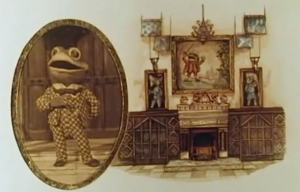
Toad of Toad Hall
We’ve recently had the pleasure of watching a few great videos shared with us by the team at Rivers Primary Academy in Walsall, England. The clips exemplify not just impressive implementation and adaptation of TLAC techniques but–pretty clearly, we think a culture that takes the support and development of teachers seriously. I’m going to share a few of their clips over the coming weeks, starting today with this lovely example of, among other things, Cold Call, Stretch It and Wait Time in Beth Peakman’s classroom during a reading of “Wind in the Willows.”
Here are some of the things we loved:
We love the way Beth previews that she his going to Cold Call and combines this with extensive (and transparent) Wait Time. There’s such deep synergy in those two moves. Cold Call is better when students can see it coming and when students have time to prepare. The Wait Time lets everyone do that. Bonus points to Beth for her careful scan during the “thinking time”: kind of fascinating to think about what she could be scanning for: who is engaged and who isn’t? who looks like they have something interesting to say? who needs a tiny bit of eye contact as encouragement? And of course we love Beth’s self-discipline. After she promises thinking time she delivers: about ten seconds of it! Just maybe part of the purpose of the scan is to slow herself down and make sure she doesn’t rush her pupils.
“Let’s go to…. Isla! Everybody track Isla.” We love Beth’s tone throughout… though you can really here it in the way she calls on Isla. She’s intrigued and welcoming- like she can’t wait to hear what Isla has to say. She walks toward her slightly and tilts her head as if t signal her fascination with what Isla might say. Not insignificantly, the message from the tracking of Isla’s peers also suggests that they value what she’s going to say as well.
Next there’s a round of follow-up questioning. Isla has rightly pointed out that Mole was embarrassed but Beth would like a little more. She wants to Stretch It and raise the standard of what a full and complete answer entails. But of course as she does this Beth’s tone is conversational, like they are chatting about the book, and her body language continues to encourage Isla and show her appreciation for what Isla’s said. Just lovely stuff.
In order to help Isla improve her answer she sends her back to the text–“Can you remember what he said?” she asks–but adds a brilliant little move. “Have a look everybody,” she says. This both causes everyone else to also look for the evidence…and make a habit of looking for evidence…but also subtly takes a bit of pressure off of Isla… it gives her a little time without everyone looking at her to step back and think. We LOVE tracking but we also love a teacher who recognizes a good moment to not use it.
Finally my personal very favorite moment in the clip. “So should we say it again but say it better?” Just a lovely way of pushing a student to refine her answer asking for a more complete answer. It feels like such a good thing–an opportunity–and she subtly gives Isla credit for her original thinking while also norming the idea of improvement.
And no surprise, Isla crushes it. At first her answer had been “I think he might have turned red because he was embarrassed.” Now she’s upgraded to: “I think Toad might have been feeling embarrassed because when he said, “My house is the finest house on the river, Rat nudged the Mole.” She’s added evidence, improved her syntax and embedded a quotation. And Beth has lovingly communicated the message that what we do with good answers is make them better.
No wonder there’s celebration at the end!
Thank you to Beth, her students (Go, Isla!) and the team at Rivers Primary for sharing their lovely teaching with us. More coming soon!
The post Beth Peakman Combines Cold Call, Wait Time and Stretch It While Reading Wind in the Willows appeared first on Teach Like a Champion.


June 27, 2023
Details of the Turn and Task with Denarius Frazier
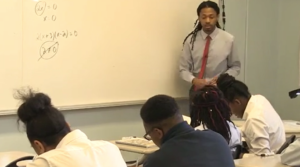
You’re probably familiar with Turn and Talk… it’s one of the most popular techniques in Teach Like a Champion and you can delve into some of the details here, here and here.
This is a video of a variation on that idea: Turn and Task. Instead of discussing a relevant question students complete a task-say a math problem-in their pairs.
You can see the always masterful Denarius Frazier do that here:
Some details that make what Denarius does here so effective:
You can see how deeply ingrained the routine of Turn and Talk is. Students know just what to do and can find their partner(s) and get to work with no extraneous load on working memory.They even know what to do if their partner is absent. (The student in the front row instantly turns to the students behind her; they all get right to work)Denarius’ language to release them to the task is a combination of What To Do directions–“In pairs. 2 minutes. … Fill in all the blanks that you can. Go.”–and economy of language.Denarius watches carefully as students work. Here, he notices that they need more time.Again, crisp What to Do Directions coming out of the Turn and Task–“Let’s bring it back in 3. Voices off in 2. All eyes up here in 1.” That set of directions is part of the routine—just a reminder really–and you can see that students are familiar with it.Denarius Cold Calls coming out of the Turn and Task. This is an ideal time to Cold Call because 1) everyone is prepared and so likely to be successful and 2) it’s ideal to establish a culture of loving accountability. I will check to see that you were productive with your time. Denarius’ language when Cold Calling Christian–“Start us off”–is one of my favorite details of effective Cold Calling. It lowers the stakes for Christian. He doesn’t have to be perfect. He’s just starting off the conversation. And his classmates are cued to be attentive. If Christian is “starting us off” they may be asked to follow-up. They are cued to be alert and attentive.
The post Details of the Turn and Task with Denarius Frazier appeared first on Teach Like a Champion.
June 19, 2023
Looking around during the movie: why sharing stories is important

Where it started…
A few nights ago I was watching a movie with my family. I was in a chair. My wife and one of my daughters were over on the couch. To my left and mostly behind me as I was looking at the screen.
But I noticed a strange behavior in myself: I kept glancing over at them at funny and important scenes. Once in a while when there was a scene I loved coming up I even glanced over in advance to make sure my daughter was watching and not glancing at her phone. Weird. Why would I do that? Why would I care.
In fact though I would wager that you do it too. And I think there are good reasons for it and that they tell us something important about reading in schools.
First why was I looking over at them? Answer: To gauge (and share in) their emotional response. Part of my purpose and part of my enjoyment comes from the shared emotional experience. The movie is a lot better if they are laughing too. If we are laughing together. Or if we share the subtle irony of a key scene. I want to see their surprise when they didn’t see a sudden reveal coming. It’s just like my own when i first watched it. And I was doing this for all the reasons we watch movies with other in the first place. To share the emotional experience. Shared experience enriches the movie and it’s one of the main reasons we are watching the movie together. Shared psychological and emotional experience connects and bonds us.
Stories, Daniel Willingham tells us, are cognitively privileged. We pay special attention to them. This you could argue has an evolutionary basis. For hundreds of thousands of years before there was written language we communicated our knowledge, our cumulative culture and our norms for community & belonging via stories, told sitting around fires. People who listened and learned thrived. People who did not were less likely to. We learned and probably evolved to pay attention when a story was told. And we also probably learned that sharing stories was how we built an ‘us’. Shared stories are critical to belonging.
Why does this matter?
Well for one thing because the book is dying.
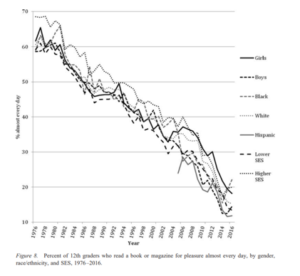
Decline in independent reading by 12th graders; 1976-2016 (ie before Tik-Tok and the last round of distraction super engines.
It is in a death struggle against the smartphone and it’s losing. Young people-well all of us–read fractionally as often as we used to. The best hope for the book, for the story lies in its roots—that it is a shared experience. We like stories more and we are more fulfilled when we experience them together-that’s why I was looking over at my wife and daughter. We experience social connection through the shared emotional experience of a story.
If the book has a chance–if we want young people to see a why in reading—one of the best ways we can do that is to leverage the book’s social nature. The pleasure we take from experiencing them together. That after all is where stories started. [I note here that while the book is dying, the book CLUB is thriving. Again: shared experience is at the center of storytelling.]
Two particular takeaways from this. First shared oral reading in class is a way to cause people to connect, to feel connected not just to reading but to each other. Young people need that now. And it helps them to see (and feel) the benefit of stories we share.
You can feel that in this video of students reading aloud together in Maggie Johnson’s English class. There’s laughter and pleasure and connection. Look at the kids furiously underlining while their classmates read. You can hear the enjoyment in their voices.
Second it suggests that the solution many people propose to declining reading rates is mostly wrong. I hear people argue that book choice will encourage students to want to read more. The result of that is often everyone in their own corner of the room reading their own book in isolation and disconnection.
[Side note: the idea that kids who have read ten books in their lives are going to choose better and more affecting stories than teachers will is a big assumption. I love soccer. I choose Cristiano Ronaldo’s biography. It is terribly written and does little to help me glimpse something more true about the world than i previously knew. I doubt I am sold on reading. Better for you to hand me the Giver and for us to read it together, understand a great book deeply, and share in the deep emotions of the final scene].
The solution, I am arguing, is not more fractured isolation and individualism it’s shared culture and connection. Great if kids ALSO get to choose books to read on their own. But more important is to without fail to have shared books that they read and experience together in class so they are connected, and feel belonging and understand that there is something in a book that cannot be found anywhere else. If the book is going to survive it will because we make it social.
The post Looking around during the movie: why sharing stories is important appeared first on Teach Like a Champion.
June 12, 2023
Casting a Spell: Ben Esser studies Maca Torres & Maria Jose de Vicente’s classroom magic
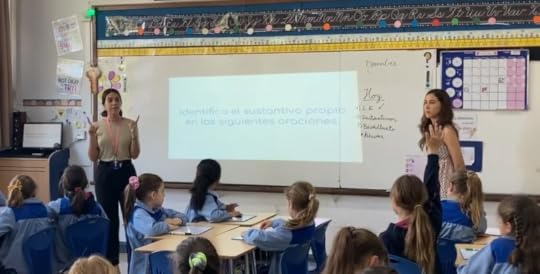
Ben Esser has featured on the TLAC blog and in TLAC books as a teacher. He’s since moved to Chile where he supports and coaches colleagues. He recently shared this reflection on the culture-building magic of his colleagues, Maca Torres and Maria Jose de Vicente.
Unimaginable as it may be in the northern hemisphere, in South America the school year just started, and with that comes the focus on establishing strong classroom culture. One of the most challenging things about helping teachers hone their classroom management is that many of their best colleagues often seem to be magical in their ability to get students to follow their directions while making a classroom feel warm and focused.
Maca Torres and Maria Jose de Vicente at Colegio Villa Maria in Santiago de Chile are two such teachers. They cast a spell on their second graders via moments that are so subtle you might miss them. If not for this video…
At the start, Maca is walking to the left side of the screen to get to a spot where she can easily see every student, and more importantly be seen looking while Maria Jose gives careful What to Do directions. I place my marker on my desk, just like Lucy and Aurora, and then please bring your eyes here because we are going to give the directions for this game. [“Dejo el plumón sobre mi mesa, así como está la Luci y la Aurora y van a mirar para acá.] The task is clear and observable and she starts narrating right away students who have done it. She pantomimes putting the whiteboard marker down, points to Lucy’s desk as a reminder of what to do, then points to her own eyes, reinforcing that she’s looking for them to follow her directions. Because she does this all the time, she is calm- serene.
I love what she says (and doesn’t say) next even more. First, she stops talking, stops circulating and positions herself at the front of the room. After a few seconds, she says, “I’m missing a few pair of eyes,” [Me faltan ojitos,] she pauses again and looks, then “Markers on your table; we aren’t drawing.” As she pauses, even the rustling in the room stops. When she says, “I’m missing two pairs of eyes,” [Me falta dos niñitas que estén mirando”] a second time, her tone remains warm and inviting, as if she cannot imagine that the last two girls will fail to meet this expectation.
Her tone invites; her anonymous individual feedback nudges; her confidence ensures. There’s a process to her magic– the what to do cycle*—but she combines it with a positive tone and confidence and so wins with a smile. That is the really hard part of this to replicate, but there’s no better place to start than by watching a master at work.
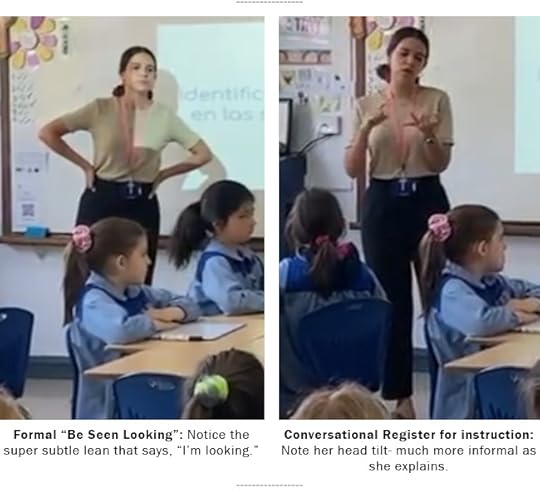
I’d like to say slightly more about what Maca does while Maria Jose casts her spell. It is as important to notice what she doesn’t do as what she does. Maca switches to a formal posture and does not move or say a word. She is modeling how every child should be paying attention. There are a million other things a teacher might be doing while Maria Jose is narrating and correcting. Maca could be writing on the board. She could be answering one of the million darling little questions 8 year olds want to ask their teachers every moment of the day. Instead, Maca stands up/squares up and communicates clearly: I look forward to giving you directions as soon as I have everyone with me.
Below is shot of Maca’s stand up/square up side by side with her much more informal posture a moment later as she begins instruction:
It’s also a valuable contrast with the inviting, informal register she uses to explain the difference between common and proper nouns in this second clip:
Here were two other things from this second clip that I particularly loved:
In less than 90 seconds, Maria Jose and Maca explain the academic task, clarify the format of student work, and check for understanding. Beginning teachers are often skeptical of the value of scripting and practicing really precise directions- isn’t this a waste of time? No, a waste of time is angrily lecturing 8 year olds when they haven’t done what you wanted because your directions weren’t clear. Because Maria Jose and Maca give directions this precise all the time, their classroom is joyful, and they take much less time repeating or clarifying.Part of the trick with really precise directions is that they should have a purpose. Maria Jose interjects a few seconds in to point out which side of the white board girls should use because, of course, we’d like to see beautiful handwriting. The message: even in the midst of using our white boards, we use our best handwriting. If every girl’s answer is the same size, in the same place, with neat handwriting, the mental load on Maria Jose and Maca is much less as they check each board. Format matters.*The components of the What to Do cycle are:
What To Do Directions: Give clear, concrete, observable directions for the task you want students to do.Be Seen Looking: Look deliberately for follow through after your directions. Make sure that students see you looking so they know it matters to you and they know you’ll notice whether they do it.Narrate the Positive: Acknowledge (but don’t praise) students as they begin to do it: “Thanks, Chris, for getting started right away. Thanks Jasmine.”Correct When Necessary: Use the Least Invasive form of correction such as Positive Group Correction (Make sure your pencil is moving) or Anonymous Individual Correction (Still need two see two students writing).Transcript to Video 1:
María José: Dejo el plumón sobre mi mesa, así como está la Luci y la Aurora y van a mirar para acá porque vamos a dar las instrucciones de este juego. (I place my marker on my desk, just like Lucy and Aurora, and then please bring your eyes here because we are going to give the directions for this game.)
(Breve pausa)
No todas me están mirando. Me faltan ojitos. El lápiz, o sea perdón, el plumón está sobre la mesa. No estamos rayando. Me falta dos niñitas que estén mirando. (Not every eye is on me. I’m missing some eyes. Markers on your table; we aren’t drawing. I am missing two girls’ eyes.)
Transcript to Video 2:
Macarena Torres: Aparece una oración aquí y ustedes tienen que identificar, identificar el sustantivo propio, es decir, esa palabra que es especifica que nombra a una persona, un país, una ciudad, y que va con mayúscula ahí tienen una pista bien grande, la mayúscula. ¿Hay alguna pregunta? ¿Se entendió lo que vamos a hacer?
(On the board, a sentence will appear, and you will need to identify the proper noun– which is to say, the specific word which names a person, a country, a city…and which will have a capital letter– there’s a big hint. Are there any questions?)
María José de Vicente: Si, miss Maca y hay que escribirlo. (Yes, Miss Maca, we need to write the word.)
Macarena Torres: Aa eso sí.
María José de Vicente: Lo encuentro, lo busco en la oración y en silencio solita lo escribo en mi pizarrita. (I’ll look for the word in the sentence, and then silently and independently write it on my little white board.)
Macarena Torres: Y escribo solamente esa palabra, una palabra es la que debo buscar. (I write only that one word, the one word I was looking for.)
María José de Vicente: Y vamos a usar esta parte de la pizarra, la que tiene rieles, para que escriban con letra preciosa. (And we’ll use this part of the white board, with lines, so that we write with beautiful handwriting.)
Macarena Torres: Haber me repite lo que vamos a hacer, para ver si se entendió. ¿Quién entendió lo que vamos a hacer? Súper. Ana, ¿qué vamos a hacer? Espérame, espérame un poquito, todos miramos a Ana para verificar si comprendimos. (Let’s repeat so we can see that we understood. Who gets what we’re going to do? Ana, what are we going to do? Wait a bit, everyone’s eyes on Ana to check that we understand.)
Ana: Va a aparecer una oración, tenemos que leerla y encontrar el sustantivo propio y escribirlo en la pizarra. (A sentence will appear, and we need to read it and find the proper noun and write it on our whiteboards.)
Macarena Torres: Excelente. Y vamos a hacer una cosa, la que ya está lista se va a tocar la nariz, la que ya lo escribió se va a tocar la nariz, y así yo voy a saber q esta lista. ¿ya? Listo, comenzamos. Todos los ojitos acá para leer la oración en la mente y buscar sustantivos propios.
(Excellent, And we are going to do one more thing, which is that when you are ready, touch your nose, so that we know you are ready. Ok, ready, let’s begin. All eyes here in order to read the sentence in your mind and look for the proper nouns.)
The post Casting a Spell: Ben Esser studies Maca Torres & Maria Jose de Vicente’s classroom magic appeared first on Teach Like a Champion.
June 7, 2023
Turning Understanding into Memory: Steve Kuninsky’s Retrieval Practice
Retrieval Practice is the act of recalling previously encountered information into working memory, or conscious thinking. Brief spurts of Retrieval Practice help students solidify information in their long-term memories, and, importantly, understanding is not learning until it is encoded in long-term memory.
We recently had the pleasure of watching Steve Kuninsky conduct some Retrieval Practice with his 10th grade AP Biology class at The Gwinnett School of Mathematics, Science and Technology, in Gwinnett County, GA. Steve is one of our newest TLAC Fellows and we are so grateful to get to learn from him and his colleagues.
TLAC team member Sadie McCleary–a fellow Science teacher and retrieval practice aficionado–described some of the things she loved about Steve’s efforts to build long-term memory:
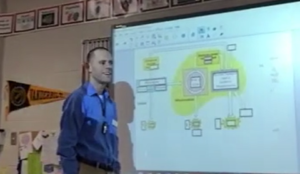
In this clip, Steve asks his students to identify key reactants, products, and processes that occur during cellular respiration on a diagram of a mitochondrion, which is foundational content knowledge. Before the clip opens, Steve has given students the opportunity to complete the diagram independently before reviewing it whole group.
Here is a partial transcript of his questions. The one he asks most often is, “What goes here?”, but he uses a variety of other retrieval prompts to push students to add to their responses:
Will you tell me what goes here?What type of phosphorylation is that?What else could we call that?How many ATPs are made?What is produced up here? Okay, and what else? And they’re carrying electrons to where?And how many CO2s are produced in the Krebs cycle per glucose molecule?What is going into the electron transport chain?We think Steve does a beautiful job of tackling four key components of effective Retrieval Practice:
Feedback is important : Retrieval Practice is ineffective without feedback—students need to know if they missed a question and what the correct answer is. We don’t want students to store incorrect information in their long-term memory! As Steve Cold Calls students for their answers, his feedback is constant; he sometimes pushes them for a more complete response (“How many ATPs are made?” “Okay and what else is produced?”) and always gives a warm “good job” when they get it right.Metacognition is important too : To continue to improve, students need the time and opportunity to reflect on what they know and what they do not know. After reviewing the answers, Steve says, “What questions do you have?” – a high school appropriate meta question. He is giving students space to reflect on their own understandings and gaps in their knowledge.
Desirable difficulty : Steve starts with “simple” (but still challenging!) recall here and is transparent with students about how the rigor will increase (they will draw completely from memory on Monday). Ultimately, this intentional increase in rigor will allow students to store the knowledge in LTM so that they can draw on and apply it when answering higher-order thinking questions.
No resources : Once students have truly learned a piece of content, they will be able to recall it from memory without using their resources. We love the arc of Steve’s Retrieval Practice here. During this session, students are asked first to fill in the diagram with no notes to see what they remember, and then he provides them with a word bank for support. On Monday, he notes, “I’m going to have you come in and draw this from memory and see if you can do it.”
A few more things our team obsessed a bit over:
From 3:00-3:45, Steve takes a moment to deliver a brief but deep bit of knowledge about process coupling and energy efficiency, explaining why students often see a range of numbers rather than a single value. This feels lovingly collegiate, and the timing of this direct instruction is key; Steve has just activated knowledge about respiration, so students are primed to receive this new information and expand their understanding further. Note that this takes less than a minute!Steve is an expert in his content, but he’s also an expert on how students will be assessed. Students end his course with the Advanced Placement Biology exam, and they only get the chance to earn college credit if they do well on this exam. When Abigail asks about including numbers of molecules in glycolysis, he says, “The type of question you’re asked will lead you to state that or not. And if it’s a ‘describe’ question, then I would throw that in because it’s a very low time commitment.” Steve’s expertise helps his students both learn the content and prepare for their assessment.
Steve’s Cold Calls often follow the “Name, Pause, Question” pattern. Though we generally advocate for teachers to use “Question, Pause, Name,” which causes all students to consider the question before someone is called on, students in Steve’s class have already worked on this diagram independently. This means everyone has already had the opportunity to think through the questions, so we feel good about this usage.
A final observation that our video guru, John Costello was excited about: Steve has some incredibly fancy technology in his classroom (a SMART board and a SWIVL to record), but the foundation of what makes this Retrieval Practice so successful is his tremendous preparation, systems, and teaching. Don’t let the fancy tech distract you from Steve’s excellence!
Additional Learning Resources to keep nerding out on Retrieval Practice:
Teacher-facing:
RetrievalPractice.org is an incredible space where you can find strategies, research, and support for implementing Retrieval Practice in your classroom.TLAC 3.0 Technique 7, pg. 82-87Blog posts on Retrieval Practice, specifically the forgetting curve and spacing here and here.
Student-facing:
Our Dean of Students High School curriculum has a brand new unit titled Succeeding Academically, where you’ll find several lessons on building productive study habits, including one on how to write effective Retrieval Practice questions.Learning to Learn by Knowing Your Brain by Hector Ruiz Martin; we love the entire book, but Chapter 2, “In order to learn…Remember!” is particularly helpful to support students in understanding RP.Outsmart Your Brain: Why Learning is Hard and How You Can Make It Easy by Daniel T. Willingham, PhD, is another incredible book whose audience is college students, though we think all high school students should read it too!
The post Turning Understanding into Memory: Steve Kuninsky’s Retrieval Practice appeared first on Teach Like a Champion.
May 31, 2023
Simple Tools Ben Katcher Uses To Keep The Big Group on Task (So He Can Work With a Small Group)
Scanning and getting those thank yous ready
Watered down instruction is a problem in American classrooms. TNTP’s 2018 white paper, The Opportunity Myth describes the scope of this problem. The average student “spent more than 500 hours per school year on assignments that weren’t appropriate for their grade and with instruction that didn’t ask enough of them—the equivalent of six months of wasted class time in each core subject.” TLAC team-member Jack Vuylsteke shared some observations about a lesson that provides some pieces of the solution.
In the post-pandemic era, when more students are farther behind, teachers are more and more often asked to answer the question:
How can I make sure everyone succeeds by giving them extra support rather than simplifying the tasks we ask of them? How can I do this in a classroom full of students of a variety of levels of preparedness
Answering this question is essential and one solution is to work with smaller “pull-out” groups. But of course doing that poses a risk. What if the rest of the class loses its focus?
Ben Katcher demonstrates a few keys to solving this challenge in his AP US History class at Valor Academy in Los Angeles. We see that Ben has his students divided into small groups for a task; one group has been strategically placed in the front of the classroom because Ben knows these students will need a bit more of his support.
Ben provides students with clear directions and allows them to begin working together on a challenging task. Students know how many statements to generate, where to record them, and that they’ll share those thoughts to the rest of their classmates in a few minutes. Establishing this clarity is a crucial step to generating student autonomy– otherwise, Ben likely will have to answer task-based questions– “Where should we write this?”– for the next four minutes instead of helping his target group develop their analysis. His students are prepared to work independently.
After giving these directions, Ben immediately takes a seat with his target group—the students who need a bit more support. Notice that he has purposefully chosen to position his chair to face outward towards the class– he can see every student in the room from that seat. His group is in the middle of the room where he can see the rest of the class clearly. His chair is placed there in advance in exactly the right spot. He doesn’t need to drag a chair over and squeeze in. The transition is seamless. He sits down in perfect position right away.
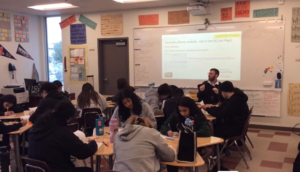
As soon as he sits and prepares to start working with the students in this group, he uses the Be Seen Looking technique, visibly scanning the room with his eyes in a slightly exaggerated manner, even swiveling a bit to get a clear picture. He wants the students in other groups to know he’s observing them. Knowing he sees them will help them stay on track. As he does this, he then Narrates the Positive, quickly describing and appreciating a few examples of on-task behavior. Students like Evelyn and Crystal are starting right away. He quickly thanks them for that maturity and autonomy and gets to work with his target group.
Roughly a minute later Ben repeats this behavior: We see him roll back in his chair and stretch a bit to scan the room. He wants students to know he’s observing. The more clear that he is looking the better. What he finds is that students are continuing to focus on the task, so Ben subtly narrates his appreciation– “I see everybody doing what they’re supposed to do, which makes me really happy.” This is preferable to overcongratulating them— which might make it seem like he was surprised— or ignore them—which might make it seem like he wasn’t watching.
His tone towards his AP students is quiet and reserved, definitely not over-the-top and OMG so excited. It’s just enough to appreciate and demonstrate that he’s looking. “Thank you,” he says, and then describing the level of effort in the room: “It’s a beautiful thing.”
We agree, but it’s certainly no accident. The sublime—an optimal learning culture—is accomplished in part by Ben’s attentiveness to the mundane: he’s positioned himself to see the class; he scans regularly and visible so students know he cares about and will see what they do; he notes their productive work when he sees it. Ben helps a “beautiful thing” become a reality by being an intentional and consistent in attending to the details.
The post Simple Tools Ben Katcher Uses To Keep The Big Group on Task (So He Can Work With a Small Group) appeared first on Teach Like a Champion.
May 19, 2023
Steve Kuninsky’s Amazing Habits of Attention Roll Out (Video)

STAR…Successfully Explained
Two of the most important culture building techniques in Teach Like a Champion are Habits of Attention and Habits of Discussion.
Habits of Attention is about teachers shaping the non-verbal signals students send to one another when they are talking. When the people in the room are looking at you–and looking a bit interested–you are inclined to share you true thoughts. You’re inclined to take some risks. If someone asks you to share your thinking in a room full of people who look like they could not care less what you say and if you speak at all, you say little–just enough to get off the mic–and seek to not speak again. And this obviously diminishes both your learning and your sense that you belong in the classroom. Among teams that care about one another and among high performing teams, people generally are not talking to the backs of other people’s heads.
Habits of Discussion is about the idea that whether people talk to each other or past each other is a key determinant of their sense of belonging and a key driver of their learning. When speakers refer back to what previous speakers said to build off their ideas, rephrase them or connect what they are saying to earlier comments, they show that those comments mattered to them. They make other participants feel validated and important AND ALSO help participants listen better to one another… and thus learn more.
But these techniques are challenging to build into a classroom. They require student buy-in. They require us to build norms and take risks.
Often that means doing a “roll out” where you explain to students the what why and how… and then get them to start building their habits.
That’s why we love–LOVE–this video of Steve Kuninsky’s class. Steve teaches AP Bio at the Gwinnett School of Mathematics, Science, and Technology outside Atlanta and here you can see him rolling out these two techniques to his class using an acronym called STAR.
The S is for “Sit up” which as Steve explains is a broader reminder to attend to one’s body language and look interested in what classmates are sayingThe T is for “Track the speaker. As he puts it in ideal classrooms people aren’t talking to the back of each other’s heads.The A is for “Appreciate.” Steve reminds his students how important it is to show one another that we appreciate their ideas. He gives them a variety of ways to do that.The R is for “Rephrase”- the idea that one speaker should build off of the previous.
A couple of things we loved about Steve’s rollout:
The way he credits students for already using and thinking about these habits. You guys are already mostly pretty good at the S, he tells them. And many of you do the T. I’d just like us to be more attentive and intentional about it.The way he combines expectation–we’re going to be tracking; we’re going t be attentive to body language; I’m going to remind you–with optionality–there are different ways you might choose to show appreciation; we’ll be experimenting with it a bit.The way he includes students in the process of building culture: I’m trying to weight what’s going to work for our classroom. We’ll figure out what works best for us.The way he gives students concrete examples of what they could and should do to exemplify the ideas he’s talking about.The way he uses a warm supportive considered tone.The way he then reinforces right away as they start teaching.
If you’re rolling out these techniques and aren’t quite sure how to do it, this is a pretty good road map.
Thanks to Steve and his students!
The post Steve Kuninsky’s Amazing Habits of Attention Roll Out (Video) appeared first on Teach Like a Champion.
May 5, 2023
Phil and Me, The Final Chapter: Toward Redemption
“After you’ve put the pens down, insist that every face is looking at you.”
I’ve posted twice this week about my journey through the valley of darkness after Phil Beadle got me in his crosshairs. Sure there was a brief high when I realized that of all the people in the world he could have foisted a shallow ill-conceived and hypocritical attack on, he’d chosen me. Me! But mostly it was tough sledding; days of doubt.
Redemption, though, could only lie in a journey inward, yea, as to glimpse myself. And truly there were dark hours of the soul as I parsed the sometimes paradoxical words contained in the master’s lessons. I wrote about those sagas here and here.
But sweet is pleasure after pain, and gradually I began to emerge from the darkness. When I revisited that hard-to-watch interview with Tom Rogers (the wasp: was it real or was it a wasp-of-the-mind?) for the thousandth time I noticed that the master had been sending me a message of hope the whole time! I had just failed to see it.
Watch this moment from the beginning of Rogers-gate, before things went south between them. What do you notice?
Well, ok, sure there’s the deft critique of my monochromatic palette. But when asked, Phil says:
“What do I do for transitions? I say, ‘Pens down and look this way.”
This is to say, he manages transitions by asking for students to track him. [To cap it off he also starts with a clear observable What to Do direction (textbook Technique 52, Phil!) ]
Yes, that’s right. He is providing an example right out of TLAC- using Habits of Attention (the technique in which I discuss how important eye tracking is to attention). He is “controlling student’s bodies” even in the midst of telling us how wrong and inhumane it is.
Here’s what I say about that in the passage I actually wrote on the topic
Habits of Attention also implies asking students to track us as teachers at times. [In addition to tracking each other] There are people who will tell you this, too, is a form of tyranny, but telling children they needn’t pay attention to adults is a cheap version of freedom to trade an education for.
I also write in the discussion of this technique, how important it is that such behaviors are a habit. There’s a section about how to establish the habit as a default but also how to “turn it off” when it’s not appropriate, but the idea is that if we can make it simple and consistent students will do it reliably and we can move on without having to talk about it much.
I think that’s implicit in Phil’s answer. He is saying that he believes in making a habit out of asking students to look at him when he gives a crucial direction because the direction is, well, crucial, and he knows that if students look at him they’ll attend to it better. That’s his routine. Tracking–SLANTing if you will–is part of Phil’s repertoire.
Needless to say there was some cognitive dissonance to work through there. After all, in his blog Phil had written this about the idea of tracking:
“Track the teacher.” This is ridiculous. I must look at the teacher at all times. I must do what I am told. I am a Dalek. I am a Dalek. I am a Dalek. Obey. Obey. Obey. Dissent will not be tolerated. You will be assimilated, or we will exclude you.
[Side note to just Phil: actually it’s really important (IMO) for students to track each other, too. So tracking is not exclusively about the teacher but rather community … though maybe a topic for another time. But seeing as how I have you here, What’s a Dalek, mate? I know this is my inexperience talking again!]
It was at this point that I began to conceive of the idea that he was just being ironic with all the invective about my “totalitarian, dehumanising… imbecility” being a form of violence and oppression! Maybe he had secretly wanted me to see that he actually used the ideas. But why??
I went back to the videos from Phil’s series How to Teach: Tips for New Teachers that I had found so instructive- but emboldened now- I knew something meaningful was near. This moment afforded yet another epiphany:
Opining on how to manage a transition, Phil notes that when students have their pens in their hands, their “focus point is on something other than the teacher.” They are probably not listening that well! So Phil advises “Step one is to ask for pens down.” He’s channeling more TLAC there–concrete, observable directions to eliminate gray area, baby!
“When you’re a managing a transition, the focus has got to be on you,” he continues. [Say it again louder, Phil, for the people in the back!] And then it all comes together. Phil says:
“After you’ve put the pens down, insist that every face is looking at you. Having got every single child’s attention in the room, you pause,” he goes on. To make sure.
In the soundtrack to my journey of self-discovery there are thunder claps here. Phil is all about Tracking! He’s a master in disguise.
From here my reconciliation was rapid. Maybe more of the things he had said were a test. Maybe the master had constructed a trial for me. I went back to the blog post he’d written, blazoning–it seemed at first–all my errors and crimes.
Sure he had said that no one with as little teaching experience as me could possibly have credibility in the great discussions about education, but that very same blog post was literally littered with the words of people who also had never taught! He’d leveraged the arguments of so many who shape classrooms from the aerie retreats of the tenure track to wage arguments about my deeper motivations and hopelessly middle class values. Was it hypocrisy or was it a message? Part of the journey?
Even the genesis of the master’s original text- Why had I not seen this?— had apparently been his reading (and being inspired by) a piece by… wait for it… Warwick Mansell!
I had always, wrongly of course, thought that Warwick was the most shameless of hacks, a bottom-feeder trafficking in shrill outrage narratives about schools for his own visibility, showing up when an institution was in crisis–or even inventing a “crisis” when necessary by finding one disgruntled parent or teacher–to enable a bit of self-congratulatory virtue signalling for his coterie of high-minded visionaries and dissenters. (And of course to improve schools by shaming them!)
But no. I had been wrong. The master was asking me to ask myself: Why would he embrace Warwick’s insights, utterly untempered by any classroom experience of any kind, but not mine?
And then late one night as I was flipping through a copy of Outline of a Theory of Practice [at first I thought referring to Pierre Bourdieu was a bit of an affectation but progressive intellectual Twitter seemed to love it when Phil did it and I really need some love from that quarter… so I am hoping they will dig my allusion to le Roi too!]…
…As I was flipping through my well-thumbed Bourdieu it came to me: I had no credibility because I tried to deal in facts. But if i created myths, if i could just get my head around the idea that facts serve ideology and not the other way around, then I too might gain the master’s ear. If Warwick Mansell could do it, by god, surely so could I. In the words of one philosopher, he was telling me there was a chance.
Reader, I will leave off the tale of my journey here. I am partly ashamed to have taken the time to share such petty satire. My policy on the foolishness of the internet is mostly to ignore it. I have violated my own rule and I am humbled by that. I mean that seriously. Plus Phil has asked–after his attempt at hearsay-based personal attacks–to have “a more friendly discourse.” Now that this is out of my system, I will perhaps be the bigger man and say yes. Ironically he’s pretty serious about the details of classroom practice and that sets him a mile above most of the ranters out there trying to claim that its wrong for adults to tell young people to do something and that all authority is oppressive etc.
But I find all the hypocrisy a little hard to bear. Maybe that’s what got me going. Call me what you will friends, but you are all looking in the mirror when you say it. If you teach well, if you change life outcomes for students, you are inherently causing people to do things they would not otherwise do–that they sometimes don’t want to do. In the classroom, Tom Bennett points out, it is impossible for everyone to do what they want all the time (if they are you are doing it wrong). That’s the point. We ask them–yes, sometimes require them– to do things with their bodies(!!! )like pick up a pencil or look at someone to better pay attention–because it changes and elevates their minds. It’s hard work. Let’s be a little more truthful about it.
The post Phil and Me, The Final Chapter: Toward Redemption appeared first on Teach Like a Champion.
May 4, 2023
Phil and Me, Part 2: Deeper Into the Master’s Words
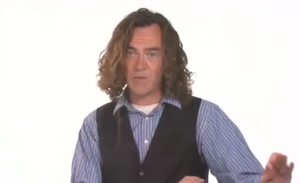
Fabulous Camera Angles, By The Way
Recently I shared a mortifying secret: I had been the subject of a full-scale take down–a full scale multimedia take down–at the hands of Phil Beadle himself. It hurt, I have to say, to hear the things one of the heroes of the movement had to say about me. [Silver lining: he did say I was handsome!] But I picked myself up, dusted myself off, and vowed to study his work more deeply so I would not be such a callow fool going forward.
Phil’s very excellent How To Teach: Teaching Tips for New Teachers has been extremely revealing and I’m going to compare some of my own rough thoughts the the silky smooth “tips” of the master. I’m starting with Rule 3 because I discussed Rules 1 and 2 here.
Rule #3: Just after the guitars you’ll hear Phil advise that only one person can be speaking in the classroom. This echoes a point I have tried to make in TLAC (see Strong Voice; Do Not Talk Over) that if you show students that you are fine with them not listening and talking while you’re talking, you suggest that your words are optional. It’s going to be a long year for you and an unproductive one for your students.
Again obviously I take huge solace in knowing that Phil and I are simpatico on this one. I was, I confess, a little confused by Phil’s assertion that I shouldn’t actually be doing it (leading discussion) but that everyone did this and that if i did it too this was the way to kick ass while doing it. There’s a lot of nuance there. But I’m not a very nuanced guy so I’ll probably watch this one a few more times. The other challenge I have with rule #3 is the potential vagueness of Phil’s prescription. Again, koans are a weak spot for me–I’m VERY literal–but I wasn’t really sure what he meant at the end by “call them on it and rewind and go back to the beginning.” Call them on it how? Using what language? And when you say “go back to the beginning…” what do you mean master? I know i can be too concrete–my wife tells me that all the time–but for all the wisdom of the advice, I’m not sure how actionable it is. That must be my inexperience showing. Still Phil and I are very similar on this and it’s nice to know he’ll be on my side when we have to circle the wagons when the four horsemen of the progressive education apocalypse come riding to tell us we are committing symbolic violence, Phil and me, when we extinguish student voices by asking them to take their turn.
I’m not going to include the video of Rule 4 here because it’s pretty straight forward. Phil weighs in on the importance of using students’ names. This is a point I try to make a few times in TLAC though I am embarrassed that I didn’t think to make it it’s own technique. Phil shares a great little get-to-know-you-name-game that literally every summer camp counselor knows I wasn’t aware of. I’ll definitely use it.
Rule 5 is a beauty. It’s all about how to deal with gum and the clever tricks kids use to not get rid of their gum when you ask them to throw it out. Phil is VERY granular on this one which just shows how much you can learn in a lifetime of teaching if you’re not distracted by Ratio and CFU and the kind of hokum that distracts me.
I’m going to share something fairly honest and vulnerable here. I don’t discuss gum in TLAC and in fact I don’t actually care that much about kids chewing gum in my classroom. No slobber; no foul. That’s my rule. I know that’s surprising- that some of my good friends on Twitter are always reminding me that I am out to repress and control young people at every turn so I’m a bit embarrassed to have slept on the whole gum issue.
But not Phil. He is all OVER the gum sitch and that secretly makes me happy. I was the strictest teacher in school until Mr Beadle arrived. Now all the internet hate about repression can go to him.
[Ok it’s a little weird though that in the blog post Phil kind of rants about how I yearn to control kids’ bodies so much and it’s him not me who cares about what they put in their mouths. Enough to put it in the top 5 pieces of guidance for new teachers. But if I had next level stuff like this–love the way he demos the student moves here–I’d put it in my top five too!] And this line puts it all in perspective: “If you’re gonna be a good teacher, you’ve gotta become expert in the technicalities of dealing with gum.” With a call to arms like that I am definitely adding a gum chewing technique to TLAC 4.0, partly out of solidarity with Phil and partly so I am not the controlling neophyte he says I am but am more like the substantial man of the world he is. It’s not as big a priority for me as it is for him–Call me soft!–but I’m going to fix it!
I’ll wrap this second blog post–I’m sure your head is spinning and your working memory on overload…I know mine is—with Rule 7. This in itself is hugely embarrassing because Phil’s rule #6 is about finishing lunch in session and I skipped it. I just didn’t–forgive me lord–I didn’t think it was that important. Awkward.
But Rule 7! Rule 7 is a Beaut! Phil is all money on this one, coming hard on the heels of more guitars–also noted for TLAC 4.0–with this little chestnut: “On detentions, simple: don’t do them.”
But just when I’m expecting more guitars, he throws the whole thing topsy-turvy. “Unless you’re in the period before lunch or the period before the end of the day.” So don’t or do, then, Phil? I’m a little new at this and kind of unclear. But before I can despair about the apparent contradiction Phil explains: “The reason for this is that kids will surely bunk them.” There’s a beautiful little turn to the camera on the side to see Phil’s profile and stress his authenticity–great camera work, can I say?–before Phil explains: “The only time you can be certain of the kid staying in the detention is before lunch or before the end of the day.”
This one is tricky as I’m not clear whether Phil is pro-detention or con. Even though I don’t write about them in TLAC you will not be surprised to learn that I am pro detention with a large asterisk. [Cue the Tweet-storm by the way about my recurring fascistic tendencies.] My asterisk is an awkward one though. Actually it’s two asterisks. First, although i think consequences are reasonable for people who repeatedly disrupt other people’s learning and don’t respond to corrections, I have this thing for fairness. I kind of think the rules for detention should be the same for everyone in the school, as opposed to, say, a teacher letting some kids get away with it and others not based on arbitrary factors like what period of the day it is. Also I am really into teaching and I kind of think that what happens in a detention matters. There should be teaching so that the students who are sent there learn to manage their own behavior. You can read more about that here.
I also find it mildly ironic that a guy who’s willing to send kids to detentions–explain again how that’s not controlling their bodies?–takes immense umbrage at the thought of asking students to look at each other when they are talking. But really the fairness issue- that’s #1 for me and so, embarrassingly, I am going to skip Phil’s advice on this one even though I am very very happy that the master is with me on Team Willing to Have Rules and Consequences.
The post Phil and Me, Part 2: Deeper Into the Master’s Words appeared first on Teach Like a Champion.
Phil and Me
The Master in His Salad Days
Well, it’s been a bit of a tough week for me! Phil Beadle, a highly renowned master teacher and author of teaching advice books sort of lowered the boom on my work in the most unceremonious way! This was devastating of course. Imagine how it felt to have the master himself accuse me of perpetuating “symbolic violence on some of our nation’s and a specific strata of American children”! Plus he went a step further and offered this devastating take down of yours truly:
He has a lovely, kind face, [Thanks, Phil!] and he expresses himself in written form with humility, modesty and grace. [Blushing, NGL] There is perhaps not enough controversy over the weight of his experience as a classroom teacher: I believe he served for a whole year as an English teacher in “New Jersey Independent School.” [Well, three actually, but NP. See below] After some time out to do his MBA at Harvard, he then became the co-founder the Academy of the Pacific Rim where he was Dean of Studies [No biggie as I know we’re not letting facts get in the way of a good narrative here but APR was before the MBA and while there I was first a teacher, then Dean of Students (not studies, mate) and then principal, again see below] then very quickly principal of the school.You could argue that, on the basis of that level of teaching experience, he has genuine reason for his modesty. But, equally, you could argue that you do not have to be a great player to be a good coach though, clearly, Lemov left the field of play as early as he was able to do so.
Ouch, Phil!
Phil, sadly, is not quite as committed to doing his homework as he is to his teaching craft (who could be??) and I don’t mean to obsess here but I do tend to prefer a fact to a lie so while I don’t claim to be the most experienced teacher I should note that I have taught for five years including three at my first school, one and a half at APR–there’s a half year in there because I was asked to become the Principal of the school mid-year when the then-principal left–again I don’t claim to be the best teacher but I think that fact that I was promoted to school leadership was at least in part a reflection of what the school and its board thought of my teaching… so maybe it wasn’t quite as bad as Phil says it was. There was another bit of teaching- introductory composition while I was getting my masters. I tend to round that and the half year before i became principal plus a few other things down to a year even though it was a little more, honestly. God who even cares?? I guess I’m just having a reaction to the self-righteous defenders of the faith who are not afraid to make things up to gain the moral high ground. I mean honestly, there’s so much about me that’s actually true. Why degrade your integrity for a tiny little win like that?
But I digress.
Phil took time out of his busy teaching schedule to go on Teachers Talk Radio with Tom Rogers to further emphasize the above points. He suggested that he might debate me if (he seemed skeptical here) I could control myself (!) [did he think i was going to ask for his autograph? I promise I won’t] and he shared his concerns that I had arranged to have his twitter account taken down.
But then things got even weirder. Phil said, “As far as I can see [SLANT] is pretty well all the pedagogical tradition that TLAC represents… all it has got on its palette.” And since, you know, there are 12 chapters in the book on things like how to enrich discussions and how to use writing to cause students to do more and better thinking , since the book is–probably as a point of weakness–almost 500 pages–forgive me but I started to ask myself: Is it possible Phil hasn’t actually read it? Is it possible that this is a second tiny gap in his research?
But Jung writes that the characteristics of others that bother us most are the ones that remind us of ourselves, and this caused me to self-reflect. I was worried that perhaps Phil didn’t know my work as well as he might. Did I truly know Phil’s work? No. I did not.
So I set out to learn more! And the upshot is that I found a great video of Phil offering teaching advice, How to Teach: Teaching Tips for New Teachers. This was especially useful because as Phil has mentioned I am practically a new teacher myself! I watched the video to see how much I could learn!
Great news! Though I hesitate to compare myself to Phil, I actually found a lot of overlap between my ideas and his–I hope that doesn’t sound like bragging–but also some points of disagreement too.
I’m going to share Phil’s teaching advice bit by bit in a series of posts, comparing what he says to my own point of view. I know I flatter myself but maybe it will be useful to others as well.
Phil’s first piece of advice is offered in this pithy piece about enforcing rules:
I feel really good about this one. Phil and I agree! It’s important to have rules to make sure everyone is safe. When people feel safe they learn. This is a point I’ve been criticized for making myself–the idea that there should be rules and everyone should follow them–so I’m glad Phil is on my side. I hope this doesn’t cause a breach between him and some of the gang on Twitter who were chiming in that they don’t think teachers should ever tell students what to do. Rules and routines are different things, of course, but I’m in favor of both, in part because I think vibrant routines prevent rules being broken in the first place and in part because they honor students learning time, and it seems like Phil does too. So far so good.
Here’s rule 2:
Here Phil Talks about the importance of a seating plan. I’m sort of with him here. I agree that seating plans are important but I personally think there’s a bit more to it than just seating people with classmates they don’t like so they don’t talk. I see it–humbly–through a bit more of a learning lens: Where can we seat people to maximize connection, learning and attention? I actually like to seat students next to people they work well with! But maybe that’s because I haven’t taught as much as Phil. But either way that’s just my personal preference. I don’t really write about seating plans in TLAC so this must be some of colorful stuff on the “palette” of pedagogy that Phil says I’m missing. [But noted for TLAC 4.0, Phil!!]
There’s a lot more advice Phil has to offer but I’m going to go all Rosenshine and pause here to let you process. I’ll pick up the discussion–and Phil’s other teaching advice!–in another post soon.
The post Phil and Me appeared first on Teach Like a Champion.
Doug Lemov's Blog

- Doug Lemov's profile
- 112 followers

