
Doug Lemov's Blog, page 9
May 4, 2023
Tracking in Classrooms: What I Really Think (and Wrote)
Every so often Teacher Twitter turns itself to the topic of tracking and “SLANTing” in the classroom- basically whether student can and should or can be asked to look at one another when they are speaking in the classroom and whether its reasonable to ask them to sit up.
That time has arrived again over in England. I’m always amazed at what people say I say about this idea–there’s a lot of “here’s what Lemov says”… usually it’s the people who know me least and who haven’t actually read my current treatment of the idea who are most sure about what I believe and say.. and who are most wrong… So for what it’s worth, here IS what I say about tracking in the classroom in TLAC 3.0 Obviously this won’t stop people from announcing confident distortions but for those who actually want to know, here it is.
TECHNIQUE 48: HABITS OF ATTENTION
“What few people ever appreciate is how central attention is for every function we perform,” writes reading researcher Maryanne Wolf. “What we attend to is ultimately what we learn,” concurs Peps Mccrea. It is the unheralded “gatekeeper” of learning. The ability to sustain focus and concentration is the unacknowledged source of many students’ success, and the inability to attend is the undoing of others.
“Neuroscience reminds us that before we can be motivated to learn what is in front of us, we must pay attention to it,” says Zaretta Hammond. “The hallmark of an independent learner is his ability to direct his attention toward his own leaning.”5 To build strong attentional habits is to give students stewardship of their own thinking.
Selective attention is the term for the ability to select what you pay attention to—to lock out distractions and lock in on the task at hand. It has “reverberating effects” on success in language, literacy, and mathematics, note cognitive scientists Courtney Stevens and Daphne Bavelier. They add that there are potentially “large benefits to incorporating attention-training activities into the school context.”6
If young people can build habits of sustained selective attention, their likelihood of success is higher. This has always been true but is magnified today when much of our universe—the online portion of it—is designed to fragment our attention and draw it to where it can be marketed and sold.
The technique Habits of Attention seeks to establish routines that cause students to focus their attention during class and build stronger attentional habits. In addition, it seeks to use the signals people send when they attend to someone else to build a stronger, more inclusive learning community.
I used to call the technique STAR/SLANT after the acronyms that schools often used to describe its component expectations in the classroom. I still suggest the use of an acronym to describe core attentional habits, but I’ve changed the name and the description to focus more on why. Understand the purpose of the technique and you are far more likely to use it effectively.
The “habits” in the technique focus in particular on eye-tracking and pro-social body language—language that communicates support for, and the belonging of, speakers. It may be helpful, before reading more, to watch these things in action in a classroom. I suggest you do so in two parts, first watching Christine Torres’s Keystone video, which shows two broad segments of her lesson, as she first teaches new vocabulary words and then leads a discussion of Lois Lowry’s novel Number the Stars. Christine’s students, I think you will agree, are unusually engaged and attentive: They enthusiastically wrestle with new words and are cerebral, respectful, and attentive in discussing a difficult question. Next watch the video Christine Torres: Habits of Attention Outtakes to see a montage of moments extracted from this lesson. Note how important it is that students look at one another, how their body language shows classmates that they belong and their ideas are welcome. Note how attentive, confident, and productive they are as a result.
“Visual cues,” writes James Clear in Atomic Habits, “are the greatest catalyst of our behavior. Where we look shapes our attention more than any single factor.”7 We are often not fully intentional or even conscious of where we look and why, however, so shaping students’ habits of looking can lead to a profound change, not only in their actions and cognition, but in those around them. For example, engaging in behaviors that show a speaker that you are listening carefully—nodding, for example, and looking interested—are often self-actualizing. They cause you to pay better attention and cause the speaker to feel a strong sense of affirmation and belonging as well. Note therefore how often—and how deftly—Christine reinforces these things.
There is a strong connection between such behaviors and our ability to build community in the classroom. Belonging8 is arguably the most powerful motivator there is. Our unconscious brains are “obsessed with it” writes Daniel Coyle in his book, The Culture Code, but he adds that the brain “needs to be continually fed by signals of safe connection.” Surveying the research, he notes that “Posture and expression are incredibly important. It’s the way we prove we are in synch with someone.” However, “a mere hint of belonging is not enough … we are built to require lots of signaling, over and over.”
You can see this happening in Christine’s classroom. Her students are constantly signaling to one another that they belong. They turn and face each other. They nod, react, and encourage. And this signal is strongest when their classmates are sharing important ideas. There is a risk that every student takes in raising their hand. To raise your hand and say something truthful in front of a group of peers is to risk failure or, worse, judgment by them. Yes, your answer could be disastrously wrong, but even worse, your classmates’ nonverbal response could say: None of us could care less about what you just said or Oh, wait, did you say something? I barely even noticed or please tell me you didn’t just make a comment about the book. If that is the case, only a rare student will raise her hand.9 The learning journey is forestalled when students must risk social transgression to embark upon it. “Regardless of how strong the logic of your pep talk,” Peps Mccrea writes, “few pupils will ask more questions in class if they sense it will result in being mocked by their mates.”
But in Christine’s classroom, to raise your hand and to begin to formulate a thought is to bask in the warm glow of acceptance and encouragement. The culture in her classroom does not just allow students to take this necessary risk, it lovingly draws them into the light. It is profound and beautiful—a gift to young people, and most of all to the hesitant and reluctant. But what you see in her classroom is not something that will happen naturally, among any group of people, unless the teacher intentionally builds it.
There are people who will tell you that building such culture is coercive and repressive, and sometimes that this is “controlling Black and Brown bodies.” I hope this discussion will make it clear that this is a not the case.10 To ask students to be attentive to their bodies is to create opportunities for their minds and spirits; to help them build habits that help them focus is to help them harness the power of their thinking. When classmates intentionally signal belonging and encouragement to one another, they release them from invisible barriers that constrain them, barriers that for some students will exist in the majority of classrooms they will enter in their lives. To shape these signals is to give students power and community in place of dependence and isolation.
Eye contact and body language are the means we use to show someone that they matter and belong. Understanding our evolution as a species can help us to understand why.
Let’s start with our eyes, which have a white outer portion called the sclera. In all of the other primates, the area surrounding the pupil is dark and as a result you cannot clearly track eye movements. Scientists explain this singular aspect of human evolution via the Cooperative Eye Hypothesis. Humans act with a level of cooperation unseen in the mammal kingdom. As a species we survived because of this unequaled ability (and desire) to coordinate and collaborate. For most of evolutionary history to be cast out of the group was certain death. Our eyes have adapted to look the way they do because the information contained in the gaze of our peers—Am I accepted and respected? What is my status? Do I belong?—is central to survival. “For hundreds of thousands of years, we needed ways to develop cohesion because we depended so much on each other. We used signals long before we used language,” says Alex Pentland of the MIT Human Dynamics Lab.11 Our physiology is designed to communicate these signals and we are profoundly sensitive to what is told in our peers’ eyes— even if we are often unconscious of it.
“Belonging feels like it happens from the inside out,” summarizes Coyle, “but in fact it happens from the outside in.” Students in Christine’s classroom feel like they belong because their peers are signaling to them that they belong—and that they still belong—just possibly they especially belong—when and if they participate in learning.
The original version of this technique—and its name—referred to acronyms such as SLANT, which several outstanding schools used to articulate the signals of belonging and attentiveness that people use when in groups:
Sit up
Listen
Ask and answer questions
Nod your head
Track the speaker
Especially crucial elements from that list were tracking the speaker—that is, following the person talking with your eyes—and sitting up—you don’t learn well if you are slouched, or at all if you have your head down on your desk, and allowing yourself to check out physically causes you to check out mentally. If we care about young people, if we believe their learning and their futures are important, we can’t allow them to simply opt out of attending to learning.
Handy acronyms such as SLANT allow teachers to explain and reinforce the component behaviors: “Don’t forget to SLANT” or “Check your S” (that is, make sure you’re sitting up); “Please track Guadeloupe while she shares her answer.” Or simply calling on Guadeloupe by saying “Track Guadeloupe, please.” But there can be challenges with these acronyms. First, they focus on the action without always fully describing its purpose and a good thing can easily become distorted when the purpose isn’t clear. The component parts of SLANT, for example, are easy to manage and so teachers—perhaps a struggling teacher for whom an orderly classroom has been elusive—can lock in on the behavior without pursuing its purpose.
An additional challenge can be that managing attention behaviors can prove successful enough that it can lead to a spread in managing behaviors less clearly tied to attention: hands folded on the desk; back flat against the chair, and so forth. To be clear, these behaviors are not something I’ve discussed in Teach Like a Champion, but I have certainly seen classrooms where they are reinforced in a counterproductive way and sometimes in the belief that this book endorses them. Reminding students who are at risk of becoming distracted—or who are sending unsupportive messages to peers—to Track or SLANT can be useful; telling students to keep their feet flat on the floor or interrupting them when they are productively engaged in a discussion to tell them to fold their hands on the desk is not.12 What if they want to take notes?
Habits of Attention also implies asking students to track us as teachers at times. There are people who will tell you this, too, is a form of tyranny, but telling children they needn’t pay attention to adults is a cheap version of freedom to trade an education for. “When parents asked me why their students should have to track me when I spoke, I explained, ‘If I can’t see your son’s eyes I don’t know if he heard. I don’t know if he will be able to complete the learning task,” my colleague Darryl Williams says of his school leadership days. “I explained it from an equity perspective. One of the reasons we get students’ attention is to give them the opportunity to be successful at a task.” That’s an educator who is clear on his purpose and who understands what supports autonomy for young people.
To address these challenges, I’m going to propose what I think is a better acronym—with the caveat that I think each school or classroom should reflect individually on any acronym they choose. Are these the tools we think will build positive attention habits in our students? If students work hard and meet these expectations, will it improve their ability to learn in a positive way? The answer must be yes, or the expectations are not worth including. But if the answer is yes, you should not shrink from including them.
With all of that in mind, it’s clear that there’s information we can add to descriptions of attention habits to provide more consistent reminders to teachers and students about their purpose. Consider the “N” in SLANT, that is, nodding your head. This not only shows interest in another person’s ideas, it also causes you to engage actively in listening. Here is an updated list for Habits of Attention, with the acronym STAR, revised to emphasize purpose more clearly:
Sit up to look interested and stay engaged.Track the speaker to show other people their ideas matter.Appreciate your classmates’ ideas by nodding, smiling, and so on when they speak.Rephrase the words of the person who spoke before you so they know you were listening.In this acronym you can see I’ve added details about purpose. Nodding is included in the “appreciate” step to emphasize the importance of appreciating your classmates. That said, you might replace the “Appreciate” A with an A called “Active listening” (to help you focus and show that you value your classmates). “Sit up” includes a purpose as well, so you look interested and engaged. You’ll also notice that I’ve brought in an idea from the Habits of Discussion technique, “rephrasing,” but you could drop it if you wanted, perhaps replacing it with something else. Again, I am describing options here because the behaviors described in any acronym (and the expectations) should be carefully thought through at the school or classroom level. My version of STAR may be helpful, but the adaptations you make to it will make it even better.
There’s one other piece that’s needed, though. Habits of Attention only work if they become habits. You can see how important this is to Christine Torres. Her classroom culture is strong—exceptional, you might argue. It’s warm and encouraging and inclusive of all. It’s fun and funny and scholarly. And yet, she is still shaping and reinforcing and lovingly correcting for Habits of Attention all the way through. She strikes a careful balance. If you have to explain and remind every time you want eye contact to validate a speaker, then it will become a constant disruption to the conversation you are trying to honor. But just because things are going well does not mean she forgets about maintaining the environment. She reinforces it lovingly, early, and often with a hint of humor so her reminders are gentle. Having an acronym helps her because it allows for easy abbreviated reminders.
Some details to notice from Christine’s class:
Frequently she reminds students to track in advance via the language she uses to call on a student, as in segment 1: “What did the girl do in the situation? Track, Etani …”Occasionally she narrates the positive to make the norm more visible, as in segment 2: “Track, Azariah. Jada’s tracking; Juju’s tracking.” Once she reminds a student to reciprocate the signal—to turn and face his classmates as they are tracking him. Other times she reminds students indirectly and playfully as in segment 4: “Ooh, Jasmine, girl, wait until you have all eyes.”You can also see habits in formation. Notice how, without her asking students to, students turn and engage face-to-face and expressively in their Turn and Talk. Many a teacher can tell you tales of flat affect and disinterest expressed in pair conversations, but not in Christine’s class.The culture carries over, too, in the moment when she calls on Nate without asking for tracking … still his classmates turn to face him. The signal of belonging is loud and clear.The montage ends with Christine asking for students to track her. She’s giving them a key piece of information. It’s critical that they hear and attend. By asking for tracking she signals the extra importance of the moment. Students lock in and, without her asking them to, adjust their own posture.That said, even a well-established routine is a default—understood as the base condition but a condition that can be changed or turned off. I witnessed an example of this in Torian Black’s history class at Freedom Prep in Memphis one morning not too long ago.
During his lesson he gave students a variety of reading and writing tasks to complete in groups. The tasks were complex and afforded students a significant amount of autonomy, so it was important that they listen carefully and get the directions right. His gentle reminders to “make sure you’re listening” were accompanied by a warm and gracious smile. This not only communicated trust and caring but confidence. As a result, things were pretty crisp and class time was spent on the activities as planned.
But here was my favorite part. As he reviewed a portion of the directions, Torian said, “No need to track me; you can just read along on the page in front of you.”
Later he summarized the directions and used that phrase again in a warm and quiet voice, “No need to track me.” So students read along.
I love that phrase … “No need to track me.” It does several things at once.
First, it reminds students that there is an intact expectation in the classroom that listeners track speakers. But it also shows intentionality on Torian’s part. A really useful rule of thumb for managing a classroom is Because you can does not mean you must. Could Torian enforce the expectation that students track him while he gave direction? Yes. Must he? No. And in fact he wanted them reading the directions, not looking at him in this case. Or perhaps he wanted to give them an inch of extra flexibility because they were so on-point. He gave them permission not to follow the default while reminding them that it was still the default—a perfect and elegant way to prevent ambiguity. But he also reminded them that the lack of tracking was intentional and not an accident. The system and the exception coexisted happily and his phrase allowed Torian to turn off the tracking default temporarily while reinforcing it as an expectation.
Let’s close then with two examples of what classrooms with strong Habits of Attention look like. First, check out the Keystone video of BreOnna Tindall’s classroom. Her students look at each other as they share their thoughts about The Narrative of the Life of Frederick Douglass. You can feel their confidence as their ideas are validated by the group. The importance of their contributions is reinforced at every turn and so the scholarly side of students is drawn out, even for the students who are at first hesitant to speak. The environment, the culture, changes them.
But notice in particular how, after the initial Turn and Talk, one student, Adriel, is called on to share his response. It’s a Cold Call, by the way. Adriel hadn’t raised his hand. But voice equity is important. In a good classroom, everyone’s voice matters and BreOnna expresses that with her Cold Call. Is Adriel nervous? Perhaps. But in addition to BreOnna’s sincere interest and gracious smile, his classmates track him to show his ideas matter to them. This draws him out. They snap occasionally as he speaks to encourage and appreciate his thinking. In the glow of their respect, he speaks earnestly and with depth. He would not do that if their eye contact and body language did not encourage him to; if they slouched and looked away out the window. No one would. Left on his own, he might have sat silently but here he is drawn out into the sunlight of his peers. Changing the social cues he sees changes his behavior. He is discovering that his ideas are worthy of appreciation from his peers. A classroom with strong Habits of Attention I noted earlier, is like a bright mirror. It reflects its students’ talents, but it is changing them at the same time.
Adriel’s relationship with BreOnna certainly influences his work in school, but not as much as the interactions with his peers do. Thus BreOnna has sought to shape and guide them so they are as beneficial as possible.
Notice also that BreOnna calls next on Renee. She’s got plenty to say as well and we can see that she knows the culture of the classroom will embrace her cerebral reflections. But notice also how she builds off of Adriel. This happens in part because of the classroom’s habits but it’s important to recognize that Habits of Discussion rely on Habits of Attention. She is attentive and focused during both the Turn and Talk—when she tracked and nodded and encouraged and so locked into her conversations—and while Adriel was speaking. Her answer reflects strong attention habits.
Finally, check out Denarius Frazier’s tenth-grade math classroom at Uncommon Collegiate High School in Brooklyn (Denarius Frazier: Solutions). Using Habits of Attention with high schoolers might seem daunting but the results are surprisingly similar. As you watch, I hope you note the high “ratio” in the classroom—it’s the students who do the work. They actively engage in tasks both challenging and worthy. The level of the discussion is high. You might also note the open-mindedness of Vanessa, who begins to defend her answer, recognizes her mistake, and changes her thinking without defensiveness. Look at the still image of the moment when this happens. The eye contact—tracking—is important and so are the facial expressions. The moment happens because she is receiving strong signals of psychological safety and belonging throughout: her classmates’ eyes and faces and body language say We are with you.
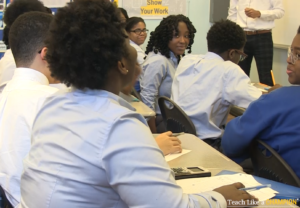
What we’re seeing is in part unnatural. At least it starts that way. At first, no group of people will of their own accord behave in a manner educationally optimal for the group as a whole. So it may be true that students begin tracking mostly because a teacher has asked them to. They are nudged, to use Richard Thaler and Cass Sunstein’s term for an environment that encourages optimal decision making from participants, but once the nudge has happened, the action often becomes their own, a vehicle by which they express a culture of belonging and supporting one another of their own volition. They feel the difference and having felt it, embrace it. The classroom is more humanized than “dehumanized” by the tracking.
The post Tracking in Classrooms: What I Really Think (and Wrote) appeared first on Teach Like a Champion.


April 28, 2023
What We’ll Be Talking About at Our Building Strong Behavior & Culture Workshop May 11 & 12

Positive Classroom Culture = Happy Kids + Happy Teacher + Maximum Learning
Vibrant, positive, productive classroom culture is a foundation of learning. Students do their best work when their time is honored and when they feel safe, successful and known.
But easier said than done. It’s hard work building pitch-perfect cultures that maximize learning.
On May 11 and 12 in Troy, NY (just outside Albany) we’ll spend two days studying how to make that happen.
We’ll look for example at how important it is for teachers to to look!
See for example how Arielle Hoo gives a clear and concise observable direction and then makes it clear by looking carefully for follow-through that the directions matter. Her students are on it!
Over and over her directions are crisp and clear and she takes a moment to make sure students see her looking at whether they’ve done it, as in this still shot, just after she’s asked for “books closed and eyes up here.”

Her students respond and she rewards them with dynamic teaching and a bit of appreciation: a thanks, a nod, a smile. If students are not with her she makes an Anonymous Individual Correction such as, “waiting on one.” The result is time on learning and a dynamic learning environment that students appreciate.
We call this the What To Do Cycle.
The 4 key components are:
What To Do Directions: Give clear concrete observable directions for the task you want students to do.Be Seen Looking: Look deliberately for follow through after you direction. Make sure that students see you looking so they know it matters to you and they know you’ll notice whether they do it.Narrate the Positive: Acknowledge (but don’t praise) students as they begin to do it: “Thanks, Chris, for getting started right away. Thanks Jasmine.”Correct When Necessary: Use the Least Invasive form of correction such as Positive Group Correction (Make sure your pencil is moving) or Anonymous Individual Correction (Still need two see two students writing).
Speaking of “narrating the positive” or describing positive behaviors in a way that shows appreciation and makes positive norms more visible to fellow students, watch how Janelle Austin uses that idea masterfully here:
The highlight of this clip is the moment when Janelle says, “I see hands up that are ready to read,” and suddenly everyone’s hand goes up. Once students recognize that positive behavior is the norm, they are usually all-in.
We’ll also talk quite a bit about having strong routines for core academic behaviors such as Turn and Talk. Watch this clip of Christine Torres. Those silly kids. They seem to think vocabulary is about as much fun as a class can have. In part it’s because the routines for Turning and Talking and other behaviors are so crisp there’s no a second of down time. In pat it’s because when they know how to participate and be successful students feel a part of something.
A happy productive positive learning environment is a gift to young people- and, we think, they deserve as much every day.
If you’d like to invest in your or your school’s capacity to build make sure the 23-24 school year starts off with maximum positivity and productivity, please join us at the workshop. Seats are open to everyone. Details here:
The post What We’ll Be Talking About at Our Building Strong Behavior & Culture Workshop May 11 & 12 appeared first on Teach Like a Champion.
April 25, 2023
Show Call, Collectively Worked Examples and the Transient Information Effect

If you want problem solving, make sure students are looking at the problem…
Cognitive load theory describes the relationship between Working and Long-term Memory during learning.
Understanding cognitive load theory and its implications for the classroom is one of the most important things teachers can do to improve their instruction.
Cognitive load theory focuses us on understanding and addressing the importance of building Long-term Memory. Kirschner, Sweller and Clark define learning as “a change in long-term memory” for example. “If nothing has altered in Long-term Memory,” they point out, “nothing has been learned.”
It also stresses the limitations of Working Memory–thinking we are aware we are doing. Working memory is powerful but small. Barak Rosenshine’s work focuses teachers on sharing new information in small steps, for example, and then giving students an opportunity to process and reflect on chunks of information briefly before then encountering another small dose of new content.
One of the most important and perhaps lesser known applications of Cognitive load theory is the “Transient Information Effect.” Working Memory is powerful but its capacity is small, so when information that is important to a required task disappears it hinders learning because students have to both remember and think about/analyze it.
If you want problem solving and analysis, this is to say, it really helps to be looking at the problem. If we’re a group and you want us to discuss solutions, ideally all of us are looking at the same problem! If we’re looking at it we can constantly refresh our working memory about the details and thus use all of our cognitive bandwidth to analyze.
One easy way to apply this in the classroom is via the TLAC technique Show Call, which involves selecting an example of student work and projecting it to the class while discussion and analyzing. When students can see it they are best prepared to study it.
You can see Britt Carson of Memphis Rise doing that here:
Britt’s asked her students to write a short response describing how the potential energy of a book changes when it moves to a new position. After they write she wants to have a brief discussion about the correct answer. She starts by taking one student’s work and projecting it to the class. Then, starting at about :50 in the video, they discuss it.
Notice that as they discuss the original answer everybody is looking at the example. This is far better than Britt reading the example to the class because they can constantly refresh their working memory about what it says and use all their capacity to reflect on its strengths and weaknesses. As they think about how to improve the sentence they can constantly refer back to what’s there.
But Britt is also easily able to direct students’ attention to specific parts of the answer by pointing or underlining. For example when she starts revising they can see and focus in on exactly the right part of the sentence. Now they have a clear and specific picture of how to improve it, not just a vague sense of what they might do. Both the initial work and the mark-up are visible to students and she can constantly direct them to specific parts of the answer, as when she underlines the word “store.”
Finally, because students are looking at the same image on the screen that they have on their page, it’s easy for them to transfer what they learn and revise to the written page.
You can see something similar at work in this video from Julia Addeo’s math class at North Stat Academy in Newark.
Julia’s approach is both similar and different. Instead of starting by projecting a student’s written answer, she transcribes Hakim’s initial response and then the group gradually improves and clarifies it. But she’s projecting as the does this so students can see the full answer and the improvements each step of the way. So for example, at the end, when Julia asks a student to refine her initial answer with a clarification–they are not manipulating the x ‘axis’ but rather the x ‘variables’–her student can re-voice the entire revised answer clearly and easily. “Say everything you just said but with the x values,” Julia says, and the student can create a full revised answer in a complete sentence easily because she can see it!! Because she can complete this summary with a lessened load on her working memory, she’s also far more likely to remember it.
In the end students are left with what we call a “Collectively Worked Example,” a single answer that represents the best thinking of the group. The model response they develop is better than what any single member of the class could produce on their own. What a powerful tool.
So… if you want to give students the opportunity to experience the full benefits of their own analytical abilities in thinking about classroom content and if you want them to be able to remember what they think about, make sure the object of their analysis is visible via Show Call or the slight variation that Julia uses, the Collectively Worked Example.
The post Show Call, Collectively Worked Examples and the Transient Information Effect appeared first on Teach Like a Champion.
March 28, 2023
Notes on Our London “Engaging Academics” Workshop

The TLAC team will be in London April 20 and 21 for a two-day workshop on Engaging Academics.
I thought I’d tell you a bit about what we’ll be working on those days.
First the content: We’ll take a deep dive into a series of key techniques focused around the skill of questioning and how it can be used to cause students to engage fully in thinking rigorously about content. The techniques we’ll study include Wait Time, Cold Call, Everybody Writes. We’ll talk about how to cue students, so they know HOW to engage the questions implicit in a lesson via Means of Participation. We’ll talk about how to ask follow-up questions after initial student responses via Right is Right, Stretch It, and No Opt out. And we’ll talk about how to prepare a lesson to ensure full engagement from students.
Here’s one example of a clip we’ll study. This is Ian Bristo of Piper’s Vale Primary in Ipswich with his Year 1 students:
Notice how he shifts deftly from Volunteers (ie taking hands of students who want to answer) to Cold Call (selecting himself who answers) to Turn and Talk to Call and Response. His students are happy and thinking hard, the fast and unpredictable shift in HOW they answer belying their deep and sustained thinking about the math.
But notice too how well he’s embedded his systems. Students know NOT to call out their answers when he’s taking hands but they know TO call out their answers when Ian uses Call and Response.
When he makes the Turn and Talk gesture with his fingers, off they go in a well-rehearsed routine.
Making the primary tools for thinking about questions well-oiled routines and making it clear and transparent which routine students should use allows them to engage un-selfconsciously and helps Ian’s lesson achieve a kind of “flow” state where students are “happily lost” in the work of learning.
After we watch videos we’ll engage in practice, with activities designed to help teachers and leaders reflect on how to cause what they WANT to happen during their lessons to ACTUALLY HAPPEN.
So we’ll watch this video of BreOnna TIndall Cold Calling
And then we’ll practice Cold Calling after letting students prepare–as BreOnna does–and with a warm smile–as BreOnna uses so that each teacher adapts the ideas to their own style and setting.
Finally we’ll reflect on how to build environments back at our schools that help teachers prepare and practice and succeed to they become the teachers they want to be.
Our goal is not only to study the craft of teaching but to work hard and have a great tie doing it. We think teachers deserve to love professional development. To have their minds lit on fire, to prepare to succeed, and to have a great time doing that.
If you want to know more or sign up to join us, the details are here.
Hope to see you there!
-Doug
The post Notes on Our London “Engaging Academics” Workshop appeared first on Teach Like a Champion.
March 24, 2023
Planning for Error: Emma Gray Prepares to Push the Rigor in Number the Stars

One of our favorite topics at TLAC Towers is Checking for Understanding. How do teachers prepare for and react to student errors and misunderstandings? Many of our best videos on the topic are of math teachers–the nature of math makes predicting and sequencing errors a bit simpler than in the humanities, say. So we were especially thrilled when we came across a great example of Emma Gray using some of our favorite moves at University Prep in the Bronx. Our own Sarah Engstrom shared this analysis of the clip:
Planning for error might be an educator’s most powerful tool. When you spend time before the lesson anticipating specific mistakes – What will they misunderstand? Where will the misconception be? – you are more likely to notice these misunderstandings when they occur. In Teach Like a Champion 3.0¸ we share about researchers Christopher Chabris and Daniel Simons’ concept of intentional blindness, the experience of looking directly at something important and not seeing it. It’s an easy thing to do in the complex environment of a classroom, but overcoming this tendency is simpler than you might expect – “make the unexpected object or event less unexpected.” By priming yourself to notice the error, you’re more likely to respond to it productively. This is the kind of off-stage magic we saw when we watched Emma Gray, a teacher at University Prep in the Bronx recently.
Emma and her 5th grade class are reading Number the Stars when Emma asks why Lowry changes the mood to one that’s lighthearted after a tense moment. As students work independently, Emma scans for an anticipated error. Emma expects that although her students will be able to identify comic relief, they aren’t yet practiced at showcasing their analytical thinking, so Emma focuses on the “why.” Identification is not the same as analysis and she wants to see her students get deeper. She knows this question is worth pausing for– this is one of the key moments students need to grasp to understand this part of the novel.
Emma pauses her students (“Put our pencils down for a second and turn over here. Thank you.”) and names that she wants to push them further (“Comic relief from what?”) She then gives them an entry point (“Turn back to your Do Now. What did we say our mood was at the beginning?”) and offers a beautiful pre-planned scaffold (“I want you to use this sentence starter: Lowry changed the mood from blank to blank because…”) Importantly, she then sends students back to work to revise their response (“I’m going to give you two whole fresh minutes.”) and restarts her monitoring. This move shows that not only does she care that students get this important idea from the novel, but she’s also going to help them get there. Emma is their coach – the expert who can gently guide them to a more sophisticated understanding. It takes planning to know what to attend to and it takes a little more planning to know how to coax this thinking out of students.
Other things we noticed and loved:
We also love the question she asks. Instead of the more simplistic “What is the mood?” Emma asks, “Why does Lowry change the mood?” Establishing the mood is important but it isn’t the stopping point.Emma’s sentence starter (Lowry changed the mood from blank to blank because…) is a great one not only because it causes students to think deeply about the key idea, but also because it’s evidence of her planning. She knew students could pinpoint the funny, lighthearted moment but might miss the significance of the timing of this moment in the text.‘Whoops my bad, put that right below your answer, no need to erase” helps set up the nice Culture of Error – or feelings of mutual trust and comfort intaking intellectual risks – present in her classroom. An added bonus is that – for students who hate to erase and start over – it makes them more likely to see this as an opportunity rather than a chore.
By the way, Emma is using our own writing-intensive, knowledge-rich Reading Reconsidered Curriculum middle school literacy. If you are interested in learning more about or in piloting the Reading Reconsidered Curriculum please visit: https://teachlikeachampion.org/reading-reconsidered-curriculum/
The post Planning for Error: Emma Gray Prepares to Push the Rigor in Number the Stars appeared first on Teach Like a Champion.
March 23, 2023
The ‘What To Do’ Cycle and Other Secrets of Positive Classroom Culture (w/ video)

One of the challenges of good classroom management is that it’s often practically invisible- it’s happening off stage or on the margins of the stage; it’s usually built into habits and expectations. When it works it’s hard to see the moves that make it possible. When you can see the behavior management moves, it’s sometimes all you can see and the larger culture of positivity and productivity gets lost.
But the video I’d like to share today is, I hope, an exception.
It’s of Rebecca Olivarez‘ math class at Memphis Rise Academy in Memphis, TN.
I’m going to show it in two parts.
First, here’s a longer segment of Rebecca’s lesson when students are working hard to solve math problems, largely on their own, but where in Rebecca observes their work, interacts supportively with individual students, gathers data carefully and then fixes a common misconception among the class. The classroom is an optimal place to learn. Students feel safe, successful and known, and they learn a lot.
Here’s the clip:
How does she do it? How is she so successful at getting everyone productively and positively engaged?
One key is something my colleague Darryl Williams calls the “‘What To Do’ Cycle.”
The best teachers we’ve studied use this cycle, or a variation of it, with consistency throughout their lessons to build a warm, supportive culture of follow-through. The 4 key components are:
What To Do Directions: Give clear concrete observable directions for the task you want students to do.Be Seen Looking: Look deliberately for follow through after you direction. Make sure that students see you lookingso they know it matters to you and they know you’ll notice whether they do it.Narrate the Positive: Acknowledge (but don’t praise) students as they begin to do it: “Thanks, Chris, for getting started right away. Thanks Jasmine.”Correct When Necessary: Use the Least Invasive form of correction such as Positive Group Correction (Make sure your pencil is moving) or Anonymous Individual Correction (Still need two see two students writing).
Here’s the equation: WTD –> BSL –> Narrate –> Correct When Necessary (using Least Invasives)
Consistency is important. When you do it consistently you can be subtle and fast.
In light of that here is a re-cut of Rebecca’s video above showing the the three times she uses the What To Do Cycle within this short segment.
As you can see, one of the keys to her successful classroom culture is her attentiveness to her direction giving. Each time: clear, crisp observable direction, scan for follow-through, acknowledge productive follow-though, correct if necessary (by now, it rarely is).
As in:
WTD: “Find this statement in your work and box it.” BSL: Rebecca scans from the doc cam (using a Swivel) to ensure students are following throughNarrate: “Thanks, Mario for doing this.”Correct: Positive Group Correction: “I should see pencils moving.”
Now you know the secret. 
The post The ‘What To Do’ Cycle and Other Secrets of Positive Classroom Culture (w/ video) appeared first on Teach Like a Champion.
March 20, 2023
Show Calling Exemplars To Build “Writing Culture” w Spencer Davis
Show Call is one of my very favorite teaching techniques and if you’re a reader of this blog you know that Spencer Davis is one of our favorite teachers to study. So what could be better than a video of Spencer modeling Show Call.
Context: Spencer’s sixth graders are reading Wonder. They’ve just read a passage about one character’s perspective on her friendship aith another character. the lesson plan–from our Reading Reconsidered Curriculum–pulls the two girls’ descriptions of the changes in their friendship and places them side by side. Spencer asks students to make notes on similarities and differences. He gives them seven minutes to do this. Then at the end, he Show Calls two students work. Both of them are exemplars- that is they’ve both done a great job.
Here’s the vid:
Spencer’s goal here is to build a strong incentive among students to do their best written work. He’s trying to make the written lives of students visible, to socialize effort and to give students a model of what great note-taking looks like. [If you allocate 7 minutes of class time to a task you want to make sure students work hard at it and know what “good” looks like!]
Spencer honors the two young women by sharing their work and having them describe it. He asks others to update their notes accordingly. The message (and incentives) around how hard you work when you given a written task are revised upwards. As we discuss on Team TLAC in our discussions of the technique Silent Solo this is a big deal.
Successful teaching often consists of sublime moments achieved in part via mundane tools. Changes in the ways we ask students to write can transform the ways they think and maximize the value and quality of other activities we engage in as well. If you can get everyone in the room to write for a sustained period of time, [with full effort] the benefits to student thinking and discussion will be many.
Spencer does just that here- using Show Call to socialize the habit of full effort at written tasks here.
The post Show Calling Exemplars To Build “Writing Culture” w Spencer Davis appeared first on Teach Like a Champion.
March 16, 2023
“We Don’t Know the Question”… [Smile]…Reminding Students That It’s Not a Race

Raising Your Hand in Class Shouldn’t Work Like This
Just watching some video this morning a recent lesson of Spencer Davis’ at University Prep in the Bronx. I’ve posted about Spencer’s teaching recently (and will post about again soon). He’s a master of subtly and lovingly building academic culture with his sixth graders. You can see plenty of that in this recent post of his retrieval practice.
But today I want to share perhaps the shortest clip I have ever shared on the blog. Short but perfect.
Background: One of the things that is necessary to a classroom with high Ratio–kids doing the cognitive work–is slowing down students who have internalized the idea that participation is a race. If you believe the goal is to get your hand up first–or even to call out your answer right away to get heard–then the maximum amount of thought you or anyone else in the room can put into an answer…even to a very good one…is limited. Rigor collapses when answers are arrived at in a fraction of a second.
So it’s important for teachers to be attentive to ensuring Wait Time and not immediately calling on the first hand–and more critically, not allowing students to call out. You’ll notice that Spencer has done that here. Super eager students but no calling out.
But the next step is to socialize students to take their time and think about their answers, to use the think time you give them.
And that is why I love this clip so much. Here Spencer refers back the the passage they’ve just read–they’re reading Wonder–and starts to ask about it. Five or six students’ hands shoot into the air. They are eager to answer. Hooray!
Or is it hooray? Because, as Spencer lovingly points out (in perfect nonjudgmental tone and with a smile) they don’t actually know the question yet!
A sin of enthusiasm? Surely, yes. But as we attend to our own teaching craft it’s also critical to help students become more mindful of their own behaviors as students. And so, rather than just allowing students to throw their hands up regardless of question, Spencer mindfully reminds them to be mindful. “We don’t know the question yet.” [Smile]. A beautiful signal to students to take their time and think about their answers.
The post “We Don’t Know the Question”… [Smile]…Reminding Students That It’s Not a Race appeared first on Teach Like a Champion.
March 13, 2023
Community on the Carpet: Engagement and Belonging in Mandie Avila’s Classroom

TLAC team-member Beth Verrilli recently watched footage of Mandie Avila’s first grade lesson at MOSAICS Public School in Caldwell, Idaho and shared these notes:
One thing that struck me about Mandie’s lesson was how effectively she engages all of her learners, and authentically creates a sense of belonging in her classroom.
You can watch some highlights of her math lesson here, which begins as students are creating a visual model to represent an addition problem on their whiteboards:
In the video, we see that Mandie carefully sequences her Means of Participation to engage students.
She begins with Everybody Writes, independent work time to allow students time to process content on their own.
A Turn and Talk follows, so students can verbalize their response and then hear it verbalized by a peer.
The sequence ends with a student coming to the board to share out the number sentence, so all students can stamp the correct response one final time.
This final whole-class share out after a Turn and Talk is a smart way for teachers to clear up misconceptions that might occur during paired conversations—though Mandie also does that during the Everybody Writes by carefully monitoring student work.
While Mandie’s thoughtful sequencing supports successful participation, it also creates a warm and positive classroom culture and fosters a sense of belonging.
Note, for example, that Mandie prepares her students for the Turn and Talk during their independent work (“…and put a star next to the representation that you want to share out with your partner”). Turn and Talk is clearly a routine (students will share out “just like we do each day”). There is a system—L and R partners are pre-assigned, Mandie explains who’s going first, checks that each student knows which partner they are, and reviews their role during the Turn and Talk. When there are familiar routines to engage in—and when students experience their peers engaging in these routines—it strengthens the sense of safety in the classroom.
Within this system, Mandie includes some variation to keep students engaged and to build a bit of student autonomy. For example, the partners are not always “L” and “R.” Somedays, the partners are “red and yellow” or “sunshine and wind.” Mandie intentionally selects the student pair and offers the labels, but within the pairing, students can determine who is sunshine and who is wind. Mandie explains that this promotes engagement: self-selecting their roles means that students won’t know whether they’ll speak or listen first, which can avoid students believing that “Oh, ‘L’ always goes first; they must be the smarter kids.”
Mandie’s sentence starters (“I believe the answer is ___and this is how I solved” or “I respectfully agree/disagree with you”) are another helpful technique to help build students’ socialization skills. Although Mandie uses sentence starters throughout the day, she finds them especially supportive in math, where they help students frame their explanations in a full sentence, slow down to explain the steps involved in a math concept, and thoughtfully enter into the give-and-take of a conversation when they just want to shout, “The answer is 11!”
We thought there was lots to learn from Mandie’s attentiveness to socialization alongside academics. Taking turns, listening respectfully, learning when and where your attention is needed (“Cap your pen…pens on chins”) are all components of successful classroom interactions. They are also, as Mandie describes them, foundations of kindness and respect and “what the world will need me to do” even when I’m not in a first-grade classroom.
As Mandie notes, we are all “still learning how to be humans” and opportunities to engage in courteous, considerate behavior make classrooms safe spaces—communities where every child feels supported in their learning.
(Thanks to the Bluum Foundation for funding TLAC’s work with school leaders in Idaho.)
The post Community on the Carpet: Engagement and Belonging in Mandie Avila’s Classroom appeared first on Teach Like a Champion.
Community on the Carpet: Engagement and Belonging in Mandy Avila’s Classroom
TLAC team-member Beth Verrilli recently watched footage of Mandie Avila’s first grade lesson at MOSAICS Public School in Caldwell, Idaho and shared these notes:
One thing that struck me about Mandie’s lesson was how effectively she engages all of her learners, and authentically creates a sense of belonging in her classroom.
You can watch some highlights of her math lesson here, which begins as students are creating a visual model to represent an addition problem on their whiteboards:
In the video, we see that Mandie carefully sequences her Means of Participation to engage students.
She begins with Everybody Writes, independent work time to allow students time to process content on their own.
A Turn and Talk follows, so students can verbalize their response and then hear it verbalized by a peer.
The sequence ends with a student coming to the board to share out the number sentence, so all students can stamp the correct response one final time.
This final whole-class share out after a Turn and Talk is a smart way for teachers to clear up misconceptions that might occur during paired conversations—though Mandie also does that during the Everybody Writes by carefully monitoring student work.
While Mandie’s thoughtful sequencing supports successful participation, it also creates a warm and positive classroom culture and fosters a sense of belonging.
Note, for example, that Mandie prepares her students for the Turn and Talk during their independent work (“…and put a star next to the representation that you want to share out with your partner”). Turn and Talk is clearly a routine (students will share out “just like we do each day”). There is a system—L and R partners are pre-assigned, Mandie explains who’s going first, checks that each student knows which partner they are, and reviews their role during the Turn and Talk. When there are familiar routines to engage in—and when students experience their peers engaging in these routines—it strengthens the sense of safety in the classroom.
Within this system, Mandie includes some variation to keep students engaged and to build a bit of student autonomy. For example, the partners are not always “L” and “R.” Somedays, the partners are “red and yellow” or “sunshine and wind.” Mandie intentionally selects the student pair and offers the labels, but within the pairing, students can determine who is sunshine and who is wind. Mandie explains that this promotes engagement: self-selecting their roles means that students won’t know whether they’ll speak or listen first, which can avoid students believing that “Oh, ‘L’ always goes first; they must be the smarter kids.”
Mandie’s sentence starters (“I believe the answer is ___and this is how I solved” or “I respectfully agree/disagree with you”) are another helpful technique to help build students’ socialization skills. Although Mandie uses sentence starters throughout the day, she finds them especially supportive in math, where they help students frame their explanations in a full sentence, slow down to explain the steps involved in a math concept, and thoughtfully enter into the give-and-take of a conversation when they just want to shout, “The answer is 11!”
We thought there was lots to learn from Mandie’s attentiveness to socialization alongside academics. Taking turns, listening respectfully, learning when and where your attention is needed (“Cap your pen…pens on chins”) are all components of successful classroom interactions. They are also, as Mandie describes them, foundations of kindness and respect and “what the world will need me to do” even when I’m not in a first-grade classroom.
As Mandie notes, we are all “still learning how to be humans” and opportunities to engage in courteous, considerate behavior make classrooms safe spaces—communities where every child feels supported in their learning.
(Thanks to the Bluum Foundation for funding TLAC’s work with school leaders in Idaho.)
The post Community on the Carpet: Engagement and Belonging in Mandy Avila’s Classroom appeared first on Teach Like a Champion.
Doug Lemov's Blog

- Doug Lemov's profile
- 112 followers

