
Doug Lemov's Blog, page 25
May 7, 2020
Coaching Athletes to Perceive: Examples w New York Red Bulls
I’ve been working a bit with New York Red Bulls to help their youth coaches teach players to watch more productively and learn more while they’re away from the game…though in fact learning to watch is just as critical once players are back. I wrote previously about some ways you could do that: specifically by asking players to watch steadily for one single thing and study it in a disciplined way. My example was watching for first touch.
Today I thought I’d share some examples of Red Bulls youth coaches putting these ideas into practice.
These two clips are of Max DuBane. The two clips are from the same session. I think it’s worth watching them both and doing a little compare and contrast.
In both clips, Max is laser focused on a study of the players first touch- a relatively unsexy first touch as it happens. This isn’t a study of Mo Salah’s once in a lifetime first touch to crack open the defense on an epic goal, it’s the kid of unremarkable first touch that happens a thousand times in every match and that good players use to gain slight advantages for their team and that lesser players fail to attend to. So I love his choices.
In both clips Max is careful to always have players looking at what they are talking about. He freezes the screen just after the first touch. Our goal is to build perception so all of the benefit accrues to the associations we make with what we are looking at.
In both cases Max draws players’ attention to both what they player with the ball does and what the context around him signals. This is perhaps most visible in the first clip. The point is that while one would ordinarily want to take space if one could, here the center back realizes his team is not set. His first touch is designed to slow play down. The context determines the right move and Max brilliantly spends most of his time studying the cues off the ball that tell the center back he should delay.
Also notice from a teaching perspective how fast Max moves and how he engages all players, mostly via Cold Call. This is important. The game requires you to be mentally ready always, so should film study. Fittingly Max often cold Calls a player to develop what the previous player said. To work together, teammates must learn to listen to one another as much as the coach. Max is building that culture even here.
Now some key differences:
In the second clip, Max asks players to study what did happen (Keeper rolls to outside back. Outside back passes out of pressure on first touch. Why did he do that? What can you observe about his pass? In the first clip Max starts before the touch. What should the center back do with this touch? BOTH of these ways of watching are valuable.
In the first clip there is a clear right answer Max ‘stamps the learning.’ There is a clear right answer here. The first touch must be slow. In the second clip Max is more open ended. Perhaps the outside back could have tried to play forward and beat his man. There were options.
Notice also how Max continually refers to and uses background knowledge in the second clip. There are five factors to consider in your first touch and he begins by asking which one is relevant in the player’s first touch. His goal is to reinforce those five factors in players long term memory as much as study this single moment. Similarly he wants players to see the potential 2v1 developing and he’s quick to ask them to name it “What’s that called?” When you have a name for something you can being to see it and talk about it.
I’ve got some more video of another Red Bulls coach, Anton McCafferty doing a great job with this as well and will post ASAP. Meanwhile thanks to Max, Kika, Rich, Bryan and Anton for all the learning.
The post Coaching Athletes to Perceive: Examples w New York Red Bulls appeared first on Teach Like a Champion.


May 3, 2020
Antidotes & Dosages: Quick Thought Re. Online Learning
 Antidote?
Even if something is valuable the dosage matters. Too much of a good thing is no longer a good thing. In the end, nothing worthwhile survives excess.
I’ve always felt this keenly about synchronous remote interactions–conference calls back in the day and now zoom calls.
I can’t speak for anyone else but I start to fade after 75 mins of zoom time. (My number for a conference call was about 1/10th that; this video is the only salve.)
The 75 mins number is arbitrary*. My number could be low because I’m the kind of guy who has to… wait for it… print something out to read it deeply. But it also could be high. I’m a technophobe adult who loves reading, running and other zen-like activities.
On the TLAC team we set a 90 minute max for any online meeting and if it goes that long it’d better be engineered to maximize the benefits of synchrony- lots of interacting and reflecting and different forms of engagement. And ideally some humor for Pete’s sake.
Anyway, synchronous lessons on screens are a generally good thing while we’re all locked down… we can connect in person, recreate the fundamental relational dynamic of teaching, and read our students’ responses.
That said it’s important to be thinking about dosage and balance for students. Yes, balance synchronous learning with asynchronous learning- but what kind? Does screen-heavy synchronous learning get balanced with screen-heavy asynchronous learning? That’s a counter-balance in some ways but not in others.
I’m just toying around with this but but I want to throw out the word ‘antidote.’ Possibly I’m misusing it. But what students do when they’re not synchronous would ideally not just be not-synchronous but have antidote characteristics sometimes: not-screened and in fact anti-screen.
Some or maybe much of the time, I’d rather kids (my own; your own; the kids we are sworn to serve and whose parents trust in us) read a book or write pencil-to-paper or listen to a book on tape when they aren’t in highest-use screen-based meetings, than be watching an asynchronous video. In other words could we design low-tech screen free asynchronous activities that we can use tech-light to hold students accountable for?
Could, “Write in your journal for 30 minutes. Take a picture and text it to me,” be better than, “Write a one page response in word and submit via google docs”? Could “Read the chapter and record yourself reading your favorite ten sentences aloud,” be a good counter weight to screen, screen screen, all day in your bedroom.
There’s also probably an argument here about diminishing marginal returns. We have to be strategic. We don’t know what the dosage is. In zero cases out of 100 should this be read as a show of support for the “we shouldn’t teach anyone until we have it perfect” crowd. Kids need us to do great work for them now. But dosage is not irrelevant. And the types of activities we use as counter-balances to what we KNOW are weaknesses to the necessary model are important.
That’s all I’ve got for you this morning. It’s Sunday. I’m writing from my garden. The sun is shining and I’m logging off.
*For the record I believe stamina can be built–always bugged me when people told me kids couldn’t concentrate on any one task for more than ten minutes. If that’s true, I always thought, we’d better get started fixing that.” I don’t think this contradicts that belief but I can’t say for sure.
The post Antidotes & Dosages: Quick Thought Re. Online Learning appeared first on Teach Like a Champion.

May 1, 2020
What Can Deans of Students Do During Online Learning
My TLAC colleagues and I have always loved Deans of Students—we
think they do some of the most important work in any school and have always thought
it was a major problem that they are asked to do such critical and challenging
work without access for the most part to quality training and resources. In
response we created a “Dean Team” under the leadership of the amazing Hilary
Lewis. Over the past few years they’ve followed Deans around to study their
work.
One result of the Dean Team’s work has been a two-day Dean of Students workshop held during the
summer for the past few years. Another is a Dean’s Curriculum—we’re finishing
it as I write this–to help ensure that teaching and learning happen more
effectively in often busy Dean’s offices.
Suddenly, though, Deans have a whole new set of challenges.
How do you build culture in a school when you’re never face-to-face with kids?
We’ve been reflecting on this question and asked our Dean Team to share some idea
for how Deans can best support their school, when “school” is virtual for the
remainder of this school year.
Kim Griffith: The Power of Informal Check-ins
One of the most difficult parts about remote education is the lack of face-to-face interactions with students, especially those who may need them most. In a brick and mortar world, there are several points during the school day where a Dean might get to have informal interactions with students. Remote learning makes creating such organic interactions challenging, but several School Culture Leaders we’ve been working with have been taking matters into their own hands and making daily check-ins with some students in order to stay connected. Generally their goal is to reach out to the most at-risk- of dropping off the school’s radar or of finding themselves in difficult situations. Ironically a list of such students often overlaps with a list of students who are frequently in the Dean’s office when school is in session. In other words, informal check-ins offer Dean’s the opportunity to build positive, caring relationships with exactly the students whom they will most need positive relationships with on that bright sunny day when we all walk back through the doors of an actual school building.
Informal check-ins could take a variety of forms, depending on how well you know a student. It could be:
If you know a student and perhaps their family a little better it could be a bit more friendly:
If you know a family situation might be challenging there’s great opportunity to be supportive
If you know a bit about a student’s particular interests that can be another way to connect.
We think informal check-ins are powerful because they allow School Culture Leaders to build trust with all students so that even though we are physically distant we don’t become emotionally distant. It’s a great move to include parents as you do so: “Just a heads up that I’m going to give Jelani a call this afternoon to check in,” so they know your purpose and can share relevant information. It’s also important for them to know that you care about and support their children.
Brittany Hargrove: Supporting Community with Communication
Community circles and school wide assemblies are opportunities many Dean’s rely on to build core values and a sense of community. While it’s probably not possible to do a synchronous zoom call for 500 or so people—or while we’re not aware of anyone who’s tried it—Dean’s could try whole-school asynchronous messages to highlight both academic and culture successes throughout the week. Here are the great things people are doing to express our core values. Here’s the great work people have been doing. Or you could try shout outs is through photo reel, competitions, and the like. These opportunities allow students to continue to build relationships from afar.
Hilary Lewis: Supporting Our Families
Calling and checking in on our students during this unprecedented time is crucial. We’d also argue that checking in with families is also essential—and can help to build relationships and trust which in turn may help you understand the challenges your students are facing. We are all in the midst of coping with this new way of living—perhaps with some unexpected positives (like getting a chance to eat dinner together as a family), and certainly some challenges (being isolated from loved ones and/or not having a moment to yourself for the foreseeable future). Some of us are teaching/leading schools while being parents and/or caretakers ourselves—and this balancing act can feel like daunting one.
Some of the families we support are trying to wrangle kids into a room to simultaneously, read, write, and watch a video on their phones while also attending to full time work, or possibly searching for work. There are families who are trying to make ends meet, lack food security, are without shelter, or grappling with fears about their own or a loved one’s health. We are in an unprecedented time—and now more than ever we need to pull together as school communities to support each other in our time of need.
Some language we might use in these conversations include:
It’s wonderful to have the chance to check in and see how you and the family are doing. How is everyone doing? How are things going?How might the school be a support to you in this time?What does learning time look like for your family right now? What could be helpful during this time?
Consider how schools might intentionally connect with families—via phone, letter, video messages—to remind them that even though the school building may be closed, “school” is still, and will remain open to support students and families throughout this year. Perhaps Deans can even take the lead in assembling resources. One school we know assembled kits of emergency food for families in need. The obvious question–Do you need help?–is a hard one to ask and can feel patronizing, but the Deans quickly figured out that it was much easier to ask people if they knew anyone who needed help with food. If they did the Dean said: please tell them to reach out to me. And sometimes parents said, “Actually we’re having a hard time,” to which the Dean said, “We’d love to help.”
Anyway, we urge Deans to pick up the phone, call families, ask how they are doing, and really listen. We may not be able to provide answers—and we think that should be okay and not the point of this exercise. Rather, the point is to support each other though empathy, through listening, and simply being there for each other.
We are all experiencing something new and possibly scary—and so I challenge all our School Culture Leaders to reach out to a few families this week, and just offer a listening ear, an empathetic heart or ask if they know anyone who needs help.
On behalf of the Dean Team, I hope these thoughts are useful and that you’ll share a few ideas of your own. Meanwhile we’re hoping to launch an Dean of Students Cohort to support professional development later this spring. Reach out if you might be interested in having your school participate!
The post What Can Deans of Students Do During Online Learning appeared first on Teach Like a Champion.

April 30, 2020
“Dissolving the Screen” in Ben Esser’s Online Classroom
 Does Mr. Esser see & value the work you do from your kitchen table? You bet he does!
In our work supporting remote teaching, we’ve been using the term Dissolve the Screen to describe one of the key tools we see successful teachers using.
To “dissolve the screen” is to heighten students’ awareness of the back-and-forth exchange that still exists between their teacher and themselves so they feel it more strongly.
To connect this to a recent post though, it’s not just connecting and and letting kids know we care about them, though hopefully there’s plenty of that–its establishing a connection through the work so they feel both accountable and connected at the same time
The message is: “I see the work you’re doing, and it matters. I’m happy when I see you taking ownership and succeeding.
This morning I watched a fantastic example of that. It comes from the class of Ben Esser, who teaches 6th grade English at Achievement First East New York Middle School and who I’ve featured on this site before.
Here’s the video:
Some moments I appreciated:
The lesson starts fast: “A king gets toppled today…” Ben begins, hitting the ground running. It feels purposeful right from the start and honors students time by getting started right away. There’s a Sports Center-like excitement- about the book. But of course the fun is doing it together: “Looking forward to doing that with you all.” Message: you are part of something. A member. The screen is starting to dissolve.
18 seconds in and we’re “snapping it up” for people who got a perfect on yesterday’s classwork. This might be my favorite part. I’ve written a couple of times about accountability in online settings. How we have to help kids feel like online is a place where they follow-through on tasks with focus and attention. By calling out people who did that Ben shows he values that and reminds them- I see the work that you do. That’s where he dissolves the screen. You’re far away, working at your kitchen table or in your room but I still know whether you do your work. I care and value it. I’m a less immediate presence in your life but the feedback loop is still there-I’m still here…
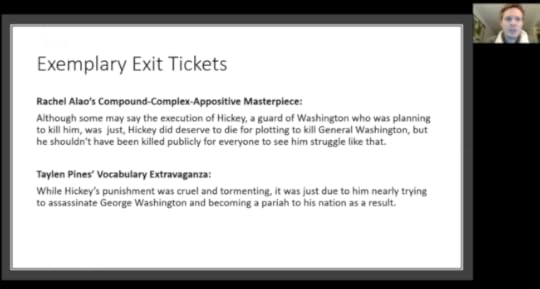
Then Ben doubles and even triples down on the idea- shouting out kids whose classwork average is high and then, best of all, showing the “really exemplary exit tickets” a couple of students wrote. The message here is important. You do good work and Mr Esser still sees it… right away… he values it, he reads it out to the class. You’re still connected. The work you do still matters, and the distance between student and teacher is dissolved.
And it’s fascinating that Ben manages to do all this in an asynchronous lesson. He’s not even there live with kids but his caring for them and their progress is hard to mistake.
Thanks to Ban for letting me share his work and stay tuned because I’ve got another clip of him coming in the next day or two.
The post “Dissolving the Screen” in Ben Esser’s Online Classroom appeared first on Teach Like a Champion.

April 28, 2020
Get Ready for our Expanded Reading Reconsidered Curriculum Pilot
Teachers and school leaders in need of a bit of good news take note: We are excited to preview details of our Expanded Reading Reconsidered Curriculum Pilot for the 2020-21 school year, which will officially be available on May 4.
Background: Two and a half years ago, with great enthusiasm (and a bit of trepidation), we set out to build a knowledge-driven, writing intensive ELA curriculum based on great books for students in grades 5-8. We mapped out some of our favorite books and got started on our daily lesson plans with embedded nonfiction, close reading and three types of writing– not to mention knowledge organizers and lots of vocabulary.
By the beginning of this school year we were ready to begin sharing our first batch of units, and approximately 100 schools asked to try them out. We offered them the materials at minimal cost and they shared feedback to help us improve what we’d developed. The first-year proved to be a great success—we piloted with district schools, charter schools and private schools in rural urban and suburban communities, in at least 25 states not to mention England.
The feedback we received was overwhelmingly positive, we
were happy and relieved to find.
“Students LOVED both the knowledge organizer and the vocabulary/active practice. The consistent format of vocabulary provided students a helpful way into the words and allowed students to engage with the words in an authentic way. The active practice pushed students to engage with the words in more challenging ways that made them really sticky.” “The clarity of the plans and accompanying student facing materials make this highly teachable.”“We love and appreciate the rich texts and corresponding student-facing materials. Additionally, we love the amount of embedded texts and Knowledge Organizers!”“We are nearing the end of our first novel and we have loved how organized and succinct the teacher plans are. This first novel was implemented flawlessly because of the way the plans are organized.”“My favorite element of Reading Reconsidered Curriculum are the supplemental texts that are incorporated in the curriculum. The background information for Number the Stars that students acquired through the perfectly placed supplemental texts made a huge difference in their ability to connect with the book. The references to the literary elements utilized and the historical contexts were extremely powerful and allowed scholars expand their understanding of what they were reading.”
But we were equally excited to have learned even more from
the feedback and videos pilot schools sent to us. Here are two (of several)
posts of our all-star curriculum pilot teachers in action:
Christine
Torres Crushes the Habits of Discussion
Emily
DiMatteo Builds Knowledge Through Embedded Nonfiction
Here you can see multiple pilot teachers demonstrating one of our favorite approaches to reading—Read Aloud:
As we revised and upgraded our units based on feedback from the pilot program, we also continued to develop new content.
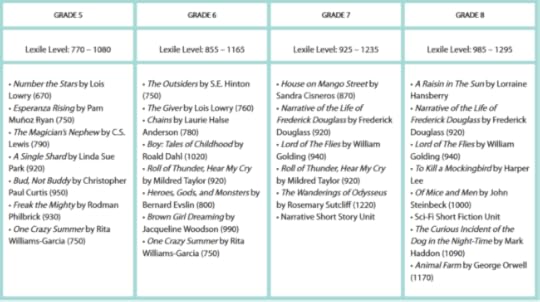
As we plan to renew and extend our pilot for the 2020-21 school year, we now have twenty-seven novel units available for schools to choose from. (You can see our book list in its entirety, see our website: https://teachlikeachampion.com/reading-reconsidered-curriculum/.)
Some of our newest titles for the 20-21 academic year include:

With every curriculum unit, schools receive:
Teacher and Student Facing
Materials:
Daily Student Packets and Corresponding Teacher Lesson
PlansStandards Aligned Unit PlansMid-Unit and End-of-Unit AssessmentsEssay Prompts and Supplementary Lesson MaterialsKnowledge OrganizersVocabulary Word Wall Images
Foundational Implementation
Documents
Curriculum Users’ Guide: A comprehensive guide to support implementation of the curriculum and the academic systems it relies uponLesson Preparation GuidanceApproach to Standards and Objectives
Remote Unboxing Session:
A one-hour session in which our team provides guidance and insight about the
curriculum materials with particular focus on the daily lesson materials.
In this second year of the pilot we’re also adding to the
support opportunities that we offer to participating schools in addition to the
curriculum materials described above. We’ve
created a new Digital Platform Subscription and expanded our menu of Professional
Development opportunities.
Want to learn more?
If you’re interested in participating in our
curriculum pilot program in 2020-21 or would like to see curriculum samples,
please email us at TLAC_curriculum@uncommonschools.org.
Check out more posts on our blog. We love
blogging about our curriculum, and here some of our favorite posts:Our first
ever post about our curriculum and its guiding principlesSome examples of our approach to Vocabulary
and Active PracticeWriting
Prompts from our Of Mice and Men UnitHow our Science
Fiction Short Story Unit made Doug fall in love with Sci Fi
The post Get Ready for our Expanded Reading Reconsidered Curriculum Pilot appeared first on Teach Like a Champion.

April 23, 2020
Quick Thought re Online Learning: Signal ‘Purposeful’ From the Start
 Start by getting started…
Watched a few synchronous online lessons today and was struck by how lacking in purposefulness the first few minutes were in several of them. Teachers seemed agenda-less. There was no clear starting point. Or there was a clear starting point but only after 6 or 7 minutes of idle chatter. There was insufficient clarity about what it means to be a student (e.g. “You’ll need a pencil and a notebook so please have those ready…”)
In general kids read this as indicating the teachers’ low value on or expectations for their time together. To them it was “not really school.” They began to check out.
So start warmly, brightly and with humanity, but start quickly. Get down to business. Get students doing something right away. Give clear decisive directions. Remind them of procedures (camera on, please).
Show that time online has value. Students do not yet know what this new form of learning means; be careful to set the norm that it is purposeful and productive and requires full engagement and attention. Honor their time in other words and they but value in the endeavor.
The post Quick Thought re Online Learning: Signal ‘Purposeful’ From the Start appeared first on Teach Like a Champion.

Doug Lemov's Blog

- Doug Lemov's profile
- 112 followers

