
Doug Lemov's Blog, page 20
December 14, 2020
“Pasting the Chat” & Other Insights from Hassan Clayton’s Lesson
 Hassan takes the chat up a level
I’ve written a lot about using the chat in remote teaching on this blog and talked even more about it in our webinars and trainings.
I wrote about Shelby Daley’s chat here. About Denise Karratti’s here. About Arianna Chopp’s here. and Eric Snider’s here.
Today I get to share something my team and I loved from Hassan Clayton’s English class at Nashville Classical Charter School. I’m going to call it ‘pasting the chat.’ Hassan is teaching Freak the Mighty and he’s asked his students to read a key line an interpret what Kevin, the protagonist means by it.
Students chat their answers and you’ll probably notice right away how positive Hassan is, how much he values their responses.
It’s also really interesting to see how he ensures a bit of Wait Time. He doesn’t open that chat for 22 seconds. Even if you want you can’t enter before that. It’s a bit like a hybrid of the “Now Question” Arianna Chopp and Shelby Daley use… you can answer right away and they narrate that to build momentum and participation and the “Wait Question” Denise Karratti uses (you hit enter on the chat when she tells you, after a full minute so there’s lots of wait time).
But my favorite part comes as Hassan starts to read student responses. He pastes them in his version of the student packet, which he is projecting to the class.
This validates student writing, making it seem important, and socializes students to write well (as opposed to hastily) in the chat. It also allows him to make the reading of the chat simpler. One of the challenges of using the chat is “the scroll” the fact that it’s hard to really attend to what your classmates have said because there’s so much of it racing by you on the screen. Hassan slows the reading-what-your-peers-wrote part down too. There are just two answers we need to read. Let’s read them well.
It also allows Hassan to move quickly without making the thinking rushed. One of the things we loved about his lesson was how thoughtful it was and how much he got done. They move briskly from question to question.
And not only did we love what Hassan does here but we found ourselves thinking of other ways to use it.
For example, you could post two examples from your classes response and ask students to compare and discuss them, focusing the conversation on a few especially valuable answers.
Or you could post one response and–a bit like a Show Call–spend a few minutes going from good to great. “This is a really nice answer. Let’s see what we can add to it.”
The post “Pasting the Chat” & Other Insights from Hassan Clayton’s Lesson appeared first on Teach Like a Champion.


December 4, 2020
Online Note-taking: A Glimpse of Joshua Humphrey’s Classroom
If you’re a regular reader of our blog you’re probably familiar with Joshua Humphrey who teaches math at KIPP St. Louis HS. I wrote previously about one of his asynchronous lessons from the Spring where he socialized students to take active control over the video by pausing consistently and where he modeled implicit assessment–asking students to self-check their work against a model, a a critical tool for asynchronous teaching where assessment options are more limited.
Now I’m happy to share a bit of a synchronous lesson taught by Joshua and his colleague Cara Ciccarelli.
The first thing that struck us was their use of the chat. We’ve posted before on the various ways it an be used and described a few models in our webinars:
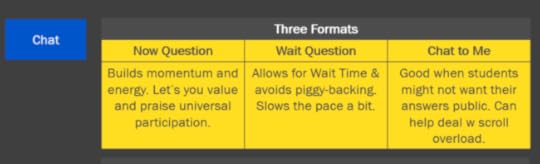
But Joshua and Cara do it a little different here. They’re not so much waiting to hear from everyone as giving a student the chance to answer correctly, letting students see (rather than just hear) that answer and using it as the jumping off point for the next step in the lesson. It’s a nice variation on the idea of taking “volunteers” in other words…using written instead of verbal answers. Love how they remind students to use parentheses… Love the shine for the student who gets it right (“Let me stop you all right there. Look at what Antonio just chatted out…”) but as soon as they get their answer, they close the chat. Time’s a wasting.
Next we loved the use of the E-white board to model note taking. What Joshua and Cara want is for students to take notes so they will have a model for how to complete rate of change problems handy, always. It’s so easy for notes–and note-taking as a daily paper to pencil process–to get forgotten online. Not here, even online it’s Board = Paper, and the model is more direct and transferable when it’s hand written and the expectation that students should be getting it down in notes is much clearer . Again, note taking by hand is still important and powerful in an online setting.
We also love the seamless team teaching. Lot’s to love, in other words
Thanks as always to Joshua, Cara and KIPP st Louis for sharing their work with us.
The post Online Note-taking: A Glimpse of Joshua Humphrey’s Classroom appeared first on Teach Like a Champion.

November 28, 2020
From the Coach’s Guide to Teaching: Sefu Bernard on Training Core Principles
 “Before you get lost in the chess match, your players have to understand some global principles…”
My new book The Coach’s Guide to Teaching comes out this month. In it I talk about how to address the teaching challenges coaches face. Most examples come primarily from soccer, the game I know best, so I asked top coaches in other sports to write side bars with their own insights to make the book more accessible to a wider range of coaches. I’m humbled by the group of coaches who contributed and thought I’d share an example. This one is from Sefu Bernard, Director of Player Development for the WNBA’s Washington Mystics. He describes the connection between global principles, which are often developed through game-based activities, and players’ ability to make tactical adjustments, usually taught through tactical activities.
As coaches, we often don’t spend enough time thinking about how to design the training environment over an extended period of time (e.g. over a two-, four- or six-week period)—especially in youth sport. We tend to be day-to-day. We finish a practice, or a game, and ask, “What are we going to do tomorrow?” If we struggled with our defense we say, “We’ve got to work on our player-to-player defense.” Then we practice it once and check the box. This is teaching to the test. It’s reactive. And it lacks a long-term view that builds the competencies we want most in our athletes.
At the professional level, the game becomes so tactical. You’re dealing with the highest level of athlete and the highest level of coaching acumen—both have the capacity to make in-game and game-to-game adjustments. That’s a lot to prepare for.
At the same time, I think it’s important to differentiate between global principles, applied and applicable throughout every game in the season, and tactics, which are game-to-game adjustments.
Ball screens are the bone marrow of modern-day basketball. They’re one of the most frequent interactions in today’s game. The game is all about finding, using, creating and sharing advantages. Ball screens are an easy way to create an advantage. There are numerous types of ball screens and even more ways teams can get into them to trigger an advantage.
For us, we know that every team is going to run some kind of ball screen action—either to provoke poor decision-making and a breakdown in the defense or to exploit a matchup. We need to be able to defend this action; yet, even with our best scouting efforts, we can’t account for every possibility.
Before you get lost in the chess match, your players have to understand some global principles for preventing and neutralizing an opponent’s use of this scheme. We need to learn deeply the fundamentals of defending and reacting to a ball screen. For instance, being able to guard the ball at an arm’s length away or closer, being able to influence the direction of the ball handler, being hard to screen (i.e. avoidance), communicating and reacting to verbal cues from a teammate (e.g. direction of screen, going over or under, possibly switching, etc.). These are foundational skills and decisions that must be developed regardless of the type of ball screen and tactics an opponent employs to get into it.
If you can develop a player who’s a great on-ball defender and unscreenable, you don’t need as many tactical adjustments. So, for us, I’m continually asking and observing. How much time are we spending on things like on-ball defense? When and how often do we come back and revisit? Are we planning for this in advance or reacting to a feeling and the emotions of the moment? Things get sloppy over a season. Forgetting happens. How do we plan for it such that the busyness of the season doesn’t make us ignore what’s most important?
One season, I started jotting down what I called “problem statements”—soundbites that we as a staff were saying: “We’re not good at this”; “She’s not doing that”; “We need to improve our IQ with X.” I took all those phrases and presented them to the coaching staff in our off-season.
I shared with them that I’d written down the things we say that hurt us most regardless of opponent. We then had the hard conversation of unpacking those comments and revealing the overarching gaps and themes. We were then better positioned to anchor what we did going forward around these issues. We could better prioritize and plan ahead to spend time on the things that mattered most, and also assess how we were doing toward moving the needle and improving.
Being sound on a small subset of universal principles—and the perception,
communication and decision-making that fuels it—will reduce the amount of tactical in-game and game-to-game adjustments that a team needs to make.
The post From the Coach’s Guide to Teaching: Sefu Bernard on Training Core Principles appeared first on Teach Like a Champion.

November 24, 2020
Online Teaching: Don’t Sleep on the Value of Everybody Writes
 “Do not forget,” said the fish, “that students need to put pencil to paper. Even online.”
At TLAC Towers, we recently had the opportunity to watch Jake Daggett of Stellar Elementary of the Carmen Schools of Science and Technology network in Milwaukee, Wisconsin teaching his second graders about fairy tales. We appreciated his use of writing and Team TLAC’s Dillon Fisher wrote this analysis:
One of our favorite things about Jake’s lesson was his use of Everybody Writes, even online. Especially online. We worry that the shift screen-based instruction will result in fewer opportunities for student to work pencil-to-paper- a setting where they tend to concentrate more deeply, where they can manage ‘zoom fatigue’ by taking a break from the screen and, in the case of younger students, ensure lots of practice at letter formation and the like.
Here’s Jake in action:
Jake’s students are reading a tale about a fisherman who catches a talking fish who asks the fisherman to throw him back, offering him and his wife a wish instead. Jake pauses his read-aloud to have all students make a prediction: Will the fish grant the wife’s wish?
Posing this question early in the story creates a Pause Point an important opportunity for students to reflect and consolidate their thinking. It also makes each of Jake’s students an active participant in class.
Jake asks them to write their predictions and he models a sentence frame, I think ______because ______, that encourages students to write complete-sentence predictions and to think about why they are making them.
Even more effective, we love that Jake chooses to have his students make this prediction pencil-to-paper. While it is easy (and perhaps faster) to favor electronic or verbal responses in our remote classrooms, infusing pencil-to-paper moments in classrooms brings in familiar echoes of the classroom and can be particularly powerful for elementary students who are still building their writing skills. Pencil-to-paper moments offer students an opportunity to pause, take a break from the screen, and use a few sacred seconds to rehearse and solidify their thinking independently before sharing out full group. It seems like Jake’s students appreciate this. They’re focused and attentive and we can see the tops of lots of heads as they work away.
The pencil-to-paper approach also let’s Jake check visually to see what and whether students have done and to include lots of students via inviting Cold Calls. Izzy goes first. He’s eager to share his ideas. Luis (upper left) is eager to share too. He raises his hand but he also holds his paper up to show Mr. Daggett how hard he’s worked.
One of our biggest takeaways from this lesson is Jake’s use of a simple, easy-to-repeat ‘handout’ that his students can use for any story and any Pause Point. Jake made a wise choice to ensure the materials his students had ready at home could work for any lesson; the handout includes room for a title, date, and four boxes to contain student thinking.
We’re big believers in keeping it simple, especially remotely. It is too easy to decide to skip pencil to paper because we weren’t able to get out lesson specific handouts the way we might have in person. Jake’s handout reminds us that it doesn’t need to be fancy to be effective.
The end result? Each one of Jake’s students has a glorious few seconds away from the screen to do some independent processing, write complete predictions, utilize their new vocabulary words, and return to the story ready to find out: just what will that fish decide?
The post Online Teaching: Don’t Sleep on the Value of Everybody Writes appeared first on Teach Like a Champion.

November 20, 2020
Postcard from the Edge: Details on the ‘Other’ Pandemic

There is a second pandemic happening. If you’re watching that should not be a surprise. In the education sector almost everyone is working very very hard. They are doing often their best in a terrible situation. They deserve thanks and praise. But that doesn’t change the fact that educational devastation is being sown across the land. Online instruction is a disaster–a faint shadow of what teaching and learning are supposed to be–and the gaps are greatest for the least fortunate.
This morning I spent 45 minutes with an outstanding principal of a very good school- one of those in-one-of-the-poorest-parts-of-town-but-three-times-the-city-average-in-proficiency kinds of places.
And the news wasn’t good.
Here’s what I asked her and here’s what she said.
First, how are your kids? Where are they when they’re working. Mostly their parents have to work. Are they in child care centers? at home? Who’s watching them?
Usually they have been set-up for class by an adult but there’s not an adult in the room. Some are in [child care] centers but most can’t afford that. Usually they’re at home. There’s someone else in the house–a middle or high school age sibling, sometimes a grandparent–but they’re alone in their room. There’s someone to make sure they’re safe but no one to make sure they’re on task or help if they have problems. 1st, 2nd, 3rd grade: they’re on their bed or their bedroom floor. Sometimes at a kitchen table. If they’re in kindergarten they’re usually sitting next to someone at a table but again its often a sibling who’s also in school or someone who’s at work.
Do you have a working theory on dosage and attention? How much online time can early elementary kids spend productively in online instruction?
We go from 8:30-10:30 and then we take a 30 minute break; then we’re back at it. But really they’re good at keeping focus until about 9:15. We get 45 minutes at a time and after that everyone starts to lose focus and concentration.
I should say: We’ve built up that stamina over the course of the year. Steadily, steadily and very intentionally, we’ve built up what they can do. So it’s getting better. But it’s hard. There’s a lot of noise and over time you just see them looking around struggling to manage it.
What about asynchronous tasks? What’s the rate of completion?
Asynchronous tasks are really a struggle to get kids to do. We were getting completion rates in the 30% range when we would simply assign a task and expect kids to complete it. Then we started assigning independent tasks to be done while their cameras were on [this is an idea we call semi-synchronous on team TLAC] and that was good. The completion rate went up to about 60%.
The rate of task completion is highest in math. It’s lowest in reading. Read a text and submit a written response… it’s just very hard for them to follow-through.
What about learning outcomes? I know the news is not good. I wouldn’t believe you if you told me otherwise. But what’s your sense of the extent of it?
It’s a catastrophe. I mean…[she is fighting back tears here]… Kids who could read at a certain level last year have gone backwards. They struggle with texts they could read before. They struggle to concentrate like they could before. It’s not just that they’re not not learning as well. They are regressing. It’ so hard to see.
And they’re just not able to get enough practice decoding and decoding and decoding. That and fluency. We just can’t get them the quantity of time in text–really focused on text in an accountable way–that we need to. They just need so much word work and we can’t manage to get it to them with everything else we’re asked to do.
The post Postcard from the Edge: Details on the ‘Other’ Pandemic appeared first on Teach Like a Champion.

November 11, 2020
New: Our Webinar on Teaching Reading Online
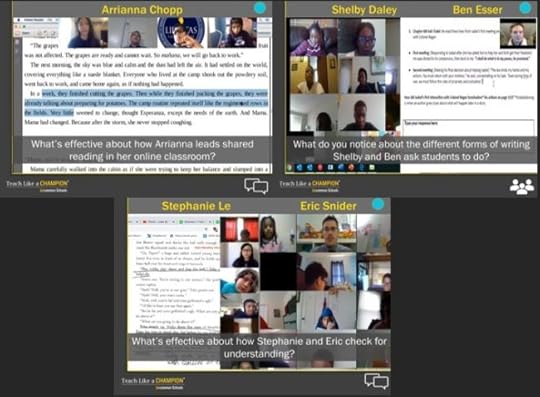 Some of the literacy videos we’ll study…
As many of you know, our team has spent much of our time over the last several months poring through footage of teachers doing incredible work in their online classrooms, trying glean as much as we can about what leads to successful online instruction. Much of what we’ve learned we’ve shared in our current online webinars: Principles of Remote Instruction (our 101 workshop) and Dynamic and Engaging Synchronous Lessons (our 201 workshop).
Now, we are excited to announce the addition of an ELA-specific webinar to our offerings. As always it’s built around analysis of video of real teachers’ online lessons!
Topics will include:
Ways of Reading: how to leverage the benefits of three primary ways of reading onlineWriting: how to make it meaningful and effective in an online classroomCheck for Understand: how to assess students’ ability to establish and analyze meaning
Our team’s goal in designing this webinar was to:
Share valuable techniques teachers can use online in pursuit of effective and rigorous literacy instructionStudy video of teachers applying them in real-world conditionsDemonstrate the techniques in the webinar, so participants can “live the learning” and bring the ideas back to their own classrooms and schools
While we hope to offer ideas that can be used or adapted in all grade levels, we think the content is most relevant for teachers and leaders of students in grades 3-12.
Sign up here: https://teachlikeachampion.com/traini...
The post New: Our Webinar on Teaching Reading Online appeared first on Teach Like a Champion.

November 10, 2020
Notes on Molly Maphis’ Phonics Lesson
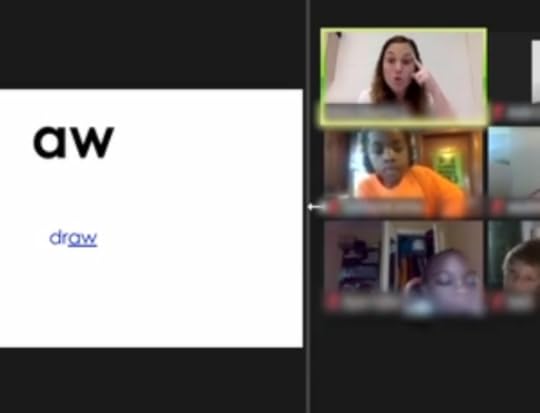 Lots and lots of practice…
We learned a lot from a video we recently watched of second-grade teacher Molly Maphis at Nashville Classical Charter School. Team TLAC’s Brittany Hargrove has worked extensively with elementary schools to help them build effective and engaging classrooms. She wrote this post describing some of the effective things she saw in Molly’s lesson:
One of the best things about Molly’s lesson, in which she’s leading a phonics exercise with her 2ndgraders, is how much it echoes all the things we—and her students—would see in a bricks and mortar classroom.
First, Molly reviews sounds au, aw, and augh showing examples on her screen.
Next, students are given the independent task of silently reading a slide of sentences using these -aw sounds to practice their fluency. Molly uses positive narration at the start, highlighting students who she can see are reading the sentences aloud. Molly says, “a point [for] Joah, he is reading the cards to himself.” This rehearsal also makes her students more likely to be (and feel) successful later on, and thus more likely to like the art of Cold Calling.
After this short bit of independent preparation, Molly brings students back to participate in an engaging synchronous activity: they’ll read the sentences aloud with expression. Molly uses Cold Calling during this activity. Her tone is inviting and because of this, students swiftly come off of mute to read the sentences not just with expression but with enjoyment. She reminds them that they are trying to beat their time from yesterday and they seem to relish the challenge.
It is obvious that Molly has done similar exercises with her students in the past, too. The familiar routine she’s established make this activity feel seamless in a minute and fifty-seven seconds, every student gets a chance to read and practice. We especially love the universality of the lesson and the message that carries. Everyone participates; everyone gets a turn; everyone is important.
The post Notes on Molly Maphis’ Phonics Lesson appeared first on Teach Like a Champion.

November 4, 2020
Welcoming Darryl Williams, Our New Co-Managing Director
We’ve been sitting on some pretty exciting news for the past few weeks here at TLAC Towers. The amazing and incredible Darryl Williams has become my Co-Managing Director on the Teach Like a Champion Team, and he and I will lead the organization together going forward.
Honestly, I couldn’t be more excited. Over the past four years I’ve come to rely deeply on Darryl’s insight and wisdom on almost every topic. He’s a true partner and this change merely formalizes that. (I know that Erica Woolway who continues as the most outstanding of Chief Academic Officers agrees).
Among other things Darryl leads our leadership and school consulting work, where we work directly with schools to identify their learning goals and use a variety of tools to help achieve them. Under Darryl’s leadership this part of our work is growing rapidly and his experience leading schools in a wide variety of settings and special talent for helping schools understand themselves and see concrete steps on the path forward has led to rave reviews. Pretty much everyone who works with him is clamoring for more.
His becoming co-managing Director is in part a reflection of the rising importance of that work–the transformation he’s brought about in the schools he works with, the rates at which we learn from those relationships and funnel that wisdom back into our other work, etc. As a result it’s our intention to expand that work and for the rest of this blog post I’m going to let Darryl introduce himself a bit more and talk about the work we’ve been doing and hope to do more of.
-Doug
 Darryl Williams
I’m grateful for the opportunity to co-lead our amazing team of trainers, analysts, content developers, curriculum writers. Sharing all that we’re learning from leaders and teachers across the world has never felt more important, so we’re excited that our growth allows us to expand the number of partnerships we can offer.
Before I offer a bit more about our expanded initiatives, I wanted to share a bit of framing for why we continue to be inspired to study the most important work in the world – teaching!
We study teaching because we believe that it is the foundation of a more just, equitable, and inclusive society. Our goal has always been to support schools in making their classrooms radically better for students, especially for children in communities where a lack of access to exceptional teachers and quality curriculum continues to widen opportunity gaps. We also recognize that the current school year may well prove to be the most consequential for a generation of students who’ve had their learning disrupted by the Coronavirus pandemic. In light of these facts, our resolve to study teaching and share our learning with the broader education community has never been greater.
In our current partnerships, we have the honor of working alongside some of the country’s most talented educators, helping them study how the ideas, practices and approaches they’ve prioritized are being implemented within their respective organizations. While TLAC techniques, our love of Practice (outlined in Practice Perfect), our Reading Reconsidered Curriculum and trainings, and now our work on remote learning are some of the tools we use to help schools achieve success, our partnership work isn’t so much about helping schools get better at implementing TLAC as it is about helping them identify and achieve their educational vision and goal. We help them find and replicate bright spots, address areas of opportunity and strengthen existing capacity to impact learning. It is through this work that we better understand how our techniques, content and resources support schools in delivering on the promise they make to families.
With that in mind here are some of the initiatives, tailored to an online world, that we’re excited to offer schools that are inspired to become the best version of themselves.
Virtual Collaboratives:
At the conclusion of our workshops, or more recently, after our online webinars, we’re often asked, “What kind of follow-up support are you providing to schools?” One of the primary ways we support schools and organizations is through our virtual collaboratives. We believe in the power of connecting leadership talent within and across organizations to facilitate learning, promote the sharing of best practices and to help find solutions for common areas of opportunity. Our current Memphis collaborative, for instance, has brought instructional leaders across eight different schools and networks together to study how to improve student engagement across their classrooms and develop their teachers’ capacity to effectively Check for Understanding within a lesson. Our thoughts and ideas about remote teaching (https://teachlikeachampion.com/blog/darryl-williams-framework-for-online-lessons/) and the importance of planning Means of Participation (https://teachlikeachampion.com/blog/how-memphis-rise-helps-teachers-build-vibrant-online-culture/) are directly shaped by the insights and experiences of leaders within the collaborative. More importantly, the collaborative provides a venue for humble, smart and like-minded leaders to study and inform each other’s work on behalf of their students and families.
In a virtual collaborative, we typically meet 2-4 times in the Fall and another 2-4 times in the Spring. Each school or organization provides framing/context for their strategic priorities and any additional data/information that helps the collaborative better understand their needs and how we might spend our time supporting their efforts. We then spend several sessions helping schools study their progress towards their strategic priorities by analyzing lesson plans, studying student work, observing classroom instruction and reviewing coaching/lesson preparation meetings. The sessions conclude with a planning meeting so the host school has a clear plan of action to implement and participating schools can capture ideas and insights they plan to take back with them to their respective campuses/organizations. Again, what leaders find most impactful about this work, is that it’s grounded in their individual needs and informed by practitioners who are aligned in their efforts to provide students the exceptional education they deserve.
The Facilitator Preparation Cycle: A Train the Trainer Program for Online Teaching
Evidence on professional development suggests that teacher training works best when embedded in the culture and systems of a school or network. There, it can be fostered by an intentional and supportive culture, connected to systems of observation and feedback, and extended by further professional development.
The purpose of the Facilitator Preparation Cycle is to increase the quality of online teaching in large districts and organizations by preparing a select group of trainers to deliver, adapt and support the Teach Like Champion Team’s online workshop content within their own schools and networks.
The Teach Like Champion online workshop content uses video of online classrooms to help teachers:
Master six Means of Participation- inclusive and engaging procedures that ensure active student participation and dynamic online classes.Understand and unlock synergies between synchronous and asynchronous modes of instruction.
Over the course of the training cycle, facilitators will work alongside Teach Like a Champion team members studying webinar content, reflecting on critical facilitation moves, practicing facilitation of the webinar, and preparing ongoing support for their district/organization.
At the conclusion of this experience, facilitators will be licensed to facilitate trainings within their respective organizations using content and video from our online workshop.
Video Infrastructure Support
Studying video of teaching and leadership is the core of what we do. Organizations have access to more video now than ever, so we’re looking forward to helping them build a video infrastructure that allows for capturing, storing and disseminating footage for the purpose of accelerating talent development across the organization.
One of the primary barriers to using video to drive development is a simple, but often overlooked challenge – logistics for access and dissemination. Even when video has been captured, it typically gets lost in a sea of folders or, even more characteristic, the video gets stored but isn’t easily identifiable because there are no standard naming conventions for the footage. For partners seeking to use video as a tool to drive talent development, we help secure reliable cloud storage for recorded online lessons, coaching clips, and other video they’d like archive for future use. Additionally, our team works with partners to build video folders and albums designed to maximize ease of use and accessibility, so you know where to find clips for use in your coaching conversations or PD sessions.
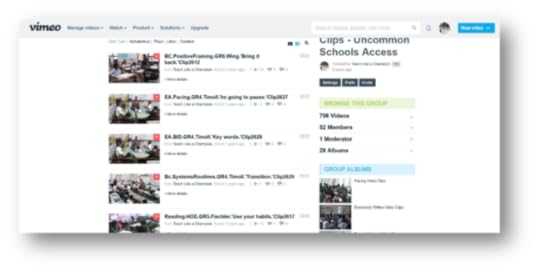
A custom Vimeo site designed to track important video data, organized in groups and albums to maximize efficient access and use.
Over the years, we’ve learned that leveraging video for talent development requires an efficient system for coding, storing, and accessing video. As part of our support, we create customized coding that tracks the most important attributes for all your videos, tracking up to 20 important demographic data fields about recorded lessons and video clips. For instructional leaders planning professional development or teacher leaders looking for a “bright spot” clip to share at their upcoming PLC, locating and sharing those clips must be a practical and efficient endeavor.
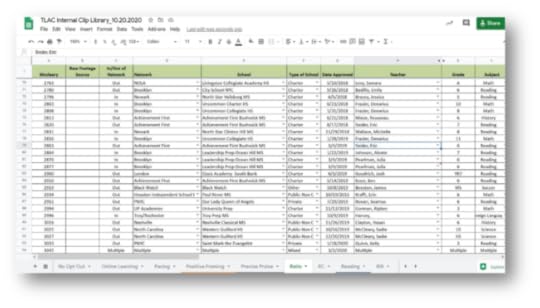
Custom tools for tracking all of your raw video and final video clips. Proper tracking of video is the first step in using it to drive change in your organization.
At the request of partners, our team will create high quality versions of all clips approved for training, coaching and the sharing of best practices (“bright spots”). This process will include the creation of title screens, captions, transitions, and other video enhancements. All approved clips will be coded with specific information and added to the Clip List for partners with links to the videos on Vimeo or the specified storage platform.
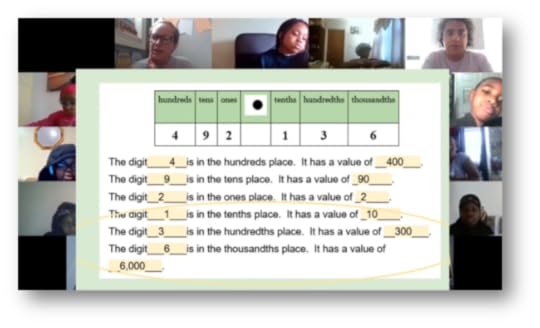
Our video editors have creatively enhanced hundreds of videos. In the example above, we captured a teacher’s work in Nearpod and spliced it into the recorded lesson to provide a better experience for the viewer.
Video Study
As part of our existing partnerships, we offer a series of Video Review Meetings (VRMs) that help schools/orgs study bright spots so they can understand the conditions that allow them to exist This is demonstrated in our partnership work in Memphis where our study of teachers like Jasmine Howard (https://teachlikeachampion.com/blog/freedom-preps-jasmine-howard-checks-understanding/) helped her network replicate practices that she routinely used to achieve amazing results with her students. Now, all teachers within their secondary Math departments can study and replicate these effective practices with video examples to guide their implementation. And the benefit to us – we learn a little bit more about how techniques like Check for Understanding are used and adapted in high performing classrooms like Jasmine’s!
We’ve supported partners in using video study for a variety of purposes: to calibrate on instructional priorities; plan feedback for teachers; prepare clips for professional development or practice labs; diagnose areas of opportunity and to develop the capacity of emerging leaders within an organization. We hope to share what we’ve learned about studying teaching and learning via video alongside new partners who are seeking to accelerate their progress towards on key initiatives and priorities.
We believe this work with schools using our combined insights to build “radically better” schools is powerful and are excited to announced an increased capacity to work with schools this year. If you’d like to learn more about our virtual collaboratives or supports for video study, please contact tlac@uncommonschools.org.
In the meantime I’m grateful for the opportunity to co-lead our amazing team of trainers, analysts, content developers, curriculum writers. Sharing all that we’re learning from leaders and teachers across the world has never felt more important, so we’re excited that our growth allows us to expand the number of partnerships we can offer.
Thanks for all your well-wishes as I step into my new, senior role on the TLAC Team.
The post Welcoming Darryl Williams, Our New Co-Managing Director appeared first on Teach Like a Champion.

October 26, 2020
A How-To Guide to ‘Cameras On’
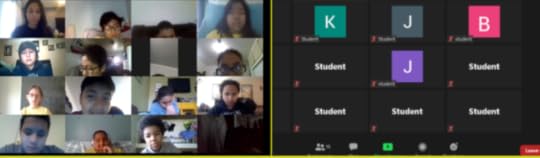 A Tale of Two Classrooms…
We’ve written before on this site about how ‘cameras on’ can be transformative in online teaching. Classrooms are most inclusive when they make as many students as possible to feel seen–literally and figuratively. That said getting cameras on isn’t always easy. TLAC Team members Jen Rugani & Dillon Fisher spent some time thinking about this challenge and put together this how to guide to getting cameras on whenever possible.
Remote teaching has left many of us feeling disconnected, so nothing beats the joy of seeing your students faces log onto your classroom via video. In most cases it’s the same for them. Seeing faces builds emotional connection, fosters classroom community, and can help us see how our students are really doing, both academically and personally, throughout a lesson. Yet, as we navigate the world of remote teaching, there are a host of valid challenges for both students and teachers being visible on camera.
Whether or not there is an explicit camera policy in place at your school or district, here are some ideas to help you establish classroom cultures where students feel safe and comfortable turning their cameras on.
Rolling out a school or grade-level cameras-on norm:
Creating strong norms for technology usage requires thoughtful planning and patience, no matter when you start. Here are two anchor beliefs to ground your thinking:
Implementing a norm of cameras on should be done in partnership with students and families: Turning on a camera from home is an unfamiliar ask. We’d be remiss to make assumptions about what may prevent students from doing this successfully. Even (and especially) if this hasn’t been an expectation all year, take time to work with families and students before you expect a dramatic turnaround in camera culture.
Share your why with families broadly: We believe that students are more likely to feel connected and engaged when they can see and interact with the faces of their peers and teachers. Sharing this rationale (with specific examples) with students and families can help create a shared understanding that makes it easier for everyone to work towards the same end-goal.Conduct opportunities to hear from families: Partnering with families is critical. Create opportunities to hear from your families regarding comfort level with norming cameras on, create spaces (e.g. virtual coffee-chats) for families to share their thinking. One network that did this was surprised to find that only 8% of parents were uncomfortable expecting cameras-on during live lessons.Create opportunities to hear from students: Being aware of and responding to student voice will help your team create norms tailored to your community. As with families, we recommend schools create space (perhaps in advisory or via survey) for students to ask questions and share their own feelings before determining camera-usage norms.
Having specific data around your school community can help your team plan for the best solutions that support students and families in feeling safe and comfortable turning on their camera and engaging in class.
The more widespread the better: Once a shared norm of ‘cameras on’ develops among most students, the resulting culture often encourages more students to want to join in. Policies alone won’t create a shared norm; gaining momentum by building an initial critical mass of students with cameras on in class is important. School teams can outline specific strategies to help nudge classrooms towards such a critical mass. These might include:
A process for family follow-up: Check in with the families of hesitant students via phone or text but decide who, how, and when outreach will happen to avoid family call overload. Focus on finding collaborative solutions that meet families where they are.Brainstorm a few “back-pocket solutions” that respond to the needs of your families:Could you create a few school-specific virtual backgrounds to offer?Do students need a poster / science board to create a “private” learning space?What are in-the-moment ways for teachers to non-invasively reach out to students whose cameras are off?Could you provide notification about especially important lessons for cameras-on in advance? (Ex: Student presentations on Friday)
Normalizing cameras in your classroom:
Within an online classroom, it’s important to take intentional steps to create a classroom culture where students feel comfortable being visible with their camera on. Purpose over power is key; we’re asking students to turn their cameras on not to monitor them, but to help build engagement and community so that discourse and learning are deeper. We’ve seen teachers do a few simple but powerful things to help gain student buy-in to a cameras-on culture:
Keep It Positive: Warm, low-stakes opportunities for cameras on can help create safe and positive online culture. You might do a quick community-building activity like Show and Tell to open class, give some cameras-on social time during a transition, or highlight creative virtual backgrounds (if technology allows). Acknowledging and expressing appreciation for students who turn on their cameras (“Thanks for that camera on! It’s great to see you;” “Love the nods I’m seeing during discussion;” “I just saw some jaws drop at this dramatic part of the book!”) can go a long way toward fostering a learning environment where faces visible is the norm and students can appreciate the benefits of seeing each other.Strategic Toggling: While preparing a lesson, consider: When will it be most important for us to see each other, and, as importantly, when is it not a priority to have cameras on? Making transparent for students when and why being visible is expected helps clarify the purpose and increase buy in.
“This section of the novel is really rich, so we’ll need to have a deep discussion about it. Let’s turn our cameras on so we can give our full attention and respect to our peers.”
Similarly, intentional moments of cameras off can help to counter fatigue and promote independent focus.
“This is a longer stretch of work time, so feel free to turn your camera off. I’ll be popping into your Google Classroom work to give feedback, and I’m available in the chat if you need me.”
Non-Invasive Follow-up: Keep in mind that there are numerous factors beyond students’ control that might be preventing them from turning on their camera. Avoid giving in-the-moment consequences (especially public consequences) to students for having their camera off; if the norm of cameras on becomes a punitive tool for monitoring instead of a vehicle for community-building and learning, students won’t buy in and it will lose its benefits. Follow up with students in a way that is private, positive, and supportive. Chat, email, and/or make phone calls to students and families to develop collaborative solutions that enable students to participate actively in class.
Private Chat : Hey [__], I noticed your camera is off today. Is everything okay? Would love to see you, let me know if I can help.”
Normalized Exceptions: Sometimes when we make time to listen, we learn there are very valid reasons for a student having their camera off. When that’s the case, use positive framing to let the student with their camera off to know that you still see them through their work engagement and to send the message to other students that it’s safe to communicate with you openly if they run into similar issues in the future. Intentional framing allows you to reinforce the existence and value of the norm while still meeting students where they are.
“Des, I know that you can’t have your camera on today, so I’m extra grateful to see your thoughtful ideas in the chat.”
Be sure your positive framing language validates the student’s engagement while keeping the details of their exception private.
The post A How-To Guide to ‘Cameras On’ appeared first on Teach Like a Champion.

October 21, 2020
Some Handy Tools for Building Student Engagement in Online Classes
As most readers of this blog probably know we’ve been offering small group online webinar-style workshops this fall on remote teaching. The workshops allow us to connect to, share with and learn from teachers and school leaders everywhere and rarely a workshop goes by where we don’t learn something we can pay forward to teachers at the next one.
A session we ran last week was no exception. We discussed when and how to use six key Means of Participation:
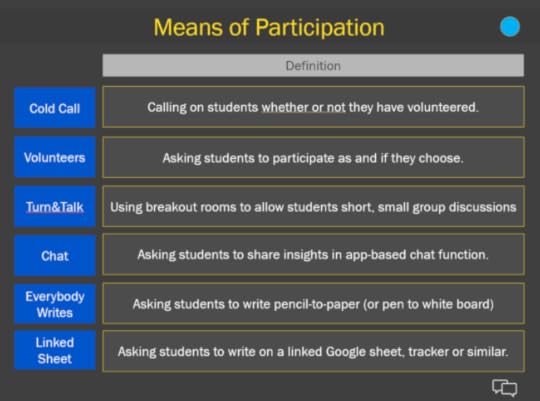
Afterwards, Libby DeBell, who is Principal at Olympic Hills Elementary School in Seattle, wrote with a couple of great suggestions.
Her first was something called “sidebar buddies,” a variation of Turn and Talk that’s especially useful when you don’t have breakout room functionality on your meeting platform.
First, she advised, list one-to-one pairs of students on a PPT slide. Perhaps something like this:
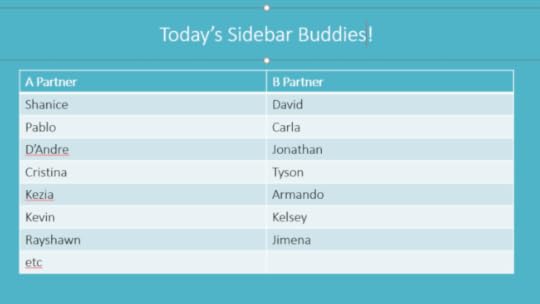
Throughout the lesson, you can then ask students to chat individually to their sidebar buddy as a written Turn and Talk. One benefit, Libby notes, is that in some platforms the teacher can view all of the Turn and Talk conversations (and should share that at the outset, she notes!).
This is an idea we know works because we frequently used it on TLAC team meetings last Spring!
Another really useful idea Libby shared was this trick for tracking participation. “We have a teacher who has little slips of paper with each student’s name on them,” Libby wrote. “She puts them all in a column to the left of her laptop on her desk. At the start of class, she moves each student that is present into a column to the right of her laptop. Each time a student participates, she moves them over again. This way, she can track how often each student has participated (whether through cold call, volunteer, etc.)”
We love to use the phrase “voice equity” referring to a teachers role in making sure everyone is heard from during a class. We think this is a great way to manage that and can imagine slight adaptations (a check list, etc) depending on personal preferences.
Thanks to Libby and her staff for sharing these great ideas!
The post Some Handy Tools for Building Student Engagement in Online Classes appeared first on Teach Like a Champion.

Doug Lemov's Blog

- Doug Lemov's profile
- 112 followers

