Amy Julia Becker's Blog, page 7
June 22, 2025
True Friendship Isn’t Built on Pity
Years ago, one of our kids came home from preschool and said, “She cries a lot and doesn’t share her toys.”
Our child were talking about a classmate who had a disability. I was tempted to jump in with “Be kind. Be a helper.” But I paused. I didn’t want to reinforce a hierarchical relationship where our child was always the helper and the other child was always the one needing help.
Instead, I asked:
“What have you noticed that’s hard for her?”
“What’s hard for you?”
“What do you think she enjoys?”
“What do you enjoy?”
That simple conversation shifted perspectives.
It wasn’t about one child always helping another. It was about understanding each other and recognizing that each of them had gifts and needs.
Too often, when kids are praised for playing with peers who have disabilities, the message becomes: You’re doing something noble.
But that praise builds walls—creates hierarchies—rather than cultivating friendships and relationships of mutuality.
True friendship isn’t built on pity.
It’s built on mutuality:
Each child with needs.
Each child with gifts.
Each one learning from the other.
Simple conversations and questions can help our kids see every peer as fully human. Not a project. Not a hero. Not a pity story. Kindness isn’t about always being the “helper.” It’s about being in relationship.
_
There’s lots more in my conversation with Heather Avis!
S8 E20 | The Lucky Few: Finding Delight and Belonging in Disability with Heather Avis
Let’s stay in touch. Subscribe to my newsletter to receive weekly reflections that challenge assumptions about the good life, proclaim the inherent belovedness of every human being, and envision a world of belonging where everyone matters. Follow me on Facebook , Instagram , and YouTube and subscribe to my Reimagining the Good Life podcast for conversations with guests centered around disability, faith, and culture.
The post True Friendship Isn’t Built on Pity appeared first on Amy Julia Becker.


June 20, 2025
Enjoying June
June has been full of gifts! We are enjoying 8th grade graduation, family parties, trips to the shore, our anniversary, Camp PALS, and more!
8th Grade Graduation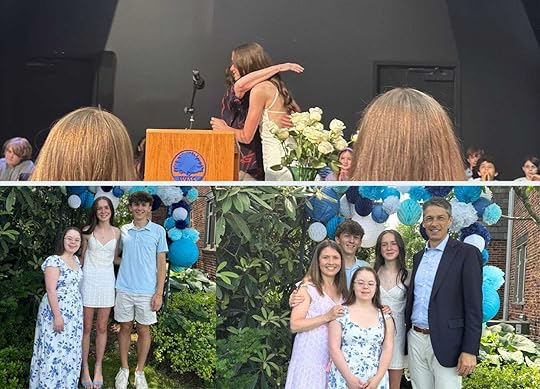
Marilee graduated from 8th grade, which also means she finished 13 years at the only school she’s ever attended. She may never have a relationship with another institution that lasts that long. I am so grateful for the way Washington Montessori School shaped her into the thoughtful, fun, kind young woman she is. I’m even grateful for the hundreds of hours we spent in the car together, where I listened to teenage murder mysteries, we solved the Wordle and Connections, I learned new words like “riz” and “sigma,” and I also—every so often—got to hear about what she was thinking or feeling. She gave a speech (as did each of her classmates) during graduation about the way her school gave her a place of safety, love, and belonging. It also made her into someone who helps other people feel safe and loved and that they belong.
Anniversary
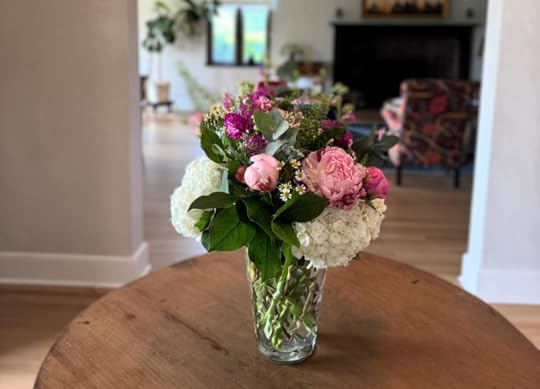
The day of Marilee’s graduation was also our 26th wedding anniversary. Peter and I haven’t done much to celebrate it yet, but he did send me some pretty incredible flowers.
Camp PALS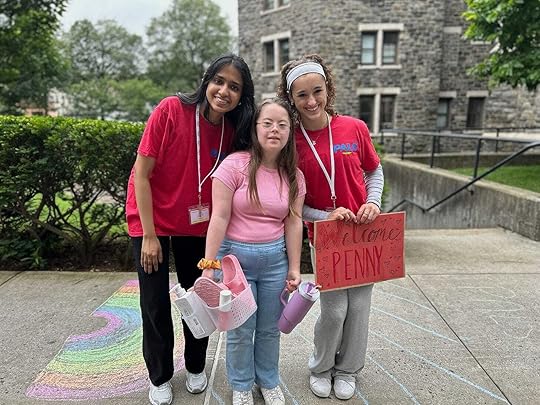
Penny is at Camp PALS, one of her favorite weeks of the year. PALS creates inclusive camp experiences for people with and without Down syndrome. She loves every minute.
A Few Days at the Shore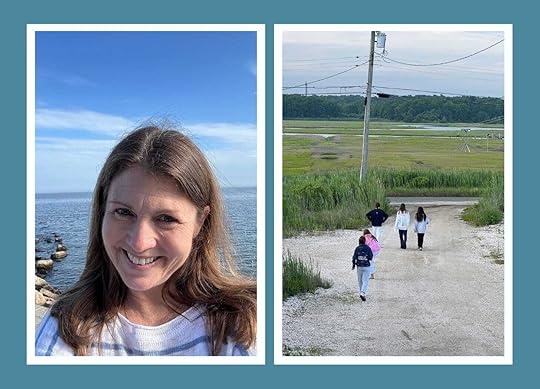
And I get to spend a few days at the shore with Marilee and five of her close friends. I honestly don’t miss the toddler years, or even the elementary school cuteness. But I cherish every one of these days.
Let’s stay in touch. Subscribe to my newsletter to receive weekly reflections that challenge assumptions about the good life, proclaim the inherent belovedness of every human being, and envision a world of belonging where everyone matters. Follow me on Facebook , Instagram , and YouTube and subscribe to my Reimagining the Good Life podcast for conversations with guests centered around disability, faith, and culture.
The post Enjoying June appeared first on Amy Julia Becker.
June 19, 2025
“You are a human. You belong here.”
I’ve been thinking a lot about belonging—what it feels like, where we find it, and how we create spaces that nurture it, spaces that say, “You are a human. You belong here.” I recently talked with , the founder and chief visionary officer of the Lucky Few, about her new children’s book I Like You So Much. She offered such a rich reflection on this topic, and I wanted to share a few thoughts with you here.
Belonging Is a Fundamental Human NeedBelonging isn’t just something we might hope to find—it’s fundamental to being human. In Heather’s words:
“Finding belonging is the deepest desire of every human being.”
And yet, true spaces of belonging—places where we can be unapologetically ourselves, where we can let our shoulders down and simply be—can feel rare.
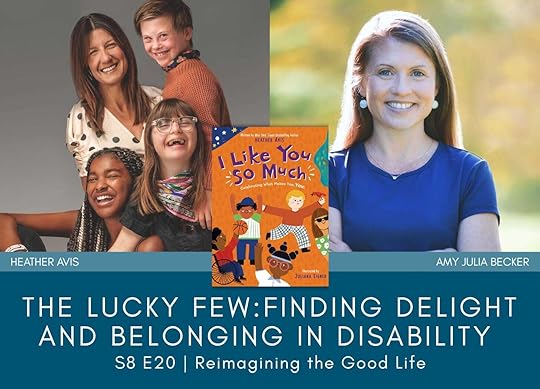 Avis Photo Credit: © Camilynne Photography
LISTEN OR WATCH:
Apple
 |
Spotify
|
YouTube
|
Spotify
|
YouTube

Affirm belonging by “shouting worth”—not waiting for permission to exist, but confidently claiming space for our kids in our communities. When Heather registers her kids with Down syndrome for local programs, she doesn’t ask whether they’re allowed—she assumes they belong.
We are humans. This is a thing for humans. So we’re going to show up.
She goes on to say that when they show up, they also work to create the necessary support. Sometimes that support plan doesn’t work out, so they don’t stay, but that doesn’t hold them back from showing up with the expectation that they belong:
Create space for difference.“At the end of the day, my kids are not asking permission to exist in the world. They’re going to show up in the spaces where other humans exist.”
Belonging doesn’t require sameness. It means being welcomed as you are. Heather’s daughter Macyn doesn’t usually jump into whatever activity is happening, but:
“ She knows she can show up as she is, and she’s embraced in the group. So it’s less about what we’re actually doing and more about the fact that she can come in and out at any time and lean on someone or make herself known or say that she likes something or doesn’t. And there’s no question in the room whether she gets to be that person or not.
We each belong as we are.
Ask: Does this space honor or exclude?There is a difference between spaces that honor and those that other. Heather gives the example of her Black daughter, Truly, starting a Black Student Union at her school—an honoring, affirming space for identity and connection. People with disabilities might also want spaces to connect only with other disabled people, and that can be a good thing. Still, too often, in the disability community, separation is not about honoring. It’s about exclusion.
It’s important to ask: Who’s missing from our communities, our schools, our churches? Are we assuming that certain bodies or minds are less valuable? Or are we celebrating each person’s presence?
Delight and CelebrationDelight and celebration anchor us—especially as parents—amid so many cultural narratives that tell us a child’s worth depends on achievement, ability, or “success.”
“What if we just celebrated and delighted in our kids because they’re them? Not for what they do, but for who they are.”
Whether parenting kids with disabilities, advocating for inclusion, or just being human with one another, may we begin with delight and create spaces where everyone is free to be fully themselves and deeply loved.
I hope you’ll listen or watch and share this episode with a friend.
And I’d love to hear from you. Where have you experienced true belonging? What does “shouting worth” look like in your family? Leave a comment!
Let’s stay in touch. Subscribe to my newsletter to receive weekly reflections that challenge assumptions about the good life, proclaim the inherent belovedness of every human being, and envision a world of belonging where everyone matters. Follow me on Facebook , Instagram , and YouTube and subscribe to my Reimagining the Good Life podcast for conversations with guests centered around disability, faith, and culture.
The post “You are a human. You belong here.” appeared first on Amy Julia Becker.
June 18, 2025
June 2025 | Things Worth Your Time
Books, essays, podcasts episodes, and more that I think are worth your time, plus recent cultural news that I’m paying attention to…
FILMS/MOVIES/DOCUMENTARIESTEDxAtlanta: Cash, Casseroles, and Grief: Rethinking How We Show Up for Each Other | Jordan ArogetiWhen tragedy strikes—whether it’s the death of a spouse, a devastating diagnosis, or a natural disaster—we often ask the same question: How can I help?
Jordan Arogeti introduces a new framework for navigating support during life’s most difficult moments: Support Languages.
SHORT FILM: Loneliness Isn’t Inevitable—See Why
Loneliness is a public crisis.
Friendship is a choice.
I just watched this 6-minute short film from L’Arche. It’s taken from over 18 hours of recorded reflections on loneliness and friendship, and it captures so well both the painful, awkward, heartbreaking experience of loneliness and the heartwarming, connected, surprising joy of friendship. L’Arche communities help create friendships across the social dividing lines of intellectual disability. There’s one man in the film whose words struck me the most. He said that “friendship is being chosen, not scheduled.” This film is an invitation for all of us to choose one another and be present to love.
DOCUMENTARY: The Speed Cubers
This short Netflix documentary follows the competition and friendship between two world-champion Rubik’s Cubers. One of them, Max Park, is autistic. I was drawn to their story because Max’s parents have talked about how they didn’t introduce him to cubing so that he could become a champion. Rather, they realized that solving a cube was a way for Max to develop motor skills, and then, through competitions, to develop social skills. Even more, Max developed friendships and empathy. It’s a beautiful glimpse of what happens when we as parents notice our kids’ interests, passions, and strengths rather than focusing on their deficits.
BOOKSMEMOIR: The Electricity of Every Living Thing by Katherine MayKatherine May came to fame with her book Wintering. I also really loved Enchantment (and got to talk with her on the podcast about that one). So I’m kind of surprised it took me this long to read her first memoir, The Electricity of Every Living Thing. The writing is as crisp and lovely as usual, and her self-deprecating British humor shines a wry, witty light on motherhood, marriage, and being human. All of this happens amidst the twin stories of seeking to hike all the trails along the coast of England while simultaneously discovering—in her late 30s—that she is autistic. I loved her insight, questions, and thoughtfulness throughout this story of self-acceptance.
RESOURCE: Space to Process by Sarah M. Spear
If you are a parent of a disabled child, and if you also like to process your thoughts and feelings by writing, Sarah Spear has offered a wonderful resource. She shares very short vignettes from her family’s life and then offers questions for reflection.
ESSAYSESSAY: Addressing Gaps in Care for Patients with DisabilitiesI knew that many people with disabilities experience discrimination in medical environments, but I had no idea the extent of it. Read here.
ESSAY: Grief and hope: The theological legacy of Walter Brueggemann
I am not alone in my deep appreciation for the life and work of Walter Brueggemann. As Michael DeLashmutt puts it in this piece for Religion News Service:
“Brueggemann wrote as someone who had wrestled with the text in all its complexity and had come out the other side still listening for the voice of God. His prose was academic and lyrical, unsettling and pastoral. Through him, I learned that Scripture could be both historically situated and spiritually alive. He reintroduced me to a Bible that could once again speak to my heart, my mind and to my public witness.”
And:
“What made his work endure wasn’t just his brilliance, though he had that in spades. It was his ability to combine scholarship with pastoral urgency, critique with hope. He was unafraid to name the idols of our age — consumerism, nationalism, white supremacy — and to do so with theological clarity, not as a pundit, but as a prophet. And he did so while remaining, in some deep sense, a preacher of the word.”
If you are new to Brueggemann, maybe start with The Prophetic Imagination. I also highly recommend his commentary on Genesis and his recent pair of books on Exodus.
Get my favorites delivered to your inbox each month!
Subscribe here!
More Favorites and AJB Recommends
If you use a link from here to purchase something I recommend, it sometimes earns me a small commission, which enables me to continue the work I do here. So thank you! (As an Amazon Associate, I earn from qualifying purchases.)
The post June 2025 | Things Worth Your Time appeared first on Amy Julia Becker.
June 17, 2025
Supreme Court Sides With Student With Disabilities
I was encouraged to see that the Supreme Court ruled unanimously to protect the rights of kids with disabilities and their parents. In this case, a family whose daughter had epileptic seizures in the morning, and thus could not learn during those hours, petitioned for her to receive additional instruction in the late afternoon or evening. Their school district in Kentucky accommodated those needs. But once they moved to Minnesota, the new school district refused. Eventually—after years of litigation—they relented, but they refused to compensate the family for the years of providing supplementary education and therapy for their daughter, and a lower court allowed that refusal to stand. The Supreme Court essentially sent the case back to the lower courts but clarified that the school does not have to show “bad faith” or “gross misjudgment” in order to be unjust in its treatment. The simple refusal to accommodate was enough for the family to have a right to sue. The ruling gives other families a broader and clearer way to fight for the rights of their children to educational accommodations.
Okay, so that’s a rather lengthy explanation. I wanted to point out not only the facts of the case, but also that Aaron Tharpe, father of the child who was denied accommodations, told NPR he was pursuing the lawsuit not only on behalf of his daughter, but also on behalf of all the other children who have been and could be denied accommodations. “This is bigger than our family,” he said.
Our cultural moment sometimes seems so individualized, and yet the disability rights movement has always depended on a sense of collective concern. We take steps forward not only for our own families, but for all the ones who come behind us. This victory is yet another moment of solidarity and community and interdependence where one family fought on behalf of their beloved daughter, and on behalf of countless individuals they will never know by name.
Let’s stay in touch. Subscribe to my newsletter to receive weekly reflections that challenge assumptions about the good life, proclaim the inherent belovedness of every human being, and envision a world of belonging where everyone matters. Follow me on Facebook , Instagram , and YouTube and subscribe to my Reimagining the Good Life podcast for conversations with guests centered around disability, faith, and culture.
The post Supreme Court Sides With Student With Disabilities appeared first on Amy Julia Becker.
June 15, 2025
Cinderella Syndrome
Cinderella syndrome. I coined this phrase in conversation with my counselor a few years ago. I suffer from Cinderella syndrome every time I feel like I can’t do what I really want to do unless I get all the menial chores done. And, beyond that, I know that the only way they will get done is if a fairy godmother and some enterprising mice show up to help.
Whenever I feel this way, it’s a signal that I need to pause and reflect. Usually, I’m overwhelmed by tasks. And usually, I’m resentful of various members of my family for not helping with said tasks. And usually, I can either ask for help, let things go, or simply wait to accomplish those tasks.
Let’s stay in touch. Subscribe to my newsletter to receive weekly reflections that challenge assumptions about the good life, proclaim the inherent belovedness of every human being, and envision a world of belonging where everyone matters. Follow me on Facebook , Instagram , and YouTube and subscribe to my Reimagining the Good Life podcast for conversations with guests centered around disability, faith, and culture.
The post Cinderella Syndrome appeared first on Amy Julia Becker.
June 13, 2025
Sparkle Show
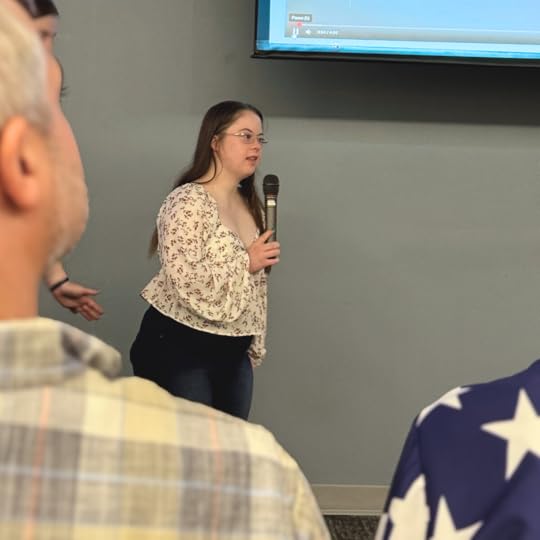
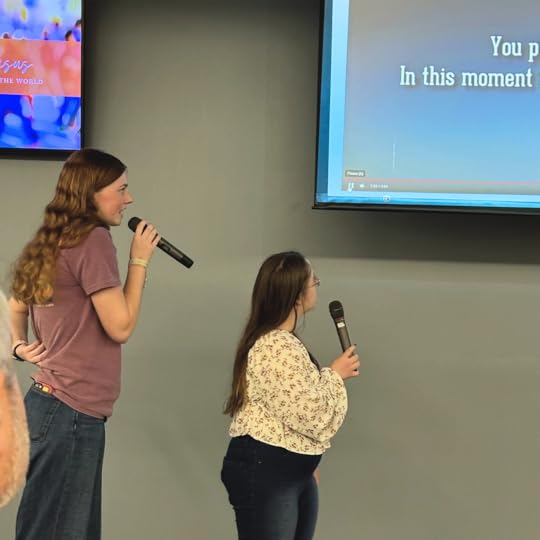
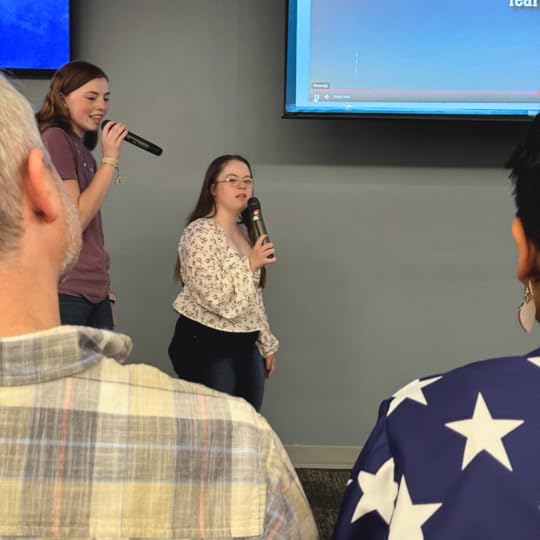
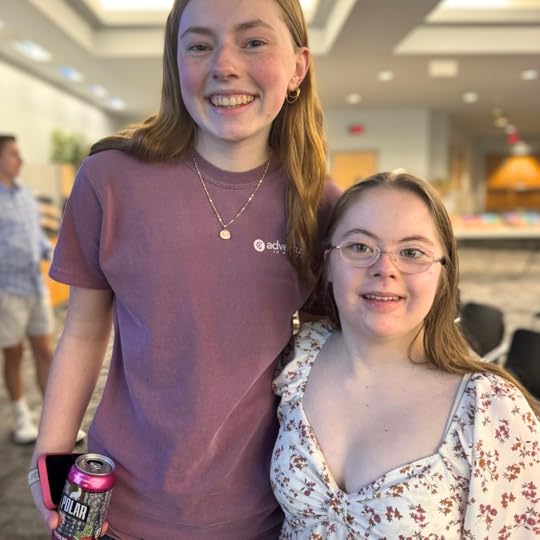
Penny decided to participate in our new church’s Sparkle Show with a friend by singing along to Taylor Swift’s Fearless.
It’s no small thing that she wanted to be there, or that we’ve happened upon a church that has a vibrant group of young adults with disabilities who enjoy one another.
Shared with permission
Let’s stay in touch. Subscribe to my newsletter to receive weekly reflections that challenge assumptions about the good life, proclaim the inherent belovedness of every human being, and envision a world of belonging where everyone matters. Follow me on Facebook , Instagram , and YouTube and subscribe to my Reimagining the Good Life podcast for conversations with guests centered around disability, faith, and culture.
The post Sparkle Show appeared first on Amy Julia Becker.
June 12, 2025
Parents and Caregivers of Kids With Disabilities, I Need Your Help!
I’ve had a few different book ideas percolating for a while now, and I would love your help as I work to bring the next one into the world. For the past fifteen years or so, my books have released every three to four years.
My writing cycle typically involves:
Year One: waiting for an idea, then sitting with the idea and trying it out in small ways, like social media posts and essays
Year Two: writing a proposal and finding a publisher
Year Three: writing the book itself
Year Four: talking about the book and learning so much more along the way
To Be Made Well came out three years ago, so I’m already behind in this process. I do not have a publisher for whatever comes next, but I also find myself with a backlog of ideas for at least three new books in my head!
Still, I’ve decided to turn my attention toward a book for parents and caregivers of children with disabilities who want to know that their family matters and that they can take the next step toward a good future. The book is based on my Reimagining Family Life with Disability workshop and has three main sections, which should equip readers to:
Delight in your childConnect to communityTake the next step toward a good futureI’m still in the early stages of drafting a proposal, chapter outline, and writing this book. And that’s where you come in.
If you are a parent or caregiver of a child (of any age) with a disability (of any type), what are your top three questions about reimagining family life with disability? (If you need more prompts: What feels impossible to you right now? What gets in the way of imagining a good future for your family? What would help you believe a good future is possible?) Leave a comment below, send me an email, message me from my Contact page.
I would love to hear from you (and/or from your friends—please share this newsletter with people who might be willing to respond). I’ll keep you posted on how this process goes. Thank you for your thoughts and questions!
Let’s stay in touch. Subscribe to my newsletter to receive weekly reflections that challenge assumptions about the good life, proclaim the inherent belovedness of every human being, and envision a world of belonging where everyone matters. Follow me on Facebook , Instagram , and YouTube and subscribe to my Reimagining the Good Life podcast for conversations with guests centered around disability, faith, and culture.
The post Parents and Caregivers of Kids With Disabilities, I Need Your Help! appeared first on Amy Julia Becker.
June 11, 2025
Staying Present
The other day, I was stranded in a small town just waiting for William to finish up an exam, pack his dorm room, and summon me to drive him home. I had work to do. I had books to read. But I also had an unexpected few hours in the late afternoon, when I’m usually driving carpool. I’m not much of a wanderer by nature, but I decided to wander. I happened upon an old rail trail, and I was given a few minutes to soak in the expanse of blue sky and the abundance of purple and white phlox. And it all reminded me of the truth of all the wise people who have gone before me and encouraged me to stay present to this moment and wonder at the gift of it all.
I feel the same when the flowers in late May and early June startle me with their intense beauty every single time. As it happens, I inherited a beautiful flower garden that I neither planted nor nurtured, and yet I am the recipient of its beauty for months on end.
Let’s stay in touch. Subscribe to my newsletter to receive weekly reflections that challenge assumptions about the good life, proclaim the inherent belovedness of every human being, and envision a world of belonging where everyone matters. Follow me on Facebook , Instagram , and YouTube and subscribe to my Reimagining the Good Life podcast for conversations with guests centered around disability, faith, and culture.
The post Staying Present appeared first on Amy Julia Becker.
June 5, 2025
How Striving to Be Better Than Others Makes Us Worse
The other day, I was talking with our son, William, who’s a junior in high school. He’s starting to think about where he might want to go to college, and all the questions that come with that.
At one point in our conversation, we started talking about how having an identity rooted in love might change the way he approaches the college application process. I asked, “Isn’t it freeing that you don’t have to get into X, Y, or Z in order to be okay?”
He said, “It’s freeing. But it’s also motivating because I can go for X, Y, and Z. And if I don’t get in, I’m still okay.”
That caught me off guard. I’d been thinking about how freeing it would be to step off the treadmill of achievement—to believe you’re okay, even if you don’t get into the top schools or hit all the milestones our culture tells you are necessary for success. But William reminded me that when you know you’re already loved, already enough, you’re actually freed up to pursue those goals, but not because you need them to prove something.
Striving for Excellence, not SuperiorityIt’s a different kind of striving—striving for excellence, not superiority. And it comes from a place of rest, not fear.
In many ways, our daughter Penny, who has Down syndrome, shows us what that kind of life can look like. She doesn’t strive in the same way the rest of us do. She doesn’t measure her worth—or anyone else’s—by success or comparison. She simply lives in the goodness of who she is. And that has become an invitation to the rest of us—to step back, to notice, to wonder if maybe we don’t have to prove ourselves all the time either.
It’s made me think about how this culture of comparison and competition distorts our understanding of ourselves—and of others. When our worth depends on being better, faster, smarter, or more accomplished, we’re never quite enough. There’s always someone else to measure against. And that constant striving can be exhausting.
But what if we believed we were already enough?
LISTEN OR WATCH:
Apple
|
Spotify
|
YouTube
That doesn’t mean we stop growing or working hard or dreaming big. As theologian Miroslav Volf has said, there’s nothing wrong with striving toward what’s good and meaningful. The problem comes when we strive from a place of fear or scarcity—when we think we have to be better than someone else in order to be okay.
What I’m learning, slowly and imperfectly, is that we are invited to live from a place of abundance. Of love. Of belonging. And from there, everything changes.
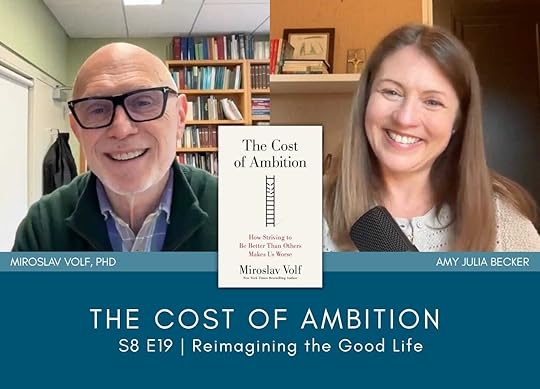
The Cost of AmbitionMiroslav joined me on the podcast to talk about his latest book, The Cost of Ambition: How Striving to Be Better Than Others Makes Us Worse. We explore:
The dark side of competitionStriving for excellence vs. striving for superiorityThe illusion of individual achievementPractices for embracing love and generosityWhat happens in a community where everyone is trying to be better than each other? And what happens when we stop striving for superiority? Here are some insights from Miroslav:
The Cost of Constant Comparison“You don’t have sufficient capital of self-love to extend the hand of friendship.” —MV
When we’re always measuring ourselves against others, we lose our capacity for generosity, joy, and connection. We stop supporting others. We struggle to celebrate their success. We see life as a competition—where someone must lose for us to win.
The Loneliness Behind the “Self-Made” Myth“There are a lot of people that have genuine merit, but the problem then becomes when they ascribe the entirety of their merit to themselves.”—MV
As a professor at Yale, Miroslav says he’d credit maybe 2% of his success to himself. We’re shaped by parents, mentors, and communities. The myth of being “self-made” isolates us.
A World of Abundance“We are garbaging the world… using it to shore up our fragile self.” —MV
We “garbage the world” and fail to recognize and experience true abundance when we only value what gives us a sense of being better than others. Instead of striving for more achievements and possessions to bolster our identity, Miroslav invites us to nurture the “spirituality of appreciation… to long for what we have.” He says: “I can breathe the fresh air freely and be who I am… It’s almost paradise when we give up on striving for superiority.”
I hope you’ll listen (or watch), and then share this episode with a friend. How do you distinguish between striving for excellence and striving for superiority in your own life or in your children’s lives? Leave a comment. I’d love to hear from you.
Let’s stay in touch. Subscribe to my newsletter to receive weekly reflections that challenge assumptions about the good life, proclaim the inherent belovedness of every human being, and envision a world of belonging where everyone matters. Follow me on Facebook , Instagram , and YouTube and subscribe to my Reimagining the Good Life podcast for conversations with guests centered around disability, faith, and culture.
The post How Striving to Be Better Than Others Makes Us Worse appeared first on Amy Julia Becker.