Amy Julia Becker's Blog, page 6
July 28, 2025
Life, Animated
Journalist Ron Suskind’s son Owen was diagnosed with autism at age three. Over the course of the previous year, Owen had stopped talking and seemed more and more withdrawn from the world. It felt to his parents like they were losing him. Owen remained interested in Disney movies. He watched them over and over. He recited lines from the movies. He learned to draw his favorite characters. Eventually, his parents wondered whether Owen might be using the films to communicate. He wasn’t simply mimicking lines. He was using lines that applied to how he was feeling, even if he didn’t have the words to say it. He was connecting, and communicating, and engaging purposefully with the world around him, albeit in an unusual way.
Suskind tells the story of their family in his 2016 book Life, Animated. Their journey to connect to Owen and provide the support Owen needs to learn and have friends and work all springs from this love of Disney. Instead of focusing on Owen’s deficits and all the ways he deviates from typical kids, they leaned into and celebrated what he loved most. Disney became the language through which they could understand and support Owen, and through which Owen could express his love in return.
The Suskinds started with delight on their autism journey. There was hardship along the way. They experienced grief in all the ways so many parents do—both the grief we don’t want to feel about kids who don’t meet our expectations and the grief of watching our kids endure rejection and misunderstanding and bullying. But love and celebration of who Owen is became a container that held the grief and hardship. Starting with delight gave them a place to return that honored their son and gave them a vision for a good future.
Suskind is a Pulitzer-prize winner, and he connects his tremendous writing skill and his deep love of his family together to tell a story of honesty and hope.”
In our own family, we’ve also learned to start with delight. Penny is 19 years old now. We still have a lot to navigate, but we’ve also learned some general principles about how to be parents of a child with a disability. We’ve learned to start with delight, connect to community, and take the next step towards a good future.
Let’s stay in touch. Subscribe to my newsletter to receive weekly reflections that challenge assumptions about the good life, proclaim the inherent belovedness of every human being, and envision a world of belonging where everyone matters. Follow me on Facebook , Instagram , and YouTube and subscribe to my Reimagining the Good Life podcast for conversations with guests centered around disability, faith, and culture.
The post Life, Animated appeared first on Amy Julia Becker.


July 17, 2025
“The Work of Caring for My Daughter Will Never Be ‘Efficient’”
I am very grateful to Julie Kim for writing about the importance of the Department of Education—and her concern over the Trump administration’s cuts to that department and the recent Supreme Court decision that allows those cuts to continue. She writes about the significance of a whole network of people who not only care for and teach her daughter Izzy but also care for and teach her how to be Izzy’s mom. She writes that she looks
“For bodies and minds filling school hallways and classrooms; for trained administrators, teachers, aides, and therapists who do the slow, important work of meeting children where they are, while modeling for those students’ parents how to do the same. This is the hard work of building a more accommodating society. It will never be efficient.”
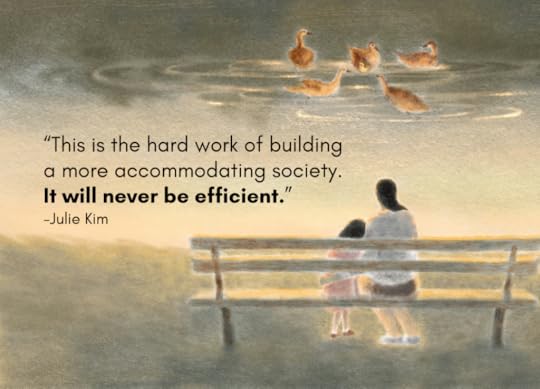
I agree with all of Kim’s points about how important it is to keep the civil rights protections and additional funding for special education. Such protections are a matter of both compassion and justice. But Kim takes it a step further. I love the way she articulates the residual benefits and life-transforming aspects of being Izzy’s mom. She explains that most of her own education had been a matter of “prize-collecting.” In reflecting on this way of being, she writes:
“One of the ugly truths of prize-collecting, especially under a regime of ‘efficiency,’ is that it feeds off anxieties about scarcity: Even within close-knit communities, individuals are positioned to compete with one another for pieces of a pie that only shrinks. The narrowness of that value system doesn’t account for Izzy’s contribution to society as that rare someone who is easy to love and who also gives love easily to anyone willing to meet her where she is. And the loneliness of abiding by that value system, of being confined by it, no longer serves me as her mother.”
Yes, the way of scarcity does not serve any of us. It keeps us in a zero-sum game of winners and losers when we are actually invited into a life of abundance, generosity, and love for one another.
Let’s stay in touch. Subscribe to my newsletter to receive weekly reflections that challenge assumptions about the good life, proclaim the inherent belovedness of every human being, and envision a world of belonging where everyone matters. Follow me on Facebook , Instagram , and YouTube and subscribe to my Reimagining the Good Life podcast for conversations with guests centered around disability, faith, and culture.
The post “The Work of Caring for My Daughter Will Never Be ‘Efficient’” appeared first on Amy Julia Becker.
July 14, 2025
Choosing not to worry about your children (and how to turn worry into prayer)
“Big kids, big problems.” I’ve heard the phrase for years, and I’ve been a little dismissive of it. I love having teenagers. I love the conversations we have about current events. I love sharing podcast recommendations and cooking together and traveling and talking about relationships and just watching them put down their roots and grow into themselves.
But as I spent yet another middle-of-the-night anxiety session circling around my different fears for each of our kids, I realized how easy it would be to spend the next few years (the next few decades?!?) worrying about them. I could worry about their eating habits—too much, too little? Whether or not they will be abused in word or action by friends or romantic partners. Whether or not they will even have friends or romantic partners. Whether they will know how deeply valuable and beloved they are. Whether they will let their own inherent light shine bright in this world or whether it will be darkened by social pressure and insecurity and anxiety.
One thing I’ve learned about myself in the past year is that sometimes I need to decide not to worry, and as I tossed and turned yet again—on vacation, no less—with anxiety, I realized that this is one of those moments. Of course, by deciding not to worry I want to remain engaged and responsive. Just not anxious about all the things I cannot control, even if somehow the anxiety gives me an illusion of control. Just not someone who deceives herself into thinking that if I fret enough, they will be okay.
For me so far, this decision not to worry starts with prayer. I asked God to show me ways to pray for each of them—to give me words and images that I can hold in my heart as they emerge into this beautiful, broken world. And I also asked God to care for them and protect them. But deciding not to worry doesn’t mean deciding not to care. It’s still my job to listen, to show up, to ask them questions and give them guidance. Deciding not to worry means becoming responsive instead of reactive, grounded instead of spinning, present to their needs rather than controlling their behavior. So, yes, big kids, big problems. Those problems will invariably lead me to big worries. I’m still learning how to turn from big worries to little prayers over and over again.
Reminder! Get your free download: 30 Next Steps for Parents… for when you feel overwhelmed by all the things you could be doing to support your kids.
Let’s stay in touch.
Subscribe
to my newsletter to receive weekly reflections that challenge assumptions about the good life, proclaim the inherent belovedness of every human being, and envision a world of belonging where everyone matters. Follow me on
Facebook
,
Instagram
, and
YouTube
and subscribe to my
Reimagining the Good Life
podcast for conversations with guests centered around disability, faith, and culture.
The post Choosing not to worry about your children (and how to turn worry into prayer) appeared first on Amy Julia Becker.
July 13, 2025
July 2025 | Things Worth Your Time
Books, essays, podcasts episodes, and more that I think are worth your time, plus recent cultural news that I’m paying attention to…
BOOKSNOVEL: How to Read a Book: A Novel by Monica WoodOne of you recommended this to me, and I loved it, so thank you! It tells the story of a women’s book club—in prison. You can probably imagine the humanity that comes forth in this setting, so I won’t say anything more except to commend this book as a sweet, thoughtful story about reckoning with our mistakes and bad choices and living with hope and forgiveness.
NOVEL: Hello Beautiful by Ann NapolitanoThis story spans decades in the life of a family of four girls in Chicago. It deals with topics of love and loss and misunderstanding and the need for hope and forgiveness and the unrelenting desire of the human ego to run away from who we really are and the unrelenting desire of the human soul to show up as we really are. The writing is beautiful, the characters are infuriating and delightful all at once, and I did not want this book to end.
Memoir: Life, Animated by Ron SuskindJournalist Ron Suskind’s son Owen was diagnosed with autism at age three. Over the course of the previous year, Owen had stopped talking and seemed more and more withdrawn from the world. It felt to his parents like they were losing him. Owen remained interested in Disney movies. He watched them over and over. He recited lines from the movies. He learned to draw his favorite characters. Eventually, his parents wondered whether Owen might be using the films to communicate. He wasn’t simply mimicking lines. He was using lines that applied to how he was feeling, even if he didn’t have the words to say it. He was connecting, and communicating, and engaging purposefully with the world around him, albeit in an unusual way.
Suskind tells the story of their family in his 2016 book Life, Animated. Their journey to connect to Owen and provide the support Owen needs to learn and have friends and work all springs from this love of Disney. Instead of focusing on Owen’s deficits and all the ways he deviates from typical kids, they leaned into and celebrated what he loved most. Disney became the language through which they could understand and support Owen, and through which Owen could express his love in return.
The Suskinds started with delight on their autism journey. There was hardship along the way. They experienced grief in all the ways so many parents do—both the grief we don’t want to feel about kids who don’t meet our expectations and the grief of watching our kids endure rejection and misunderstanding and bullying. But love and celebration of who Owen is became a container that held the grief and hardship. Starting with delight gave them a place to return that honored their son and gave them a vision for a good future.
Suskind is a Pulitzer-prize winner, and he connects his tremendous writing skill and his deep love of his family together to tell a story of honesty and hope.”
In our own family, we’ve also learned to start with delight. Penny is 19 years old now. We still have a lot to navigate, but we’ve also learned some general principles about how to be parents of a child with a disability. We’ve learned to start with delight, connect to community, and take the next step towards a good future.
FILMS/MOVIES/DOCUMENTARIESTV SERIES: AndorWe just finished season 1 of Andor, and it lived up to the hype. I am not a big Star Wars fan, but this prequel to the Star Wars franchise offers a thought-provoking meditation on human freedom. There’s complexity in the characters—the bureaucrats working for the Empire sometimes think they are doing everything in the name of what is good and true, and the rebels run the gamut from quiet resistance from inside the system and those seeking to overthrow it from the outside looking in. I started watching Andor on Jemar Tisby, PhD’s recommendation, so read his Substack here for more on why this show matters in our time.
TEDx | I’m not your inspiration, thank you very much | Stella YoungAs I work on this next book, I’m returning to some resources from a while ago, including this Tedx talk by Stella Young. Young explains the idea of “inspiration porn,” images that objectify disabled people for the benefit of nondisabled people. As she says, “Disability is not a bad thing. And it doesn’t make you exceptional.” She says she envisions a world in which disability is not the exception, but the norm.
RESOURCESRESOURCE: How to Slow Down and Be a Peaceful Presence When Tensions Are HighThis short, thoughtful guide is all about how to slow down and stay grounded when tensions run high.
RESOURCE: DIGNITY TRAILERI love seeing organizations use their imaginations to create a world of welcome and belonging. Watch this short video from Certain Hope Community in Michigan about the dignity trailer. “Designed exclusively for special needs families, this fully accessible mobile restroom is equipped with features built upon the beacon of inclusivity and compassion.”
ESSAYSATLANTIC ESSAY: “Why Evangelicals Turned Their Back on PEPFAR”I am still saddened by the Trump administration’s decision to effectively end PEPFAR, the program that saved tens of millions of lives in this century. And after reading Peter Wehner’s account of why evangelical Christians have failed to protest its demise, I’m not only saddened but angered. We don’t want to be the ones who walk to the other side of the road when we see our brothers and sisters in need.
NYT ESSAY: “Autism Rates Have Increased 60-Fold. I Played a Role in That.”I appreciated this succinct history of the way clinicians diagnose autism spectrum disorder and how these changes have led to the increase in both helpful and false diagnoses.
ESSAY: “Inclusive Worship Shouts, Shushes, and Sings to the Lord”I hope more and more churches consider what it looks like to create welcoming spaces for all sorts of people. This essay offers some suggestions on how and why we can
Get my favorites delivered to your inbox each month!
Subscribe here!
More Favorites and AJB Recommends
If you use a link from here to purchase something I recommend, it sometimes earns me a small commission, which enables me to continue the work I do here. So thank you! (As an Amazon Associate, I earn from qualifying purchases.)
The post July 2025 | Things Worth Your Time appeared first on Amy Julia Becker.
July 11, 2025
Our daughter has Down syndrome. Can she live a full life?
Here’s what I know… Penny has different capacities when it comes to learning, but she has no limits on her capacity to love, or to live a full life. Our value as humans arises out of our belovedness, not our potential to produce.
Penny challenges me to pay more attention to people instead of tasks, to laugh instead of curse when I make a mistake, and to value mutuality more than self-sufficiency.
Penny doesn’t strive the way many of us do. She doesn’t measure her worth—or anyone else’s—by success or comparison. She simply lives in the goodness of who she is. And that has become a quiet invitation to the rest of us. An invitation to step back and ask:
What if we don’t have to prove ourselves all the time either?
Can Penny live a full life without reading Dostoevsky or solving a quadratic equation? I’m pretty sure she can. Can I live a full life without learning to cherish and welcome those in this world who are different from me? I’m pretty sure I can’t.
People who live with Down syndrome do face hardship and suffering. They also live lives of beauty, purpose, and love.
Read more in my 2023 essay for TIME: Doctors Don’t Know How to Talk About Down Syndrome
Let’s stay in touch. Subscribe to my newsletter to receive weekly reflections that challenge assumptions about the good life, proclaim the inherent belovedness of every human being, and envision a world of belonging where everyone matters. Follow me on Facebook , Instagram , and YouTube and subscribe to my Reimagining the Good Life podcast for conversations with guests centered around disability, faith, and culture.
The post Our daughter has Down syndrome. Can she live a full life? appeared first on Amy Julia Becker.
July 10, 2025
Assumptions Without Curiosity
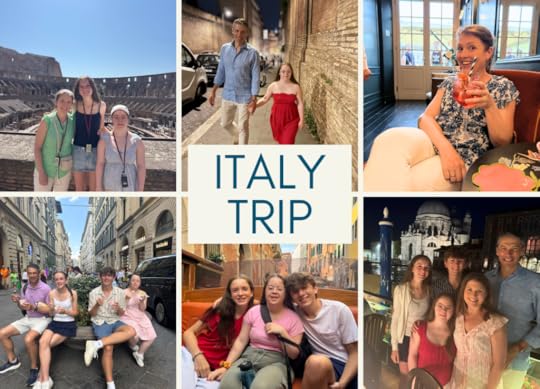
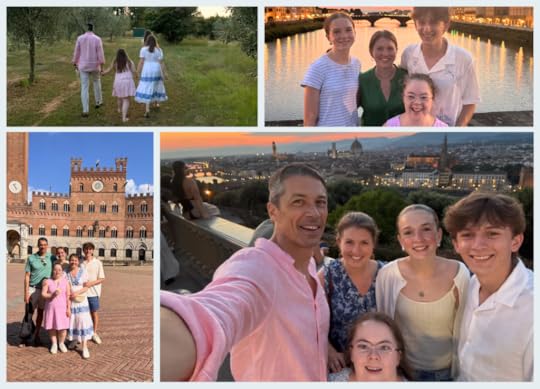
We just returned from two weeks in Italy as a family. It held all the things we had hoped for. We peeked into churches with some of my favorite Caravaggio paintings and talked for a long time about Michelangelo’s David and whether or not there is such a thing as “genius.” We climbed towers and stood inside Etruscan tombs and rode in a water taxi in Venice. We ate our way through each city, but also walked nearly 20,000 steps each day. The cheese and bread and olive oil and wine and daily afternoon snack of gelato fueled us well. And we laughed together. What a gift.
But there were a few moments that interrupted the feeling of being anonymous Americans just enjoying the standard tourist attractions.
 Assumptions Without Curiosity
We were standing in line for the Vatican when a man approached Peter and said, “You know, special children get in for free.” He said it loudly, and he pointed at Penny. He went on to insist that we get a refund for her ticket.
Penny immediately turned away and looked down. We were all a little taken aback by the exchange. On the one hand, we applaud policies and programs that signal welcome and support for disabled people and their families. On the other, as Penny said later, “I didn’t like that he talked about me with Dad instead of talking to me. And I didn’t like that he did it so publicly.”
As the trip progressed, there were other little indications that people didn’t see Penny in the same way that they saw Marilee and William. Those little exchanges can be summed up by the waiter who removed a wine glass from Penny’s place setting (note: she’s the 19-year-old, who legally could drink wine in Italy), but offered wine to Marilee (14) and William (16).
Our friend Katherine Wolf, co-founder of Hope Heals, talks about having “curiosity without assumptions” when it comes to disability.
Curiosity without assumptions = welcome, insight, connection
Assumptions without curiosity = stereotypes, exclusion, dehumanization
We realized at the end of the trip that many people treated Penny with “assumptions without curiosity.” She doesn’t mind people noticing that she has Down syndrome. We understand people might wonder whether she has particular needs or limitations when it comes to mobility or communication. But it’s a problem when everyone assumes that she can’t order her own dinner or speak for herself or ask questions or drink wine. Curiosity isn’t a problem, but assumptions without curiosity sting.
Assumptions without curiosity lead to stereotypes and dehumanization. Instead of seeing Penny as a particular individual, she is not really seen at all.
Renaissance Art and Curiosity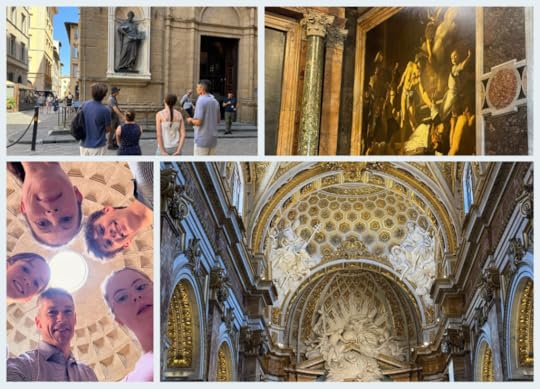
Over the course of our time in Tuscany, we looked at paintings that show the transition from the Byzantine period through the Renaissance. From flat, standard, idealized forms to the faces of real humans with emotions and distinctiveness. The Renaissance artists became curious. And what they were able to offer in return for that curiosity was creativity, beauty, and an explosion of color and insight and truth about the human soul.
We return from our trip filled with gratitude, for the time together and the experience of places with thousands of years of history and, yes, again, the gelato. But we also return especially grateful for the people—both past and present, both here and abroad—who are curious without assumptions and the ways that curiosity leads to creativity, beauty, generosity, and care.
I’d love to hear from you! When have you noticed yourself shifting from assumption to curiosity? What made the difference? Leave a comment!
Reminder! Get your free download: 30 Next Steps for Parents… for when you feel overwhelmed by all the things you could be doing to support your kids.
Let’s stay in touch.
Subscribe
to my newsletter to receive weekly reflections that challenge assumptions about the good life, proclaim the inherent belovedness of every human being, and envision a world of belonging where everyone matters. Follow me on
Facebook
,
Instagram
, and
YouTube
and subscribe to my
Reimagining the Good Life
podcast for conversations with guests centered around disability, faith, and culture.
The post Assumptions Without Curiosity appeared first on Amy Julia Becker.
July 8, 2025
The Big, Beautiful Bill?
As we return from vacation and I get back up to speed on the news, I’m trying to wrap my head around the implications of the “Big, Beautiful Bill” that just passed through Congress. Here’s what I do know:
It cuts Medicaid, putting more vulnerable people at risk. It increases financial advantages for the wealthy.
I’m someone who stands to benefit individually from this recent legislation, and yet I see this bill as a loss personally and collectively because it does not seek the common good. Our economy in general operates from a perspective of Winners vs. Losers and Givers vs. Takers.
It feeds a collective attitude of:
Taking what we want—rather than receiving what we are givenGiving only to those who deserve it—rather than assuming we all belong to each otherWhat might it look like to lovingly resist the assumptions of this zero-sum game?
Walter Brueggemann writes:
“piety can imagine an alliance between the needy poor who refuse to be submissively silent in a context of exploitation and the prosperous wealthy who refuse to be defined by their wealth.”
Brueggemann urges us to consider: What if we were defined not by wealth or power, but by love of neighbor and a belief that generosity helps us all flourish?
Okay, but what does this have to do with political legislation and tax reform and Medicaid? I’m still working that out, but one thought I’ve had is that even if our government doesn’t operate from abundance, we can.
In our homes.
In our churches.
In our communities.
What could that look like? One way that people will be denied Medicaid coverage, for instance, is through cumbersome paperwork requirements. What if churches and other civic organizations offered free clinics to help people navigate that paperwork? Or what if people like me—who receive a tax break through this legislation—look for ways to invest what would have been paid in taxes in opportunities for more vulnerable people to flourish?
What if we refused to be defined by what we have, and chose instead to be defined by love?
Let’s stay in touch. Subscribe to my newsletter to receive weekly reflections that challenge assumptions about the good life, proclaim the inherent belovedness of every human being, and envision a world of belonging where everyone matters. Follow me on Facebook , Instagram , and YouTube and subscribe to my Reimagining the Good Life podcast for conversations with guests centered around disability, faith, and culture.
The post The Big, Beautiful Bill? appeared first on Amy Julia Becker.
July 5, 2025
Kids, Disability, and Relationships
Here’s what I wish parents of typically developing kids knew about disability and relationships: Disability isn’t a completely different experience. It’s often a magnified version of the human experience we all share.
For example, what might be mildly stressful for your child—a loud noise, a crowded room, unfamiliar textures—could be intensely stressful for a child with a disability. Our children are not fundamentally different, but my child’s sensitivities and responses might be heightened.
Disability may magnify certain challenges. But it can also magnify empathy, creativity, and connection. If your child wants to invite a peer with a disability to play, here are some helpful steps:
Talk about what to expect.Create a calm and welcoming environment.Ask questions if you’re unsure.Assume friendship is possible.Disability can feel unfamiliar at first, but shared experiences build understanding. And remember:
Inviting a child with a disability into your home or your child’s life is an opportunity for growth and joy—for both of them.
Mutuality is the foundation from which true friendship grows.
More with Amy Julia:
Let’s stay in touch. Subscribe to my newsletter to receive weekly reflections that challenge assumptions about the good life, proclaim the inherent belovedness of every human being, and envision a world of belonging where everyone matters. Follow me on Facebook , Instagram , and YouTube and subscribe to my Reimagining the Good Life podcast for conversations with guests centered around disability, faith, and culture.
The post Kids, Disability, and Relationships appeared first on Amy Julia Becker.
June 27, 2025
When the Eye Twitch Comes Back—And What That Has to Do With Hope
As those of you who have read White Picket Fences may remember, I developed an eye twitch when I was working on that book. So maybe I shouldn’t be surprised that said eye twitch has returned, even though I was not conscious of feeling a lot of fear around the next book. Thankfully, I wrote To Be Made Well in the interim, so I’m more equipped than I was eight years ago to address moments when my body tells me I’m experiencing stress (even when my mind disagrees). So, every time the twitch began, I paused, closed my eyes, breathed deeply, and prayed for insight as to what was prompting it.
After a week or so of this, I was listening to a (fantastic) talk by Andy Crouch. In this talk, he quoted from Paul’s prayer for the Ephesians in chapter 1. Paul prays, “that the God of our Lord Jesus Christ, the Father of glory, may give you a spirit of wisdom and revelation as you come to know him, so that, with the eyes of your heart enlightened, you may perceive what is the hope to which he has called you…” I started to meditate on the idea of having the “eyes of my heart enlightened,” and asking God to show me what I need to see. But I have also begun to ask that with that insight I might be able to see clearly “the hope to which he has called” me. Yes, I want to be a person of hope in God’s love and grace in a general way. But I also want to perceive—to understand clearly—the particular hope to which I have been called. I want to steward that hope well. I want to proclaim that hope to the people who need it most. For me right now, the particular hope I get to tell people about is that disabled people, of all ages, of all diagnoses, of all skill-levels, matter. They are beloved. They have purpose. We need them. We need each other.
Particular HopeI recently learned the story of Chiune Sugihara, a Japanese diplomat in Lithuania in 1939, who was at work when the Germans occupied Lithuania. When hundreds of Jewish Lithuanians petitioned him for visas to flee the country, he defied his government’s orders. He worked ceaselessly over the next few weeks to issue 2,100 visas, essentially saving all those lives. He later lost his job and worked as a laborer in Japan for the rest of his days. He knew the particular hope to which he was called, and he lived it out.
Let’s stay in touch. Subscribe to my newsletter to receive weekly reflections that challenge assumptions about the good life, proclaim the inherent belovedness of every human being, and envision a world of belonging where everyone matters. Follow me on Facebook , Instagram , and YouTube and subscribe to my Reimagining the Good Life podcast for conversations with guests centered around disability, faith, and culture.
The post When the Eye Twitch Comes Back—And What That Has to Do With Hope appeared first on Amy Julia Becker.
June 26, 2025
When the parenting to-do list feels like a flood and I catastrophize
I get overwhelmed pretty regularly by all the things I could be doing to support our kids. Marilee is heading to a new school in the fall, and the forms and the preparation for sports and having a roommate and just spending time with her before she goes away feels big and scary. William just finished his junior year, so we are thick in the college search process and SAT prep, not to mention getting a driver’s license and nudging him to make some spending money. And then there’s Penny, 19 years old now, with Down syndrome, navigating the world of early adulthood. The list of things I could be doing to support her sometimes feels like a flood.
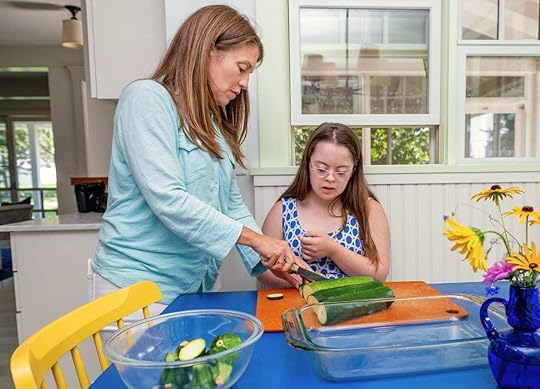 Photo by Cloe Poisson {2024}When I’m tempted to catastrophize…
The torrent began a few months ago when we realized that Penny probably couldn’t get a job through a local program as planned. I fought against catastrophizing. Eventually, I remembered the words I tell people in the Reimagining Family Life with Disability workshops: start with delight, connect to community, and take the next step towards a good future.
We started with delight:
Penny and I sat down together and made a list of places where she might enjoy working or volunteering.
We connected to community by reaching out to people we know:
She emailed a local bookstore, our church, and a wedding planner, and she texted a neighbor interested in having someone read to her daughter. Two of them never responded, but two said they would love to have her involved in some way this summer.
And now we take it one small step at a time.
(The same is true with our other kids; I just tend to do less catastrophizing with them!)
Free CalendarIf you are a parent who finds yourself needing some encouragement to start with delight, connect to community, and take the next step towards a good future—I’m sending along a free calendar with 30 simple next steps to get you going. Each one takes five minutes or less.
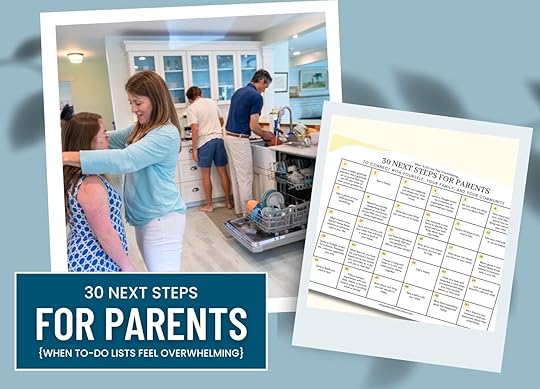 DOWNLOAD THE CALENDAR
I’m excited to see what the future holds for all of us and for each of our kids.
Happy Summer!
Let’s stay in touch. Subscribe to my newsletter to receive weekly reflections that challenge assumptions about the good life, proclaim the inherent belovedness of every human being, and envision a world of belonging where everyone matters. Follow me on Facebook , Instagram , and YouTube and subscribe to my Reimagining the Good Life podcast for conversations with guests centered around disability, faith, and culture.
The post When the parenting to-do list feels like a flood and I catastrophize appeared first on Amy Julia Becker.