Amy Julia Becker's Blog, page 143
September 19, 2018
Penny, 7th Grade
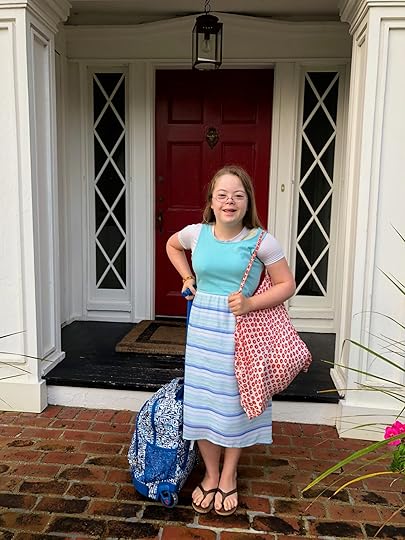
Everyone told me that seventh grade is just the worst. The nadir of self-consciousness and social awkwardness and everything horrible about tween-dom. And it may turn out to be that way. But that isn’t how it has begun.
Penny started seventh grade a little over two weeks ago. She got teary the night before and asked me to pray for her when we both realized we didn’t know where her new locker would be or what the combination was or how she would figure that out. But she fell asleep, “a little nervous, a little excited,” and she came back the next day with her locker combination memorized.
Since then, she’s started making her own lunch (not every day, but still). She’s stolen my phone on multiple occasions to text with friends new and old. She’s arranging sleepovers. I talked with the mother of one new friend who told me that her daughter had been talking about Penny all week and couldn’t wait to come over and play. She’s becoming more aware of herself and her own emotions (“I get anxious whenever you or Dad raise your voice,” she shared this morning.).
She’s leaning on her geography-oriented younger brother to learn the countries in Central America, and they seem to be enjoying each other more than ever. I recently walked into the playroom to find the two of them on the couch, lying side by side, giggling. (William always says the thing he admires most about Penny is her ability to laugh at herself, and she seems to help him do that for himself too.)
It shouldn’t surprise me to find that Penny is my daughter–my responsible, oldest child, growing-in-independence, a little bit socially awkward and bookish and sweet and sensitive daughter. The path through seventh grade may well get rocky, but it has started well.
(I should add two more things in the midst of sharing this positive post. One, that I hesitate to do so because I know there are lots of kids out there who had miserable weeks, whether in relation to having special needs or not. Two, because I am really unlikely to share negative stories about anything that happens with Penny in real time these days because it violates her privacy in a way that the positive doesn’t, so I am always in danger of painting a misrepresentation of our life. But I’m sharing it anyway because I also think it’s important to document that life with Down syndrome–even in middle school!!!–can involve laughter, friendship, and healthy independence.)
The post Penny, 7th Grade appeared first on Amy Julia Becker.


What Our Summer Vacation Taught Me
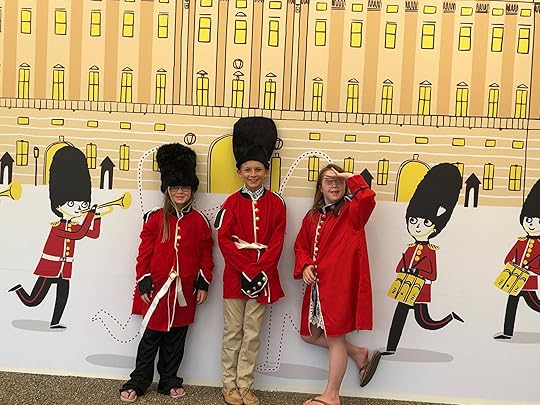
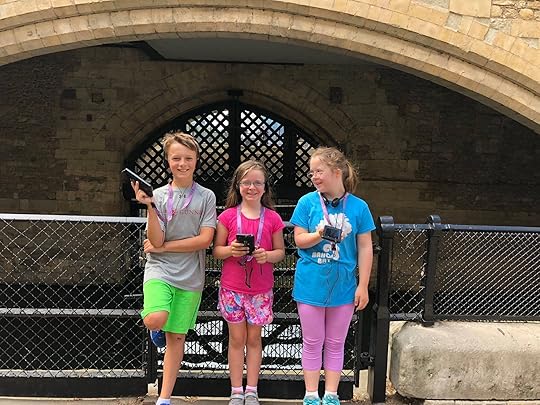
Over the summer we took a family vacation in Europe. It was a wonderful trip where we met up with old friends in a simple cottage on the coast of Wales, ate lots of fish and chips, traveled to London and Paris and visited Peter’s cousins in Denmark. We climbed towers and walked miles and hiked cliffs. We toured museums and galleries and attended concerts and stood in the center of ancient cathedrals.
For much of the walking, which is to say much of the trip, Penny lagged behind. She moves more slowly than her brother and sister, and it isn’t easy to keep up with her active and type-A mom and dad. It didn’t really bother Penny to be at the back of the line. She wasn’t rushing to get to cross the street before the light turned red. She wasn’t fretting about whether we’d miss out on an attraction. She took it all in, but in her own way, and at her own pace. Well, at her own pace when we let her.
There was a lot of cajoling. I held her hand and tugged her along through many blocks of walking. We counted the steps up to the top of Notre Dame (428). We counted the steps down the Eiffel Tower. We played spelling games and category games as we walked beside the River Thames in London. And sometimes we let her opt out—to “miss out” on an experience because she wanted to take it all more slowly or just go back to the room and read.
When we returned from this European adventure, the kids went right into Vacation Bible School at our church. On the second day, they came home talking about their Bible lesson. It was the story of Mary and Martha, two sisters who receive an unexpected visit from Jesus and his disciples. Martha huffs and puffs her way through preparing a meal for this band of traveling men. Mary sits on the floor and listens to Jesus. And Jesus commends her for it.
The kids sat around our kitchen island munching on nachos and Marilee said, “I would be like Martha—working in the kitchen.” William nodded. “Me too,” he said. We went through each member of the family, and one by one we noticed that almost all of us would be in the kitchen, banging the pots
and pans in frustration, missing out on the experience of Jesus in our midst. “
“But Penny would be like Mary,” Marilee said. Penny shrugged and nodded.
Penny would be like Mary.
It’s true. She would sit at Jesus’ feet without feeling responsible for feeding him, without worrying about the resentment oozing from her siblings’ hard work, and without worrying what other people were thinking of her. And Jesus would commend her for listening, for being still, for receiving what he wanted to give her.
Our trip to Europe was wonderful, and I’m glad we pushed ourselves and our kids and saw so many sights and experienced so many places. But I come home aware that Penny had something to teach me in her unwillingness to hurry. She was willing to accept her own limitations without turning them into anxiety. She was willing to miss out on some opportunities in order to rest and take care of herself. She wasn’t in a rush. She was willing to listen.
Jesus says that in the kingdom of heaven—in the place where God’s rule governs–the last will be first. I imagine that someday Penny will be the one leading me, holding my hand not to tug me along and help me keep up, but to gently remind me that sometimes it is good to slow down.
The post What Our Summer Vacation Taught Me appeared first on Amy Julia Becker.
The Invitation to Confess

I shared this short thought on Facebook over the summer, but also wanted to share it here….
Historically speaking, I am not good at confessing sin. Here’s my problem: I’m a perfectionist. I don’t do very much that is wrong, objectively speaking. I follow rules. It makes me squirm inside even to think about other people breaking rules. I obey the speed limit. I didn’t drink alcohol until my 21st birthday. I have a deep inner need to do things right all the time.
None of these facts mean that I don’t sin. But it does mean it is hard to see my sin, to confess it, to receive forgiveness for it, and to be free of it.
Maybe I should start by defining sin. I know it’s an old-fashioned religious word, but it’s also a word I appreciate, because it can be used to describe so much that is wrong in the world–wrong within me as an individual, wrong within systems and structures, wrong within communities and families and bodies and governments. Sin, as I understand it, is anything–any action or attitude or inaction–that separates us from God. Anything that separates us from Love. Anything that breaks us apart from ourselves, from one another, from creation, from wholeness and health and beauty and truth and goodness.
I’m sure that sin is at work within me. I do not live in a state of perfect bliss. But it isn’t easy for me to see my own sin, because my sin rarely shows up as doing things “wrong.” In fact, my sin often shows up as doing things right.
But recently, I’ve been more able to see my own sin. Some of that has come because I’ve asked God to show it to me. Some of it has come from doing some work with the Enneagram and a helpful yoga teacher. Some of it has come from growing up a little bit.
Without providing an exhaustive list, I’ve found that I worry a lot. I worry about the future. I worry about my kids having friends. I worry about how I appear, how much I weigh, whether my career is successful and meaningful. And every time I worry, I turn away from Love, away from trusting in God’s goodness, away from peace and wholeness. For years, I didn’t see my worry as sin. I saw it as responsibility, executive function, an ability to plan well and take care of everyone. But now that I can see that this worry causes me to judge others, to condemn myself, to snap at our kids, and literally to carry around a dull ache in my right hip, I am grateful to name it for what it is. Because when I name it as sin, I can relinquish it. I can confess it, turn away from it, and ask God to heal it.
I am discovering that confession is an invitation to healing and wholeness. It is not an invitation to shame or guilt. It is a kind welcome back into the goodness of God. Confession is the beginning of freedom.
The post The Invitation to Confess appeared first on Amy Julia Becker.
September 1, 2018
Trust Your Love Instead Of Your Fear
“Trust your love instead of your fear.”
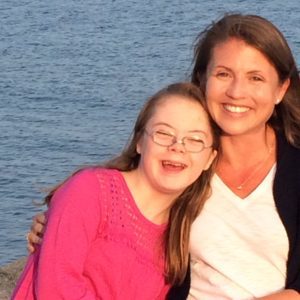
I first said those words in a conversation with a woman who had received a prenatal diagnosis of Down syndrome, but they have returned to my mind again and again. I have held on to hope and love for my own child with Down syndrome: when she’s diagnosed with scoliosis, trust your love instead of your fear… when she’s not invited to a party, trust your love instead of your fear… when she comes home and tells me she’s “dating” a boy in her class, trust your love instead of your fear…
I’ve also taken those words as an invitation to look for love all around us—the love exhibited by friends and family members, teachers and doctors, by Penny herself, by the “consequential strangers” in our life— the crossing guard, the man who works at the post office, the cashier at the grocery store who knows her by name.
What if we—as individuals, as communities, as a nation— trusted our love instead of our fear? What if we articulated the things about this nation that are worth loving—the ideals of justice, and freedom, and the pursuit of happiness? What if we believed that love could bridge the gaps between ethnic and racial and religious groups? What if we chose to love one person who represents “the other” to us, walked in his or her shoes, listened to his fears, received her anger and hurt?
There are many good reasons to be afraid. Many good reasons to shut our doors and our hearts and to only talk to people who read the same books and listen to the same news and work in the same places as we do.
But what if, instead, we decided to trust our capacity to love? What if everyone who voted for Clinton decided to love a Trump supporter and vice versa? What if love triumphed instead of fear?
I can only speak to my own little life, with a baby girl who was diagnosed at birth with a genetic condition destined to bring challenges. People told me to fear the doctors and the school system and the caregivers and the Sunday School teachers and the culture that would mock her and dismiss her and treat her as an outcast.
But when she was five months old and needed ear tubes, the doctor gently took my baby girl in the crook of her arm and carried her back to the operating room so I wouldn’t need to watch her be rolled away on a stretcher. When she was two and having unexplained fevers, the church prayed for her and for us with gentle persistence until she was well. When she was five, she found her first best friend and they walked to school hand in hand. When she was six, her school changed their structure and added a special education teacher so that she could fully belong in the classroom with her typical peers. At each step along the way, I have been called to trust my love for her, trust the love of our community, instead of my fear.
As I began to consider these thoughts, I wondered if they came only out of a place of power and privilege and protection, the luxury of a white, overeducated, economically secure woman. But then I thought about the people who have modeled love instead of fear—Jesus, Martin Luther King, President Obama, the men and women in Charleston who offered words of forgiveness to Dylann Roof, my friend Patricia Raybon who dared to hope even after her candidate lost the 2016 election, the Orthodox Jewish man in Florida who befriended a white nationalist, the heroes like Malala Yousafzai who refused to live in fear of the Taliban. It is not only my daughter who has taught me to trust in love, but these men and women throughout history and across the globe who have modeled a different way that the way of fear and hatred, who have modeled a way of forgiveness and hope and healing.
Fear causes us to duck our heads and hide, to set our boundaries, to categorize human beings by their race, class, ethnicity, religion, or interest group. But love grows us up, and it binds us together.
Love costs us. We make ourselves vulnerable to hurt when we love. We give time and money and resources. We risk broken hearts. But love also grows us up. It cannot be contained. It cannot be defeated. Even when the people embodying love are killed, their love spurs others on. Love is the power that fuels the universe, and we are invited to participate in that power, to be animated and anchored and transformed by that power.
I am grieved by the divisions within our nation. But I am hopeful for our future. And I am choosing to trust my love instead of my fear.
An earlier version of this post appeared on my blog after the Presidential election of 2016.
The post Trust Your Love Instead Of Your Fear appeared first on Amy Julia Becker.
August 28, 2018
New Rules For Screen Time Pt. 2
I mentioned a while back that I wanted to revise our family’s policies regarding screen time in response to a podcast I heard with Heather McFadyen and Andy Crouch.
In response, we decided that the kids couldn’t watch/use screens until after lunch. I thought it would stop them from thinking about screens as soon as they woke up. Instead, it meant they pestered me about it for even longer than they have the rest of the summer, and I got twitchy and impatient and huffy about it all and it felt worse than it had the week before when they arose every morning and watched a show before even saying hello.
So then we had a fascinating conversation around the dinner table about all this and William argued himself into a place he didn’t like. As he talked, he said screens aren’t nearly as good for him as using his brain or body in other ways. His conclusion: “My head says this is the way it should be” (very limited screens) “But my feelings don’t agree!”
Penny jumped in. “William, I have some concerns,” she said, and went on to argue that there are appropriate and inappropriate uses of screens (her words) as well as educational and non-educational uses (her words) and we need to be discerning (my word) about how we use them but not get rid of them all together.
Meanwhile, Marilee offered an interpretive dance to the Bela Fleck music playing in the background.
Peter and I have now left our phones plugged in downstairs for one week running, as one step in a new commitment to reduce our reliance upon these devices throughout our household. The kids agreed that we won’t use screens until the afternoon, and we also won’t ask about using them until after lunch. And we reminded them, and ourselves, again, that the purpose of all of this is not to punish ourselves, not to deny fun, not to belittle entertainment. Rather, it is to become more and more fully human, to deepen ourselves and to connect in deeper ways to God, to our own feelings and hopes and dreams, to the natural world, and to one another.
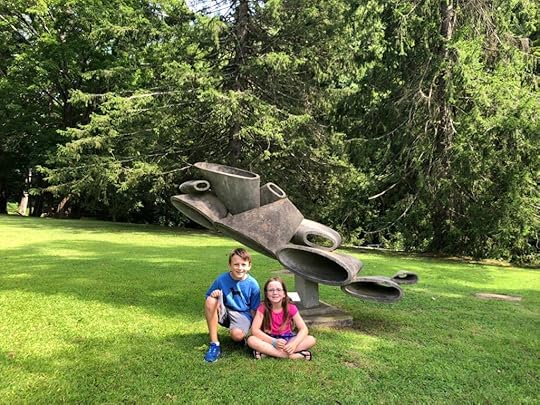
(The above photo is from our town’s sculpture walk–60 sculptures positioned around the town center, which took us over an hour to see. Walking around and talking about sculpture asked more of us than an equivalent hour in front of a screen ever would have. I’m trusting it gave us more too.)
The post New Rules For Screen Time Pt. 2 appeared first on Amy Julia Becker.
August 17, 2018
New Rules For Screen Time Pt. 1

When I was a kid, we spent two weeks at my grandparent’s beach house every summer. It was a simple cottage with painted wooden floors and sheets and blankets that had been in use for decades, and an outdoor shower. We ate outside and played cards and kick the can and explored the shoreline. As we got older, some of my aunts taught me how to weave baskets. We decorated mirrors and lamps with seashells. We learned sailing songs.
We also didn’t have a television, and I have to imagine that the lack of screen time contributed to the exploration we did and the relationships we built with one another in those weeks together.
I was reminded of those moments when I listened to Andy Crouch summarize parts of two of his books (Strong and Weak and Tech-Wise Family) in this podcast: http://bit.ly/2KXzToZ
One of the things Andy mentions is that if we reflect on the best times we’ve had as a family (and, I would think, the best times we’ve had as couples or friends or even as individuals), we will rarely, if ever, mention a screen. The time I got to level 10 while playing Halo… the time we binge-watched Breaking Bad… the time I stayed up later than I should checking my email… These are not the stuff that memories are made of. These are not the stuff that build relationships.
We are not banning screens in our household, but in listening to this podcast, I did have three takeaways:
— We are going to become more intentional in turning off all our devices for one hour a day, one day a week, and one week a year.
–I’m getting the devices out of the bedroom
–And finally, we are changing a habit that began earlier this summer. The kids are still allowed screen time every day (which is different for us than during the school year), but it has to be after lunch so the day doesn’t start with a screen.
What are your rules when it comes to screens? For yourself or your kids?
The post New Rules For Screen Time Pt. 1 appeared first on Amy Julia Becker.
July 26, 2018
Camp Pals {Read All The Way To The End To Find Out How To Get An Early Copy of White Picket Fences}
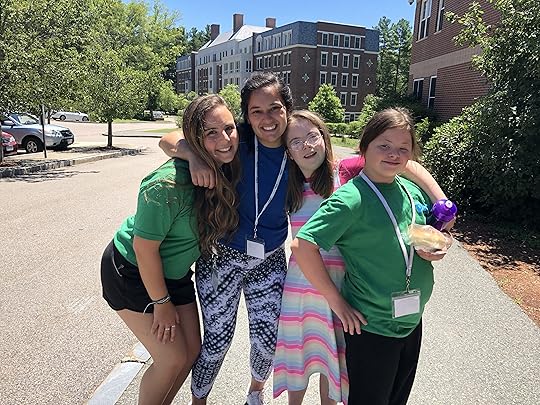
Penny and friends at Camp Pals
Once a week I compile the refl ections I’ve offere d on Facebook into one blogpost. Here are some thoughts from the past few days.
July 13th, 2018
On Saturday, I picked Penny up from Camp Pals. Each week of PALS ends with an opportunity for campers and counselors and parents to share with the entire group, and I sat next to our daughter for an hour listening to all these people speak about the impact of spending a week together.
The counselors were all intellectually typical people. One of them has been volunteering his time each year for nine years running. What began as a teenage experience has carried him into his twenties. Others were there for the first time, and they gushed about how the week had changed their lives. They spoke about learning what it meant to live life “to the fullest,” and about what it means to be human. Spending a week with a group of people who have been rejected by our society at large–people who do not “measure up” on standardized tests, people who will never achieve “success” in our meritocratic culture–didn’t evoke pity or impatience. It evoked joy and gratitude.
When I got home, the first thing I read was David Brooks’ article about the new documentary about Fred Rogers’ (aka Mr. Rogers) life. Brooks writes, “And here is the radicalism that infused that show: that the child is closer to God than the adult; that the sick are closer than the healthy; that the poor are closer than the rich and the marginalized closer than the celebrated.”
Our beautiful daughter is closer to God because she is closer to her humanity, closer to her vulnerability, closer to her need for others, closer to honesty, closer to so much that matters. She is more quick to laugh. She is not in a rush. She does not hold grudges. She is closer to love. She is closer to the heart of God, and our culture rejects her, and people like her, from the moment of conception on through their lives. I stood in our living room with my phone in my hand thinking about Mr. Rogers and about Camp PALS and the gift of this child, and the tears streamed down my cheeks.
Here’s the reality–if I want to participate in the kingdom of God, if I want a glimpse of who I could be if I surrendered my perfectionism and my striving and achieving and my pretenses of invulnerability, my pretenses of limitlessness–then I must embrace my daughter, and I must embrace the part of me that is just like my daughter. I must embrace all the other people who are marginalized and dismissed, who are “burdens,” and I must see myself in them. The ones who speak out of turn. The ones who drool. The ones who sing off key and dance off beat and wear mismatched clothes. I am not embracing them with pity, or even compassion, but with connection, with understanding, with a deep gratitude for our common humanity.
July 17th, 2018
Every summer, I face the same dilemma as many parents–I want our kids to have a summer with lazy mornings and sunny afternoons and fun with family and friends. I also want to get some work done. Which is to say, every summer, I sign them up for camp. (As an aside, this in itself is a sign of advantages we have as a family–camp is expensive and it usually requires a parent who has flexible hours since it rarely extends for an entire work day.)
But camp is not easy for kids with special needs. It’s a new environment, with new skills required and new teachers and new peers. We learned years ago that Penny would be inclined to test her teachers in a new setting, and we also learned that most teachers would respond by coddling her. So instead of playing kickball, she would bring a book and read on the sidelines. Instead of participating in an activity, she would sit in the corner and take notes. Instead of engaging with peers, she would latch on to one counselor and befriend them.
We started giving behavior tips to everyone at the beginning of camp. We tried to emphasize Penny’s abilities and push teachers and counselors to hold her to high expectations. And while these tips helped, and most adults and leaders truly love Penny and have helped make her the shining young woman she is today, it was also always an effort. I was always holding my breath a little bit, wondering how it would go.
On the final day of Camp PALS, the camp Penny attended last week which is designed for teenagers and young adults with Down syndrome, a few parents stood up to share about their experiences. Two different mothers talked about how they had received “behavior calls” over the course of the week.
I’ve been on the receiving end of those calls before–the time Penny decided she had an arch-enemy at school, the time she walked out of science class without permission, the time she disappeared during a school performance. I know the sinking feeling, the sense of desperation, the desire to plead with whoever is on the other end to please please please give my child another chance and please don’t write her off and please see her for who she is. These other moms have gotten those calls before too. All of us know what it feels like for the world to see our kids as problems to be managed rather than people to be loved.
For what it’s worth–and it is worth a lot–the teachers in Penny’s life have almost unanimously been on her team. They don’t give up on her. They cheer for her and champion her. They emphasize her strengths and they want to work together for her good. But that’s not always how it goes.
At Camp PALS, both of these mothers said, they got behavior calls from people who didn’t see their children as problems. They saw them as young adults who needed help. They called because they wanted to reach out to someone else who knew and loved this person and might be able to help care for them better. The parents were in tears. Their children were ready to come back for another week of camp, to be in a place where people assumed they were people.
It makes a world of difference to be loved instead of managed.
July 18th, 2018
Here’s my last and final word about Camp PALS. To be more accurate, here are Penny’s words about Camp PALS:
“I would recommend Camp Pals because you have to have Down Syndrome to go to the camp. I would also recommend it because of the fun activities and the fun holiday spirit when we celebrated the 4th of July. The counselors and the campers were crazy excited. I want to go back because my counselor was really nice and she talked to me everyday. She also let me read before bed but one time she did not let me because we got back from a field trip late. I was hoping that I could still have time to read when we got back but she said no because it was late and I needed my rest for the next day.
It was the best camp all summer because it was nice to be away and independent for a while. Also, it was great not having my brother and sister bossing me around when I did not have to do chores.
Camp PALS was a blessing towards all of the campers and watching all the people grow with different perspectives in one another. Also they asked us questions about different people and I got to hear different answers from everyone because it was a miracle to be away from my family and it was relaxing and calming and peaceful.”
Finally, watch this video for an exciting announcement about the opportunity to be a part of my launch team and be an early reader for White Picket Fences! If you are interested please fill out this form.
July 14, 2018
The Tide of Life
Once a week I compile the refl ections I’ve offere d on Facebook into one blogpost. Here are some thoughts from the first half of July.
July 2nd, 2018
I’m reading Austin Channing Brown’s new book I’m Still Here: Black Dignity in a World made for Whiteness. Important reading For any white person who cares about understanding what it feels like to navigate school and work and Christianity as a black person in predominantly white America. To quote one example— she’s receiving prayer from Christian coworkers and suddenly realizes, “Before I know it, the prayers take a turn… they ask not that I be understood but that I would find it within myself to give more grace. The prayers don’t ask that doors would open for me; they ask that God would gift me with skills they wish I had. These prayers aren’t for me. The prayers are that I would become who they want me to be. ‘Lord, make this Black person just like us.’ “ https://amzn.to/2KyxLYz
July 6th, 2018
Penny is at Camp PALS this week. It’s a camp designed for people with Down syndrome, which was both a draw and a concern. On the one hand, we wanted to give Penny a space in which having Down syndrome was the norm, a space where perhaps she wouldn’t need to work quite as hard socially, a space where she could rest and relax and laugh and be herself. On the other hand, as Penny herself put it, “Why can’t my friends who don’t have Down syndrome come?”
So we pushed Penny to go.
Before she went, we promised that she could FaceTime every night, and that if she didn’t like it she could come home after three days. When I texted her leader, Ally (in the photo below), on the second day about setting up a time to talk, Penny told her she could wait until tomorrow. And then on the third day, again, she had Ally text that we could talk the next day. She comes home tomorrow, and we’ve spoken once. I received this text on Wednesday: “Mom I just wanna tell you that I went on my first ever roller coaster it as so amazing and scary that I wanted to go on again today was a blast”. We’ve seen photos and videos of Penny in her element–talking, laughing, stretching herself. She’s having a blast, and we are very grateful.
July 10th, 2018
Are you in danger and you don’t even know it? Last week, my husband took our kids swimming off the little local beach near our house. It’s a tame environment here on the Long Island Sound–very minimal waves, lots of seaweed. Our kids have passed the swim test so they are allowed to swim out to the raft by themselves. I’ve finally stopped fretting at night about the scary possibilities that water presents.
But yesterday the tide turned just as they reached the raft, and on the way in, they drifted. They didn’t realize it was happening. In their minds, they were swimming toward shore like they always do. But in reality, they were drifting into the rocks that line the coast next to the sandy beach. In Peter’s words, “it was intense,” because by the time they saw where they were headed, they couldn’t get out. They weren’t strong enough to resist the tide, and they were in danger of getting stuck and battered among the rocks.
Peter was able to rescue them from danger and get them on shore safe and sound, but the incident stuck out to me because I thought of how much we are just like my kids. We think we know where we’re headed, and then the current of our surroundings pulls us in a different direction, and before we know it we’re being beaten up. I’ve done it with eating and body image time and again, where I think I’m being healthy and I end up becoming judgmental of others and self-critical. I’ve done it with gossip, where I find myself in a conversation where I’m talking badly about someone else and feeling crappy about that and I don’t even know how I got there. The list goes on.
There are two ways to handle these situations. One, make sure to keep my eyes on the shore. In spiritual terms, that would mean constantly returning to who God is and how God empowers us to live differently, fully, as ones who are blessed and in turn bless others. Two, when I find myself in the rocks, to cry out for help. God will lift me out of the danger, just like Peter lifted our kids and set them on solid ground.
July 6, 2018
What Can Trees Teach Us About Loving Each Other?
Once a week I compile the reflections I’ve offered on Facebook into one blogpost. I am a little behind this month, so here are some thoughts from the second half of June.
June 21st, 2018
The voice on the radio asked, “Why are black children in the United States six times more likely to drown than white children?”
William was with me in the kitchen, and he cocked his head when he heard the question. “Why is that, Mom?”
I threw it back at him. “Why do you think?”
“Racism?” he asked, in a tone of voice that implied he knows this is the “right” answer, kind of like saying “Jesus” in Sunday School.
“Well, yes,” I said. “But how does racism work itself out in that way?”
His furrowed brow told me he was thinking. “White people won’t save black children when they’re drowning?” he asked.
“I don’t think that’s it,” I said. “Let’s think about this a little more. What does it take to learn how to swim?”
“Parents who know how to swim?” he said.
“Well, sure, that would be part of it. What does it take for parents to learn how to swim?”
“Um, well, also parents who know how to swim. Oh, and water to swim in? Wasn’t there a time where black people weren’t allowed to swim with white people in the same places?”
“Exactly,” I said. “There are other factors as well, but there’s a history here that began with injustice and even now has consequences–tragic, real, life and death consequences for kids.”
We talked a little bit more about how racism works. Yes, sometimes as overt horrors , but also through discriminatory laws and policies that have an effect even when those laws and policies aren’t on the books any longer. Racism can be easy to spot when someone makes awful comments, but the more insidious forms of racism work in subtle ways, ways that we won’t see unless we are willing to look for them and recognize how cultural factors from past and present combine to affect the safety (and enjoyment) kids can have playing in the water in the summertime.
Here’s the full episode of the radio program we were listening to: http://bit.ly/2lrmfA6
June 22, 2018
“There is a practical utility to Scripture reading. But prayer? Prayer is absurd, inefficient, immeasurable. Stupid. Unless it’s true that God exists, interacts, and cares, in which case prayer is an inexhaustible gift to my spirit.”
I wrote those words a few years ago, and I just received an email letting me know that they made it onto the “Notable Quotes about Prayer” list: http://bit.ly/2yyeHVL
If you have five seconds, you can help more people see this quotation about prayer by clicking on the link above and “liking” the quote!
June 29th, 2018
I gave a talk on a passage from Ephesians 3 a few weeks ago in which I talked about what it means to be “rooted and established in love.” It’s an image that provoked me to think about trees and how trees work. I already knew that tree roots provide stability during storms and that they are conduits of nourishment. What I didn’t understand is how the roots system of trees connects trees to one another.
I’m learning more by reading The Hidden Life of Trees by Peter Wohlleben. So much fascinating information in these pages, but here is today’s nugget: “Each beech tree grows in a unique location, and conditions can vary greatly in just a few yards. The soil can be stony or loose. It can retain a lot of water or almost no water… Accordingly, each tree experiences different growing conditions; therefore, each tree grows more quickly or more slowly and produces more or less sugar or wood, and thus you would expect every tree to be photosynthesizing at a different rate. And that’s what makes the research results so astounding. The rate of photosynthesis is the same for all the trees. The trees, it seems, are equalizing the differences between strong and weak.”
For us as humans, when we put our roots down into love, that love stabilizes us, nourishes us, and it also connects us to others so that we can give and receive love one to another.
June 29, 2018
On a Scale of 1-10…
Once a week I compile the reflections I’ve offered on Facebook into one blogpost. I am a little behind this month, so here are some thoughts from earlier in June.
June 9th, 2018
Earlier this week, I was talking with Penny about school. I happened to mention an older girl, who I will call Jane, who used to dote on her when she was in elementary school. When I said this other girl’s name, she looked away from me. When she glanced back, her eyes were even wider than usual, and tears were pooling.
“She won’t talk to me, Mom,” she said. “I just don’t understand why.”
I sat through that day with worry that I tried to turn into prayer. What if she was feeling that way all day long? What if other kids who used to be nice were now being mean or rude or dismissive? Is it because she has Down syndrome?
That night, Penny and I were sitting at Chipotle together after her physical therapy session. “Pen,” I said, “On a scale of 1 to 10, if 1 is sad and 10 is super happy, how are you right now?”
“8,” she said, between bites of a carnitas bowl.
“How were you at school today?”
“10.”
“How about when you see Jane?”
“4.”
“Doing homework?”
“6.”
“Going to ballet class?”
“Oh, Mom. 18!”
“So, are there any other times during the day when you feel a 4?”
She shook her head.
If the worst things our daughter encounters in a day is a seventh grader who can’t muster up the kindness to say hello, we’re in a pretty good place, with a pretty happy kid, and I am grateful.
June 12th, 2018
My husband Peter is the headmaster of a school. In his role, he has the authority to admit students to the school and to kick them out. As a result, students interact with him differently than they might if he were just another adult in their lives. They are on their best behavior.
Our children understand that Peter is a headmaster, but that isn’t their primary way of knowing him. They know him first as a loving father. As a result, they whine and complain to him. They play with him. William and Marilee ask him to spray paint their hair green and red, respectively, for field day at school. Penny asks him to hold her hand as we go for a family walk. They don’t relate to him as a headmaster. They relate to him as a dad.
In the New Testament–the books of the Bible written about Jesus’ life and the books that emerged out of the early church–Jesus insists that if his followers don’t change and become “like little children” before God, they will never understand and participate in God’s kingdom. He invites his followers to pray with the words “our Father.” In his parables, Jesus compares God to a father again and again. Paul writes over and over again about our adoption into the family of God.
In other words, we have been invited to relate to God first and foremost in the intimate terms of a child to a father. Taking my own kids as my lead here, I’ve been invited to complain, to ask for what I want and need, to tell God about my day, even to reach out my hand and walk side by side in contented silence.
God remains God–the one who brought life into being, the one who created the cosmos, the one who spread the stars in the sky like a blanket of light. God remains the one who has power to judge and rule. But we have been invited to know him in a very different way, as our dad.
June 19th, 2018
“More alike than different” is a tagline for the movement to include and advocate for people with Down Syndrome. It’s a short way to challenge people to look for similarities instead of categorizing people with DS as “other.” But I heard a mother of a child with DS say the other day that she really doesn’t like the phrase “more alike than different” because she celebrates her child’s differences.
I know what she means. The features that make Penny distinct from me–she moves slowly and patiently, she laughs at herself easily, she doesn’t hold grudges, she gets distracted by the needs of others–those differences are beautiful and challenging and I would never want them to change.
But at the same time, the reason I can value those differences is because I value the underlying sameness to us. Because I have an underlying belief in our shared personhood, I revel in her particularities as a person. Because I believe in our common creation as beings “in the image of God,” I can look for the expression of God’s love in her and marvel at the ways it is different than mine.
The same would be true if Penny were non-verbal, if she had physical or cognitive impairments that made her life ostensibly even more different than my current way of being in the world. She would still be a person, a person created in the image of God, a fellow human being with the capacity to love and be loved.
When Penny was first born, I thought she was different than me. Then I insisted on our similarities. Now I embrace her differences, but only because I have come to truly believe in our common identity as children of God.