Amy Julia Becker's Blog, page 145
March 16, 2018
What a Snow Day Taught Me about God’s Love
Once a week I compile the reflections I’ve offered on Facebook into one blogpost. Here are the thoughts from the past five days:
Tuesday, March 13, 2018
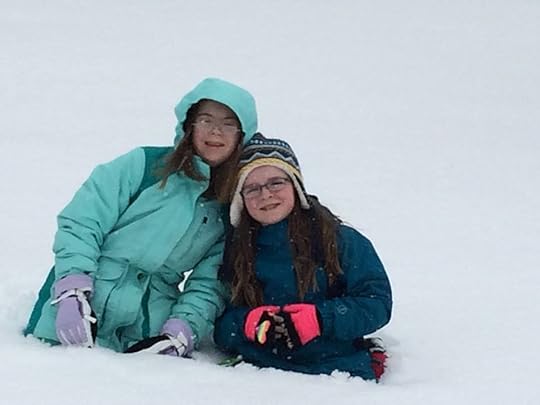
It’s been a long few weeks here in the Northeast, as any parent of any small child can tell you. Here in my part of Connecticut we are on snow day number TEN for the year. Lovely as my view out the window is, we were ready for spring and instead got walloped with three storms in a row, power outages, and kids who haven’t gone to school for a full uninterrupted week since October (I might be exaggerating, but I might not…).
We are at a stage in our family life where snow days aren’t as much a burden on me as they used to be. We enjoy the lazy mornings. We cuddle up and watch movies. I sneak away for a few hours to post things like this on Facebook. But now that our kids don’t need me to attend to them at every turn, now that a screen or some neighborhood friends or even a coloring book or a game with siblings can occupy them and I can do my own thing, I’ve started to think about the difference between being with them and observing them.
When I’m with them on snow days, I’m on the floor playing a matching game. I’m pretending to be Samantha, one of Marilee’s dolls. I’m reading one page out loud with Penny and then listening as she reads the next one. I’m dancing to Taylor Swift and painting fingernails. And it’s in those moments that we laugh together. It’s in those moments that they know I love them and that my love for them means enjoying who they are.
When I’m observing them on snow days, I bring my computer downstairs and they play or watch stuff or read on their own. I still enjoy them a lot of that time, but I’m not sure they receive that enjoyment. I still love them, but I’m not sure they receive that love.
Which all brings me back to the Christian idea that God is Emmanuel, which when translated means “God with us.” God is the one who gets down on the floor and plays, not the one who stands far off at a distance. God wants us to know that God loves us, God enjoys us, God listens to us.
What if God wants to be with you as a way for you to know God really loves you and takes great delight in you, like a parent who finds she actually enjoys her children?
Wednesday, March 14, 2018
What comes to mind when you hear the words “Bible study”? For me, I get excited. I love school. I love literature. I love thinking about God. BUT I am starting to think that for many people those words are a non-starter.
They either signal boring, irrelevant, or intimidating.
Would you be interested in a group that reads a book from the Bible and talks about it, kind of like a book club? A group where intellectual curiosity (including respectful skepticism) is honored, where you learn something new, and where there is a possibility of spiritual growth? Where you aren’t expected to bring anything but honest questions and honest responses to the table?
If you would be interested in this kind of a group, what would you call it?
Wednesday, March 14, 2018
I know you all have seen the cover already, but it is really fun to see the book available on Amazon.
Thursday, March 15, 2018
I read Jesmyn Ward’s Salvage the Bones–winner of the National Book Award–last year. It is worth reading on many levels with a strong main character, gripping storytelling, and compelling prose. BUT I just read Where the Line Bleeds, Ward’s first novel, and I recommend that one even more.
Where the Line Bleeds is set in the fictional town of Bois Sauvage, Mississippi. It’s a simple story–twin 18-year-olds graduate from high school and need to figure out what comes next. One of them, Joshua, gets a job at the docks. The other, Christophe, gets no response from the many job applications he fills out. He doesn’t want to go into the business of selling pot, but that feels like his only option.
As I write this, it occurs to me that there’s a moral dilemma at the heart of this novel, but it is not a morality play in any way. It’s a story–a beautiful, heart-wrenching, loving story–about two boys and their family and the way one decision leads to another and another until it feels like there was nothing to decide in the first place.
And then there are phrases like this one: “a loose rope of wind wound its way through the screen” or “the asphalt shimmered like a handheld fan down the length of the road” or “the air reminded Joshua of melting butter.” The prose doesn’t distract. It paints a picture of a world that makes this book read like a film.
I highly recommend it.
Friday, March 16, 2018
It’s certainly worth 2 minutes of your time to see this report about a man with Down syndrome who has just been hired as Boston Children’s Hospital as a full-time employee. Again, new frontiers and new possibilities!


March 9, 2018
A New Frontier for People with Disabilities
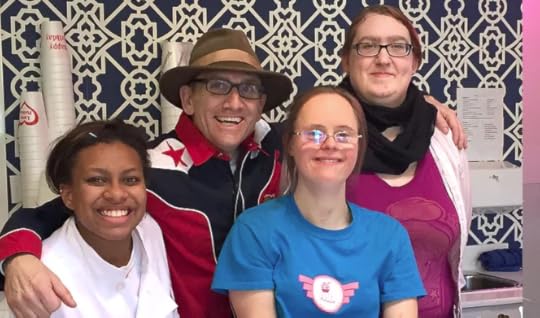
Photo courtesy of Howdy Homemade Ice Cream Shop
Once a week I compile the reflections I’ve offered on Facebook into one blogpost. Here are the thoughts from the past five days:
Monday, March 5, 2018
I didn’t watch much of the Oscars last night, but I will confess to always at least scrolling through the pictures of men and women on the red carpet. I’m more interested in the women’s outfits, truth be told. They seem to fall into two categories: the ones who make a statement either with surprisingly plunging necklines or the ones who make a statement with their choice of color or style. Then there are the ones who aren’t surprising, who wear more classic examples of elegance and style. (Here’s Vogue’s set of images from this year if you want to page through.)
I’m not planning to give my own opinions on these dresses. Looking at these women, I first starting thinking about the ways clothing has been used to make public statements of late (from Michelle Obama’s black dress during the Inauguration to the now infamous pussy hats to the black dresses at the Grammy awards).
But then I started thinking about the statements our clothing makes even when we aren’t trying to enter into politics or the public eye. In these situations, clothing can be an expression of individuality. It can also be a way to blend into the crowd. But I care most about clothing as an act of hospitality, a way to welcome others and connect with others and encourage others.
It’s so easy to think only of myself when I’m getting dressed in the morning–what will feel comfortable or look good or just be easy. Those are fine things to be thinking about. But I can also think about the people I will be seeing all day–about respecting and welcoming them with who I am and how I express that reality. Even the most seemingly superficial aspects of who we are can have deep meaning that connects or divides us from those around us.
Tuesday, March 6, 2018
I’m grateful for Keith Dow’s thoughts on the Gerber baby of the year who has Down syndrome, and his thoughtful use of quotations from A Good and Perfect Gift and my own thoughts here on Facebook.
Wednesday, March 7, 2018
Decades ago, people with intellectual disabilities went to institutions on a regular basis. Life expectancy was short and quality of life was low. In the 1970s, more and more parents refused to allow their children to go to these institutions. Over time, they advocated for their kids to be included in public schools (It is AMAZING how many people, to this day, ask me whether Penny goes to school). Laws changed. Quality of life improved. Life expectancy for people with Down syndrome has more than doubled over the course of my lifetime.
What happens after people with intellectual disabilities finish school? The workplace is the next frontier for people with Down syndrome and other conditions like it. It is really hard for people with intellectual disabilities to find work, and this fact often leads to isolation, depression, and a sense of meaninglessness.
Michael Berube has written a beautiful memoir about his son Jamie, Life as Jamie Knows It, in which he describes his adult son with Down syndrome. Jamie is an interesting, dependable, hardworking young man who loves people and can tell you all sorts of things about art and music. Jamie is unemployed and struggling with depression. Jamie’s story is emblematic of the situation for thousands of others like him.
But there are signs of hope. This 2-minute video tells the story of an ice cream shop in Texas that employs people with intellectual disabilities throughout the store, including in management positions. It highlights some of the advantages of such employment: not one worker has left the company since it began, and these hardworking young people are faithful to the job entrusted to them. They work hard, with good attitudes, and they always show up for their jobs.
Penny is twelve now, and my hope and prayer is that over the course of her lifetime we will see more and more employers recognize that it is good for business to employ people with intellectual disabilities.
Thursday, March 8, 2018
I posted questions here a while back to find out what you all envisioned for the cover of White Picket Fences. I got all sorts of responses, many of which aligned with my own thoughts on what the cover should look like. Most involved physical white picket fences. Some people imagined pristine houses with manicured lawns. Others saw a gritty scene of dilapidated homes behind a fence. I personally envisioned a white picket fence with an open gate.
And none of these are where the cover landed.
If you spend some time looking at covers, you’ll notice that most covers with a concrete title offer an abstract image, and vice versa. The advantage of pairing abstract and concrete is that the title and the cover enhance each other rather than echoing each other. When I read “white picket fences” I already have an image in mind. The cover shouldn’t take away that image or contradict it. It should deepen it or expand it or complicate it in some way. A cover that echoes a title can be limiting.
After lots of back and forth, I’m sharing here the final cover design of White Picket Fences: Turning toward Love in a World Divided by Privilege. The book comes out in October, but it is available for pre-order now. I’d love to hear what you think, and I hope you’ll consider purchasing a copy to enter into a conversation about race, class, disability, identity, and how love can move us toward an understanding of our common humanity in the midst of our messy and beautiful differences.
Friday, March 9, 2018
Last week I heard a podcast interview with Dr. Maurice Wallace, a UVA professor in the department of English and African American Studies. (Here’s the interview, and I recommend the entire series) Dr. Wallace cited a study showing that when you ask groups of people about their theological beliefs, there is one group that most of all identifies with the theology of evangelicalism. Not the social or political assumptions of evangelicalism, mind you, but the theological assertions such as the authority of the Bible, the need for a personal relationship with God, the reality of sin, the atoning death of Jesus.
There’s been a lot of press coverage of white evangelicals. But Dr. Wallace pointed out that it is African Americans who, percentage-wise, are most likely to identify with evangelical beliefs.
Which makes it all the more disheartening (though entirely understandable) that African Americans are leaving evangelical churches.
And which makes it all the more important for white evangelicals to listen to their African American (and Latino and other people of color) counterparts. Listening doesn’t just mean letting other people speak their mind. It means understanding, being able to reflect back what it is that the other person has said. If white evangelicals could understand that opposing views of politics can emerge from the same theological beliefs, it wouldn’t change everyone’s political positions. But it could change some of those positions. It could build trust. It could offer a way for the church to shine a light into the culture of division instead of becoming a mirror image of that culture.
March 5, 2018
What Do You Want to Do when You’re Happy?
 Once a week I compile the reflections I’ve offered on Facebook into one blogpost. Here are the thoughts from the past five days:
Tuesday, February 27, 2018
I’ve been thinking about happiness lately. My hypothesis is that we don’t engage in destructive behavior when we’re happy. We don’t say, “I’m so happy, I think I’ll go eat a pint of ice cream,” or “I’m so happy, I think I’ll drink a bottle of wine,” or “I’m so happy, I think I’ll watch some mindless television.”
I don’t mean to say that wine and ice cream and television can’t be a part of happiness. Just that when we are happy, we eat a serving of ice cream or drink a glass of wine with great pleasure and gratitude. We watch television or other forms of entertainment because it is deepening our souls rather than keeping us up on the surface of our lives.
I thought about happiness when I listened to a segment of the Ted radio hour about addiction. Johann Hari talks about how addicts stop using drugs when they are meaningfully connected to other people. When they are happy (in a deep sense of that word), they are healthy.
So if we find ourselves in a pattern of living that isn’t healthy, that brings us to the surface of our lives, that feels good temporarily but leaves us feeling icky afterwards, maybe the answer isn’t punishing ourselves for the behavior, but rather, looking for ways to connect, to deepen, to seek out a deeper and more sustaining source of happiness.
Saturday, March 3, 2018
We’ve just started reading A Wrinkle in Time again (in anticipation of the movie version coming out next week! Our first time through was three years ago, and the story of awkward Meg Murray and her little brother Charles Wallace and their adventures through time and space to save their father and save life as we know it doesn’t disappoint.
I suspect Ava Duvernay’s imagined visual world taken from this book and put on screen will not disappoint us either, and I suspect that having a multiracial cast (including Oprah Winfrey) will enhance and deepen our reading of the book. My imagination tends to go in directions that reinforce my own experience. This is a book that invites exploration and pushing beyond the bounds of personal experience, and a film that conveys the same plot and themes using unexpected characters can only help my imagination grow. (To read more about her vision and the imagination behind it).
I’m encouraged to encounter more and more ways–in literature, on screens, and even in advertisements–to expand the types of people who inhabit the stories we tell and therefore to expand the ways we tell them. We can imagine so much more for the real people in our lives when we have stories that aid us in that work.

February 23, 2018
My Daughter with Down Syndrome Finds a Mentor
 Once a week I compile the reflections I’ve offered on Facebook into one blogpost. Here are the thoughts from the past five days:
Tuesday, February 20, 2018
A friend of mine recently invited another friend to a Bible Study. I bumped into this new member in the grocery store and after we talked a bit, she asked what she needed to do to get ready. “All you need to do is read Mark 1 and 2,” I said.
She said, “Oh, where do I find that?”
“Oh, sorry–In the table of contents.”
She responded, “In the table of contents of what?”
“I’m so sorry. In the table of contents of the Bible.”
She was very gracious, and all the assumptions I made about her knowledge of the names of the books of the Bible did not prevent her from coming to our discussion of Mark 1 and 2. But I’ve been thinking about that interaction for a long time now, because it underscored how easily we put up road blocks that prevent people from exploring matters of faith.
In the Bible, Jesus makes it pretty clear that he is a stumbling block. People will love him or hate him. They won’t stay neutral. And the reason he will make us stumble is that his claims are outrageous unless they are true. He claims to be the Lord of our life–the one to whom we should turn for guidance and direction and correction and purpose. Submitting my desires to a Jewish rabbi from 2,000 years ago is a tall order. It’s a worthy barrier to faith.
BUT so many people don’t even make it to the true barrier when it comes to Christianity. Christians use insider lingo–phrases like “I have a heart for” or “he’s a believer” or “quiet times.” Churches make assumptions that people know what a Call to Worship is or why we read the Bible or where the Bible came from or how to sing the Doxology. I make assumptions that people know what “the good Samaritan” means or that people are familiar with those little numbers littering the paragraphs of the Bible or that people have prayed out loud–or even heard someone else pray out loud–before.
Here’s my point–it’s totally reasonable for people to encounter Jesus and decide they don’t want to follow him. But it’s a tragedy when Christians put up one barrier after another that prevent people from ever coming face to face with Jesus.
Thursday, February 22, 2018
For many years, if you asked Penny what it meant to have Down syndrome, she would not say a word and instead drop into a full split. We had told her that Down syndrome came with some challenges like ear tubes and glasses and taking longer to learn some things. She mostly ignored that. We also told her Down syndrome came with low-muscle tone, which in her case meant she was very flexible and could do various contortionist moves as well as a full split. She paid attention to that, and therefore, in her mind, Down syndrome equals doing the splits.
Earlier this week, Penny attended a cheerleading clinic at her school. Little did we know that would result in her doing a full split in center court at halftime of the boys varsity basketball game that night (yes, I missed the whole thing but thankfully other moms took pictures!). Not only did Penny get to show off one of the perks of her extra chromosome, but she was able to do so next to her friend Alicia.
Alicia is a senior who also has Down syndrome (watch the video to see a little bit of Alicia in action). She’s a member of the cheerleading squad, and Penny has been enamored with her since day one of middle school. Yesterday, Penny and I talked about what it means to have a mentor–an older person who has had similar experiences in life so that person can offer advice and encouragement. We talked about inviting Alicia over so that she could answer questions about having Down syndrome and navigating the social and academic world of middle and high school.
For Penny right now, having Down syndrome is not a big deal. Yes, she sometimes struggles in science class and it can be tricky to figure out how to insert herself into conversations at the lunch table. Yes, the next few years are likely to bring all the typical tween and teenager angst over identity compounded by the reality of a disability. But she can do the splits. And she can look up to people like Alicia with gratitude.
February 16, 2018
What are you Turning towards this Lent?
 Once a week I compile the reflections I’ve offered on Facebook into one blogpost. Here are the thoughts from the past five days:
Friday, February 9, 2018
The cynic might call it a politically correct marketing ploy, but the cynic would be wrong. Gerber just announced the winner of their annual Gerber baby contest. This baby is named Lucas, and he has Down syndrome.
To me, this choice signals two things (in addition to the obvious one that Lucas is very cute). Yes, Gerber must have considered the implications of choosing a child with Down syndrome. Yes, you can argue that this decision was politically correct. That’s the big news: Gerber decided that to choose a child with Down syndrome meant a positive association for their brand.
Two, in doing this, companies like Gerber (alongside companies like Target and others, who have been including kids with Down syndrome as models for a few years now) are helping to populate the visual imagination of our culture. They are helping to demonstrate the truth that most people with Down syndrome live happy lives. They are helping to erase the negative impressions from the days when people with Down syndrome were automatically sent to institutions. Instead of allowing a medical narrative of Down syndrome as a set of deficits to control the perception of people with Down syndrome, these companies are helping to tell a different story of Down syndrome as an aspect of some children’s lives that includes family and school and friendship and often great joy.
When Penny was born, I didn’t know how to imagine a good future for her, and meeting real people with Down syndrome helped me to begin to see her future as one filled with possibilities for meaning and connection. Plenty of stigma and misinformation still exists, but I am grateful for images and stories that tell the truth about the lives of people with Down syndrome like little baby Lucas, like Penny, and like hundreds of thousands of other beautiful people around the globe
Monday, February 12, 2018
As most of you already know, I’m working on a book called White Picket Fences. What most of you don’t know is that this book has been without a subtitle for many months, but we have finally landed on one that hopefully conveys the scope of the words inside. (Drumroll please…)
White Picket Fences: Turning toward Love in a World Divided by Privilege
White Picket Fences itself is intended to conjure up an image–it will be a different image from one person to another. It might be an image of suburban blandness or of a picturesque small town, but either way the image is probably domestic and iconic. I’ll share the cover image here in a few weeks, but let me just say for now that the cover image of this book will let readers know that the iconic image in their heads isn’t all this book is about.
Beyond the immediate meaning of the title is the subtle suggestion that this book has to do with issues relating to privilege (which I see as an intersection of forces including race) and that it has to do with divisions. Fences keep us safe and demarcate boundaries. Fences also keep us away and apart and divided from one another. They can be positive or negative, and the title hints at this complexity.
We worked through dozens of subtitle possibilities, which in and of itself speaks to the heated nature of this topic and the way language itself can connote very different things to different readers. Ultimately we settled on Turning Toward Love in a World Divided by Privilege in order to demonstrate that yes, this book is about division, it is about privilege, it is about tough topics, but it is also about a journey that could be headed somewhere good–toward love– a journey that could be hopeful and imbued with possibilities for connection instead of division.
And that, indeed, is my hope for this book. That it creates connections instead of exacerbating division. That it allows for understanding and compassion instead of animosity. That it points not towards bitterness or even tolerance but towards love.
Tuesday, February 13, 2018
I had a chance to talk with Religion News Service reporter Bobby Ross Jr. about Tim Tebow’s “Night to Shine,” a prom-type dance held at hundreds of churches across the country for young adults with intellectual disabilities. As I said to Mr. Ross, “The only concern I would have is, what happens the other 364 days of the year when it comes to churches that are celebrating these young adults with disabilities this one day a year?”
I’m working on an article right now for Christianity Today’s April issue that talks about the ways churches can not only include people with disabilities in the life of the church but the way churches can begin to see people with disabilities as integral to the way the church functions. Not just as people who have needs but also as people who contribute, as vital parts of God’s work among us.
Wednesday, February 14, 2018
So I’ve been thinking about the word “repent.” It’s a fire-and-brimstone word, a kind of old-fashioned religious word, a word I associate with street preachers and accusation. It’s also one of the first words spoken by Jesus in the records of his life. “Repent and believe the good news!” Jesus says. “The kingdom of God is near.”
In a literal translation, to repent is to turn around. We often think of it as turning away from sin, and that’s an accurate way to think of it. But what has struck me recently is that whenever we turn away from something we also turn towards something. What happens if I start to think of repentance as a turning towards God? Turning towards light and life and hope and joy and love? Then it begins to make sense that Jesus would call this good news.
Today is Ash Wednesday, the first day of a 40-day season in the life of the Christian church where people traditionally give something up–chocolate, wine, Facebook. I’m giving up shopping until Easter (I decided to do this after reading this article by Ann Patchett, who gave up shopping for an entire year). I’m doing this because I buy things impulsively and because we have more than what we need already and because it will help me see the ways I unthinkingly consume. (I am still going to be shopping for food, just not clothes or toys or books.)
My new understanding of repentance has me thinking about what I am turning towards when I turn away from buying more stuff. I’m turning towards riches that satisfy eternally. I’m turning towards gratitude for the goodness of the stuff we already have.
So if you are someone who observes Lent, I encourage you not only to give something up, not only to turn away from something, but to turn towards a richer and deeper experience of God at the same time.
Friday, February 16, 2018
Every time I see a story about people with Down syndrome who break barriers I pay attention. That used to be because I needed reassurance that Penny had a promising future ahead of her. I didn’t need her to become a superstar, but I wanted to know that it was possible for her to become her own person. Seeing stories of people with Down syndrome who swam across Lake Tahoe, like Karen Gaffney, or who ran marathons, or starred in sitcoms like Chris Burke, or who got married all gave me a way to imagine a life of purpose and connection for her in the future.
I still show Penny these types of stories when I find them. I want her to see that people with Down syndrome can be celebrated and achieve their dreams. But these stories matter not only because they are shaping the imagination of our daughter or our family. They matter because they are shaping the imagination of our culture, and our culture still fails to see the value of people with intellectual disabilities.
I just learned that Jamie Brewer, one of the stars of American Horror Story, will be playing the lead in an off-Broadway play in New York starting next month.
Just one more story that helps us all imagine a future with the richness and complexity of diverse lives, abilities, talents, and dreams.
Friday, February 16, 2018
How would you describe the difference between compassion and empathy? When do you feel compassion? When do you feel empathy? According to this researcher, writing for a journal of medicine at Stanford, empathy is feeling the same thing as another person. Compassion is understanding what that other person is feeling and wanting to take action on their behalf. Brain scans show a difference between when we feel empathy and compassion, and Chris Kukk writes,
“Compassion’s strength as a power source for fostering communal as well as individual success is that it is not only derived from the same neural networks as love but it is centrally focused on the concern and care for others. When empathy is used as the source for helping another, the central motivation is to alleviate your own pain and stress. And that egocentric motivation is, I believe, one of the keys for understanding why burnout occurs much easier when we think empathetically. Emotionally absorbing another’s feelings, which empathy entails, is physically draining and can make you feel metaphorically stuck in quicksand. Compassion, on the other hand, keeps the emotional quicksand at a distance by using a more cognitive understanding of a person’s suffering when attempting to alleviate the pain: understanding without absorbing.” – “The Compassionate vs.Empathetic Brain”
February 9, 2018
Why Does a Toyota Ad about the Paralympics Make Me Cry?
Once a week I compile the reflections I’ve offered on Facebook into one blogpost. Here are the thoughts from the past five days:
Monday, February 5, 2018
Housekeeping update: If you want to be sure you know when White Picket Fences (my new memoir about privilege) comes out, I have a new set of options for hearing from me via email. You can sign up to receive an email notification when the book comes out, which is to say, you’ll get an email from me about once every three years. Or you can get that plus a monthly newsletter. Or you can get those plus a weekly blogpost. So please take a few seconds to tell me whether you want to hear from me annually (or less), monthly, or weekly right here.
Tuesday, February 6, 2018
So why is it that I get all choked up when I watch this Toyota commercial? It features Paralympic gold medalist Lauren Woolstencroft, a young woman who was born with significant physical disabilities and went on to win a gold medal in Paralympic skiing. Here’s the one-minute ad that tells her story.
I think I would find this story moving no matter what, but I know I’m also drawn to it because we too have a daughter with a disability. On the surface, it’s a strange parallel. Penny is not an exceptional athlete or student. She has overcome obstacles and defied expectations, but she’s just a kid who likes weddings and ballet and cheeseburgers. She’s just a kid who has Down syndrome. There’s no part of me that sees her going on to win a gold medal. There’s no part of me that aspires for her to be in the spotlight or on a national stage. So what’s the connection between her story and Lauren Woolstencroft?
I think the reason this story moves me to tears is not the gold medal, and it’s not the incredible athletic ability of this young woman. If anything, those aspects of who she is could prove to be a distraction from what really matters about her life. What really matters is that this young woman was valued and loved. Her body looked different from other kids’ bodies. She faced serious physical challenges that other kids never had to face. But what strikes me as significant about her is not her awards and accolades but the way her life testifies to the possibility for joy, for connection, for satisfaction that comes from knowing you are loved and knowing you have purpose. We don’t see the love behind the scenes in this ad, but it seems impossible that she would be who she is without a tremendous amount of love behind her.
When Penny was born, the odds were against her. In many ways, they still are. She has had multiple minor surgeries. People sometimes struggle to understand her speech. Schoolwork is challenging. Social life is challenging. But her life is also a testimony to the possibilities that open up when we know we are created in love and loved by others.
We often only hear stories about disability that end in triumph (a gold medal!). And those stories often seem like the exception. But those stories should instead be a reminder that every human life is imbued with quiet possibility, that every human life holds opportunities for connection and purpose, that every human life is worthy of faith and hope and love.
Wednesday, February 7, 2018
I have recently wondered whether much of modern life is an attempt to avoid or ignore living in reality. That can take…
Posted by Amy Julia Becker on Wednesday, February 7, 2018
I have recently wondered whether much of modern life is an attempt to avoid or ignore living in reality. That can take the form of self-medication for pain or distracting ourselves through screens and devices or using multiple credit cards to ignore the state of our bank accounts.
During the years when I was drinking one or more glasses of wine every night and wondering why my waistline was expanding, for instance, I was not living in the reality of a body governed by caloric intake and output. When I was getting sick for one week of every month, I wasn’t living in the reality of too-much-stress.
Right now, time is the area where I am most tempted to not live in reality. When I get to the end of another day and can’t understand why I haven’t finished my to-do list, I am not living in the reality of time, but I’m trying to look at time honestly and live according to the natural limits and rhythms given to me through the hours and days and weeks I am given.
Cal Newport’s book Deep Work: Rules for Focused Success in a Distracted World has been one resource for me as I struggle to live in the reality of time, as has Michael Hyatt’s Full Focus Planner. In some ways, both of these books are designed to help me work harder and become more productive. They are supposed to help me identify the fluff and the distractions in my life. And while I’ve appreciated the goal-setting of the planner and focusing on chunks of “deep work time” that Newport advocates, what I’ve realized most of all is that in this season of life I don’t have very much time to work.
These books are supposed to ramp up my professional hours. Ironically, they’ve convinced me that my slow pace of work–I average one book every three years, most weeks get interrupted by snow days and doctor’s appointments and kids who forget their homework or canceled activities–is living in reality.
I want to live a life with self-care (regular exercise, meal-planning and cooking, time for prayer and reading the Bible and reading novels), a life with deep relationships (date night with my husband, one-on-one time with each child once a week, walks and lunches and phone calls with friends), a life where I give back to my community (church, school, other writers). I also want to write books and cultivate an audience for those books so that I’m not just sharing my words with my mother’s friends.
I could choose a more ambitious pace for work, but if I did that I would have to give up self-care or family engagement or volunteering in our community. In the past, I’ve tried to cram it all in, and I’ve wondered why the wheels seem to be falling off the vehicle. But naming the constraints on “my” time has resulted in a greater sense of contentment with this reality, a greater sense of freedom to make choices that aren’t just about my own well being but about my family and the town and even the world we live in.
February 2, 2018
Reading the Bible as a Love Letter
Once a week I compile the reflections I’ve offered on Facebook into one blogpost. Here are the thoughts from the past five days:
Monday, January 9, 2018
We’ve been reading through the Biblical book of Genesis at church lately, and yesterday we looked at Genesis 4, the story of Cain and Abel. It’s a famous story because so quickly in this ancient account of human origins, one brother kills another brother out of anger and jealousy. But what struck me while reading it was the character of God.
Genesis 3 is also famous–this is the story of when the woman and the man decide to eat of the forbidden fruit. Again, an account we focus on because of the consequences–the origin of sin and the curses God declares upon creation and humanity. But again what struck me was not so much the human behavior (as much as it resonates with who I am and with our world today), but the character of God.
In both cases, humans make an egregiously bad choice. The woman decides it’s no big deal to disobey the one prohibition God has placed on her. Her husband shrugs his shoulders and does the same. Later, their son Cain is warned by God not to let his anger get the best of him. He promptly murders Abel. And in both cases, God’s first response is a question. God doesn’t come in with guns blazing, eager to demonstrate righteousness or enact justice. God comes in gently, relationally, lovingly. “Where are you?” he asks Adam and Eve. “Where is your brother?” he asks Cain.
The humans have a chance here to confess, to name the way they have done wrong. But instead they hide. They point fingers. They blame each other. They blame God. Only then does God declare the curses. And even then, God in both cases protects them. He makes clothing for Adam and Eve. He puts a mark on Cain to protect him from harm.
These chapters are about the brutal nature of human sin. They are even more about the tender nature of a God who is constantly looking for ways to bless human beings.
Greg Boyle (author of Tattoos on the Heart and Barking to the Choir) says that our only responsibility is to be the way God is in the world. He says that our actions and attitudes towards other people will reflect what we believe about who God is and how God acts towards us.
I want to know this God of tender love more and more. And I want to live my life out of that love for others.
Wednesday, January 31, 2018
I’m reading through the Gospel of Mark with some friends right now. Scholars say that Mark was written earlier than Matthew, Luke, and John, the other books that narrate Jesus’ life and teachings and his final week on earth. The thing about Mark, even more so than the other books about Jesus, is that scholars also say it was pretty poorly written.
Two thoughts on why it is encouraging that this book of the Bible wasn’t written by high literary standards.
One, this book lasted. It lasted not because the words were powerful and beautiful but because the story and the person the story was about was powerful and beautiful. It lasted not because of scholarship but because it conveyed something meaningful and true.
Two, this book wasn’t written by scholars and it wasn’t written for scholars. It was written for a general public who didn’t know much about Jesus but wanted to learn. In other words, it was written for us.
If you have five minutes today, read the first chapter of Mark (link in comments below) and see what impressions it leaves about who Jesus is and whether you might be interested in knowing more. The writer of this book wasn’t looking to impress anyone, but he was trying to invite us into a story that matters so much it has been preserved for two thousand years. All we need to do is read.
Thursday, February 1, 2018
Penny reads Psalm 139:13-18
Posted by Amy Julia Becker on Thursday, February 1, 2018
January 26, 2018
Redeeming the Pain of the Past
Once a week I compile the reflections I’ve offered on Facebook into one blogpost. Here are the thoughts from the past five days:
Tuesday, January 23, 2018
I listened to a great interview between Kevin Kelly, co-founder of WIRED magazine, and Krista Tippett about technology and spirituality. His comments on how the Amish decide when to permit new technology were particularly insightful as we think about how to use technology within our family. A lot of it comes down to asking questions–what purpose does this serve? Does it enhance the larger vision/goal/purpose we have for our family or does it diminish them? (He gives the example of using horses because they intentionally limit the number of miles you can travel because that supports other goals of the community, namely relationships.)
He also talked about how machines are very good at giving answers but really don’t know how to ask questions. Humans–inefficient, vulnerable, unpredictable humans–are very good at asking questions.
It’s kind of cool to think about asking questions as a distinctly human trait, and one that is hard to replicate. It’s one that starts almost as soon as we can talk and continues for our entire lives.
Years ago, it struck me all at once that the Bible is full of questions. In particular, I noticed how in chapter after chapter of the gospels Jesus asks questions and people ask him questions about the smallest details and their biggest concerns.
In an age of easy answers and googleable everything, this is a good reminder to me to take the time to ask and listen to questions and consider what the questions (and not just the answers) tell me about who we are as humans.
Wednesday, January 24, 2018
I’m preparing for a talk about parenting, which is really going to be a talk about identity, for Saturday night (in Fairfield, CT), and I came across this quotation from Stanley Hauerwas in Living Gently in a Violent World: “We believe we should be held responsible only for things we freely chose when we knew what we were doing… How do we ever know what we are doing when we promise lifelong monogamous fidelity? Christians are required to marry before witnesses in a church so we can hold them to the promises they made when they didn’t know what they were doing. If marriage renders this understanding of freedom unintelligible, try having children. You never get the ones you wanted.”
But if we receive the children we are given, we discover the gift of not knowing what we are doing and trusting in a Love that is greater than ourselves.
Friday, January 26, 2018
When I was in high school and college, I threw up almost every day. It’s a long story, but I had a paralyzed stomach that wouldn’t process food and I developed all the behavior of someone with a severe eating disorder. It was a physical, emotional, and spiritual problem. I am so grateful to say that I experienced tremendous healing over the course of many years of work–healing that was physical, emotional, and spiritual in nature. By the time I graduated from college, not only did I no longer throw up my food but I enjoyed food, felt grateful for the health and strength of my body (at least most of the time), didn’t weigh myself and didn’t obsess about food or body image.
But then, five years ago, after giving birth to three children and discovering the delight of Chardonnay and neglecting exercise and continuing to enjoy french fries and pizza and nachos at a rate that doesn’t go well with an aging/slowing metabolism, I was gaining weight. And I felt crappy about myself.
Still, the only way I had ever lost weight in the past had been through an eating disorder. I wasn’t willing to go back there. I would rather end up 50 pounds overweight with knee problems than go back to the emaciated, hospitalized kid I was my freshman year in college.
Thankfully, a few friends intervened and said gently, “Maybe there’s a different way.” Somehow it was shocking to me to consider that starvation/bulimia and indulgence/weight gain weren’t the only options. There was another way. To eat healthily. To enjoy food. To eat french fries and drink Chardonnay, sometimes. In moderation. To give thanks for the goodness of it.
I did lose weight, slowly. But this new approach to eating (and drinking) and exercise also seemed like an opportunity for redemption. I went back to a place that in the past was a place of pain and destruction, and it became a place of healing and wholeness, of blessing for me and for others.
There are certainly painful experiences of the past that should never be revisited. But there are also painful experiences from our past that we are given the opportunity to return to in order to approach them differently, that we can ask God to redeem.
The dictionary shows two definitions for redemption. One, there’s “the action of saving or being saved.” Two, “the action of gaining or regaining possession of something.” God is all about redemption from harm, healing (which in Greek is a word closely related to saving) the wounds of the past, about regaining possession of what has seemed lost forever.
January 19, 2018
Two Great Books for Kids about Women of Color
Once a week I compile the reflections I’ve offered on Facebook into one blogpost. Here are the thoughts from the past five days:
Monday, January 15, 2018
I realized a few years ago that because we were only reading “classic” children’s books out loud to our kids, we were only reading books with white children and animals as main characters. (It’s not to say there are NO classic children’s books with people of color as main characters, just that they are few and far between. My journey to figure out why and wrestle through this issue is chapter two in White Picket Fences, so you can read more on that when the book comes out!)
Since that time, we’ve been more attuned to populating our bookshelves with images and stories that reflect the diverse nature of the human story. Two books were added this year that deserve mention because not only do they involve women of color, but they also demonstrate the powerful and courageous actions these women have taken throughout history. First, there’s the story of Ruby Bridges, a 6-year old girl who not only endured the taunts and hatred lobbed at her every morning on her walk to her newly-integrated elementary school, but who did so with peace because she had been taught the love and forgiveness of Jesus. She prayed for the people who screamed at her. This picture book tells her story.
Second, Little Leaders, a book that tells the (brief) stories of 40 black women throughout history and the change their lives brought through social activism, artistic expression, and accomplishments in other fields.
Books can be a portal into different times and different experiences that open up our sense of wonder and compassion. And they can connect us through time, place, and experience to those we haven’t had the privilege to meet in person.
Tuesday, January 16, 2018
There’s an old saying, which I think is attributed to Joan Didion, that if you are a writer you are going to need to “kill your darlings.” There will be sentences, paragraphs, maybe even whole chapters that you just LOVE, but they don’t actually support the work you’re doing as a whole.
In some ways, the whole process of writing White Picket Fences has been killing my darlings. First, I abandoned the idea of a book about reading books to our children in favor of a book about privilege (the fascinating part, though, is to see how much reading comes into this book about privilege). Then I wrote a draft I was really happy with and handed it in last May. I spent the summer rewriting it, which meant throwing away about half of it. I “killed” the story about my grandfather and birdwatching, about summertimes at the shore, and about the time I didn’t speak up in the face of a racist comment in college. I handed that draft in at the end of September, again really satisfied with where things had ended up.
I got it back again in mid-December. My editor only had small suggestions, but enough time had passed for me to see that there were whole chapters that needed to be pushed further. And there was more content that needed to disappear. So in this round, I eliminated stories about New Orleans, added a story about a prayer group in the town where I grew up, and added the story about a chapel talk I gave last spring.
I sent the document last night, this time with far less confidence than the other two times I have sent it in, even though it should be a much better book by now. I’m just more aware that when it comes to healing the wounds of privilege–the wounds I believe have been inflicted upon people who are excluded from positions of privilege by virtue of race, wealth, and ability, to name a few, and the wounds that come to the people of privilege through being cut off from the whole of humanity–when it comes to healing, I am a very small voice with a very small offering.
From here, the book goes to the copy editor, and within a few months it will take its final shape. I look forward to sharing it with you next fall.
Friday, January 19, 2018
Jean Vanier, founder of the L’Arche communities, writes, “To love someone is not first of all to do things for them, but to reveal to them their beauty and value.” (from From Brokenness to Community)
Earlier this week, Penny received a birthday card from our pastor, in which our pastor reminded Penny that she is loved by God. Without any prompting, Penny wrote back. She said, “Thank you for remembering me on my birthday. It brought tears to my eyes when you said God loves me. He loves you right back.”
He loves you right back. Penny and our pastor, loving one another, revealing their beauty and value that emanates from the love of God.
January 12, 2018
What I Gain from Having a Child with Down Syndrome
Once a week I compile the reflections I’ve offered on Facebook into one blogpost. Here are the thoughts from the past ten days:
Wednesday, January 3, 2018
A friend of mine who is relatively new to Christianity said to me recently, “I think I’m becoming an evangelelical. Is that how you say it?” She said, “I used to be scared of that term but you explained once that it means person who shares the good news and I’ve started to tell people about God’s love and I love it.”
I’ve written here (and elsewhere) before about why I too love the word evangelical and why I want to be someone who shares the invitation to know God’s abundant love for us. I’ve also written recently about why I have walked away from the label evangelical even though I continue to see evangelicals (and Catholics and progressives and on down the line) as brothers and sisters in faith.
Tom Gjelten wrote about the state of evangelicalism in America for a year-end piece last week, and he made mention of my piece for the Washington Post on the topic.
In the midst of all the debate, maybe I should just start calling myself an evangelelical.
Wednesday, January 3, 2018
Ever since Penny was born, I’ve spent a lot of time thinking about the idea of a “common humanity.” What are the things that we all hold in common, no matter our political, racial, religious, gender, etc. identities?
For a while, I thought three things made up our common humanity: our belovedness, our brokenness, and our limitations. I’ve come to believe that can be summarized even more succinctly: what we all hold in common is love. The love that God has for each of us, and the love we give and receive whether to God or to one another in return. That’s what makes us human and what holds the power to heal our wounds and overcome our divisions.
I write a LOT more about that in White Picket Fences, but it was on my mind today when I read David Brooks’ recent op-ed and this line in particular, “From an identity politics that emphasized our common humanity, we’ve gone to an identity politics that emphasizes having a common enemy.”
There’s a sad truth to Brooks’ analysis. I’m holding out hope for love as the answer.
Friday, January 5, 2018
“Thank you for remembering me on my birthday.”
Not only have the past two days been snow days here in Connecticut, but Penny has also had insomnia. She was up at 4 yesterday and at 5 today. The good news is that she has written all her thank you notes for Christmas and her birthday and then some. Again and again, her notes included the words, “Thank you for remembering me on my birthday.”
We surprised the kids with a trip to Florida–their big Christmas present (and ours)–for five days this year, which meant we were far away from friends and extended family when Penny’s 12th birthday rolled around. We didn’t have any physical gifts for her to open. She isn’t someone who cares much about stuff, so Peter and I were giving her a trip to a dance performance with some friends, and Marilee and William hadn’t even purchased presents yet, much less wrapped them and packed them for Florida. So I was a little worried her birthday would be a bust.
As the day went on, a few family members sent video greetings and text messages. Her best friend from elementary school sent a text too. We went to the pool, Penny’s favorite place in the world. And after lunch we decided to visit Books and Books, the local bookstore in Key West. We had heard it was owned by Judy Blume, one of Penny’s favorite authors (she has read half a dozen Judy Blume books, and all more than once). But we weren’t expecting Judy Blume to be there in person.
We spotted her as soon as we walked in, and within minutes she had walked over to us and started talking with the kids. We talked about Fudge and her voice as the narrator of the audiobooks about him and his big brother Peter. She pointed out some of her newer books that the kids didn’t know about yet. She signed the books they picked out. “Happy Birthday, Penny.” And then, with the kids a little starstruck, we took a picture.
Later in the day, Penny sat by the ocean reading her new Judy Blume book. A harpist. Yes, a harpist, began to play for the two of us. “Tell her its my birthday,” Penny whispered. A few minutes later, I got a text from Maddie.
Maddie was Penny’s first long-term babysitter. She came into our lives when Penny was one and Maddie was 16. Every summer for at least the next five years, Maddie was our go to helper in every way. We all adore Maddie. Since then, she has graduated from college with a degree in special education and now works with kids with special needs in Charleston, SC. Her boys (almost all of the kids in her classroom are African American boys) love her, and she loves them, as unlikely a pairing as they are.
Maddie texted me to ask when she could call to wish Penny a Happy Birthday. Five minutes later, my twelve-year old girl had walked away from me, my phone to her ear. They talked for a while, and she sat back down, beaming.
Penny did not open one present on her birthday. But people remembered her, and it meant the world. And honestly, as the sun set over the ocean and the harpist played Happy Birthday and I considered our encounter with Judy Blume, I couldn’t help but think that God remembered Penny’s birthday too.
Monday, January 8, 2018
I can’t remember why we were talking about the Garden of Eden last night at dinner, but in the midst of the conversation Marilee said, “Can we go visit it?”
Peter said, “No. It isn’t on a map. We aren’t sure where it was.”
Ever the English major, I chimed in with, “We aren’t even totally sure from the Bible if it was a place that they knew the location of or if it was a story that describes how all of us humans end up turning away from God.”
“I wouldn’t have listened to that snake!” Marilee said.
“We all listen to the snake,” Peter said.
Marilee frowned. Then her eyes got wide and bright. “I know! Let’s Google it!”
We assured her this plan–for all the wonders of the Internet–still wouldn’t take her to Eden.
She paused again, thinking. “I know,” she finally said. “The way to find the Garden of Eden is to follow God’s love.”
Tuesday, January 9, 2018
I had the privilege of talking with a mother who has received a prenatal diagnosis of Down syndrome with her third child today. I told her about Penny, and how I used to be afraid and now I have great hope, and I told her that my grief has turned to joy, and I told her of the gift that Penny is in my life and in our family.
At one point, she said, “Yes, everyone says that kids with Down syndrome are a gift and that they teach you to be patient and compassionate.”
“Yes,” I said, “that’s true. But it’s more than that.” I paused, trying to find the words.
And then I remembered what William said to Penny on her birthday. “I really admire the way you don’t get stressed out about time,” he said. And it’s true. Penny likes to be on time, but she doesn’t worry about time. She likes to accomplish things, but she doesn’t insist that she accomplish them immediately. She is willing to practice for years. She doesn’t hold grudges.
I said to this woman on the phone, “It’s not just that by having Penny in my life I have needed to learn how to be more patient or more kind, though that may be true. It’s not just that she has taught me things because there are challenges in having a condition like Down syndrome. When I say she has taught me things I mean that she is actually a role model to me in many ways.”
She doesn’t teach me simply by what she requires me to give her. She teaches me by what she gives me. She teaches me by who she is, not just by who she calls me to be.
Wednesday, January 10, 2018
I’ve listened to Father Greg Boyle speak a few different times, but I only recently read his books, Tattoos on the Heart and Barking to the Choir (link in comments below). Boyle is the founder of Homeboy Industries. He lives in Los Angeles in a neighborhood with lots of gang activity. Boyle himself is an older white man. He compares himself to Santa Claus in appearance. Most of the “homies” (their term) he works with are Latino or African American men and women with multiple tattoos designating their gang affiliation. In other words, at least as far as appearance goes, “G” (as he is affectionately known) looks very different from the homies.
But story after story after story demonstrates not only the love that G has for the homies, and they for him, but story after story after story also demonstrates the connection that these men have with one another.
Still, I was surprised as I was reading at how much these books resonated with me. My life could not be farther from this neighborhood in Los Angeles as far as education, socio-economic status, or race and ethnicity. But I found myself nodding my head again and again. On the one hand, Boyle is a great storyteller, and he deserves some credit for drawing me in. But I was also drawn to these stories because of the truth they contain, the truth not just about former gang members on the streets of LA, but the truth they contain about me and about every other human being, the truth that we are all longing to be accepted, to have purpose and friendship, to be known and received and loved.
In Barking to the Choir, Boyle tells the story of Andres, a boy “abandoned by his mother when he was nine years old…” Andres tells G a story: “I see an old man lying on a bench. There’s a half-full forty on the ground in front of him and the old guy, well, he’s shiverin’ cuz it’s cold. So you know my favorite sweater? Well I was wearin’ it and I took it off and I laid it over this guy. He didn’t wake or notice.” Boyle writes, “For a moment, Andres enters a sort of trance. And then suddenly he’s shaken from it. “Hey. I’m not tellin’ ya all this so you think I’m AAALLL that. Nah, I’m telling ya all this cuz I know that bench. I been on that bench.”
When we start to see ourselves not only as the people who are willing to give our favorite sweater to the guy on the bench, but as the people who have been on the bench and give the sweater not out of pride but out of humility, not out of superiority but out of solidarity, then we start to tap into the love that fuels the universe, the love that created us all.
Thursday, January 11, 2018
Have you ever struggled with how much of your family story you should tell your kids? Or how much of the hard, ugly side of American history? Or how much of the horrible things that come up on the nightly news?
I’ve wrestled with these questions for years now–how do I protect my kids in an appropriate way and yet also introduce them to the truth that the world we live in is marked by both brokenness and beauty?
I wrote about it for Christianity Today, using the Little House on the Prairie books as a launchpad. (I’m pasting the link in the comments section.) I would love to hear how you handle telling the truth to kids or how your parents handled it with you.
Friday, January 12, 2018
I posted this trailer for the film our family will be in which examines the idea of being “normal” through the lens of Down syndrome. Here it is again for those of you who didn’t get to enjoy it the first time. You can learn more at www.normiefilm.com