Amy Julia Becker's Blog, page 14
December 23, 2024
Patiently, Beautifully Wrapping Presents
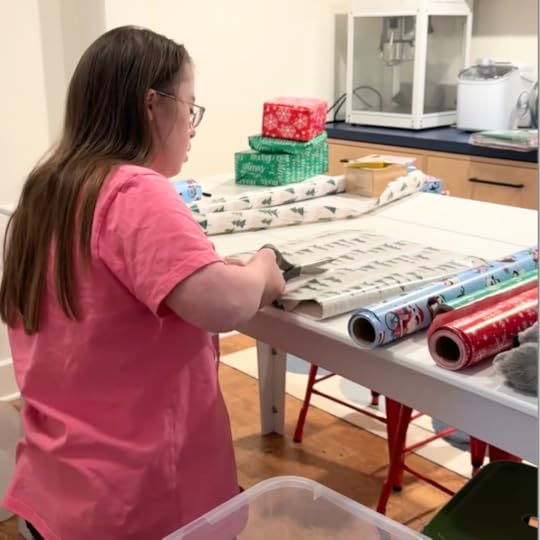
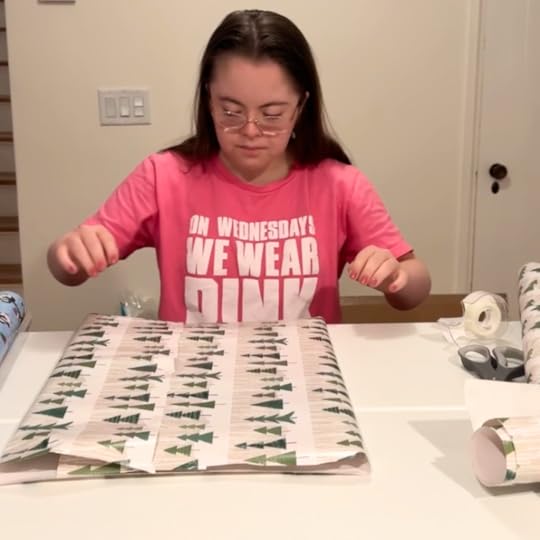
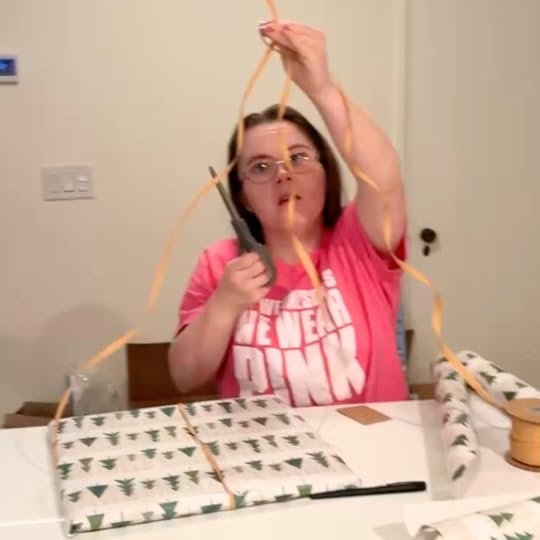
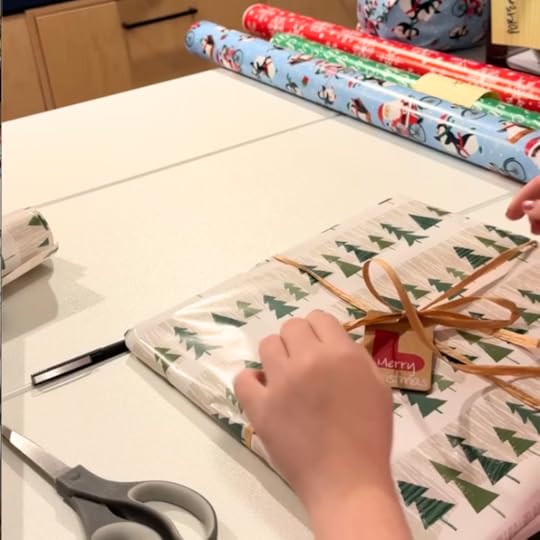
Gift wrapping has never been an easy task for Penny. Typically, she’s been relegated to the background of the wrapping extravaganza in our household—handing over supplies to her siblings or to me. But this year she made it clear that she wanted to wrap her gifts. I offered as much support as she needed. I promised I wouldn’t take over. It was hard work. It took a while. She wasn’t fully satisfied with the jagged edges of the wrapping paper. But she made it happen, patiently, beautifully.
The post Patiently, Beautifully Wrapping Presents appeared first on Amy Julia Becker.


December 20, 2024
Embracing the Mystery (more than the magic) of Christmas
Amidst the morning snowfalls and twinkling lights and jolly tunes, we’ve received grim news from a few different people in recent weeks. One of my childhood friends died in her sleep, leaving her beloved husband and children behind. One of our kids’ friends lost her dad to cancer. Another friend told us his granddaughter had taken her life.
I want the story of our life to be one of tinsel and mistletoe. Often it is one of sorrow and shadow.
 2016 photo of an assortment of Christmas cookies, decorated by our childrenMagic of Christmas
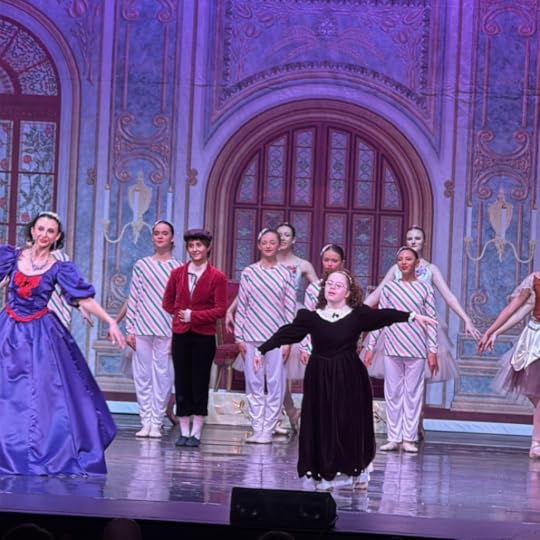
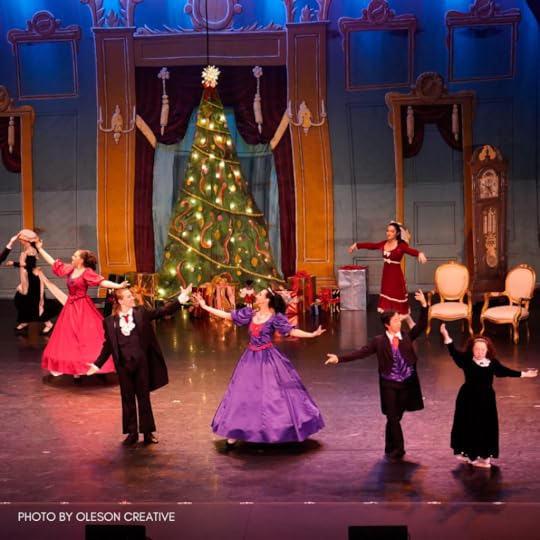
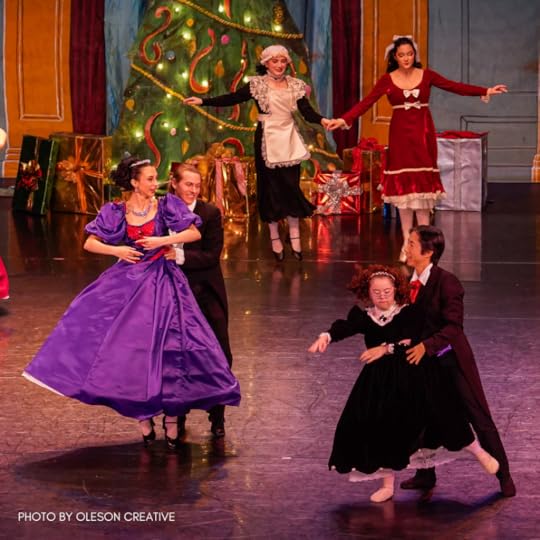
Her words got me thinking about the difference between magic and mystery at Christmas. The magic of Christmas comes through all the things we can control: the decorations and sugary treats, the balls of light and jingling playlists, the eggnog and presents. It comes through Santa Claus and holiday movies, through town festivals, winter carnivals, and cocktail parties. There’s nothing wrong with the magic, per se. We loved hearing Marilee sing Carol of the Bells in our local Holiday in the Depot. We loved seeing Penny dance in The Nutcracker (you can watch a one-minute clip here). We’ve watched Elf and hung our stockings and decorated with delight. Magical.

But if Christmas is reduced to magic, it is reduced to things we can control. And that control is based on an illusion—the illusion that everything is sugar and light, that everyone has their material and emotional needs met, that we exist to gratify our surface desires, and that all we need is belief in human goodness in order to make the world right.
 Photo courtesy of Canva ProMystery of Christmas
The core message of Christmas is something very different than magic. Instead, Christmas invites us into mystery, something by definition, unknowable and uncontrollable. The core message of Christmas is that we live in darkness and desperately need light that we cannot create for ourselves, that we live through grief and loss and pain and violence that we cannot rectify for ourselves, that our world is as very hopeless as it seems, unless. Unless God enters into the void.
The mystery of Christmas is that God entered time and space. Even more, that God entered time and space in the form of an embryo, a zygote, a fetus, a baby, dependent and needy and embodied. The mystery—the unknowability—of Christmas is the promise that God has made himself known in the person of Jesus Christ. The mystery of Christmas is that God continues to enter in, even to this current moment of violence and despair and shadow.
As Andy Crouch has written, we live in an era of magic that extends far beyond Christmas. More so than ever before, our technology promises magic—effortless power wielded on our behalf and for our desires.
But we also live in an age where that magic disappoints us, over and over again. Where the kid finally realizes who puts the gifts in the stockings. Where the adult recognizes that sadness doesn’t ebb just because it is Christmastime. Where our devices have only led to greater anxiety, depression, and despair, though they promised effortless connection and endless scrolling delight.
God With UsThe mystery of Christmas acknowledges the suffering and sorrow of a lonely and broken world. It even claims that the God who created the cosmos not only cares about that suffering and sorrow but enters into it as Emmanuel, “God with us.”
If we move past magic and enter the mystery of the incarnation, we, alongside Mary all those years ago, acknowledge the darkness and at the same time surrender to God’s promise of inbreaking light.
So, even as we bake cookies and clink our glasses and purchase yet more items from Amazon, we also remember that the shepherds shook with fear when they heard of the gift God gave on Christmas morn. We wonder at the promise of light and life. We proclaim, with the gospel writers, that the light shines in the darkness. We become people at home with both the darkness and the light, people who move from the surface of entertainment and cheer to the depths of sorrow and the depths of joy. When we enter the mystery of Christmas, we surrender control. We enter into suffering. And, ultimately, we enter into the mystery of unending and unfailing love that promises to save us all.
Get my reflections on disability, faith, and culture delivered to your inbox each week.
Subscribe here!
Let’s stay in touch. Subscribe to my newsletter to receive weekly reflections that challenge assumptions about the good life, proclaim the inherent belovedness of every human being, and envision a world of belonging where everyone matters. Follow me on Facebook , Instagram , and YouTube and subscribe to my Reimagining the Good Life podcast.
The post Embracing the Mystery (more than the magic) of Christmas appeared first on Amy Julia Becker.
December 16, 2024
Dancing Again | Nutcracker 2024
(Keep scrolling for video!) | Our daughter Penny danced for twelve years at Fineline Theatre Arts, which included many years of performing scenes from the Nutcracker. We moved this year, and we didn’t know that Penny would have another opportunity to take ballet, nor did we know that she might be able to perform. And honestly, I didn’t know whether a new studio would treat her with the same dignity and respect that her previous studio had.
Every new experience for a person with Down syndrome carries the risk of misunderstanding, and it is easy for Penny’s gifts and abilities to be overlooked. But she auditioned for the show, she received her part, she showed up for rehearsal, and then there we were, excited to see her on stage again.
We are so proud of Penny for showing up and doing her part. And we are so thankful for the leaders at Fineline and Woodbury Ballet and all the other places like them that create spaces of belonging for so many kids and adults, including our daughter.
Here’s what Penny had to say about dancing again (and keep scrolling for a one-minute video clip from the performance!):
Penny, how did it feel to be dancing in the Nutcracker again?
Honestly, it felt amazing to be able to perform again.
I know you were a little concerned at the beginning that you wouldn’t have a big enough part. Why were you worried about that? How did it work out?
I was worried about that because I didn’t know if I was going to be dancing or not. It worked out pretty well.
What was one highlight from your experience?
One highlight from my experience was being able to dance with the principal dancers.
Video clips courtesy of Woodbury Ballet; some photos courtesy of Oleson Creative

MORE WITH AMY JULIA:
More of Penny in her own wordsWorkshop: Reimagining Family Life with DisabilityFREE RESOURCE: 10 Way to Move Toward a Good Future (especially for families affected by disability)Let’s stay in touch. Subscribe to my newsletter to receive weekly reflections that challenge assumptions about the good life, proclaim the inherent belovedness of every human being, and envision a world of belonging where everyone matters. Follow me on Facebook , Instagram , and YouTube and subscribe to my Reimagining the Good Life podcast.
The post Dancing Again | Nutcracker 2024 appeared first on Amy Julia Becker.
December 13, 2024
From Conditional Love to Unconditional Growth
I sometimes beat myself up as a parent. In all honesty, I also beat myself up as a human, but on the parenting front, I think about how I let our kids stop playing piano during Covid because Skype lessons were so painful. I wish I hadn’t given in on that one. And then there are the screens. I regret so many things about the amount of short and superficial content that has crept into our lives.1 I wish that I had worked harder to instill habits of daily spiritual reflection as a family. The list goes on.
There are some good lessons for me in reflecting on areas where I’ve conceded too much. But sometimes, in the midst of the waves of self-recrimination, I ask myself what is motivating the regret. And usually, what I find is that I want our kids to perform well and impress others and look good. I want them to achieve their potential.2 And I’m not convinced that’s a great way to parent. I’m not convinced it’s a good way to think about myself either.
How the Ivy League Broke America (and parenting?)The cover story of December’s Atlantic Magazine comes from David Brooks, who writes about the problems of the American meritocracy, which is to say, the trouble with our social hierarchy and the way we decide who is deserving of admission to selective colleges and worthy of attention in classrooms and internships and job interviews. He lists six problems of the meritocracy, including the claim, “the meritocracy is a gigantic system of extrinsic rewards.” His description of how this happens is worth quoting at length:
What I don’t want to do as a parentStudents are trained to be good hurdle-clearers. We shower them with approval or disapproval depending on how they measure up on any given day. Childhood and adolescence are thus lived within an elaborate system of conditional love. Students learn to ride an emotional roller coaster—congratulating themselves for clearing a hurdle one day and demoralized by their failure the next. This leads to an existential fragility: If you don’t keep succeeding by somebody else’s metrics, your self-worth crumbles.
There’s much more to comment on in Brooks’ essay, but for now I want to focus on this point. He is making an argument about society as a whole. I’m thinking about his words as it pertains to my own parenting and my own sense of self. I don’t want to be someone who offers conditional love to our kids. I don’t want to contribute to existential fragility. I don’t want to put them on that emotional rollercoaster, not only with the congratulations and demoralizing he describes but also the rollercoaster of comparisons to all the other striving students around them. I’m skating close to that thin ice (if not finding myself underwater) every time I wish I had done more to make sure they have more success.
I don’t want our children to achieve their potential.
I do want them to become who they are created to be.
What we get to do as parentsI have started to see our role as parents not as pressure-cookers, but also not as passive observers. Rather, we get to nurture them, guide them, and offer them a vision of who they are becoming. We get to help them notice what they really enjoy and love. We get to point out the ways they bring delight and excitement and goodness to the world around them. Instead of pushing them up a ladder of success, we get to walk with them along a path of discovery. And, sometimes, we get to encourage them to try something on their own, to take a risk, even if it doesn’t look like succeeding.
We had one of those moments recently with Penny, when she had a chance to go through airport security on her own (you can read more about that—and watch a video—here).

We are encouraging William to take the classes he’s most interested in, even though he thinks he might struggle to get As in them. We comment on the ways we see Marilee becoming more and more interested in schoolwork rather than on the grades she gets on tests and papers. And we are increasingly demonstrating the same attitude in our own lives, whether that’s offering a public apology after we act like a jerk, or sharing a story of rejection or defeat. We want our kids to know that we are just like them—in the process of becoming who we are meant to be, not in a desperate race to prove ourselves to the world.
We can start here.David Brooks says the meritocracy is here to stay, and all we can do is try to reform it so that it is more equitable and more expansive. I don’t disagree with his realism about our society, but I do think we can establish smaller local communities—starting with our families—where we are defined by assuming the intrinsic value of each individual, celebrating the process of becoming, and unconditional love.MORE WITH AMY JULIA:
Embracing Belovedness: A New Approach to Parenting and Mental Health
Meritocracy Is the Antithesis to Love | Plough Essay
Let’s stay in touch. Subscribe to my newsletter to receive weekly reflections that challenge assumptions about the good life, proclaim the inherent belovedness of every human being, and envision a world of belonging where everyone matters. Follow me on Facebook , Instagram , and YouTube and subscribe to my Reimagining the Good Life podcast.
The post From Conditional Love to Unconditional Growth appeared first on Amy Julia Becker.
December 11, 2024
RNS | You will need to stay for 15 minutes to see the art
A few weeks ago, my husband and I visited Mass MoCA, the Massachusetts Museum of Contemporary Art. One wing of the museum is devoted to the creations of James Turrell, an American artist who has been exploring light, space and color for the past six decades. As we approached one room within the exhibit, a museum guide surprised me when she called out, “You will need to stay for 15 minutes to see the art.”
We stumbled through a carpeted hallway until Peter realized there was a railing to guide us into the space. One wall contained a dimly lit rectangle, but other than that, we saw nothing. We stood, disoriented, in the dark. I had no sense of the size of the room, or whether I might trip over objects. I couldn’t tell if other people were there. So I stopped. I stood still. I waited.
Soon enough — five minutes later? three? — I noticed a wooden bench along the back wall. I made my way to it and sat down. My pupils slowly expanded to allow more and more light. The artwork came into view— glowing pink and white and shimmering before my eyes. The room itself grew lighter and lighter. I could make out the dimensions — a simple, flat, square floor. We sat together, in silence. And I realized we could only see this beauty, we could only comprehend this space, we could only receive the light, if we waited, and if we paid attention.
Most of my life requires very little waiting and very little attention…
Go here to continue reading my essay: You will need to stay for 15 minutes to see the art | Religion News Service
Let’s stay in touch. Subscribe to my newsletter to receive weekly reflections that challenge assumptions about the good life, proclaim the inherent belovedness of every human being, and envision a world of belonging where everyone matters. Follow me on Facebook, Instagram, and YouTube and subscribe to my Reimagining the Good Life podcast.
The post RNS | You will need to stay for 15 minutes to see the art appeared first on Amy Julia Becker.
December 9, 2024
Truths From “The Best Christmas Pageant Ever”
We went to see The Best Christmas Pageant Ever as a family a couple of weeks ago. I’m still an even bigger fan of the 1980s, made-for-tv, low-budget, low-quality, 48-minute version, BUT four out of the five of us cried (I won’t tell who) in the theater, and we were glad we saw it.
The movie (and the book) tells the story of a group of delinquent kids—the Herdmans—who take over the Christmas pageant from the typical cast of characters. So instead of Mary being an angelic, blonde-haired, blue-eyed and rather self-righteous doll of a girl (Alice Wilkerson), she becomes a scared and confused kid who yells and cries and has dirt on her cheeks and under her fingernails (Imogene Herdman). All of a sudden Mary is a kid who is desperately trying to figure out how to take care of this baby entrusted to her, this baby she didn’t ask for and didn’t expect, this baby who may very well ruin her upcoming marriage to Joseph and leave her destitute and unable to provide for herself or the child.
I was reading recently from the early chapters of Luke as a part of getting ready for Christmas, and I came to the moment when the angel appears to Mary. So the Bible translation I read says that when the angel appears Mary feels “greatly troubled.” Translating that into what I might say inside my head if an I were her is something along the lines of, “Oh, crap.” Then the angel tells Mary she’s going to have a baby, and Mary says, “Who, me? Are you sure you have the right person? I, um, I haven’t had sex yet and even though we don’t have sex ed here in Nazareth, I’m pretty sure I can’t have a baby unless I, um, you know… with someone?” And then the angel says, “Yep. That is correct. But in this case, God’s going to make it happen. That’s what you get to do when you’re God. Congratulations!” And Mary says, “Um, okay. I’m not going to disagree with God” (Luke 1: 26-38, my very loose translation).
We know Mary was frightened, because the angel says she doesn’t need to be afraid. We know Mary was confused, because she asks questions. And we might even be right in speculating that Mary was not thrilled about this news. That even with an angelic visitation, the situation felt pretty hopeless. She will soon be a poor, unmarried, teenage mother.
And then Mary goes to visit her cousin Elizabeth. Just imagine. You’re going to see your older relative, and you’re filled with this news that might be from God and also might have been a dream and might mean the end of your marriage that hasn’t even begun, and might mean your death (you could be stoned for having sex outside of marriage in those days). So, you, Mary, have no idea how to tell Elizabeth or what she will say. Maybe she will think you’re losing your mind and hallucinating. Maybe she will shun you like your religion says she should. Maybe however she responds will be a signal of how the rest of the world will respond.
So Mary gets there, and she doesn’t say anything to Elizabeth about being pregnant. She simply says hello. As soon as she says hello, Elizabeth says, “Blessed are you and blessed is the fruit of your womb!” Elizabeth, without knowing that an angel has visited, without knowing any of the details, echoes the words the angel has spoken.
Only now, only after Elizabeth has given affirmation to the angel’s words, does Mary rejoice. She proclaims what she has only dared hope up to this point: that God is actually going to do something beautiful and merciful and just and right and true in and through her, through the birth of this unexpected baby.
So what does it take for Mary to have hope? It takes God’s word, sure. But it also takes Elizabeth. It takes another person to affirm God’s work in Mary’s life. Hope depends upon God’s promises, but the way we have access to hope is as we speak the truth of those promises into one another’s lives.
This Christmas season, let us be Elizabeth to one another. Let us see what God has promised through Jesus and name that. Let’s call it forth. Let’s remind each other of what is true. That the God who is just and right and good hates injustice. That the God who is grace and mercy and light loves all people. That the God who spoke creation into being can handle our sins and sorrows. That the God who came to us as a baby helpless in a manger can handle our helplessness.
Once Elizabeth speaks that affirmation, Mary rejoices. And then she goes on to fulfill the purpose for which she has been chosen. She gives birth to a little boy, the light who shines hope for all the world to see.
adapted from the December 12th reflection in my Advent Devotional
Get my reflections on disability, faith, and culture delivered to your inbox each week.
Subscribe here!
MORE WITH AMY JULIA:
FREE RESOURCE: 5 Ways to Experience God’s LoveWorkshop: Reimagining Family Life with DisabilityFREE RESOURCE: 10 Way to Move Toward a Good Future (especially for families affected by disability)The post Truths From “The Best Christmas Pageant Ever” appeared first on Amy Julia Becker.
Step by Step by Step | Increasing Independence
Step by step by step. For our daughter Penny, who has Down syndrome, the path toward adulthood and increasing independence involves many more deliberate and supported steps than it will for our other kids.
We had a chance to take one of those steps over Thanksgiving, when we were all flying together. Because Penny recently turned 18, she doesn’t have TSA Precheck status automatically anymore. Her siblings do because they are minors in our care. Last time this happened, her dad walked through the typical security line with her. This time, we decided she could go through it by herself.
And she did. Step by step by step, she is moving toward a good future.
MORE WITH AMY JULIA:
Let’s stay in touch. Subscribe to my newsletter to receive weekly reflections that challenge assumptions about the good life, proclaim the inherent belovedness of every human being, and envision a world of belonging where everyone matters.
Follow me on Facebook , Instagram , and YouTube and subscribe to my Reimagining the Good Life podcast.
The post Step by Step by Step | Increasing Independence appeared first on Amy Julia Becker.
December 6, 2024
Let’s have this conversation together.
These days, my writing and speaking are drawn to interdependence—the beauty of life together, of reciprocal relationships of love and care. Often, these relationships of mutuality (or, as Rosemarie Garland-Thomson called them, complementarity1) don’t just happen. They depend upon intentional invitations and commitments.
Part of this intentionality is listening and learning together. That isn’t always as easy as it sounds, so I was grateful to talk on the podcast this week with Rev. Dr. Esau McCaulley about how we attend to diverse voices in the church without silencing or patronizing one another. While our conversation is specific to his latest book for faith communities, his wisdom also connects in multiple ways to our broader culture.
“I hadn’t begun to listen…”Esau recounts how he was sitting in a coffee shop in Rochester, New York, and thinking to himself, “I’m so mad that no one ever pays attention to what’s going on in the Black church.” But then, as he continued his inner dialogue, he realized, “Esau, you’re a hypocrite…”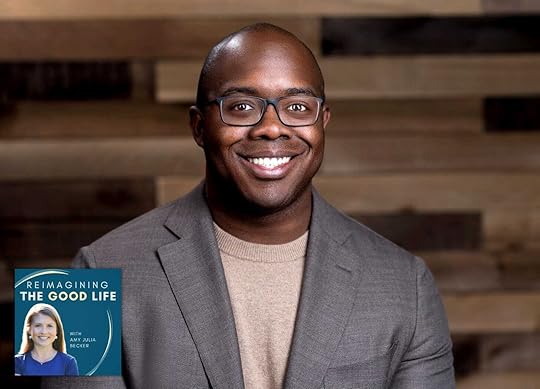
“You’re a hypocrite because you know nothing about the Asian American experience in the United States… You know almost nothing about what’s happening with Latino culture.”
He goes on to say, “I realized that I spent so much time trying to get people to listen to me, I hadn’t begun to listen to other people… What would happen if we had a conversation amongst each other?”
This realization was the genesis for The New Testament in Color: A Multiethnic Bible Commentary, a collaborative project that Dr. McCaulley describes in this way:
“When we say multiculturalism, it’s actually a code for everybody except for white people. But to be truly multicultural in the United States actually means to include everybody. So what if we did something super subversive, like have a multiethnic commentary that included Black, white, Asian, Latino and First Nations people in the United States… Sometimes de-centering yourself can give you a broader appreciation of what God is up to in the world. But that also doesn’t mean that you have to be quiet. We’re not saying, ‘If you are from the majority culture, you have nothing to offer.’ We’re saying, ‘Let’s have this conversation together about what it means to follow Jesus.’”
Conversations That Foster Interdependence“Let’s have this conversation together.”
What a beautiful way to grow in interdependent relationships. I wrote last year in an essay for Comment Magazine that “people with disabilities need opportunities for friendships to develop in schools, workplaces, and faith communities” in order for relationships of interdependence to flourish.2
Creating opportunities for friendships, where we can listen and learn together, gives us one way to participate in love. Where have you found opportunities to have conversations together in community? I’d love to hear from you! Reply to this email or leave a comment.
Complicated History (and more)Esau and I also talk about how to interact with flawed voices from our past. How is it that “complicated cultures can say things that are true and beautiful and good?” And we end our conversation with a beautiful challenge from Esau about the role of integrity and character in inviting the younger generation into communities of belonging. I hope you’ll listen or watch! Then tell me what you think. (At one point, Esau took over the podcast and gave my work a very kind and rather embarrassing shout out! You can watch that here.)
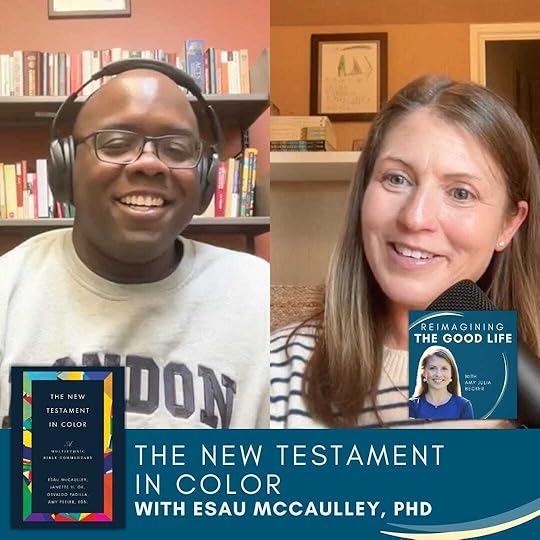
Listen on Apple | Listen on Spotify | Watch on YouTube
And Fun Fact! On the day this episode was released, Christianity Today announced that The New Testament in Color won book of the year in the category of Biblical studies. Congrats to Esau and the rest of the editorial team!3
Let’s stay in touch. Subscribe to my newsletter to receive weekly reflections that challenge assumptions about the good life, proclaim the inherent belovedness of every human being, and envision a world of belonging where everyone matters. Follow me on Facebook , Instagram , and YouTube and subscribe to my Reimagining the Good Life podcast.
The post Let’s have this conversation together. appeared first on Amy Julia Becker.
November 30, 2024
November Favorites {2024}
Recent favorites—a podcast and two essays—that I enjoyed in November 2024:
1. The Antidote To Not-Enoughness | Robin Wall Kimmerer.I could listen to snippets of this conversation every day just to remind myself of the truth of our interdependence and the abundance of provision in this world. It prompted me to buy Robin Wall Kimmerer’s new book, The Serviceberry.
2. How the Ivy League Broke America.I’m grateful that David Brooks is critiquing the foundations of American meritocracy and seeking to expand our understanding of how to reform the meritocracy. I still have questions about how we value the people who will never fit within the bounds of the meritocracy, and I’ll write more on that in a few weeks.
3. The Body She Had.In case you missed it, I talked on the podcast last week with Rosemarie Garland-Thomson about this essay. It’s a compassionate and challenging meditation on which lives we value, how we make choices, and what it would look like for us to live in love.
Get my favorites delivered to your inbox each month!
Subscribe here!
More Favorites and AJB Recommends
The post November Favorites {2024} appeared first on Amy Julia Becker.
November 27, 2024
When Is It Time to Speak Up?
After our most recent national election, I started wondering when/whether/how I should respond publicly to politics here in this newsletter or on social media. You might be thinking about this same thing as you imagine Thanksgiving dinner seated next to the relative who voted differently from you.
Why stay silent?The argument for staying silent includes the thought that my voice won’t make a big difference, so why risk offending people or, in my case, losing “followers.” (As an aside, I found that every time I mentioned either candidate or their words or actions toward people with disabilities during the campaign, I lost followers and provoked controversy. I hope I also contributed something helpful. This held true even in a post about Penny voting for the first time without disclosing the candidate she selected.)

But I also need to heed the reality that I’m no expert on international conflict or the economy or climate change. Staying silent can demonstrate a proper humility, an awareness of all I don’t know, and a desire to learn from others, especially those with whom I disagree.
I don’t want to use my platform to advocate for a particular political party. I don’t want to increase division. And I don’t want to paint a portrait of conservatives or progressives as unilaterally right or wrong. Maybe it’s better to stay neutral.
The Difference Between Staying Neutral and Being Non-PartisanA friend offered me some helpful advice when I shared these thoughts. She said there’s a difference between staying neutral and being non-partisan. She suggested that instead of seeing issues as political positions in favor of Democrats or Republicans, I could look at them in terms of values.
When a politician or a policy goes against my values—my personal values, my family’s values, my community’s values, my values as a follower of Jesus—then I probably want to speak up, especially when it’s related to issues I know something about. When a politician or a policy related to disability or family or faith violates those values, I will try to name it as a problem and propose a solution.
Wading Into Our Messy RealityEvery issue is complicated. Sometimes asking questions is better than proposing solutions. Sometimes the best course of action is to stay silent. But the work of peacemaking, of being salt and light, often involves wading into the messy realities of human conflict, with humility, and curiosity, and conviction, and courage.
So. I’m not going to stay neutral at Thanksgiving dinner or on social media. But I am planning to stay curious, to listen to other points of view, and to speak up, or act up, when the time comes.

How have you discerned when to speak up and when to stay silent? Reply and leave a comment. I love to hear from you.
Happy Thanksgiving!
Let’s stay in touch. Subscribe to my newsletter to receive regular updates and reflections. Follow me on Facebook , Instagram , and YouTube and subscribe to my Reimagining the Good Life podcast.
The post When Is It Time to Speak Up? appeared first on Amy Julia Becker.