Amy Julia Becker's Blog, page 18
September 1, 2024
Our Story: Down Syndrome, Identity, and Love
I was scared when I found out our oldest daughter, Penny, had Down syndrome. My husband Peter and I were 28 years old, and we weren’t prepared to welcome a child with an intellectual disability into our lives. But the fear didn’t last forever.
Penny took longer to meet her developmental milestones, and we spent more time with specialists than most parents, but she also slept through the night and smiled her adorable smile and gazed at us with her huge blue eyes. It was easy to love her.
Early on, we all learned basic sign language until she could speak words. As she got older, we focused with her on the things she loved—reading books, ballet class, playing backgammon, Taylor Swift. We began to see that Penny could learn and grow, even if it was at her own pace.
We eventually realized that what was true about Penny was true for us, and for our other children. That we all are needy and vulnerable and dependent. That we can ask for help and build relationships of mutual care. That we all are gifted and beloved. That our identity can arise from love, not from achievement.
Now, Penny can articulate her own goals for the future, and we get to help her move towards them. We no longer feel afraid of Down syndrome. Instead, we’ve been able to reimagine a good life based on love.
Workshop: Reimagining Family Life with DisabilityMORE WITH AMY JULIA:
Book: A Good and Perfect Gift: Faith, Expectations, and a Little Girl Named Penny Free Resource: Missing Out on Beautiful: Growing Up With a Child With Down SyndromeLet’s stay in touch. Subscribe to my newsletter to receive regular updates and reflections. Follow me on Facebook , Instagram , and YouTube and subscribe to my Reimagining the Good Life podcast.
The post Our Story: Down Syndrome, Identity, and Love appeared first on Amy Julia Becker.


August 30, 2024
A New Way of Seeing Our Humanity
My first traditionally-published book, A Good and Perfect Gift, tells the story of our daughter Penny’s early years after her diagnosis of Down syndrome. Even more so, it tells the story of what it took for me to be able to receive her as a gift. This book took years to write—it came out when Penny was five—and sometimes I think I’m still writing it. Certainly all the work that followed built upon the initial insights from those early years.
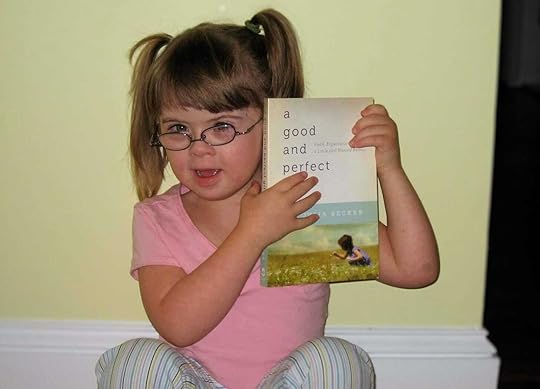
Having a daughter with Down syndrome has changed the way I see everything, for the better1. She has invited me to reimagine identity, purpose, relationships, politics, and spirituality. Her presence in my life has slowed me down, opened me up, connected me to my humanity, and transformed my understanding of what life is all about.
“She’s perfect.” “He was a gift.”On the night Penny was born, a few minutes after two doctors had said to my husband, “We suspect your daughter has Down syndrome,” another little girl was born in the room next to ours. Through the walls, we heard someone in that room proclaim: “She’s perfect! She’s perfect!”
A few hours later, a nurse came in. She checked my vital signs and dimmed the lights. I closed my eyes, but as she was leaving the room, she stopped and turned back towards me. “I had a special child too,” she said.
I looked up. I didn’t know what it meant to have a special child or how to ask questions or how to receive whatever she wanted to tell me. “How old is your child now?” I murmured.
“He died a long time ago,” she said, and all of a sudden my chest felt tight.
“I’m so sorry,” I said.
She shook her head. I didn’t understand. She was not looking for consolation. She said, “He was a gift.”
She walked out of the room. I never saw her again.
That nurse invited me to travel an unknown road, from the words “She’s perfect” to “He was a gift.”
She invited us to move from a culture that assesses us according to what we can do to a way of being that welcomes each of us as we are.
A Whole New Way of Seeing Our HumanityThat nurse hinted at a whole new way of seeing our humanity—not just Penny, but myself and those around me. She invited me to believe that who we are as humans is not a measurement against a norm but rather a wondrous exploration of abundant diversity. She invited me to love our daughter for who she is rather than who I might think she ought to be. She invited us away from individual achievement, social hierarchies, and competition to greater freedom, connection, and a world of possibility.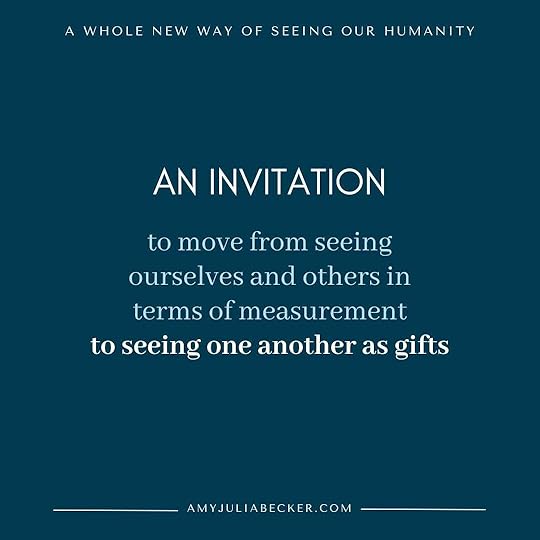
Over the years, the more I got to know our daughter, the less I needed her to prove herself through activity and achievement. The more enamored I became with who she already was. The more I saw my role as a parent not as training her to become who I wanted her to be, not as forcing her into the mold of average American, but rather as helping her grow into herself. Of course, then she helped me grow into myself too.
On Monday of this week, that little girl walked out the door as an eighteen-year-old young woman starting a program at Post University2. And the words from that nurse ring true. She is a gift.
We are all invited to move from seeing ourselves and others in terms of measurement to seeing one another as gifts. If you want to walk that road, perhaps our story can help. I kind of can’t believe that thirteen years later, I still hear from people about the way A Good and Perfect Gift has helped them, but I do. It’s available in paperback, Kindle, and audiobook, and I hope you find grace, hope, and freedom in your story by engaging with ours.
I’d love to hear from you. In what ways have you felt the need to prove yourself through abilities and achievements? How have you been invited into a different way of being?
MORE WITH AMY JULIA:
Workshop: Reimagining Family Life with DisabilityBook: A Good and Perfect Gift: Faith, Expectations, and a Little Girl Named Penny Free Resource: Missing Out on Beautiful: Growing Up With a Child With Down SyndromeLet’s stay in touch. Subscribe to my newsletter to receive regular updates and reflections. Follow me on Facebook , Instagram , and YouTube and subscribe to my Reimagining the Good Life podcast.
The post A New Way of Seeing Our Humanity appeared first on Amy Julia Becker.
August 28, 2024
Penny Is Off to College!
Penny is off to college! She started her first year at Post University. I recorded a video with some of her thoughts over on Instagram. You can watch below.
View this post on Instagram
A post shared by Amy Julia Becker| Author, Speaker, Podcaster (@amyjuliabecker)
MORE WITH AMY JULIA:
Workshop: Reimagining Family Life with DisabilityBook: A Good and Perfect Gift: Faith, Expectations, and a Little Girl Named Penny Free Resource: Missing Out on Beautiful: Growing Up With a Child With Down SyndromeLet’s stay in touch. Subscribe to my newsletter to receive regular updates and reflections. Follow me on Facebook , Instagram , and YouTube and subscribe to my Reimagining the Good Life podcast.
The post Penny Is Off to College! appeared first on Amy Julia Becker.
August 26, 2024
We Are Beloved: The Mindset Shift That Transformed Our Family
I remember being at a retreat where there were a lot of children present who were around the same age as Penny, our daughter who has Down syndrome. I spent most of the weekend in a place of darkness in my soul because I was comparing Penny’s abilities to the abilities of the other children. I ended up distanced, isolated and separated because I was filled with judgment and jealousy. And I didn’t like that at all.
I realized the problem was not what Penny could or could not do. The problem was not what these other children could or could not do. The problem was in how I was constructing identity.
Many of us construct identity based upon ability, achievement, and appearance.
We ask each other questions, like, “What do you do?” In the disability world, we sometimes ask whether people are high or low functioning. We tend to rank and rate ourselves according to ability and achievement.
When Penny came into our life, I discovered that I was constructing identity through comparisons.
If we construct identity based on ability, it will lead to judgment and jealousy and insecurity and isolation and separation and all the rest.
But what if we construct our identities based on belovedness? What if we begin to believe that we are beloved as we are and we don’t have to prove it through our abilities? I discovered that constructing identity on belovedness moves us away from judgment and jealousy and into a place of compassion and celebration. It brings us together and builds us up.
I moved from the question, “What can she do? to “Who is she?”
This mindset shift (I talk a lot about this in my workshop) changed our family life. We are beloved. Before we’ve done anything right, before we’ve built any achievements, before we’ve received any awards, we are beloved.
MORE WITH AMY JULIA:
Workshop: Reimagining Family Life with DisabilityBook: A Good and Perfect Gift: Faith, Expectations, and a Little Girl Named Penny Free Resource: Missing Out on Beautiful: Growing Up With a Child With Down SyndromeLet’s stay in touch. Subscribe to my newsletter to receive regular updates and reflections. Follow me on Facebook , Instagram , and YouTube and subscribe to my Reimagining the Good Life podcast.
The post We Are Beloved: The Mindset Shift That Transformed Our Family appeared first on Amy Julia Becker.
August 24, 2024
Gus Walz and the Significance of Belonging
Tim Walz took center stage at the Democratic National Convention and so did his son Gus, who has a nonverbal learning disorder as well as ADHD. Through their interaction, we saw a significant message that was demonstrated not through words, but through an embrace.
We saw Gus’s pride in his dad through his tears, his gesture. We saw their embrace of each other. And all of that spoke to the significance of their relationship and the importance that Gus holds within their family. It spoke to the fact that Gus belongs.
We are a society that often communicates tolerance at best and exclusion at worst. Seeing families like the Walzes on center stage helps us begin to envision a world where everyone belongs and everyone matters.
MORE WITH AMY JULIA:
My Daughter Does Not Exist to Teach Me a LessonHow Politicians Talk About Disability MattersLeBron James: “Being a Winner Is a Curse”Let’s stay in touch. Subscribe to my newsletter to receive regular updates and reflections. Follow me on Facebook , Instagram , and YouTube and subscribe to my Reimagining the Good Life podcast.
The post Gus Walz and the Significance of Belonging appeared first on Amy Julia Becker.
August 22, 2024
5 Things I Love Right Now {August 2024}
Here in Connecticut, it is still summer. I know there are parts of the country where kids have been back in school for weeks, but our kids are sleeping in and going to the beach and bemoaning our family screen-time rules and enjoying the local carnival and the slower pace of everything. It is all about to come to an end, but I am so grateful for these days.
As a result of the delights of summer, I have read and watched and listened to fewer things than usual, but I still want to share a few of my current favorites here. As always, I would also love to hear what you’re appreciating, so please share in response!
1. My favorite get-to-know-you question of the summer.This question came from the Hope Heals Conversation Cards:
If you had to give a 30-minute presentation on a topic that was not related to your profession, what would it be?
(I said I would choose life hacks. Another person in the group said cereal. Another said an analysis of America’s Top Model. You get the idea…)
2. The Hospitality of Need.
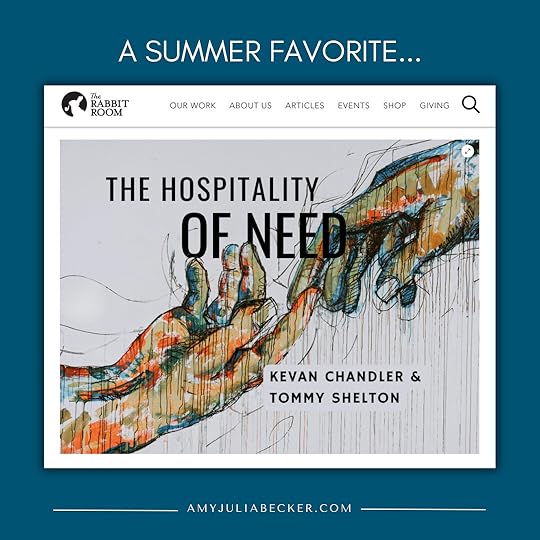
I loved Kevan Chandler’s exploration of how we can see needs as an opportunity for relationships and hospitality rather than sources of shame and burdens to others. In his words:
3. Toward a Gift Economy.
“Whether I’m traveling or at home, because of my disability, pretty much anything I do is going to require more of me and others…There’s a temptation to assume this is a bad thing, but maybe it’s a grace, as Jesus saw it.
Being so acquainted with the need, I have often struggled, wondering if I am, more than anything else, a burden. … Then I read about how Jesus asked a Samaritan woman for a drink of water, how a sinful woman washed his dusty feet, how his disciples gave him something to eat after his resurrection. …[Jesus] saw the need as a door to be opened into fellowship, healing, and wholeness.”
This essay is a wonderful pairing with the previous one. Simon Oliver writes about how we as a society have moved from having a market economy to being a market society. I appreciated thinking about our relationships in terms of gifts (not transactions), and I want to use this essay as a launchpad for considering what we can do to shift our mindset toward one another.
4. What Tweens Get from Sephora and What They Get from Us.I’d like to write more about Jia Tolentino’s essay about tween girls and really expensive skin-care products and the role that middle-aged women (i.e. their moms, like me) play in it. One of the gifts of having a child with Down syndrome has been the challenge to receive one another as we are, receive our bodies and minds and faces and aging, rather than resisting it or trying to improve it or change it. This essay got me thinking about how, when we receive ourselves—and our wrinkles and gray hair and aging bodies—as we are, we can offer that same gift to our kids.
5. For the Glory.One of you recommended this biography of Eric Liddell. Thank you! I’m so glad to learn more about this man and the way he pursued both the joy of running and his calling as a missionary in China.
Get my favorites delivered to your inbox each month!
Subscribe here!
More with Amy Julia:
Let’s stay in touch. Subscribe to my newsletter to receive regular updates and reflections. Follow me on Facebook , Instagram , and YouTube and subscribe to my Reimagining the Good Life podcast.
The post 5 Things I Love Right Now {August 2024} appeared first on Amy Julia Becker.
I Want to Celebrate Aging
I want to celebrate aging. I’m 47 years old. I’m not starting a Botox regimen, even though I have plenty of wrinkles. I’m not dying my hair, even as the gray starts to come in. I’m not setting weight-loss goals, even though my body has grown. I’m embracing the signs of age.
And yes, this is for me. I want to get off the treadmill of comparisons and celebrate the life I have, not some idealized version of me that has never been true or satisfying anyway.
And it is also for our daughters. I just read an essay by Jia Tolentino about living in an era that tells little girls they need to spend hundreds of dollars at Sephora in order to be beautiful. I want our daughters to receive their own beauty—and the beauty of everyone around them. I want them to see aging as a gift, a journey towards wisdom and compassion, for ourselves and for others. I want them to see their own faces and hair and bodies as good gifts both now and as they grow up.
MORE WITH AMY JULIA:
How Politicians Talk About Disability MattersThe Good Life Belongs to the Ones who are Unimportant and OverlookedChapter 3: BeautyLet’s stay in touch. Subscribe to my newsletter to receive regular updates and reflections. Follow me on Facebook , Instagram , and YouTube and subscribe to my Reimagining the Good Life podcast.
The post I Want to Celebrate Aging appeared first on Amy Julia Becker.
August 19, 2024
My Daughter Does Not Exist to Teach Me a Lesson
Many people, when Penny was first born, talked to me about why it would be good for me to have a child with Down syndrome.
They said: Penny would be good for me because she would help me to slow down. She would be good for me because she would teach me patience, and she would be good for me because she would help me confront my own perfectionism.
All of those things are true, but Penny does not exist in this world in order to be a lesson for my self-advancement. I never want to diminish her humanity or the humanity of any other person with a disability in order to prop myself up.
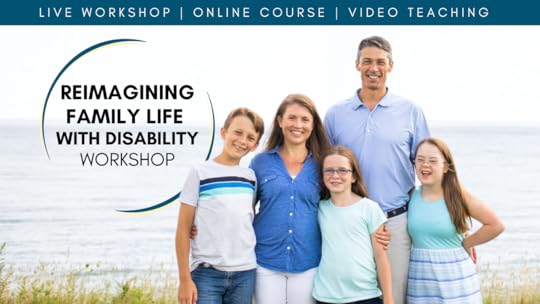
We receive lots of cultural messages about disability that just aren’t true. I love helping parents shift their mindsets as we reimagine family life with disability. Check out my workshop!
MORE WITH AMY JULIA:
Workshop: Reimagining Family Life with DisabilityFREE RESOURCE: 10 Way to Move Toward a Good Future (especially for families affected by disability)Supporting Penny’s GoalsLet’s stay in touch. Subscribe to my newsletter to receive regular updates and reflections. Follow me on Facebook , Instagram , and YouTube and subscribe to my Reimagining the Good Life podcast.
The post My Daughter Does Not Exist to Teach Me a Lesson appeared first on Amy Julia Becker.
August 16, 2024
Universal Design Matters to All of Us
The cool thing about universal design is that you don’t even notice it.
I’ve been attending Hope Heals Camp at Camp McDowell in Nauvoo, Alabama for four summers now.1 I’ve heard people say that it is a “fully accessible” space. I’ve seen the sign at the entrance to the camp that says, “The way the world could be.” But it wasn’t until this visit that I noticed the lack of staircases.
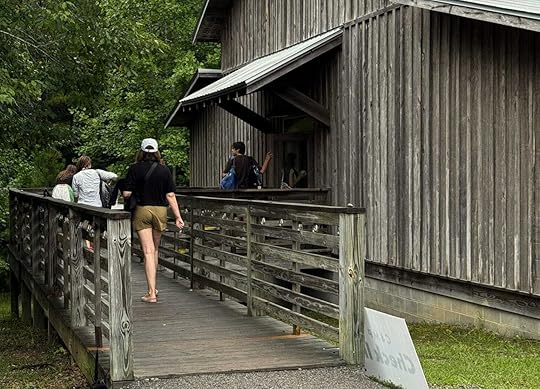
None of the main entryways to any buildings at Camp McDowell have any steps. They all offer flat surfaces so that everyone can walk, or roll, right in. The cottages are all situated so that the ground level always allows rolling directly onto a porch and into the main room, or down a gently sloping incline to the side that leads to the lower level. The entrance to one main building comes via a ramp, not a staircase. This design allows access and communicates welcome to a broad group of people, and it took me years to even notice it.
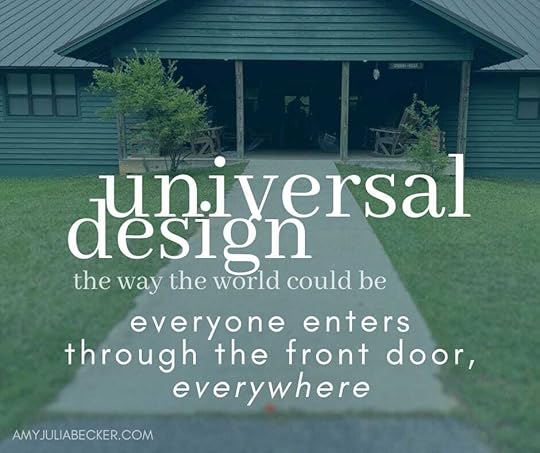
At Camp McDowell, everyone enters through the front door, everywhere.
Universal design is the idea that designers can create spaces that welcome people with disabilities and families with young children and tall people and short people and everyone in between.
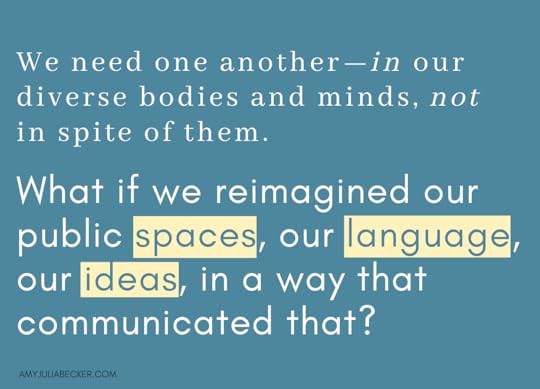
The thing is, it’s harder to retro-fit spaces than it is to design them anew. How do you communicate welcome to all people from the doors of an old cathedral with stone steps? How do you hold on to the beauty and honor the labor of those who created these spaces while also making room for a more diverse community? Is it wrong to attend schools that select for intellectual ability or to have classes within schools that group people according to ability?
I do not pretend to have the answers to these questions. And they aren’t just an intellectual exercise for us.
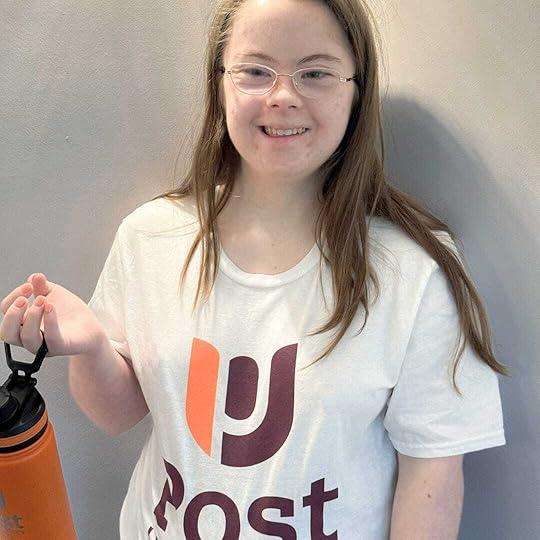
Penny, our 18-year-old daughter who has Down syndrome, is heading to a university in a few weeks where she will be integrated into some aspects of campus life, and where she also will be set apart within a cohort with other students with intellectual disabilities.3 I’m inclined to believe she will benefit from both of these settings, and I’m hopeful that the experience feels like one of “walking through the front door” alongside her typical peers even when there are alcoves within the metaphorical building where she learns only alongside her cohort.
Universal Design Matters for All of UsFor people with typical intellectual and physical ability, universal design can seem like an afterthought, or even an inconvenience. Or it can seem like something necessary for justice or kindness. But it’s more than that. It’s a way of communicating a different way of being in the world. Yes, universal design demonstrates welcome to the ones who are most likely to be excluded and overlooked, the ones who are the most vulnerable. But it also communicates a desire for a world where we are welcome as we are. It pushes against the need to get everything right and have it all together and never get old and never show weakness.
Most of us aren’t designing buildings. Most of us aren’t starting new schools. But all of us have opportunities to communicate welcome to the ones in our community who are most likely to be excluded.
All of us have opportunities to open the front door.
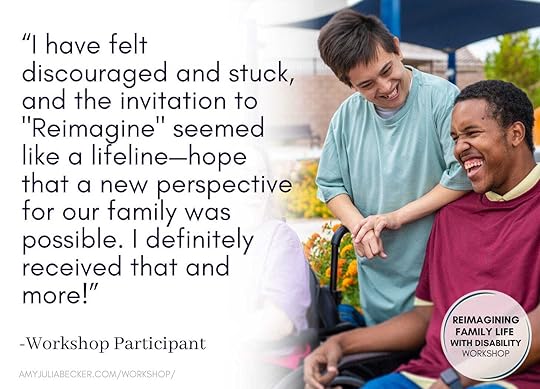
If you’re a parent of a child with a disability, do you wonder if it’s possible to build a team of support, to connect with people in your community who hold the front door wide open and welcome your child and your family as you are? I’ve created a workshop just for you: Reimagining Family Life with Disability.
Make an action plan and take meaningful and manageable steps toward a good future. The next live, virtual workshop begins on September 18. The online course and group curriculum are available any time. Check out the workshop and register today! And please share with a friend.
As always, I love to hear from you. Where have you seen universal design? In what ways do you wish people would “open the front door”?
Get my reflections on disability, faith, and culture delivered to your inbox each week.
Subscribe here!
MORE WITH AMY JULIA:
Supporting Penny’s GoalsHow Politicians Talk About Disability MattersThe Wonder of Kindness and Joy on Planet EarthLet’s stay in touch. Subscribe to my newsletter to receive regular updates and reflections. Follow me on Facebook , Instagram , and YouTube and subscribe to my Reimagining the Good Life podcast.
The post Universal Design Matters to All of Us appeared first on Amy Julia Becker.
August 14, 2024
Supporting Penny’s Goals
I used to be afraid to set goals for our daughter Penny, who has Down syndrome. It felt like if we didn’t meet those goals, we would be passing judgment on her or on ourselves or on the team of people supporting her.
Penny is 18 now. We set goals together all the time, and we want to support her in achieving them. Penny’s not going to meet all of the goals that she sets—neither am I—but part of believing in her and respecting her includes supporting her goals.
Penny’s presence in this world matters. She is valuable in and of herself, and the ways she can contribute to the world brings value to others.
I used to be afraid to set goals because I was afraid we would be disappointed. Now, we can set goals and work towards them because we can imagine a good future for our daughter.
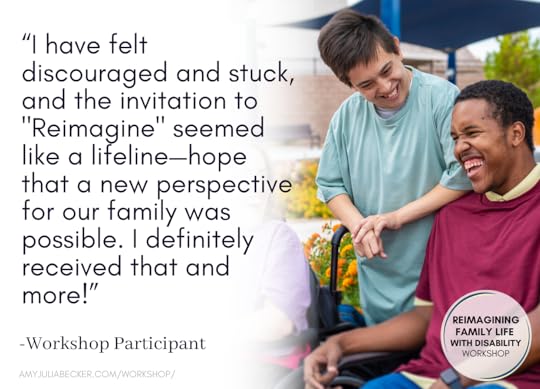
That’s why I’ve created a workshop called Reimagining Family Life with Disability. I’d love to invite you to be a part of that, especially if you want to be able to move towards a good future for yourself and for your family.
“I have felt discouraged and stuck, and the invitation to “Reimagine” seemed like a lifeline—hope that a new perspective for our family was possible. I definitely received that and more!”
-Workshop Participant
MORE WITH AMY JULIA:
Workshop: Reimagining Family Life with DisabilityBook: A Good and Perfect Gift: Faith, Expectations, and a Little Girl Named Penny Free Resource: Missing Out on Beautiful: Growing Up With a Child With Down SyndromeLet’s stay in touch. Subscribe to my newsletter to receive regular updates and reflections. Follow me on Facebook , Instagram , and YouTube and subscribe to my Reimagining the Good Life podcast.
The post Supporting Penny’s Goals appeared first on Amy Julia Becker.