Amy Julia Becker's Blog, page 15
November 23, 2024
Disability’s Beautiful Complication of Human Flourishing
I’ve written a lot from the perspective of a white, affluent, educated, able-bodied, married woman about the ways in which my demographic group has rates of anxiety and depression. Similarly, studies put high-achieving high school kids, like I was as a teenager, into a high-risk group that also includes kids who experience major, traumatic situations, such as being in the foster care system or having parents in prison.
What we hold up as the good life—for ourselves, for our children, for our teenagers—is actually often a mirage in our culture.
I think a significance of the encounter with disability—whether that’s in our own bodies or in those that we love and hold and behold—is that there is this complication in a beautiful way of what it means to be human, what it means to flourish, what it means to have a good life.
View this post on Instagram
A post shared by Amy Julia Becker| Author, Speaker (@amyjuliabecker)
These were some of my thoughts as I asked Rosemarie Garland-Thomson how she understands the good life and why that good life is possible for us in all our human variations.
You’re going to want to listen, share, and take notes on this episode. Find it wherever you get your podcasts: S8 E6 A Life Worth Living? Reimagining Life, Choice, and Disability with Rosemarie Garland-Thomson, PhD
Let’s stay in touch. Subscribe to my newsletter to receive regular updates and reflections. Follow me on Facebook , Instagram , and YouTube and subscribe to my Reimagining the Good Life podcast.
The post Disability’s Beautiful Complication of Human Flourishing appeared first on Amy Julia Becker.


Culture’s Good-Life Mirage
How do we decide who has a life worth living?
I thought about this question as I listened to bioethicist Rosemarie Garland-Thomson, PhD, tell me about a group of friends. These friends, like her, live with disabilities. These friends, like her, enjoy the lives they’re living. As she talked about her friends and their good lives, she said, “Disability is not what determines human flourishing.”
Her statement comes out of her experience living with a disability in a world that, as she describes it, often assumes that “disability is a disqualifier from the good life, from human flourishing.”
Rosemarie lives with a disability. You might not.
I live in a family affected by disability. You might not.
But I would guess that you too have asked the questions:
What makes a life worth living?Who decides?Am I disqualified from “the good life”?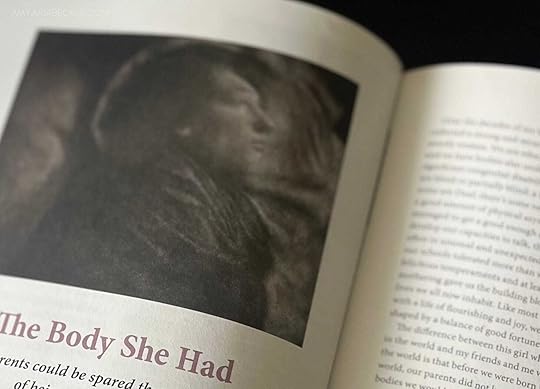 Plough Magazine essay by Rosemarie Garland-ThomsonWhat Makes a Good Life?
I’ve appreciated Dr. Garland-Thomson’s writing for years, and her recent Plough essay prompted our conversation, a conversation for all of us who question culture’s assumptions about achievement, productivity, and the good life. She points out that her life contradicts culture’s assumptions. “I’ve had an extraordinarily good life… It’s impossible to predict what a good life will be.”
Although it may be impossible to predict exactly what makes a good life, our culture continues to insist on trying. But the version of the good life held up by our culture is a mirage. It doesn’t exist. It’s no wonder, then, that we’re unprepared, even afraid, when we experience the actual reality of being human. There’s so much that’s unexpected and unimagined. Birth and illness and aging and disability and a myriad of human experiences refuse to be contained within culture’s expectations of a life worth living.
So what do we do when we find ourselves with a variation of life that no one seems to want?When you feel disqualified from the good life, here are four things to remember:
1. Remember that:
The “good life” predicted by our culture doesn’t exist. Your life doesn’t have to measure up to a mirage.
2. Remember that:
When you push past the messages of our culture, you’ll find that there are many of us who do want the varied good-life realities that come with being human. Find those stories.
Rosemarie and her friends have particular stories to tell of their good lives, of the lives they want. Our family has a particular story to tell of the good life we have. It’s not a perfect life, but it’s the life we want, and it’s a life worth living.
3. Remember that:
It’s possible to move past the fear of the unexpected and to move toward love. Turn your attention toward your embodied life—toward the unique faces you behold, the hands you hold in yours.
As Rosemarie writes:
“To love is the act of recognizing one another, of witnessing the uniqueness of distinct human beings, precious and irreplaceable.”
4. Remember that:
Human flourishing is not limited to one small definition of the good life. There are immeasurable ways to embrace the beauty and diversity of what it means to be human. There are immeasurable ways to live what Rosemarie calls “an extraordinarily good life.”
Human FlourishingHow can we redefine human flourishing in a way that welcomes the reality and gifts of being human in all its different forms? We begin by sharing our stories. In Dr. Garland-Thomson’s words, our “literature of welcome” creates an “openness to the unexpected” within our society. She tells a compelling story about mittens (yes, mittens!) around minute 32:30 of our conversation. It helps us imagine how to be people who are creating spaces and postures of welcome. (If you prefer visuals, you can watch that segment of our interview here!)
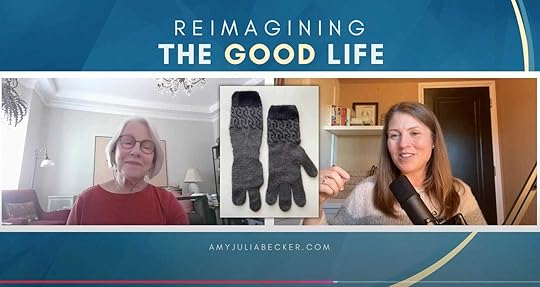
Our conversation is a compassionate and challenging meditation on which lives we value, how we make choices, and what it would look like for us to live in love. We discuss what is means to:
be humanlive in communitycare for one anothernavigate the complicated ethics of selective abortionfind the language and stories to talk about a life worth living
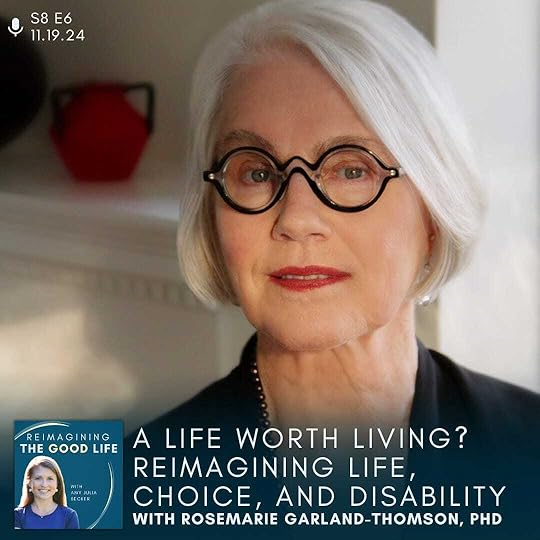
Listen on Apple | Listen on Spotify | Watch on YouTube
I hope you’ll listen or watch and then tell me what you think. You can reply to this email or leave a comment. I know this conversation contains some tender topics, and I’d love to hear your thoughts.
Thanks for listening.
Let’s stay in touch. Subscribe to my newsletter to receive regular updates and reflections. Follow me on Facebook , Instagram , and YouTube and subscribe to my Reimagining the Good Life podcast.
The post Culture’s Good-Life Mirage appeared first on Amy Julia Becker.
November 19, 2024
A Life Worth Living? Reimagining Life, Choice, and Disability with Rosemarie Garland-Thomson, PhD
How do we decide who has a life worth living? Rosemarie Garland-Thomson, PhD, author and professor emerita of English and bioethics at Emory University, joins Amy Julia Becker to discuss what it means to:
be humanlive in communitycare for one anothernavigate the complicated ethics of selective abortionfind the language and stories to talk about a life worth living
ADVENT DEVOTIONAL:
Prepare Him Room: Advent Reflections on What Happens When God Shows Up
ON THE PODCAST:
Plough essay : “The Body She Had” by Rosemarie Garland-ThomsonBook: About Us: Essays from the New York Times about Disability by People with Disabilities Sara Hendren’s episode : “Who Belongs? Disability and the Built WorldCONNECT with Dr. Garland-Thomson on her website: rosemariegarlandthomson.com
Watch this conversation on YouTube by clicking here.
Guest Bio:
Rosemarie Garland-Thomson is professor emerita of English and bioethics at Emory University. She works in disability culture, bioethics, and health humanities. She is a Hastings Center Senior Advisor and member of the American Academy of Arts and Sciences. She is co-editor of About Us: Essays from the New York Times about Disability by People with Disabilities and author of Staring: How We Look and several other books.
Note: This transcript is autogenerated using speech recognition software and does contain errors. Please check the corresponding audio before quoting in print.
Amy Julia (02:23)
Rosemarie, it is really delightful to be sitting here with you today. Thank you so much for joining us
Rosemarie Garland-Thomson (02:28)
Thank you, Amy, Julia. I’m delighted to be here with you and to contribute to your wonderful program or conversation about reimagining the good life.
Amy Julia (02:37)
Mmm.
Well, I’m so happy to have you here because as I mentioned before we even started recording, I’ve been following your work for a long time and I’ve been looking for a way to have, I think the conversation we’re about to have for a long time and you seem like the ideal person to have it. And I think this really beautiful and poignant essay that you wrote recently for Plough Magazine is the way into that conversation.
So I’ll give the listeners a little bit of context here. We’ll certainly link to that essay in the show notes, but you begin with a quotation from an essay in the New York Times. So the quotation from that New York Times essay is, my husband and I decided that it was a loving decision not to bring her into the world with the body that she had. So I wonder if you can explain what that quotation is referring to and maybe give us an introduction to you and your work.
through that sentence and we’ll then get to talk about the essay that follows.
Rosemarie Garland-Thomson (03:36)
Well, thank you for asking. The place to start is that I am an English teacher, an educator. And as an English teacher, what you, and I’ve always done this, I taught high school, junior high school, even a little elementary school. But most of my work has been done at the university higher education level.
But as an English teacher, what one does is work with stories. So literature is a compilation of stories. Even grammar is a compilation of stories because language itself and story and the meaning making work of language and story and what we think of as representation as well is that that’s what I do.
And that’s what all of us who are English teachers, but in some sense, all of us who work in what we call the humanities, that’s what we do. We think about questions of what does it mean to be human? What is, what are the stories that human beings have made and exchanged and passed on to one another? And they’re always stories about lived human lives. So that
That set of questions informs everything that I do in my own work and in my own life. so part of thinking about human stories is thinking about what I call human particularity or human distinctiveness. What is it that makes us human? What do we share in common that’s the same? And what differences do we have?
Amy Julia (05:21)
Hmm.
Rosemarie Garland-Thomson (05:28)
from one another and how are we all embedded in, you know, the beginning and the middle and the end. Those are three elements to every story of a human life. So I have always been alert to human story. And so when I read this article in the New York Times, I was particularly struck by the logic of it.
The idea that this, let me call her a mother and her husband, who I presume was understood as the father, that this mother was in a position to have to make a decision about whether or not to bring this child that she was making with her body.
Amy Julia (06:06)
Hmm.
Mm-hmm.
Rosemarie Garland-Thomson (06:21)
into the world that somehow she had been forced or put in a position to have to make a decision about what we might call in bioethics, quality of life or medical diagnostic predictions, prognosis about this person that’s a girl. Of course, I’m a girl. So
Amy Julia (06:35)
Right.
Rosemarie Garland-Thomson (06:48)
I am thinking about this and it was disconcerting, but it was also an unsettling, but I felt a great deal of empathy for everyone involved in this story. And I had just been with a group of friends in the UK and there are people that I know and I’m often with friends and
And we all have disabilities in this group and we were getting together and we were talking about the kinds of things that over a lifetime we have heard, the kinds of stories that we have heard that were very much like this, that were about our bodies and the bodies that we have and how those bodies are rejected in many ways.
Amy Julia (07:36)
Thanks.
Rosemarie Garland-Thomson (07:42)
by the world. One of my friends said, you know, someone was saying to me, I can’t believe they said it, my friend said, that if I were you, I’d kill myself. And the rest of us are thinking, good heavens, do we seem like people who want to kill ourselves? the answer, of course, is no. And so when I read this story in the New York Times, I was thinking about my friends and the good lives that we have. And this
Amy Julia (07:57)
Yeah.
Rosemarie Garland-Thomson (08:12)
assumption that living a life with a body understood as having a disability is a disqualifier from having a good life, from human flourishing,
Amy Julia (08:20)
Right, right.
Rosemarie Garland-Thomson (08:22)
this poor woman and her husband did not understand
that this girl could have had a life like ours, a good life, and that disability is not what determines human flourishing.
Amy Julia (08:29)
Yeah, yeah.
Well, yeah, so that’s, we’re going to explore all of this. I want to start with disability. So the word itself, how do you think about disability? What does it mean? How would you define it?
Rosemarie Garland-Thomson (08:48)
Well, it’s a word that is little understood now in kind of the popular conversations. It’s a word like every other word that has a history. The word has shifted its meaning over time in English. The best way, I think, to talk about this is to…
say that the word disability, of course, has been with us as people with these human variations known as disabilities for a long, long time.
Disability was understood as a medical condition, as a distinct disadvantage, as something that happens to a person’s body that is disastrous, that is something you don’t want to have happen. So that’s been the long history of the word disability.
Amy Julia (09:35)
Mm-hmm. Right.
Rosemarie Garland-Thomson (09:43)
But in the mid 20th century, we have the civil and human rights movement that comes forward and creates identity categories around what we think of as ethnicity, race, gender, and disability. And the civil and human rights legislation, the civil rights laws of the mid 1960s in the US and everywhere else created
Amy Julia (09:52)
Mm-hmm.
Rosemarie Garland-Thomson (10:11)
a category of people that are disabled people or people with disabilities. These are created through legislation, through IDEA, the legislation about equal and fair education, and of course the Americans with Disabilities Act. It constitutes a identity group. It constitutes a group of people who are in a protected class, recognized,
Amy Julia (10:28)
Right.
Rosemarie Garland-Thomson (10:40)
And this changes disability. moves us, is how I like to talk about it, away from being patients and into being citizens. And that transformation has been less well understood in terms of our group because disability is still residual understood in its medical way, is having something undesirable wrong with you.
Amy Julia (10:50)
Hmm.
Right.
Mm-hmm.
Rosemarie Garland-Thomson (11:08)
the pathological understanding of disability rather than the social and political understanding of disability. So there’s been a kind of incoherence with the word itself in comparison to the way we think about women and African Americans or black people or LGBT even as a category. So there’s a certain
Amy Julia (11:27)
huh.
Right.
Rosemarie Garland-Thomson (11:37)
difficulty, a certain legibility problem that disability has. And the other element about disability that is a recognition problem is how I like to think about it, is that it’s very difficult to recognize disability because it appears to us in public and private life in such varying forms. We think about visible disabilities and invisible disabilities.
Amy Julia (12:03)
Sure.
Rosemarie Garland-Thomson (12:03)
We think about cognitive, intellectual, physical, psychiatric. We think about neurodiversity. There are so many different categories of being that qualify that it’s very difficult to recognize disability in one another. And then to agree to enter into that category, which is still very highly stigmatized.
Amy Julia (12:25)
Yeah.
Yep, yep.
Rosemarie Garland-Thomson (12:33)
So there’s a legibility problem with disability.
Amy Julia (12:36)
And it makes me think about even just the words you used earlier in terms of human variation. I’ve noticed that the statistics around how many people are qualify kind of as disabled, which is important from a political standpoint in terms of who gets what services and access to care and things like that. I also find it almost indicative that it’s so hard to categorize because there is a sense of all of us being on a spectrum of what we might call disabled
So the other thing I want to kind of zoom out for a minute and just talk about is what I think some people call selective abortion. So abortion that is not based on an unwanted pregnancy, but actually on the presence of a distinctive characteristic of a fetus. So…
Typically not in the United States, but in other countries around the globe, we’ll hear about selective abortion generally of girls because of cultures in which it is better to have a boy and especially if you are only allowed, as for many years was true in China, to have one child. But in the United States, we see selective abortion around disability and certainly across Europe, maybe in other countries as well. So I’m just wondering if you could talk again a little bit about just
What is selective abortion? What’s the history there? And also when we think about eugenics, what is eugenics and how do these things relate to each other?
Rosemarie Garland-Thomson (13:58)
We need to begin with the transformation in, let’s say, the end of the 19th century and into the 20th century of our understanding of who we are as humans. So this is sometimes called secularization, where there’s a shift in our understanding of who we are.
Amy Julia (14:20)
Mm-hmm.
Rosemarie Garland-Thomson (14:28)
toward what is sometimes called medicalization. So we have come to understand ourselves in medical terms more than in theological terms. So what that tends to mean is that we begin to see ourselves in terms of pathology, in terms of medicine, in terms of illness and disease or health.
Amy Julia (14:38)
Mm-hmm.
Rosemarie Garland-Thomson (14:54)
and normalcy and these kinds of.
Amy Julia (14:55)
and
Rosemarie Garland-Thomson (14:57)
of systems of thinking about what it means to be human, of thinking of ourselves as embodied humans, has produced a whole set of understandings and a whole set of what we might call medical interventions. So take pregnancy and birth.
Over the course of, let’s say, starting around in the 1960s, you can begin this narrative in a lot of places, medical technologies have been developed to gather information about human beings. So x-rays, every kind of medical technology that you can imagine, been developed.
Amy Julia (15:41)
Right.
Mm-hmm.
Rosemarie Garland-Thomson (15:52)
to gather information about us as human beings. And so in what I like to call rather pretentiously the obstetrical environment, what has happened is that we have been developing technologies that gather information about human beings in embryonic and fetal states. So before, let’s say, the 1960s,
Amy Julia (16:14)
Mm-hmm.
Rosemarie Garland-Thomson (16:20)
A woman, a pregnant person, if we want to use that language, which I think there’s some justification for using that language, but let me just say a woman knew very little about the child that was developing within her body. She knew that she was pregnant. Maybe had some information about that. Much of that information came to her.
Amy Julia (16:36)
Sure, yeah.
Rosemarie Garland-Thomson (16:46)
by touch, by her own touch and the touch of the medical But once we developed this suite of technologies that gathered information about these fetal and embryonic beings, what we had to do was to make sense of this information.
And we began then to think about evaluating these.
emergent human beings in terms of their medical status, which we linked to their quality of life. And so the, the kind of mandate that I think of as a eugenic mandate, but the mandate to bring people into the world who are imagined as contributing citizens.
Amy Julia (17:25)
Hmm.
Mm-hmm.
Rosemarie Garland-Thomson (17:43)
who are imagined as having good lives, who are imagined as being the right kind of people, that mandate is brought into this obstetrical environment by these technologies that can gather all of this information, all of these prognoses really and diagnoses. And so that changes the picture, if you will, quite literally in many cases of
Amy Julia (17:49)
Yeah.
Mm-hmm.
Rosemarie Garland-Thomson (18:11)
who we think this being is. So the being is given particularity in a way that it wasn’t before the 1960s. We maybe knew we had a baby in there, but we didn’t know anything else about that.
Amy Julia (18:23)
It’s so interesting even for you to use the word particularity. It makes so much sense, but I’m also skipping ahead a little bit, but in your essay, you have, I want to read actually a couple of sentences about the experience of holding and beholding babies once they’re born, which is an experience that parents who make a prenatal choice to terminate a pregnancy do not have, right? They have.
They have this medical particular information, but they don’t have that particular experience of holding their baby. So I’m just going to read from this, from your essay for a minute. So you wrote, although a mother begins to know her child during gestation, the face-to-face bond that holding and beholding her baby forges is less vulnerable to the interrupting abstraction of a diagnosis. We are most capable of loving particular human beings.
distinct persons whose tender faces and fragile bodies we directly encounter. I’m gonna read a little bit more. To love is the act of recognizing one another, of witnessing the uniqueness of distinct human beings, precious and irreplaceable. The denial of a face-to-face encounter with her parents reduced that girl to the one pathologized characteristics. The clinical image of that girl with the body like mine and my friends overtook her whole being.
blunting the generosity recognition brings. The static fact of her diagnosis overwhelmed other versions of how she might have lived, who she might have been, and how we might all have loved her. I mean, that, you know, it’s kind of a mic drop moment in terms of the words and the power behind them that you wrote, but I wanted to ask you to speak to that difference between that particular diagnostic information that many
parents are receiving in the name of love and care for their babies, right? And then this experience of holding a child, which is also a particular experience, what do you see as the differences and the implications for us in this modern age?
Rosemarie Garland-Thomson (20:26)
Well, thank you for selecting that passage because it really is the most important passage in what I wrote. And it comes from my own experience. I have birthed children myself, but I’ve also witnessed repeatedly how in the abstract,
These human variations that we think of as disabilities are imagined as terrible things that no one wants that reduce a person’s life quality that are unlivable.
Amy Julia (21:04)
Yeah.
Rosemarie Garland-Thomson (21:09)
human conditions. And yet repeatedly, when you move through life, you see that this is not true. You see this over and over and over. That when these things, these forms of enfleshment, that’s one of my favorite pretentious words, come to us, we find that we can live with them.
But asked in advance, we think we can’t. This is a really important ethical or bioethical controversy, for example, over the practices of what is sometimes called medical aid in dying or euthanasia, the idea that people can predict what they can live and not live with.
Amy Julia (21:53)
Mm-hmm.
Right. Yes.
Rosemarie Garland-Thomson (22:03)
I’m in the future and so they write advanced directives that say something like kill me when I’m in diapers in continents is intolerable I can’t imagine being hooked up to machines all of these human indignities that of course none of us want are very often much more livable when we are face to face with these literally face to face in the sense of
holding another human being, holding a person as they die, holding a person when they’re ill, holding a person when they are a newborn. These choreographies, I like that pretentious word as well, of literal human holding, of touching, that are so fundamental to us as human animals, right?
Amy Julia (22:51)
Hmm.
Rosemarie Garland-Thomson (22:58)
We have to be held, we have to be cared for from the very moment of our emergence in our complete state of vulnerability. And we move into what we think of as a more autonomous position in life when we acquire the various capabilities that we
used to get through life, but we return to this position if we’re fortunate at the end of our lives. And this is where these human variations that we think of as disabilities are most salient for us. But we have a lack of imagination about what we can live with. I think a lot about people’s dating profiles.
Amy Julia (23:40)
Right.
Rosemarie Garland-Thomson (23:49)
A friend of mine has a story about finding the love of her life, who she married. And I said, did you find this person on your dating profile? Because she was using that, one of those apps. And she said, no, he would have not fit my qualifications for one reason or another. He would have been sorted out.
Amy Julia (24:06)
Yeah.
Yep, by an algorithm.
Rosemarie Garland-Thomson (24:18)
And yet, in fact, by an algorithm, yet in fact, he was the one that when she encountered him in the flesh, there was this opportunity for connection because there were things that she was able to recognize in him that were simply not available in these digital profiles. And this is really what we have in terms of the information about the children.
Amy Julia (24:26)
Yeah.
Rosemarie Garland-Thomson (24:44)
the babies, the fetuses, the embryos that we carry within ourselves that we don’t have direct access to. And that’s why this moment of holding and seeing and recognizing fully the distinctive human being that is yours. I mean, the world says this one’s yours, take it home.
And any of us who, we know this is transformational.
Amy Julia (25:10)
Absolutely. And as many, many listeners, and you also know we had our own experience of that in our daughter Penny being born. And something I have mentioned many times is that when she was, we didn’t have a prenatal diagnosis because we made some choices about prenatal testing in which we said we don’t need that information. And I’m so glad that we did. But when she was born, one of the things we recognized is that when she was in our arms, when we were holding and beholding her, we were just present with a, at that point,
healthy baby. That was it. When she was out of the room and became an abstract diagnosis, it was as if the world had crashed in upon us, right? So I’ve had that experience just very viscerally. And it does make me, yes, have great compassion for women and their partners in getting this information in the medicalized context that without even intending to has reduced
a human to this information that may actually say nothing about their quality of life. this actually maybe leads me to my next question. One of the things you wrote is that, and you’ve mentioned this, but this girl who is not in the world had the same potential for living a good life as any of us, which in some ways might sound like a big claim to say, you know, a girl whose parents said, I don’t think she could live a good life.
you’re saying actually I’m certain that she could and I’m just wondering if you could share with us what you understand is a good life and why that good life is possible for us in all our human variations.
Rosemarie Garland-Thomson (26:42)
good life, of course, is a life of human flourishing, which is something of an abstract idea. But I like to think of it as the life course being the opportunity to grow into oneself, to grow into the distinctive person that one is when one emerges.
Amy Julia (26:49)
Yeah.
Rosemarie Garland-Thomson (27:06)
into the world. So that’s sometimes called development, human development, but it’s also growing. It’s becoming something. And of course, medicine and what we think of as eugenics has flattened out an appreciation for human distinctiveness through its
assigning pathology to so many aspects of the human. And of course it needs to do this. It has no other way of operating, but it has overtaken other understandings. And all we need to do is look around a little bit and we see that there are so many factors that
affect people that shape us as we move through life, our own temperaments, the shape and scale and size and form of our own bodies, the families that we have, the whole sustaining environment around us that provides what we need in order to live. Those things are so much more important than any disability status.
Amy Julia (28:05)
Mm-hmm.
Rosemarie Garland-Thomson (28:22)
And we can look around, we have all these examples of this. People who have had very good lives that they’ve lived with what we think of as quite significant disabilities. mean, I’m a good example. have congenital, I try to avoid pathologizing terms, so I’ve come to say that I have
Amy Julia (28:38)
Mm.
Rosemarie Garland-Thomson (28:49)
unusual asymmetrical arms and hands, which is pretty significant. And this kind of syndrome, medical syndrome, I know that now, when detected in utero is generally understood as a condition that is certainly targeted for termination on the basis of this same
Amy Julia (28:53)
Yeah. Right.
Yeah.
Rosemarie Garland-Thomson (29:18)
kind of logic that I was writing about. But I’ve had an extraordinarily good life, in some ways because of this disability, but in the same way that anyone’s human particularities interact with the world and their own temperament and the environments that they’re in and produces a kind of life. And the other thing, of course, to look at is that there are so many people.
Amy Julia (29:28)
and
Rosemarie Garland-Thomson (29:44)
who have all the benefits of normalcy. I’ve called these people normates, people like that term, who have all of these biological and medical advantages who often end up having terrible lives because of circumstances, because as I said of temperament, I like that word a lot, because of the environments that they have to grow up in.
whatever those environments are, whether it’s the wrong kind of economic sustenance or the right kind of economic sustenance, it’s impossible to predict what a good life will be.
Amy Julia (30:30)
Well, I’ve written a lot from the perspective of a white, affluent, educated, married woman who is able-bodied, et cetera, et cetera, and the ways in which my demographic group has rates of anxiety and depression. When you look at high-achieving high school kids who were like the way I was when I was in high school,
they literally were put into a high risk group that also contained kids in the foster care system and with parents in prison, like in these major traumatic stressful situations. And it’s one that is imposed by its own insularity as opposed to kind of these external forces, just to your point that what we hold up as the good life is actually a mirage often in our culture. And so there’s just this…
I think one of the significance of the encounter with disability, whether that’s in our own bodies, which some of us, at some point in our lives, most of us will encounter, right? Or in those that we love and hold and behold, there is this complication in a beautiful way of what it means to be human, what it means to flourish, what it means to have a good life. And for me, at least, having a child with a disability has been a total invitation.
to expose my own vulnerability, neediness, belovedness, to believe that I don’t have to get everything right and achieve everything right in order to be okay. I mean, there’s been a long, long list of ways in which I have benefited because my own sense of human flourishing has expanded with her particularity.
in my life and and I don’t want to be dismissive of some of the hardships that she has faced as a result of having Down syndrome, but I also Yeah, I’m really grateful to have a child with the Down syndrome and I’m very grateful to have her as her particular self but also as Yeah, yeah you shared a story with me when we were emailing and a photograph of a pair of mittens and I
Rosemarie Garland-Thomson (32:28)
Her particulars help.
Uh-huh.
Amy Julia (32:39)
just wanted to ask you to share that story here because I do think it is this beautiful and simple almost parable or anecdote or something of some of the things you’ve been speaking about especially when it comes to both your experience of living in the body that you have and being in a world in which most people do not have the same body.
Rosemarie Garland-Thomson (33:04)
Exactly. I think of those mittens as
as a story, a literature, if you will. And in the article that I wrote about the girl with the body who’s no longer in the world, I wanted to end with a kind of invitation. And I called for a literature of welcome. I wanted to use the word welcome
Amy Julia (33:14)
Mm-hmm.
Mm-hmm.
Rosemarie Garland-Thomson (33:39)
as a bidding, as an openness. That’s a term I’ve used before too, an openness to the unexpected. That’s what I wanted to call for. those mittens represent a kind of literature of welcome. And I had not thought about them very much when I made that call in the article that I wrote.
Amy Julia (34:00)
Hmm.
Rosemarie Garland-Thomson (34:07)
plow. But I’ll tell you the story of the mittens. I was at a conference out in a kind of wilderness area on disability and theology, disability and religious studies. And one of the people that was at the conference is a woman
who uses a wheelchair and she was knitting and we sat together on the porch quite a bit and talked because it was a environment and it was a lovely weather. And I said, what are you knitting? And I’m very interested in knitting anyway because it’s something I can’t possibly do. And so there was a lovely kind of parallel in our developing.
Amy Julia (34:55)
Hmm.
Rosemarie Garland-Thomson (35:02)
friendship or a complementarity in our developing friendship because she used a wheelchair and doesn’t walk, but she’s knitting, she has 10 fingers. And so she was knitting the whole time, which is a lovely activity. And I, with sturdy legs and very few fingers, was walking around.
quite a bit and so we rolled around she rolled around and I walked around together and we sat together and we talked together and I thought about as I said the complementarity of our capabilities that that our bodies had and we began to talk a bit more and she said She’s from Toronto. Her name is Jasmine. She said Do you have any mittens? And I said, of course, I don’t have any mittens and she said
Amy Julia (35:40)
Yeah.
Rosemarie Garland-Thomson (35:54)
I’m going to knit you some mittens. And it had never occurred to me. So I said, that’s wonderful. And she asked me what kind of mittens I would like, what color I would like, what she’d like me to make them out of, what material she wanted me to make them, what kind of patterns there were. And then she measured my hands and she traced my hands. And this kind of an encounter, pulling my hands,
up putting them forward really so much is generally been very uncomfortable to me. I’ve spent my whole life saying, attention to my mouth, not my hands, which is why I’m an English teacher. I talk for a living. And it was a very tender, really physical encounter when she asked me to put my hand up against her hand, which
Amy Julia (36:28)
Hmm.
Hmm.
Hmm.
Yeah.
Rosemarie Garland-Thomson (36:51)
her measure my hand somehow. So we parted and in a few months arrived in my mailbox these beautiful mittens. And so I took a picture of the mittens and I gave a talk at a conference later on showing this picture of the mittens. But I haven’t been able to fully put together the work.
Amy Julia (37:01)
Mm.
Rosemarie Garland-Thomson (37:19)
that these mittens can do because the picture of the mittens is very confusing because one can recognize them as mittens, but because they’re so unusual, one of them has a thumb and three fingers and one looks at them and says, hmm, there’s a little something off here. But the other one shows my very unusual hand, which is quite small and has
Amy Julia (37:21)
Mm-hmm.
Right.
Mm-hmm.
Rosemarie Garland-Thomson (37:47)
two fingers. So when one views these mittens, they’re recognizable as mittens, but they’re very unusual mittens. And in that sense, they are a metaphor, an image of human beings in general. We all have certain shared embodied characteristics.
Amy Julia (37:59)
Mm-hmm.
Yeah.
Rosemarie Garland-Thomson (38:14)
We all have faces, but our faces are intricately, our faces are intricately different from one another. They’re very distinctive. And we recognize our particularity. We can tell the stranger from the friend, the mother from anyone else.
Amy Julia (38:26)
Hmm.
Rosemarie Garland-Thomson (38:37)
by being able to perceive these distinctive characteristics, these differences amid sameness. And I thought that those mittens emblematized that in this very beautiful way. And I’d be delighted to figure out how to write an article about that. We’ll work on. There’s so much there. There’s so much there.
Amy Julia (38:58)
Yeah, I think there’s so much there. I agree. like, that’s, and some of the things that strike me in hearing that story are first of all, the ways in which measurements are so often used to diminish us and the thought that measuring you was a kind of an expansive, a generous, right? An act of generosity, and of care and of welcome. Yeah, I love that. Right. And also that
Rosemarie Garland-Thomson (39:12)
Exactly.
And of welcoming. The world is cold, and I’m going to keep your hands warm.
Amy Julia (39:27)
She didn’t see there as being anything problematic about making you mittens. I just need the right measurements. That’s all that’s going on here. This is not some absurd, far-reaching experience. Of course, your hand should have mittens and I can do that. I don’t know. I love the…
Rosemarie Garland-Thomson (39:35)
Well, exactly.
Amy Julia (39:47)
the beauty of that exchange. love the word also the way you described that as it happened, the two of you in terms of complementarity. I also I often think a lot about mutuality giving and receiving, but I like the word complementarity also in terms of thinking about these ways in which we you know, there’s there’s so much you had in common. Obviously, you’re at a conference together. You both are interested in similar things. And there are these kind of beautiful differences in terms of what you can offer to one another. So I just.
Yeah, I really appreciate that story. And I do think that I think a lot about, usually the term I use is belonging, but the ways in which spaces and words and experiences and body language, mean, all of these things may or may not create a community of belonging, of welcome, and how we can, if we are people who want to be creating,
spaces and postures of welcome. What do we need to be thinking about? How do we need to be thinking about? I have written a little bit this year about being at a camp which was designed to be accessible for people who use mobility devices of all sorts of kinds and I didn’t even notice the fact that everyone can go through every front door at that camp. There are stairs and the stairs are at the back. There are, you know, some of their ramps there but
Rosemarie Garland-Thomson (41:03)
Everything, Norm.
Amy Julia (41:10)
if there’s a ramp for the front door, everyone is walking through the ramp. It’s not a ramp on the side and it’s actually, you know, and so there’s just this experience of literally everyone is invited in their bodies in the front door. And when I recognized that that was what was happening, it actually was welcoming to me, even though I can walk through the door with the steps, you know? So I do think there’s a way in which her act communicates welcome.
that goes beyond even your particularity because it is an indication of welcome to whatever else, whatever other particularity and variation you encounter in any human being who comes your way.
Rosemarie Garland-Thomson (41:49)
One way that we think and talk about disability that I think is really important that comports with what you’re saying is that one way of defining disability is to say that a person with a disability is someone who doesn’t fit into the world as it is designed and built. And that people with disabilities must live in a world that is not
Amy Julia (42:13)
Yeah, yeah.
Rosemarie Garland-Thomson (42:18)
designed and built for us. We don’t fit. I’ve coined this term misfit that people like a lot. It’s a verb, it’s a noun at the same time. We are misfits because we have a misfit between our bodies and the world. And of course, everyone will eventually experience that misfit.
And the response to that misfit, of course, is to build a different kind of world. The world that you described, literally the world that you described, a world that has ramps, a world that has curb cuts, a world that has my mittens, a world that has the kinds of doorways you’re talking about, a welcoming world, a world with
the kinds of thresholds, both in a literal and metaphorical way, that will allow all of us to come into that world. So that metaphor of thresholds, as I said, curb cuts, the designed and built world is an extraordinarily powerful metaphor set of metaphors and things.
Amy Julia (43:20)
Mm-hmm.
Rosemarie Garland-Thomson (43:31)
So not just words, but actual things that I think can be brought forward as this literature of welcome. So it’s a material set of meaning-making things, if you will. And those mittens are simply part of that. So thresholds, mittens, bespoke mittens, that’s important.
ramps. There’s a whole collection of these things and much has been written about these. mean there’s some beautiful examples.
Amy Julia (44:10)
Yeah, I’ve had Sarah Hendren on the podcast before who wrote a book called What Can a Body Do? We’ll link to it in the show notes because she gives more examples and does, I think, great job writing about that from a kind of the physicality of particularity. But I also do think there is, again, in our language, there can be welcome or exclusion in our, even just the
Rosemarie Garland-Thomson (44:13)
Yes, exactly.
Exactly.
Amy Julia (44:36)
our body language, right? Like our posture physically towards one another. Again, I think to that experience of having your hands, it sounds like she beheld, is that the right verb tense? She beheld your hands, you know, rather than kind of clinically assessing them, you know? And I just think about you saying, look at my face, not at my hands, as opposed to like, behold my hands, you know? that’s, and Penny talks often about being in situations where people give her funny looks.
Rosemarie Garland-Thomson (44:53)
Absolutely.
You opened my hand.
Amy Julia (45:06)
And so, and that’s a very different experience than being beheld by someone else. And so I do think that again, you’re right, absolutely physical objects can become a literature of welcome, but so can the look on our face, the language we use, our posture in our bodies. And that is certainly part of what I want my work to do is to be helping us all like actually envision a world.
Rosemarie Garland-Thomson (45:19)
Absolutely.
Amy Julia (45:31)
and work towards and live into an experience of welcome and belonging.
Rosemarie Garland-Thomson (45:35)
And build is a really good verb to use. World building is a term that I’ve used quite a bit to think about how we can collectively build the kind of world that the girl who’s no longer in the world could live in. And of course, that world actually exists. This is the tragedy to me, is that that mother did not know us.
Amy Julia (45:42)
Hmm.
Right.
No.
Rosemarie Garland-Thomson (46:00)
did not know that that world existed, that a narrative of pathology had overtaken all of the possibilities that that girl would have had for all of the possibilities that this mother might have been able to imagine. And that is
Amy Julia (46:16)
Yeah, have.
Rosemarie Garland-Thomson (46:26)
in part the challenge, I think, is for us to be able to bring forward different stories. My Mitten story, your threshold story. There are so many of them. But the woman and her family, they were isolated. They were overtaken.
Amy Julia (46:37)
and
Right. And presumably whatever, I’m just thinking whatever doctor gave their news also did not have an imagination for a good life for their child. And again, I don’t by any means imply the doctor should have been applying pressure in one direction or another, but just that most, I mean, statistics would show that many women who are receiving those types of diagnosis feel as though they are also receiving the
Advice that the life that your child will have is not a good one
Rosemarie Garland-Thomson (47:17)
Absolutely. Yeah, there’s really a lot of work done in bioethics and medical ethics about this, but also in that field of genetic counseling. For one thing, the human variations that we test for immediately mark an embryo or a fetus in this way. What we develop tests for tells us it over determines our decision-making.
Amy Julia (47:25)
Yeah.
Right, right, what we’re looking to potentially sort. Yeah.
Rosemarie Garland-Thomson (47:46)
capability. So there is not neutrality in the obstetric clinic. There’s not neutrality in any of that information.
Amy Julia (47:52)
Right, right.
Well, as we come to a close of this conversation, I could certainly talk to you for hours. I’m curious if there’s anything else you would add. You’ve given us a lot already, but to kind of ways in which we can do the work of the imagination. You know, this podcast is called Reimagining the Good Life. Like what is what are some of the ways that you and we might be able to imagine and envision?
and then build right into that world of belonging.
Rosemarie Garland-Thomson (48:25)
Well, primarily through bringing story forward. Because as I mentioned, story is located in the human experience. It’s close to the quick of human experience. And story or narrative or what we sometimes call qualitative information does not have as much
purchase in the world we live in now as the other kind of information or the other kind of knowledge. So what we want and need is what I call narrative knowledge more than counting and measuring knowledge. So I’m talking about in terms of what is sometimes called qualitative and quantitative. But I like thinking about counting and measuring knowledge versus
story knowledge or narrative knowledge to bring forward stories that speak to the particularity of human experience. And there is so much of that. It’s in what we think of as literature, poetry, the arts. There are many stories in the larger human world that we might be able to give priority to that will help overtake
Amy Julia (49:18)
Yeah. Yeah.
Rosemarie Garland-Thomson (49:45)
this other kind of knowledge that is so prevalent, this statistical knowledge, and to put those forward in the ways that we can put them forward, in the forms that we can put them forward. So they come to us in what we think of as, you know, public writing, in literature, in education, in journalism, in all sorts of institutions.
Amy Julia (49:50)
Hmm.
Rosemarie Garland-Thomson (50:12)
I mean, religion is a compilation of stories. The humanities, philosophy, literature, film, art, these are all stories about what it means to be human, about human life. And to find those stories and bring them to people in whatever
forms that we have the access to to bring them forward. So you do it in your world, in your work, I do it in my world, in my work, but everyone has the capacity to do that.
to make the stories and to bring them forward.
Amy Julia (50:55)
Thank you for bringing your story forward with us here today.
Rosemarie Garland-Thomson (50:59)
Well, thank you for the invitation. It’s wonderful to have had the chance to have this conversation with you, and I look forward to many more.
Amy Julia (51:07)
Mm, agreed.
Rosemarie Garland-Thomson (51:09)
Thanks.
[image error]Apple Podcasts[image error]Spotify[image error]CastBox More!
More!
Learn more with Amy Julia:
Workshop: Reimagining Family Life with DisabilityFREE RESOURCE: 10 Way to Move Toward a Good Future (especially for families affected by disability)S8 E4 | The Measure of Intelligence with Pepper Stetler, Ph.D.Let’s stay in touch. Subscribe to my newsletter to receive regular updates and reflections. Follow me on Facebook , Instagram , and YouTube and subscribe to my Reimagining the Good Life podcast.
The post A Life Worth Living? Reimagining Life, Choice, and Disability with Rosemarie Garland-Thomson, PhD appeared first on Amy Julia Becker.
November 18, 2024
One Way Churches Can Welcome People With Disabilities
Want to make your church more welcoming?
Invite individuals with disabilities to lead in reading or prayer.
MORE WITH AMY JULIA:
FREE RESOURCE: 10 Way to Move Toward a Good Future (especially for families affected by disability)Workshop: Reimagining Family Life with DisabilityLet’s stay in touch. Subscribe to my newsletter to receive regular updates and reflections. Follow me on Facebook , Instagram , and YouTube and subscribe to my Reimagining the Good Life podcast.
The post One Way Churches Can Welcome People With Disabilities appeared first on Amy Julia Becker.
November 14, 2024
What Can We Do After the Election? Be Salt and Light
In the wake of the results of the American Presidential election, I suspect many of you feel like I do. Bedraggled and unimportant and impotent in the face of our divided nation. I have a hard time believing that anything I say or do matters. I have a hard time believing that our political polarization won’t get even more extreme.
The left denounces the right as misogynistic and racist or just plain stupid. The right lashes out at the left as priggish and elitist and extremist, or, again, just plain stupid. What good is there in entering into the fray of loud and dehumanizing voices? (As an aside, I appreciated both of the essays I just linked to, and yet I’m not convinced that the sweeping characterizations of either side helps anyone.)
Salt and LightPost-election, I’ve returned to the words of Jesus in Matthew 5: “You are the salt of the earth … You are the light of the world.” Plenty of people who read this newsletter aren’t looking to the words of Jesus as a daily guide, but for all of us who wonder how to respond to the current state of our country, there’s wisdom and grace and truth we can receive.
As many of you already know, last week I released a podcast conversation with Rev. Corey Widmer about “How to Be Christian in an Election.” Corey spoke (before the election) about what it looks like to follow the way of Jesus whether your candidate wins or loses. We talked there about the Beatitudes, the list of blessings that Jesus offers to “those who mourn,” “the poor in spirit,” “the meek,” “the peacemakers.”
The Beatitudes form a prologue to Jesus’ Sermon on the Mount, where Jesus starts by commending the people who have no economic or political or social power, the ones who are vulnerable and weak and feel like they have nothing to offer and even when they do, they get knocked down.
Jesus commends the ones who feel like they have no voice, have no power, have no say—and then he says to them:
“You. You are the salt of the earth… You are the light of the world.”
Yes, you. And me.
Jesus is not talking about turning on a switch and suddenly everything will be different and amazing and beautiful and loving. He’s talking about small lights, small enough to hide under a bushel basket—lights so small they’re only seen by people nearby.
This realization moves me to a sense of possibility and responsibility. To shine my very little light in the very little spaces that I occupy—whether that’s on the internet, in my family, in my neighborhood—through kindness and curiosity.
Through stopping to pay attention.
Through trying to understand where other people are coming from.
Through being willing to lay down some of the things that I want and to seek the good of other people around me.
Through being true to the way I’ve been made and the gifts I have to offer.
We all are invited to be the light of the world.
Care for People, Care for PlacesLocal CommunitiesI wrote last week that our 16-year-old son, William, was asked to speak to his school right before the election about why politics matters to him. He decided not to talk about Presidential politics, but rather, about local politicians who have worked across the divides in order to seek the common good. His words seem even more appropriate to me now that we are on the other side of this election. He said:
“Politics should be about coming together, across party affiliation, across race, across class, across gender, to implement solutions to the problems that we face as people. Politics, in its best form, is people from different backgrounds coming together to find solutions that help everyone.”
These types of solutions are most likely to happen within our local communities, when we have relationships with each other grounded on more than political affiliation.
Go Slow and Repair ThingsTish Harrison Warren wrote an essay for Christianity Today last week called “Go Slow and Repair Things,” where she commended us to connect in our local communities and care for people, and places, over time.
So I am taking heart that the small, slow, hidden work of faithful care for people and places really does matter. That there really are ways for us to come together across our divides in order to help everyone. And that the God who is love calls us to exactly that work, equips us for it, and blesses us in it.
You are the salt of the earth.
You are the light of the world.
P.S. As it happens, Corey Widmer also preached on salt and light this past Sunday. For any of you who appreciated his words on the podcast, you’ll also benefit from his sermon.
Get my reflections on disability, faith, and culture delivered to your inbox each week.
Subscribe here!
MORE WITH AMY JULIA:
FREE DOWNLOAD: 5 Ways to Experience God’s Love and Practice PeaceS8 E5 | How to Be Christian During Election Season with Corey Widmer, Ph.D.When You Get Knocked Down: The Aerobics of JesusLet’s stay in touch. Subscribe to my newsletter to receive regular updates and reflections. Follow me on Facebook , Instagram , and YouTube and subscribe to my Reimagining the Good Life podcast.
The post What Can We Do After the Election? Be Salt and Light appeared first on Amy Julia Becker.
Waiting With Hope in the Dark | Advent Devotional
With all the political divisions and election news this year, it can feel like we’ve come to the end of ourselves. We’re waiting—impossibly waiting—for our world to become less divided, less dehumanizing, less dark. I’ve discovered that Advent, with its focus on waiting with hope in the dark, is exactly the season for me to come to the end of myself, to come before God with my desperate need for God to do impossible things.
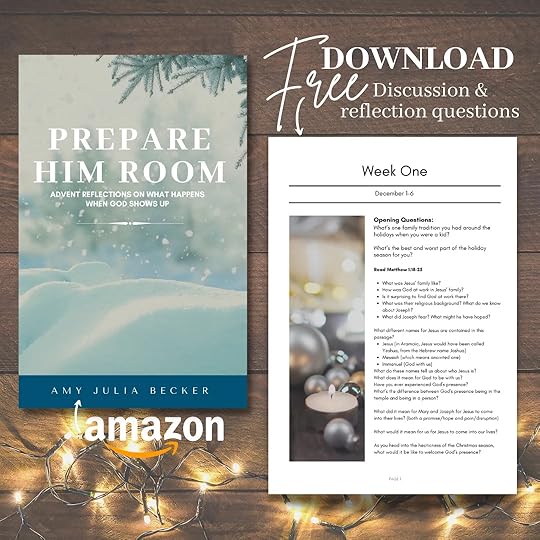
A few years ago, I published a book that walks through this season of waiting with patience and eager expectation. This devotional, for individuals or groups, has daily Bible readings that will move through the birth stories about Jesus over the course of the month of December. I’ve also created a free resource with discussion and reflection questions as a companion to the devotional.
Perhaps you’ll join me in walking through Advent this year; it begins on December 1. More info here.
The post Waiting With Hope in the Dark | Advent Devotional appeared first on Amy Julia Becker.
November 9, 2024
When You Get Knocked Down: The Aerobics of Jesus
I love this imagery of the aerobics of Jesus from my conversation with Rev. Corey Widmer.
If you try to mend broken things and get in the middle of conflict, you’re going to get knocked down. People aren’t going to like it. You’re going to get thrown down on your back.
That’s the continual movement of grace: on your knees, on your feet, on your back. This is actually the postures of Jesus. Jesus first begins on his knees. He begins in abject humility and poverty. He emptied himself and made himself nothing.
Jesus is filled up by the Spirit at his baptism, and he has this amazing ministry of healing and extending God’s compassion and justice. And then what happens? He gets pinned down on his back and crucified. This is actually the pattern, the aerobics of Jesus. It’s the aerobics of his people. And it’s a very different pattern than the narrative of American p0litics, which is about fortifying your base, seizing power, gaining control. This is the opposite of that. Jesus is saying, in my kingdom, it’s a different pattern. It’s a different way of engaging and being in the world.
You can listen to more of our conversation here.
MORE WITH AMY JULIA:
FREE DOWNLOAD: 5 Ways to Experience God’s Love and Practice PeaceS8 E1 | Narrow Path, Spacious Life with Rich VillodasS7 E15 | Bringing Politics Under the Power of Love with Michael WearLet’s stay in touch. Subscribe to my newsletter to receive regular updates and reflections. Follow me on Facebook , Instagram , and YouTube and subscribe to my Reimagining the Good Life podcast.
The post When You Get Knocked Down: The Aerobics of Jesus appeared first on Amy Julia Becker.
November 5, 2024
How to Respond to Election Results
Today is Election Day here in America. For some of us, the last few months have made us want to plug our ears and run away until the dust settles on our hopeless, political process. For others, this season has made us feel like politics—and our preferred candidate—is the only hope for spiritual and societal change in our country.
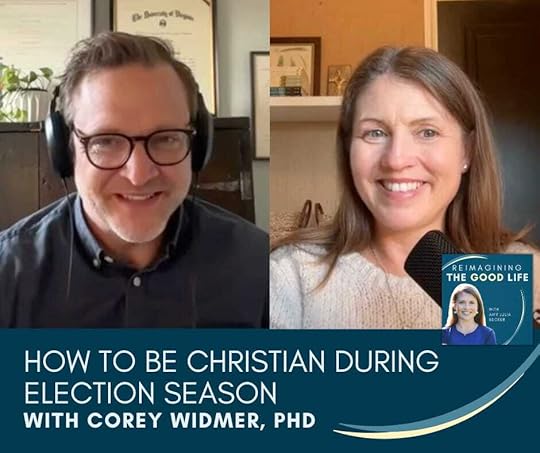
Political quietism or political supremacy might seem like our only options. But if you long to traverse our political divides in a different way, I have a conversation just for you. Rev. Corey Widmer joins me on the podcast to talk about how to navigate political polarization with humility, love, and a commitment to Jesus’ way of life.
Corey and I don’t talk about the actual results of the election or even mention the candidates running for President. But we do talk about a different approach to politics.
In particular, how do we embody the way of love in our political climate?
For example, assuming that the audience for this newsletter aligns with the American people, about half of you reading this letter will be pleased with the election results, and about half of you will be disappointed.
So how do we respond to the election results, whether happy or disappointed, in a way that embodies love?
Here’s Corey’s advice (edited for clarity and length):
If people are disappointed with the election results:If people are happy with the election results:
I would remind them that in democracy, political disappointment is always better than having your own despot in power. And for Christians, we deeply believe that the future of the Kingdom of God isn’t tied to a specific candidate. So acceptance is actually a really Christian response.
We then move on, and we work constructively. We pray for wisdom. We pray for those in power. We work for the good of all.
Our main call in life has not changed, which is to follow Jesus in the pattern that he’s laid out in the Beatitudes and the Sermon on the Mount, continuing to love and serve our neighbor, and ultimately to hold our leaders accountable to what we see as the way of justice.
I would remind them that they are still called to be part of the loyal opposition. Our ultimate allegiance is to Jesus.
In the days ahead, you’ll need to remember that the person you voted for, that you’re excited about, is not someone who is always going to perfectly embody the values of Jesus and is not always going to do things that are aligned with God’s vision for life.
There may be things that happen that are good. There may be things that happen that are really bad, that denigrate life, that distort the image of God, that neglect justice, that neglect compassion. No matter who is elected, we pray for our state and work for good, but we give our ultimate allegiance to Jesus. We know that every nation state and every human leader will fall short.
I would love to know what you think about this conversation, and I would love for you to pass it along to the people in your circle who might also be encouraged by Corey’s words.
LISTEN TO THE PODCAST EPISODE HEREAlso, William, our son, was invited to talk to his school about why he thinks politics is important. He said:
“Politics should be about coming together, across party affiliation, across race, across class, across gender, to implement solutions to the problems that we face as people. Politics, in its best form, is people from different backgrounds coming together to find solutions that help everyone.”
The rhetoric of our current national political situation does not involve a whole lot of coming together. But we all can participate locally in coming together to find solutions that help everyone. I’m grateful for William’s clear and hopeful vision.
Get my reflections on disability, faith, and culture delivered to your inbox each week.
Subscribe here!
MORE WITH AMY JULIA:
FREE DOWNLOAD: 5 Ways to Experience God’s Love and Practice PeaceS8 E1 | Narrow Path, Spacious Life with Rich VillodasS7 E15 | Bringing Politics Under the Power of Love with Michael WearLet’s stay in touch. Subscribe to my newsletter to receive regular updates and reflections. Follow me on Facebook , Instagram , and YouTube and subscribe to my Reimagining the Good Life podcast.
The post How to Respond to Election Results appeared first on Amy Julia Becker.
November 4, 2024
“My Vote Makes a Huge Difference”
Does this election matter for people with disabilities and their families?
Does this election matter to people with disabilities and their families?
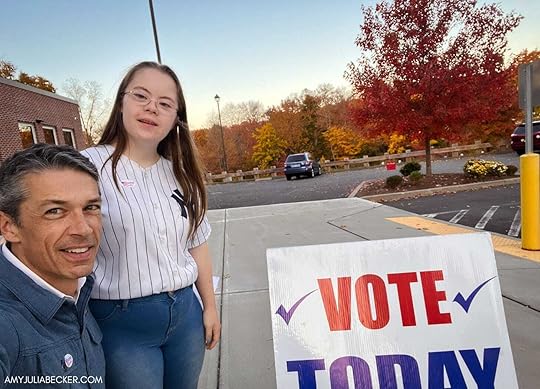
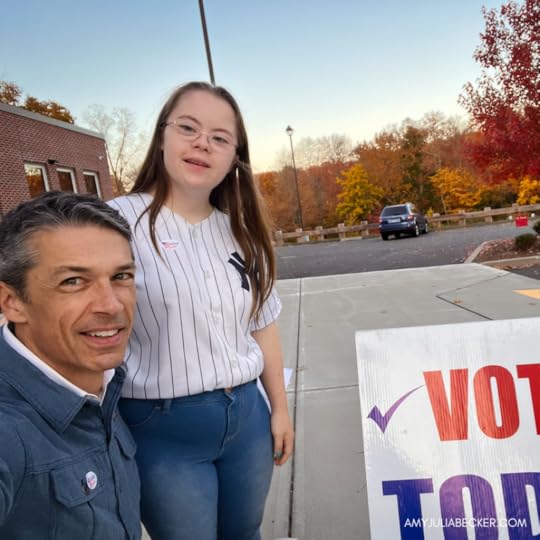
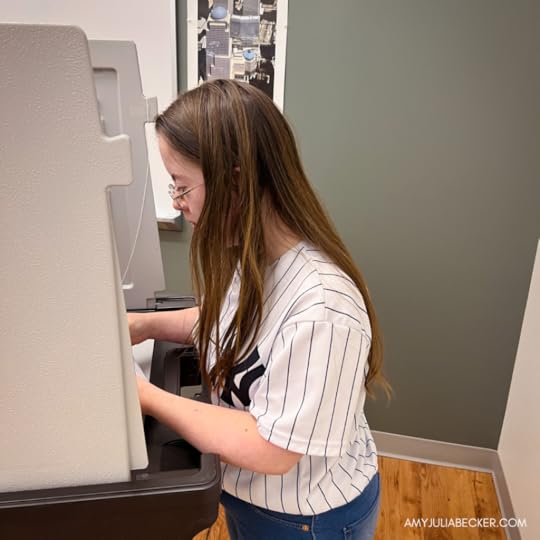
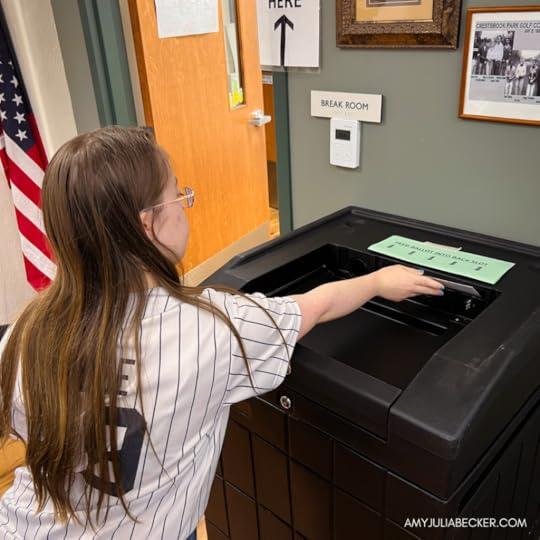
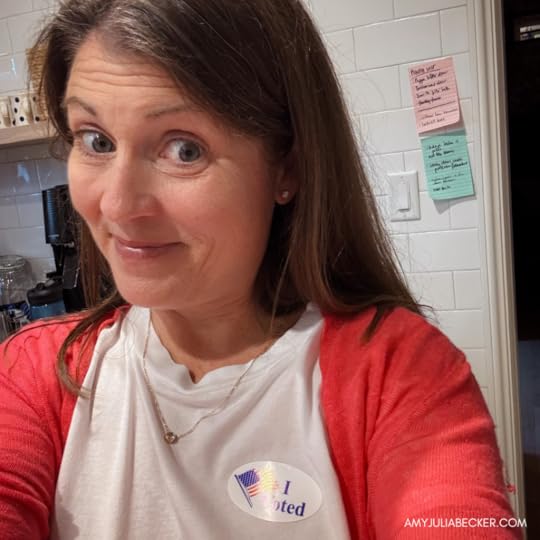
Our daughter Penny, who has Down syndrome, cast her first vote last week. When I asked her what mattered to her in voting for President, she replied, “Believing in other people’s rights. Caring for the community and world.”
And when I asked her about the experience of voting, she said, “Since I am 18, it felt powerful. The experience made it easy to understand what I was doing In the moment.”
Nearly one-third of eligible voters in this election are disabled or live with a disabled family member, according to a recent study out of Rutgers University. It’s unclear whether families and individuals affected by disability take their experience into consideration when they vote:
“limited prior evidence indicates that people with disabilities are similar to those without disabilities in patterns of party identification and placement on a conservative-liberal scale, but are more likely to favor a greater government role in health care and creating employment opportunities.”
So we don’t know whether disability will be a major factor in who we choose to elect. But we do know that the votes of people with disabilities matter.
After she cast that vote, I asked Penny, “What difference do you think your vote makes?”
She replied, “My vote makes a huge difference.”
All of our votes make a huge difference.
MORE WITH AMY JULIA:
More of Penny in her own words Using Our Strength to Lift UpWorkshop: Reimagining Family Life with DisabilityFREE RESOURCE: 10 Way to Move Toward a Good Future (especially for families affected by disability)Let’s stay in touch. Subscribe to my newsletter to receive regular updates and reflections. Follow me on Facebook , Instagram , and YouTube and subscribe to my Reimagining the Good Life podcast.
The post “My Vote Makes a Huge Difference” appeared first on Amy Julia Becker.
November 1, 2024
Love for the Yankees | Penny in Her Own Words
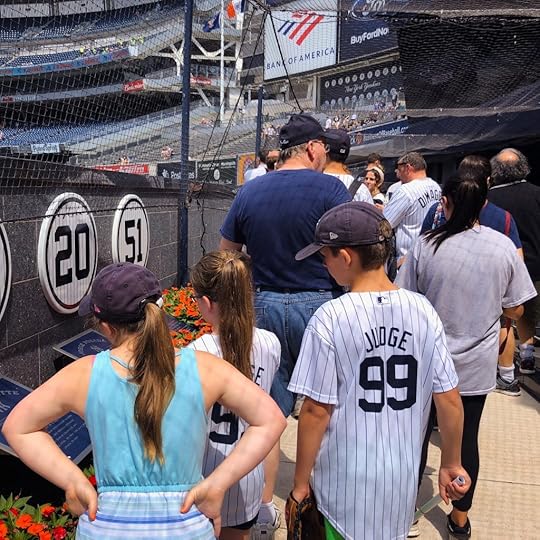
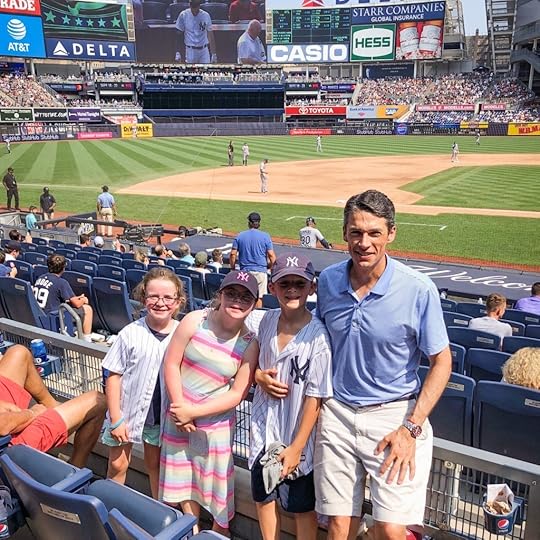
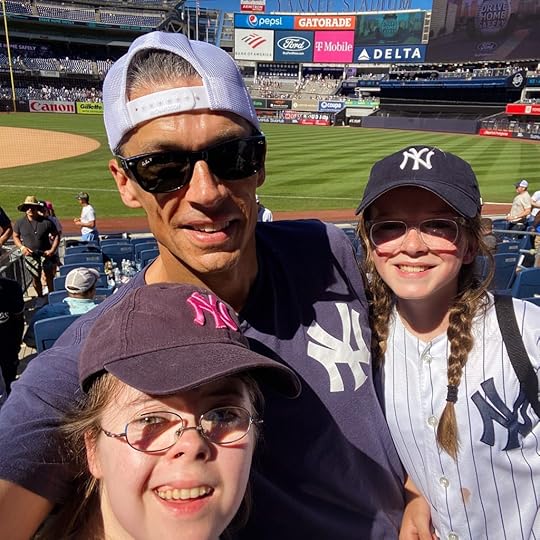
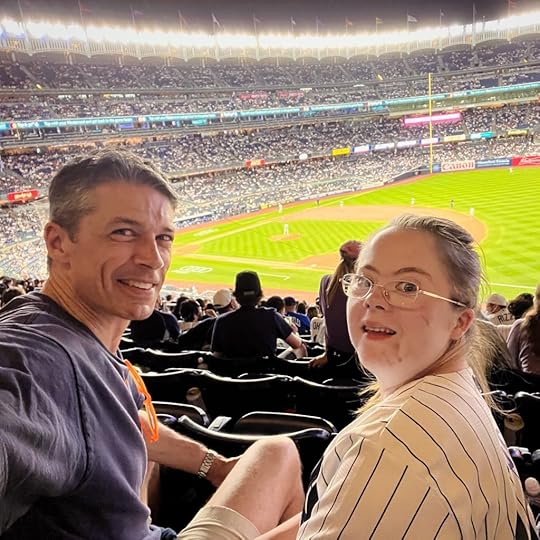
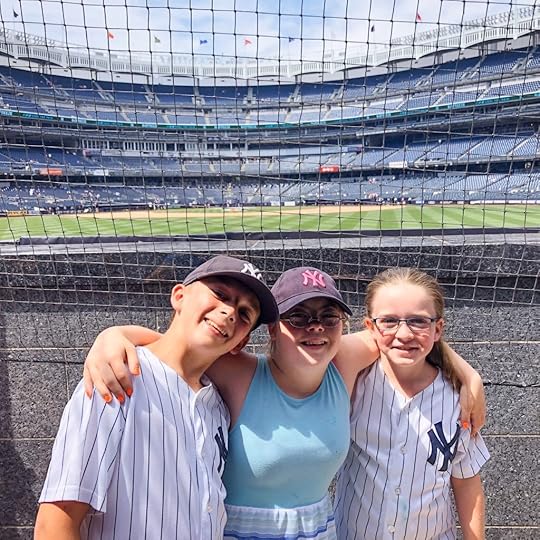
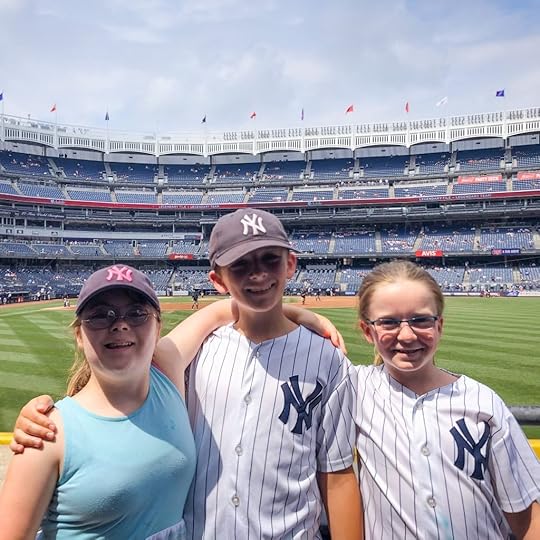
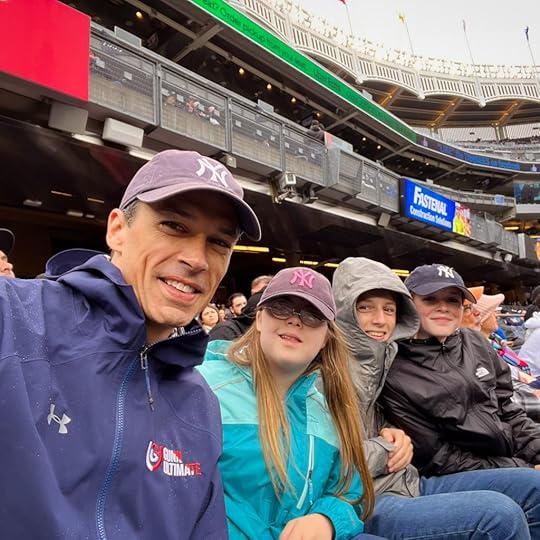
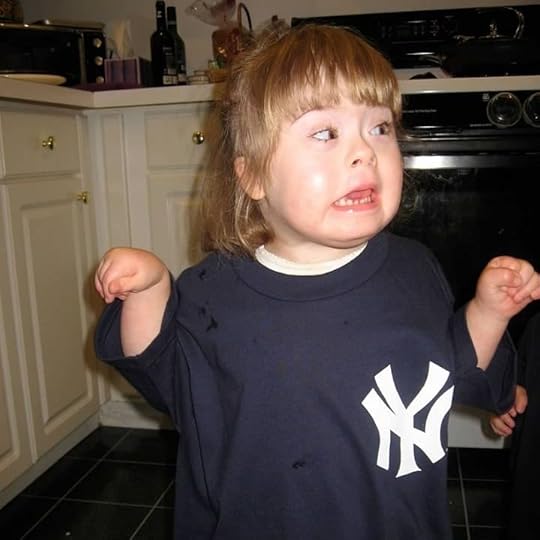
Every night, before she goes to bed, Penny walks into our bedroom for an evening ritual with Peter. No matter what time of year it is, they chant for their favorite teams. But for the six or seven months of baseball season, Penny also offers a report on how the Yankees are holding up. This season was especially exciting, because they finally–it’s been fifteen years, which is to say, all of Penny’s fandom that she can remember–made it to the World Series.
I tend to be a bit of a curmudgeon about sports in general and professional sports in particular. But when they allow for sweet moments of joy between a father and daughter, I’m a fan too.
Here are some of Penny’s thoughts about the Yankees this year:
How long have you been a fan of the Yankees
Since I was a little kid.
How would I know that you are a big fan?
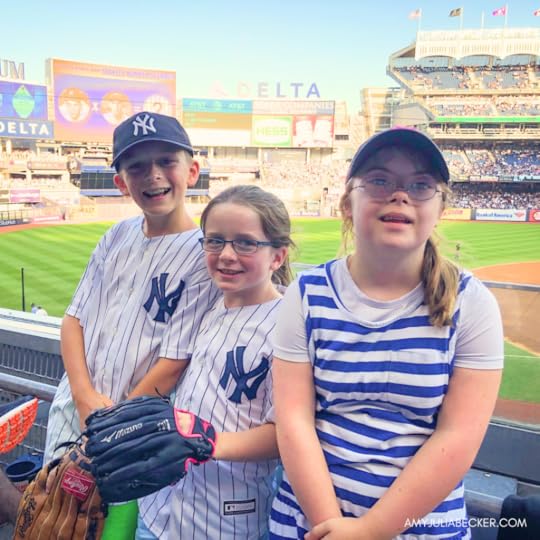
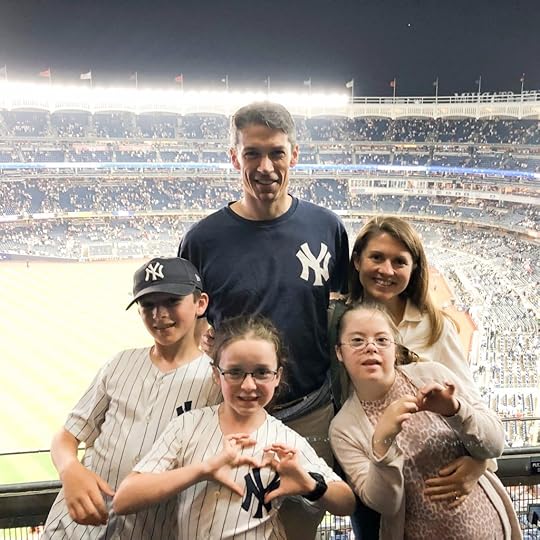
I have Aaron Judge’s jersey and we have been to some games over the seasons.
Every night before bed I would check the MLB app on my phone for most updates scores.
What are some of your favorite Yankees memories?
When dad got tickets for my graduation present
All of Judge’s home runs
Going to games live
Who is your favorite player and why?
Aaron Judge because I’ve always wanted to meet him and he Is so close to the record of 60 home runs in a season, and I am so proud of him for that.
Tell me about how the Yankees affect your relationship with your Dad.
We are both obsessed
Our top choice for our favorite player Is Aaron Judge
We both get very excited when anyone gets a home run
What is the world series?
The world series Is the annual championship series of American League Baseball.
How many times have the Yankees won?
The Yankees have won 27 world series games.
Who are the best players on the Yankees now? How about in the past?
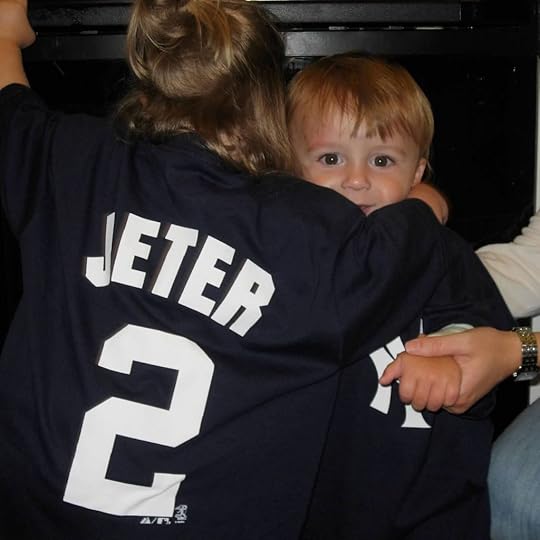
Aaron Judge Derek Jeter
Juan Soto Babe Ruth
Gerrit Cole Mickey Mantle
What are you looking for in the games ahead?
How many home runs they can get
How do you feel about them being in the World Series again?
I am so proud of the whole team for making It this far.
Okay, the World Series is now, sadly, over. How did you feel about the game they won?
The Yankees deserve this win. I felt excited and proud that they managed to pull it off.
How did you feel about their losses?
I felt discouraged because I know they can do better as a team.
Is there anything you’d like to say to the Yankees’ players?
Yes, I am proud of your whole team for making it to the World Series, even though some games were tougher than others.
Anything you’d say to other Yankees’ fans?
Bring all the Yankee spirit to any game that you go to live.
You wrote a ton of fun facts about the Yankees (below). Can you pick a few of your favorites to share?
Current best players are Aaron Judge, Juan Soto, Gerrit Cole
Giancarlo Stanton homers for Yankees in game 1 of World Series
Wells has been one of the best defensive catchers in the game
MORE WITH AMY JULIA:
More of Penny in her own wordsWorkshop: Reimagining Family Life with DisabilityFREE RESOURCE: 10 Way to Move Toward a Good Future (especially for families affected by disability)Let’s stay in touch. Subscribe to my newsletter to receive regular updates and reflections. Follow me on Facebook , Instagram , and YouTube and subscribe to my Reimagining the Good Life podcast.
The post Love for the Yankees | Penny in Her Own Words appeared first on Amy Julia Becker.