Amy Julia Becker's Blog, page 16
October 31, 2024
The Best Questions to Ask Parents
Here in Connecticut, we are settling into the rhythms of fall, with soccer games and afterschool activities and the waning temperatures of summer and the advent of golden leaves amidst the bright green. I finished up a new live workshop on Reimagining Family Life with Disability, and I’m in conversation with multiple groups about how they could use the videos from this series to serve people in their local communities.
Every Child, Every Person MattersThat workshop, and those conversations, reminded me of the first time I taught the course last spring. At the end of that time, I came away all the more convinced:
that each and every human life matters,that each and every one has value,that we collectively need the gifts that each and every human has to offer.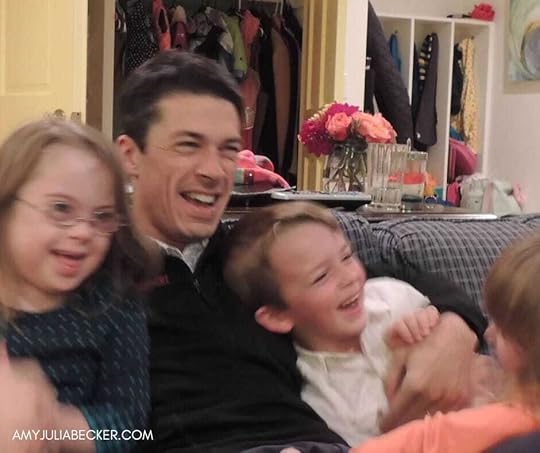 2013
2013I also came away with the realization that many parents don’t know how much their child matters to the rest of us. They know how much they love their kids. They know their child matters to them. But for parents and caregivers who constantly hear a message of deficiency and challenge, the message that their community needs their child is both a surprise and a balm.
Whether your child has mental health concerns, behavioral challenges, physical or intellectual disabilities or other diagnoses or if your kid is just a typical kid—your child matters. Their needs matter. Their gifts matter. We need them. And yet our culture often communicates a different message, one that focuses on the way they disrupt or fail to conform. That cultural message can lead parents to feel apologetic about their child’s presence or to feel grateful for even the smallest display of kindness or justice.
2 Questions to Celebrate Every ChildI had a conversation with a friend whose daughter had recently been diagnosed with autism. She told me how hard it had been—the challenges they had communicating with her, the times she moaned without words and they couldn’t make it better, the fears they had for the future. It was easy for me to construct a bleak picture of their life together with a one-dimensional portrait of their child. It was easy for me to imagine this child as a burden.
But then I asked the question, “What do you love about her?” My friend’s face lit up. She talked about how affectionate her daughter is—how she loves to snuggle on the couch. She bubbled with pride at the way her daughter pays attention in her dance class.
“What does your child love?” and “What do you love about your child?” have become my favorite questions to ask parents and caregivers.
These questions don’t take away the sting of social rejection or the anxiety of what might come or any of the day-to-day hardships. But they do fill in the picture.
They do remind us of our full humanity, with joys and sorrows, fears and opportunities, challenges and loves, gifts and needs. They remind us to pay attention to the love that grounds almost all caregiving relationships. They remind us to build from that place of mutual affection and care and giving and receiving rather than from the place of missed milestones or perceived weakness.
(And yes, these questions emerge for me most profoundly in relation to kids with disabilities, but how important is it for us to remind ourselves and others of the ways we love and take delight in one another in general?)
As we come to the end of Down Syndrome Awareness month, I’m all the more convinced of how much each and every one of us matter.
Get my reflections on disability, faith, and culture delivered to your inbox each week.
Subscribe here!
More with Amy Julia:
Workshop: Reimagining Family Life with DisabilityFREE RESOURCE: 10 Way to Move Toward a Good Future (especially for families affected by disability)Let’s stay in touch. Subscribe to my newsletter to receive regular updates and reflections. Follow me on Facebook , Instagram , and YouTube and subscribe to my Reimagining the Good Life podcast.
The post The Best Questions to Ask Parents appeared first on Amy Julia Becker.


October Favorites {2024}
Books, essays, podcasts, films, and more that have prompted me to stop and reflect during the month of October.
1. Special Hope Network.We have been supporters of Special Hope Network for over a decade now, and we are always excited and grateful to see the work they are doing to proclaim belovedness and envision belonging for families in need of affirmation, care, and support in Zambia.
2. Faithful Presence.
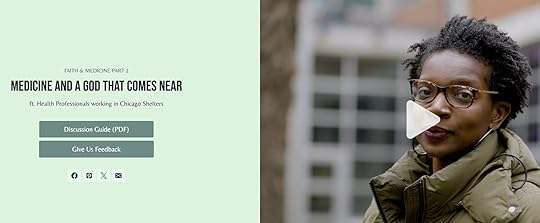
What if young people believed that they could make a real difference in the world through their work? What if they could use their education and connections and passions and gifts for real good? Faithful Presence is helping our young adults envision a way of pursuing work that has meaning and serves the common good. Here’s their first round of videos.
3. A Fancy New Restaurant in London, Staffed by the Recently Homeless.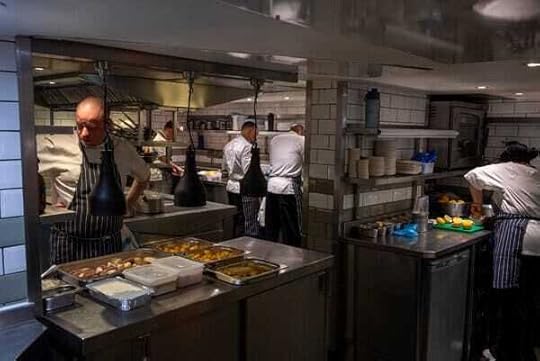
I love stories like this, where a successful restaurateur conceives of a way to employ people experiencing homelessness. There are so many details that speak to the possibilities we have as humans—the founder had his own experience of need due to a cocaine addiction. He set up the restaurant as a first step towards a culinary degree. And the food sounds delicious. It’s a little glimpse of the way an economy based on our common humanity could work and bring blessing.
Two essays about abortion.Two things get lost in the midst of our political fights about abortion. One, that the ethics and the politics of abortion are not the same. And two, that when we only talk about the individual choices of individual women, we fail to see the collective decisions we are making about when, how, and whether to welcome life.
As I mentioned in a recent Instagram post, I do not agree with either of our major political parties when it comes to abortion, which means I am grateful for people who are writing and thinking about the ethics and not just the politics, as Emma Camp and Rosemarie Garland-Thomson both do in these essays:
Yes, Third-Trimester Abortions Are Happening in AmericaThe Body She HadBook: The Frozen River.I haven’t quite finished this novel yet, but I think I can safely recommend it since I’ve been reading it in the middle of the night. It’s a murder mystery set in the 1700s, told from the perspective of a woman who serves as a midwife to her community. It’s a fascinating look at New England culture in the 18th century but also a riveting read.
Essay: Confessions of a Republican Exile.I appreciated so many things in this essay by David Brooks about his move from his early days of socialism, to his time in the Republican party, to his newfound appreciation (and critique) of the Democratic party.
Podcast: Can A Person With Down Syndrome Find Community & Belonging?I loved this podcast about what true inclusion looks like and why that’s hard but possible and good. It got me thinking about how our society has been built to reinforce separation based on ability. Community and belonging depends upon both shifting our mindset towards disability and changing the structures and systems that have been operating for so long.
Get my favorites delivered to your inbox each month!
Subscribe here!
The post October Favorites {2024} appeared first on Amy Julia Becker.
October 27, 2024
Welcoming Kids With Disabilities to Trick-or-Treat on Halloween
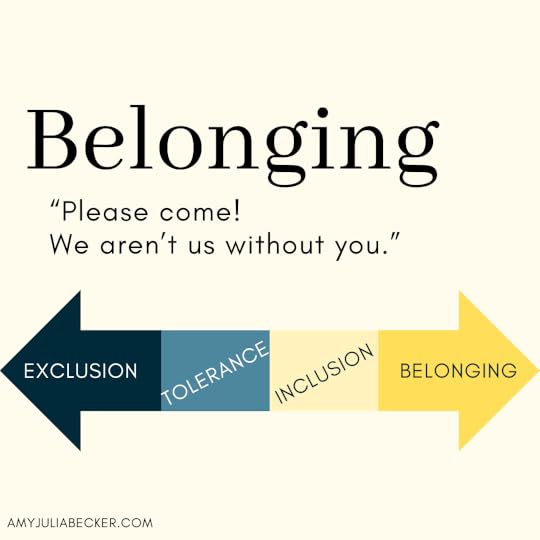
I’m thinking about Halloween for kids with disabilities. Part of what makes Halloween exciting is the idea of having fun and being together with other people.
Parents, if you have a typically-developing child who has a friend, or a classmate, with a disability, you could ask them to consider what it would be like to add that friend to their group. You can talk to your child about how it might mean moving more slowly from one house to the next. It might mean there are some friends who move ahead without you.
But guess what you get? Not a pat on the back for being a good person—that’s not what this is about. You get friendship in return, you get to participate in a world where we believe in each other, where we exist not just for ourselves but in order to lift one another up.
I know it’s hard. It’s hard to be a kid. It’s hard to be a friend, and that’s true with or without disabilities. But these holidays can be particularly hard for kids with disabilities, and an invitation to run or roll around the neighborhood together can make all the difference.
View this post on Instagram
A post shared by Amy Julia Becker| Author, Speaker, Podcaster (@amyjuliabecker)
MORE WITH AMY JULIA:
Why Belonging MattersWorkshop: Reimagining Family Life with DisabilityFREE RESOURCE: 10 Way to Move Toward a Good Future (especially for families affected by disability)Let’s stay in touch. Subscribe to my newsletter to receive regular updates and reflections. Follow me on Facebook , Instagram , and YouTube and subscribe to my Reimagining the Good Life podcast.
The post Welcoming Kids With Disabilities to Trick-or-Treat on Halloween appeared first on Amy Julia Becker.
A Halloween of Welcome for Kids With Disabilities
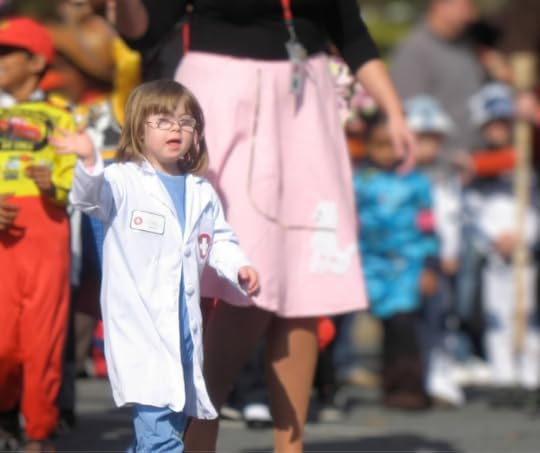
I’m thinking about Halloween for kids with disabilities. Part of what makes Halloween exciting is the idea of having fun and being together with other people.
Parents, if you have a typically-developing child who has a friend, or a classmate, with a disability, you could ask them to consider what it would be like to add that friend to their group. You can talk to your child about how it might mean moving more slowly from one house to the next. It might mean there are some friends who move ahead without you.
But guess what you get? Not a pat on the back for being a good person—that’s not what this is about. You get friendship in return, you get to participate in a world where we believe in each other, where we exist not just for ourselves but in order to lift one another up.
I know it’s hard. It’s hard to be a kid. It’s hard to be a friend, and that’s true with or without disabilities. But these holidays can be particularly hard for kids with disabilities, and an invitation to run or roll around the neighborhood together can make all the difference.
MORE WITH AMY JULIA:
Why Belonging MattersWorkshop: Reimagining Family Life with DisabilityFREE RESOURCE: 10 Way to Move Toward a Good Future (especially for families affected by disability)Let’s stay in touch. Subscribe to my newsletter to receive regular updates and reflections. Follow me on Facebook , Instagram , and YouTube and subscribe to my Reimagining the Good Life podcast.
The post A Halloween of Welcome for Kids With Disabilities appeared first on Amy Julia Becker.
October 25, 2024
Is Independence the Goal?
Every so often I get asked, “Do you think Penny will live independently?”
I’ve started answering that question about my daughter who has Down syndrome by saying, “I never want her to live independently.”
In reality, I have never lived independently. Life for all of us, if we stop and think about it, is an existence of interdependence. Independence is not my goal for myself, for Penny, or for any of our children.
That said, do I think Penny can live outside of our home? I do, because I think she will be able to develop interdependent relationships with other people.
Interdependence, not independence, is the goal.
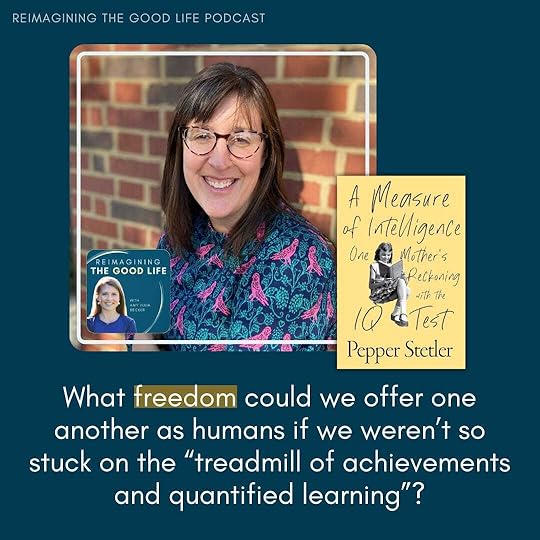
My guest on the podcast this week is author and professor Pepper Stetler. In our conversation about measuring intelligence, she says this about independence:
“Being able to do things by yourself is the gold standard of being an adult. That is what being an adult is—being independent. Maybe we don’t think about it that way. Maybe we prioritize community and collaboration and helping one another and respecting everybody’s needs, rather than pushing for independence as the goal of life.”
You can probably already imagine why I loved this conversation and her book!
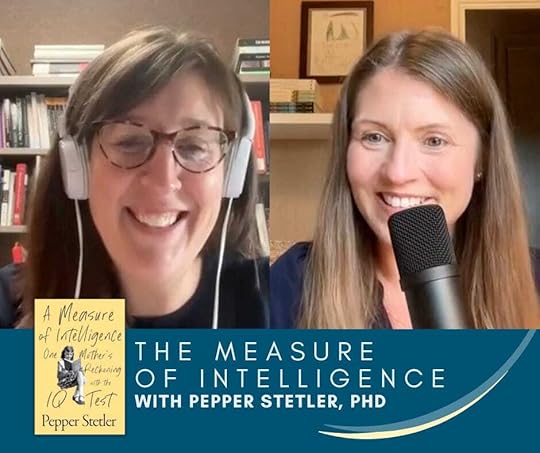
Dr. Stetler is the author of A Measure of Intelligence: One Mother’s Reckoning with the IQ Test. She shares with me her personal journey navigating the world of IQ testing with her daughter Louisa, who has Down syndrome. Together we explore:
the historical roots of intelligence assessmentsIQ testing’s societal implicationsthe ethical dilemmas the tests present for parents and educatorshow IQ tests shape our understanding of intelligence and the pursuit of a fulfilling lifeways to challenge conventional notions of achievement and success“Either you’re in or you’re out.”You may have noticed that there’s this mindset around disability, or anything that varies from what we consider the norm, that says, “Either you’re in or you’re out.” Instead of shaping a posture of curiosity and possibility, IQ tests often fuel this mindset of exclusion. So why do we measure intelligence?
What freedom could we offer one another as humans if we weren’t so stuck on the “treadmill of achievements and quantified learning”?
This conversation is an illuminating dive into education and societal perceptions around intelligence that you won’t want to miss!
Listen on Apple | Listen on Spotify | Watch on YouTube
“The way that we think about intelligence affects everybody. My students in college are still often quite miserable because of the system of intelligence that we have. We’re all shaped by it.”
“Education is supposed to be about helping somebody grow, helping somebody learn to be their happiest and most fulfilled self rather than a kind of placement. It’s become this achievement of a kind of quantified number instead of deep, meaningful learning in other ways.”
“We need to work against a regime of intelligence that gives [my daughter] no space to be herself.”
I’d love to hear from you. How have you found freedom from the “treadmill of achievements”?
Get my reflections on disability, faith, and culture delivered to your inbox each week.
Subscribe here!
MORE WITH AMY JULIA:
COMMENT MAGAZINE | The Blurring Is Part of the BeautyWorkshop: Reimagining Family Life with DisabilityFREE RESOURCE: 10 Way to Move Toward a Good Future (especially for families affected by disability)Let’s stay in touch. Subscribe to my newsletter to receive regular updates and reflections. Follow me on Facebook , Instagram , and YouTube and subscribe to my Reimagining the Good Life podcast.
The post Is Independence the Goal? appeared first on Amy Julia Becker.
October 23, 2024
Developmental Milestones for Children With Down Syndrome
I used to love developmental charts and graphs and measurements when it came to parenting.
Then I hated them.
And now I’m realizing their value all over again.
So I loved the milestones that marked when kids were supposed to walk or talk or clap when I thought they would tell me that I was doing everything right and deserved a parenting prize. And then I was given a daughter with Down syndrome. And she didn’t walk “on time.” Speech came slowly too. Everything seemed unpredictable and uncertain. I knew that if I paid too much attention to the milestones, I would think that we were somehow failing her, or I would think that she just needed to work harder. I learned instead to receive her as she was—delightful, beloved. I learned to celebrate who she is instead of what she can do.
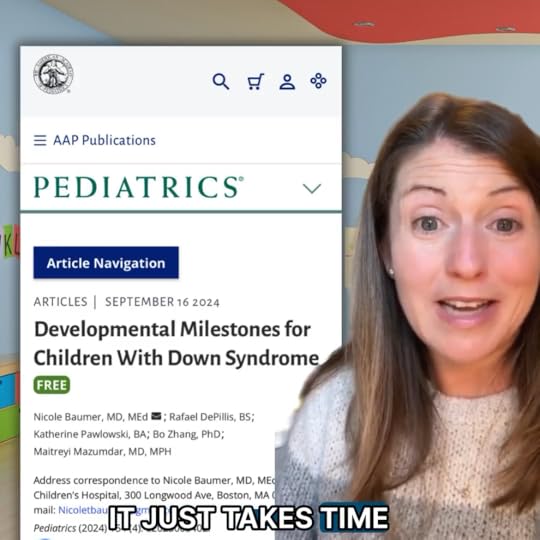
A New Study on Developmental MilestonesRecently a study came out that offers the ranges of time when kids with Down syndrome can be expected to walk and talk and sip from a cup and climb stairs. At first, I felt skeptical, as if the doctors just wanted to push parents back onto a hamster wheel of performance and achievement with their kids.
But I think there’s another way to use these milestones. The study showed that kids with Down syndrome have a really wide range of time in which they might learn a new skill. Some kids with Down syndrome walk at age two. Others at age six. Neither one is doing something right or wrong. In each case, the child is taking the next step towards learning and growing, and we can celebrate those steps. We can also use them as a guide to know when outside intervention might be helpful.
Measurements like this harm us if we use them to try to determine human value. But they serve us if they give us ways to celebrate kids learning and growing—and sometimes needing help—at their own pace.
MORE WITH AMY JULIA:
Embracing Belovedness: A New Approach to Parenting and Mental HealthWorkshop: Reimagining Family Life with DisabilityFREE RESOURCE: 10 Way to Move Toward a Good Future (especially for families affected by disability)Let’s stay in touch. Subscribe to my newsletter to receive regular updates and reflections. Follow me on Facebook , Instagram , and YouTube and subscribe to my Reimagining the Good Life podcast.
The post Developmental Milestones for Children With Down Syndrome appeared first on Amy Julia Becker.
October 18, 2024
You Don’t Need to Be Afraid
“God is with you and for you.” That line comes directly from our time at Hope Heals Camp in the summer, when campers make the sign of the cross on one another’s hands and repeat those words.
“God is with you and for you” always brings me to tears because it speaks so simply and deeply to the truth our souls long to hear.
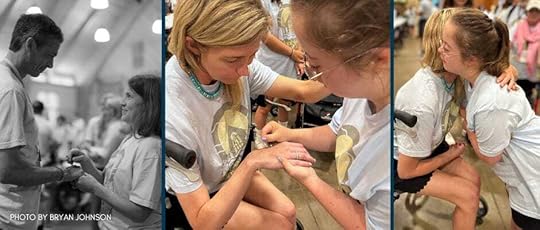 Hope Heals Camp | Penny with Katherine Wolf
I recently asked Penny, “What would you want a new parent of a child with Down syndrome to know?”
Penny said, “You may be afraid of not knowing what to do, but, in reality, you don’t need to be afraid… because God is with you and for you.”
I love that she carries those words with her and offers them to new parents.
A few weeks ago, I asked Penny to answer some questions related to Down Syndrome Awareness month. They give me a window into her thought process, and I love the truths she expresses about what is good and hard about her life:
Penny’s Thoughts on Down Syndrome Awareness MonthWhat would you want a new parent of a child with Down syndrome to know?
You may be afraid of not knowing what to do, but, in reality, you don’t need to be afraid.
If you are afraid you let your emotions overpower, but you don’t need to be afraid because God is with you and for you.
You may wonder why this is a gift, but it’s a gift because this child is special.
My parents specifically have thought, “She is a gift.” Also, did anyone know that there is a book out there called A Good and Perfect Gift? It’s all about me and my journey.
My brother and sister’s lives would not be the same without me. I think they feel connected to me more by supporting me in everything I do.
What would you want a parent of a teenager with Down syndrome to know?
Their life is in a good place and is special.
It may be harder to make friends. It may mean they need more time on schoolwork. Parents can support or help in these areas by taking their time explaining the process of each of the above areas.
They can support your hopes and dreams by encouraging you to try some new things that may be outside of their comfort zone.
They can support you by teaching their kids not to be overprotective so they can do the same.
What would you want teenagers who don’t have Down syndrome to know?
Act kindly to the person who has Down syndrome.
Accept them into your life even if you don’t want to. Other teenagers can do more to welcome you by letting the person with the disability join into the group or conversation.
They should know that you want to be included and your opinion matters.
What are some of the things that make your life good?
I have a good amount of friends.
I enjoy being a positive person and writing encouraging notes.
I care for others by being there for them within a hard time.
I enjoy spending time with my brother who we don’t see very often.
What are some things that make your life hard?
God is with you and for you.
Changing plans.
Putting off watch parties for a while.
Not always being included, especially in conversations.
Stop and think before acting/reacting. I tend to skip the stop and think and act right away.
One of my favorite nuggets of Penny’s words here is when she says, “God is with you and for you.”
So I will conclude this note with those words, and with hope and a prayer that the truth they contain might connect with the deepest part of who you are: “You don’t need to be afraid because God is with you and for you.”
Get my reflections on disability, faith, and culture delivered to your inbox each week.
Subscribe here!
MORE WITH AMY JULIA:
Free Resource: 5 Things I Wish I’d Known When Our Daughter Was Diagnosed With Down SyndromeWorkshop: Reimagining Family Life with DisabilityFREE RESOURCE: 10 Way to Move Toward a Good Future (especially for families affected by disability)Let’s stay in touch. Subscribe to my newsletter to receive regular updates and reflections. Follow me on Facebook , Instagram , and YouTube and subscribe to my Reimagining the Good Life podcast.
The post You Don’t Need to Be Afraid appeared first on Amy Julia Becker.
October 14, 2024
Using Our Strength to Lift Up
“The strength that we each have is to lift one another up, not to push people down.” Vice President Kamala Harris spoke these words to a young man with Down syndrome when she visited him and his coworkers at a facility in New Hampshire. He mentioned that her opponent had made remarks that insulted people with disabilities. She didn’t respond with an accusation. She just looked this young man in the eye and said,
“The strength that we each have is to lift one another up, not to push people down.”
If there’s anything I’ve learned from being around kids and adults with disabilities, and typical kids and adults too, it’s that focusing on our strengths and on how we can lift one another up is the lifegiving, meaning-making work of creating communities of belonging and hope.
I’m grateful that Harris chose to visit this workplace and highlight a small business offering meaningful employment to people with disabilities. They are helping to shape our imagination about what’s possible.
We all can be people who seek to lift others up.
View this post on Instagram
A post shared by Amy Julia Becker| Author, Speaker, Podcaster (@amyjuliabecker)
MORE WITH AMY JULIA:
Workshop: Reimagining Family Life with DisabilityFREE RESOURCE: 10 Way to Move Toward a Good Future (especially for families affected by disability)The Problem with Calling Kamala Harris “Mentally Disabled”Let’s stay in touch. Subscribe to my newsletter to receive regular updates and reflections. Follow me on Facebook , Instagram , and YouTube and subscribe to my Reimagining the Good Life podcast.
The post Using Our Strength to Lift Up appeared first on Amy Julia Becker.
October 11, 2024
How the Stories of Our Past Shape Our Future
These days, I think many of us feel weary. Weary in advocacy, weary of politics, weary and wondering if the change we hope for is possible. I recently wrote, in reference to Down Syndrome Awareness month, that “awareness isn’t just about information and action. It’s also about paying attention.”
I’ve been thinking a lot about the stories we pay attention to, about how our imagination for the future is shaped by the way we narrate our past. Storytelling has a profound influence on how we imagine what’s possible.
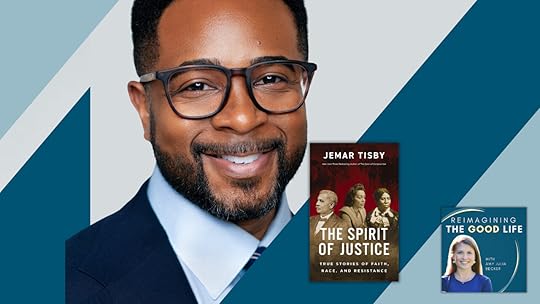
That’s why I was grateful to talk with author and historian Jemar Tisby, Ph.D., on the podcast about his latest book, The Spirit of Justice. In his work, Jemar insists that we tell a fuller story of our past, especially when it comes to the history of race and justice within the United States. He makes a powerful point:
“Evil is unsurprising. It’s always showing up. Evil in the form of racism is always showing up in different ways. What is truly remarkable, what is truly astounding, isn’t necessarily the evil, but that there’s always people willing to stand up against it.”
He also writes,
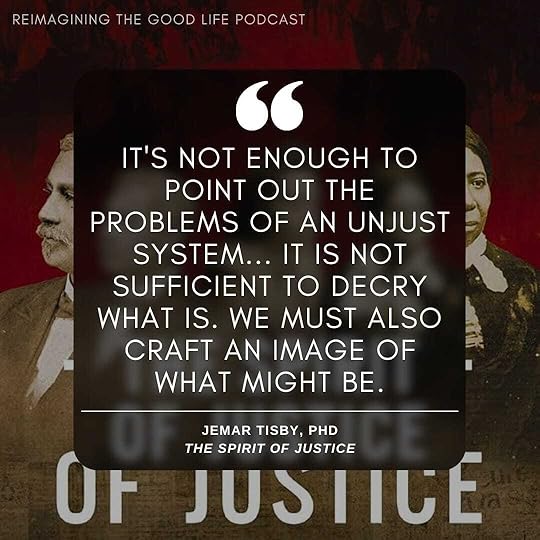
“It’s not enough to point out the problems of an unjust system. The people who become the greatest agents of change also convey a notion of a better future. It is not sufficient to decry what is. We must also craft an image of what might be.”
I love that: We must also craft an image of what might be. That’s part of the work we hope to do here at Reimagining the Good Life.
In our conversation, Dr. Tisby and I dive into the true stories of faith, race, and resistance that his book explores, and how these stories give us a blueprint for imagining a better future. We talk about:
The persistent spirit of justice in the Black Christian experience in AmericaThe historical and ongoing struggles against racismHow faith and storytelling fuel resilience and hopeProfessor Tisby encourages us to see “hope not simply as a feeling but as action. And any action we take to resist injustice is an act of hope.” This conversation is an invitation to join in the creative work of renewal and justice. I hope you’ll listen in—his words remind us that while our path toward change is long and hard, it’s also filled with hope and possibility.
As it happens, this episode also releases one week after the sixth anniversary of my book White Picket Fences: Turning toward Love in a World Divided by Privilege.
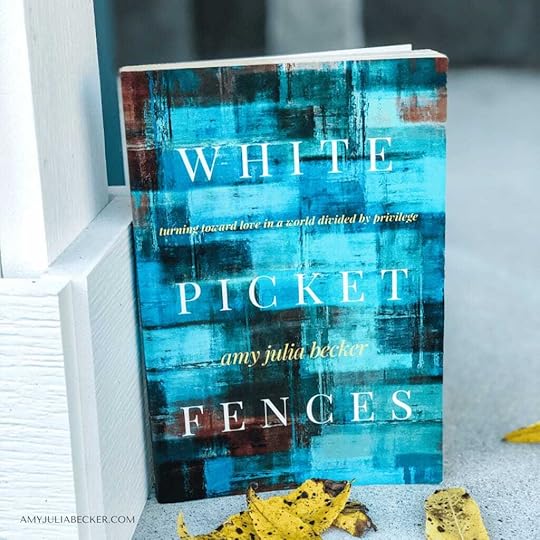
That book holds my attempt to both reckon with the injustices that make up my history and move with hope towards a good future. I’m incredibly grateful for the work of people like Dr. Tisby who have helped me along this way!
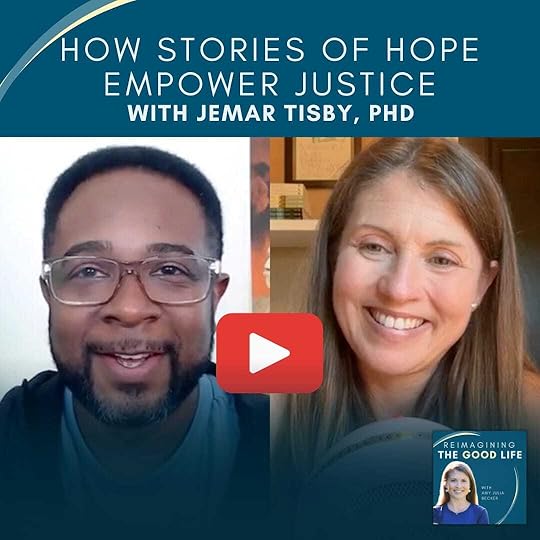
Listen on Apple | Listen on Spotify | Watch on YouTube
I hope you’ll watch or listen to our conversation. Let me know what you think! And tell me—what stories have your attention? What stories bring you hope in the midst of weariness?
MORE WITH AMY JULIA BECKER:
Civil Rights Tour | A 3-Day Itinerary for Families Recommended Books, Podcasts, and Films about Race and PrivilegeLet’s stay in touch. Subscribe to my newsletter to receive regular updates and reflections. Follow me on Facebook , Instagram , and YouTube and subscribe to my Reimagining the Good Life podcast.
The post How the Stories of Our Past Shape Our Future appeared first on Amy Julia Becker.
October 10, 2024
Embracing Belovedness: A New Approach to Parenting and Mental Health
Today is World Mental Health Day. The Surgeon General recently issued a warning about the mental health of parents. Parents are stressed out about everything. (more here)
The warning contains great suggestions for how every aspect of society can support parents and help alleviate the crisis.
But there’s one piece missing. In addition to all sorts of ways we could better care for and support parents, we need the spiritual awareness of our belovedness as humans. We need to know that we are good enough as we are, for all our flaws. We need to know we are loved before we’ve gotten things right and after we’ve gotten things wrong. We need to connect to sources of love outside of ourselves, ground ourselves in that belovedness, and allow that same love to animate our relationships with ourselves, our fellow caregivers, and our children.
I learned this need to know my belovedness, and to know our children’s belovedness, when our daughter Penny was born with Down syndrome. I could strive all I wanted as a parent, and she still wouldn’t meet the developmental milestones at the pediatrician’s office. I could allow the stress of all the therapists and specialists and educators to keep me up at night, and she would still learn and grow at her own pace. Or I could start to rejoice in who she was as she was. I could start to receive her as beloved and understand the same about myself. That, even as her mom, I wasn’t loved because I found the best orthotics for her feet or because she wore cute clothes or because I read 27 books about Down syndrome. I was loved because I was loved. And I could love her out of that deep and unending source of love.
We need to change our approach to parenting in the United States in all the ways Dr. Vivek Murthy suggests. And we also need to change our mindset about ourselves and our kids. We need to receive our own belovedness as the foundation of our being so that we can create communities not based on stressful striving, but communities of belovedness.
View this post on Instagram
A post shared by Amy Julia Becker| Author, Speaker, Podcaster (@amyjuliabecker)
MORE WITH AMY JULIA:
Self-Care in Seasons of StressLike Trees, We Need Stress in Our LivesS7 E6 | How to Become a Worry-Free Parent with Sissy Goff, LPC-MHSPLet’s stay in touch. Subscribe to my newsletter to receive regular updates and reflections. Follow me on Facebook , Instagram , and YouTube and subscribe to my Reimagining the Good Life podcast.
The post Embracing Belovedness: A New Approach to Parenting and Mental Health appeared first on Amy Julia Becker.