Julia Flynn Siler's Blog, page 2
February 19, 2025
Walking the Bells
My first Saturday in Oxford, I walk down the Banbury Road towards St. Giles Church. My small roller bag click clacks over the broken sidewalk. Bells peal in a melodic succession:123456…654321. At first, the ringing seems to be coming from a dated glass and concrete building – a structure, I learned, that some locals consider…
The post Walking the Bells appeared first on Julia Flynn Siler.


March 17, 2024
Becoming a Late-in-Life Athlete
In the early days of the pandemic, I began sculling on a creek flowing into the San Francisco Bay – a waterway that’s home to egrets, herons, and the occasional northern spotted owl. Wearing a mask inside the boathouse, I joined other fledgling rowers on a novice master’s team.
Four years later, I’m still rowing (despite a few pulled muscles early on and two comic-but-distressing moments when I flipped my single boat.) I lost fifteen pounds, vastly improved my strength, and am now on a women’s intermediate team.
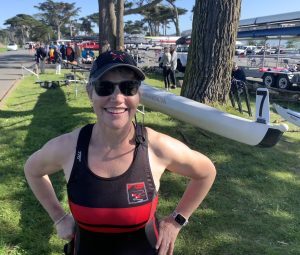
I’ve made some good friends and learned important lessons as a late-in-life athlete: arriving at practice ten minutes before the 5:30 a.m. start time to make sure I have time to warm up my aging muscles, doing more than expected, staying positive, accepting that some days–just like some strokes–will be better than others.
This is the first time I’ve been on a team. I was in seventh grade when Title IX, which prohibits sex discrimination in school sports and other activities, came into effect. I’d never competed athletically until I began rowing in my sixties, at the time when many of our friends are becoming grandparents.
To my delight, I’ve learned that advanced age can be an advantage in this sport through handicapping. My height, alas, at 5’3”, is not.
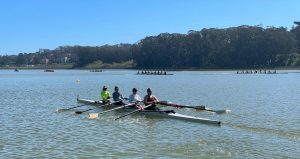
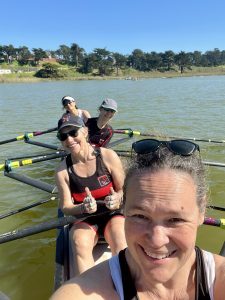
Yesterday, I competed in the first regatta of the season – the Pacific Invitational Regatta on Lake Merced in San Francisco. I rowed in a quad – a four-woman scull where each rower has two oars (as opposed to sweep rowing, where each of the eight rowers only has one oar.) I was seated behind our far more experienced lead rower – our stroke, Jennifer Bowman – and my job was to support and mirror her movements as closely as possible.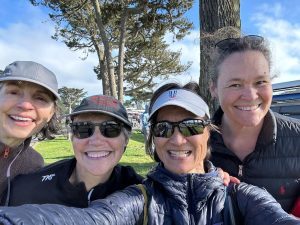
Our results weren’t anything to boast about. Fighting the wind and a crowded course, we hit a buoy at the end of the course – a three (in our case four) stooges-like move that you can only laugh about afterwards. As the photo our our boat shows, I have a lot more to learn (my catch, the moment when the blade enters the water is not matching up with Jenn’s.)
But we had a lot of fun and my affection for my teammates has only deepened. I sought out the boathouse as a way to exercise safely during a period of profound isolation. I’ve stayed for the comradery, which is just important as exercise to healthy aging and a happy life.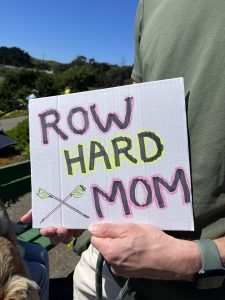
The post Becoming a Late-in-Life Athlete appeared first on Julia Flynn Siler.
September 17, 2023
How a Sentence Reverberated
We’re all connected.
I was reminded of that when a neighbor mentioned he’d read my story for Alta Journal about traveling to the Arctic Circle last fall.
Once sentence leapt out at him: “Nothing seemed fixed: water, stars, sky, or people. It was all changing and rotating and moving in a dance governed by randomness.”
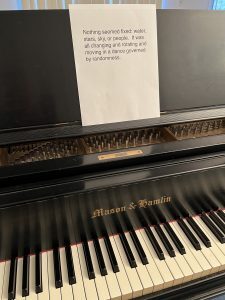
Late at night, after a nighttime expedition in an inflatable Zodiac raft, I’d written that sentence while tucked up beneath my comforter the upper bunk of my tiny cabin.
Most mornings and every night, I’d tap away on my laptop about my experiences aboard ship as one of the 29 writers and artists who were taking part in a residency organized by the non-profit group, The Arctic Circle. It was my version of a daily ship’s log.
When I got home to Northern California, I sat down to write the article for Alta about the experience. The log I’d kept was helpful, as was a detailed log of the ship’s daily movements compiled by our expedition leader, Sarah Gerats. I lifted that sentence (and a few others) for the Alta article straight from my diary.
My neighbor, Jeremy Levin, is a classical pianist and a composer. He’d been working on a composition for Ukraine and found inspiration in that sentence for a key tonal change in the piece.
He and his wife Charlotte invited me to his studio to play the piece, followed by tea and treats afterwards. He sat down at his Mason & Hamlin grand piano and took a deep breath before beginning. Chills ran through me when he played his composition for us.
Hearing how Jeremy had incorporated the spirit of my sentence into his piano piece was a lovely experience. It reminded me how the work we do can sometimes reverberate in beautiful and unexpected ways.

The view through the porthole in my cabin aboard Antigua.
The post How a Sentence Reverberated appeared first on Julia Flynn Siler.
August 14, 2023
Lahaina’s Banyan Tree
The subject line was “Hello from New York Times Opinion.” It landed in my inbox about 24-hours after the horrific wildfires on Maui had begun to spread. I’d already checked in with friends who live on the island, to make sure they were safe. Like the rest of the world, I was watching in horror as historic Lahaina town went up in flames.
The editor explained that the paper was looking for a historian of the islands who could speak to the tragedy, including what had been in lost in Lahaina. I’m the author of a narrative history of 19th century Hawaiian history, Lost Kingdom: Hawaii’s Last Queen, the Sugar Kings, and America’s First Imperial Adventure. Although we live in the San Francisco Bay Area, my family and I have visited the islands many times over the years.
I wrote an essay focused on Lahaina’s beloved banyan tree – a huge botanical wonder that has captured the heart of many residents and visitors to the island over the years. I first visited it with one of our sons, and I remember looking up through the branches of this immense mother tree and feeling awe.
My heart goes out to the people of Lahaina and I pray for the revival of both the tree and the town in the weeks and months ahead.

A damaged 150 year old tree caused by wildfires at Lahaina Banyan Court in Lahaina, Maui.Credit…Philip Cheung for The New York Times
The post Lahaina’s Banyan Tree appeared first on Julia Flynn Siler.
June 28, 2023
Arctic Adventures
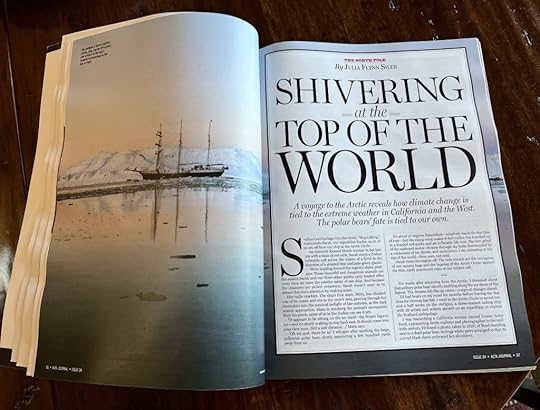
Last fall, I flew from the Bay Area to the Arctic Circle as part of an unusual residency program to spend two and a half weeks on Antigua, a three-masted sailing ship with 29 artists and writers aboard on an expedition to explore the Svalbard archipelago. It was quite a trip.

I wrote a story about my experience for the current issue of The Journal of Alta California. We hiked on frozen tundra, encountered a polar bear, hunkered down during a howling wind storm, and gazed in awe at the spectral beauty of aurora borealis. My shipmates were artists and writers who’d come from Hong Kong, Berlin, Toronto, Washington, D.C., and elsewhere for an off-the-grid wilderness experience.
Two of the gorgeous photos in the story were taken by the expedition leader Sarah Gerats, a photographer herself when she is not leading groups around the Arctic. The stunning photo of the polar bear we saw was taken by my shipmate Frankie Carino, an L.A.-based photographer. And the startling archival photo of explorer Louise Arner Boyd and the dead polar bear comes from the Marin History Museum.
Several friends have asked if I’m really planning to go back to the Arctic soon (perhaps alarmed by my description of Covid’s arrival on the ship). The answer? I hope so, if I can land a berth on an expedition in the summer of 2024 or 2025. I’ve written to two captains of Arctic boats and have heard back from one of them. I’ve also begun exploring the possibility of joining a commercial expeditions. Wish me luck!
[image error]
The post Arctic Adventures appeared first on Julia Flynn Siler.
June 5, 2023
92nd Annual California Book Awards
Founded in 1931 during the depths of America’s Great Depression, the Commonwealth Club’s California Book Awards celebrates its 92nd anniversary this year and tonight is the award’s ceremony.
Please join us at 6 p.m. PT to honor some of the state’s most distinguished writers. It will be streaming at https://www.commonwealthclub.org/even...
The purpose of the awards is to highlight the work of California authors – a praiseworthy goal at a time when the publishing industry (then and now) remains focused on East Coast writers.
Over the years, many of the most important voices in American literature, such as Joan Didion, Ishmael Reed, Amy Tan, Hector Tobar, and Viet Thanh Nguyen, have been honored with California Book Awards.
Once again, I was honored to serve on the nonfiction jury this year. My colleagues and I and read many fine submissions from the Golden State. Here are the stellar books we chose as this year’s honorees in nonfiction:
American Midnight: The Great War, a Violent Peace, and Democracy’s Forgotten Crisis, by Adam Hochschild, Mariner Books (Gold Medal)
The Man Who Could Move Clouds: A Memoir, by Ingrid Rojas Contreras, Doubleday (Silver Medal)
Bad Mexicans: Race, Empire, and Revolution in the Borderlands, by Kelly Lytle Hernández, W.W. Norton and Company (Silver Medal)
Julia presents at the 90th annual California Book Awards at the Commonwealth Club on August 16, 2021
Serving on the jury has been tough but rewarding work. The history of the West is a subject that fascinates me – especially as historians and public scholars unearth often deeply unsettling stories about California and the West.
Filed Under: Uncategorized Tagged With: Books, California history, Commonwealth Club
The post 92nd Annual California Book Awards appeared first on Julia Flynn Siler.
April 19, 2023
Remembering a Hawaiian Queen
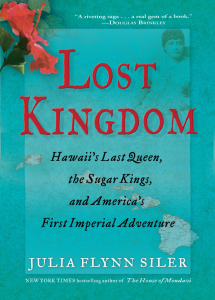
A few weeks ago, I was asked by a producer at Wondery if I’d be interested in being interviewed for the podcast American History Tellers about Hawaii’s last queen. I hesitated at first because my book on Hawaii had been published more than a decade ago. Agreeing to the interview would mean that I’d have to give myself a crash refresher course on my own book.
 Since I’d never fully listened to the audio version of Lost Kingdom: Hawaii’s Last Queen, the Sugar Kings, and America’s First Imperial Adventure, I dove into it to prepare for the interview. Produced by Brilliance Audio and narrated beautifully by Joyce Bean, who mastered the Hawaiian names and words, I felt as if I was reading someone else’s book. It was a joy to have a voice actor read it to me.
Working with the producers Lushik Lotus Lee and Polly Stryker from Wondery was a pleasure. We ended up doing two takes of the interview, in large part because I wasn’t as relaxed as I might have been during the first one. When Polly made the trek to my house to re-tape it a second time, the interview flowed more smoothly. Not to mention that Polly brought me a gift of homemade marmalade as a gift!
A few days later, Polly shared with me an article she’d found from Hawai’i Magazine titled “5 Beautiful Versions of ‘Aloha Oe,’ Queen Lili’uokalani’s Most Famous Song.” To my surprise, the magazine had found versions of Aloha Oe covered by Israel “Iz” Kamakawiwoole, Tia Carrere, slack key master George Kahumoku Jr, and Amy Hanaiali’I – but also a haunting version by Johnny Cash.
American History Teller’s host, Lindsay Graham, asked me at the end of our interview what I thought Queen Lili’uokalani’s most powerful legacy might be. She sat on the throne for a brief period – from 1891 to 1893. Yet the more than one hundred songs she composed are still performed today. To many people, she is remembered as much as a composer as a queen.
The post Remembering a Hawaiian Queen appeared first on Julia Flynn Siler.
August 20, 2021
California Book Awards – 2022 Finalists!
Founded in 1931 during the depths of America’s Great Depression, the Commonwealth Club’s California Book Awards celebrates its 92nd anniversary this year.
The purpose of the awards is to highlight the work of California authors – a praiseworthy goal at a time when the publishing industry (then and now) remains focused on East Coast writers.
Over the years, many of the most important voices in American literature, such as Joan Didion, Ishmael Reed, Amy Tan, Hector Tobar, and Viet Thanh Nguyen, have been honored with California Book Awards.
Once again, I was honored to serve on the nonfiction jury and read many fine submissions from the Golden State. Here are the stellar books we chose as this year’s finalists. The nonfiction finalists are:
The Man Who Could Move Clouds: A Memoir, by Ingrid Rojas Contreras, Doubleday
American Midnight: The Great War, a Violent Peace, and Democracy’s Forgotten Crisis, by Adam Hochschild, Mariner Books
Bad Mexicans: Race, Empire, and Revolution in the Borderlands, by Kelly Lytle Hernández, W.W. Norton and Company
Geography Is Destiny: Britain and the World: A 10,000-Year History, by Ian Morris Farrar, Straus and Giroux
Last year, we awarded the Gold Medal in nonfiction to historian Alice L. Baumgarten’s South to Freedom: Runaway Slaves to Mexico and the Road to the Civil War, a revelatory work that compels us to rethink the reasons for the U.S. Civil War.
The silver medal in nonfiction went to Conor Dougherty’s deeply reported and empathetic Golden Gates: The Housing Crisis and a Reckoning for the American Dream. The Californiana award went to the father-son team of Richard White and Jesse Amble White for California Exposures: Envisioning Myth and History.
Julia presents at the 90th annual California Book Awards at the Commonwealth Club on August 16, 2021
One of the most touching moments in the awards ceremony from that year came from Richard and Jesse’s video remarks. You can watch them here.
Serving on the jury has been tough but rewarding work. The history of the West is a subject that fascinates me – especially as historians and public scholars unearth often deeply unsettling stories about California and the West.
The post California Book Awards – 2022 Finalists! appeared first on Julia Flynn Siler.
California Book Awards
Founded in 1931 during the depths of America’s Great Depression, the Commonwealth Club’s California Book Awards celebrated its 90th anniversary this year.
The purpose of the awards is to highlight the work of California authors – a praiseworthy goal at a time when the publishing industry (then and now) remains focused on East Coast writers.
Over the years, many of the most important voices in American literature, such as Joan Didion, Ishmael Reed, Amy Tan, Hector Tobar, and Viet Thanh Nguyen, have been honored with California Book Awards.
A recent story in the San Francisco Chronicle by L.A. Taggart explores this history and focuses on the stellar books chosen as this year’s winners. It was my great honor to serve on the nonfiction jury and to read many fine submissions from the Golden State
After months of reading, discussing, and debating, we awarded this year’s Gold Medal to historian Alice L. Baumgarten’s South to Freedom: Runaway Slaves to Mexico and the Road to the Civil War, a revelatory work that compels us to rethink the reasons for the U.S. Civil War.
The silver medal in nonfiction went to Conor Dougherty’s deeply reported and empathetic Golden Gates: The Housing Crisis and a Reckoning for the American Dream. The Californiana award went to the father-son team of Richard White and Jesse Amble White for California Exposures: Envisioning Myth and History.
Julia at the 90th annual California Book Awards at the Commonwealth Club on August 16, 2021
One of the most touching moments in the awards ceremony came from Richard and Jesse’s video remarks. You can watch them here.
Serving on the jury was tough but rewarding work. The history of the West is a subject that fascinates me – especially as historians and public scholars unearth often deeply unsettling stories about California and the West.
The post California Book Awards appeared first on Julia Flynn Siler.
July 7, 2021
History Written by the Victors….
For an example of history being written by the victors, consider the case of Jane Lathrop Stanford, the victim of one of California’s most puzzling unsolved murder mysteries.
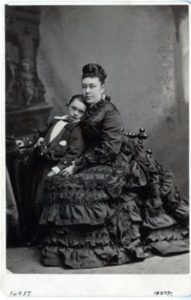
Leland, Jr. and Jane Lathrop Stanford, courtesy of Stanford Special Collections
As co-founder and primary benefactor of Stanford University, Jane died of strychnine poisoning in 1905 in Waikiki. For nearly a century, the fact of her murder was successfully covered up.
The key figure involved in that cover-up was the university’s first president, David Starr Jordan. He was the victor in shaping how history judged Jane’s contribution as a leading educational philanthropist over the next hundred years or so.
At a moment in time when many institutions are examining their histories, will Jane finally get her due? Aside from the lingering question of whodunit, will we finally discover more about how one of America’s most powerful women came to such a tragic end.
I wrote about the still-unsolved mystery of Jane Stanford’s death for the summer issue of Alta Journal and discussed the story today in an Alta Live online event. Join us for an unsettling conversation.

The post History Written by the Victors…. appeared first on Julia Flynn Siler.