Julia Flynn Siler's Blog, page 12
November 5, 2008
Book Group Expo: Shakespeare … or Sex?
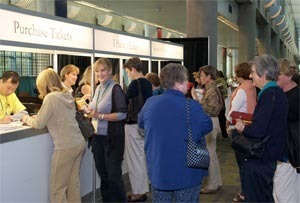
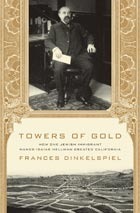
Crowds of book group aficionados flocked to San Jose for the third annual Book Group Expo, above; below, author Frances Dinkelspiel debuted her book, Towers of Gold, at the convention.
There are conventions for everyone: dog lovers, tattoo artists, people who trade sports memorabilia, barristas, and hairdressers. They all have their annual gatherings to swap tales, make friends, and do business.
So why shouldn't book groups have theirs? For the third year, an estimated 1,700 people gathered over a weekend in October for Book Group Expo at the San Jose Convention Center in California's Silicon Valley to meet authors, eat chocolate, and engage in high (and low) book talk.
Some 75 authors also made the trip, including Andre Dubus III (House of Sand and Fog, The Garden of Last Days), Gail Tsukiyama (Women of the Silk, The Street of A Thousand Blossoms), Julia Glass (Three Junes, I See you Everywhere) and Will Durst (The All-American Sport of Bipartisan Bashing).
Since some book groups have started reading The House of Mondavi alongside King Lear, I was invited to participate in a panel called "Where There's A Will….Shakespeare In The 21st Century." And let me tell you: I felt pretty sheepish when I misstated the century in which Shakespeare wrote his plays. Okay, so I was off by a hundred years!
I'm hoping the audience focused instead on the Reduced Shakespeare Company's Austin Tichenor and Reed Martin, who brought their considerable wit to the panel. Jennifer Lee Carrell, author of the Shakespeare-inspired mystery Interred With Their Bones, was our expert, as a Harvard Ph.D. who's directed Shakespeare's plays. (Jenny was too kind to mention my public faux pas when we chatted afterwards.) And Kirsten Brandt, a playwright and Associate Artistic Director of the San Jose Repertory Theatre, moderated our panel with skill and good cheer.
The session, which was being videotaped, was lively and provoked a lot of laughter from the audience. One of the first comments came from Julie Robinson, the book group moderator extraordinaire and founder of L.A.'s Literary Affairs. Julie said the ongoing joke in her book groups is that all you have to do is compare a contemporary text to a story from the Bible or one of Shakespeare's plays to sound smart. I'm hoping that will work for me next week, as my book group discusses Ian McEwan's On Chesil Beach (although I'm not sure Romeo and Juliet really works…).
Julie Robinson's comment led to the question of what Shakespeare character or play reminded us of the final days of the Bush Administration. A Comedy of Errors? (Although as someone pointed out later, the past eight years have not been funny.) Perhaps Macbeth? Or Julius Caesar, with the Senators led by John McCain?
Unfortunately, we were scheduled at the same time as a session on an arguably more provocative subject: sex. Specifically, a panel titled "Makin' Whoopee: Let Us Count The Ways," with Karen Abbott, author of the delightful Sin in the Second City; Mary Roach, author of the bestseller Bonk; and Ellen Sussman, editor of the racy anthology Dirty Words: A Literary Encyclopedia of Sex. While our panel had lots of murder, mayhem and intrigue, theirs was the juicier subject (and featured foxy panelists!).
The highlight of the wonderful weekend was seeing finished copies of my friend Frances Dinkelspiel's first book, Towers of Gold, go on sale for the first time (the official publication date is Nov. 11). A labor of love that took eight years to publish, it is a beautiful book will fundamentally change our understanding of California history.
Bravo, Frances. Book Group Expo was a great place for Towers of Gold to make its debut!


October 20, 2008
Mo' Bob Mon …
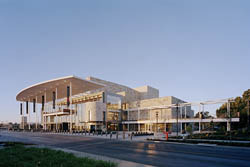
The elegant Mondavi arts center, above, is a dramatic addition to the rural landscape of Davis — and it will soon be joined by the Robert Mondavi Institute, depicted in an artists' rendering below.

Anyone driving east from San Francisco on Highway 80, the 10-lane transcontinental highway to Nevada and points east, can't miss the name Mondavi. In California's Central Valley, where the Mondavi family first made its name in the grape wholesaling business in the 1920s and then became America's foremost wine dynasty, Robert and Margrit Mondavi have passed into legend – so much so that their names are heralded for all to see from the freeway.
This past week, I gave talks on my book, The House of Mondavi, in Sacramento and the nearby town of Davis, where the University of California's renowned viticulture program is based. Davis is home to both the Robert and Margrit Mondavi Center for the Performing Arts and the Robert Mondavi Institute for Wine and Food Science. You can see the sign for the Mondavi Center on one side of the I-80 and the construction site for the new RMI on the other.
When I told a good friend from Alabama about these author events, she teased, "Oh, Julie, it's just Mo' Bob Mon …" — meaning that talking about the late Bob Mondavi had become a long-standing routine. In fact, it's been Mo' Bob Mon for more than 15 months now, and that's why I was was not much looking forward to what had threatened to be a long and taxing day in the Central Valley.
But to my surprise, the two events were some of the liveliest and most though-provoking I've yet attended. The first took place at a breakfast for about 50 members and guests of the Capital Region Family Business Center, a non-profit group made up of second-, third-, and even a few fourth- and fifth-generation members of local family businesses.
Not only did they ask unusually astute questions about the challenges the Mondavis faced in passing on their family business to the next generation — but to my delight, one member suggested that Holly Hunter be cast in the role of the intrepid reporter in the film version of "The House of Mondavi." I'd prefer Tina Fey, but, hey, who's complaining?
That evening, I made my way to the Avid Reader bookstore in Davis, where several members of a book club that had already read "The House of Mondavi" turned the evening into a salon, rather than a soliloquy. Even better, a woman who had been one of the first employees of Copia, the food and wine center Mr. Mondavi spearheaded in Napa, joined us and shared her first-hand observations of him in Copia board meetings and his relations with the rest of the family.
Once again, though, the evening ended with a guessing game: who should be cast in the role of Robert Mondavi? (Clint Eastwood, Robert Duvall?) Margrit? (Meryl Streep, plying her skills with foreign accents, or Carol Channing?) Michael? (Robert De Niro?)
I thoroughly enjoyed myself and learned much from the region where the Mondavi dynasty got its start. Those who are interested in what Michael Mondavi learned from the events I describe in The House of Mondavi may wish to attend a conversation between him and Professor Robert Smiley at U.C. Davis's Graduate School of Management, which will take place Wednesday, Nov. 12.
I'm sure it will be a good evening, but for me, with a lot of work ahead for my next book, it's No Mo' Bob Mon!