Shahree Vyaas's Blog, page 9
April 24, 2025
Reshuffling my Art and Finding my own Style.
I decided to pause the report of my quest into the canon of the world literature because there was a similar hiatus in my exploration process back then in 2015 that actually lasted till May 20th, 2015.
Instead I’m going to expand a little bit upon how I’ve recently developed my own artist’s style or signature, which is the unique visual language that defines my work, making it instantly recognizable.
It’s a combination of elements, techniques, themes, and choices that consistently appear throughout my body of work. This signature style has been developed over time through experimentation and refinement.
My first step was to make of black pressed card board my primary choice of background for all my designs and to fit all relevant existing works that belong to the same series into a decorative frame of my own design.
I started to rework my whole oeuvre, beginning with the series A Cosmology of Civilization, a subject that has absorbed the first years of my experimentation with visual arts. It is a series that wants to connect the different phases of a civilization with a planet of our solar system, illustrating how human civilization is a process of birth, decline, and renewal. A constant dance on the thin rope between chaos and order while moving around the globe’s time-space continuum.
 In the middle of this display you have Apollo, who symbolizes the Sun and order, surrounded by the other planets while involved in his eternal dance with Eris, the goddess of Chaos. On the left you have Mercury, Venus, Terra, Mars, Ceres and Jupiter. They symbolize the phases when a civilization evolves to its peak, while on the right you have Saturn, Uranus, Pluto, Charon, and Eris who stand for the declining phases of each civilization.
The second series I’ve decided to rework was actually the one that inspired me to develop my actual signature and is called Art in the Dark. In this series I want to reinterpret the different art forms from the perspective of darkness. The most stylistic characteristics of this series are that all the works feature a different art form, supported by a hyperbolic geometrical concept, and are executed upon a black background while using fluorescent paints.
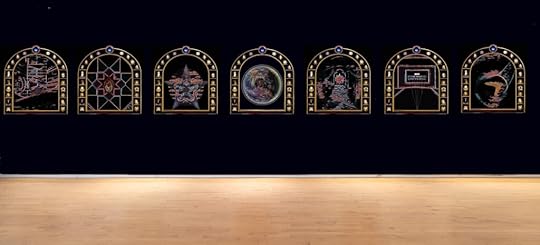 Art in the Dark. From left to right Architecture .., Dancing …, Painting…, Poetry…, Sculpting…, Watchers…, Whistling … in the Dark.
I followed up on these works with a series in which I had a look at some atavistic human behavior and named this series Dark Arts.
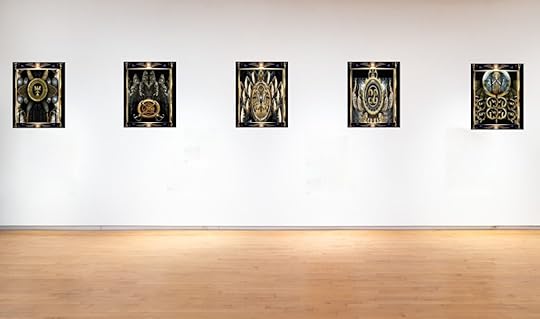 Azrael, The Clan, The Conclave, Danse Macabre, and Fear.
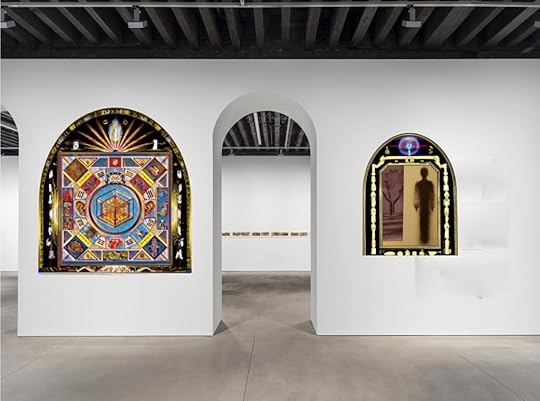 A new work called Symbiosis (right) and the reframing of one of my earlier works called Assimilation (left).
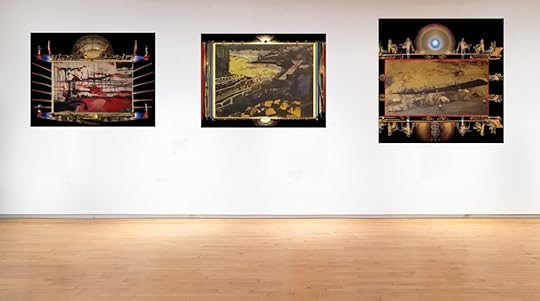 My latest works: Taiji Cove, The River, The Bridge.
In those last works I gave my surpressionist style a new twist with a different use of colors, shapes, and interpretation of the themes. Don’t know if those will last, but it definitively frames into my developing art style.

The design that features on top of this post is called Reflections. This canvas is a further elaboration upon an earlier work that is called The Zone. While The Zone was a rather formal investigation into color and line, this work gives a surpressionistic interpretation of the point where conscious and subconscious thinking processes confluence. It is a collection of free associations upon the metaphoric, tectonic representation of the no man’s land between the Noosphere and the individual while imposing stricter geometrical constraints upon the conception of the design.
I invite those who want to discover more about my visual works to visit my page on the Saatchi website at https://www.saatchiart.com/en-es/shaharee


April 22, 2025
Reading the Canon of the World Literature April 19 – 22.
The Idiot by Fyodor Dostoevsky.

19-22 April 2015.
Due to a glitch of the local internet that lasted for three days, I was confined to the books that I already downloaded. So after a small excursion to the early Indian literary space time continuum, I had to contend myself to be warped back into the 19th century of the Russian literature because it was the only book from my list of remaining books to read that was downloaded on my Kindle.
Summary
During the last segment of his travel from Switzerland to St. Petersburg, Prince Lev Nikolayevich Myshkin, a penniless aristocrat, met Parfyon Rogozhin (who just inherited a fortune of one million rubles), and Lebedev. Myshkin passed the last four years in a special clinic in Switzerland to be treated for a severe case of epilepsy. The reason for his return was a letter that he received while abroad and even his doctor found him well enough to undertake the travel to deal with the matter.
In St. Petersburg he wants to get advice concerning the suit he has to give to the letter that summoned him from abroad from Lizaveta Epanchin, a distant relative and the wife of General Epanchin with whom she has three daughters. When he obtained an interview with the General to talk to him about the letter but when the General came to the realization that the Prince was penniless he interrupted him, procured him with a job and loaned him 25 rubles. At several occasions the Prince tried to put forward the real reason for his visit, but was on every occasion interrupted by some mini-crisis that arose.
The general had an old friend, Totsky, who had for many years a young girl for a mistress called Nastasya Filippovna Barashkov but the affair dried out and she started to threaten to ruin his reputation. Therefore the two old men concocted a plan to marry her off to the General’s secretary Gavril Ivolgin (Ganya) by dangling a dowry of 75.000 ruble as bite for the nose of the money hungry Ganya.
He’s also introduced to the General’s wife and meets his three daughters.
Ganya finds out he’s in fact in love with the General’s youngest daughter Aglaya, but is holding back because of the dowry that he hoped to cash in to start his own business when he marries Natasya and fearing that the General wouldn’t find him a worthy candidate for his daughter.
So if he would marry her without her father’s consent he would end up penniless (as in “no dowry”) and jobless. Meanwhile the Prince was taken under the patronage of the General’s wife and his youngest daughter developed a fancy for him.
The Prince, after seeing a picture of Natasya, fell in love with her and he decided to go to her birthday party the next day where she would announce her decision concerning Ganya’s marriage proposal.
The Prince took a room into the boardinghouse managed by Ganya’s mother and his scheming, practical sister Varya. The other members of the household were his alcoholic and confabulating father, General Ivolgin, who was a constant source of embarrassment for Ganya and his younger teenage brother Kolya who was charged to keep an eye on his father.
Into the middle of his introduction of the Prince to his family, Natasya Filippovna showed up and a very embarrassing situation occurred when she pointed out that one of General Ivolgin rants at this occasion was very similar to a story she read into the newspaper a couple of days before. In the middle of all that, the newly baked millionaire Rogozhin, who was by himself feverishly possessed by Natasya, burst in half drunken together with his also drunk friends and declared that at the evening he would bring her at her birthday party hundred thousand ruble to better the proposed dowry of seventy-five thousand of Ganya’s sponsors.
Myshkin invited himself to Natasya’s birthday party and animated everybody with his simpleton remarks, till Rogozhin at his turn crashed the party with his friends and put the promised 100.000 rubles on the table. Now Natasya found the time ripe to ask the love-struck Myshkin if she should marry Ganya or Rogozhin; of course he said none of them and made his own proposal and put the mysterious letter upon the table wherein a Lawyer stated that he came into a heritage of one and a half million rubles.
Natasya refused him by saying he was too good for her, threw Rohozhin’s money into the fireplace and dared Ganya to take it out with his bare hands. He refused and fainted on his way out. Natasha took some poke, fished the money out of the fire and put it next to him.
During six months that followed the party, Natasya Filippovna kept going forth and go between Rogozhin and Myshkin; every time running to the other when one of them came too close of marrying her.
Myshkin was really a soft egg and some scam artists had field day with him. By the time that he made back to St. Petersburg six months later, he was left with only a mere 130.000 rubles of his fortune.
His main reason to return to St. Petersburg was that he pursued Natasja who was there hanging out with his rival Rogozhin, who declared he was nevertheless also his best friend, brought him to his old and senile mother to be blessed and exchanged crosses with him.
That didn’t withhold Rogozhin to try to murder Myshkin the same day. His plot just folded because at the moment he wanted to stab the Prince, the latter got a violent epilepsy seizure and dived head forward from the stairs. After he recovered a little from his injuries, Myshkin decided to rent some rooms at some vacation resort close by St Petersburg and his landlord happened to be Lebedev, the murky civil servant (but a first class opportunist and manipulator) he met on the train.
The prince was barely installed into his new quarters or some scheming nihilists tried to scam him from a part of his heritage by claiming that one of them was the illegitimate son of Pavlichev, Myshkin’s benefactor.
Already a while before their visit, the prince heard of this story and had asked Ganya to look into the matter. As it were to expect, all their claims were at unfounded and most of them just outright lies that could easily be exposed by documentary evidence.
Nevertheless, out of the goodness of his heart, the Prince offered financial assistance of 10.000 ruble to Burdovsky, the one who claimed to be the illegitimate son, but the latter indignantly refused “the charity” (although his friends were pushing him to take it) and offered hospitability to Ippolit, a teenager who was into the terminal phase of tuberculosis.
Myskhin started to pay social visits to the Epanchin family and fell in love with the youngest daughter Aglaya, who most of the time made fun of him but seemed at last to give in.
On his birthday party Ippolit gave a long speech that he called his confession but that was in fact a veiled suicide note. Then he tried to shoot himself through the head, but didn’t load the gun properly. Everybody laughed at his antics and a drooping Ippolit was escorted by his friends to his own quarters.
At the Epanchin household they were getting used to the idea of Myshkin as Alaya’s fiancé and they decided to throw a party to introduce him to their circle. The prince, of course, misread the guests completely. What for them is just common sense decorum and etiquette, he takes for genuine feelings and thoughts.
As a result he started wild, hugely misplaced and very opinioned speeches about religion, nobility and patriotism. He also managed, by gesturing wildly while delivering his sermons, in breaking one of Mrs. Epanchin’s favorite vases to end by getting an epileptic fit.
Aglaya is not turned off by this but before consenting to the marriage, she decided to put Myshkin through a final test. She asked him to escort her to Natasya Filippovna’s house and to make out with her.
Of course the damsel is raged with jealousy (although she wrote three letters to Aglaya, pressing her to marry Myshkin) and when Aglaya summoned Myshkin out of the house she “fainted”. The over-compassionate Myshkin was all over her and a furious Aglaya ran off. All future marriage plans were shelved and the Epanchin’s excluded him from their house and so did all their socialites.
Again preparations for a marriage were made and again Natasya glided into the familiar pattern of despair and emotional outbursts. Just when Myshkin’s best man wanted to fetch her to bring her to the church for the wedding ceremony, she jumped into a chariot with Rogozhin and they escaped to St Petersburg.
Myshkin, the faithful dog went the next day also to St Petersburg on a frantically search and rescue mission to but couldn’t find them. Finally Rogozhin found him and took him to his house where he showed Myshkin her corpse; he had stabbed her to dead the previous night.
The whole night long they held a wake near her body and were next day discovered by Lebedev and a bunch of policemen. The Prince was in a near catatonic state and Rogozhin suffered of a severe case of brain fever.
After Rogozhin recovered, he was sentenced to 15 years of hard labor in Siberia and all his fortune was forfeited in favor of his giddy younger brother.
The prince was returned to the Swiss sanatorium by Kolaya and presumably never recovered. Aglaya married an exiled Polish count who turned out to be an imposter and conman.
Comments;
It seems that the theme of declining dynasties was fascinating a lot of European writers by the end of the 19th century. For sure that period of time was characterized by the downfall of centuries old dynasties of nobility to be replaced at the top of the heap by a new class of emerging industrial capitalists.
Those old traditional nobles who were relying too much on what their estates produced and missed the train to the future, were confronted by falling prices for agricultural products, and those who persisted in their disdain for money management were driven into poverty and anonymity.
All books of that time describe, up to a certain degree, the last siblings of a decaying dynasty as “idiots”.
April 18, 2025
Reading the Canon of the World Literature April 16 – 18
The Ramayana
Volume six; The Book of War.
The Monkey army under command of Sugriva and Rama marched up to the shores of the Southern Sea where they find Vibishana, the brother of Ravana. When they brought him as a prisoner to Rama he explained that he got exiled because he spoke in favor of a honorable return of Sita to Rama. Rama made him one of his closest advisors and the monkey engineer Nala, with the help of the other monkeys, build in five days a bridge to Lanka. After the army crossed the bridge, Rama sent an ultimate messenger to Ravana with the demand to elease his wife, but an angered Ravana ordered him out of his palace. After a lengthy battle, the monkey army won the battle and Rama killed Varana, thus completing the task that Vishnu put upon his incarnation into Rama. Upon his victory he installed Vibishana upon the throne of Lanka.
Volume seven; The Last Book
When Sita heard of Rama’s victory, she happily put on her best perfumes, make up and clothes and ordered a palanquin to bring her to Rama. When she reached her husband, he wanted her to prove that she remained pure while being imprisoned by Varana. In despair she orders a big funeral fire to be build and stepped into the flames, praying to Agni, the God of the fire, to spare her if she remained pure. The god acknowledges her fire and lifts her out of the fire while proclaiming her purity and all rumors fell still. Meanwhile Rama’s term of exile expired and they returned to Ajodhya where Rama was crowned.
April 16, 2025
Reading the Canon of the World Literature April 14 – 15
The Ramayana by Valmiki.
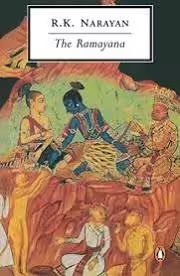
The title can be translated as the Journey of Rama (who was an avatar of Vishnu) and consisted of 24,000 verses in seven books (kāṇḍas) and 500 cantos (sargas) all good for more than 50.000 lines of scripture. It is the second pillar of Indian literature and luckily, just like with the Mahabharata there were summarized versions available that only retain the most essential verses.
Although its story tells the story of an incarnation of Vishnu, Rama whose wife Sita (avatar of the goddess Lakshmi, Vishnu’s wife) was abducted by Ravana, a demon who ruled over Lanka (contemporary known as Sri Lanka), but the intrinsic goal of the book is to describe essential human values and the principles of Dharma, Samsara, Karma and Moksha.
It describes also the rituals and stages of passage, yoga and personal behaviors, non-violence, Law and Justice and the stages of life (student, householder, retiree and finally renunciation of the world through Moksha).
Hindus believe that there is only one supreme Absolute Deity called “Brahman”. It also does not promote the worship of any one particular deity. There are thousands of gods and goddesses of Hinduism and all represent the many aspects of Brahman. Although this faith is characterized by the multiplicity of deities the most revered deity is the Trinity of Brahma, Vishnu and Shiva – creator, preserver and destroyer.
Another noteworthy detail of this epic is that the first letters of every thousand verses (24) compose the Gayati mantra who’s not just a prayer to a deity but the deity itself.
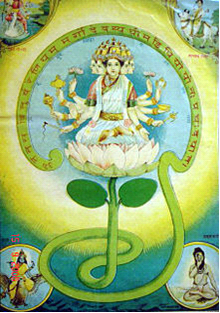 The “Gayatri mantra“ personified into a goddess
14 April 2015
Volume one; The Book of Childhood
Around the seventh century BC, at a place that now is known as Utar Pradesh, was there the small kingdom of Kosala having as capital the city Ajodhya ruled by King Dasharatha.
Al went well into the Kingdom and the country was prosperous and its citizens where happy and the King ruled wisely. There was only one thing that bothered the King; although he had three wives, he didn’t have children.
His high priest advised him to perform a ritual sacrifice and out of the flames raised a figure handing him over a bowl with rice pudding that he had to give to his wives to eat. After that his first wife Kausalya gave birth to Rama, his second wife Kaikeyi gave birth to Bharata and his third wife Sumitra gave birth to a twin Laksmana and Shatrugna.
They were all sons who were up to a certain degree were avatars of Vishnu, because Vishnu decided to incarnate as a mortal in order to defeat a demon called Ravana who was terrorizing the Gods.
No god or demon could defeat Ravana because Brahma granted him a boon that he could not die through the hand of a supernatural being; only a mortal could defeat him.
The boys were raised as royal princes but when Rama turned sixteen a wise man called Viswamitra came to see the King and requested that Rama would be sent with him to kill the Rakshasas that were disturbing the Brahmans fire sacrifices.
The King objected by mentioning Rama’s young age and proposed to go by himself, but Viswamitra declined and assured the King that Rama would be safe under his guidance.
Lakshmana decided to accompany his brother and both of them would receive instructions about supernatural weapons from Viswamitra and managed to destroy the demons. But the destruction of the demons was not the real reason why Viswamitra whisked Rama away of his father’s royal court; Rama was to win the hand of Sita, a princess of superb beauty and elegance, in a Swayamvara organized by her father, King Janaka of Mithila.
The God Shiva had given the King an immense bow and only the one who could wield it was to get the princess hand. Only Rama could wield the bow and when he wanted to string it, it snapped in two. Sita was very pleased because she had already a crush on him before he entered the competition and the King proclaimed that not only she would marry Rama, but that he would also provide wives for all his brothers. When their father assented to the proposed marriages, a big wedding party took place at Mithilia whereupon the Princes and their brides returned to Ajodhya.
Volume two; Book of Ajodhya.
After the princes were married for twelve years, their father wanted to abdicate in favor of his oldest son Rama. The evening before the coronation, a manipulative servant convinced Kaikey that if Rama would become king, she would be exiled and her son murdered and suggested that the second queen should collect the two boons that the old King awarded her once for saving his life on the battlefield. The first boon would be that her own son Bharat (who was visiting his maternal grandfather at that time) should be crowned King and the second boon that Rama was to be sent into exile for 14 years. The King tried to reason with his second wife but she was beyond reasoning so he granted her the awarded boons and Rama goes in exile, followed by his wife Sita and his brother Lakshmana. Shortly afterwards the old, heartbroken king died and they sent a message to Bharata to come home but without explaining why. When he comes back and heard the whole story, he became furious and renounced his mother. After he organized his father’s funeral, he went looking for Rama to break him the news about their father’s dead and to plead him to come back and take the throne, but Rama refuses and stuck to his father’s edict. In a response, Bharata asked for Rama’s sandals and placed them upon the throne as a sign that he only ruled the county as a regent in his brother’s name till Rama would come back from his exile.
15 April 2015.
Volume three; The Book of the Forrest.
During their dwellings in exile, they reached the riverside of the Godavari and deceided to build a couple of huts there and to live of what the land provided them. A female rakshas, Surpanakha, tried to seduce the two brothers and when they refused her advances, she angrily tried to kill Sita. Lakshmi thwarted her attempt and in the battle that followed, het cut of her nose and ears. She fled to her brother, the demon Khara and he vowed to take revenge against the once that mutilated her. He assembled his demon army, but Rama slaughtered all of them. When his brother Ravana heard of his dead and of the beauty of Sita he decided to abduct her with the help of a demon Maricha who could take whatever shape he wished. Maricha took the shape of a golden dear and when Sita saw the beautiful dear she pleaded with Rama to catch it for her. Even when Rama suspected that it was a demonical ploy, Sita kept imploring him to catch the deer so he set out to catch it, leaving Lakshmana with her to protect her. When Rama tried to catch the demonical dear it fled to the surrounding forest, a fight followed and he wounded the demon deadly. The demon then imitated Rama’s voice and cried out for help. Lakshmana and Sita heard that cry for help and Sita convinced him to leave her to help Rama. Before he left he drew a magic protective circle around the house and summoned her not to step out of the circle. Shortly after he left, Ravana showed up into the disguise of a wise man and tricked her out of the circle and abducted her into his flying charriot. The King of the eagles, Jatayu tried to prevent this but got deadly wounded by Ravana and with his dying breath could tell the brothers what happened. During their expedition to rescue her, they met a rakasha and a wise woman who indicated him to seek the help of Sugriva, the banished younger brother of the monkey king and the monkey hero Hanuman, his loyal follower.
Volume four; The Book of the Monkey Kingdom.
When Rama and Lakshmana found Sugriva and Hanuman, Sugriva indicated that he would not be able to help unless they helped him to conquer the throne of Kishkindha, the monkey kingdom. So the two brothers set out to help to defeat and kill his brother. Soon afterwards Sugriva sent out search parties into all wind directions and those sent to the south, who included Hanuman, stumbled upon an eagle called Sampati, the brother of Jatayu who was slaughtered by Ravana. Sampati told Hanuman that Sita was abducted by Ravana to the island of Lanka.
April 12, 2025
Reading the Canon of the World Literature April 10 – 11
War and Peace by Leo Tolstoi
10 April 2015
Volume 3.
.
Natasha started slowly to recover from her disastrous liaison with Anatole and its calumnious fall out thanks to her loving family, her cousin Sonya and some newly found religious believes. At the same time the whole country was gearing up for an imminent confrontation with the French troops under the command of Napoleon.
In this part of there is also a rather historical correct description of Napoleon, his rise through the ranks, his qualities as a strategist and lawmaker, his quirks and vanities and the army of 400.000 that he used to overrun half of Europe (that consisted for more than half out of non-French allies) whose swiping advance through Europe ran for the first time ran some serious resistance at Smolensk, where they fought the battle of Borodino. Both armies suffered substantial losses, although the Russians could claim to have won the battle, even when the Russian General Kutuzov decided to retreat after learning the amount of casualties that his army suffered. During the battle, Pierre was hanging around the battlefield, his friend Andrei Bolkonsky got seriously wounded at the abdomen while trying to protect a Russian standard and Anatole Kuragin lost a leg.
Because of the Russian withdrawal, Napoleon could march up to Moscow but the withdrawing army torched everything useful during their retreat, thus made it impossible for the invading army to take provisions from the conquered land
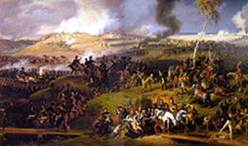 Battle of Borodino, Painting by Louis-François, Baron Lejeune, 1822.
Pierre was still lost into masonic esotericism and by doing some numerological deductions, became convinced that Napoleon was the anti-christ and he was the anti-anti-christ. At Bald Hill, the Bolkonsky estates, the old Prince died of a stroke while trying to put up some defense against the French invaders. His daughter Marya was left alone with a band of hostile serfs who refused to let her flee the estates. Nikolas Rostov, on his way to Moscow came just in time to set her free and quell the revolt of the serfs. Marya fell in love with the knight in the shining harness and he also developed feelings for Marya but held back because he made a wedding pledge to his cousin Sonya. His parents were struggling to keep his 15 year old brother Petaya out of harm’s way, but the youngster was so pumped up by the propaganda and the idolatry around the Tsar that he threatened to elope. Finally they allowed him to enlist in a militia funded by Pierre Bezukhov.
Sensing the mood between Nikolas and Marya (at least a financially worthy party), the countess pressured Sonya to write Nikolas a letter to release him from his pledge to marry her.
With Napoleon almost at the gates of Moscow, the Rostovs were still pondering if they should evacuate or not. When they finally made up their mind they started frenetically packing and loading chariots, just at the end to ditch everything and to take instead wounded soldiers upon their chariots.
Amongst this soldiers was Andrei Bolkonsky, but nobody told Natasha. When they left, the city was already engulfed in flames and looting was underway. They passed by Pierre who was trying to make himself invisible by wearing peasant clothes, in an attempt to escape from the responsibilities of his rank by convincing himself that he was on a mission to murder Napoleon.
Instead he saved the life of a French officer, had dinner with him and when he saved a woman from being raped by some French soldiers he got arrested by a passing by French patrol on the suspicion of being a saboteur and arsonist.
11 April 2015.
Volume four.
While being a prisoner, Pierre develops a close understanding with Platon Karatev, a wise, down to the ground and integer peasant. Just the facts of having him around makes Pierre discover the nature of the flow of life and its sense. The prisoners forced to march with the retreating French army during one of the harshest Russian winters without getting much of food or clothing (the French themselves were lacking it). When Platon finally got ill and developed fever, the French shoot him, because he would have slowed them down. Shortly after that the French are attacked by a group of partisans and during the ensuing fight, Petaya Rostov got shot.
Meanwhile his family reached Yaroslavl, where they kept taking care of Andrei, who’s dying of his injuries. Finally Natasha discovered that Andrei was among the wounded soldiers that they evacuated out of Moscow. They reconciled and Andrei forgave her just before dying.
At St Petersburg Pierre’s wife, Helene, died of an overdose of an abortion drug. This left Pierre free to propose to Natasha but custom demanded that they had to respect a period of grief for their lost relatives and friends.
Epilogue
It was seven years later (1820) and the victorious Russians rebuilt Moscow. Natasha and Pierre were married and had four children. Shortly after their wedding Count Rostov (Natasha’s father) died and Nikolas became in charge of the family’s almost bankrupt finances.
Because he always maintained that he would never get married for the money, he almost didn’t propose to Marya, but at the end reason sunk in and they got married. Marya’s fortune gave the much needed boost to the Rostov family’s finances. They took also care of Nikolai Andreyevich Bolkonsky, Andrei’s orphaned son.
Strange enough both men after they got married turned into loving husbands, seasoned estate managers and careful traders. The Tsar was increasingly preoccupied with religious matters and the government fell into the hands of reactionary forces; much to the exasperation of Pierre and his liberal friends who tried to figure out some way to counter that. At the end of the epilogue about the book’s characters, Nikolai exclaimed “That he would do something that would have made even his father proud of him”.
The rest of the epilogue is a monograph about Tolstoy’s vision upon history writing.
His main criticism was that the historians of that époque were too much concentrated upon historical personages that, into their opinion, made things happen instead of investigating the process that made them historical.
For Tolstoy, history was more like infinitesimal calculus; a big amount of small events converging to a point where the right person was at the right place and time to make them cumulate into a cohesive process.
Comments.
Like most Russian aristocrats of that time, Tolstoy spoke fluently French and so do all of his aristocrat characters. Not astonishingly 2% of the text is written in French followed by a translation.
Some translators omit the French texts and publish only the translations but by doing so you don’t realize that the more the Russians got involved into Napoleons battle, the more French started to lose its popularity as a conversation language because it was perceived as the language of the oppressor. It got the reputation to be the language of deceitful and artificial manners while Russian got portrayed as the language of honesty and seriousness.
So the slow process of French fading away into the book gave the book an extra touch of comprehension of the change of mindset that occurred into the Russian elite. Most of them were so unaware of Russian that they had to rent tutors.
Although this book was written sixty years after Napoleon wars, the Russian aristocracy was apparently still firmly embedded into the French culture (note Tolstoy’s mastery of the language).
One has also to admire the enormous amount of time and historical research (he only used primary sources) and the amount of real historical characters he described accurately and in detail. This was also the reason why Tolstoy was reluctant to call this book a novel.
After the Napoleonic Wars, Tsar Alexander was undeniable the most powerful monarch of the world, ruling over a vast Imperium that stretched over three continents; Europe, Asia and North America (Alaska was then still part of Russia) … and did nothing with it.
It was a blessing for the rest of the world that after his victory over Napoleon, he started to sulk and turned his attention to religious mysticism.
April 10, 2025
Reading the Canon of the World Literature April 7 – 9
War and Peace by Leo Tolstoy.
April 7, 2015.
Volume 1;
The book started with a party given by Anna Pavlovna Scherer (the best friend of the Empress Dowager who was the most powerful woman at the court of her son, Tsar Alexander) in St. Petersburg in 1805 and introduced Pierre Bezukhov and his good friend Prince Andrei Bolkonsky and the Kuragin family. Pierre is one of the illegitimate children of Count Bezukhov, an old and wealthy aristocrat. Although he behaved a little strange and asocial, he was his father’s favorite child and was educated abroad for several years. Prince Andrei Bolkonsky was the son of Prince Nikolai Bolkonsky, who used to be a general under Catharina The Great and retired afterwards to the family’s country estates at Bald Hill. Andrei was an intelligent and integer person with a slight sarcastic trait that caused him sometimes unwanted trouble. He had a complete contempt for his wife Lisa (who was a big superficial socializer) and even displayed that publicly. His unhappy family life and the superficial mentality of St Petersburg’s elite made him to confide to Pierre that he contemplated about enlisting into the army. Also at the party was Prince Kuragin and his depraved family; his sons Hypolite (the family moron) and Anatole (intelligent, complete amoral womanizer and boozer) and their sister Helene ( an amoral beauty of low intellect but a keen manipulator). The main occupation of the Kuragin family was to take care of themselves; they focused at that time on finding wealthy partners for their offspring to cover for the dwindling family fortune. Andrei specifically warned Pierre not to hang out with that bunch and to get a grip on his drinking and womanizing. Pierre promised him he would but was shortly afterwards sent away from St Petersburg with Anatole and his friends when after a drunk escapade they tied up a policeman to a bear.
They land in Moscow where the book introduced the family of Count Ilya Andreyevich Rostov and his wife a loving couple who were constantly fussing about their ad hoc financials and their four adolescent children. Their thirteen years old daughter thinks that she’s in love with Boris Drubetskoy, an impoverished noble who is about to get a commission as an officer into the imperial army but who had to lend the five hundred rubles needed to buy his first uniform from his uncle, count Bezukhov. The 20 year old Nikolas has set his mind upon his cousin Sonya, a fifteen years old orphan that was brought up by the Rostov family while the oldest one, Vera was set to marry a Russian-German officer, Adolf Karlovich Berg, whose family was well off.
Shortly afterwards count Bezukhov got a sixth, fatal stroke and his legitimate heirs already warmed up to the prospect of receiving a big chunk of his heritage, when they suddenly learned that the old count had written a letter to the Tsar asking him to legalize posthumously Pierre so that he could inherit title, land and fortune. With the help of Princess Anna Mihalovna Drugotbetskaya (an impoverished family member) he managed to retrieve the letter just before the count died and the other family members could destroy it. In return he promised to support her and her son Prince Boris Drubetskoy, who was pursuing a career into imperial service.
Meanwhile at the Bolkonsky estate at Bald Hills, Prince Andrei left to join the army to be an aide-de-camp to Prince Mikhail Ilarionovich Kutuzov while the Russian army was readying itself for a war with France in Austria. He left his pregnant wife into the care of his bucolic father and his super-religious sister Marya, who was constantly verbally abused by their father.
Into the preparations of the war, the 20 years old Nikolai Rostov got drafted to serve as an ensign into a hussar regiment and would have his first battle experience at the Schöngrabern engagement. As so many young soldiers he was influenced by the charisma of Tsar Alexander and fell into idolatry of the Tsar. After that Boris introduced him to Andrei and in a fit of righteous impertinence, he insulted Andrei, who decided to let it pass by. Soon after that they were all engaged into the disastrous battle of Austerlitz, where Andrei would get wounded.
9 April 2015.
Volume 2.
Nikolai Rostov returned home to Moscow on a leave from the army to find his family tethering of the brink of a bankruptcy. His mother begged him to marry a rich girl, but he remained headstrong about marrying his penniless cousin Sonya. He’s accompanied on holydays by a fellow officer called Denisov, who proposed to his sister, the beautiful Natasha, but his proposal was rejected.
After receiving his heritage and new title, Pierre Bezukhov turned into a very eligible bachelor, but got by the old Prince Kuragin lured into marrying his amoral, stupid but beautiful daughter Helene who was rumored to have an incestuous relation with her brother Anatole. After the marriage she starts a romance with Dolokhov, who openly mocks Pierre about it. Finally Pierre lost his temper and challenged Dolokhov to a duel. Although Dolokhov was an experienced duelist, Pierre managed to wound him and remained unharmed. After the duel he threw his wife out and in search for a new spirituality he joined the free masons where he got embroiled with their esoteric philosophy and internal policies. Into his quest to become a better person he tried to liberate his serfs but got instead swindled by the manager of his estates and in the end realized nothing from al his good intentions while thinking he did.
His friend, Prince Andrei Bolkonsky managed his estates as an enlightened despot; he created schools and hospitals for the serfs, improved their living and working conditions and liberated them without breathing a word about it while Pierre was boasting about his reforms that behind his back went nowhere. On top of it, when his wife Helene begs him to take her back, again all common sense but inspired by some metaphysical teachings of the free masons, he took her back. Despite her superficiality, she was shortly afterwards running the most thriving intellectual and artistically salon of St Petersburg.
While Pierre was lost in the esoteric theories of the freemasons, his friend Andrei was composing a study about the shortcomings of the Russian army and how to overcome them. When he finished his essay, he felt compelled to present it to the Tsar or to someone with influence at the court and went to St Petersburg. There he meets the 17 years old Natasha Rostov and was revitalized by her youth and charm. After a couple of visits to the family, he proposed and they accepted, but his father imposed a year delay of the wedding. Initially the would be wedded were crushed, but then Andrei decided to go abroad to cure from his injuries and the Rostovs returned to Moscow to visit some old friend.
When the Rostovs went to the opera in Moscow, they ran into Anatole and Helene Kuragan. Anatole lusted for Natasha and with the complicity of his sister and a friend, he developed an ingenious plan to seduce her. They exchanged very passionate letters and at some point Natasha wrote a letter to Andrei’s sister Marya, announcing that she broke the engagement and decided secretly to elope with Anatole. At the very last moment her plans are torpedoed by her cousin Sonya. Pierre was called in because he was Andrei’s best friend to mediate and from him she learned that Anatole was already married to a Polish woman and had no intention to marry her. She would have been eternally dishonored and shamed because she fell for an egoistic womanizer. Andrei returned all her letters and presents to Pierre and announced that his honor didn’t allow him to renew his proposal. While intermediating between Natasha and Andrei, Pierre discovered that he fell in love by himself with Natasha and interpreted the Great Comet of 1811 as a good omen; indicating a new start.
April 6, 2025
Reading the Canon of the World Literature April 4 – 6
One Hundred Years of Solitude by Gabriel Garcia Marquez.

We’re halfway Semana Santa and our little rock is invaded by herds of drunk and pot smoking tourists. The part of the population that isn’t working into the tourism industry is either gleefully participating or went into lockdown with enough food and drink to survive for a week; just occasionally throwing a little diner party into each other’s house with a carefully edited guest list.
Meanwhile I’m going to make another major jump through the literary space-time continuum to get to another family saga that evolves having for background Columbia from the middle of the 19th century till the middle of the 20th century. The novel was first published in Spanish in 1967.
April 4, 2015.
Summary;
Because the book used a lot of flashback and actually started with an event that was only to occur somewhere halfway, I decided to summarize it in a chronically linear way.
Two cousins, Jose Arcadio Buendia and Ursula loved each other and got married without their families’ permission. After the marriage, Ursula gets preoccupied that incest will lead to a child with a pig’s tail and she refused to consume the marriage.
When Jose won a cockfight the loser of it, Prudencio Aguilar, teased him with his wife’s virgin state and in a rage Jose killed him, went home and forced his wife to have sex with him.
After that Prudencio’s ghost started to haunt them and they decided to move away with some of their friends to found a new town to be called Macondo. The idea was to set Macondo up at the seaside, but despite a long search they couldn’t find the seaside.
Ursula and José Arcadio Buendia got two sons, José Arcadio (II) who was strong and hard while his brother Aureliano was more studious, withdrawn and clairvoyant. The main contact with the outside world that the town had was through a band of gypsies leaded by Melquíades who always brought some wonderful technological and magical gadgets like magnifying glasses, flying carpets, magnets, ice, etc… These things were always carefully scrutinized by José Arcadio Buendia to see if he couldn’t turn them into weapons.
Because José Arcadio grew frustrated by the fact that the town’s only contact to the outside world depended upon a yearly visit of a group of nomadic gypsies, he and some other men organized an expedition to find a way to the outside world. They went off but got lost into the jungle, became a little psychotic and in the end, they gave up.
During the time that his father was away from home, José Arcadio (II) had a relation with Pilar Ternera that resulted in a pregnancy but he shrank away from the responsibilities of fatherhood and started instead an affair with a gypsy girl and joined their band when they moved on.
In an attempt to find him, his mother left the town for some time and during her search she found a way to another town, thus connecting Macondo with the outside world and bringing in some new townsfolk. As a side effect, the government also became aware of the existence of Macondo and sent an administrator called Don Apolinar Moscote.
After giving birth to her baby, Pilar Ternera gave her son up to the Buendia clan and they named him Arcadio and he grew up without knowing who his parents were. Around the same time the Buendias also adopted an orphan called Rebecca who carried a bag with her parents’ bones and a letter for José Arcadio.
Ursula and José Arcadio got a daughter named Amaranta. Their youngest son, Aureliano developed meanwhile an obsession for Remedios, Don Apolinar’s beautiful but only nine year old daughter.
Shortly afterwards the town was hit by a plague that caused insomnia and a complete loss of memory. They tried to fight the plague by putting post signs and to create a memory machine, but it was all in vain. At the brink of a catastrophe, they were saved by Melquíades who brought them a potion that restored their memories. Melquíades claimed that he resurrected from the dead because dead was to boring. He took up residence into an empty room of the Buendia mansion and started to teach Aureliano how he could become a goldsmith and the rest of his time he spent on writing manuscripts in a secret language.
Another memory that popped up after the plague was the ghost of Prudencio Aguilar, who had spent years trying to find José Arcadio and Macondo. He hung out with José Arcadio for a long night, and the next day José Arcadio had gone completely insane. The family tied him to a tree in the backyard where he seemed happy, speaking some language no one could understand.
Aureliano found an outlet for his frustrations about the little girl by having sex with Pilar Ternera and she got pregnant. But he couldn’t put the girl out his head and at the end he confessed to Pilar who arranged an agreement for the marriage when the girl would get her first period. When Remedios got her first period at the age of twelve, she married Aureliano and he was a happy man for a while.
Ursula wanted to organize a party to brighten the mood of the family a little and for that purpose she decided to buy a player-piano. The player-piano arrived with a technician to install it; a man called Pietro Crespi. Two girls of the Buendia household, Rebeca and Amaranta fell in love with him, but Pietro decided to marry Rebecca (probably because Amaranta was still very young). Amaranta went completely nuts and invented all kinds of plots to sabotage the wedding plans, but ultimately she started to contemplate murder as an ultimate resort although she hoped that she wouldn’t have to resolve to that solution. Shortly afterwards Remedios died of a bleeding caused by an extra-uterus pregnancy.
The unexpected comeback of José Arcadio (II) to town as a wild and tattooed giant did shake up the relational balances and he and Rebecca (his step-sister) fell wildly in love with each other and she married him instead of Pietro while everyone else disapproved because of the almost incestuous nature of the relation. Now Pietro fell in love with Amaranta (who was meanwhile a couple of years older) but she rejected him (probably not happy about being just second choice) whereupon a desperate Pietro committed suicide.
After the dead of his child-bride, Aureliano got gradually more involved into politics; at first in support of the conservative party that his Father in Law adhered, but when he realized how corrupt that party was, he switched sides to the Liberal rebellion. He started to call himself Colonel Buendia and fought in more than 30 rebellions that he lost all, but always narrowly escaped capture or assassination attempts. During his campaigns he fathered seventeen sons who were all called Aureliano with seventeen different women. But his luck didn’t last and finally he was imprisoned and got the dead penalty. His last wish was that they would put him before the firing squad in Macondo and there, into the nick of time, he got saved by his brother who stormed out of his house as a screaming tattooed giant, threatening the soldiers of the firing squad with a rifle till they backed off.
Meanwhile the civil war went on and Arcadio, the secret son of José Arcadio (II) with Pilar Ternera, married Santa Sofia de la Piedad. They had three children; Remedios and the twins Aurelianus Segundo and Arcadio Segundo. While she was pregnant, the Colonel put him in charge of the town and he started to terrorize the people out of resentment for all the mishaps he had to suffer during his childhood and met his fate in front of a firing squad. At the end of the civil war, the power-hungry liberal leaders forced the Colonel to endorse a peace agreement that contained almost nothing of the values he was fighting for and he retired to Macondo as a disillusioned man. In Macondo he sank into depression and kept to his alchemist laboratory, where he kept making golden fishes in order to melt them down and to start all over again.
The relative political stability attracted foreign investors and an American company started a banana plantation at the outskirts of Macondo with their own fenced community. Shortly afterwards the plantation workers start to complain about their working conditions and lack of payment. They got only some kind of monopoly money that they only could spend into the companies’ stores, where there was almost nothing to buy. So they go on strike and the company invited them to a reconciliation meeting under supervision of a government negotiator.
The workers gathered at at the place that was agreed but found themselves surrounded by soldiers with machineguns who shot all 3000 of them, loaded the bodies upon a train and dumped them into the sea. The only survivor was José Arcadio Segundo, who was one of the union leaders, who came back to himself on the train, surrounded by corpses and managed to jump of it and to escape back to Macondo.
The people of Macondo would till the end believe the government version; that the workers reached an agreement with the company and went peacefully home. Shortly afterwards the banana plantation folded and the company moved its operations elsewhere.
Meanwhile his brother, Aureliano Segundo had a romance with Petra Cotes, but instead of marrying her, by a twist of mind, he married a compulsive religious fanatic called Fernanda who was raised by her lunatic parents into the belief that she would become a queen.
After his wedding he kept frequenting Petra Cotes and their wild sex life created an aura that made their farm animals breed like crazy and as a result they became very wealthy. Meanwhile he fathered with Fernanda a daughter called Meme and a son José Arcadio (III).
When Meme as a teenager fell in love with a young mechanic called Mauricio Babilonia her mother, upon discovering the romance had him shot as a thief when he tried to sneak into the house to make love to Meme and sent her daughter off to a convent as a lunatic.
After a year a nun showed up with a very unwelcome surprise; meme’s baby son, who was kept sequestered to the house who had as only company Fernanda and Aureliano Segundo’s last daughter Amaranta Ursula, without knowing that the girl was actually his aunt and Fernanda his grandmother.
Next thing that happened was a rain flood of biblical proportions that lasted for five years without interruption and completely washed away all the town’s assets. The mater familias of the clan, Ursula, died and so did almost everyone else
Fernanda’s daughter, Amaranta Ursula took off to Belgium where she married a pilot by the name of Gaston and Auriliano (II) stayed behind alone into the family’s mansion. Jose Arcadio (III) came back and discovered a gold treasure that his bet grandmother (Ursula) was hiding under the floor of her bedroom and got killed by a band of young punks that he was hanging out with him so that they could steal his gold.
Amaranta Ursula returned with her husband and found nothing better to do then to start an affair with her nephew and the pilot eventually filed for divorce.
The more their relation evolved, the faster speeded the decay of the house. They still didn’t know in what way they were related when Ursula Amaranta got pregnant and gave birth to a child with a pigtail and died during the birth process.
He got depressed and went off for a drinking marathon and by the time he remembered the baby, it was eaten by ants. Torn between guilt and self-pity he turned to Melquíades’ manuscripts and finally managed to decipher it, just to discover that it told the family saga from the moment that the insane patriarch of the Buendia family was roped to a three, up to the devouring of his baby by the ants.
Then a huge storm formed and wiped out the whole town and its remaining habitants from existence and memory.
April 6, 2015
Comments;
The massacre of the bananeros in Macondo is a fictional version of a real massacre that took place on December 6, 1928 in the town of Ciénaga near Santa Marta, Colombia on behest of the United Fruit Company and under pressure of the US government who threatened to send in the Marine Corps to protect the interests of the United Fruit Company.
Just like in the novel, the mention of the massacre was for a long time suppressed by the official history writing and even well into the sixties of the twentieth century, it caused Gabriel Garcia Marquez, who was at that time also working as a journalist, problems to obtain a visa to travel to the US.
April 3, 2025
Reading the Canon of the World Literature April 1 –
Buddenbrooks by Thomas Mann
April 1, 2015.
Part six.
Tony decided to marry Alois Permeneder. Upon the moment he received his wife’s dowry, he retired with the intention to splash the money. She left him when he tried to rape a servant after an evening of drinking. Christian embarrassed Thomas by saying that businessmen are swindlers but inconsequently went after that by himself into business in Hamburg.
Part seven to eleven
As suspected, Christian’s business in Hamburg folded and he returned to Lubeck to parasite further on his family’s fortune. He started a relation with an actrice /call girl named Aline Puvogel. Thomas disapproves heartily of his brother’s behavior and is the only one who keeps the family floating.
He becomes a senator and expands his business even further so that he can even afford himself a bigger house. His sister Clara died and their mother gave her daughters heritance to Sievert Tiburtius, what caused a big row with Thomas. In 1866 there was the Austro-Prussian war that lasted for seven weeks and resulted in the Prussian hegemony over the other German states. Austria lost also Venice to the Italians, who annexed it.
Tony’s daughter Clara married a business relation of Thomas, but the guy went broke and Thomas who speculated on his harvest lost lots of money. Weinschenk went to prison and disappeared upon his release.
After the consul’s widow died, the two brothers had a horrible row and the firm’s business becomes under pressure because of competition of Hermann Hagenstrom. They even had to sell their family house to him and he made a big spectacle of moving in, turning the previous offices of the family business on the ground flour into profitable shops. Thomas turned into a weak refection of his former self and believed that his wife had a secret love affair with an army officer.
He started reading Schopenhauer, what didn’t exactly improve his mood and died shortly afterwards. His hypochondriac dandy of a brother married Aline Puvogel and ended shortly afterwards up into a psychiatric institution.
Thomas widow sold the big house at Fischergrubben and went to live into a small villa at the seaside where she filled her days by playing music with her son Hanni.
When Hanni died of typhus, aged fifteen years, the remnants of what once was a proud dynasty consisted out of a bunch of elderly woman. Tony was the only family member who remained to live in Lubeck.
2 april 2015.
Comments;
The novel’s style frames into the 19th century prevailing realism but contained also modernist elements such as a psychological study of decadence, leitmotifs and collage. It reflects also much of the in Germany at that time widespread cultural pessimism that was a reaction upon the fast industrialization of the country after its unification.
This can be illustrated by a section at the end of chapter 10 where Thomas contemplates upon “The World as Will and Representation”, a tractate published by Schopenhauer in 1819. For this philosopher the only true reality is the will and the notion of historical progress is an illusion.
This can be illustrated by comparing the fate of the Buddenbrooks with that of the previous owners of their family house at the Fishergruben; the Rattenkamps who’s gradual decline could be seen as a result of a failure to keep a competitive edge and decadent neglect.
The other interpretation is that of a natural cycle of biological en psychological decline of the successive generations. Whatever interpretation is favored, the results remain the same; the Buddenbrooks couldn’t adapt to the new environment brought by the rapid industrialization and were pushed aside by the Hagenstroms.
The transition of power indicated also a shift from a culture of paternalistic “burghers” to a more anonymus, speculative and ruthless financial “bourgeois” mentality.
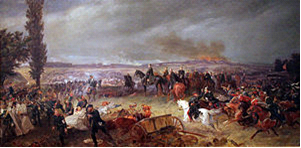 Battle of Königgrätz, by Georg Bleibtreu. Oil on canvas, 1869.
While all other European countries were into the process of acquiring colonies to sell their products and as source for the raw materials, the Germans where putting their internal affairs in order.
By the time that the German unification was a fact in 1866, the rest of the European nations had conquered substantial colonies and Germany had to satisfy itself with the leftovers. This was a cause of big resentment by the German ruling elite. It eventually became one of the casus belli of the First World War
April 1, 2025
Reading the Canon of the World Literature: March 28 – 31
Buddenbrooks; The Decline of a Family by Thomas Mann.

March 28, 2015.
Buddenbrooks is a voluminous; partially autobiographically novel that describes the relentless decline of a family living in the North German town of Lubeck between 1834 and 1877. At first sight, the ideas developed into this novel seem a little outdated and the style of the book that of an extreme pessimistic cultural realism. But it describes also the family as a social institution, which is for most people still defining their lives.
Part One
Johan Buddenbrook II (whose father started the family business in 1768) and his French wife Antoinette are in 1835 moving in their new house annex offices and celebrate that event by inviting their friends and family to a dinner party.
The book describes their world in detail; the clothes they’re wearing, the kind of food that was served, the interior decoration of the house where three generations live under one roof and the daily routines of all its occupants.
We get introduced to the third a and fourth generations; his sons Gotthold out of a first marriage with Josephine, who died in Gotthold’s birth giving and his half-brother Consul Johan Buddenbrook III and his children Antony (eight years old and also called Tony) and her brothers Thomas (10 y/o) and Christian (7 y/o). They discuss French politics; Napoleon’s demise and the politics and the rule of the French monarchy under King Louis Philippe. Gottlieb is not invited because he acted against his father’s wishes by marrying under his stand with a shopkeeper’s daughter and his father blamed him also for the dead of his first wife.
Meanwhile the consul and his father discuss a letter that the first one got from his half-brother Gotthold, asking for his fair share of the inheritance and the consul advises his father not to lose any capital on Gottlieb.
March 29, 2015.
Part two
In 1838 the consul and his wife Elisabeth (née Kröger) get another daughter Clara and sent their daughter Tony to visit her wealthy maternal grandparents. There she snubs the rude advances of a certain Hermann Hagenström. Three years later Johan Buddenbrook and his wife Antoinette die and the heritage dispute with Gotthold is resolved through a cash settlement.
The consul takes over the family business but runs it rather more as an accountant (constantly worrying about his cash flow position) than as an entrepreneur. He sent his daughter Tony to a boarding school where she befriended Armgard von Schilling descending form an aristocrat family from Mecklenburg and Gerda Arnoldsen, a violin playing girl from Amsterdam and Eva Ewers.
March 30, 2015.
Part three and four.
A commercial agent courts Tony’s parents in order to win her hand while she had a love affair with a poor medical student during summer holidays at a resort town at the seaside. Bendix (Benedict) Grünlich was a commercial agent who claimed he had a thriving business and threatened to commit suicide if Tony didn’t marry him.
Although she had instinctive objections and was even repulsed by him, she dumps her poor suitor and married reluctantly with Bendix in 1845 because her father pressured her. Afterwards she went to live with him around Hamburg. Her brother Thomas also broke up with his secret girlfriend Anna because she was only a salesgirl.
After Tony was married with Bendix for a couple of years, the consul learned that he only married his daughter for her dowry to pay off his debts and that he wanted the consul to pay off more of his debts. There was no love into the marriage and Bendix was exposed as a swindler. Tony and her daughter Erika escaped from his house. The consul who had a guilty conscience for having her forced into the marriage takes them back in.
In 1848 there was a popular uprising in Lubeck, but a paternalistic speech by the Consul defused the revolutionary mood although the stress caused the consul of suffering a stroke and he died, leaving the direction of the family business to Thomas.
Tony divorced Bendix in 1850. That year Lebrecht’s widow died and left a fortune. The consul’s widow, Elisabeth, grew into a religious zealot and her brother Justus disowned his younger son Jakob in favor of his oldest son Justus. The consul’s oldest son Christian went to Chili.
March 31, 2015.
Part five.
The half-brother of the consul, Gotthold, died. Christian returned from Chili and became a womanizer who preferred to spend his heritage by traveling, visiting bars and theaters. Thomas married Gerda Arnoldsen, his sister’s friend from Amsterdam and managed the firm diligently although not with the same passion and drive as his father.
While Tony was visiting a friend in Munchen, she made the acquaintance with a hop merchant Alois Permenader. Her sister Clara married Sievert Tiburtius and Thomas and Gerda got a son they named Johan (Hanni) who had from birth on a weak constitution.
March 25, 2025
Reading the Canon of the World Literature March 23 till 25.
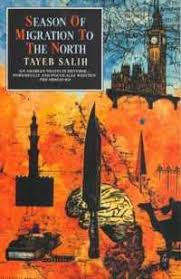
Season of Migration to the North by Tayeb Salih
March 23, 2015.
Introduction
This Sudanese, Arab written novel was published for the first time in 1966 and plays during the early years of independence from British rule (1955 till early sixties).
Summary
The story is told by an unnamed narrator, who just came back from studying seven years poetry in Great Britain (What kind of career advisor had this guy?), just to fall back upon his return into the same atavistic, tribal behavior pattern of his ancestors.
For all his erudition, he’s unable to make the simplest decision till one is forced upon him. Still the villagers regard him with awe because of his scholarly status although the elderly complain that he doesn’t use his position in the government administration to improve the access to education for the village’s children. Just one fifty years old farmer with an unknown past going by the name of Mustapha Sa’eed, who settled down five years earlier and married a local woman doesn’t seem too much impressed by his scholarly status, which of course irritates the narrator.
After the narrator lures the old man into some binge drinking, a slip of the tong reveals that Sa’eed is a scholarly trained man by himself. Onwards he agrees to tell the narrator about his past and this story will dominate the content of the book and make him the most important drama personae.
Mustapha Sa’eed was a precocious child growing up into a poor environment without father, who was sent further up the educational ladder by a succession of impressed headmasters till he wins a scholarship to study in Oxford.
Sa’eed arrives in England somewhere during the late twenties or early thirties of the 20th century and became very soon a celebrity into the left winged bohemian circles of the British bourgeoisie. Sa’eed secretly loathed this environment and their misconceptions of African culture by turning himself into the image of their parodies and reinforcing their misconceptions by inventing tales about all the clichés of oriental exoticism. At that time a lot of woman still lived into a Victorian time warp and the imposture that Sa’eed was putting down of Othello worked upon them as an irresistible aphrodisiac.
But what they got was not an Othello but a black dominator who decided to decolonize himself with his penis. After he destroyed and drove into suicide three young women, he married a white dominatrix with a dead wish.
She found fun into destroying all his works and possessions, ridiculing him at every opportunity till at the end he kills her; a fate that she apparently welcomed with pleasure. He was sentenced to seven years of prison and deported back to Sudan after finishing his sentence where he took up the life of a farmer and married a young girl.
At this point of the story, somewhere halfway the book, Sa’eed disappeared during a flood. The villagers believed he died accidently but the narrator suspected he committed suicide. Saeed’s will made him the executer of his testament and guardian of his two sons and widow, Hosna bint Mahmoud.
During the following years the narrator got an important position at the ministry of education, but kept to divide his time between Khartoum and his village, Wad Hamid. After a couple of years he learned that an elderly friend of his grandfather wanted to marry the young widow of Sa’eed, but when he consulted her about the subject she vehemently rejected it, adding that she would rather kill a new husband imposed upon her and commit suicide afterwards.
When the narrator told this to his grandfather’s friend, the old man was insulted and angry, telling him that Hosni’s father and brothers already consented to the marriage. The narrator realized that he was in love with Hosna by himself, but when a friend suggested him to marry the young widow, thus solving the dilemma, he sulked again in undecidedness and fled to Khartoum.
Upon his return to the village he learned that Hosni’s father was beating her until she consented to marry the old man of his choice. After the wedding she didn’t want to consume the marriage and shortly afterwards she stabbed her husband and herself to dead.
The narrator was inconsolable and when he heard that his friend, who’s meanwhile chief of the village, refused Hosni a funeral he got into a fitting rage who was just met with indifference (he could have avoided the whole thing to happen into the first place). Afterwards he opened Saeed’s room, which was closed since his dead and found more pictures and other memorabilia’s of Sa’eed’s time in England.
Shortly after that he decided to drown himself into the Nile, but somewhere into the middle of the stream, when he contemplated if he should live or die, for the first time into his life he made a decision; he wanted to live and started to cry for help.
Comments
The reader must imagine by himself to what purpose the narrator decided to live. To me it just sounded like that again the narrator couldn’t make up his mind; first he decided to kill himself and then, into the middle of the process, he started to contemplate if he should live or die while usually that question precedes the decision to commit suicide.
The author depicted two personages who ultimately failed to reconcile their European scholarly knowledge with their African tribal values. The first one reacted violently and turned himself into a caricature of an African man to ridicule an as oppressive perceived culture. At the end of his life, Sa’eed simply decided to ignore the knowledge he accumulated in Oxford to dedicate himself to the life of a farmer.
The narrator secretly admires the first one but is hampered by undecidedness and weak will power. Every time he tries to mimic Sa’eed; first by lusting for his widow and secondly by wanting to undergo the same fate as his hero, he wrestles with the decision till other people take it out of his hands.
At the end of the story, when he decided to live, he started also to cry for help, thus again putting the decision if he should live or die in the hands of other people.
Obviously, the narrator got saved; otherwise, there wouldn’t have been a story to tell. To paraphrase the title of this book, his mind migrated to the North while his heart remained into the South.