Shahree Vyaas's Blog, page 5
September 30, 2025
The Cintamani: Gem of Chaos and Creation
The Cintamani in The Maharajagar is no mere artifact. It is a shard of cosmic potential, a crystallized fragment of pure possibility, bound by the Elder Gods yet constantly straining against its chains. Whoever controls it can rewrite reality — but only at immense karmic cost.
Long Feng seeks to reassemble its shattered pieces, using the trauma of wars and massacres to feed its core. In the hands of the Qi’tet, it can stabilize shrines, heal ruptured timelines, and contain nightmares like Carcosa. But even they fear its pull; every use of the Cintamani invites chaos.
Throughout the saga, it changes hands — sometimes willingly, sometimes through treachery. In WWII’s closing days, it becomes both the bait and the battlefield for the final confrontation between Long Feng and the Qi’tet.
The Cintamani is a perfect metaphor for The Maharajagar’s central tension: creation and destruction are the same force, and the difference lies only in the will of the one who wields it.
System Input: Human actions, historical events, karmic residues.
System Process: Cintamani acts as a non-linear amplifier that converts localized trauma and intention into global metaphysical turbulence.
System Output: Dimensional ruptures, dream distortions, chaotic loops.
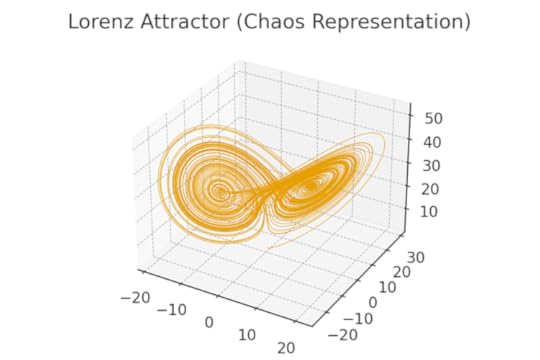
In system theory, the Cintamani is a chaos node—an attractor that does not stabilize, but continuously pulls events toward increasing entropy. Unlike equilibrium attractors, it never converges to steady states, but oscillates across historical and metaphysical domains.
Let:
H(t) = historical trauma intensity at time t
K(t) = karmic debt accumulation
D(t) = dimensional stress load
C(t) = Cintamani resonance
We define:
C(t+1) = α·H(t) + β·K(t) + γ·D(t) + δ·C(t)·(1 – C(t))
Where α, β, γ are scaling constants tied to ritual amplification. The last term δ·C(t)·(1 – C(t)) mirrors logistic map chaos, introducing bifurcation sensitivity.
Thus, C(t) behaves as a logistic chaos attractor fed by human suffering and dimensional instability.
• During Nanking (1937): H(t) spikes → Cintamani resonance surges.
• During Hiroshima/Nagasaki (1945): nuclear trauma collapses C(t) into near-zero but leaves residual oscillations (echo attractor in Dream Web).
• Post-war: Cintamani functions not as an artifact but as a latent attractor field—any new chaos (war, trauma, exploitation) risks reactivating it.
For interviews, press access, or review copies, contact:
shaharee.vyaas@gmail.com
ARC are available through bookfunnel by following link : https://BookHip.com/JQXXDRQ
Website: http://www.maharajagar.com


September 27, 2025
Alec Bannon: From Journalist to Spiral Self
Alec Bannon’s journey begins in The Maharajagar as a journalist with a knack for finding trouble — and a stubborn moral compass that won’t let him look away from injustice. Alongside Millie, his wife, he’s drawn into a web of mysticism, political intrigue, and cosmic danger.
His transformation accelerates through encounters with Wen, Minik, and the Shrine Network. By the fourth volume, Alec becomes the Spiral Self — a state of being where every version of him across the multiverse is woven into a single consciousness. This allows him to bind all the shrines into one metaphysical knot — a failsafe against the unraveling of reality.
During WWII, Alec uses this power strategically, slowing the collapse of the Mirror Shrine with Tesla’s resonance engine, sacrificing possible futures in exchange for time. In the postwar years, he becomes a teacher, founding a school of memory-keepers and dream-walkers in New York.
Alec’s arc is the reminder that heroism isn’t about the loudest battle — it’s about making the choices that keep the world turning, even if no one remembers your name.
Image Idea: A surreal composition showing multiple “versions” of Alec spiraling into a single figure, with threads of light binding shrines and timelines in the background.
For interviews, press access, or review copies, contact:
shaharee.vyaas@gmail.com
ARC are available through bookfunnel by following link: https://BookHip.com/JQXXDRQ
Website: http://www.maharajagar.com
September 24, 2025
Shambhala: Fortress of Memory and Light
Shambhala in The Maharajagar is not merely a mythic city of enlightenment — it is the strategic heart of the Shrine Network, a place where time and space fold in on themselves to protect the karmic balance of the Materium. Guarded by the Order of the Green Dragon, it serves as a final refuge for the Qi’tet when war rages in the waking world.
In WWII, Shambhala becomes the staging ground for the sealing of Carcosa and the preservation of humanity’s collective memory. Souls rescued from collapsing dreamscapes are ferried here, where spectral archivists weave them into the Great Tapestry — a living record of what must not be forgotten.
But Shambhala is not impregnable. When disturbances in the Shrine Network threaten its stability, Sheeva stands at its gates, joined by R’luh and the Bungoo warriors. Each incursion is both a test of strength and of will; to defend Shambhala is to protect not only the world, but the very idea of truth.
It remains, at the series’ close, a glowing mystery — untouched yet forever at risk, waiting for the day the veil trembles again.
September 21, 2025
Carcosa Rises: The Return of the King in Yellow
Carcosa, the city of forgotten names and endless twilight, exists both as a place and a contagion of memory. Its ruler, the King in Yellow, has no fixed form—he is an echo that inhabits hosts, warping reality through dreams and despair.
Through Long Feng, the King in Yellow finds his most potent vessel. His influence spreads not by armies, but by eroding the stability of worlds, bleeding the Materium into nightmare realms. The shrines, the Dream Web, and the Cintamani are all pieces in his cosmic game.
When Carcosa breaches the veil in Eastern Europe during WWII, the result is a city overlaid on ruins, erasing history as it exists. The Qi’tet’s sealing ritual in Rennes-le-Château is an act of desperate magic, combining Tesla’s resonators, Esther’s Phoenix Crown, and the Mandala Core to push Carcosa back beyond the veil.
But sealing is not destruction. Carcosa lingers, waiting for fractures to widen again. The King in Yellow is not a villain that can be slain—he is a force that must be contained, again and again, as long as memory itself can falter.
The shadow he casts ensures that the war for reality is never truly over.
September 18, 2025
The Qi’tet: Warriors Bound by Karma and Chaos
The Qi’tet are the heart of The Maharajagar—a found family forged in the fires of conflict, exile, and spiritual trial.
• Wen, the Taoist strategist, balances philosophy with action.
• Sheeva, the martial mystic, guards both body and soul.
• Minik, the Inuit truth-seeker, wields fire and purpose.
• Alec, the dream-chronicler, walks between memory and prophecy.
• Mahmoud, the earthbound voodoo priest, holds the weave of worlds together.
They are bound by chimerism—a rare mutation that grants mastery over elemental forces. But their bond is more than biological; it is karmic. Each has sacrificed something irreplaceable, from family to identity, to protect the Materium from incursions like Carcosa.
The Qi’tet’s strength lies in their diversity. They come from different traditions, each bringing unique magic and perspective. Their conflicts are real, but so is their unity in the face of threats that transcend individual ambition.
Their journey spans the mundane and the mythic: from New York streets to the Labyrinth’s River Acheron, from the jungles of Burma to the ruins of Hiroshima. In every place, they leave a mark—not always visible, but always woven into the deeper pattern of history.
In a world where alliances shift like sand, the Qi’tet remain proof that loyalty can survive the collapse of worlds.
September 15, 2025
Esther’s Fire: The Phoenix Crown and the Weight of Memory
Esther’s journey begins humbly, but by the later volumes of The Maharajagar, she becomes a figure of mythic resonance. Bearing the Phoenix Crown, she channels the fire of rebirth itself—able to stabilize timelines and mend fractures in the Dream Web.
Yet every act of restoration comes at a cost. Each time she weaves a stabilizing pattern across war-torn Europe or seals a collapsing shrine, a piece of her fades from the physical world. Her presence becomes spectral, half in this reality and half in the space between.
Esther’s strength lies not just in her mystical abilities, but in her endurance. She faces horrors that would break others—wars both physical and metaphysical, betrayals from within, and the psychic scars of sealing Carcosa.
Her defining moment comes at Hiroshima. In the wake of devastation, she channels the psychic scream of the bomb through the Phoenix Crown, storing it in Shambhala’s Final Memory Shrine. It is an act of containment, not victory, but it preserves the possibility of renewal.
In planting the spectral flower in the ruins—a seed from the Phoenix Crown—Esther ensures that remembrance, not annihilation, will shape the future. She is not simply a hero; she is the axis around which the fate of worlds turns.
September 12, 2025
Long Feng’s Gambit: Power, Betrayal, and the Cintamani
Long Feng’s story begins as a ruthless rival to Wen for control of the Chinese tongs, but his ambitions soon outgrow mortal power struggles. When he becomes host to the reincarnation of the King in Yellow, his influence extends across continents, wars, and dimensions.
Central to his strategy is the Cintamani, a gem of chaos and infinite potential. By reforging it, Long Feng hopes to reshape reality itself, bending timelines and memory to his will. His manipulations span from orchestrating massacres to destabilizing the Shrine Network, feeding on the psychic trauma of world wars.
Long Feng is not evil for its own sake—his cruelty is deliberate, his choices calculated. He believes in breaking the current order to create a new one under his rule. His philosophy is as dangerous as his power: he sees the destruction of the old as necessary to make way for the new.
For the Qi’tet, defeating him means more than ending a reign of terror—it means preventing the unmaking of reality. Every move against him is a battle not just for survival, but for the integrity of memory, time, and the soul of the world.
Long Feng’s arc reminds us that in The Maharajagar, there is no clear boundary between visionary and tyrant. And that sometimes, the most dangerous adversary is the one who believes he’s right.
September 9, 2025
The Flame of Rebirth: Esther’s Journey in The Maharajagar
Esther begins her journey as one of the Qi’tet’s most enigmatic members—a woman whose connection to the element of fire is as much a curse as a blessing. Her destiny crystallizes when she inherits the Phoenix Crown, an ancient relic capable of channeling not just fire, but rebirth itself.
The Crown is no ordinary artifact. It responds to sacrifice, burning away pieces of the wearer’s life-force to weave new possibilities into the fabric of reality. As the war against Long Feng intensifies, Esther uses it to stabilize collapsing timelines, each time fading further from the physical world.
By the time the final war approaches, Esther has become more spirit than flesh. Her ultimate act comes in Hiroshima, where she channels the psychic scream of the atomic blast into the Final Memory Shrine—preventing the destruction from unraveling existence itself.
Esther’s arc is a meditation on the cost of heroism. In wielding the Phoenix Crown, she becomes both savior and sacrifice—a flame that burns so that others may endure.
Image Idea: Esther standing in a field of ash with a crown of living flame, holding a single ember in her palm.
September 6, 2025
Carcosa Rises: The Forgotten City in The Maharajagar
Carcosa, in The Maharajagar, is not simply a place—it is a wound in the fabric of existence. It bleeds into our world during moments of great chaos, overlaying itself like a mirage upon cities broken by war or disaster. In these moments, the air thickens, colors fade to ochre, and the streets seem endless yet empty.
This spectral metropolis is ruled by the King in Yellow, whose influence seeps into minds and erases histories. To walk Carcosa’s streets is to risk losing one’s identity entirely. The Qi’tet encounter it during the Fall of Warsaw, where its presence turns tragedy into a metaphysical apocalypse.
Carcosa’s architecture defies logic—spirals where there should be corners, doors leading back to the same place, towers taller inside than out. It is a city designed to trap thought itself. For the Qi’tet, entering Carcosa is a necessary evil. They must navigate its shifting geometry, steal back fragments of the Cintamani gem, and close the breaches before the city fully manifests in the Materium.
September 3, 2025
Shrines of Power: Mapping the Threads of Fate in The Maharajagar
Throughout The Maharajagar, the Qi’tet’s journey revolves around the discovery and activation of the Shrines—a web of metaphysical anchors that tie together elemental power, timelines, and karmic balance. Each shrine is more than a location—it is an intersection of worlds, where the past, present, and possible futures meet.
The Shrines are dangerous to seek and dangerous to hold. Some lie hidden in mountain monasteries; others slumber beneath cities, deserts, or oceans. When awakened, they shift the balance of history, rippling across realities. In the wrong hands, they can unmake entire timelines.
The quest to bind the Shrines leads the Qi’tet into alliances with forgotten gods, spirit guardians, and immortal wanderers. It forces them to confront not just enemies like Long Feng, but also the karmic weight of their own actions.
By the time the final war approaches, the Shrines are no longer just tools—they are the last hope for sealing Carcosa and restoring order to a fractured multiverse.
Hashtags: #TheMaharajagar #FantasyLore #EpicQuest #ShrinesOfPower
Image Idea: A glowing network of shrines connected by luminous threads, overlaid on a world map with shifting constellations.