Shahree Vyaas's Blog, page 6
August 31, 2025
The Return of the King in Yellow: The Maharajagar’s Darkest Shadow
In The Maharajagar, no enemy is more haunting than the King in Yellow—a dream-born sovereign of Carcosa whose touch corrodes both reality and memory. His return is heralded through the machinations of Long Feng, a cunning and charismatic antagonist who masks ancient hunger behind political power.
The King in Yellow is not a mere villain; he is entropy given form. His realm, Carcosa, is a city that overlaps the world like a ghost, feeding on chaos and despair. As the Qi’tet move through the Labyrinth and the Void, they encounter fragments of his reality—places where time loops, memories vanish, and even hope feels alien.
But the King is more than an otherworldly threat. He is a karmic reckoning. His arrival signals the unbalancing of cosmic order, forcing our heroes to face debts from lifetimes they barely remember. Through Lovecraftian horror, ancient myth, and geopolitical intrigue, The Maharajagar reframes the King in Yellow as both an invader and a mirror—showing humanity what it becomes when dreams rot.


August 28, 2025
Forged in Fire: The Birth of the Qi’tet in The Maharajagar
The Maharajagar’s first great turning point comes with the rise of the Qi’tet—a group unlike any other in fantasy fiction. Drawn from vastly different worlds, each member possesses a unique elemental mastery: fire, water, earth, air, and shadow. But their connection is more than mystical—it’s genetic, born of a rare mutation called chimerism.
Their formation is not voluntary. Circumstances—part accident, part cosmic manipulation—force them into alliance against unseen powers pulling the strings of history. The early volumes chart their growth from reluctant collaborators into a force capable of reshaping timelines. From the voodoo-charged streets of New York to ancient Chinese tongs, from Cree powwows to dream-bound labyrinths, the Qi’tet’s journey is one of trust forged in peril.
They are pursued by Long Feng, a rival whose power is tied to the King in Yellow, ruler of Carcosa. Yet the true challenge lies within: mastering their own fears, memories, and karmic debts before the coming war.
This is the heartbeat of The Maharajagar: a war fought not just on battlefields, but in the soul.
August 25, 2025
The Hidden War Beneath History: Enter the World of The Maharajagar
History tells us that World War I began in 1914, but in The Maharajagar, the real battle started long before the first bullet was fired. In the shadowed corners of New York City, journalist Alec Bannon and his wife Millie Bloom stumble into a conspiracy that stretches across continents and centuries.
What begins as a simple act of mischief — swapping the bones of an Inuit man’s father with those of a powerful museum director — quickly spirals into a labyrinth of voodoo rites, Taoist mysteries, and an ancient war between cosmic forces.
They are joined by an unlikely band: Mahmoud and Channelle, a voodoo-practicing couple; Sheeva, an Indian martial artist and spiritual adept; and Wen, a Taoist priest with deep connections to China’s most dangerous secret societies.
This is the birth of the Qi’tet — five elemental beings bound by fate, each wielding powers that defy reality itself. Their mission is clear: protect the fragile weave of existence from those who would unravel it, including the terrifying King in Yellow.
Dive into the saga that rewrites history from the inside out, where every war is a shadow of a greater one.
August 22, 2025
How do the 3 metathemes relate to the content of the Maharajagar?
Let’s now explore how those three meta-themes (as described in the foreword) integrate with the content, structure, and symbolism of The Maharajagar across the whole saga:
“The All is a projection of informational modulated energy waves by a cosmically horizon on the time-space continuum.”Interpretation in the series:
This is a deeply metaphysical idea—drawing from quantum field theory, Eastern mysticism, and dream logic. In the context of The Maharajagar, it suggests that reality itself is a constructed illusion, shaped not by matter but by information, memory, and waveform resonance. This is not abstract for the characters—it’s lived truth.
How it manifests:
• The Shrines are not physical structures but nodal informational wave hubs—sites where timeline interference can be modulated or collapsed.
• The Mandala Pulse, which begins to ripple in Book IV and reverberates throughout Book V, is essentially an informational reset, like a recalibration of reality’s waveform projection.
• Baphomet’s Dream Archive becomes the most literal expression of this idea: a library where information, memory, and waveform are interchangeable, and reality is rewritten by how things are remembered, not how they occurred.
Narrative examples:
• The dreams of the unborn children become instruments of harmony—because they align vibrational fields across dimensions.
• The Mirror Shrine in Prague warps time because it reflects probabilities, not certainties—revealing reality as a spectrum of collapsed informational states, not a fixed linearity.
• Oppenheimer’s mind, “flickering with a presence not his own,” shows how entities like the Yellow King manipulate waveform consciousness to hijack human agency.
Summary:
The world of The Maharajagar is not built on atoms, but on modulated information structured by karmic memory and spiritual interference—exactly as the theme states.“Synchronicity is a phenomenon that comes to us with a message.”
Here, the Jungian concept of synchronicity is not coincidence—it is narrative intervention from the deeper weave of the Dream Web. What the characters perceive as “chance” is actually message-coded interference from the Spiral, the Knots, or the All.
How it manifests:
• Synchronicities often guide the characters at turning points—Esther’s lullabies, Alec’s multiple appearances, or the seemingly random dreams that turn out to contain keys to shrines.
• The repeated reappearance of objects, like the Flame Totem or the Knife of Kalari, often happens when the Troupe most needs them—not because of fate, but because the Web responds to karmic readiness.
• Symbols are more than metaphors—they’re carriers of encoded intent. The Yellow Sign, the Spiral Knot, and the Phoenix Crown are not “artifacts” in the material sense, but synchronistic interfaces.
Narrative examples:
• The opening of the Pearl Harbor rift is triggered both by military action and a synchronous psychic pulse from Esther’s daughter, proving the event is not linear—it’s narratively primed.
• Wen’s meeting with Oppenheimer is not random—it is an information vector set into motion by the larger synchronic structure of the Dream Web.
• The Judgment Scrolls are a form of karmic synchronicity codified—souls brought into alignment not by causality, but by the Web’s encoded messages.
Summary:
In The Maharajagar, synchronicity is the voice of the cosmos speaking to characters through meaningful, improbable alignments—each one a message demanding interpretation.“The Long Now is the only time concept to give a lasting meaning to our thinking and, hopefully, consequent actions.”
Interpretation in the Maharajagar:
This is perhaps the most powerful philosophical theme. The Long Now is a time horizon that resists immediacy and short-termism. In The Maharajagar, it becomes the very consciousness of the Dream Web—a field where all time is present, all memory accessible, all action part of a larger arc.
How it manifests:
• The entire Spiral structure of the books reflects this. Actions in Book I ripple into Book V. Memories sealed in the past ignite in the future. Nothing is lost.
• The final sacrifice of memory shows the characters consciously choosing to forget—not for themselves, but for the survival of meaning across generations.
• The Last Dream Parliament becomes a literal expression of the Long Now—a moment when all living guardians choose legacy over power.
Narrative examples:
• Baphomet’s transformation into a living shrine of the Codex of the Forgotten is the ultimate Long Now gesture—memory preserved not for today, but for the echo of tomorrow.
• Alec’s ascension as the Spiral Self shows a character embodying all versions of his own timeline—past, future, lost, and unlived—and anchoring them into a single awareness.
• The final scene, “The River That Remembers”, is a poetic metaphor for the Long Now: a place where no one has ever died, because remembrance suspends decay.
Summary:
The Long Now in The Maharajagar is both a time philosophy and a metaphysical location. It is the only realm where actions matter eternally, and memory becomes salvation.
In short:
The foreword’s three meta-themes are not abstract—they are encoded into the series’ plot, characters, cosmology, and symbol system:
• Modulated information forms the scaffolding of reality.
• Synchronicity is the guiding grammar of fate.
• The Long Now is the only realm where memory, morality, and magic coexist with meaning.
The Maharajagar is a mythic dream opera built from the very themes the foreword outlines—each of them a lens through which the war for reality is both fought and remembered.
I’m currently running a giveaway on goodreads where reviewers can download an ARC. Just follow this link: https://www.goodreads.com/giveaway/show/419999-the-maharajagar
August 19, 2025
What drives the Maharajagar?
This novel uses metaphors, symbols, ambiguities, and overtones which gradually link themselves together to form a network of connections binding the whole work. This system of connections gives the novel a wide, more universal significance as the tale becomes a modern microcosm presented from a fictive metaphysical perspective. This system can be described as the “mythic method”: a way of controlling, of ordering, of giving a shape and giving significance to the immense panorama of futility and anarchy which is contemporary history.
As such, this derivate of the Mahabharata contains several textual, biographical, temporal, and topographical discrepancies during its adaption to a contemporary novel, as do the names and some facts derived from the lives of real people in a variety of often unexpected ways to recreate the life-stories of its protagonists.
I made an effort to connect this novel with the work of more contemporary writers as James Joyce (Ulysses), Thomas Mann (Buddenbrooks: The Decline of a Family), Tayeb Salihel (Season of Migration to the North), Honoré de Balzac (Father Goriot), H. P. Lovecraft (The Dreamland Cycle), … and many other literary icons while taking some artistic liberties with their creations.
Although this is a work of fiction, there are nevertheless three meta-themes interwoven with the tale of the Maharajagar;
The All is a projection of informational modulated energy waves by a cosmically horizon on the time-space continuum.Synchronicity is a phenomenon that comes to us with a messageThe Long Now is the only time concept to give a lasting meaning to our thinking and, hopefully consequent, actionsThese principles offer a perspective from where a powerful code of conduct can emanate, transforming our lives to a new experience of freedom, happiness, and love.
I hope you’ll enjoy the new universe that waits for you to be discovered on 25th of October 2025.
Reviewers can download an Advanced Reading Copy on bookfunnel using this link: https://read.bookfunnel.com/read/m9pdto6t4n
Goodreads Giveaway: Opens for entries on August 21, 2025
Format: Kindle book, Availability: 100 copies available
Giveaway dates: Aug 21 – Sep 02, 2025 Countries available: U.S.
August 15, 2025
The Maharajagar: The Title as a Mythic Graft
At its core, The Maharajagar is a literary graft onto the Mahabharata, one of the world’s greatest epics. The word “Maharajagar” itself is a constructed or mythopoeic name—evocative of Sanskrit roots:
• “Maha” = great
• “Raja” = king or ruler
• “Gar” / “Agar” = abode, gathering, or enclosure
Thus, “The Maharajagar” can be interpreted as “The Great Gathering of Kings”, or more abstractly, “The Grand Convergence of Powers.”
This is deeply relevant to the content of the novel, which follows:
• The gathering of five powerful individuals from diverse cultural, racial, and metaphysical backgrounds,
• Their formation as the Qi’tet, a group united not by blood but by fate and awakened potential,
• Their movement across space, time, dimensions, and mythic archetypes, as they confront systems of power, memory, war, and identity.
Epic Structure and Intertextuality
Each volume of The Maharajagar mirrors a corresponding section of the Mahabharata—not by imitation, but through creative reinvention. The series becomes a modern mythic cycle, where the war is not just external but psychological, karmic, and dimensional.
• Book I: The Beginning sets the origin tale, paralleling the birth of heroic lineages.
• Book II: The Assembly Hall shows the rise and fall through pride and trickery.
• Book III: The Forest marks exile, transformation, and mythic trials.
• Book IV: Virata follows incognito return and subtle interference.
• Book V: Kurukshetra is the battlefield—not of swords, but of memory, reality, and metaphysical truth.
The name Maharajagar links all of these books as chapters in a new epic of convergence—where kings and warriors are not just literal rulers, but also bearers of memory, dream, grief, and choice.
A Meta-Spiritual Courtroom
Throughout the book, we encounter councils, shrines, trials, and sacred gatherings:
• The Qi’tet functions as a kind of metaphysical royal court.
• The Shrines—Earth, Fire, Air, Ether, Thread—are spiritual thrones and judgment halls.
• The Dream Parliament, the Troupe of Harlequins, and the Order of the Green Dragon all reflect institutions of higher consciousness, karmic justice, and mythic consequence.
So Maharajagar is not just the title—it is the setting behind the setting:
The place where real choices are made, truth is remembered, and reality is decided not by brute force, but by sacrifice, memory, and resonance.
Thematic Core: Gathering of Fate and Identity
Finally, the name Maharajagar captures the central themes of the series:
• Intercultural convergence: protagonists from different heritages (Cree, Indian, African-American, Taoist, Western) form a sacred union.
• Mythic identity: characters evolve from ordinary individuals into myth-bearing agents who reweave the fabric of reality.
• Choice over destiny: kingship is not about rule, but responsibility—the ability to choose compassion, remembrance, and unity over power and revenge.
To resume:
“The Maharajagar” refers to:
• A mythic epic reborn for the modern, multicultural, multidimensional age,
• A sacred convergence of paths, powers, and principles,
• A courtroom of memory and karma, where identity and history are rewritten,
• And above all, a gathering of awakened kings—not by blood, but by action.
It is not about royalty, but royal responsibility. Not about empire, but remembrance.
The Maharajagar is the epic place—and process—where the world decides what it will become.
August 13, 2025
What is the Maharajagar about?
The Maharajagar is an epic, genre-blending saga of myth, memory, and power, set against the shifting backdrops of early 20th-century Earth and beyond. Rooted in historical fantasy and inspired by the structure of the Mahabharata, the series traces the paths of a diverse ensemble of characters bound together by fate, ancient forces, and a mysterious cosmic bond called the Qi’tet.
The narrative begins with the collision of five strangers in North America at the dawn of World War I. Each hails from a different cultural and spiritual tradition—Taoist mysticism, Voodoo, Indigenous shamanism, South Asian martial philosophy, and European rationalism. Together, they form a brotherhood that unlocks latent powers buried within human memory and genetic myth. Drawn into a web of occult conspiracies, forgotten shrines, and supernatural allegiances, they soon discover their bond transcends time and may be tied to the fate of humanity itself.
As the story unfolds, The Maharajagar travels across continents and dimensions—from war-torn cities and subterranean libraries to floating islands and labyrinthine dreamscapes. Along the way, the protagonists encounter ancient beings, cryptic prophecies, and symbolic entities that challenge their identities, loyalties, and very understanding of reality.
At the heart of the tale is a question: what is the cost of power when memory itself becomes a weapon? Each member of the Qi’tet must face personal trials that blur the lines between history and mythology, self and shadow, destiny and choice. Their journey demands sacrifice—not only of comfort and illusion, but of what they hold most dear.
The series explores major metaphysical themes: synchronicity, the idea that meaningful coincidences are shaping evolution; the Longer Now, a view of history as a living continuum; and the nature of reality as a dynamic projection shaped by memory, intention, and language. Woven through it all is the interplay between belief systems—Eastern and Western philosophies, Indigenous cosmologies, Afro-Caribbean spiritualities—without reducing any to cliché or caricature.
The tone of The Maharajagar is rich and layered: at times dark, poetic, surreal, and humorous. Its chapters unfold like mythic episodes, resonating with archetypes while maintaining deep psychological realism. The world it builds is not merely an alternate history—it is a reflection of our own, magnified through the lens of dreams, trauma, and the hidden forces that bind people across cultures and generations.
Ultimately, The Maharajagar is about remembrance: of lives lost, stories buried, and truths suppressed. It is a story of unlikely kinship, of resistance through compassion, and of becoming more than what history would allow. While steeped in mythology and fantasy, it never strays far from the human heart.
It is not a tale of conquest or domination, but of balance—and the price of maintaining it.
August 10, 2025
An impending book launch: The Maharajagar
I know that I’m a poor internaut. When inspiration strikes me, I just disappear in my studio and the blogosphere will have to keep running without me. It probably saddled me up with a a couple of D’s in its subroutine. To blog is to be on the internet.
Now what happened that I risked the scorn of the Almighty Internet Subroutine?
After almost four years of having a writer’s block about finishing my saga The Maharajagar, I got suddenly struck by a lightening of inspiration and the words just kept pouring. I didn’t dare to interrupt the flow out of fear to be cast back into the wordless desert.
In the end, it was even a challenge to make the whole saga fit into a paperback of 581 pages (the format allowed a maximum of 590 pages) eh, size 8′ x 11′ (or 22 x 28 cm). I know: it’s a monster of 295,517 words. Here comes the cover and under it the press release:
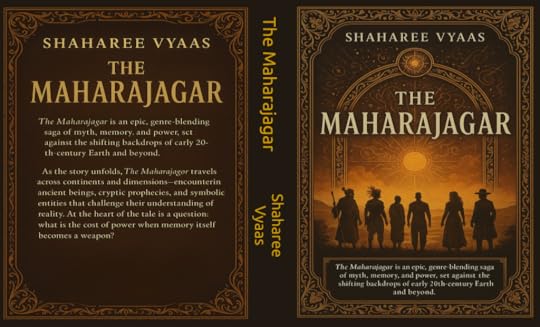 The Maharajagar, ISBN: 9798297178304, paperback 8.5′ x 11′(22 x 28 cm), 581 pages, Amazon $ 39, release Oct 25, 2025
Locations: Frankfurt Book Fair (Digital Pavilion) & Barcelona (Live Presentation)
Barcelona, Spain – The Maharajagar, a sweeping historical fantasy epic, will be unveiled in a groundbreaking dual launch event this October: digitally at the prestigious Frankfurt Book Fair and live in Barcelona.
Written in English and weaving global mythologies, speculative metaphysics, and historical realities into a breathtaking tapestry, The Maharajagar reimagines the 20th century as a stage for karmic war, ancestral reckoning, and multidimensional memory.
From Harlem to Carcosa, from Alakapuri to Hiroshima, this saga spans continents and dimensions as the enigmatic Qi’tet battles not merely evil—but entropy itself. It is a series for readers of The Mahabharata, Sandman, The Invisibles, or Cloud Atlas.
The Barcelona event will include a live ritual reading, panel discussion, and unveiling of the book’s striking cover art, followed by a Q&A with the author.
Join the resistance against forgetting. Enter the Maharajagar.
For interviews, press access, or review copies, contact:
shaharee.vyaas@gmail.com
Website: http://www.maharajagar.com
July 19, 2025
The contemporary critical art theory
A common critique of the art world is the emphasis on financial gain over critical engagement with art theory. Many artists feel that the focus on monetization, particularly through NFTs and other speculative markets, overshadows the potential for deeper artistic and social commentary. This can lead to a situation where artistic merit is secondary to market value, and critical perspectives are sidelined in favor of profit-driven narratives. On the other hand, it can be hard to remain a principled artist when the rent is due.
The contemporary critical art theory examines the relationship between art, power, and culture, using theoretical frameworks like feminism, postcolonialism, and critical theory to analyze artworks and their contexts. It focuses on how art reflects and shapes societal structures, often challenging traditional narratives and power dynamics.
The critical art theory often challenges traditional narratives: it questions established art historical narratives and explores how these narratives might perpetuate biases or exclude certain voices.
Through analyzing power structures it examines the power dynamics within the art world itself, including institutions, markets, and critical discourse. It emphasizes the importance of understanding the cultural and historical context in which art is created and received. Drawing on various theoretical perspectives like feminism, postcolonialism, queer theory, and critical theory to analyze art. It can inspire new forms of art that actively engage with social and political issues, challenging traditional notions of art and its role in society by considering the artist’s writing and reflections on their own practice, as well as how their work engages with issues of identity, representation, and social critique.
Contemporary critical art theory provides tools for understanding how art functions within broader social, political, and cultural contexts, encouraging a more nuanced and critical engagement with artistic practice and its impact on the world.