Shahree Vyaas's Blog, page 33
December 30, 2020
Holidays,…. Again?
My previous holiday dates from August last year. Before that I didn´t have a holiday for more than twenty years. Last November I had some kind of burnout in combination with a writer’s block, and my better half suggested that maybe it was time for another break.
It´s not evident for artists to break away from their work. Compare it with priests on holidays: they can take a vacation of their parish but can never shed their priesthood. They keep carrying it around wherever they go. They can conceal it, but deep down it´s there: a vocation that is deeply intertwined with their personality and ways to deal with daily life.
While you have priests and artists who will use their holidays to immerse themselves in alternative ways of approaching the cornerstone of their daily occupation, I want nothing of that.
When I´m on holidays, I’m not visiting any museums, expositions, concerts or literary events: that´s work. Still, the artistic mind tends to be a restless one. You tell it that right now you just want to swim into the sea, lay into the sun and sip your margaritas, to make it go nuts with all kinds of wild ideas of new projects and inspiration after weeks of being completely numb. Just like a little child: the surest way to make them climb into a tree, is to forbid it.
Luckily, I discovered painting during the past year. Some among you may argue that this is cheating since it´s an artistical activity, but in truth, for me it´s just a way to relax. It´s an occupation I considered just to be a wayward way to break a writer´s block. Till I got really invested into it during my holidays. Up to the point that my wife sighed: ¨let´s go home, you´re doing nothing else than working again¨.
Why? Because I started to make designs for decors and sketches of scenes that align with a theatre piece I was working at before our departure.
It looks that an artist can´t have any hobby without turning it into work.


November 20, 2020
Create the art you like, or create art that is likable?
Most people have an innate desire to be liked by other people. While the desire to be liked is normal, feeling that it’s necessary that everyone likes you and experiencing anxiety and stress when they don’t isn’t. The prevalence of social media in today’s society only exacerbates these struggles. People on social media literally compete for likes, thus increasing the potential for inappropriate or damaging behavior by those for whom being liked is an unhealthy need.
But through the lens of art, technology tells a completely different story. Just as the internet has affected dating, travel and the way we see ourselves and understand the truth, we see a lot of changes in how we view older art forms, like painting, sometimes referred to as “the oldest screen in the world”.
The new social media have changed the ways we see ourselves. It’s not surprising that facebook is often nicknamed “the fakebook”. While the internet has offered the artist a direct way to reach out to the world by circumventing the traditional hurdles of gallery owners and publishers, it also increased the pressure upon them to conform to the generally accepted opinions and values. An artist’s desire to be authentic and to create art that ventilates their own believes, values and aesthetics can be as damaging to their personal life as the image that fakers create about themselves.
In our post-Snowden world, surveillance is something we all worry about. Remember; it’s not only the government who may read your posts. Your boss, colleagues, family, neighbors and other acquaintances may also check them out (and often do so). People have seen their careers disappear through the gutter because of some “incorrect” opinion, picture or remark on the social media. Artists have been sued by family and friends for slander or breach of privacy, because the latter didn’t want to get associated with certain artistic creations.
Many contemporary artists thus decided to disconnect their work from their personal life, and hide behind an avatar. They argue that once a work is finished, it stands on its own. The “Death of the Author” is a concept from mid-20th Century literary criticism; it holds that an author’s intentions and biographical facts (the author’s politics, religion, etc) should hold no special weight in determining an interpretation of their writing. It suits me since I’m not looking to become rich or popular. I just want to pound my egg, and keep conducting my private life as it suits ME. And if someone, sometime, somehow would decide to pay me for that, that’s fine too.
November 13, 2020
The NeverEnding Story.
We have a kaki tree growing on our patio, and for the last month the dropping fruits and leaves account for the lion share of my household shores. Every three days or so, I’m getting our little stepladder out of our bodega and trim the ripe ones within my reach, but since I’m not an acrobat, those who’re growing on the top of the tree remain out my clipping range. And drop by preference on me when I’m relaxing a little before dinner.
It’s a NeverEnding Story, and for those among you who’re familiar with my tendency to make analogies between ordinary facts in daily life and my artistic activity, will not be astonished that this daily kaki bombardment is leading me to contemplate about my more common activities; writing, painting and composing music.
Somewhat a year ago, I adopted Frank Zappa’s approach of art: he called it Object/Project. He said about it;
“Project/Object is a term I have used to describe the overall concept of my work in various mediums. Each project (in whatever realm), or interview connected to it, is part of a larger object, for which there is no ‘technical name.’
Think of the connecting material in the Project/Object this way: A novelist invents a character. If the character is a good one, he takes on a life of his own. Why should he get to go to only one party? He could pop up anytime in a future novel.
Or: Rembrandt got his ‘look’ by mixing just a little brown into every other color — he didn’t do ‘red’ unless it had brown in it. The brown itself wasn’t especially fascinating, but the result of its obsessive inclusion was that ‘look.’
In the case of the Project/Object, you may find a little poodle over here, a little blow job over there, etc., etc. I am not obsessed by poodles or blow jobs, however; these words (and others of equal insignificance), along with pictorial images and melodic themes, recur throughout the albums, interviews, films, videos (and this book) for no other reason than to unify the ‘collection.'”
I my case, this leads me to tinker eternally on my so called “finished” projects. Just like Zappa, I have recurring themes into my artwork and like to synchronize those with my latest insights. Especially the nonfiction part of my writing is causing me to constantly updating the more “inspirational” facets of my art. Not to mention that nonfiction is well … nonfiction, and as such, needs constant updating.
“The NeverEnding Story”, concludes with the narration that its main protagonist had many more wishes and adventures, “but that’s another story”.
One third of a kaki tree (fruits and leaves) still to go this year.
October 25, 2020
The Death of an Artist and his Reputation .
At the start of this post, I hesitated if I should include outsider artists like Henri Dagger, James Hampton or Charles Dellschau into my considerations. The works of these artists were only discovered after their deaths and gained considerable recognition. During their lifetime they’ve never sought to share their creations with the world, but considered them a private undertaking. In fact, they were rather fierce about keeping their art a private undertaking.
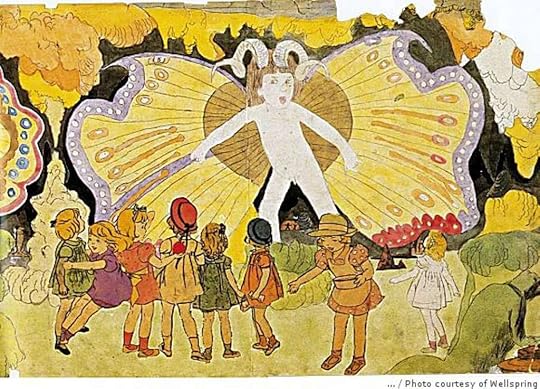 Henri Dagger – Vivian Girls
The artists that I want to consider in this post, are those who despaired to share their creations with their contemporaries, but were rebuffed. Some of these artists experienced success early on, but later died in obscurity, with little money and even less praise, only becoming icons after their deaths.
My aim is to set off these artists against those who were gaining fame and wealth during their lifetime, just to sink into obscurity afterwards.
Vincent Van Gogh (30 March 1853 – 29 July 1890) was a Dutch post-impressionist painter who is among the most famous and influential figures in the history of Western art. He is probably the most famous example of an artist who was completely ignored and turned away by his contemporaries during his lifetime, while his work was hailed as a turning point in the visual arts once he passed away.
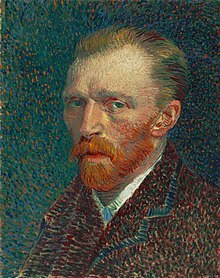 Vincent Van Gogh, Self-Portrait, 1887, Art Institute of Chicago
Hans Makart (1840–1884) was a contemporary of Van Gogh, Monet, Manet and Degas, but enormously more acclaimed in his lifetime than any of those. One reason for his success was that he was a master of PR. Makart transformed his studio, an old foundry, into a vast stage set crammed with floral displays, sculpture and opulent bric-à-brac. Cosima Wagner described it as a ‘wonder of decorative beauty, a sublime lumber-room’. To a 21st-century eye, old photographs of the space look like installation art. He gave his age what it wanted: masses of voluptuous naked flesh depicted with sub-Rubenesque gusto, mixed with jewels, rich textiles and maybe a spot of blood. But who remembers Makart now?
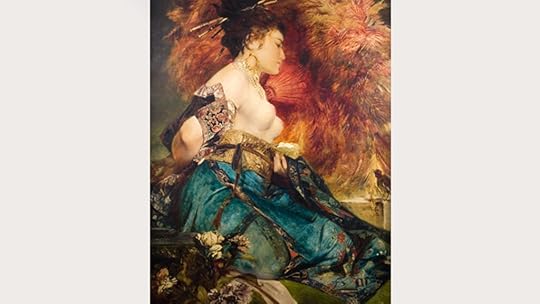 Hans Makart – Japanese.
Van Gogh on the other hand, suffered from psychotic episodes and delusions, and though he worried about his mental stability, he often neglected his physical health, did not eat properly and drank heavily. Between 1885 and his death in 1890, Van Gogh appears to have been building an oeuvre, a collection that reflected his personal vision and could be commercially successful. However, he shied away Gauguin, did brusque several artists, and other influential people, that might otherwise have advanced his career.
Among the writers one can discern a similar group. Just to name a few examples: John Keats, Herman Melville, James Joyce and Fernando Pessoa.
And then you have on the other hand the example of Bret Harte (August 25, 1836 – May 5, 1902). He was an American short story writer and poet, best remembered for his short fiction featuring miners, gamblers, and other romantic figures of the California Gold Rush. His work neglected on purpose the woes that accompanied the expansion of his country to the West. On the contrary, his poem “The heathen Chinee” even increased the existing he prevalence of anti-Chinese sentiment among the white population of California. Mark Twain referred repeatedly to Harte as “The Immortal Bilk”. Harte’s work rests into a well deserved oblivion, albeit it generated a generous flow of income and popularity to its creator during his lifetime.
The ones that were successful during their lifetimes but slid into obscurity afterwards show the same pattern: they created what people wanted to hear and see, not necessarily what they SHOULD hear and see. These artists had an immaculate reputation, possessed an ability to rub elbows with influential people, were socially acceptable, and had a great sense for public relations. They didn’t see art as a tool to promote new ideas or insights, but as a tool to achieve fame and fortune.
The lives of those now famous, but who lived and died as a marginal, often followed a downward spiraling pattern: substance abuse, mental instability, delusions, disruptive behavior, untimely death. All of them became artistic icons once their own existence didn’t obscure the access to their works anymore. Very few people would know what the truly significant art of today is. You’d have to be an incredibly perceptive person to do so. The history books keep being changed.
October 18, 2020
Time in Art.
Time is one of the most common commodities of any artistic work. Yet it is also one of the least comprehended ingredients.
Albert Einstein, who thought a lot about the nature of time, despaired at his failure to explain the meaning of now. The moment now remains something ephemeral. In his Special Relativity Theory, he showed that the flow of time is affected by both velocity and gravity, and he conceded that the phenomenon simultaneity depended upon a chosen frame of reference.
Art exists in time as well as space. Time implies change and movement; movement implies the passage of time. Movement and time, whether actual or an illusion, are crucial elements in art although we may not be aware of it. An art work may incorporate actual motion; that is, the artwork itself moves in some way. Or it may incorporate the illusion of, or implied movement.
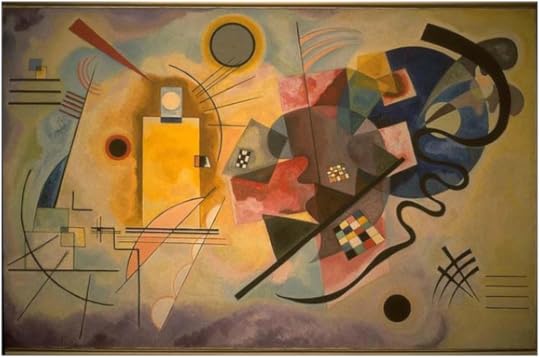
Figure 1: Wassily Kandinsky Yellow — Red — Blue 1925
Kandinsky used abstraction to represent the intangible. He used formal elements to portray what can’t be seen with the eyes and has no physical form. In this painting, there is a strong and vibrant sense of movement. If you study it you will find diagonal, gestural, and directional lines; repetition; and placement of objects to give it an illusion of motion.
Or it may imply the suggestion of movement as in the next figure, a statue that symbolizes a sense of forward progress, speed, and determination in moving toward something.
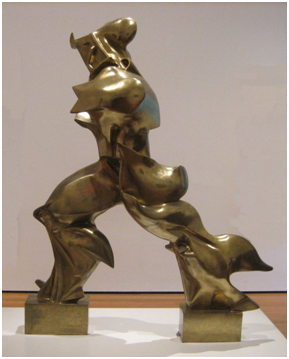
Figure 2: Umberto Boccioni Unique Forms of Continuity in Space 1913 (cast 1931)
Art can also move through the effect of some natural properties, either its own inherent properties or their effect, is unpredictable. Spatial relationships within the work change continuously, with endless possibilities. One of the delights of experiencing such artwork is the element of change and surprise. It’s as if every time we look at it we are seeing a new artwork.
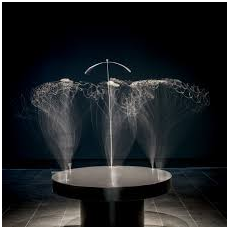
Figure 3: Witch Dance by Len Lye
Mechanical or technologically driven movement in art may be more predictable and limited than movement through natural properties, or it can seem endless, depending on the complexity of the system that moves the artwork.
Contemporary artists have been exploring the concept of how a viewer experiences an artwork, and either forcing the viewer to become aware of their process of experiencing the artwork, or inviting them to become part of the artwork itself.
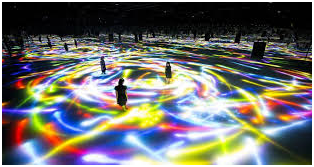
Figure 4: Drawing on the water surface created by the Dance of Koi and People – Infinity
Visual, literary, and performing arts function as sources of inspiration for each other. Time in art can be actual time or implied time. Actual time includes time-based work and media, artwork that changes through time, and the effect of time on artwork and how that affects its meaning. Implied time can be represented in the captured moment, an illusion of time passing, or the evidence of time already past. Rapid technological developments have spawned many new forms of artistic possibilities such as video game art and virtual art. A whole new genre of art has been created, known as new media art.
The traditional art of animation–crafted, detailed, painstaking, and requiring many artists for one project– has been revolutionized by the advent of digital animation processes like Pixar. Some artists, however, stubbornly refuse to abandon the traditional art and process of animation.
Some artists deliberately create work that will change during the course of time. To fully experience it you must return at a later time to see what’s happening. It is extremely unpredictable. The end result is a completely different form and sometimes different material, functioning as a testament to the history of its existence and the changes that have taken place. This type of artwork is ephemeral and sometimes, in the end, nothing is left but a memory.
When contemplating into the future a work of art, maybe spend also some thoughts about how the dimension time influences its existence.
October 13, 2020
Exploring Other Avenues.
For a very long time I’ve been considering myself an artist, solely based upon my ability to fabricate stories. Only lately it occurred to me to put my creativity at work outside the self-imposed confinement of literature.
It started innocently: I wanted to design my own book covers by taking old movie posters as a source of inspiration. By doing so I discovered the possibilities and the relative ease of creating complicated designs and special effects that modern technology brings into the grasp of people with little graphic skills.
I’m the first one to admit that the work of real graphic artists will always have a qualitative and creative edge over the designs I’m able to produce, but most of the techniques that used to be the exclusivity of those with the talent to finish an artistic education, became suddenly available for my personal use.
Then I started to write a play, made designs for the costumes and the décor. While working at it, it occurred to me that the concept could lend itself for a musical. And off I went, in search of a program that would allow me to make my own compositions.
The latter was more tedious than working with a graphic design program. Music has a language and alphabet of its own, and my knowledge of it was deeply buried into a long forgotten vault of a previous lifetime. Again, also here the internet was putting tools at my disposal that allowed me to visualize sounds and bits of audio recording into music notes, allowed me to make changes in tempo, key signatures, assign instruments, etc…
Modern technology and the internet have allowed me to create the fundamentals of a musical: the libretto, the décor and the music. This said, only after I finished, I realized I had created something that probably will never see the stage-light.
To start with the most obvious: the cost, time and amount of people that are needed to produce a musical. Most musicals, whatever their artistic qualities, are writing red numbers. Most of these projects have corporate sponsoring of companies who just need a write-off, and who want to connect their brand to some artistic happening (for the prestige of it, to be able to give their customers free tickets, etc…).
Producers need to have a couple of box-office successes to make up for the deficit making projects, of which some of them are even canceled after a disappointing premiere. Understandable, they’re very reluctant to take on new projects and even don’t consider unsolicited scripts. In fact, producers rarely finance a project they didn’t dream up by themselves or a play that hasn’t proven itself into the amateur circuit.
Writing a play made me also understand why the plot and characters of a movie always feel a little flat compared to the novel whereupon they’re based. A play or movie has 90 minutes to make its point and the stage can only support that many actors or changes of venue. So the advice of the playwrights was: kill your darlings – elements you may have worked hard to create but that must be removed for the sake of your overall story in a play.
The harshest rule among playwrights is this one; even when you have a good play, it cannot succeed when the other ones don’t fail.
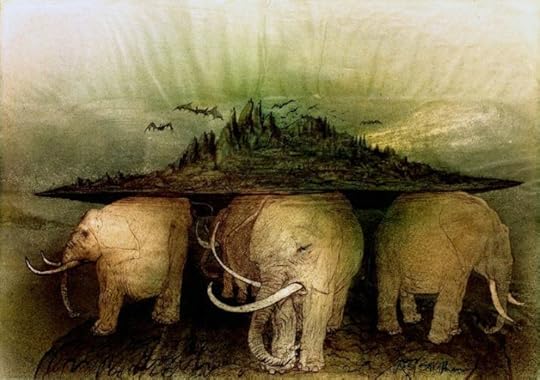
No wonder that the first advice of most playwrights is … don’t.
Who believes that publishing is a though business, better doesn’t start writing scripts; compose music; or design decors and costumes. Or just do it for the pleasure of the creative process. To break a writer’s block for example.
October 3, 2020
About Nuclear Mysticism.
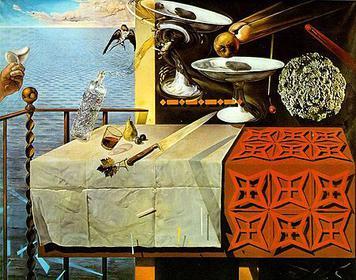 Still Life Moving Fast
by Salvador Dalí, 1956
Still Life Moving Fast
by Salvador Dalí, 1956Ever since I’ve been visiting the Dali museum in Figueres, I’ve been infatuated by Dali’s paintings and philosophies as a source of inspiration for my own artistically activity. Dali conceived Nuclear Mysticism as a reaction upon the dropping of the nuclear bombs on Japan during the second world war. This vision is composed of different theories that try to show the relationships between quantum physics and the conscious mind.
His foresight was truly prodigious and a productive forerunner of the coming age. The hyper-reality theme of nuclear mysticism is present somewhat in nearly all Dali’s work since 1950. Atoms explode into cubes and spheres, the material world is broken down into disconnected particles, and swirling cones (“rhinoceros horns”) symbolize manifestation, appearance and purity. Other ontological symbols are used throughout Dali’s version of the Tarot, where they often take on a hermetic, alchemical quality. Nature works in sacred geometry, curves, fractals, chaotic emergence, reiteration, complex dynamics, embedded imagery. Dali’s later art also explores the subjects of quantum physics and genetics with a metaphysical vision.
After the disenchantment of Post-modern deconstructionism, what we need is a neo-Nuclear Mysticism to heal the fragmentation and atomization of our psyches which have been blasted by the future-shock of post-postmodern life. Looking within for a moment of stillness, we cannot help but find imagery of our most fundamental being, that threshold where psyche, matter and energy share the same essence.
An offspring of Dali’s nuclear mysticism is quantum mysticism. The latter has lately been very commonly used as a literary device in books that develop supernatural themes. It’s based upon a somewhat scientifically distortion of Heisenberg’s Uncertainty Principle that states that the act of observing a particle influences the behavior of the observed. Quantum mystics have lifted this principle out of its quantum-mechanical context and applied it to the reality as a whole. Thus you get humans who can influence the course of the reality by the sheer power of their thoughts.
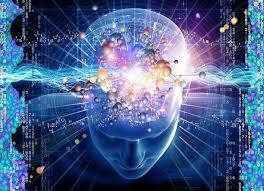
Quantum mysticism is a great literary device when you want to create magical protagonists, but somewhat unpractical in daily life. Until of course you’ve humans who can influence the outcome of Schrödinger’s thought experiment “the cat in de box”(1), just by wishing for a certain outcome. Sometimes I’m astonished by the amount of people who believe that this is really possible. They usually belong to the same category as those who believe that magic is for real and not just a literary device to spice up a story.
As an artist I’ve always been careful to mark the line between the myths I’m creating and the facts whereupon I base my vision upon the reality. Some people seem to have lost the ability to make a distinction between them.
(1)
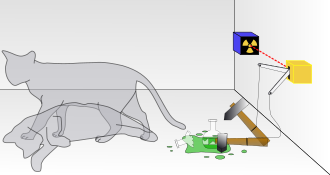 Schrödinger’s cat: a cat, a flask of poison, and a radioactive source are placed in a sealed box. If an internal monitor (e.g. Geiger counter) detects radioactivity (i.e. a single atom decaying), the flask is shattered, releasing the poison, which kills the cat. The Copenhagen interpretation of quantum mechanics implies that after a while, the cat is simultaneously alive and dead. Yet, when one looks in the box, one sees the cat either alive or dead, not both alive and dead. This poses the question of when exactly quantum superposition ends and reality collapses into one possibility or the other.
September 7, 2020
What the heck is going on?
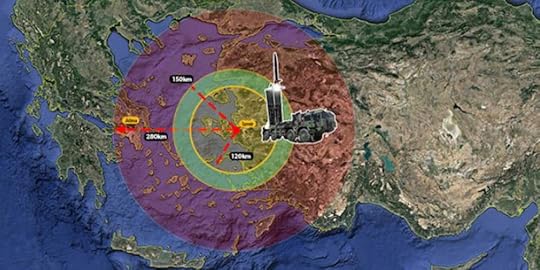
This post deviates a little from my regular discourse and has been triggered by mounting military tensions between Turkey and Greece about some drilling rights in the Mediterranean.
Now, there is a similar dispute between Spain and Morocco about some areas in the Atlantic Ocean surrounding the Canary Islands. Because Morocco isn’t part of the NATO, they have to maneuver with greater care then Turkey, since an open attack upon a member state by a non—member state automatically triggers article 5; the collective defense clause of the treaty.
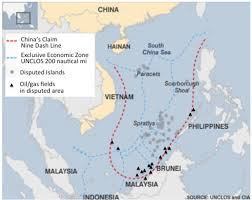
Then you have China who’s laying wildly claims upon big Oceanic stretches in Asia where mineral riches are to be found and Iran who threatens to cut off the West from the Arab oil fields by blocking the street of Hormuz in retaliation of the international sanctions that have been in imposed upon the regime in Teheran.
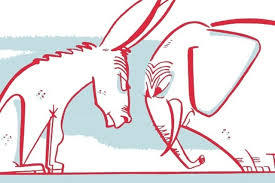
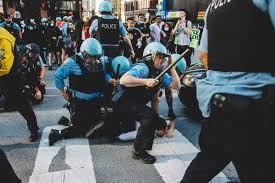
All above is already bad, but then you have in the USA a two party system that is on the verge of implosion, where militants of both sides are confronting each other in clashes of increasing violence. And this happens in a country where there are 100 million guns in circulation and the law enforcement is going rogue because they’re losing a war against gangs and terrorists.
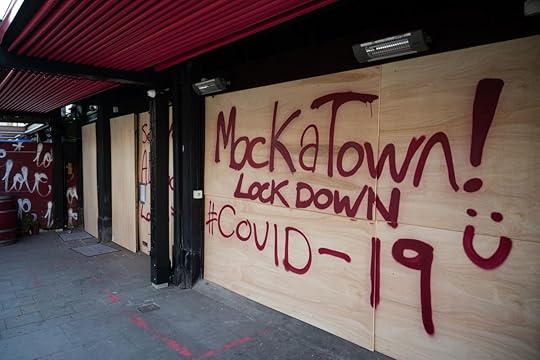
While the world is still digesting the aftermath of 9/11 we’re getting as cherry upon the cake a worldwide pandemic that drives business and people into bankruptcies while the media publish alarmist messages of rising infection rates. This prompts politicians to introduce ridiculous rules and gives an opening to some puritan lobby groups to press their own agendas. Few journalists indicate that the testing rate is meanwhile tenfold higher than 6 months ago and the amount of hospitalizations is about 10 % of what it used to be. Alarmist news sells better.

Also the drugs dealers in Europe start to feel the effect of the downturn in business due to the lock downs and this results in turf fights that were previously unseen in countries as Belgium and Sweden. And now you have armored vehicles patrolling the streets of some European capitals.
Is it just my perception or is our model of society unraveling at an alarming speed? Experts predict that next new-year and Christmas will not be as any other year.