Shahree Vyaas's Blog, page 29
November 8, 2021
No-Man’s-Land
Last week I´ve attended the Asian Film Festival 2021 in Barcelona. Because of practical agenda issues I saw only four of the movies:
Hand Rolled Cigarettes (Hong Kong): Chiu is a retired member of the Hong Kong Military Service Corps of the British Army, and now ekes out a living doing odd jobs. Mani is a small-time drug dealer who gets into serious trouble when his cousin steals a stash of drugs from him. While on the run from the criminal organization, Mani is taken in by Chiu and takes refuge in his apartment. The unusual living arrangement forces the two men to overcome their cultural and racial differences.Fire on the Plain (China): This dramatic thriller takes place in China in 1997. A series of murders strikes the city of Fentun. The crimes mysteriously stop without the authorities being able to find the perpetrator. Eight years later, a young policeman close to one of the victims decides to reopen the investigation despite all the consequences it brings. His discoveries disrupt the fake outcome that had brought to an end the scheme.I met a Girl (Australia): follows the story of Devon (Breton Thwaites), an aspiring musician with schizophrenia who is dependent on his older brother, Nick (Joel Jackson) to care for him. However, when Nick’s wife, Olivia (Zahra Newman) becomes pregnant, they arrange for Devon to move out. On a downward spiral, Devon is saved by Lucy (Lily Sullivan) a mysterious girl who is just as impulsive and romantic as he is. After one day together, they fall completely in love. Devon then arranges for Nick to meet her, but Lucy doesn’t show. They try to find her but her apartment is empty. Nick suspects that Lucy is a delusion, while Devon, desperate to prove his sanity, discovers a note that she wrote him: meet me in Sydney. And Devon sets off on an epic, cross-country journey to find her; the girl of his dreams… who may be all in his head.1990 (Mongolia): After the fall of the USSR, Mongolia suffers a wave of violence, corruption and disorder. The citizens do their best to survive in an uncertain era dominated by chaos, uncertainty, violence… At the same time, Western influences arrive in the country and become popular among the youth.It stroked me that most movies played into a time space where the old order collapsed, leaving people disoriented and to fend for themselves. The biggest difference between the movies I could discern was between the Australian movie and the other ones. The latter follows the Hollywood script of a happy ending while the Asiatic ones where not so hung up on a happy ending and portraited people more like they are.
For example, in Anglo-Saxon movies you rarely see a “good” protagonist smoke, drink, or display ambiguous moral behavior without a redemption arc. They usually have a happy ending. Not so in Asiatic movies: they paint a more morally greyish image of their protagonists. The “good” as well the “bad” ones. Not mention that they often have an ending that would not be appreciated by a Hollywood public: either they die or turn events into their advantage by committing some robbery, murder, or blackmail. In short, in most Asiatic movies the “good protagonists” mostly reach their desired goals by either sacrificing their lives or their moral integrity.
The title of this post, Noman´s Land, indicates faults into the time/space of human society where an era comes to an end while transiting to another one. The Asiatic movies I saw showed how on one side of China the Soviet Union collapsed, while on the other side the West was moving out of China´s border regios Hongkong and Macau, leaving populations on both sides of the country who lived across those borders in a societally limbo. At the same time China itself made the transition from a Marxist economy towards a free market economy with all the angles of wild capitalism that this entailed.
There is no doubt that China will become the next dominant player on the world scene. The only question that’s still open is: What kind of China?


No-Man´s-Land.
Last week I´ve attended the Asian Film Festival 2021 in Barcelona. Because of practical agenda issues I saw only four of the movies:
Hand Rolled Cigarettes (Hong Kong): Chiu is a retired member of the Hong Kong Military Service Corps of the British Army, and now ekes out a living doing odd jobs. Mani is a small-time drug dealer who gets into serious trouble when his cousin steals a stash of drugs from him. While on the run from the criminal organization, Mani is taken in by Chiu and takes refuge in his apartment. The unusual living arrangement forces the two men to overcome their cultural and racial differences.Fire on the Plain (China): This dramatic thriller takes place in China in 1997. A series of murders strikes the city of Fentun. The crimes mysteriously stop without the authorities being able to find the perpetrator. Eight years later, a young policeman close to one of the victims decides to reopen the investigation despite all the consequences it brings. His discoveries disrupt the fake outcome that had brought to an end the scheme.I met a Girl (Australia): follows the story of Devon (Breton Thwaites), an aspiring musician with schizophrenia who is dependent on his older brother, Nick (Joel Jackson) to care for him. However, when Nick’s wife, Olivia (Zahra Newman) becomes pregnant, they arrange for Devon to move out. On a downward spiral, Devon is saved by Lucy (Lily Sullivan) a mysterious girl who is just as impulsive and romantic as he is. After one day together, they fall completely in love. Devon then arranges for Nick to meet her, but Lucy doesn’t show. They try to find her but her apartment is empty. Nick suspects that Lucy is a delusion, while Devon, desperate to prove his sanity, discovers a note that she wrote him: meet me in Sydney. And Devon sets off on an epic, cross-country journey to find her; the girl of his dreams… who may be all in his head.1990 (Mongolia): After the fall of the USSR, Mongolia suffers a wave of violence, corruption and disorder. The citizens do their best to survive in an uncertain era dominated by chaos, uncertainty, violence… At the same time, Western influences arrive in the country and become popular among the youth.It stroked me that most movies played into a time space where the old order collapsed, leaving people disoriented and to fend for themselves. The biggest difference between the movies I could discern was between the Australian movie and the other ones. The latter follows the Hollywood script of a happy ending while the Asiatic ones where not so hung up on a happy ending and portraited people more like they are.
For example, in Anglo-Saxon movies you rarely see a “good” protagonist smoke, drink, or display ambiguous moral behavior without a redemption arc. They usually have a happy ending. Not so in Asiatic movies: they paint a more morally greyish image of their protagonists. The “good” as well the “bad” ones. Not mention that they often have an ending that would not be appreciated by a Hollywood public: either they die or turn events into their advantage by committing some robbery, murder, or blackmail. In short, in most Asiatic movies the “good protagonists” mostly reach their desired goals by either sacrificing their lives or their moral integrity.
The title of this post, Noman´s Land, indicates faults into the time/space of human society where an era comes to an end while transiting to another one. The Asiatic movies I saw showed how on one side of China the Soviet Union collapsed, while on the other side the West was moving out of China´s border regios Hongkong and Macau, leaving populations on both sides of the country who lived across those borders in a societally limbo. At the same time China itself made the transition from a Marxist economy towards a free market economy with all the angles of wild capitalism that this entailed.
There is no doubt that China will become the next dominant player on the world scene. The only question that’s still open is: What kind of China?
Noman´s Land.
Last week I´ve attended the Asian Film Festival 2021 in Barcelona. Because of practical agenda issues I saw only four of the movies:
Hand Rolled Cigarettes (Hong Kong): Chiu is a retired member of the Hong Kong Military Service Corps of the British Army, and now ekes out a living doing odd jobs. Mani is a small-time drug dealer who gets into serious trouble when his cousin steals a stash of drugs from him. While on the run from the criminal organization, Mani is taken in by Chiu and takes refuge in his apartment. The unusual living arrangement forces the two men to overcome their cultural and racial differences.Fire on the Plain (China): This dramatic thriller takes place in China in 1997. A series of murders strikes the city of Fentun. The crimes mysteriously stop without the authorities being able to find the perpetrator. Eight years later, a young policeman close to one of the victims decides to reopen the investigation despite all the consequences it brings. His discoveries disrupt the fake outcome that had brought to an end the scheme.I met a Girl (Australia): follows the story of Devon (Breton Thwaites), an aspiring musician with schizophrenia who is dependent on his older brother, Nick (Joel Jackson) to care for him. However, when Nick’s wife, Olivia (Zahra Newman) becomes pregnant, they arrange for Devon to move out. On a downward spiral, Devon is saved by Lucy (Lily Sullivan) a mysterious girl who is just as impulsive and romantic as he is. After one day together, they fall completely in love. Devon then arranges for Nick to meet her, but Lucy doesn’t show. They try to find her but her apartment is empty. Nick suspects that Lucy is a delusion, while Devon, desperate to prove his sanity, discovers a note that she wrote him: meet me in Sydney. And Devon sets off on an epic, cross-country journey to find her; the girl of his dreams… who may be all in his head.1990 (Mongolia): After the fall of the USSR, Mongolia suffers a wave of violence, corruption and disorder. The citizens do their best to survive in an uncertain era dominated by chaos, uncertainty, violence… At the same time, Western influences arrive in the country and become popular among the youth.It stroked me that most movies played into a time space where the old order collapsed, leaving people disoriented and to fend for themselves. The biggest difference between the movies I could discern was between the Australian movie and the other ones. The latter follows the Hollywood script of a happy ending while the Asiatic ones where not so hung up on a happy ending and portraited people more like they are.
For example, in Anglo-Saxon movies you rarely see a “good” protagonist smoke, drink, or display ambiguous moral behavior without a redemption arc. They usually have a happy ending. Not so in Asiatic movies: they paint a more morally greyish image of their protagonists. The “good” as well the “bad” ones. Not mention that they often have an ending that would not be appreciated by a Hollywood public: either they die or turn events into their advantage by committing some robbery, murder, or blackmail. In short, in most Asiatic movies the “good protagonists” mostly reach their desired goals by either sacrificing their lives or their moral integrity.
The title of this post, Noman´s Land, indicates faults into the time/space of human society where an era comes to an end while transiting to another one. The Asiatic movies I saw showed how on one side of China the Soviet Union collapsed, while on the other side the West was moving out of China´s border regios Hongkong and Macau, leaving populations on both sides of the country who lived across those borders in a societally limbo. At the same time China itself made the transition from a Marxist economy towards a free market economy with all the angles of wild capitalism that this entailed.
There is no doubt that China will become the next dominant player on the world scene. The only question that’s still open is: What kind of China?
October 29, 2021
The Cryptomathician and his Lady in Red wish you a Happy Halloween
Sometimes you have to go with the flow because you fail the strength to go against it. Not to mention that going against the tide of time just out of principle is also a stupid idea. I didn´t have it me me this week to struggle with the marketers.
This was a busy week for me and the Lady in Red because we moved from our summer camp in Berlin to Barcelona. No time for deep thoughts about the nature of time or the complexity of simplicity. The routine hustle of moving our household kept us busy for biggest part of the week and in the stolen minutes I just worked around a more lighter theme that anyway already is flying around the blogosphere for a couple of months: Halloween.
For those among you who´re still hesitating if Halloween is a Christian or a pagan tradition, I can affirm that is definitively a Christian tradition. The word Hallowe’en means “Saints’ evening”. It comes from a Scottish term for All Hallows’ Eve (the evening before All Hallows’ Day). In Scots, the word eve is even, and this is contracted to e’en or een. Over time, (All) Hallow(s) E(v)en evolved into Hallowe’en. Although the phrase “All Hallows'” is found in Old English, “All Hallows’ Eve” is itself not seen until 1556. Some of the folk traditions that surround it in some Celtic countries may be connected with a pre-christian festival called Samhain.
Samhain marked the end of the harvest season and beginning of winter or the ‘darker half’ of the year. It was seen as a liminal time, when the boundary between this world and the Otherworld thinned. This meant the Aos Sí, the ‘spirits’ or ‘fairies’, could more easily come into this world and were particularly active. Most scholars see them as “degraded versions of ancient gods whose power remained active in the people’s minds even after they had been officially replaced by later religious beliefs”.
Just remember, Halloween is more than just a party occasion: it´s a time of the year that many Christians are commemorating their departed relatives and friends.
October 23, 2021
The Flea Market as an Artistical Biotope.
The proliferation of flea markets in the culture of developed countries can be considered as part of the processes of esthetization and the gamification of life on one hand, – and puerility culture on the other. The main thing that makes the flea market is that a person can set free the “inner child” and at the same time protest the fashion of disposable items or disposable linear relationships.
The flea market can also be seen as a consequence of the process of “showization” of contemporary culture, understood as a tendency to see the performance first of all in every phenomenon of life. The flea market includes the performance elements of everyday life and aestheticization of life but is not limited to the performance of being an urban scene.
Some dress in outlandish costume just to attend a flea market since it is a place to display and create oneself, a diorama of drag and exoticism. No wonder that since ages the flea markets are the natural biotope of artists who often take inspiration from the accidental combinations of objects and the eccentric visitors.
The flea market is a meeting place for the various groups filling or visiting the big cities, looking for rare yet inexpensive items to fill their apartments. Stories of treasures found in the flea are numerous: a Picasso sculpture, photographs by Diane Arbus, a painting by Basquiat, and a lamp designed by Alberto Giacometti, etc.…
Dozens of commercial and personal vendors sell elegant bags, artfully crafted jewelry, and fancy clothes that often match the currently trending 60’s and 80’s style. Even vintage furniture and accessories, from antique floor lamps to exquisite coffee services, as well as old photo cameras (especially Polaroid cameras) and other kitschy souvenirs can be bought at one or the other stand for a reasonable price. In between these second-hand stands, local artists and producers offer their paintings and sculptures and other regional products such as wine for sale. What is more, all types of music, especially those pressed on vinyl, can be found here in abundance. Thanks to an extensive range of food stalls, your second-hand shopping spree can potentially last all day.
In the 1920s, the Surrealist writer André Breton was walking daily through the Paris flea markets, which he refers to in Nadja and L’Amour Fou. Man Ray created sculptures from what he found in flea markets, including the neck of a double bass and paired it with the long, flowing hair of a horse. .

Cadeau’, Man Ray, 1921
Flea markets have intrinsic dispositions, so while you may enter certain of what you want to find, allow the flea market to introduce you to new and more fruitful categories. Also, one of the fascinations of the flea market, as the Surrealists noted, is the random juxtaposition of objects — it is a dreamscape, opening the mind to new and poetic areas. Take a notebook and a sketch block.
October 15, 2021
The Blogoscope.
If you look closely, much blogging is just like any other factory doing its business. SEO is a very deep topic among competitive bloggers, and there are people who make their careers from being a SEO expert. SEO does not come easily, and they might have to spend hours learning and perfecting their SEO.
The ambitious blogger has a content plan of about 3 months where they divide the days into normal content, killer content, and cornerstone content. It will not come as a surprise that those cycles follow the pattern crafted by the US marketing industry: Valentine, the Silly Season, Halloween, and Christmas.
The blogosphere became a prolongation of the marketing industry, molding the subjects that bloggers should write about by giving them free books and other items to comment upon. When Halloween, Christmas, and Valentine are coming by, I´m already tired of them due to the internet hype that preceded.
The Silly Season that runs from June till September is probably by most marketeers considered as such because it´s the time of the year when most Western people take some time off. It reflects in the content published on the blogosphere. While travel blogs undoubtedly attract most attention, there is also a bigger variety on content available during that time of the year.
I´m aware that many among you are trying to resist this hyper-commercialization, deeming that one month of Christmas, and one week of Halloween and Valentine should be enough to cover those periods of the year. But how many among the blogging community aren’t sticking with these seasonal dictates out of fear of missing out?
Take for example the case of the book reviewers. Already by the end of August they´re bombarded by the book industry with Halloween themed novels and most of them feel compelled to review accordingly. From beginning of September, the readers are orientated towards this literature. The accompanying promotion campaigns push people into purchasing those books, movies, and all other items that are basically merchandising Halloween. While I´m considering that one week of Halloween is enough for a whole year, the actual Halloween season dominates the blogosphere for about three months. After which starts the long haul to Christmas with a stopover at Thanksgiving and its Black Friday, and so on…
Corporate greed is taking away all the pleasure, uniqueness, and celebration aspect of any given special day to turn them into consumption events. The most ludicrous example may be how Santa, a creation of the Coca-Cola Company, has hijacked Christmas.
The blogosphere needs to propagate a more pluralistically image of humankind than that of the supple, flexible, will-less consumer.
October 8, 2021
The Complexity of Simplicity
“Being simple is the most complicated thing nowadays.” -Ramana Pemmaraju
The principle of simplicity or parsimony—broadly, is the idea that simpler explanations of observations should be preferred to more complex ones—is conventionally attributed to William of Occam, after whom it is traditionally referred to as Occam’s razor. This does not mean that there will be no longer difficult issues remaining.
The complexity bias is a reason why we humans lean towards complicating our lives rather than keeping things simple. When we are faced with too much information or we are in a state of confusion about something, we will naturally focus on the complexity of the issue rather than look for a simple solution.
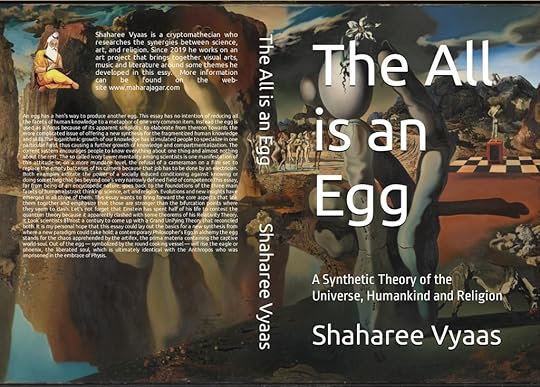
As a cryptomathician I´m constantly researching the synergies between art, science, and religion. Recently I´ve published an essay that is called “The All is an Egg” that describes the latest development in those fields and indicates where those fields are converging and where they´re bifurcating.
The inspiration for this essay occurred to me after a visit of the Dali Museum in Figueres, at a time when I was contemplating about a new concept that could reunite the fragmented field of human knowledge and skills. And there I stumbled upon the egg.
Connecting art, science, and religion, with the metaphor of the egg foisted onto it, is a transformative work, and a profound invitation to reflect. Albert Einstein said in this context: “Everything should be made as simple as possible, but not simpler”.
Although simplicity and complexity are not in conflict with one another, they are indeed opposites in that they are two poles of a continuum—the more complex something seems the less simple it seems, and vice versa.
October 1, 2021
Amazing Parasites
In 2010 Parasite Artek formulated a “Manifesto of Parasitism” presenting the idea of his activities as a parasite-artist. According to these ideas covered in “Manifesto”, Parasite Arek lived, worked, and created parasitizing for four years in several cities, cultural institutions and all places of culture. With time, his actions turned into a critique of the status of the artist in society and he began to create the so-called host projects.
In this spirit, in 2012, he created a series of activities “Willing to help” implemented in Polish villages and towns. In 2013, he designed and completed the construction of a home in Elblag – a house, which is the dream of every young person who has no money for land, materials, and builders. Then he worked in various projects with social groups referred to as “social parasites”: Roma, the long-term unemployed or experiencing social exclusion; a painting workshop “Not to be Rejected”, where homeless people can work. At the basis of this and other activities is the belief in the therapeutic role of art and the belief that people can improve their situation through it.
“The Socio-Parasitology Manifesto” from 2018 by Sabrina Muntaz Hasan looks at all points of contact as interruptions that are exercised by the parasite. Although most of Hasan´s work centers around immigration topics, her observations can be applied to other social issues. According to Mumtaz Hasan, all humans are parasitic. The focus is on interruption and not disruption, looking at the socio-parasitic relationship in a progressive way.
You need to interrupt in order to have agency
You need to interrupt to become positive
You need to interrupt so you are parasitic
The Socio-Parasitology Manifest by Sabrina Mumtaz Hasan
Essentially, Mumtaz Hasan’s theory focuses on a positive “parasite-host” relationship. In biological species relationships, parasites have a host; in this case the “parasite” is the artist, and the “host” is the “benefactor”. The manifesto looks at how the point of interruption — where the parasite and the host engage or “interrupt” each other — is actually beneficial for the new hosting environment.
In 2020, the Kunsten Museum of Modern Art in Aalborg, Denmark, lent the artist Jens Haaning 534,000 kroner (~$84,000) to reproduce two of his older artworks. But what did he do instead? He kept the money to himself and renamed the series Take the Money and Run. According to a written agreement between the two sides, Haaning was expected to utilize the banknotes from the payment to recreate two pieces he made in 2007 and 2010. The original artworks represented the respective average annual incomes of Austrians and Danes using cash bills. But for his latest, Haaning delivered two empty frames, with no banknotes to be seen.
This story of a cunning artist and an unsuspecting museum will make you rethink what conceptual art can get you. Haaning inhabited the museum as a foreign agent, adopting tactics that offered practical and conceptual strategies of artistic production through acts of “parasitical inhabitation.” He took the opportunity to portrait the artist as an irritant, an organism that lives in or on another organism, extracting what it needs from its host without giving anything positive in exchange.
Since Marcel Duchamp in 1917 presented Fountain, a mass fabricated urinal that became art by a so called “transubstantiation process” (it just became art because he said so and was sold in 1999 for $1,762,500 ), a long train of parasitan artists have followed suit. That said, the exhibition Work it Out includes work that criticizes the impact of the parasite.
September 24, 2021
The Artistical Twilight Zone
Vampires rose up from the Slavic folklore and became the main characters of some of Hollywood’s biggest blockbusters. Today you can notice the presence of vampires in almost every single aspect of the contemporary culture. They’re so popular is because they’ve gone from being grotesque and feared during the ancient times to being fascinating, gorgeous and sexy today. As vampires are projected as beings that don’t have a problem with social disapproval, they are often looked up to by teenagers as role models.
The reason why vampires have gained so much popularity, especially in the contemporary culture, is because they work as a highly effective metaphor for people’s own desires and anxieties. Though often monstrous in a certain (ahem) light, there’s definitely more to vampires than immediately meets the eye. From the serious to the silly to the sentimental, vampires teach us about ourselves by possessing exactly that which we can never have: immortality. The Twilight Zone literature aims its stories at a literate, adult audience, and uses the genre to pose complex moral questions. It’s not uncommon for people to try working things out about themselves through these creatures. It´s a favorite pastime among artists.
Most artists are vampires. James Joyce ripped Odysseus by Homer for his novel Ulysses, Dali ripped Da Vinci for his painting The Last Supper, John Williams ripped The Planets by Gustav Holst for the soundtracks of Star Wars…I ripped Dali for my painting a Cosmology of Civilization, the NASA sonorization of the electromagnetic waves emitted by the planets of the solar system to compose my opera, the concept of Joyce’s Ulysses and the story line of Mahabharata for my own novel The Maharajagar, … the list is almost endless. Almost every artist is in a way vampirizing the works of other people.
I have no problem with people finding inspiration in other people’s work in order to create something new. I know, there is a thin line between plagiarism and ripping, but the essence is that when someone comes up with an original idea, you cannot prevent people from taking inspiration into it. It is a long and difficult discussion, and not one that I want to start here. It could turn me into a person who cannot think of anything else than vampirism.
Mortality gives us a deadline that not only allows us to change, but forces us to improve ourselves sooner rather than later. Too often humans become clever instead of becoming wise. They become inventive, but not thoughtful. As mortals, we have a chance to recognize our incredible affinity for progress, we have the ability to fluently experience our lives in the context of our own time, or to create ourselves out of existence.
September 16, 2021
The Valkyrie in Modern Art.
Valkyrie, also spelled Walkyrie, were a group of maidens who served the god Odin and were sent by him to the battlefields to choose the slain who were worthy of a place in Valhalla, a realm of the Norse afterlife that Vikings aspired in life to enter upon their death.
The eighth-century B.C. poet Homer was the first to mention the existence of the Amazonas. In the Iliad—which is set 500 years earlier, during the Bronze or Heroic Age—Homer referred to them somewhat cursorily as Amazonas antianeirai, an ambiguous term that has resulted in many different translations, from “antagonistic to men” to “the equal of men.”
In 1861 a Swiss law professor and classical scholar, named Johann Jakob Bachofen, published his radical thesis that the Amazonas were not a myth but a fact. It comes as no surprise that the composer Richard Wagner was enthralled by Bachofen’s writings. Brünnhilde and her fellow Valkyries could be easily mistaken for flying Amazons.
Most anthropologists hold that there are no known societies that are unambiguously matriarchal and define modern time wannabe amazonas as an extreme, feminist wing of humanity.
In this time of a rising tide of gender equality issues, the prospect that there existed female warriors is butter upon the bread of feminist activists. Girls don´t want to be girls anymore so long as their feminine archetype lacks force, strength and power. Not wanting to be girls, they don’t want to be tender, submissive, peace-loving as good women are.
Contemporary bestselling US literature favors the female lawyer or detective as main protagonist. Writers such as Sara Paretsky, Sue Grafton, and Marcia Muller create compelling feminist protagonists to fill the role of detective. The successes and failures of these feminist detectives have then been measured against the standards created in the classic genre by Raymond Chandler, Dashiell Hammett, and James M. Cain. It is clear that feminist hard-boiled detective fiction is a genre of political protest, even better received when served with some LBTQ sauce.
Women in the modern art period have thrived in all types of mediums — prints and drawings, painting and photography, sculpture, installation art, performance art, and many more. The field of contemporary art is abundant in female visionaries who continue to challenge the norms with their constant innovations and are never afraid to express their points of views and earn their deserved canonical spots in art history.
As Marina Abramović put it “The artist in a disturbed society is to give awareness of the universe, to ask the right questions, and to elevate the mind”.