Shahree Vyaas's Blog, page 30
September 9, 2021
Galactic Pilgrims
The title of this post is a lore that I’ve encountered first in the Star Wars series where Jedha, a small desert moon frosted by a permanent winter, was home to one of the first civilizations to explore the nature of the Force. At one time a world important to the Jedi Order, Jedha served as a holy site for pilgrims from across the galaxy who sought spiritual guidance.
In a game created by LegendaryCollector, “Galactic Pilgrim” is an A.I. machine and a member of the Interspecies Collaboration. The Interspecies Collaboration was constructed by humans and machines who thought that working together instead of against each other was the way into the future. The “Galactic Pilgrim” is on the lookout for new habitable planets in her custom-built spaceship “Seeker” that is equipped with a fully autonomous explorer drone.
There exists also a HipHop group called Galactic Pilgrims who made an album called The Dark Side (https://soundcloud.com/thabenjaofficial/galactic-pilgrims-dark-side) and launched in 2017 a project called Artz &nd Craftz (https://soundcloud.com/thabenjaofficial/galactic-pilgrims-artz-nd-craftz). I have no knowledge of more recent projects.
Galactic Pilgrim exists also into the form of an album of Christian inspired poetry by Daniel Orsini that wants to explore key concepts from Jungian psychology and the new physics. In this bundle the author examines the spiritual as well as the psychological effects of being a Christian, trying to reconcile them with an amalgam of diverse yet related influences.
The theme also relates to my own project ” A Cosmology of Civilization“, since it incites people to have a look upon human civilization from a broader perspective.


August 30, 2021
The Blowfish who Stole my Weekend.
Porcupinefish are also called blowfish because they have the ability to inflate their bodies by swallowing water or air, thereby becoming rounder. This increase in size (almost double vertically) reduces the range of potential predators to those with much bigger mouths. A second defense mechanism is provided by the sharp spines, which radiate outwards when the fish is inflated.
I like more the name blowfish, because it allows me to relate to some characteristics that can be found in human behavior. The wish to look bigger, more important and menacing then one really is for example.
Again I have been wasting my weekend on some visual arts project instead of working on the fourth part of my series. It all came along when I showed my other better half a picture of a blowfish and she mooned “can’t you do something artistical with that?”
The first image that popped into my head was the goldfish in a bocal that figures prominently in Monty Python’s “The Meaning of life”, so it’s not astonishingly that the first thing I came up with looked like this:
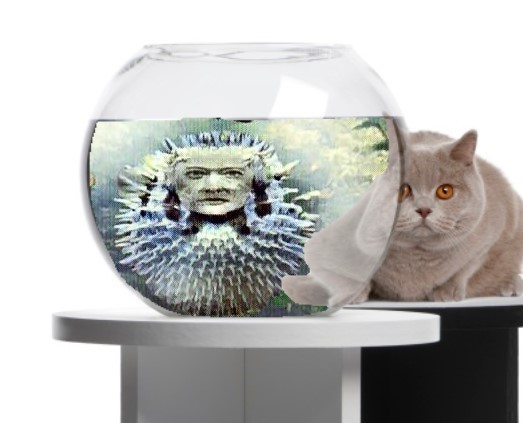 Meaning of Life 1 by Shaharee Vyaas
And no, that particular design didn’t take me too long. About an hour or so. It’s just that it deviated my thinking processes towards unexpected paths that made me contemplate about what people believe is the meaning of life. After some reflection I decided that there are three things that most people seem to believe worthy to strive for: wealth, eternal youth, and power. Most marketing campaigns center around one, two, or all three of these three subjects.
So the remainder of my weekend went up working on the following design:
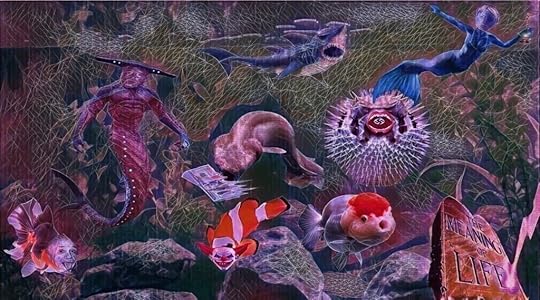 The Meaning of Life 2 by Shaharee Vyaas
In this design you see a mermaid holding a flask containing the elixir of eternal youth, who’s chased by a shark. Below her you find a blowfish carrying a nazi symbol in his mouth, who symbolizes the megalomaniacally rhetoric of many power hungry politicians with their inflated egos. Under them you have a sea monster that bears some resemblance with a moray eel that chases a bundle of banknotes. Under it you have an evil grinning clown fish. In the left corner under you can see what an Einstein goldfish answers when asked about the meaning of life, while in the right corner at the bottom you have a Tsubaki goldfish staring in bewilderment at the stone that carries the title of this painting. In the left part of the painting you find yours truly when I was a couple of years younger and still in my hammerhead phase of a becoming human being.
That was the story of how the blowfish stole my my weekend.
August 22, 2021
The reality of being a writer.
In 2020, there were over 44.2 thousand writers and authors working in the United States, down very slightly from the previous year but still markedly higher than the figure recorded back in 2011. Many changes have occurred for employees in this sector over the last few years, and it is a truth universally acknowledged that writing for a living is no mean feat.
The total number of books published in the U.S. exceeded 4 million — including both self-published books and commercially published books of all types—according to data provided by ProQuest.
Printed book sales amounted to 750.89 million units in 2020, marking growth of 8.2 percent, the highest year-on-year increase since 2010.
For those lucky enough to have got their big break, work as an author can be incredibly lucrative. The group of top 25 bestselling authors sold together 37 million units. Only 10 books sold more than a million copies last year, and fewer than 500 books sold more than 100,000 copies. The midlist author that sells between 20,000 to 100,000 units became the bread and butter of the publishing and bookselling industry.
Many self-published authors would be ecstatic when they would sell 5,000 copies a year, even when this means that they would have to get by with an income of about 25,000 $ yearly (before cost and taxes, in the optimistic case the writer can earn 5 $ on each copy).
But here comes the heck: only 25,000 books out of the 4 million published titles sold more than 5,000 copies in 2020. The average U.S. book is now selling less than 200 copies per year and less than 1,000 copies over its lifetime.
Most books don’t sell at all. Knowing this as a writer, how are you going to feel about publishing your book? One choice will have you turning to the next story with a smile on your face, disbelieving that you can make your works available for them to be discovered or not. The other choice is to give up in frustration, your expectations unmet.
The bottom line of this post is: don’t turn to writing in the expectation of earning a living. First make sure it earns you a living before counting upon it to pay for a roof above your head and bread upon the table. Only 0.62 % of the writers manage to reach that stage. Their average income fluctuates between $15,080 to $127,816 per year.
Compared to the average odds of 2 % to become a millionaire in the US, the path of the artist doesn’t favorize young people in search for fortune and fame. And don’t throw your money away on courses or websites that warrant you a sure path to success. There is only hard work and a little bit of luck that will get you there.
August 20, 2021
Request for reviews
As a cryptomatician who researches the synergies between science, art, and religion, I would be glad if you could take the time to review my essay The All is an Egg: A Synthetic Theory of The Universe, Humankind, and Religion.
An egg has a hen’s way to produce another egg. This essay has no intention of reducing all the facets of human knowledge to a metaphor of one very common item. Instead the egg is used as a focus because of its apparent simplicity, to elaborate from thereon towards the more complicated issue of offering a new synthesis for the fragmentized human knowledge and skills.
I hereby offer you the opportunity to download a free Kindle version of this essay and would be grateful if you would cross post your review to the amazon page. The book will be available for a free download between Friday, August 20, 2021, 12:00 AM PDT and Saturday, August 21, 2021, 11:59 PM PDT by clicking on this link: https://www.amazon.com/dp/B094R62N11
The book is permanently for free available for those holding a Kindle unlimited subscription.
A second free book promotion is scheduled between Thursday, September 16, 2021, 12:00 AM PDT and Saturday, September 18, 2021, 11:59 PM PDT.
Currently I’m working on a multidisciplinary art project that centers visual arts, music, and literature around some themes I’ve developed in this essay. A catalogue (pdf) with more information concerning this subject can be downloaded here.
I wish you many happy readings,
Shaharee.
August 15, 2021
The Flow
The Flow is the mental state of operation in which a person performing an activity is fully immersed in a feeling of energized focus, full involvement, and enjoyment in the process of the activity. The ego falls away. Time flies. Every action, movement, and thought follows inevitably from the previous one, like playing jazz. Your whole being is involved, and you’re using your skills to the utmost.
In my artistic vision, The Flow is a pathway to access The Zone, an intangible no-place: a blank terrain, an abstracted map space of the no man’s land between the Noosphere and the individual.
This canvas is derived from the image of a river rapid to illustrate that The Zone can be a dangerous place for fragile minds. The Flow is a metaphysical river that meanders through The Zone and is the only way to access it. To find it, some people use hallucinogenic substances to widen their perception and might end up as addicts. Most people emerge from it as improved persons, some others with a broken mind.
“The Flow has its counterparts in the rivers that run through our civilizations like strings through beads, and there is hardly an age that is not associated with its own great waterway. The lands of the Middle East have dried to tinder now, but once they were fertile, fed by the fruitful Euphrates and the Tigris, from which rose flowering Sumer and Babylonia. The riches of Ancient Egypt stemmed from the Nile, which was believed to mark the causeway between life and death, and which was twinned in the heavens by the spill of stars we now call the Milky Way. The Indus Valley, the Yellow River: these are the places where civilizations began, fed by sweet waters that in their flooding enriched the land. The art of writing was independently born in these four regions, and I do not think it a coincidence that the advent of the written word was nourished by river water.” (Adapted quote from “To the River” by Olivia Laing)
August 5, 2021
Artists and the Middle Way.
Why do you have so many contemporary painters who pose with brush and pallet in their hands while most of their work consists of digitally created canvas prints?
Previous generations were proud to pose with the latest tools of their craft that offered them more possibilities to increase the quality and quantity of their output. I don’t have any recollection of 20th century writers proudly posing with a goose feather, parchment, and an inkwell instead of with their typewriter.
The machine is the single most defining entity of the twentieth century. Its role at the turn of the century was a central one: it was the dawn of the modern age facilitated by the energy and productivity of the machine and its impact of mass production also influenced the visual arts. Few 20th-century visual artists accepted the Industrial Revolution with as much enthusiasm as Andy Warhol.
A pivotal event was the 1964 exhibit The American Supermarket, a show held in Paul Bianchini’s Upper East Side gallery. The show was presented as a typical small supermarket environment, except that everything in it—from the produce, canned goods, meat, posters on the wall, etc.—was created by prominent pop artists of the time. The exhibit was one of the first mass events that directly confronted the public with both pop art and the perennial question of what art is, slowly eliminating the handmade from the artistic process. Warhol frequently used silk-screening: his later drawings were traced from slide projections. At the height of his fame as a painter, Warhol had several assistants who produced his silk-screen multiples, following his directions to make different versions and variations.
Some critics have come to view Warhol’s superficiality and commerciality as the most brilliant mirror of our times, contending that Warhol had captured something irresistible about the zeitgeist of American culture in the 20th century. From thereon we can see a reverse into the culture of making art more accessible for society in general towards a refocus upon its exclusivity.
Where the artists of the sixties claimed that their works should be available for the public in general, I detect the resurgence of the tendency to make art for the happy few who can afford it. Hence you get artists who want to emphasize the uniqueness and artisanal aspects of their creations by posing with the traditional tools of their craft. Most artists have sooner or later to make a choice if they want to create art for the happy few or make their work available for a broader specter of society.
I believe that The Middle Way of Aristotle can reconcile the need of the artists to make a decent living while still reaching with their works a substantial part of society. Aristotle is not defending mediocrity. He is advocating for a life most fully lived. Laugh at life, said Nietzsche. Aristotle would agree. But he would also say to be careful that that laughter does not turn to mockery.
July 22, 2021
My Kingdom for a Comfortable Chair.
An incredibly comfortable chair. One that looks nice. I just want to be able to sit and work without having to use any muscle in my body except my fingers and maybe my brain muscle.
Those who’re following me for a while will probably notice that my studio became a little crammed. That’s also a point of contention. I don’t want a chair that’s taking up the remaining floor space.
I’m doing something old-fashioned while using highly advanced technology to do it. One challenge for me and many other artists today is to put the human touch in digital technology. But bonding that old technology to a new one gives hope that digital creativity can be a great artistic path. It can respond to the need of the artist to express emotion and create things with a real sensuality.
Digital art can be used to create an old-fashioned artistic sensibility in a time where a lot of digital art is cold and removed. I think our way of living needs to be upgraded into old- fashioned values. We have a responsibility as artists to turn not only digital technology into something more human, but life itself into something more human.
A good chair would be a tremendous help to achieve that goal. Until then, I have to improvise with what I have.
July 21, 2021
Balancing individual freedom, privacy and social responsibility
I’ve been long time staying out of the public debate concerning the pandemic, but lately a large group of people are starting to irritate me. Those who stubbornly refuse the vaccine and simultaneously protest the consequences of that choice.
When actually 95 % of those being hospitalized in Western countries because of Covid 19 are not vaccinated, the question might be legitim if society needs to support the healthcare cost of those who deliberately refused a preventive treatment.
If an employer, public transport, country, or school refuses non-vaccinated people because that could endanger the good functioning of their organization: that’s also part of THEIR freedom of choice.
Remember people: only between your own four walls you have the maximum of freedom that society allows to its members. The moment you leave those walls and want to participate to the social life, a different set of rules applies that is mainly concerned to put the needs of society above the rights of the individual.
July 10, 2021
The Butterfly Effect in Art
There is an iconic scene in “Jurassic Park” where Jeff Goldblum explains chaos theory. “It simply deals with unpredictability in complex systems,” he says. “The shorthand is ‘the butterfly effect. ‘ A butterfly can flap its wings in Peking, and in Central Park, you get rain instead of sunshine.”
In the visual arts world, butterfly effect means the singularity whereby a minute contained change in a complex system can have large effects elsewhere and it’s a term used to describe how the future state of a complex system can change hugely based on small changes in the original state.
Artist Tasha Wahl started in 2013 a micro-philanthropy movement that combined Mahatma Gandhi’s popular concept, “Be the change you want to see in the world” with Edward Lorenz’s “Butterfly Effect” theory that even the softest flutter of a wing can affect the molecules around it, setting off a chain reaction that produces major change.
The 1952 short story A Sound of Thunder by Ray Bradbury explores the concept of how the death of a butterfly in the past could have drastic changes in the future is a representation of the butterfly effect, and has been used as an example of how to consider chaos theory and the physics of time travel. The influence of the concept can be seen in the films The Terminator, Back to the Future, X-Men: Days of Future Past, and Cloud Atlas, as well as an episode of the television series The Simpsons.
Butterfly as a symbol can also represent transition, celebration, and lightness. Butterfly is the power of air, the ability to float upon a breeze.
Art survives through its effect on others.
July 2, 2021
Writer’s block or completely wrong outline?
Since two years I’m trying to finish the fourth part of my pentalogy The Maharajagar. Since I’m a dedicated plotter, I started with an outline as I did with the previous parts of this series.
To recapitulate, The Maharajagar is a contemporary retelling of the story line whereupon the Mahabharata rests. The fourth part of The Mahabharata describes in four chapters the year that the five Pandava brothers had to remain incognito in their own empire to avoid another twelve years of exile and is called Virata.
Virata was the king of Matsya Kingdom, in whose court the Pandavas spent a year in concealment during their exile. The book is divided in four chapters and I estimated that an actualized retelling should take about 200 pages. But nothing worked out as I planned.
In my series the Pandava brothers are replaced by a Qi-tet, loosely based upon the concept of the Ka-tet that Stephen King developed in his Dark Tower series. The first chapter of The Maharajagar required me to give over 26 pages a description of the different disguises the individual members would take upon them, based upon their secondary skills. The Matseya Kingdom became a huge ranch in Nebraska, and Virata a young heiress who has to deal with a conglomerate of hostile bankers, industrialists, politicians, and gangsters.
At this point of my writing, I’m about halfway the first chapter and the page count is about 49 pages, a far cry from the planned 26 pages and I got completely stuck. The story line sits in my head, but somehow it doesn’t come out in words. Or when it does, it’s some boring rambling prose that only half-heartedly connects with the sub plots I developed in the previous three parts of The Maharajagar.
The only good thing that came out of it is that in my frustration to get around this writer’s block, I turned to compose music and paintings. I discovered that they were very complementary forms of art to express the vision that underlies my writing project.
However, after more than a year of experimenting with other art forms, people started to inquire what happened to The Maharajagar. Not to mention that I abhor unfinished projects.
So, this morning I woke up at five o’clock to stare with quiet desperation at my 49 pages manuscript, trying to figure out if I should start over or try to repair what went wrong. I think it should be a little of both since I can’t find anything amiss with the outlined plot.
I will not hide that I’m using this post as a sounding board to order my own thoughts about this subject. In fact, I believe it might have helped to formulate what was bothering me and if any among the readers of this post happens to have a suggestion of the way to deal with this issue, they’re more than welcome to share their thoughts.