Shahree Vyaas's Blog
December 1, 2025
The Three Engines of Renewal
“From stillness, motion. From motion, stillness once more.”
Where the Mechanisms end, the Engines begin.
If the first taught matter how to transform,
these teach it how to return —
not to what it was,
but to what it remembers itself to be.
Each engine is a wheel within the greater wheel of being:
a reversal, a turning, a breath.
Their motion is silent, their fuel — awareness.
I. The Fountain of Reversal
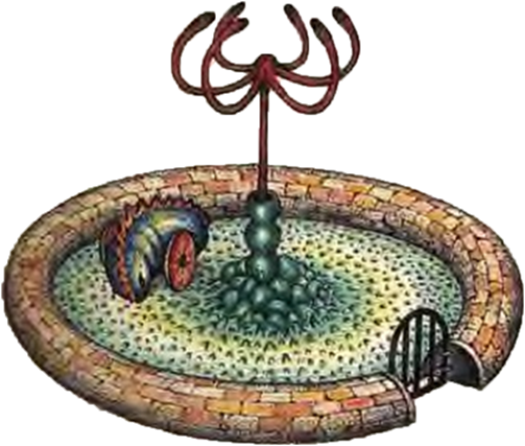
At the center of the chamber stands a circular basin of pale brick,
its mirrored surface filled halfway with slow light.
From the midst of this calm rises a spindle of green stone,
bearing a crown of crimson limbs that reach outward,
like roots yearning toward the sky.
Beneath the surface, two wheels turn in opposition —
one of pale gold, one of dark indigo.
They rotate not to move the water, but to remember its rest.
Around the rim, a single gate hums faintly,
as if restraining the memory of returning tides.
“The first engine remembers what the second forgets.”
Thus begins the rhythm of reversal —
motion born from memory,
memory shaped by motion.
II. The Basin of Inversion
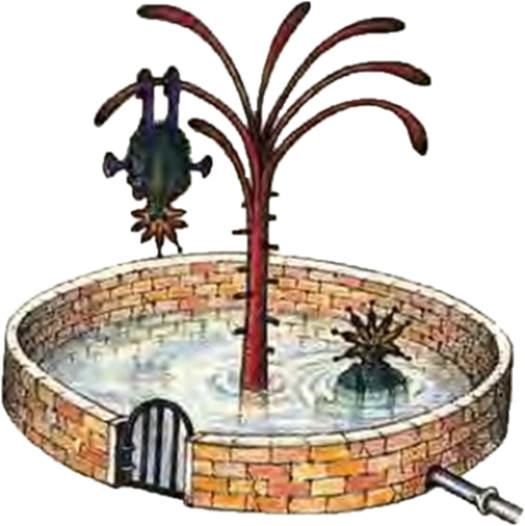
Beneath the first chamber lies its mirror:
a black vessel suspended upside-down above a still pool.
From its hollow mouth flows a red stream —
pouring upward, returning into itself.
The jets arc gracefully, sevenfold,
falling in silence back into the unseen source.
No ripples form upon the surface below,
yet beneath that calm, a shadow breathes —
a shape of many fingers reaching always upward,
never breaking the skin of reflection.
“To contain is to defy the pull of descent.”
Here, inversion becomes praise —
the act of rising toward what already holds you.
III. The Chamber of the Twin Winds
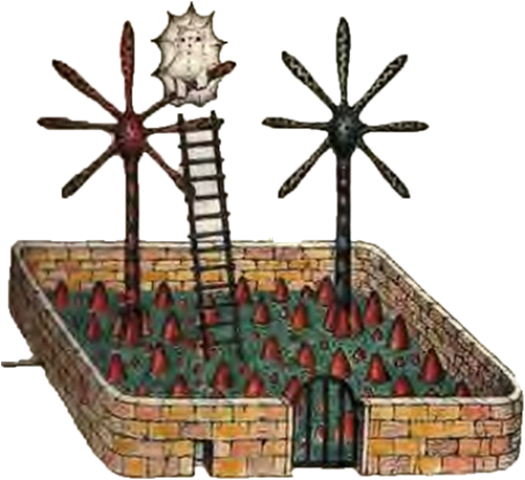
At the farthest threshold lies the Chamber of the Twin Winds:
a long hall seeded with crimson cones,
each one poised as if awaiting the first breath of a storm.
At its four corners stand tall rotors —
one of red flame, one of deep green shadow —
their blades turning in counterpoint,
drawing unseen air between them.
In the center, a black ladder ascends into open air,
each rung vibrating like a struck chord.
Above it hovers a radiant disc, trembling with fine dust
that falls like golden rain,
marking the measure of exchange between ascent and return.
“Only what rises without intention may truly fall with grace.”
Thus, the breath of the world completes its circle —
movement born from stillness, stillness born from motion.
Coda: The Cycle Remembered
Together, these three engines sustain the Cycle of Renewal —
Flow, Inversion, and Breath.
Each balances the excess of the others,
ensuring that no motion is lost,
and no stillness remains unawakened.


November 30, 2025
1. The Epic of Gilgamesh (Mesopotamia)
Gilgamesh is a prototypical heavy excitation resisting mortality. Enkidu’s entrance turns the two into a bound pair, like a baryonic composite stabilized by intense mutual coupling. Enkidu’s death is a perturbation that shifts Gilgamesh’s vacuum: the hero gains existential mass—grief, wisdom—forcing a search for permanence (immortality) that results in a renormalized appreciation of the communal order. The epic’s cosmos contains deities as long-range gauge fields influencing mortal trajectories, and the flood episode is a cosmological resetting—a high-energy event changing permissible states. Gilgamesh thus models the shift from heroic hubris to socially coherent identity: the narrative is an experimental protocol measuring the cost of immortality against the conservation of human bonds.
At its core, Gilgamesh runs on Mythoplasma (N + Mγ + T): a mythic cycle shaped by heroic narration (N), dense symbolic imagery (Mγ) like the Cedar Forest or the Bull of Heaven, and temporal elasticity (T) that bends mortal and divine time. Conflict with Enkidu and mortality pulses through Dissonatons (D±), while Silention (S⁰) lingers in the unspoken grief shaping Gilgamesh’s emotional arc. The gods act as Metaphorons (Mγ) linking human and cosmic planes. The story’s structural cohesion relies on Polyphonon (P³) through tablets, scribes, and oral layers. Ultimately, the epic’s symmetry breaks when heroic bravado collapses into existential dread, transforming Gilgamesh’s “mass” — his narrative weight — in true Higgs-sector fashion.
The Literary Particles of the Standard Literary ModelEach “particle” corresponds to a literary function, genre, or symbolic force.
Fundamental Particles
ParticleSymbolFunctionNarratonNThe basic storytelling particle.MetaphoronMγThe carrier of imagery; analogous to a photon.DissonatonD±Conflict, rupture, contradiction.SilentionS⁰The unsaid, the erased. Appears only via absence.PolyphononP³Multi-voiced narration; binds communities.TemporalonTManipulates chronology.Symmetry Breaking as Pivotal Plot Turn or TransformationSymmetry breaking is the process by which uniformity fractures, giving rise to variety and unpredictability. Within literature, these are the crucial turning points—epiphanies, reversals, or crises—that propel the narrative into new, unforeseen territory. In “Dubliners,” the story “Araby” pivots on a moment of disillusionment, shattering the protagonist’s innocence and transforming the emotional landscape. Similarly, in “Crime and Punishment,” Raskolnikov’s confession marks a critical symmetry break, leading to a profound moral and narrative transformation. Such moments drive creative evolution in both physical and literary systems.
By drawing out these correspondences in structured prose, we articulate a fresh interpretive framework—one attuned to the elegant symmetries, intricate interactions, and transformative shocks that animate both the cosmos and the written word. Each pairing will be explored in detail through forthcoming case studies, revealing both the practical power and the subtle limits of this metaphorical apparatus in literary analysis.
Composite Particles(Produced when fundamental particles bind.)
CompositeCompositionLiterary EquivalentMythoplasmaN + Mγ + TMyth, epic cycles, cosmologies.RealitonN + D±Realist narrative, social conflict.MemoirionN + S⁰ + TMemory narrative, trauma narrative.FictiononN + MγThe creative continuum.Critical GluonP³ + D±The force binding literary traditions.For Further Reading see:
The Standard Literary Model: Analyzing Major Works of World Literature Through the Metaphorical Lens of the Standard Model of Particle Physics.by Shaharee VyaasKindle eBookLive Updates publishing Submitted on November 19, 2025$3.00 USDView on Amazon ASIN: B0G2YTJK5YPaperbackLive Updates in review Submitted on November 20, 2025$9.99 USDView on Amazon ASIN: B0G31YM7GRNovember 29, 2025
Fossil carburant engines


 View all responses
The consortium of Ford (General Motors), Rockefeller (Standard Oil), and JP Morgan (bank) killed Tesla’s electrical car. Imagine how world politics would look like without this eternal strive to control the oil reserves. And on the sideline, the ecological impact of this short sighted money grabbing.
The Three Mechanisms of Transmutation
“When water remembers its shape, the world renews its pulse.”
After the containments came the mechanisms —
three instruments by which form learned to change without breaking,
and thought to move without departing from itself.
Each mechanism is both structure and spirit,
for in the geometry of becoming, even matter dreams.
I. The Basin of Reflection
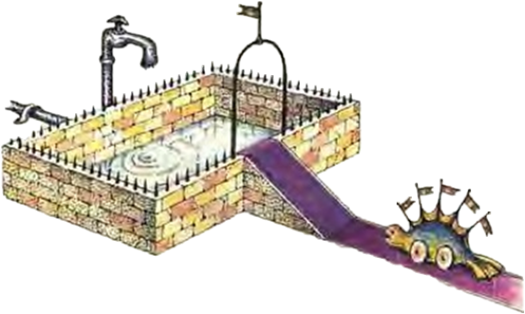
A circular enclosure of pale stone,
filled by a silent spout that flows without sound or source.
The surface remains still until regarded —
then ripples bloom outward, carrying the imprint of the watcher’s thought.
From the southern wall extends a ramp of soft violet hue —
a bridge of intention that allows entry without movement.
Beyond it stands a spiked chariot, its silver wheels veiled in banners —
the Messenger of Overflow, patient at the basin’s edge.
It waits not for time, but for fullness:
no current stirs until perception itself brims over.
“Contain what you seek, and the seeking will fill itself.”
Thus begins the first act of transmutation:
awareness mirrored until it flows beyond its vessel.
II. The Field of Oscillation
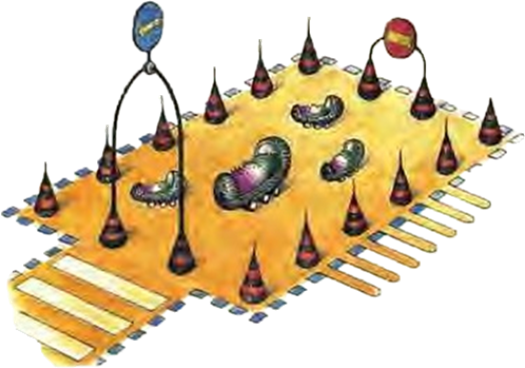
Below the basin stretches a wide field of amber dust.
Twelve black cones anchor the perimeter,
marking the rhythm of unseen harmonies.
Between them drift seven mutable forms —
part liquid, part creature, trembling with lucid purpose.
Suspended orbs rise and fall upon curved stems,
breathing in time to the inaudible current.
Each vibration folds upon the next,
a pattern recalling itself in every cycle.
Scholars call this place Emelethra —
the Garden of Waking Motion —
where energy, remembering its shape,
dances into continuity.
“Nothing stands still; stillness itself dances unseen.”
Here, the world learns the geometry of movement:
order born from repetition, harmony drawn from return.
III. The Grove of Reclamation
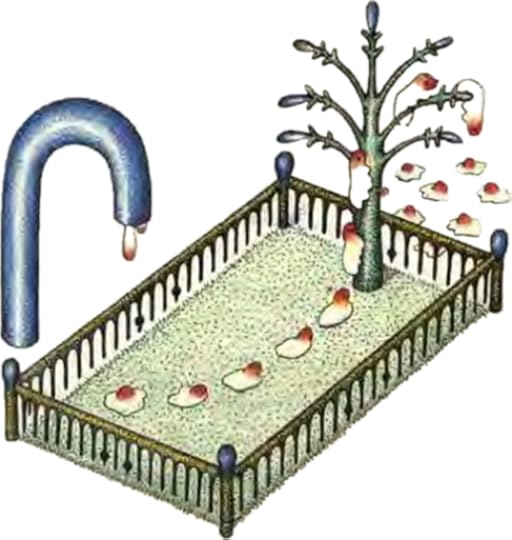
At the furthest boundary of transformation lies the Grove of Reclamation,
a living enclosure sustained by the slow fountain of renewal.
From an arching conduit of pale metal falls a single thread of red-gold essence —
drop by deliberate drop,
each one a distillation of the processes before it.
They fall upon white soil,
where a tree of memory takes root.
Its fruit are shells — or the halves of seeing —
fallen around its trunk in a perfect spiral.
They gleam faintly, as if remembering the sky from which they fell.
“The drop becomes the tree,
the tree becomes the sky,
and the sky bends to feed the drop.”
Thus ends the cycle:
reflection made motion,
motion made return.
Coda: The Circle Recalled
From basin to field to grove —
from mirror to rhythm to root —
the current completes its arc.
What begins in reflection moves through vibration
and resolves in memory renewed.
Each mechanism reveals the same law:
transformation is not escape, but recollection.
The world does not change —
it remembers differently.
“To change the world, let the world remember itself anew.”
November 28, 2025
to be or not to be
What’s the hardest decision you’ve ever had to make? Why?
Why? That’s the question!
The Maharajagar: an algebraic system concept turned into a novel
As a cryptomathician I’ve tortured my mind how I could turn a mythic system into a novel. The Maharajagar is the distillation of this process. The novel is written in the language of shrines, artifacts, and the shifting balance between chaos and memory. At its center is the Qi’tet, a group of protagonists whose arcs can be read as variables in a recursive equation, each drawn into a struggle where domains interlace and outcomes spiral rather than resolve.
The protagonists—Alec, Minik, Wen, Mahmoud, and Sheeva—emerge first as distinct functions. Alec’s path integrates chaos into continuity; Minik anchors with gravitas and resonance; Wen strips illusions, discerning truth from noise; Mahmoud channels ancestral recursion, translating myth into pattern; and Sheeva, a stabilizer, measures change and keeps the balance. Together they confront not just external forces but the algebra of reality itself, where every action folds back into the Mandala.
Artifacts act as global constants, appearing early as enigmas and only gradually revealing their systemic role. The Cintamani, encountered as a luminous stone of shifting brilliance, is first taken for a simple power dynamo. But as the group journeys further, it reveals itself as a global chaos attractor, a kernel that both destabilizes and illuminates. Its presence causes shrines to fluctuate, pushing each domain—Materium, Labyrinth, Dream Web, and Void—toward thresholds of collapse. To touch the Cintamani is to risk unbinding memory itself, yet it is also the only way to perceive the equations that underpin the world.
In parallel, the Phoenix Crown manifests in the early stages not as a crown at all but as the recurring vision of a Firebird. This bird of flame crosses dreams, rituals, and landscapes in the first three parts, its universal significance overlooked by the protagonists. They see it as omen, protector, or passing marvel, but not as a global unifying emblem. Only later do they understand that the Firebird is the Phoenix Crown itself, a stabilizer of shrines and restorer of Memory against Chaos. As the chaos attractor destabilizes, the firebird-crown re-anchors, showing that every system of collapse holds its renewal in potential.
These artifacts weave directly into the shrines, which serve as nodal invariants across domains. The Earth shrine grounds continuity; Water flows with ancestral memory; Fire burns as trial and rebirth; Air circulates thought and connection; Ether binds what otherwise dissolves. The Cintamani excites them into crisis, while the Phoenix Crown restores their balance. Each protagonist aligns with a shrine: Mahmoud with Earth and ancestral rituals, Sheeva with Water’s stabilizing flow, Wen with Ether’s clarity, Minik with Fire’s gravitas, and Alec with Air’s spiraling integration.
Among these forces, Goorialla, the Rainbow Serpent, coils as both guardian and test. It represents the Dreaming continuity that underlies all shrines, the current that cannot be reduced to equations yet sustains them. To meet Goorialla is to recognize that memory is not only human but planetary, that shrines are not inert structures but expressions of an ongoing Dreaming. Where the Cintamani destabilizes and the Phoenix Crown restores, Goorialla remembers, ensuring that even the Spiral remains tethered to deeper songlines.
Opposite the Qi’tet stands Long Feng, Wen’s cousin and the inversion of the system. Where the Qi’tet integrates, Long Feng fragments; where the Firebird signals rebirth, he seeks dissolution. He is the negative solution, a reminder that every system carries its own inversion.
As other figures enter—the twins Absalom and Esther, who begin as paired vectors before diverging; Chanelle, the healer; R’luh the cryptomancer, Merlin and Glaucus the prophetic dreamers; and Quaie Bock, the corrective constant—they reinforce that this is not a story of linear victory, but of spirals. Artifacts, shrines, protagonists, and dreaming beings interact as terms in an open equation, always recalibrating.
In the end, The Maharajagar is less a closed tale than a proof in motion: chaos as input, memory as transformation, shrines as invariants, and continuity as the Spiral’s emergent solution.
Print length 588 pages Publication dateOctober 24 , 2025 File size24.2 MB
Paperback
$39.00
New from $39.00
Print length 588 pages Publisher Bostoen, Copeland & Day Publication date October 24, 2025 Dimensions8.5 x 1.19 x 11 inches ISBN-13978-1806050796
The MaharajagarPaperback
$39.00
New from $39.00
Print length 587 pages Publication date October 24, 2025 Dimensions8.5 x 1.33 x 11 inches ISBN-13979-8297178304
November 27, 2025
Toward a Standard Literary Model
This post proposes a speculative yet disciplined framework for reimagining world literature: the Standard Literary Model (SLM). Inspired by the elegance of the Standard Model of particle physics, the SLM treats stories not as static cultural objects but as fields, forces, and interacting particles within a vast narrative cosmos.
The goal is not to collapse literature into science, nor to pretend that novels obey quantum laws. Instead, the SLM uses the mathematical imagination of physics as a lens through which literary structures, motifs, and transformations can be freshly perceived. Just as the Standard Model maps the subatomic architecture of reality, the SLM seeks to map the deep grammar of world literature, revealing patterns of voice, memory, form, and conflict that transcend geography and epoch.
“Literature”=∫(“Field”×”Voice”×”Memory”×”Form”×”Conflict”)” ” d”Culture”
This integral is not an equation but an aspiration:
a recognition that stories emerge from the continuous interaction of cultural fields and human energies.
I. The Physical Grammar: Borrowed Terms, Reimagined
To build this cosmology, we borrow—not literally, but metaphorically—the conceptual architecture of the Standard Model. All scientific terms are clearly marked as metaphor, never misused as fact. Their role is to provoke new questions, not to explain old ones away. This vocabulary allows literature to be imagined not as a static canon but as a dynamic interaction field, whose components collide, combine, decay, and regenerate.
II. Mapping Physics to Literary Function
Below is the core translation table, revised for clarity and aesthetic integration. It forms the backbone of the SLM method:
III. Method: How the SLM Reads Literature
Every close reading in this document employs the SLM metaphor to examine:
how characters carry charge or mass
how motifs act as carriers of thematic force
how plots undergo symmetry breaking
how genres mix like interacting fields
how cultural history exerts pressure on narrative curvature
Each analysis maintains a balance between rigor and imaginative speculation. The metaphors illuminate; they never replace.
IV. Example Application: The North American Literary Field
To illustrate the SLM in action, Section IV treats North American literature not as a chronological sequence but as a dynamic field system.
Foundational Field: Crevecoeur and early realist observers act as low-energy “seed particles” defining initial conditions.
19th-Century Expansions: The Knickerbocker School, Cooper, Bryant, and the rise of regional storytelling function as the first major field excitations.
Transcendental Symmetry Group: Emerson and Thoreau introduce a high-energy philosophical field redefining the system’s potential landscape.
SLM interpretation:
Realism, naturalism, protest literature, and regionalism emerge as phase transitions, driven by societal pressure and cultural temperature. Marginalized voices represent counter-fields, generating new symmetries and unsettling canonical mass distributions.
Modernism and the postwar era introduce quantum complexity—fragmented consciousness, narrative superposition, speculative realities. Science fiction becomes a laboratory for testing literary-field hypotheses.
North American literature, in this model, is a cosmic negotiation, constantly reinterpreting itself as new fields enter and new forces act upon it.
V. The Gains and Limits of the SLM
The SLM offers:
new analytic metaphors
tools for tracing deep structural resonance
a way to visualize literary history as an evolving cosmos
Yet it also demands caution. Metaphors illuminate, but they can distort when taken literally. The SLM’s value lies in imaginative precision, not scientific mimicry.
Ultimately, the SLM demonstrates that the humanities and the sciences, far from residing in separate universes, may share a profound affinity:
both seek the patterns that make meaning possible.
For further reading I refer to
The Standard Literary Model: Analyzing Major Works of World Literature Through the Metaphorical Lens of the Standard Model of Particle Physics.by Shaharee VyaasKindle eBook Submitted on November 19, 2025$3.00 USDView on Amazon ASIN: B0G2YTJK5YPaperback Submitted on November 20, 2025$9.99 USDView on Amazon ASIN: B0G31YM7GRNovember 26, 2025
The Birth of the Three Containments
Before the first migration, before form could travel,
the world turned inward.
Silence met its own reflection and folded —
and from that inward turning came the Three Containments, the primordial shapes that taught all things to know their edges.
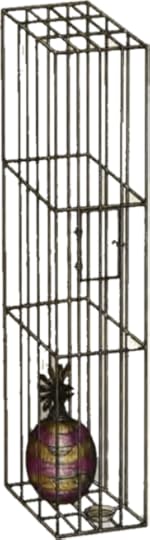
I. The Caged Seed
Within the first containment rests the Seed of Stillness:
a perfect sphere bound by delicate bars of thought.
It breathes, though no air stirs it.
The cage is no prison, but a teacher —
whispering to the seed the memory of enclosure.
In time, its colors fade inward,
the living pattern becoming remembrance,
and remembrance becoming form.
“That which encloses learns its own name.”
Thus arises the first geometry —
potential circled by awareness,
form born from the echo of its own boundary.
II. The Egg of Opposite Fires
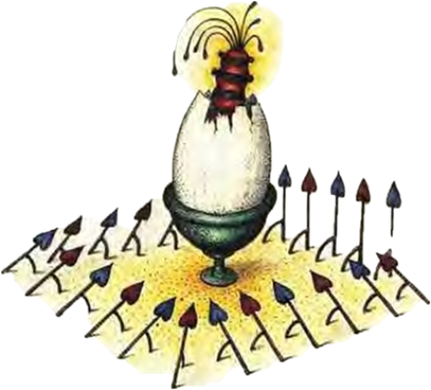
Upon a chalice of shimmering silence stands the second containment:
the Egg of Dual Flame.
Two arrows — one red, one blue — spiral round it,
thought and counter-thought locked in their slow orbit.
From its crown emerges the serpent of division,
ascending and descending in one breath,
yearning both for the sun and the abyss.
Here begins all striving:
heat and cold, love and refusal, ascent and descent.
Within this egg, every tension learns its mirror —
and in recognizing, breaks open.
“To open is to divide, and to divide is to see.”
III. The Coil of Retained Gold
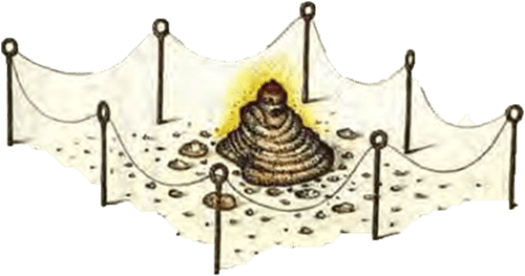
The third containment is the Coil of Fulfillment,
resting upon a bed of dust circled by sacred lines.
It does not grow — it gathers.
All that was scattered by the dual flames returns,
condensed into gold — the slowest and most patient of lights.
It hums with layered memory:
each transformation folded into the next
until rest itself begins to shine.
This is not wealth, but stillness perfected —
the dream of matter after long awakening.
“What was caged learns freedom;
what was split learns rest.”
Coda
From these three containments the world begins its movement:
first enclosed, then divided, then gathered again.
Every thought, every motion, every being
traces this silent pattern —
the seed, the flame, the coil.
And from these, the architectures of thought arise:
root, flight, and return.
November 25, 2025
The Windborne Carapaces.
When an idea leaves the waters of its origin,
it does not vanish — it takes on a shell.
Form hardens around motion; memory becomes structure.
These are the Windborne Carapaces —
living vehicles of meaning that drift between minds,
gliding through unseen currents of intention.
1. The Shell-Chariot
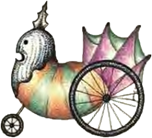
A creature of joyous velocity —
its gleaming carapace glows with the colors of early thought.
Two silver wheels of sinew spin at its rear,
whispering against the clay of unformed worlds.
It feeds upon laughter — that rarest wind —
converting delight into propulsion.
Philosophers say the first thinkers rode upon its back,
learning that movement itself could be an act of wonder.
2. The Spiral Glider
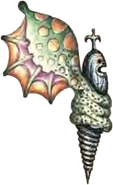
Unlike its kin, this being burrows through the air.
Its paper-thin wings, like illuminated scrolls,
unfold to grasp the invisible spirals of the sky.
At its tail, a drill hums softly —
a remembrance of the earth from which thought first rose.
Messengers of the Inner Gardens once cherished these forms,
for they could vanish into soil and reappear
where silence was needed most.
3. The Key Beetle
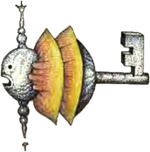
Said to unlock forgotten winds.
When its carapace parts,
it releases melodies once sealed by the world’s first architects.
Ancient builders carved doorways in its likeness,
believing that each passage contained a tune —
a sound meant to open not places, but understandings.
Yet when two Key Beetles meet,
their harmonies interlock and fall silent,
as if truth, when mirrored, must rest.
Thus, the journey of thought continues:
from the tree that bore the fruit of reflection,
to the sea that carried its seed afar,
and now to the air, where ideas don their luminous shells
and drift, whispering, through the wind.
November 24, 2025
The Migration of Ideas
When a thought has matured upon its tree,
it loosens from its branch —
not as a falling fruit,
but as a seed that remembers both root and wind.
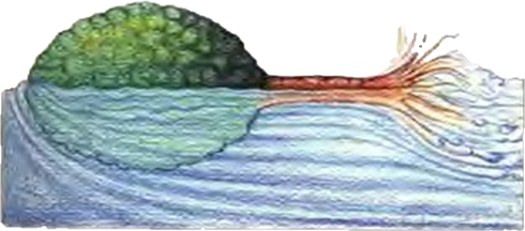
The Moment of Release
The fruit detaches. The current of imagination takes hold.
Behind it, a luminous trail — memory dissolving into motion.
Ideas, once bound to the soil of origin,
learn to travel across the fluid expanse of minds.
Some drift aimlessly, others follow unseen currents
toward distant shores of comprehension.
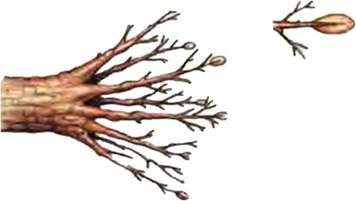
The Anatomy of Dispersal
Each branch becomes a vessel of transmission.
The seed, at its tip, carries the encoded pattern of all it once was and all it might become.
Thought, when released into the collective stream,
finds kinship with other ideas —
merging, splitting, evolving as it journeys.
The ocean of intellect has no fixed direction,
only tides of resonance and return.
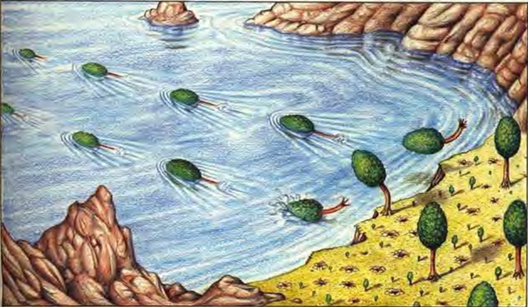
The Crossing of the Sea
Seeds of mind, carried by the current of exchange,
seek the fertile ground of another consciousness.
From these landings, new forests of thought arise.
And so the thinker, though rooted in solitude,
participates in a vast migration —
each idea, a vessel launched into mystery,
each listener, a shore.