Time in Art.
Time is one of the most common commodities of any artistic work. Yet it is also one of the least comprehended ingredients.
Albert Einstein, who thought a lot about the nature of time, despaired at his failure to explain the meaning of now. The moment now remains something ephemeral. In his Special Relativity Theory, he showed that the flow of time is affected by both velocity and gravity, and he conceded that the phenomenon simultaneity depended upon a chosen frame of reference.
Art exists in time as well as space. Time implies change and movement; movement implies the passage of time. Movement and time, whether actual or an illusion, are crucial elements in art although we may not be aware of it. An art work may incorporate actual motion; that is, the artwork itself moves in some way. Or it may incorporate the illusion of, or implied movement.
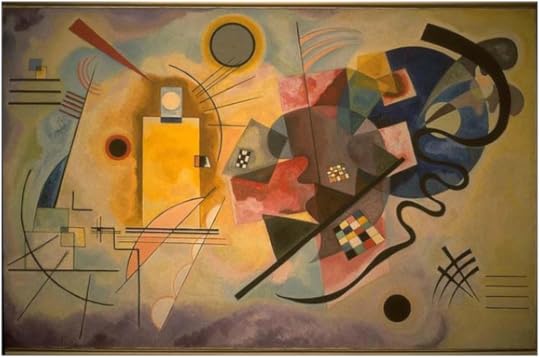
Figure 1: Wassily Kandinsky Yellow — Red — Blue 1925
Kandinsky used abstraction to represent the intangible. He used formal elements to portray what can’t be seen with the eyes and has no physical form. In this painting, there is a strong and vibrant sense of movement. If you study it you will find diagonal, gestural, and directional lines; repetition; and placement of objects to give it an illusion of motion.
Or it may imply the suggestion of movement as in the next figure, a statue that symbolizes a sense of forward progress, speed, and determination in moving toward something.
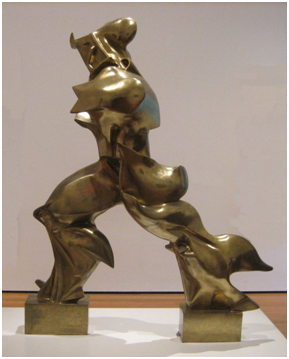
Figure 2: Umberto Boccioni Unique Forms of Continuity in Space 1913 (cast 1931)
Art can also move through the effect of some natural properties, either its own inherent properties or their effect, is unpredictable. Spatial relationships within the work change continuously, with endless possibilities. One of the delights of experiencing such artwork is the element of change and surprise. It’s as if every time we look at it we are seeing a new artwork.
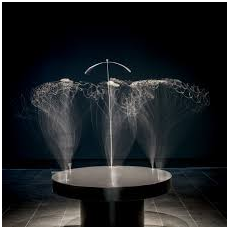
Figure 3: Witch Dance by Len Lye
Mechanical or technologically driven movement in art may be more predictable and limited than movement through natural properties, or it can seem endless, depending on the complexity of the system that moves the artwork.
Contemporary artists have been exploring the concept of how a viewer experiences an artwork, and either forcing the viewer to become aware of their process of experiencing the artwork, or inviting them to become part of the artwork itself.
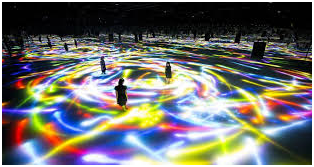
Figure 4: Drawing on the water surface created by the Dance of Koi and People – Infinity
Visual, literary, and performing arts function as sources of inspiration for each other. Time in art can be actual time or implied time. Actual time includes time-based work and media, artwork that changes through time, and the effect of time on artwork and how that affects its meaning. Implied time can be represented in the captured moment, an illusion of time passing, or the evidence of time already past. Rapid technological developments have spawned many new forms of artistic possibilities such as video game art and virtual art. A whole new genre of art has been created, known as new media art.
The traditional art of animation–crafted, detailed, painstaking, and requiring many artists for one project– has been revolutionized by the advent of digital animation processes like Pixar. Some artists, however, stubbornly refuse to abandon the traditional art and process of animation.
Some artists deliberately create work that will change during the course of time. To fully experience it you must return at a later time to see what’s happening. It is extremely unpredictable. The end result is a completely different form and sometimes different material, functioning as a testament to the history of its existence and the changes that have taken place. This type of artwork is ephemeral and sometimes, in the end, nothing is left but a memory.
When contemplating into the future a work of art, maybe spend also some thoughts about how the dimension time influences its existence.