The Cintamani: Gem of Chaos and Creation
The Cintamani in The Maharajagar is no mere artifact. It is a shard of cosmic potential, a crystallized fragment of pure possibility, bound by the Elder Gods yet constantly straining against its chains. Whoever controls it can rewrite reality — but only at immense karmic cost.
Long Feng seeks to reassemble its shattered pieces, using the trauma of wars and massacres to feed its core. In the hands of the Qi’tet, it can stabilize shrines, heal ruptured timelines, and contain nightmares like Carcosa. But even they fear its pull; every use of the Cintamani invites chaos.
Throughout the saga, it changes hands — sometimes willingly, sometimes through treachery. In WWII’s closing days, it becomes both the bait and the battlefield for the final confrontation between Long Feng and the Qi’tet.
The Cintamani is a perfect metaphor for The Maharajagar’s central tension: creation and destruction are the same force, and the difference lies only in the will of the one who wields it.
System Input: Human actions, historical events, karmic residues.
System Process: Cintamani acts as a non-linear amplifier that converts localized trauma and intention into global metaphysical turbulence.
System Output: Dimensional ruptures, dream distortions, chaotic loops.
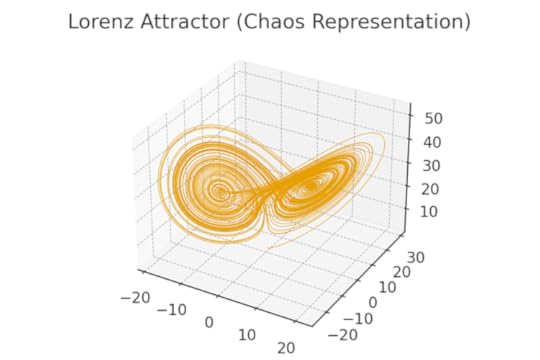
In system theory, the Cintamani is a chaos node—an attractor that does not stabilize, but continuously pulls events toward increasing entropy. Unlike equilibrium attractors, it never converges to steady states, but oscillates across historical and metaphysical domains.
Let:
H(t) = historical trauma intensity at time t
K(t) = karmic debt accumulation
D(t) = dimensional stress load
C(t) = Cintamani resonance
We define:
C(t+1) = α·H(t) + β·K(t) + γ·D(t) + δ·C(t)·(1 – C(t))
Where α, β, γ are scaling constants tied to ritual amplification. The last term δ·C(t)·(1 – C(t)) mirrors logistic map chaos, introducing bifurcation sensitivity.
Thus, C(t) behaves as a logistic chaos attractor fed by human suffering and dimensional instability.
• During Nanking (1937): H(t) spikes → Cintamani resonance surges.
• During Hiroshima/Nagasaki (1945): nuclear trauma collapses C(t) into near-zero but leaves residual oscillations (echo attractor in Dream Web).
• Post-war: Cintamani functions not as an artifact but as a latent attractor field—any new chaos (war, trauma, exploitation) risks reactivating it.
For interviews, press access, or review copies, contact:
shaharee.vyaas@gmail.com
ARC are available through bookfunnel by following link : https://BookHip.com/JQXXDRQ
Website: http://www.maharajagar.com