Shahree Vyaas's Blog, page 11
March 2, 2025
Reading the Canon of the World Literature – day 1 to 15.
I made nine years ago a new year’s resolution to read the Top 100 Works in World Literature by the Norwegian Book Clubs with the Norwegian Nobel Institute. The club polled a panel of 100 authors from 54 countries on what they considered the “best and most central works in world literature.”
I was setting out to read ALL the 100 best books of the world literature in one year and keep a diary of this experience. I soon found out that this wasn’t manageable if you also want to have a real life and not destroy your relationship. So I decided to spread my readings as much as possible over the different continents and timeframes. This resulted in a rather randomly chosen sequence of 23 readings over 365 days.
Day 1. Full of good intentions, I set myself to the task to read Middlemarch by George Eliot. To my dismay I soon discovered that it was not “A” book but a series of eight books;
Book 1; Miss Brooke, Book 2; Old and Young, Book 3; Waiting for death, Book 4; Three love problems, Book 5; The dead hand, Book 6; The widow and the wife, Book 7; Two temptations, Book 8; Sunset and sunrise.
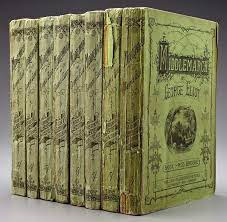
Together good for a monster of 908 pages. Already at the start of this challenge, my resolve started to waver. Anyway, I got off with Miss Brooke into the tale by George Eliot, who by the way wasn’t a man, but the pen name of a woman called Mary Ann Evans.
Introduction
Miss Brooks is a beautiful, talented, intelligent and compassionated young woman, who lived during the beginning of the nineteenth century in a small, fictional, English town called Middlemarch. The subtitle of the book is “A Study of Provincial Life” because it describes with a painstaking accuracy the drives and interactions of the different social actors of a small town into the Midwest of England at that period of time.
At day three I was halfway through the book (series) and got in general a little irritated by all those Victorian people building air castles, just to fall on their face every time when they tried to live into them. My wife reminded me that I got a Kindle book reader for Christmas and that I didn’t touch it since then. Honestly, I was so busy with finishing and revising my previous manuscripts that I didn’t get to read the instructions for it. Tomorrow I definitively will have to make some time free during my allotted read and writing time. At the end, it can facilitate greatly the challenge that I’ve put on myself.
Day 15.
I’m through with Miss Brooks, her family, and townsfolk. Her middleclass family considered her rightfully a little nutty, because she refused a marriage proposal of a local nobleman who owned most of the land in and around the town. Instead she married an older clergyman who pretended to be a scholar in the false hopes that she would be allowed to help him with his academically researches. The guy turns out to be an asshole, but luckily for her he doesn’t live too long and leaves her his fortune on only one condition; that she’ll never marry his nephew. She had of course to marry the nephew and to throw away the fortune. She ended up as the wife of a politician and into the process of doing so, shelved all her ideals and ambitions.
Although most of the book is centered on Marry Brooks, my most preferred personage was the tragic physician, Dr. Lydgate. He wanted to introduce newly conceived medical treatments and to conduct medical research, but he was his own biggest enemy. He thought highly of himself, snubbed on all those who didn’t meet his standards and on country side mentality in general. Of course a medical practitioner with that kind of attitude didn’t go far in a country side town. He married the daughter of the mayor because he hoped it would give him more stature into the community, while she thought that she procured herself a moneymaker and social climber. Instead of that, unpaid bills started to fly in, and she turned his life into hell. They had to leave town in disgrace and deeply indebted. Once resettled in London, he became a gout treating doctor for the affluent; exactly the kind of doctor he never wanted to be. He died early and his wife remarried an elderly man with deep pockets and a lot of patience. Finally a perfect match.
Comment
Finishing the reading of Middlemarch had bolstered my confidence and I decided to take on another monster – In Search of Lost Time by Marcel Proust.


February 26, 2025
Searching for Meaning in a Digitalized World
This post is about my ongoing quest to find purpose and significance in life, particularly within the context of an increasingly digital society where interactions, information access, and even social connections are largely mediated through technology, presenting both opportunities and challenges in the pursuit of meaning.
The internet, social media, and digital devices have become central to daily life, creating a vast online space where individuals can connect, learn, and express themselves, but also potentially leading to feelings of isolation or comparison with others.
The main challenges I encounter as a digital nomad are:
The main advantages are that digital creativity allows me to express myself through online content creation, writing, art, or other digital mediums.
Science and the arts might seem very different, but the processes that both fields use are very similar. The scientific method is a way to explore a problem, form and test a hypothesis, and answer questions. The creative process creates, interprets, and expresses art. Inquiry is at the heart of both of these methods. My cryptomatic approach of art, science, and literature centers around four pillars:
A Cosmology of Civilization. This section forms the foundation upon which all my artisticendeavors rest. It is a personal view upon the reality from a cosmologically perspective through a cryptomathic lens.A Society in Transit concentrates more in detail upon the contemporary challenges that human civilization is facing.Time in Modern Art explores the ways this mysterious dimension has been approached in different art forms, science, and literature.The Chaotium deals with uncertainty and the darker sides of the human experience.
To offer a bird’s view upon my works, I’ve published an artistic diary in which I’ve resumed and catalogized my artistic and literary creations, larded with the thoughts, philosophies, and observations that induced them. Its title is “An Emporium of Order and Chaos” and you can download a free pdf-version by clicking on the book cover below.
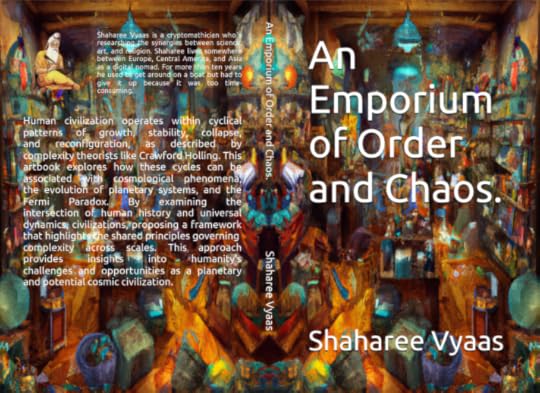 An Emporium of Order and Chaos. Paperback – February 11, 2025 – by Shaharee Vyaas (Author). Paperback : 195 pages, ISBN-13 : 979-8310409880, Item Weight : 12.5 ounces, Dimensions : 6 x 0.46 x 9 inches, price $39.99.
This publication is an invitation to further explore the theme of Mystic Cyclical Synthetism that runs as a red thread to all my literary and other artistic endeavors. More information can also be found on my website http://www.maharajagar.com.
My visual works can be viewed and purchased online through the Saatchi Art website
on this link.
My most important publications include:
Fiction:
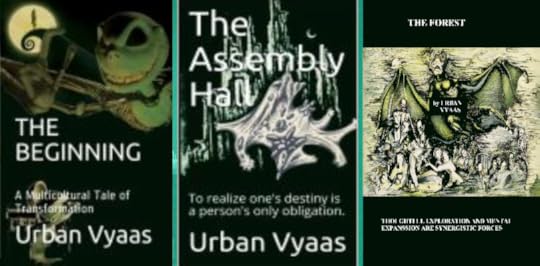
The Beginning: A Multicultural Tale of Transformation (The Maharajagar Book 1). : Publisher : Bostoen, Copeland & Day; 3rd ed. edition (September 18, 2020), Paperback : 268 pages,ISBN-10 : 1636256805 -ISBN-13 : 978-1636256801,Dimensions : 6 x 0.56 x 9 inches, $14.99.The Assembly Hall: To realize one’s destiny is a person’s only obligation. (The Maharajagar Book 2). Paperback : 284 pages, ISBN-10 : 1636256945, ISBN-13 : 978-1636256948,$ 14.99The Forest: Thoughtful exploration and mental expansion are synergistic forces. (TheMaharajagar Book 3). Paperback : 411 pages, ISBN-13 : 979-8632170796, $ 19.99.Here Comes Everybody’s Karma. (An art book that contains a transcription of Finnegans Wake from Joycean Gibberish into Plain English), Print length, 566 pages, Publication date: April 30, 2024, Dimensions: 8.5 x 1.28 x 11 inches, ISBN-13: 979-8324434571, $37.94.
Non Fiction:The All is an Egg. A Synthetic Theory of the Universe, Humankind, and Religion. Paperback – September 1, 2021,288 pages, $19.99.The Encyclopedia Bhutanica, paperback, 2021, 578 pages, ISBN-13: 979-8462102684,
Dimensions : 8.5 x 1.36 x 11 inches $38.42.Time in Art, 2021, Paperback: 123 pages, ISBN-13: 979-8753199256, $ 19.99Literary Criticism and the Systems Theory: Towards a paradigm in literary studies Paperback – 2024, 87 pages, ISBN-13 : 979-8329093155, $ 9.99
Most books are also available in Kindle editions at reduced prices or for free for those having access to Kindle Unlimited.
February 20, 2025
Housing Crisis and economical growth
Lately I was looking upon a table provided by the UN and saw that about 30 years ago the world population stood at 4 Billion people. Today we stand at 8 Billion and the prognosis is that by 2050 we will reach the 10 Billion, mostly spurred by the African continent.
More people equals more consumers leading to economical growth: the magical mantra of all economical scientists. But at what cost? The worldwide tendency is that population growth is mainly happening among the poor and uneducated segments of the population. How will those fit into a future knowledge economy when automatization is right now eliminating blue and white collar jobs alike?
I was reading that in the coming years, the Canadian economists expect a trillion dollar wealth transfer from the baby boomers towards later generations. That wealth transfer would mainly consist of real estate property changing hands.
That seems impressive, but when you take a closer look, you will soon find out that the quantitative and qualitative growth of real estate market has not so much changed over the last 30 years or so. What has been increasing is the demand: hence people have to cough up more money to pay for a roof over their head. Money is a fiction, but real estate isn’t. So we could say that this “wealth transfer” is at least for 60 % pure economical fiction.
February 13, 2025
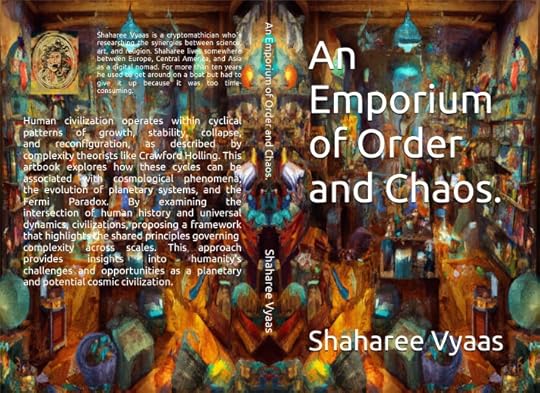
An Emporium of Order and Chaos.
The title and image of this post refer to an artistically diary in which I’m resuming and catalogizing my artistic and literary creations, larded with thoughts, philosophies, and observations that induced them.
The chronological order in which the works were produced has been abandoned in favor of a systematic approach were the subjects are brought together in five different approaches:
1. A Cosmology of Civilization. This section forms the foundation upon which all my artistic endeavors rest. It is a personal view upon the reality from a cosmologically perspective through a cryptomathically lens.
2. A Society in Transit concentrates more in detail upon the contemporary challenges that human civilization is facing.
3. Time in Modern Art explores the ways this mysterious dimension has been approached in different art forms and literature.
4. The Chaotium deals with uncertainty and darker sides of the human experience.
5. Installations and other designs make up the concluding chapter in which I leave my comfort zone and adventure into the world of installations and interior designs.
I hope that this bird’s view might inspire some people to take a deeper dive in my cryptomatically approach of art, science, and literature.
You can download a free PDF version by clicking of the cover of the publication below this paragraph.
February 2, 2025
Stupid is as Stupid Does.
Since a couple of days I’m back in Asia, and as far as it stands now, it hasn’t provided me with the right vibes to pick up the fourth part of my series “The Maharajagar 4”.
Thailand is a wonderful country, but all those sexagenarians hanging out with those teenagers who barely reached the age of consent work on my system. Young Thai girls with easy smiles and dollar signs in their eyes, walking hand in hand with men of the age of their grandfathers. Agreed, consenting adults can do whatever they want between the four walls of their bedroom, but the scale of this phenomenon is a bit ridiculous.
Then comes “The Morning After”.
One was sitting in the swimming pool complaining that his credit card was plundered and another one was carried off with an ambulance (either got a heart infarct of excitement, got drugged, or a combination of both when he checked his credit card balance). It turns around the narrative of whom is predating on whom.

“Stupid is as stupid does” is certainly one of the best-known quotes from the film “Forrest Gump”, which allows us to reflect on the theme of stupidity. Or is it early senility?
But this atmosphere kills my creative vibes. Can’t wait to move on, but that will have to wait till the wife gets cured of some stomach bug she caught at some food stand on the market.
January 18, 2025
Kindle Launch of Here Comes Everybody’s Karma
Here Comes Everybody’s Karma is a translation of Finnegans Wake from Gibberish into pure English.
It took me some time, but I’ve finally put in the effort to convert the print version into a Kindle book. Hereby I invite everyone who has been putting Joyce’s masterpiece aside as an unreadable Moloch, to have a look at this version that you can download for free during the five days launch period (from January 19th till 23th) of this version by following this link.
Joyce claimed that by writing Finnegans Wake he was attempting to “reconstruct the nocturnal life”, and that the book was his “experiment in interpreting ‘the dark night of the soul’.” Alas, for most lovers of English literature, he (subconsciously?) created a reader’s ultimate nightmare.
The impression exists that only accomplished philologists have ever managed to decipher the novel’s polysemantic vocabulary that was borrowed from approximately sixty-five languages and dialects.
The primary transcription goal of Finnegans Wake into Here Comes Everybody’s Karma was to open Joyce’s Opus Magnum for a wider reading public by replacing the foreign language idiosyncrasies with an English equivalent and by streamlining Joyce’s sibylline prose.
This required me to engage with the prose of Finnegans Wake that goes beyond that of simply transcribing the text in readable English.
While the foreign language idiosyncrasies in Finnegans Wake are often open constructs that gave place to multiple interpretations, transcribing this novel into plain English required choices to be made which translation would fit best with my interpretation of Finnegans Wake.
I chose to interpret the novel from a personal cryptomathematical perspective by placing the novel into a contemporary context that reflects the links that can be laid between Finnegans Wake and some Asiatic philosophical tenets, quantum mechanics, and the system theory.
I had to leave out the decorative page frames due to some formatting issues, but could keep them around the illustrations. You can download the Kindle version for free from January 19 till 23th on this link. After that it costs 9.99 USD. Book reviews of the print version can be found on Goodreads and reviewers are invited to leave their impression of the book under the same link or on Amazon (or both, if it’s not too much asked for).
January 1, 2025
The Maharajagar Part IV
I finally managed to get a fresh start on the 4th part of my series, the Maharajagar, which is a portmanteau of the words Mahaan (great) Hara (green), and ajagar (dragon).
The tale is conceived as a series of 5 books and is loosely based upon the structure of the Mahābhārata and carries the title of the five parts that make up the Mahābhārata (translated as “Great Bharat “), or “the story of the great descendents of Bharata”, or as “The Great Indian Tale”. The Mahābhārata is the longest epic poem known and has been described as “the longest poem ever written”. Its longest version consists of over 100,000 śloka or over 200,000 individual verse lines (each shloka is a couplet), and long prose passages. At about 1.8 million words in total, the Mahābhārata is roughly ten times the length of the Iliad and the Odyssey combined, or about four times the length of the Rāmāyaṇa. Within the Indian tradition it is sometimes called the fifth Veda.
The Maharajagar has however not such overwhelming dimensions or ambitions. The novel is foremost a historical urban fantasy whose major aim is to entertain the reader with a spellbinding tale of ambition, anarchy and absolute power, set against the canvas of the first half of the twentieth century.
Since the story-line of this book is grafted upon the structure of the Mahabharata, it seemed appropriate to stick to the titles of the corresponding sections in the original tale. The Maharajagar is not highbrow literature, and the series reads as if it is a set of ideas with the convention of a novel foisted onto it. The grand theme – an emerging humanity-wide consciousness – required a fictional narrative to make it really come alive, in this case a historical urban fantasy which carries the reader back into the historical setting of the beginning of the 20th century.
It’s however not recommended to skip the first parts of this series, since it impoverishes the reading experience. The first book is the only one that can be read as a standalone and laid down the groundwork for the epic; the backgrounds of the protagonists and antagonists, their power struggles and claims. One could have closed the first book and never have expected a sequel to it.
The second book of the series is the pivotal one of the five books of the Maharajagar, where the delicate balance reached at the end of the first book gets disturbed and reignites the struggles between the actors of this tale that will dominate the consecutive parts of the series.
The third book of the Maharajagar describes the twelve years in exile of the protagonists and the focus lies upon the character building that the main personages experience during this period.
This novel expresses in a popular way what is latent in contemporary culture by weaving three metatheses through its narrative. The idea of synchronicity, first postulated by Carl Jung, is no longer new, but this series wants to revive interest in it by stating that coincidences are happening more often, to a greater number of people, and that they are somehow linked to our evolution as a species.
The ’longer now’, describes an enlargement of the circle of our thinking beyond our life, our job, our country, to appreciate humanity across the ages. We see the evolution of humankind almost as the story of a single person. The book exposes how in the last thousand years we have moved from a world centered on religion to one based on our own achievements and discoveries.
The philosophical security we felt in the Middle Ages was replaced by a drive for secular material security, but now this is being questioned. The attachment to ‘scarcity consciousness’ is being eclipsed by the realization that we must now pursue that which has most meaning for us. The past few hundred years have set the stage for a new era of ‘mystery appreciation’ – whatever we find amazing, and nothing less, will determine how we spend our time.
The third metathesis states ‘The All is a projection of informational modulated energy waves by a cosmically horizon on the time-space continuum.’ These themes relate directly to the concerns of our time: the preoccupation with relationships and their fragile balance; environmental awareness; and, as we have left the 20th century and all that history behind, grows the desire to see the human experiment in its entirety. In this respect, The Maharajagar is compelling the reader to reflect upon its broader theme: the further evolution of the human species.
 https://kdp.amazon.com/en_US/series/A32GWTMXCCA
December 21, 2024
Inventory Time
It’s that time of the year were all society’s gears slow down a little bit to re-focus on their different familial nuclei and take stock of what has been done while looking forward to what has to be done.
Blogging- wise this hasn’t been such a productive year for me since there have been months that I’ve neglected this platform almost completely. Just taking stock every now and then of what was shaking and moving the blogosphere. Lately I’m skipping over the Trump-posts, although I’m also quietly worrying and started to interrogate myself if I should not get ready for some kind of apocalypse with this new crew moving into Washington. Not that the ones in the Kremlin or in Beijing are inspiring much more confidence: at best they seem to deserve each other. And Africa slides further down into the abyss of corruption and nepotism, South Africa apparently also getting sucked into that spiral, while South America seems to get its act together.
But I’m getting distracted. Yes, I have probably spent more time reading posts then actually writing them. And so what? If we’re all going to spend more time on writing posts then reading them, we’re going to have a forum of writers without readers.
And then you have that phenomenon that is called “Life Away of the Internet”. When I see the productivity rate of some bloggers, I wonder if they still have such thing or if they leave the management of their website to some chatbot.
This year I’ve managed to finish the transcription of Finnegans Wake from gibberish into plain English and lard it with some illustrations. The work is called Here Comes Everybody’s Karma. Next I traveled to Dublin to launch the book at the Bloomsday festival, who by the way invited me to come over again next year to give a lecture about it.
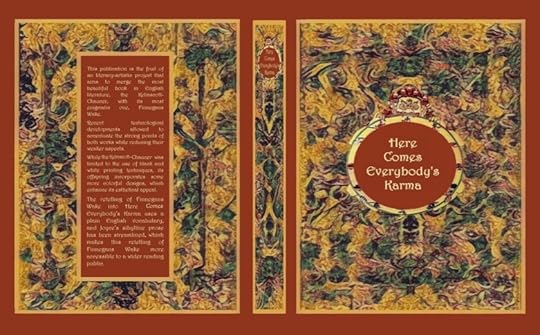 Here Comes Everybody’s Karma, Print ISBN
Bostoen, Copeland & Day, isbn print edition 978-1-7377832-9-9, amazon 979-8324434571
Here Comes Everybody’s Karma is a transcription of Finnegans Wake from a contemporary perspective that reflects the links that can be laid between Finnegans Wake and some Asiatic philosophical tenets, quantum mechanics, and the systems theory.
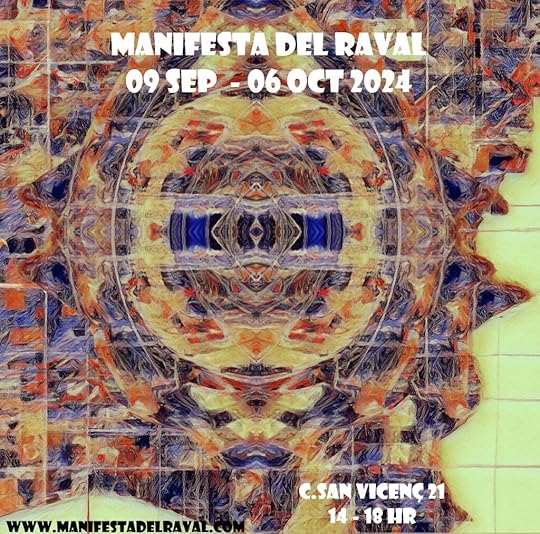
Then in September I curated an exposition in the margins of Manifesta 15 in Barcelona called Manifesta del Raval, a co-creation model that linked critical urban research, community building and contemporary culture with local identities and visions.
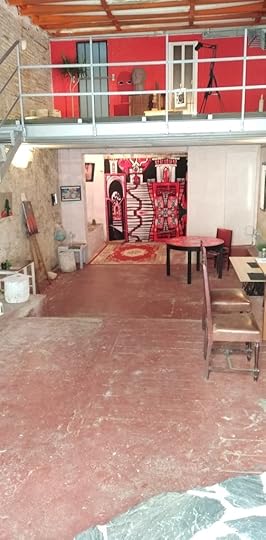
And then I still have of course a family to take care of and the usual dramas this involves. Mother died (at age 93), the in-laws are getting increasingly incapacitated by old age, a little inundation in our house, the studio and adjacent living space (still) under reconstruction and the related wrangling with contractors, and I could go on and on…
I still wonder how I found time to do some creative work done in between. So the blog was put on a backfire for a while. I have seriously considered of canceling the Facebook after reading that it’s a main source of brainrot and it seems that most traffic is anyway generated by chatbots talking to other chatbots. Just decided to keep it on for promotional purposes of events, although I start to have serious doubts about that too. There might still be some actual humans who use it as a communication tool.
Right now most of my time is going into the editing of a new novel and after new year I’m off to Malaysia for two months where I hope to be able to make finally a start at the 4th part of my series The Maharajagar, which is already four years overdue. The problem is that I know what has to come into it, but the right words seem to escape me. The whole storyline is drafted, but every time I’m trying to type it out, the rights words seem to fail. Time to give it a new push when I’m done with editing and my latest novel moves to the publisher.
Wish you all a happy end of the year and a fresh start in the coming one.
October 22, 2024
I finally did it.
Already since ages I was contemplating how to resist this artificial hype around Halloween.
Well, it’s simple. I just eliminated all those lit-bloggers who enforce it.
There are luckily enough of them left who still have something interesting to say that goes beyond “Spooktober” and don’t turn a day when we remember our deceased into some fun-event.
Now I’m on the lookout for those who can’t resist to promote the Coca-Cola man and his elves.
October 21, 2024
Connection and Isolation
Connection in isolation (acrylic and ink on paper 50 x 40 cm) found its inspiration during the period when covid quarantines were harshly imposed upon most. While people were effectively banned of interacting in person, most managed to stay in touch or found other ways to provide for themselves by using recent evolutions in communication and information technology.
This painting reflects on the process whereby the discourse of contemporary art and the phenomenon of art is becoming global. It implies a consideration in which a voice is given to the global ‘others’, and an attention to the conceptual shifts within the field.
On the cultural map, it does so with a new policy of promotion of commemorative events and urbanistic expansion, leading to a time that sees the hybridization of the traditional categories of artistic genres in installations.